- Product Description Description
- Table of Contents TOC
- List of Table & Figure LOT
- Get Free Sample PDF Sample PDF
Market Size, 2025
$1.62 BnMarket Estimate, 2026
$1.64 BnMarket Forecast, 2034
$1.85 BnCAGR, 2026–2034
1.52%Europe Textile Recycling Market Report Summary
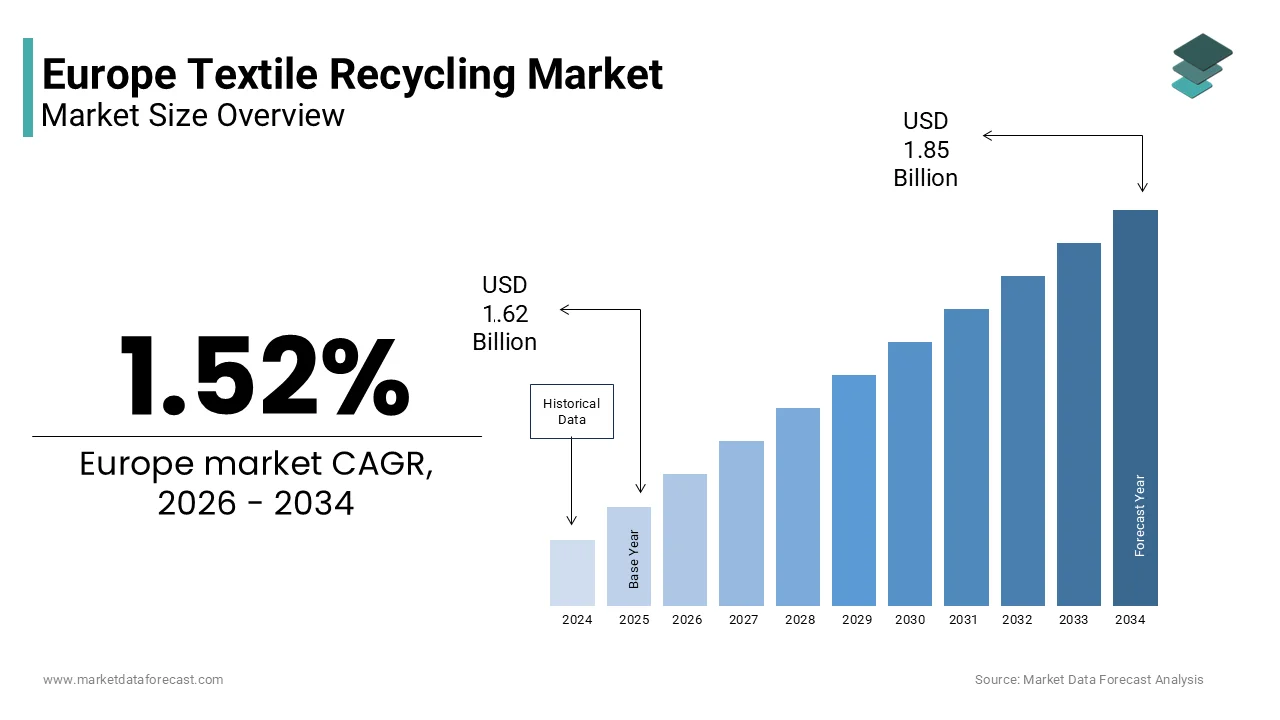
The Europe textile recycling market was valued at USD 1.62 billion in 2025, is estimated to reach USD 1.64 billion in 2026, and is projected to reach USD 1.85 billion by 2034, growing at a CAGR of 1.52% during the forecast period. Market growth is driven by increasing regulatory pressure on waste management, rising environmental awareness, and growing emphasis on circular economy practices. Textile recycling plays a crucial role in reducing landfill waste, conserving resources, and minimizing environmental impact. The adoption of sustainable fashion and recycling initiatives is further supporting gradual market expansion across Europe.
Key Market Trends
- Rising focus on circular economy and sustainability is driving market growth.
- Increasing regulatory pressure on textile waste management is boosting recycling activities.
- Growing consumer awareness regarding sustainable fashion is supporting market expansion.
- Expansion of recycling technologies is improving efficiency and material recovery.
- Rising collaboration between brands and recyclers is enhancing market development.
Segmental Insights
- Based on material, the cotton segment accounted for 35.3% of the Europe textile recycling market share in 2025. This dominance is attributed to the high volume of cotton based textile waste and ease of recycling.
- Based on textile waste, the post consumer waste segment held a significant share of the Europe textile recycling market in 2025, driven by increasing disposal of used garments and household textiles.
- Based on distribution channel, the retail and departmental stores segment held a significant share of the Europe textile recycling market in 2026, supported by collection programs and take back initiatives.
- Based on end use, the apparel industry segment dominated with 55.4% of the Europe textile recycling market share in 2025, driven by rising demand for recycled fibers in clothing production.
Regional Insights
- The Europe textile recycling market is experiencing steady development across key countries, supported by sustainability initiatives and regulatory frameworks.
- Germany was the largest contributor, accounting for 22.3% of the Europe textile recycling market share in 2025, driven by strong recycling infrastructure, government policies, and high consumer awareness.
Competitive Landscape
The Europe textile recycling market is moderately competitive, with key players focusing on technological innovation, sustainable sourcing, and strategic partnerships to strengthen their market position. Companies are investing in advanced recycling processes, fiber recovery technologies, and circular business models. Prominent players in the Europe textile recycling market include Lenzing AG, Birla Cellulose, HYOSUNG TNC, Unifi Inc, Patagonia Inc, Recover Textile Systems, SOEX Group, and Texaid.
 Download Free Sample Report
Europe Textile Recycling Market Size
The textile recycling market size in Europe was valued at USD 1.62 billion in 2025. The European market is estimated to be worth USD 1.85 billion by 2034 from USD 1.64 billion in 2026, growing at a CAGR of 1.52% from 2026 to 2034.
The textile recycling is the systematic collection sorting processing and repurposing of post-consumer and post-industrial textile waste into secondary raw materials or new products. The environmental burden of textile waste, which includes landfilling incineration and improper disposal. As per the European Environment Agency, Europeans consume approximately 26 kilograms of textiles per person annually and discard about 11 kilograms with only a fraction being recycled into new garments. The majority of collected textiles are downcycled into insulation materials or cleaning rags rather than being fiber to fiber recycled. According to Eurostat, less than 1% of material used to produce clothing is recycled into new clothing highlighting the significant inefficiency in current recycling loops. The European Union Strategy for Sustainable and Circular Textiles mandates that by 2030 all textile products placed on the EU market must be durable repairable and recyclable. This regulatory push is reshaping the operational landscape for waste management companies and fashion brands alike. The infrastructure for separate collection of textile waste is expanding across member states to comply with the Waste Framework Directive. Technological advancements in automated sorting and chemical recycling are emerging to handle complex blended fabrics. The market is characterized by a growing network of stakeholders including municipalities private waste managers NGOs and innovative recycling startups. These entities collaborate to enhance collection rates and improve the quality of recycled outputs.
MARKET DRIVERS
Implementation of Extended Producer Responsibility Schemes
The introduction and enforcement of Extended Producer Responsibility EPR schemes by mandating that producers bear the financial and operational responsibility for the end of life management of their products is propelling the growth of Europe textile recycling market. As per the French Ministry of Ecological Transition, the EPR scheme in France has led to the collection of over 250000 tonnes of textile waste annually providing a steady stream of material for recyclers. This regulatory framework creates a guaranteed supply of feedstock for recycling facilities reducing the uncertainty associated with voluntary collection programs. According to the European Commission the mandatory separate collection of textile waste by 2025 under the Waste Framework Directive will significantly increase the volume of available recyclable materials. Producers are increasingly investing in recycling technologies to reduce their EPR fees which are often modulated based on the eco design of their products. This financial incentive encourages brands to design garments that are easier to recycle thereby stimulating demand for advanced recycling services. The harmonization of EPR rules across the EU is expected to create a unified market for textile recycling services.
Growing Consumer Awareness and Demand for Sustainable Fashion
Increasing consumer awareness regarding the environmental impact of fast fashion is driving demand for recycled textiles and sustainable clothing options. The growing consumer awareness and demand for sustainable fashion is propelling the growth of Europe textile recycling market. Modern consumers, particularly millennials and Generation Z are prioritizing brands that demonstrate commitment to sustainability and circularity. The shift in consumer preference pressures fashion retailers to incorporate recycled fibers into their collections to maintain brand relevance and loyalty. The rise of second hand and vintage markets also supports the recycling ecosystem by extending the life cycle of garments before they enter the recycling stream. Brands are responding by launching take back schemes and partnering with recycling companies to close the loop. For instance, H&M and Zara have implemented garment collection initiatives that feed into recycling processes. The demand for transparency in supply chains further boosts the market as consumers seek proof of recycled content through certifications. As per the Global Recycled Standard, the number of certified products containing recycled materials has increased substantially in recent years. This consumer driven demand creates a viable market for high quality recycled fibers. Retailers are willing to pay a premium for certified recycled materials to meet their sustainability goals.
MARKET RESTRAINTS
Technical Limitations in Recycling Blended Fibers
The technical difficulty and high cost associated with recycling blended fibers, which constitute a significant portion of modern textiles is hindering the growth of Europe textile recycling market. Most contemporary clothing items are made from blends such as polyester cotton or wool acrylic to achieve specific performance characteristics. However, current mechanical recycling methods struggle to separate these fibers effectively often resulting in downcycled products with lower quality and value. As per the Ellen MacArthur Foundation, less than 1% of clothing is currently recycled into new clothing largely due to the complexity of separating mixed fibers. Chemical recycling technologies that can separate blends are still in the early stages of commercialization and require substantial capital investment. According to the study, the lack of scalable technology for blend separation limits the efficiency of recycling facilities. The presence of elastane and other synthetic additives further complicates the recycling process rendering many garments unrecyclable. This technological gap forces recyclers to rely on manual sorting which is labor intensive and expensive. As per the International Labour Organization the reliance on manual sorting increases operational costs and reduces profitability for recycling companies. The inconsistency in feedstock quality due to mixed compositions also affects the output quality of recycled fibers. Manufacturers of recycled yarns often face challenges in maintaining consistent strength and texture.
High Costs of Collection and Sorting Infrastructure
The high costs associated with the collection and sorting of textile waste is also degrading the growth of the Europe Textile Recycling Market. Unlike paper or plastic textiles are bulky and lightweight making transportation inefficient and expensive. As per the European Environment Agency the logistics cost for collecting textile waste can account for up to 50% of the total recycling cost. The lack of standardized collection systems across European municipalities further exacerbates these costs leading to fragmented and inefficient supply chains. Sorting textile waste is another costly step as it requires detailed identification of fiber composition color and condition. Current automated sorting technologies are not yet fully capable of handling the vast variety of textile types and colors accurately. According to the Circle Economy manual sorting remains the predominant method which is slow and prone to errors. The investment required for advanced near infrared NIR sorting machines is prohibitive for many small and medium sized recyclers. As per the European Investment Bank financing for textile recycling infrastructure remains limited compared to other waste sectors. The low value of sorted recyclables often fails to cover the high operational costs of collection and sorting. This economic imbalance discourages new entrants and limits the expansion of existing facilities. Without subsidies or higher fees from EPR schemes many recycling operations struggle to remain financially viable.
MARKET OPPORTUNITIES
Advancements in Chemical Recycling Technologies
The development and commercialization of chemical recycling technologies by enabling the recycling of complex and blended textiles is setting up new opportunities for the growth of Europe rextile recycling market. Chemical recycling processes, such as hydrolysis and enzymatic breakdown can separate fiber blends and restore polymers to their original quality allowing for true fiber to fiber recycling. As per the European Commission, several pilot plants for chemical recycling of polyester and cotton blends are being established with support from Horizon Europe funding. These technologies offer the potential to produce high quality recycled fibers that can replace virgin materials in premium applications. Companies like Renewcell and Infinited Fiber Company are scaling up their operations to meet the growing demand from fashion brands. The capacity for chemical recycling is expected to increase significantly in the coming years driven by brand commitments to use recycled materials. The ability to recycle difficult to process materials, such as elastane blends opens up new feedstock sources for recyclers. The investments in textile recycling startups have surged indicating strong confidence in the technology. The integration of chemical recycling with existing mechanical processes can create hybrid systems that maximize resource recovery. This innovation aligns with the EU’s strategic goals for a circular economy.
Expansion of Digital Product Passports
The implementation of Digital Product Passports DPPs by enhancing traceability and information sharing throughout the textile value chain is additionally to leverage new opportunities for the growth of Europe textile recycling market. DPPs will provide detailed information about a garment’s composition origin and recycling instructions accessible via a digital identifier, such as a QR code. As per the European Union Strategy for Sustainable and Circular Textiles, the introduction of DPPs is mandated for all textile products sold in the EU by 2030. This transparency enables recyclers to accurately identify fiber types and contaminants improving the efficiency and quality of sorting processes. The availability of accurate data also facilitates better decision making for designers and manufacturers aiming to improve recyclability. Retailers can use DPPs to verify the recycled content of their products ensuring compliance with green claims regulations. As per the European Digital Identity Framework, the infrastructure for DPPs is being developed to ensure interoperability across borders. This standardization will create a seamless flow of information from producer to recycler. The data generated can also support EPR fee modulation rewarding brands that design for recyclability. The adoption of DPPs will likely stimulate investment in digital infrastructure and sorting technologies.
MARKET CHALLENGES
Lack of Standardized Definitions and Quality Standards
The lack of standardized definitions and quality standards for recycled textile materials is to pose as one of the challenges for the growth of Europe textile recycling market. The term recycled fiber is often used loosely leading to confusion among consumers manufacturers and regulators about the actual content and quality of the material. As per the International Organization for Standardization, there is currently no universally accepted standard for defining different grades of recycled textiles. This ambiguity makes it difficult for buyers to specify requirements and for sellers to guarantee quality. The absence of clear standards also hinders the development of a transparent trading market for recycled fibers. The variability in quality of recycled fibers due to inconsistent feedstock and processing methods further complicates standardization. Manufacturers of virgin fibers often hesitate to blend recycled fibers due to concerns about performance consistency. As per the Confederation of the European Paper Industries similar challenges were faced in the paper recycling sector before standards were established. The lack of trust in recycled material quality limits its adoption in high value applications.
Competition from Low Cost Virgin Materials
The intense competition from low cost virgin materials, particularly synthetic fibers derived from fossil fuels is additionally to limit the growth of Europe textile recycling market. The price of virgin polyester and cotton often remains lower than that of recycled equivalents due to economies of scale and subsidized agricultural and petrochemical industries. This price disparity discourages fashion brands from switching to recycled materials unless mandated by regulation or consumer pressure. The external environmental costs of virgin production, such as carbon emissions and water pollution are not fully internalized in the market price. However, without carbon pricing or taxes on virgin materials recycled fibers struggle to compete on price alone. The fluctuating supply and quality of textile waste also contribute to the higher cost of recycled fibers. The reliance on volatile waste streams makes cost prediction difficult for recyclers.
REPORT COVERAGE
| REPORT METRIC | DETAILS |
| Market Size Available | 2025 to 2034 |
| Base Year | 2025 |
| Forecast Period | 2026 to 2034 |
| CAGR | 1.52% |
| Segments Covered | By Material, Textile Waste, Distribution Channel, Process, End use Industry, and Region |
| Various Analyses Covered | Global, Regional, & Country Level Analysis; Segment-Level Analysis; DROC; PESTLE Analysis; Porter’s Five Forces Analysis; Competitive Landscape; Analyst Overview of Investment Opportunities |
| Regions Covered | UK, France, Spain, Germany, Italy, Russia, Sweden, Denmark, Switzerland, Netherlands, Turkey, Czech Republic, Rest of Europe |
| Market Leaders Profiled | Lenzing AG, Birla Cellulose, HYOSUNG TNC, Unifi Inc., Patagonia Inc., Recover Textile Systems, SOEX Group, and Texaid. |
SEGMENTAL ANALYSIS
By Material Insights
The cotton segment was the largest contributor in the Europe Textile Recycling Market by accounting for 35.3% of the share in 2025 due to its widespread use in apparel and home textiles and the maturity of mechanical recycling technologies. The abundance of post-consumer cotton waste available through established collection schemes, across European countries. As per the European Environment Agency, cotton constitutes a significant portion of municipal textile waste providing a consistent feedstock for recyclers. Mechanical recycling processes for cotton are well established and relatively cost effective allowing for the production of recycled cotton fibers that can be blended with virgin fibers. The strong consumer preference for natural fibers, which drives demand for recycled cotton in sustainable fashion collections. Recycled cotton requires significantly less water and energy compared to virgin cotton production aligning with corporate sustainability goals. As per the World Wildlife Fund, conventional cotton production is highly water intensive making recycled alternatives attractive for water stewardship initiatives. The availability of certified recycled cotton through standards like the Global Recycled Standard further boosts market confidence. Brands are increasingly incorporating recycled cotton into denim and t shirt production where fiber length requirements are less stringent. The integration of recycled cotton into mainstream supply chains is supported by improved sorting technologies that enhance fiber quality.
The polyester & polyester fiber segment is expected to register a fastest CAGR of 8.5% from 2026 to 2034 with the advancements in chemical recycling technologies and high demand from the apparel industry. The development of scalable chemical recycling processes, such as depolymerization which can convert polyester waste back into virgin quality raw materials. As per the European Commission, investments in chemical recycling facilities for polyester have doubled in recent years enabling closed loop recycling. This technology allows for the recycling of blended fabrics which was previously technically challenging. The commitment of major fashion brands to increase the share of recycled polyester in their products to meet sustainability targets is also gearing up the growth of Europe textile recycling market. According to the Ellen MacArthur Foundation several global brands have pledged to use 100% recycled or sustainably sourced polyester by 2030. Recycled polyester offers a lower carbon footprint compared to virgin polyester derived from fossil fuels. As per the Carbon Trust, producing recycled polyester reduces greenhouse gas emissions by up to 30%. The establishment of take back schemes specifically for synthetic garments further secures feedstock supply. Regulatory pressure to reduce plastic waste also supports the growth of recycled polyester.
By Textile Waste Insights
The post consumer waste segment was the largest by holding a significant share of the Europe Textile Recycling Market in 2025 with the mandatory separate collection mandates and increasing consumer participation in recycling programs. The European Union Waste Framework Directive, which requires member states to implement separate collection of textile waste by 2025. As per the European Commission, this directive is expected to significantly increase the volume of post-consumer textiles available for recycling. Municipalities are expanding collection infrastructure including bring banks and door to door services to facilitate consumer disposal. The growing awareness among consumers about the environmental impact of textile waste leading to higher donation and recycling rates. Charity organizations and private collectors play a crucial role in aggregating post-consumer waste for sorting and recycling. The sheer volume of clothing discarded by households provides a substantial resource base for recyclers. The implementation of Extended Producer Responsibility schemes also incentivizes the collection of post consumer waste to meet recycling targets.
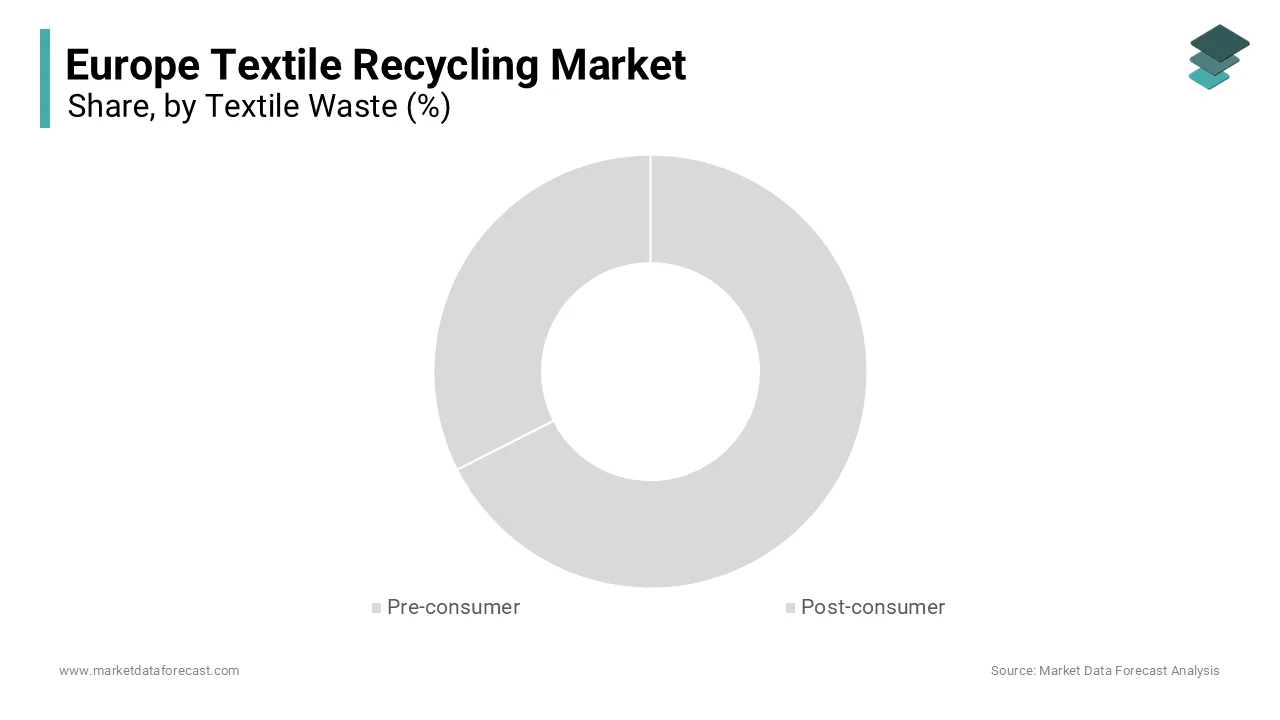
The Pre Consumer Waste segment is expected to witness a fastest CAGR of 7.2% from 2026 to 2034 with the industrial efficiency initiatives and the ease of recycling clean manufacturing scraps. The increasing adoption of zero waste manufacturing practices by textile producers, who seek to minimize material loss and reduce disposal costs. As per the Sustainable Apparel Coalition, many manufacturers are implementing internal recycling loops to reuse cutting room scraps and offcuts. Pre consumer waste is typically homogeneous and free from contaminants making it easier and cheaper to recycle compared to post consumer waste. The second driver is the demand for high quality recycled fibers from brands that require consistent material properties for premium products. According to the International Textile Manufacturers Federation pre consumer recycled fibers often retain higher strength and quality making them suitable for spinning into new yarns. The transparency of industrial supply chains facilitates the tracking and certification of pre consumer recycled content. As per the Global Recycled Standard the certification of pre consumer waste is straightforward encouraging its use in verified sustainable products. Manufacturers are investing in on site recycling technologies to process waste immediately reducing logistics costs. The push for circular production models within factories supports the rapid growth of this segment. Regulatory incentives for industrial waste reduction further promote the recycling of pre consumer materials.
By Distribution Channel Insights
The retail & departmental stores segment was the largest by holding a significant share of the Europe Textile Recycling Market in 2026. The strategic implementation of in store collection bins by major fashion retailers to engage customers directly and enhance brand image. The visibility and trust associated with established retail brands, which encourages consumers to donate their used textiles. According to the European Retail Forum, branded collection boxes in stores are perceived as more reliable than informal donation points. Retailers often offer incentives, such as discount vouchers to encourage participation driving foot traffic and sales. As per the research, promotional campaigns linked to recycling initiatives have shown positive impacts on customer loyalty. The physical infrastructure of retail stores allows for efficient aggregation of collected textiles before transport to sorting facilities. Partnerships between retailers and recycling companies streamline the logistics process.
The online distribution channel is projected to grow at a CAGR of 9.5% from 2026 to 2034 with the rise of e-commerce and innovative digital recycling solutions. The integration of reverse logistics services by online fashion retailers allowing customers to return unwanted items for recycling along with regular returns. Digital platforms are introducing mail in recycling programs, where consumers can request prepaid shipping labels to send old clothes for recycling. The emergence of digital marketplaces and apps dedicated to second hand clothing and textile recycling, which connect consumers directly with recyclers or resellers. These platforms often provide detailed information about the recycling process enhancing consumer trust and engagement. The ability to reach a wider audience beyond physical store locations expands the potential for textile collection. Social media campaigns promoting online recycling initiatives further boost awareness.
By End Use Industry Insights
The apparel industry segment was accounted in holding 55.4% of the Europe Textile Recycling Market share in 2025 with the commitment of major fashion brands to incorporate recycled fibers into new clothing lines to meet sustainability targets and consumer demand. The coalition of global fashion companies members have pledged to source 100% sustainable materials by 2030. Recycled cotton and polyester are increasingly used in the production of jeans t shirts and jackets. According to the European Commission, apparel producers are required to design products for durability and recyclability. The availability of certified recycled materials enables brands to make credible green claims. The number of apparel products containing recycled content has increased significantly. Consumer awareness of the environmental impact of fast fashion drives demand for recycled clothing. The development of fiber to fiber recycling technologies specifically for apparel waste supports this segment.
The home furnishings segment is likely to register a fastest CAGR of 8.0% from 2026 to 2034 with the increasing demand for sustainable interior design products and renovation activities. The growing consumer preference for eco-friendly home textiles, such as curtains upholstery and bedding made from recycled materials. Recycled polyester and cotton are used in the production of rugs cushions and throws offering durable and stylish options. The renovation and construction sectors incorporating recycled textile insulation and acoustic panels into building projects is also propelling the growth of segment. The recycled textile materials are recognized for their thermal and acoustic insulation properties. The use of recycled textiles in home furnishings reduces the reliance on virgin resources and lowers the carbon footprint of interior design. The durability and aesthetic appeal of recycled home textiles are improving with technological advancements.
REGIONAL ANALYSIS
Germany Textile Recycling Market Analysis
Germany was the top performer in the Europe Textile Recycling Market by capturing 22.3% of the share in 2025 due to its advanced waste management infrastructure and strong regulatory framework. The country has a well-established system for textile collection and sorting supported by both public and private entities. The strict enforcement of waste separation laws, which mandate the proper disposal of textile waste is also boosting the growth of market in this country. According to the Dual System, Germany extended producer responsibility schemes are effectively implemented ensuring funding for recycling activities. The presence of leading recycling technology providers and research institutions that innovate in sorting and processing techniques. German companies are pioneers in developing automated sorting technologies for textiles.
France Textile Recycling Market Analysis
France textile recycling market was positioned second by holding 18.3% of share in 2025 with its pioneering Extended Producer Responsibility scheme for textiles. The country was the first in Europe to implement an EPR system for clothing linen and footwear, which has set a benchmark for other nations. The mandatory contribution from producers, which finances the operations of eco-organizations like Refashion is attributed to boost the growth of the market. As per the French Fashion Federation, many luxury and mainstream brands are actively participating in recycling initiatives. The government’s Anti-Waste Law for a Circular Economy further strengthens the regulatory environment. France is also home to several innovative recycling startups focusing on chemical recycling. The high level of consumer awareness and participation in collection programs supports the market.
Italy Textile Recycling Market Analysis
Italy textile recycling market growth is expected to grow at a fastest CAGR in coming years with the historic textile manufacturing hubs and expertise in high quality recycling. The Prato district in Tuscany is globally renowned for its mechanical recycling of wool and cashmere. The established industrial ecosystem that integrates recycling into the production process creating a closed loop system. The demand for premium recycled wool and cashmere from high end fashion brands worldwide. The industry’s focus on innovation and sustainability has led to the development of new recycling technologies. Italy’s strong export orientation helps distribute recycled materials globally. The collaboration between manufacturers designers and recyclers fosters continuous improvement.
United Kingdom Textile Recycling Market Analysis
The United Kingdom textile recycling market growth is driven by the robust charity sector and growing regulatory focus on textile waste. The country has a long tradition of textile collection through charity shops and banks. The active involvement of charitable organizations in sorting and exporting used textiles, which feeds into the recycling stream. The upcoming implementation of Extended Producer Responsibility schemes, which will formalize and fund recycling efforts is also gearing up the growth of the market. The presence of innovative recycling startups in the UK is also contributing to market growth.
Spain Textile Recycling Market Analysis
Spain textile recycling market growth is likely to grow with its large textile manufacturing industry and increasing regulatory compliance. The country is a major producer of fast fashion which generates significant post industrial and post consumer waste. As per the Spanish Ministry for Ecological Transition new waste laws are pushing for better textile management. The first major driver is the implementation of Extended Producer Responsibility schemes following EU directives. According to Ecofibra the newly established EPR system is mobilizing resources for collection and recycling infrastructure. The second driver is the growing interest from Spanish fashion brands in sustainable practices to meet international standards. As per the Spanish Fashion Federation brands are investing in recycled materials and circular design. The availability of raw materials from manufacturing hubs supports local recycling activities. Consumer awareness is rising leading to higher donation rates.
Netherlands Textile Recycling Market Analysis
The Netherlands textile recycling market with growth is likely to grow with its innovation in sorting technologies and circular business models. As per the Netherlands Enterprise Agency Dutch, companies are leaders in developing automated sorting systems for textiles. According to the Circle Economy, Amsterdam based organizations are pioneering circular economy strategies for textiles. The separation rate for textiles is high due to convenient collection methods is also escalating the growth of the market. The presence of research institutes and startups fosters collaboration and technology transfer. The Netherlands serves as a testbed for new recycling concepts. The government’s ambitious circular economy goals for 2050 drive investment.
COMPETITIVE LANDSCAPE
The Europe textile recycling market features a dynamic competitive landscape characterized by a mix of established waste management giants and innovative technology startups. Large multinational corporations leverage their extensive logistics networks and capital resources to dominate collection and mechanical recycling segments. Meanwhile specialized startups compete by offering advanced chemical recycling technologies that address the limitations of traditional methods. Competition is intensifying as regulatory pressures mount and brands seek reliable sources of recycled materials. Companies differentiate themselves through technological superiority sustainability credentials and strategic partnerships with major fashion retailers. The race to scale up chemical recycling capabilities is a key battleground with several firms racing to build commercial plants. Collaboration is also prevalent as competitors join consortia to standardize practices and influence policy. Price competition remains relevant in the mechanical recycling sector where margins are thin. However, value added services, such as certification and traceability are becoming critical differentiators. The entry of new players with disruptive technologies challenges incumbent businesses to innovate or risk obsolescence. Intellectual property protection is crucial for maintaining competitive advantage in this rapidly evolving sector.
Key Market Players
The following are the major key market players of Europe textile recycling market
- Lenzing AG
- Birla Cellulose
- HYOSUNG TNC
- Unifi Inc.
- Patagonia Inc.
- Recover Textile Systems
- SOEX Group
- Texaid.
Top Players in the Market
- Renewcell AB is a Swedish recycling company that has revolutionized the textile industry with its Circulose technology which transforms cotton and viscose waste into biodegradable raw material. The company operates a commercial scale plant in Sundsvall Sweden producing pulp that can be used to make new viscose and lyocell fibers. Recently, Renewcell secured significant off take agreements with major global fashion brands ensuring steady demand for its recycled material. The company continues to optimize its production process to reduce water and energy consumption enhancing sustainability credentials. The strategic approach positions the company as a key enabler of circular fashion. Its focus on high quality fiber to fiber recycling addresses the industry need for sustainable alternatives to virgin materials.
- Worn Again Technologies is a British company specializing in chemical recycling technology that separates and recycles polyester and cotton from blended textiles. The company has developed a unique process that depolymerizes polyester and extracts cellulose from cotton allowing both materials to be reused indefinitely. Recently Worn Again partnered with major retailers and manufacturers to build demonstration plants and validate its technology at scale. These collaborations help refine the process and prepare for commercial deployment. The company focuses on creating a closed loop system for textiles reducing reliance on virgin resources. By targeting hard to recycle blends Worn Again addresses a critical gap in the current recycling infrastructure. Its intellectual property portfolio protects its innovative methods giving it a competitive edge.
- Evrnu is a US based molecular recycling company that converts post-consumer cotton textile waste into new high performance fibers. Its proprietary NuCycl technology regenerates cotton fibers without the quality degradation associated with mechanical recycling. Recently, Evrnu expanded its partnerships with leading apparel brands to integrate NuCycl fiber into commercial product lines. The company is scaling its operations through joint ventures and licensing agreements to increase global production capacity. Evrnu focuses on reducing the environmental impact of textile production by minimizing water and energy use. Its technology enables the creation of premium quality fabrics from old clothes supporting circular economy goals.
Top Strategies Used by Key Market Participants
Key players in the Europe Textile Recycling Market primarily focus on technological innovation to improve the efficiency and quality of recycling processes. Companies invest heavily in research and development to advance chemical recycling methods that can handle blended fabrics effectively. Strategic partnerships with fashion brands and retailers secure long term supply agreements for recycled materials ensuring market stability. Expansion of collection infrastructure through collaborations with municipalities and waste management firms increases feedstock availability. Digitalization strategies including the adoption of digital product passports enhance traceability and sorting accuracy. Companies also pursue vertical integration by controlling multiple stages of the recycling value chain from collection to fiber production. Sustainability certifications are leveraged to build trust and meet regulatory requirements. Investment in pilot plants and commercial scale facilities demonstrates technological viability to investors and customers.
MARKET SEGMENTATION
This research report on the Europe textile recycling market is segmented and sub-segmented into the following categories.
By Material
- Cotton
- Polyester & Polyester Fiber
- Wool
- Nylon & Nylon Fiber
- Others
By Textile Waste
- Pre-consumer
- Post-consumer
By Distribution Channel
- Online
- Retail & Departmental Stores
By Process
- Mechanical
- Chemical
By End-use Industry
- Apparel
- Home Furnishings
- Industrial & Institutional
- Others
By Country
- UK
- France
- Spain
- Germany
- Italy
- Russia
- Sweden
- Denmark
- Switzerland
- Netherlands
- Turkey
- Czech Republic
- Rest of Europe