- Product Description Description
- Table of Contents TOC
- List of Table & Figure LOT
- Get Free Sample PDF Sample PDF
Market Size, 2025
$1.38 BnMarket Estimate, 2026
$1.47 BnMarket Forecast, 2034
$2.36 BnCAGR, 2026–2034
6.13%Europe Thermal Paper Market Report Summary
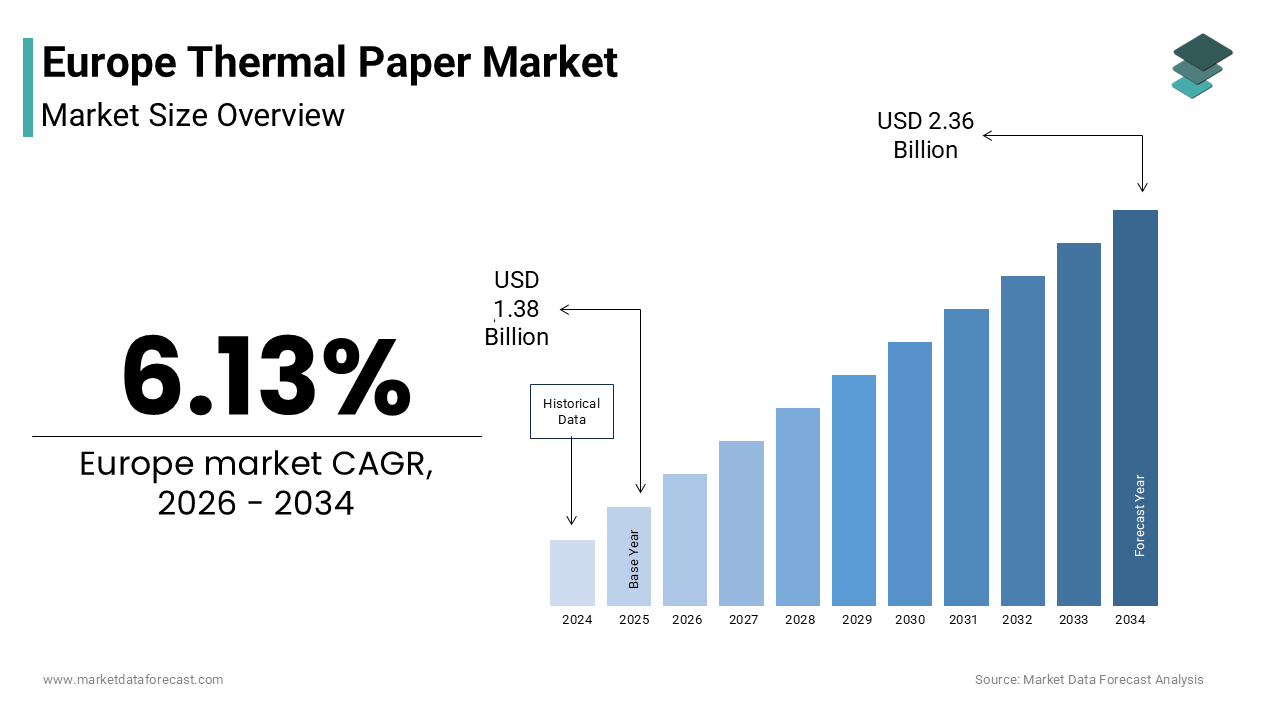
The Europe thermal paper market was valued at USD 1.38 billion in 2025, is estimated to reach USD 1.47 billion in 2026, and is projected to reach USD 2.36 billion by 2034, growing at a CAGR of 6.13% during the forecast period from 2026 to 2034. The growth of the European thermal paper market is driven by sustained demand from retail and hospitality sectors, expanding e-commerce and logistics activities, and continued reliance on thermal printing for receipts, labels, and tickets. Despite rising digitalization, regulatory requirements for fiscal receipts and the operational need for fast, low-maintenance printing continue to support demand. Moreover, growing adoption of eco-friendly and phenol-free thermal paper, along with increasing use of smart labels in healthcare and supply chain tracking, is further strengthening market growth across Europe.
Key Market Trends
- Growing demand for thermal labels is driven by e-commerce logistics, warehousing, and parcel delivery services.
- Increasing adoption of phenol-free and eco-friendly thermal paper to comply with EU environmental regulations.
- Continued reliance on thermal receipts in countries with fiscalization laws such as Italy, Greece, and Poland.
- Rising use of thermal printing in healthcare for wristbands, specimen labels, and medical documentation.
- Integration of QR codes, smart labels, and track-and-trace features into thermal paper applications.
Segmental Insights
- Based on width, the 3.125-inch (80mm) segment dominated the market, accounting for 59.8% of the Europe thermal paper market share in 2025. The dominance of this segment is attributed to its standard compatibility with point-of-sale printers used across retail, hospitality, and banking environments.
- Based on printing technology, the direct thermal segment led the market in 2025, supported by its cost efficiency, ease of use, and suitability for high-volume applications such as POS receipts and logistics labels.
- Based on application, the point-of-sale (POS) segment dominated the market, accounting for 61.7% share in 2025, supported by high retail density and legal mandates for physical receipts in multiple European countries.
Regional Insights
The Europe thermal paper market demonstrates stable growth across key economies supported by retail density, logistics activity, and regulatory frameworks.
- Germany led the market with a 22.1% share in 2025, driven by strong fiscal compliance laws, a large retail base, and a highly developed logistics sector.
- France held a significant share supported by retail usage, transportation ticketing systems, and strong hospitality activity.
- The United Kingdom remains a major market due to extensive POS infrastructure, healthcare labeling needs, and high e-commerce volumes.
- Italy continues to show strong demand supported by strict fiscal receipt regulations and a large number of small businesses.
- Spain is emerging as a high-growth market due to expanding logistics networks, tourism activity, and retail modernization.
Competitive Landscape
The Europe thermal paper market is characterized by strong competition among global and regional specialty paper manufacturers. Companies are increasingly focusing on sustainability-driven innovation, including phenol-free formulations, recyclable coatings, and low-impact production processes. Strategic partnerships with retailers, logistics providers, and printer manufacturers are strengthening market positioning. Investment in R&D, supply chain optimization, and compliance with EU environmental regulations remains a key competitive strategy. Prominent players in the Europe thermal paper market include Koehler Paper Group, Mitsubishi HiTec Paper, Oji Holdings, Jujo Thermal, Appvion, Ricoh, Hansol Paper, Iconex, Nakagawa Manufacturing, and Rotolificio Bergamasco.
Europe Thermal Paper Market Size
The europe thermal paper market size was valued at USD 1.38 billion in 2025 and is anticipated to reach USD 1.47 billion in 2026 from USD 2.36 billion by 2034, growing at a CAGR of 6.13% during the forecast period from 2026 to 2034.
Thermal paper refers to a specialized coated paper that changes color when exposed to heat, eliminating the need for ink in printing processes. In Europe, this medium remains integral to point of sale receipts, shipping labels, tickets, and healthcare documentation. Despite growing digitization, thermal paper maintains steady relevance due to its reliability in environments demanding immediate hard copy output. The European market operates within a highly regulated environmental and chemical safety framework, which significantly influences material composition and supplier compliance. Municipal waste generation in the European Union has fluctuated, with recent data showing a slight decrease in per capita waste generation, though it remains higher than levels from a decade prior, and paper/cardboard remains a significant component of total packaging waste. Additionally, paper recycling rates in Europe have remained consistently high, with a large majority of paper products being recovered for recycling, enabling the industry to remain a leader in circularity. The unique role of thermal paper in essential transactional and logistical documentation ensures continued demand even amid sustainability pressures and regulatory scrutiny across the continent.
MARKET DRIVERS
Persistent Demand from Retail and Hospitality Sectors Fuels Consumption
The retail and hospitality industries across the region remain major drivers of the Europe thermal paper market. This is driven by the need for real-time physical transaction records and compliance with national fiscalization laws. Countries such as Italy, Greece, and Poland enforce mandatory use of fiscal printers that issue thermal receipts for every sale, ensuring tax transparency. Retail and food service establishments across Europe routinely use thermal paper for transactional documents. A large number of point-of-sale terminals in the region use thermal printing technology for receipts. The volume of receipts generated annually in major European markets suggests frequent thermal paper consumption. This entrenched reliance on hard copy documentation, particularly in sectors resistant to full digital transformation, sustains robust thermal paper demand. Even as contactless payments rise, the legal and operational necessity for printed receipts ensures uninterrupted consumption. The hospitality segment further amplifies usage through kitchen order tickets and bar tabs, where speed and legibility are non negotiable. Consequently, regulatory mandates and operational workflows jointly anchor thermal paper within Europe’s commercial infrastructure.
Expansion of E Commerce and Logistics Networks Drives Label Usage
The exponential growth of e commerce across the continent has intensified demand for thermal paper in logistics labeling applications, which is also among the key accelerators of the Europe thermal paper market. Digital commerce growth across the continent has led to a consistent rise in online purchases. This expansion relies heavily on a logistical framework where packages require specific documentation for identification and routing. Moving goods through regional shipping networks creates a sustained demand for specialized labeling materials, leading to an increase in the production and use of thermal labels to support supply chain transparency. Major logistics firms such as Deutsche Post DHL and La Poste have standardized on direct thermal label printers for warehouse and last mile operations due to their speed, reliability, and low maintenance. Additionally, the rise of same day and next day delivery services increases label turnover, as split shipments and returns generate additional documentation. Cold chain logistics for pharmaceuticals and perishable goods further depend on thermal labels that withstand refrigeration without smudging. This operational indispensability within Europe’s rapidly scaling delivery infrastructure cements thermal paper as a critical consumable in the logistics value chain.
MARKET RESTRAINTS
Stringent EU Regulations on Bisphenol A Restrict Material Formulations
The European Union’s progressive restriction on bisphenol A in thermal paper has significantly constrained manufacturers’ formulation flexibility and increased production costs, which restrains the growth of the Europe thermal paper market. Regulatory changes have prompted manufacturers to shift the developer substances used in thermal paper production. The phase-out of a historically common, highly effective developer has resulted in a reliance on alternative substances. The transition to these alternatives presents challenges in balancing cost and image durability. Some alternative developers currently in use may share similar characteristics with the replaced substances, leading to increased scrutiny and potential further adjustments in regulatory approaches. Consequently, manufacturers face recurring reformulation cycles and certification burdens. Additionally, inconsistent enforcement across member states creates market fragmentation, complicating pan European distribution. These regulatory complexities not only elevate operational expenses but also delay product innovation, thereby restraining market adaptability and growth.
Accelerated Digitalization of Transactions Reduces Hard Copy Dependency
The structural shift toward digital receipts and paperless transactions across the region is eroding traditional thermal paper consumption in retail and service environments, which further inhibits the expansion of the Europe thermal paper market. Consumer payment habits across the region show a distinct movement away from traditional physical currency toward digital methods. Advancements in technology have facilitated a rise in the use of contactless and mobile payment solutions for everyday transactions. Certain nations have established themselves as early adopters by integrating digital alternatives into the standard retail experience. Retailers are increasingly providing electronic documentation options as a standard practice rather than as an exception. The shift toward paperless systems reflects a broader transformation in how financial information is exchanged and recorded. Consumer privacy awareness further accelerates this trend, as thermal receipts often contain personal data subject to GDPR compliance risks. Major retailers have rolled out digital first receipt systems across European stores, directly reducing thermal roll orders. Additionally, banking and utility sectors have almost entirely eliminated printed statements, transferring billing documentation online. This behavioral and infrastructural pivot diminishes the volume of thermal paper required for daily transactions, particularly in urban areas with high digital literacy. Mounting regulatory and consumer pressure is forcing businesses to treat thermal receipts as outdated expenses rather than necessary tools, which is hindering long-term market growth.
MARKET OPPORTUNITIES
Development of Eco Friendly Thermal Paper Opens New Market Segments
Innovation in phenol free and recyclable thermal paper formulations offers a significant growth area within the region’s environmentally conscious landscape, which is anticipated to fuel the growth of the Europe thermal aper market. Responding to EU chemical regulations and circular economy mandates, manufacturers such as Mitsubishi HiTec Paper and Oji Holdings have commercialized thermal coatings that eliminate bisphenols entirely while maintaining print quality and archival stability. European paper manufacturers are increasingly launching new thermal paper grades that adhere to certified sustainable formulations, reflecting a shift toward higher environmental standards in the industry. These products align with the EU’s Green Deal objectives, particularly the Circular Economy Action Plan, which emphasizes design for recyclability. Major European retail organizations are transitioning their sourcing strategies to ensure that consumer packaging and consumables are designed for recyclability or reusability, aiming for compliance with stricter European sustainability goals. Moreover, certification schemes like the EU Ecolabel and Nordic Swan increasingly influence public sector purchasing decisions, favoring suppliers with verified sustainable credentials. German municipalities are showing a significant year-over-year increase in the adoption of phenol-free thermal paper, accelerating the transition to safer, non-toxic alternatives for receipts. This convergence of regulatory alignment, corporate sustainability targets, and technological readiness positions eco friendly thermal paper as a high potential niche, capable of capturing market share from conventional grades.
Integration of Smart Label Technologies Enhances Functional Utility
The convergence of thermal printing with smart packaging and traceability technologies is opening advanced applications beyond traditional receipting, which is likely to promote fresh prospects for the Europe thermal paper market. In Europe’s food and pharmaceutical supply chains, thermal labels are increasingly embedded with QR codes, NFC tags, or time temperature indicators that interface with digital logistics platforms. Driven by the EU's push for circularity and enhanced transparency, fresh produce exporters are increasingly adopting digital, smart, and dynamic labeling solutions to align with emerging sustainability initiatives and traceability requirements, even while direct, mandatory Digital Product Passports for food are still in the early stages of development. These systems rely on high resolution thermal printers to encode batch data, origin information, and expiration alerts directly onto labels. Similarly, the European Medicines Agency mandates serialization of pharmaceuticals, requiring unique identifiers on every package—a process heavily dependent on thermal barcode printing. The pharmaceutical logistics sector is widely adopting advanced, integrated thermal labels and intelligent indicators on shipments to ensure strict adherence to temperature requirements, reducing waste and strengthening cold chain integrity. This functional enhancement transforms thermal paper from a passive medium into an active data carrier, increasing its value per unit and justifying premium pricing. The non-negotiable EU push for supply chain transparency elevates smart thermal labels, creating opportunities for product differentiation and margin growth for producers.
MARKET CHALLENGES
Recycling Infrastructure Limitations Impede Circular Economy Integration
Thermal paper faces significant barriers to effective recycling, despite the region’s advanced waste management systems, due to its chemical coating and contamination profiles, which constrains the growth of the Europe thermal paper market. Thermal paper introduced into mixed recycling streams presents challenges during the recovery process. The chemical components found in thermal coatings can interfere with deinking procedures and affect the quality of recycled pulp. Standard graphic paper shows greater compatibility with current recycling methods than thermal paper. Thermal paper makes up a smaller portion of recovered materials compared to conventional paper products. Many municipal recycling facilities in countries like Spain and Italy explicitly exclude thermal receipts from collection bins, directing them to residual waste instead. This exclusion stems from technical limitations: the heat sensitive layer does not dissolve during pulping and often results in speckled or discolored recycled sheets, reducing end product quality. Even phenol free thermal grades face rejection due to residual coating residues that compromise paper strength. Consequently, the industry struggles to meet the EU’s 2030 target of packaging recycling, as thermal labels and receipts remain largely non compliant. The lack of standardized sorting protocols across member states further fragments recycling outcomes. Thermal paper remains a major hurdle for circularity, putting producers at risk of reputational damage and regulatory penalties until coating technologies catch up with recycling infrastructure.
Volatility in Raw Material Costs Threatens Price Stability
Persistent margin pressure owing to fluctuating costs of key raw materials, particularly specialty chemicals and base paper, holds back the expansion of the Europe thermal paper market. Thermal paper production relies on high brightness wood free base paper, whose price is tied to pulp markets that experienced extreme volatility in recent years. Market dynamics for European pulp have experienced notable price increases as energy constraints and capacity adjustments affected regional availability. Production levels in key Nordic regions have faced limitations, contributing to shifts in the overall supply balance for wood-based materials. There is a visible transition toward specialized chemical alternatives in manufacturing, despite their higher cost relative to conventional options. Technological shifts in thermal paper and coating industries have led to the adoption of substitute developers that maintain a significant price gap over traditional versions. The broader sector shows a pattern of rising operational costs coupled with a willingness to pay more for specific material compliance or performance. These cost escalations are difficult to pass on to price sensitive end users such as small retailers and logistics operators, compressing manufacturer margins. Furthermore, supply chain bottlenecks for specialty coatings, many of which are sourced from Asia, exacerbate procurement uncertainty. Unlike commodity paper grades, thermal paper cannot easily substitute base materials without compromising print performance, limiting cost mitigation options. This structural vulnerability to upstream price swings constrains investment in innovation and sustainability initiatives, thereby hampering long term competitiveness in an increasingly regulated and cost conscious market.
REPORT COVERAGE
| REPORT METRIC | DETAILS |
| Market Size Available | 2025 to 2034 |
| Base Year | 2025 |
| Forecast Period | 2026 to 2034 |
| CAGR | 6.13% |
| Segments Covered | By Width, Printing Technologies, Application, and Country |
| Various Analyses Covered | Regional & Country Level Analysis, Segment-Level Analysis, DROC, PESTLE Analysis, Porter’s Five Forces Analysis, Competitive Landscape, Analyst Overview on Investment Opportunities |
| Countries Covered | UK, France, Spain, Germany, Italy, Russia, Sweden, Denmark, Switzerland, Netherlands, Turkey, Czech Republic, and Rest of Europe |
| Market Leaders Profiled | Koehler Paper Group, Mitsubishi HiTec Paper, Oji Holdings, Jujo Thermal, Appvion, Ricoh, Hansol Paper, Iconex, Nakagawa Manufacturing, and Rotolificio Bergamasco are the key players in the Europe Thermal Paper market. |
SEGMENTAL ANALYSIS
By Width Insights
The 3.125 inch width segment held the majority share of 59.8% of the Europe thermal paper market in 2025. The prominence of the 3.125 inch width segment is attributed to its universal compatibility with standard point of sale printers used across retail, hospitality, and banking sectors. Many point-of-sale terminals throughout the European Union are configured to use a specific, widely adopted paper roll width. This size was chosen to meet requirements for clear receipt printing and to comply with various national fiscal regulations. A significant majority of registered retail cash registers in Germany utilize this same paper width. The reliance on this specific width is heavily influenced by adherence to national standards for cash registers. The format efficiently balances paper economy with sufficient surface area for transaction details, return policies, and QR codes features increasingly mandated under consumer protection directives. Furthermore, major printer manufacturers such as Epson and Star Micronics design their European models around this dimension, reinforcing ecosystem lock in. The segment’s entrenched position is further sustained by bulk procurement practices among supermarket chains like Carrefour and Aldi, which standardize roll dimensions across thousands of outlets to streamline logistics and reduce inventory complexity. This convergence of technical standardization, regulatory alignment, and supply chain optimization solidifies 3.125 inch thermal paper as the market’s backbone.
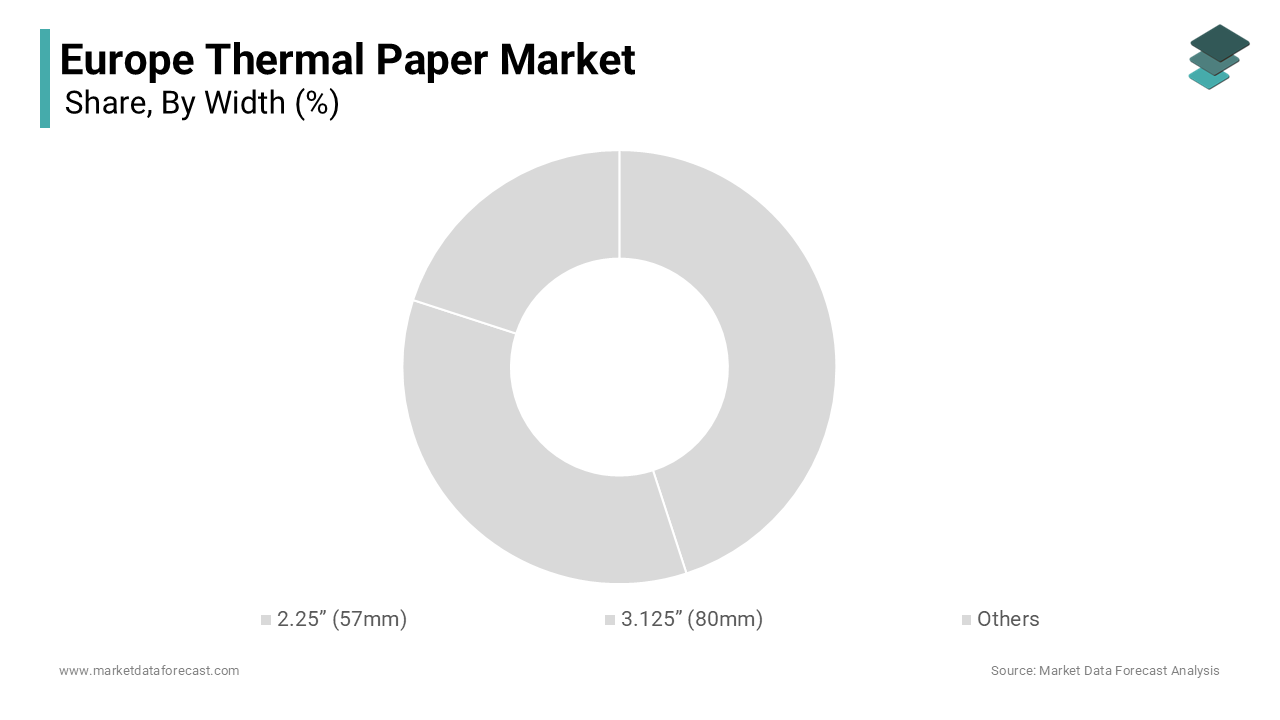
The other width segment is anticipated to witness the fastest CAGR of 6.8% from 2026 to 2034 owing to the proliferation of self service kiosks and automated ticketing systems across transport and entertainment venues. Transportation hubs are increasingly utilizing wider thermal printing formats to enhance the readability of boarding passes and baggage tags. The requirement for higher data density in transit documents has driven the adoption of broader media in major railway stations and airports. The healthcare sector is adopting bedside printing solutions to improve specimen and medication tracking, with a preference for non-standard, wider labels. Hospital infrastructure upgrades are favoring label sizes that accommodate multilingual information and complex, scannable identifiers for patient safety. A general shift towards wider thermal printing media is observed in both transportation and healthcare sectors for improved information handling. Urban mobility services like bike sharing and EV charging networks also deploy compact kiosks with bespoke thermal paper widths, further diversifying demand. Unlike standardized retail formats, these niche applications prioritize functionality over uniformity, enabling premium pricing and rapid segment expansion.
By Printing Technology Insights
The direct thermal technology segment led the Europe thermal paper market by holding a significant share in 2025. The leading position of the direct thermal technology segment is driven by its simplicity, low maintenance, and cost efficiency in high volume printing environments. Direct thermal technology is the prevalent method for thermal printing in the European market, mainly because it does not require ink or ribbons. This printing approach is typically applied in areas like retail receipts, logistics labels, and transport tickets, where speed and reliability are more important than keeping documents long-term. Many supermarkets primarily use direct thermal systems, often choosing them for benefits such as less downtime and lower overall costs. Additionally, EU regulations restricting volatile organic compounds have indirectly favored direct thermal over technologies requiring solvent based ribbons. The integration of energy efficient thermal print heads, such as those compliant with the EU’s Ecodesign Directive, further enhances adoption. Unlike thermal transfer, which requires consumable ribbons and complex mechanisms, direct thermal printers operate with fewer moving parts, making them ideal for compact devices like handheld labelers used in warehouse fulfillment. This operational and regulatory alignment ensures direct thermal’s continued dominance across commercial and industrial applications.
The thermal transfer printing segment is likely to experience the fastest CAGR of 5.9% over the forecast period due to rising demand for durable, long lasting printouts in industrial and outdoor labeling applications where image permanence is critical. European chemical and automotive manufacturers are increasingly adopting thermal transfer printing technology to meet demand for more durable labeling solutions. Unlike direct thermal prints that fade under heat or UV exposure, thermal transfer labels retain legibility for years, a necessity for machinery tags, safety instructions, and export documentation. The updated European Chemicals Agency (ECHA) CLP regulation demands that hazard labels on chemicals remain durable and readable throughout the product's entire lifespan. Additionally, the expansion of cold chain logistics for pharmaceuticals, where labels must survive sub zero temperatures without smudging, has accelerated adoption. The European Medicines Verification Organisation (EMVO) framework necessitates secure, high-definition printing for serialization, promoting the use of durable printing methods like thermal transfer for pharmaceutical packaging. This convergence of regulatory rigor, supply chain complexity, and durability requirements positions thermal transfer as the preferred solution for mission critical identification tasks.
By Application Insights
The point of sale application segment was the largest segment in the Europe thermal paper market by accounting for a 61.7% share in 2025 because of the continent’s dense retail infrastructure and legal mandates for physical receipts. Eurostat suggests the European Union's business economy, largely comprised of small and medium-sized enterprises, operates a massive, continuous volume of daily retail transactions. Countries like Italy and Greece enforce fiscalization laws requiring every transaction to produce a government authenticated thermal receipt, directly linking sales data to tax authorities. Due to mandatory electronic reporting, Italian businesses are now consistently transmitting daily, real-time fiscal data to the national revenue agency. Even in digitally advanced markets like the Netherlands, small businesses and hospitality venues maintain thermal receipt systems due to customer preference and technical simplicity. Despite the push toward digital receipts and eco-friendly alternatives, traditional thermal POS printers remain widely utilized by merchants in Germany. Furthermore, the integration of QR codes for loyalty programs and return processing has increased data density on receipts, reinforcing the need for high quality thermal media. This regulatory, operational, and behavioral triad ensures that point of sale remains the market’s largest and most stable application segment.
The tags and labels segment is on the rise and is expected to be the fastest growing segment in the market by witnessing a CAGR of 7.2% from 2026 to 2034. The rapid expansion of the tags and labels segment is fuelled by the exponential rise in e commerce logistics, industrial automation, and regulatory traceability requirements across supply chains. The volume of European parcel shipments has created a consistent demand for labeling, with each package requiring tracking and identification. Direct thermal label printers have become standard in warehouse management systems, supporting real-time inventory updates within Western Europe. These labeling solutions are utilized across carrier operations, customs processes, and final delivery tracking. Simultaneously, the EU’s Deforestation Regulation mandates detailed origin labeling for commodities like coffee and soy, compelling exporters to adopt high resolution thermal labels with scannable data matrices. Cold chain integrity monitoring further drives demand, as temperature sensitive labels printed on thermal media are essential for vaccine and biologics distribution. Unlike receipts, which face digital substitution, labels are indispensable in physical goods movement, ensuring sustained and accelerating growth.
REGIONAL ANALYSIS
Germany Thermal Paper Market Analysis
Germany dominated the Europe thermal paper market by capturing a 22.1% share in 2025. The dominance of the German market is propelled by its robust industrial base, stringent fiscal compliance regime, and advanced logistics network. The country’s mandatory electronic cash register law requires all businesses to issue tamper proof thermal receipts linked to tax authorities, generating substantial amount of receipts annually as per sources. Germany also hosts Europe’s largest e commerce and manufacturing sectors, both heavy users of thermal labels for parcel shipping and asset tracking. Additionally, Germany’s leadership in automotive and machinery exports necessitates compliance with global identification standards, further boosting thermal transfer label usage. Retail chains like Edeka and REWE standardize on 3.125 inch thermal rolls across thousands of stores, ensuring consistent bulk demand. Hence, Germany’s logistics ecosystem remains a key thermal paper consumption engine, solidifying its top position in the regional market.
France Thermal Paper Market Analysis
France was the next prominent player in the Europe thermal paper market by holding a 15.1% share in 2025. The expansion of the French market is fuelled by a combination of retail density, public transport ticketing, and digital receipt opt out regulations. The widespread presence of retail and food service locations in France continues to support a high utilization of thermal POS systems. Regulatory measures requiring explicit consent for digital receipts help maintain the prevalence of physical thermal receipts in consumer transactions. Transportation infrastructure, including train and urban transit systems, contributes to significant thermal paper usage through the issuance of physical tickets. The growth of e-commerce, along with associated parcel delivery services, drives demand for thermal shipping labels. The hospitality sector, driven by high volumes of domestic and international visitors, sustains demand for thermal paper in the form of guest folios and dining receipts. This multifaceted demand across public and private sectors cements France’s position as Europe’s second largest thermal paper market.
United Kingdom Thermal Paper Market Analysis
The United Kingdom is another key player in the Europe thermal paper market due to its mature retail environment, integrated logistics hubs, and healthcare documentation needs. Despite Brexit, the UK’s internal market remains highly active. Many registered businesses in the country use thermal point-of-sale systems for daily transactions. Large healthcare operations extensively utilize thermal media for printing essential items like patient wristbands and prescription labels. The substantial volume of e-commerce activity, marked by significant online sales, fuels considerable demand for thermal shipping labels. Additionally, national postal and courier services commonly use thermal labels as the standard for processing and tracking parcels. Additionally, UK fiscal policies do not mandate digital receipt adoption, allowing retailers to continue thermal printing without legal pressure. The prevalence of convenience stores and hospitality venues in urban centers like London and Manchester further ensures steady roll demand. This blend of public sector reliance and private sector scale maintains the UK’s strong market position.
Italy Thermal Paper Market Analysis
Italy is moving ahead steadfastly in the Europe thermal paper market owing to its strict fiscalization laws and dense network of small retail businesses. National regulations require commercial establishments to utilize specialized hardware for documenting sales, resulting in the continuous generation of digitalized paper records for every exchange. The high concentration of small-scale retail and dining businesses contributes to a widespread and recurring need for paper-based transaction logs. A robust influx of international travelers increases the volume of administrative documentation required for lodging, dining, and cultural activities. The combination of regulatory compliance and a service-oriented economy maintains a consistent demand for thermal printing supplies across various sectors. Additionally, Italy’s fragmented logistics landscape, comprising thousands of regional couriers, relies heavily on thermal labels for last mile delivery tracking. Unlike northern European countries, Italy has not implemented aggressive digital receipt policies, preserving thermal paper relevance. The combination of regulatory enforcement, micro enterprise prevalence, and tourism dependency ensures Italy remains a top four market.
Spain Thermal Paper Market Analysis
Spain is anticipated to grow in the Europe thermal paper market over the forecast period due to its vibrant tourism economy, expanding e commerce logistics, and retail modernization. The flow of international visitors across service industries in Spain supports a consistent need for documents such as restaurant bills, tickets, and hotel summaries. While digital invoicing is becoming more common for business transactions, physical thermal receipts remain a necessary form of purchase verification in many situations. An increase in package handling by delivery services is associated with a greater need for thermal shipping labels. The growth of the gig economy, involving numerous delivery and transport personnel, requires portable thermal printers for generating tickets and receipts as needed. Retail chains like Mercadona and El Corte Inglés have standardized thermal POS systems across thousands of locations. Unlike Nordic countries, Spain’s digital receipt adoption remains low, with only a portion of consumers opting in. This ongoing reliance on physical documentation secures Spain’s position among Europe’s top five thermal paper markets.
COMPETITIVE LANDSCAPE
The Europe thermal paper market is characterized by intense competition among established multinational corporations and regional specialty paper producers. Companies compete primarily on product quality sustainability credentials and technological innovation rather than price alone. Regulatory pressures particularly around chemical use and recyclability drive continuous investment in eco friendly alternatives such as BPA free and phenol free thermal papers. Market participants also differentiate themselves through customized solutions for retail logistics and healthcare sectors. The presence of vertically integrated players gives some firms cost and supply chain advantages. Meanwhile smaller niche manufacturers focus on agility and specialized applications to carve out market space. Consolidation through mergers and acquisitions has further intensified competitive dynamics as companies seek to broaden their product portfolios and geographic reach. Overall the market rewards those who combine environmental responsibility with operational excellence and strong customer relationships.
KEY MARKET PLAYERS
Some of the companies that are playing a dominating role in the Europe Thermal Paper Market include
- Koehler Paper Group
- Mitsubishi HiTec Paper
- Oji Holdings
- Jujo Thermal
- Appvion
- Ricoh
- Hansol Paper
- Iconex
- Nakagawa Manufacturing
- Rotolificio Bergamasco
Top Players in the Market
Oji Holdings Corporation
Oji Holdings Corporation is a leading Japanese manufacturer with substantial operations across Europe contributing significantly to the global thermal paper market. The company emphasizes sustainable production practices and has invested heavily in developing BPA free thermal paper to meet stringent European environmental regulations. Recently Oji has expanded its R&D collaborations with European partners to enhance coating technologies and improve recyclability of thermal paper products. These initiatives align with growing consumer demand for eco friendly solutions and help Oji maintain a strong foothold in both European and global markets through innovation and compliance with regional standards.
UPM-Kymmene Corporation
UPM-Kymmene Corporation a Finnish multinational has been a pioneer in sustainable forestry and paper manufacturing in Europe. The company plays a crucial role in the thermal paper segment by offering phenol free thermal paper grades that cater to environmentally conscious customers worldwide. UPM has recently upgraded its production facilities in Germany and Finland to increase capacity and reduce carbon emissions. These upgrades underscore its commitment to circular economy principles and support its strategy to lead in responsible thermal paper production not only across Europe but also in key export regions including North America and Asia.
Koehler Group
Koehler Group headquartered in Germany is a key European producer of specialty papers including thermal paper used in point of sale and labeling applications. The company contributes to the global market through its high quality thermal paper solutions that combine performance with sustainability. Recently Koehler has focused on enhancing its digital capabilities and supply chain efficiency by integrating smart manufacturing technologies and expanding partnerships with European retailers and logistics firms. These strategic moves have enabled the company to respond swiftly to market demands and reinforce its reputation as a reliable and innovative supplier in the thermal paper industry.
Top Strategies Used by the Key Market Participants
Key players in the Europe thermal paper market prioritize sustainability by shifting to phenol free and recyclable thermal paper formulations to meet regulatory and consumer expectations. They invest in advanced manufacturing technologies to improve production efficiency and reduce environmental impact. Strategic partnerships with retailers logistics providers and technology firms enable better integration across the value chain. Companies also focus on geographic expansion by strengthening distribution networks within Europe and exporting to emerging markets. Additionally product innovation through enhanced coating technologies and compatibility with digital printing systems helps maintain competitive differentiation and customer loyalty in a dynamic market landscape.
MARKET SEGMENTATION
This europe technical textiles market research report is segmented and sub-segmented into the following categories.
By Width
- 2.25” (57mm)
- 3.125” (80mm)
- Others
By Printing Technologies
- Direct Thermal
- Thermal Transfer
- Others
By Application
- Point-of-Sale (POS)
- Tags & Labels
- Ticketing
- Lottery & Gaming
- Medical
- Others
By Country
- UK
- France
- Spain
- Germany
- Italy
- Russia
- Sweden
- Denmark
- Switzerland
- Netherlands
- Turkey
- Czech Republic
- Rest of Europe