- Product Description Description
- Table of Contents TOC
- List of Table & Figure LOT
- Get Free Sample PDF Sample PDF
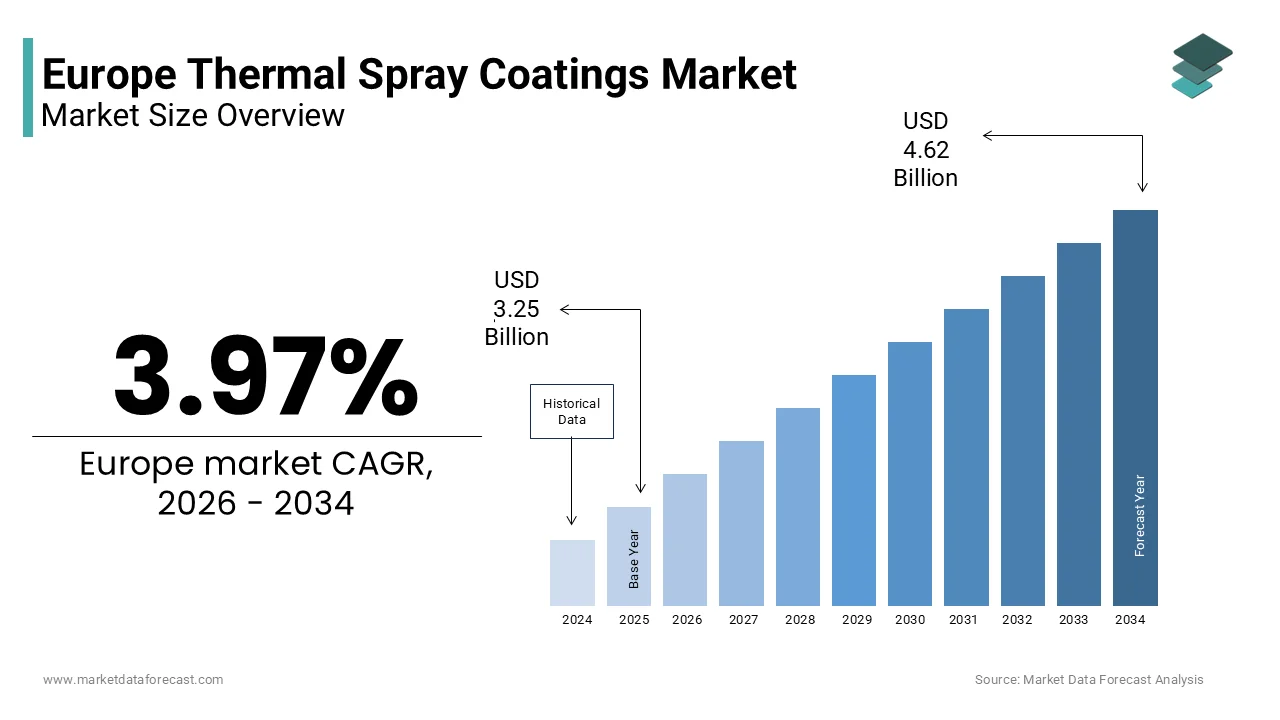
Market Size, 2025
$3.25 BnMarket Estimate, 2026
$3.38 BnMarket Forecast, 2034
$4.62 BnCAGR, 2026–2034
3.97%Europe Thermal Spray Coatings Market Size
The Europe thermal spray coatings market size was valued at USD 3.25 billion in 2025 and is projected to reach USD 4.62 billion by 2034 from USD 3.38 billion in 2026, growing at a CAGR of 3.97%.
Thermal spray coatings are engineered surface treatments applied by heating and propelling feedstock materials, such as metals, ceramics, or composites onto substrates to enhance wear resistance, corrosion protection, thermal insulation, or electrical conductivity. In Europe, this technology is critical to maintaining the longevity and performance of high value assets across aerospace, power generation, oil and gas, and industrial machinery sectors. As per Eurostat, Europe’s industrial sector accounts for over 22% of total final energy consumption, driving demand for thermal barrier coatings that improve turbine efficiency. Additionally, the European Aviation Safety Agency mandates that over 80% of jet engine components undergo recoating every 5,000 flight hours to ensure airworthiness with the indispensable role of thermal spray technology in sustaining Europe’s advanced industrial and transport infrastructure.
MARKET DRIVERS
Aerospace Maintenance and Engine Overhaul Cycles
The robust aerospace sector for thermal spray coatings through mandatory engine maintenance and component refurbishment protocols is propelling the growth of Europe thermal spray coatings market. As per the European Union Aviation Safety Agency, commercial aircraft engines must undergo intermediate or major overhauls every 5 000 to 10 000 flight hours, during which turbine blades, combustor liners, and seal rings are stripped and recoated with thermal barrier and abradable coatings to restore performance and safety margins. The European aerospace industry supports over 700,000 direct jobs and maintains a fleet of more than 10,000 commercial aircraft, according to the AeroSpace and Defence Industries Association of Europe. Each overhaul cycle consumes 3 to 5 kilograms of yttria stabilized zirconia and MCrAlY bond coats per engine, materials applied almost exclusively via atmospheric plasma spray. Major maintenance hubs in Germany, France, and the UK, including Lufthansa Technik and Air France Industries operate dedicated thermal spray facilities compliant with Nadcap accreditation standards.
Energy Efficiency Mandates in Power Generation
The push for decarbonisation and energy efficiency is accelerating the adoption of thermal spray coatings in gas and steam turbines used in combined cycle power plants, which is eventually accelerating the growth of Europe thermal spray coatings market. As per the European Commission’s Energy Efficiency Directive, all new and refurbished power plants must demonstrate at least a 2% annual improvement in thermal efficiency achieved in part through thermal barrier coatings (TBCs) that allow turbines to operate at higher temperatures without damaging metal substrates. These TBCs, typically composed of yttria stabilized zirconia applied via plasma spray reduce cooling air requirements and extend component life by 3 to 5 times. The International Energy Agency reports that Europe added over 12 gigawatts of gas fired capacity in 2023 to balance intermittent renewables, each unit requiring thousands of square meters of coated turbine parts. Furthermore, the EU’s Net Zero Industry Act designates advanced turbines as strategic technologies, incentivising coating upgrades.
MARKET RESTRAINTS
Stringent Occupational Health and Emissions Regulations
The increasing operational constraints due to rigorous air quality and worker safety regulations governing, particulate matter and metal fume exposure is restraining the growth of Europe thermal spray coatings market. As per the European Agency for Safety and Health at Work, thermal spray processes generate ultrafine particles of nickel chromium and cobalt, classified as substances of very high concern under REACH by requiring engineering controls, such as negative pressure booths and high efficiency particulate air filtration. The Industrial Emissions Directive mandates Best Available Techniques for surface treatment installations, with emission limits for total dust set at 20 milligrams per cubic meter forcing many small and medium enterprises to invest over 500,000 euros in abatement systems. Additionally, Germany’s Technical Rules for Hazardous Substances TRGS 528 classify thermal spray booths as high-risk workplaces, requiring continuous air monitoring and mandatory respiratory protection. These compliance burdens increase operating costs by 25 to 40% and have led to the closure of over 30 independent coating shops in Southern Europe since 2021 according to the European Thermal Spray Association. The regulatory environment thus favours large integrated players with capital for compliance while stifling competition and innovation among smaller service providers.
Limited Availability of High Purity Coating Feedstock
The dependent on imported high purity powders and wires for advanced applications in aerospace and energy is also hindering the growth of Europe thermal spray coatings market. As per the European Commission’s 2023 Raw Materials Act, key feedstock elements, such as yttrium cobalt and rare earth oxides are classified as strategic with over 85% of supply sourced from China and the United States. European powder producers like Oerlikon Metco and Saint Gobain rely on long term contracts to secure feedstock, but smaller applicators face spot market shortages and inconsistent quality. Moreover, the EU’s stringent REACH registration requirements for nanomaterials complicate the import of advanced nanostructured powders, delaying innovation cycles.
MARKET OPPORTUNITIES
Adoption of Cold Spray for Sustainable Component Repair
The growing adoption of cold spray technology with a solid state thermal spray process that uses high velocity gas to deposit metal particles without melting, as a sustainable alternative for repairing high value components in aerospace and defence. This factor is quietly creating new opportunities for the growth of Europe thermal spray coatings market. Unlike traditional plasma or HVOF methods, cold spray produces zero fumes minimal waste and negligible heat distortion enabling the repair of temperature sensitive parts like aluminium landing gear or titanium drone frames. As per the European Defence Agency, over 15 military maintenance depots across France Germany and Sweden have integrated cold spray systems since 2022 to extend the service life of helicopter gearboxes and radar housings. The European Space Agency has also qualified cold spray for in situ repair of satellite antenna brackets using aluminium-copper alloys. This shift aligns with the EU’s Circular Economy Action Plan which prioritises remanufacturing to reduce raw material consumption. A 2023 study by the Fraunhofer Institute found that cold spray repairs reduce lifecycle carbon emissions by 60% compared to part replacement.
Integration into Offshore Wind Turbine Maintenance
The offshore wind energy in turbine component protection and repair is additionally to escalate the growth of Europe thermal spray coatings market. As per WindEurope, the EU installed 3.8 gigawatts of offshore wind capacity in 2023 with over 100 new turbines deployed in the North and Baltic Seas each exposed to highly corrosive marine environments. The components, such as pitch bearings main shafts and gearboxes require HVOF applied tungsten carbide coatings to resist saltwater corrosion and fretting wear. Moreover, the remote location of offshore farms makes component replacement costly and logistically complex, driving interest in on site recoating using mobile thermal spray units. Additionally, the EU’s Net Zero Industry Act includes offshore wind in its strategic net zero technologies list, accelerating investment in durable surface engineering. Companies like Bodycote and Castolin Eutectic have deployed marine certified coating teams to service hubs in Denmark, the Netherlands, and the UK, positioning thermal spray as a key enabler of Europe’s renewable energy resilience.
MARKET CHALLENGES
Skilled Labour Shortage in Advanced Coating Application
The shortage of certified thermal spray technicians capable of operating complex plasma and HVOF systems to aerospace and energy standards is ascribed to pose as a challenge for the growth of Europe thermal spray coatings market. As per the European Federation for Welding Joining and Cutting, over 60% of current thermal spray operators in Germany, France, and Italy, are aged above 50 with insufficient apprenticeship pipelines to replace them. Nadcap and ISO 14916 certification requires 2000 hours of supervised practice and rigorous testing in coating parameters bond strength and porosity control skills that cannot be quickly replicated. The German Engineering Federation estimates that the shortage has delayed turbine maintenance schedules by 3 to 6 weeks in 2023 alone. While automation and robotic spraying are emerging they still require human oversight for path planning quality control and defect interpretation.
Inconsistent Certification and Quality Standards Across Member States
The harmonisation efforts thermal spray coating services face fragmented quality assurance requirements, across national aviation and energy regulators, complicating cross border service delivery. The inconsistent certification and quality standards across member states is also to degrade the growth of the Europe thermal sprat coatings market. While the Nadcap standard is widely accepted in aerospace, national grid operators in Spain, Italy, and Poland impose additional coating thickness adhesion and porosity tests not required in Germany or the Netherlands. As per the European Thermal Spray Association, a single turbine blade coating may require three separate quality dossiers to be accepted across major EU countries thereby adding 4 to 8 weeks to project timelines. In the defence sector, France’s DGA and Sweden’s FMV maintain proprietary coating specifications that restrict interoperability of repaired components. This regulatory patchwork discourages small applicators from expanding beyond domestic borders and inflates costs for multinational OEMs managing pan European maintenance contracts.
REPORT COVERAGE
| REPORT METRIC | DETAILS |
| Market Size Available | 2025 to 2034 |
| Base Year | 2025 |
| Forecast Period | 2026 to 2034 |
| CAGR | 3.97% |
| Segments Covered | By Product Type, Process Type, End User Industry, and Region |
| Various Analyses Covered | Global, Regional, & Country Level Analysis; Segment-Level Analysis; DROC, PESTLE Analysis; Porter’s Five Forces Analysis; Competitive Landscape; Analyst Overview of Investment Opportunities |
| Regions Covered | UK, France, Spain, Germany, Italy, Russia, Sweden, Denmark, Switzerland, Netherlands, Turkey, and the Czech Republic |
| Market Leaders Profiled | Oerlikon, Kennametal Stellite, Wall Colmonoy, Castolin Eutectic, H.C. Starck Ceramics, Praxair Surface Technologies, GTV Wear Protection, Powder Alloy Corporation, Hoganas, Fujimi Inc., Carpenter Technology Corp, and Compagnie de Saint Gobain SA |
SEGMENTAL ANALYSIS
By Product Type Insights
The Coatings services segment was the largest by holding 54.3% of the Europe thermal spray coatings market share in 2024 with the high cost of equipment, stringent quality certification requirements, and the prevalence of outsourced maintenance in capital-intensive industries. Most end users in aerospace and power generation, lack the capital or expertise to operate in house thermal spray lines compliant with Nadcap or ISO 14916 standards. As per the European Thermal Spray Association, over 75% of turbine blade and aircraft engine component recoating in Europe is performed by specialised service providers such as Bodycote Castolin Eutectic and Aalberts Surface Technologies. These companies operate certified booths with real time process monitoring and full traceability documentation required by the European Aviation Safety Agency and grid operators. Additionally, the Industrial Emissions Directive imposes significant abatement and monitoring costs that are more efficiently managed at scale by dedicated coating centres. In Germany, alone over 120 thermal spray service facilities support the country’s industrial base, far exceeding the number of captive lines.
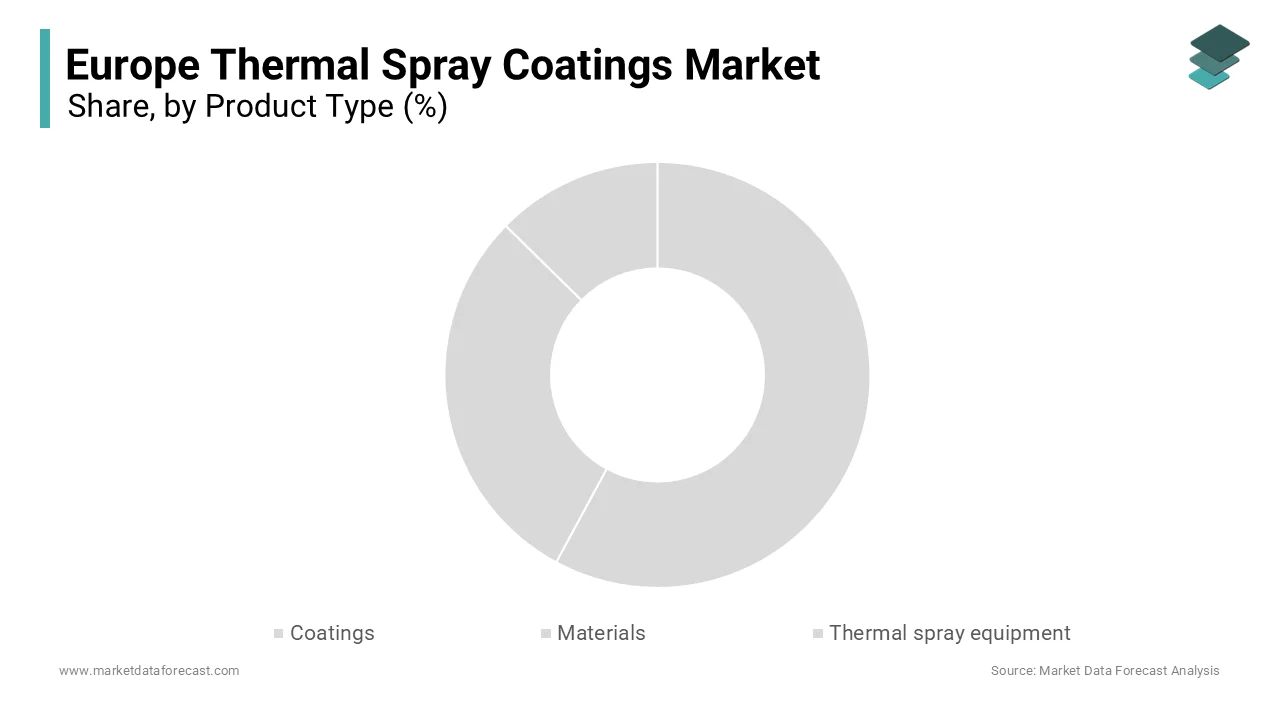
The materials segment is likely to witness a fastest CAGR of 8.4% during the forecast period with the rising demand for advanced feedstock formulations that enable higher performance coatings in extreme environments. As per the European Commission’s Critical Raw Materials Act, strategic materials like yttria stabilized zirconia tungsten carbide cobalt chrome and rare earth doped alloys are increasingly prioritised for secure supply due to their role in energy and defence applications. The International Energy Agency reports that each new combined cycle gas turbine installed in Europe in 2023 required an average of 450 kilograms of high purity thermal spray powders up 12% from 2021 due to thicker thermal barrier coatings for higher efficiency. Furthermore, aerospace OEMs like Safran and Rolls Royce now specify nanostructured and amorphous metal powders that improve coating density and fatigue resistance. Companies such as Oerlikon Metco and Saint Gobain have responded by expanding European powder production with in line quality control and REACH compliant documentation.
By Process Type Insights
The combustion-based processes segment was accounted in holding 59.2% of the Europe thermal spray coatings market share in 2024 due to their superior bond strength wear resistance and cost efficiency for industrial applications. HVOF is the preferred method for applying tungsten carbide coatings on oil and gas valves pump shafts and hydraulic rods, where erosion and corrosion resistance are critical. As per the European Federation of Corrosion Engineers, over 70% of new offshore oil and gas components in the North Sea are now specified with HVOF applied WC CoCr coatings that extend service life by 3 to 5 times compared to hard chrome plating. The process’s lower capital cost and portability also make it ideal for on-site repairs in remote locations such as wind farms and refineries. In Germany, the VDMA reports that over 60% of industrial thermal spray lines installed in 2023 used HVOF due to its compatibility with EU emissions standards when fitted with afterburners and filtration.
The electric energy processes segment is swiftly growing with an expected CAGR of 9.1% from 2025 to 2033 with aerospace and defence demand for high purity low porosity coatings that electric processes uniquely deliver. Atmospheric plasma spray is the only method approved by the European Aviation Safety Agency for applying yttria stabilized zirconia thermal barrier coatings on turbine blades due to its precise temperature control and coating homogeneity. As per the AeroSpace and Defence Industries Association of Europe, over 85% of jet engine overhauls in EU maintenance hubs use plasma spray for critical hot section components. Meanwhile cold spray, classified as an electric energy process due to its reliance on high pressure gas systems powered by electricity is gaining traction for repairing aluminium and titanium parts without thermal distortion.
By End User Industry Insights
The aerospace segment was the largest by holding a dominant share of the Europe thermal spray coatings market in 2024 with the mandatory engine maintenance cycles and stringent airworthiness regulations. Every commercial and military jet engine operating in Europe requires periodic recoating of turbine blades combustor liners and seal rings to maintain efficiency and safety. As per the European Union Aviation Safety Agency, over 9,000 commercial aircraft based in the EU underwent engine shop visits in 2023 each consuming 3 to 5 kilograms of thermal spray materials per overhaul. Major maintenance repair and overhaul hubs in Germany (Lufthansa Technik) France (Air France Industries) and the UK (StandardAero) operate Nadcap accredited thermal spray lines producing millions of coated components annually.
The industrial gas turbines segment is likely to grow at an anticipated CAGR of 9.7% during the forecast period with the Europe’s energy transition strategy, which relies on flexible gas fired power to balance intermittent renewable generation. As per the International Energy Agency, Europe added over 12 gigawatts of new gas turbine capacity in 2023 with each unit requiring thousands of square meters of thermal barrier coatings on blades vanes and combustors to operate at temperatures exceeding 1 400 degrees Celsius. Furthermore, the EU’s Net Zero Industry Act designates advanced turbines as strategic net zero technologies accelerating retrofit programmes that include full recoating of legacy components. Companies like Siemens Energy and Ansaldo Energia, now specify dual layer thermal barrier systems applied via atmospheric plasma spray to extend inspection intervals from 24 000 to 36 000 operating hours. This combination of regulatory support technological advancement and grid stability needs positions industrial gas turbines as Europe’s highest growth thermal spray application.
REGIONAL ANALYSIS
Germany Thermal Spray Coatings Market Analysis
Germany was the largest contributor of the Europe thermal spray coatings market by capturing 25.3% of share in 2024 owing to its world leading aerospace maintenance sector advanced power generation infrastructure and strong industrial machinery base. The country hosts Lufthansa Technik the largest aircraft engine MRO provider in Europe which performs over 1,200 engine overhauls annually requiring extensive thermal spray recoating. As per the German Engineering Federation VDMA, Germany’s industrial sector operates over 4,000 combined cycle and steam turbines all subject to EU energy efficiency mandates that drive demand for thermal barrier coatings. Additionally, Germany is home to leading thermal spray service providers like Aalberts and Oerlikon Metco which supply coatings for oil and gas automotive and tooling applications. The Federal Ministry for Economic Affairs has allocated funding under the Important Project of Common European Interest for strategic material processing including thermal spray feedstock.
United Kingdom Thermal Spray Coatings Market Analysis
The United Kingdom thermal spray coatings market growth is likely to grow with its aerospace engineering legacy and offshore energy maintenance needs. Rolls Royce’s Derby facility alone maintains over 14,000 civil and military engines requiring plasma sprayed thermal barrier coatings compliant with EASA standards. As per the UK Civil Aviation Authority over 2,500 engine shop visits were completed in the UK in 2023 driving steady demand for high integrity coatings. Additionally, the North Sea’s 200 offshore platforms and 30 subsea hubs rely on HVOF applied tungsten carbide coatings for valves and risers resistant to seawater corrosion. The HyNet and East Coast carbon capture clusters further create demand for wear resistant coatings in CO2 compression systems. The UK’s departure from the EU has not diminished technical alignment, Nadcap and ISO standards remain mandatory.
France Thermal Spray Coatings Market Analysis
France thermal spray coatings market growth is steadily growing with its civil and military aerospace industry nuclear energy fleet and defence manufacturing. Safran’s engine division performs over 800 overhauls annually at its Villaroche facility using plasma and HVOF coatings for turbine and landing gear components. Additionally, the Direction Générale de l Armement funds cold spray repair programmes for helicopter gearboxes and radar systems to extend asset life. Companies like Castolin Eutectic operate certified coating centres in Lyon and Toulouse serving aerospace and energy clients. These strategic sectors ensure consistent demand for high performance thermal spray solutions in a highly regulated technical environment.
Italy Thermal Spray Coatings Market Analysis
Italy thermal spray coatings market growth is driven by the industrial machinery automotive and oil and gas sectors. The country is a global hub for machine tool manufacturing with companies like DMG Mori and Ficep requiring wear resistant coatings on spindles and hydraulic components. As per Confindustria, over 60% of Italian machinery exporters specify HVOF coatings to enhance product longevity in global markets. Additionally, Eni’s refineries and offshore platforms in the Adriatic Sea use thermal spray coatings for corrosion protection on valves and pipelines. Italy also hosts Leonardo’s aerospace division which applies thermal barrier coatings on helicopter engine parts under EASA oversight. The National Recovery and Resilience Plan allocates 2.3 billion euros for industrial modernisation including surface engineering upgrades.
Sweden Thermal Spray Coatings Market Analysis
Sweden thermal spray coatings market growth is attributed to grow with the defence aerospace and renewable energy maintenance. Additionally, Vattenfall and other utilities operate over 8 gigawatts of gas and biomass turbines requiring plasma sprayed thermal barrier coatings to meet EU efficiency standards. Sweden’s strong materials science base led by KTH Royal Institute of Technology supports innovation in nanostructured and amorphous metal coatings for extreme environments. Companies like Sandvik and Oerlikon operate advanced coating centres in Sandviken serving global mining and energy clients.
COMPETITIVE LANDSCAPE
Competition in the Europe thermal spray coatings market is defined by technical certification scale and regulatory compliance rather than price alone. The market is bifurcated between large integrated players like Oerlikon Bodycote and Castolin Eutectic that operate certified multi technology centres and smaller regional applicators serving niche industrial segments. Success hinges on Nadcap accreditation for aerospace work ISO 14916 compliance for industrial coatings and adherence to the EU Industrial Emissions Directive for emissions control. This high compliance threshold creates significant barriers to entry and favours established firms with capital for abatement systems and quality documentation. While Asian and North American players supply powders equipment dominates remain European due to proximity to maintenance hubs and deep integration with OEM supply chains.
KEY MARKET PLAYERS
Some of the notable key players in the Europe thermal spray coatings market are
- Oerlikon
- Kennametal Stellite
- Wall Colmonoy
- Castolin Eutectic
- H.C. Starck Ceramics
- Praxair Surface Technologies
- GTV Wear Protection
- Powder Alloy Corporation
- Hoganas
- Fujimi Inc.
- Carpenter Technology Corp
- Compagnie de Saint Gobain SA
Top Players in the Market
- Oerlikon Balzers AG is a leading European provider of surface solutions including advanced thermal spray coatings for aerospace industrial turbines and precision components. Headquartered in Liechtenstein the company operates a network of over 30 coating centres across Europe offering plasma spray HVOF and cold spray services compliant with Nadcap ISO and aerospace OEM specifications. Oerlikon supplies thermal barrier and wear resistant coatings to major engine manufacturers such as Rolls Royce and Safran and serves industrial clients in power generation and oil and gas. Oerlikon launched a new generation of nanostructured yttria stabilized zirconia powders that enhance thermal barrier coating durability by 25% under cyclic heating conditions. It also expanded its cold spray repair capabilities for defence applications in Sweden and Germany under European Defence Agency funding. These initiatives reinforce Oerlikon’s role as a technology leader in high performance surface engineering globally.
- Bodycote PLC maintains a dominant presence in the Europe thermal spray coatings market through its extensive network of heat treatment and surface technology facilities offering HVOF plasma spray and flame spray services. The UK based company serves critical sectors including aerospace energy and industrial machinery with certified coating solutions that meet EASA grid operator and automotive standards. Bodycote’s thermal spray operations are integrated into its global supply chain enabling just in time delivery to OEMs like Siemens Energy and Airbus. Bodycote upgraded its turbine blade coating lines in Germany and France with real time process monitoring and digital traceability compliant with EU Industrial Emissions Directive requirements. It also launched a dedicated offshore energy coating unit in Aberdeen to support North Sea platform maintenance with corrosion resistant tungsten carbide coatings. These actions position Bodycote as a reliable high volume partner for Europe’s mission critical infrastructure.
- Castolin Eutectic Group is a major European player in thermal spray materials and services with a strong focus on industrial maintenance repair and wear protection. The company offers a comprehensive portfolio of HVOF and plasma spray powders wires and automated systems used in oil and gas mining and power generation. Based in France Castolin Eutectic operates over 20 application centres across Europe providing on site and in house coating solutions with full metallurgical validation. In early 2024 the company introduced a new cobalt free tungsten carbide formulation compliant with EU REACH restrictions on cobalt while maintaining equivalent wear resistance. It also partnered with Enel and other utilities to develop thermal spray repair protocols for steam turbine components under Italy’s National Recovery Plan.
MARKET SEGMENTATION
This research report on the European thermal spray coatings market has been segmented and sub-segmented based on categories.
By Product Type
- Coatings
- Materials
- Coating materials
- Powders
- Ceramics
- Metals
- Polymer
- Other coating materials
- Powders
- Wires and rods
- Other materials
- Coating materials
- Thermal spray equipment
- Thermal spray coating system
- Dust collection equipment
- Spray gun and nozzle
- Feeder equipment
- Spare parts
- Noise reducing enclosure
- Other thermal spray equipment
By Process Type
- Combustion
- Electric energy
By End User Industry
- Aerospace
- Industrial gas turbines
- Automotive
- Electronics
- Oil and gas
- Medical devices
- Energy and power
- Steel making
- Textile
- Printing and paper
By Country
- UK
- France
- Spain
- Germany
- Italy
- Russia
- Sweden
- Denmark
- Switzerland
- Netherlands
- Turkey
- Czech Republic
- Rest of Europe