- Product Description Description
- Table of Contents TOC
- List of Table & Figure LOT
- Get Free Sample PDF Sample PDF
Market Size, 2025
$613.75 MnMarket Estimate, 2026
$693.70 MnMarket Forecast, 2034
$1,848.15 MnCAGR, 2026–2034
13.03%Europe Thermoelectric Generator Market Summary
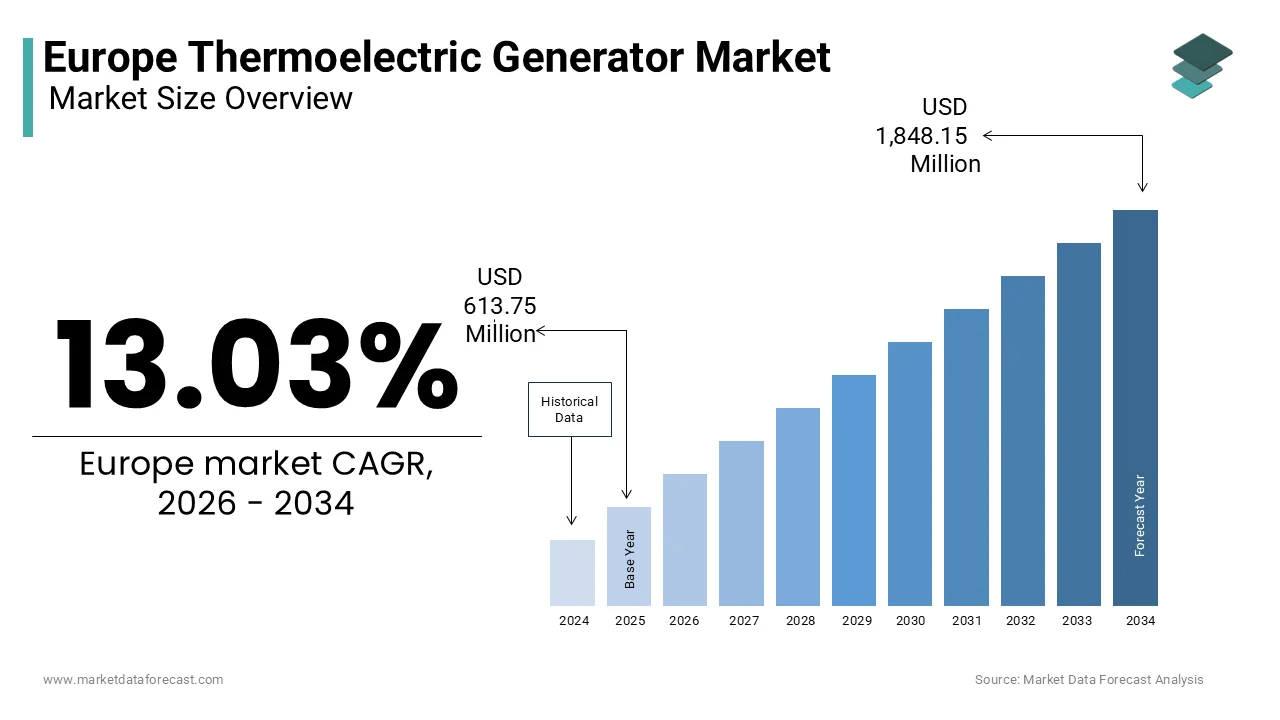
The Europe thermoelectric generator market, valued at USD 613.75 million in 2025, is projected to reach USD 1,848.15 million by 2034, expanding at a CAGR of 13.03% driven by EU waste-heat recovery mandates, industrial decarbonization, and energy-autonomous sensor networks.
Key Market Insights
- 2025 Market Size: USD 613.75 million
- 2026 Market Size: USD 693.72 million
- 2034 Forecast: USD 1,848.15 million
- CAGR (2026–2034): 13.03%
- Base Year: 2025
- Forecast Period: 2026–2034
Quick Growth Drivers
- EU Industrial Emissions Directive accelerating waste-heat recovery adoption
- Mandatory energy audits across energy-intensive industries
- Growth of electrified transport and onboard auxiliary power needs
- Expansion of Industry 4.0 and self-powered industrial sensor networks
- Alignment with circular economy and waste-energy reuse objectives
Principal Restraints
- Low energy conversion efficiency (typically 5–8%)
- High cost per watt versus mature alternatives
- Dependence on critical raw materials (tellurium, bismuth)
- Limited recycling infrastructure for thermoelectric materials
High-Value Opportunities
- Smart factory deployment of maintenance-free energy harvesting sensors
- Urban waste-heat utilization under EU Climate-Neutral Cities Mission
- Integration into district heating networks and data centers
- Embedded power solutions for electric rail and commercial EV platforms
Key Market Challenges
- Material degradation under repeated thermal cycling
- Absence of standardized lifetime testing protocols
- Lack of harmonized system integration and mounting standards
- Bespoke engineering requirements limiting scalability
Fastest-Growing Segments
- Energy Harvesting: 12.4% CAGR — wireless industrial sensor networks
- Medium Temperature Systems: 13.8% CAGR — industrial exhaust recovery
- Medium Power TEGs: 14.2% CAGR — EV and auxiliary industrial power
- Healthcare Vertical: 15.6% CAGR — autonomous medical devices
Regional Leadership & Dynamics
- Germany (24.3%) — heavy industry base, Energiewende incentives
- France (16.8%) — nuclear & chemical process heat utilization
- United Kingdom — offshore energy, district heating telemetry
- Italy — ceramics, glass, and food processing heat recovery
- Sweden — sustainable manufacturing and electrified transport
What Wins Commercially
- Modular, low-maintenance solid-state designs
- Compatibility with low-grade waste heat sources
- Integration with digital monitoring and IIoT platforms
- Long operational life with minimal servicing requirements
Top Strategic Ask for Executives
Prioritize thermoelectric solutions for low-grade waste heat and autonomous sensor power, while investing in material durability, standardization, and critical raw-material supply security to unlock scalable adoption.
Leading Players
Some of the companies that are playing a dominating role in the Europe thermoelectric generator market include
- II‑VI Incorporated
- Ferrotec Corporation
- GreenTEG AG
- Laird Performance Materials
- Marlow Industries
- TEGpro
Europe Thermoelectric Generator Market Size
The Europe thermoelectrc generator market was valued at USD 613.75 million in 2025 and increased to USD 693.72 million in 2026. The market is projected to reach USD 1,848.15 million by 2034, growing at a CAGR of 13.03% from 2026 to 2034.
A Thermoelectric Generator (TEG), also known as a Seebeck generator, is a solid-state device that directly converts heat (temperature differences) into electrical energy. These solid-state devices are increasingly deployed in industrial exhaust recovery, automotive applications, and remote off-grid power solutions where reliability and maintenance-free operation are paramount. Europe’s thermoelectric generator market beneoff-gridm stringent EU energy efficiency directmaintenance-freeng emphasis on circular economy principles that prioritize waste energy reuse. Large volumes of thermal energy produced during manufacturing in the European Union remain uncaptured, representing a significant opportunity for recovery in high-temperature industrial processes. Concurrently, the industrial sector remains one of the primary drivers of energy demand across the European Union, trailing only the transport and residential sectors in its share of total final usage. Unlike photovoltaic or wind systems, thermoelectric generators offer continuous baseload power in environments with stable thermal gradients, making them uniquely suited for integration into heavy industry and transportation infrastructure across Germany, France, Italy, and the Nordic nations.
MARKET DRIVERS
Stringent EU Industrial Emissions Regulations Are Accelerating Waste Heat Recovery Adoption
The European Union’s Industrial Emissions Directive and the associated Best Available Techniques reference documents impose progressively tighter constraints on energy inefficiency and thermal discharge from manufacturing operations, which contributes to the growth of theEuropeane thermoelectric generator market. Companies across sthe teel cethe ment and chemical sectors face mounting compliance pressure to reduceEuropeanfic energy consumption and associated carbon dioxide emissions. Large enterprises operating within the European Union are required to conduct regular energy audits to identify energy-saving opportunities. This regulatory architecture has catalyzed interest in thermoelectric generators as auxiliary power sourcesenergy-saving otherwise wasted exhaust heat into usable electricity. For instance, the European steel industry possesses significant potential for utilizing waste heat, with recoverable, low-temperature energy available in volumes sufficient to heat a substantial number of households. German industrial policy under the Energiewende framework further incentivizes the deployment of low-grade heat recovery systems through non-repayable grants under the Federal Ministry for Economic Affairs and Climate Action. The Glow-gradeeral government has provided sinon-repayableding for industrial decarbonization, investing in projects focused on lowering greenhouse gas emissions through specialized, competitive, and innovative initiatives. This regulatory-driven impetus ensures that thermoelectric generators are no longer mere experimental fixtures but viable compliance tools regulatory-drivenope’s net zero industrial roadmap.
Expansion of Electrified Transportation Infrastructure Is Creating New Embedded Power Applications
The ranet-zerotrification of the region’s automotive and rail sectors has opened avenues for thermoelectric generators to supplement onboard power in electric and hybrid vehicles, which further boosts the expansion of the European thermoelectric generator market. These generators harvest heat from battery systems, inverters, and electric motor casings. According to the International Energy Agency's Global EV Outlook 2024, battery electric vehicle registrations in Europe saw substantial growth in 2023. This significantly expanded the total electric car fleet. These vehicles generate substantial low to medium-grade heat during high-load operations, particularly in climate control and fast charging scenarios, which thermoelectric systems can partially reclaim. Automotive manufacturers have explored incorporating thermoelectric generators into vehicle exhaust and battery systems to supplement auxiliary power during operation. Waste heat recovery technology is considered a focus area for enhancing energy efficiency in rail applications, where auxiliary systems consume a notable portion of total energy. Trials on regional commuter trains have demonstrated that thermoelectric components applied to braking systems can contribute to reduced net energy consumption. The ongoing shift toward electric mobility in private and public domains is driving a synchronized demand for embedded thermoelectric solutions that offer efficiency gains without adding to a vehicle's mechanical burden.
MARKET RESTRAINTS
Low Energy Conversion Efficiency Remains a Fundamental Technical Limitation
Thermoelectric generators in commercial deployment still operate at low conversion efficiencies, despite decades of materials research, which restricts the growth of the European thermoelectric generator market. These efficiencies typically range between 5 and 8 percent. This performance remains substantially below the efficiency range of conventional heat engines or even emerging organic Rankine cycle systems. This limitation stems from the intrinsic trade oftrade-off electrical conductivity and thermal conductivity in thermoelectric materials, governed by the dimensionless figure of merit ZT. Advanced thermoelectric modules generally exhibit relatively low figures of merit (ZT) within standard moderate-temperature operational ranges. The actual conversion efficiencies represent only a small fraction of the theoretical maximum available at similar thermal gradients. These performance limitations result in relatively high financial costs per unit of electrical power generated. Thermoelectric systems currently exhibit significantly higher expenses compared to established renewable energy alternatives like crystalline silicon photovoltaics. Consequently, many industrial operators in Europe view thermoelectric generators as economically nonviable for large-scale deployment, particularly when competing against mature combined heat and power or heat pump alternatives. Market penetration will remain limited to specialized or mission-critical applications until advancements in quantum-engineered superlattices or nanostructured materials yield commercially viable ZT values exceeding 2.
High Dependency on Critical Raw Materials Poses Supply Chain Vulnerabilities
The performance of high-efficiency thermoelectric modules relies heavily on rare and geopolitically concentrated elements, such as tellurium, bismuth, and, in turn, hampers the expansion of the European thermoelectric generator market. These elements are classified as critical raw materials under the European Commission’s 2023 lEuropeanellurium serves as a critical component in advanced compounds used for temperature-regulating technologies. The current supply of this material is heavily dependent on the processing of other base metals. Regional production imbalances exist, leading to a high reliance on external markets for necessary supplies. Concentrated global supply origins present potential vulnerabilities for stable procurement and distribution. Projected advancements in the environmental and energy sectors are expected to significantly increase the need for this resource. The growth in demand may eventually exceed the volume of material generated through traditional refining methods. Additionally, the extraction and refining of these materials entail significant environmental externalities, including sulfur dioxide emissions and heavy metal leaching, which conflict with the EU’s Green Deal sustainability criteria. Recycling rates for tellurium in end of life thermoelectric devices remain low, further exacerbating resource scarcity concerns. This raw material bottleneck not only inflates system costs but also undermines the strategic autonomy goals enshrined in the EU Critical Raw Materials Act, deterring large-scale investment in thermoelectric manufacturing infrastructure within the region.
MARKET OPPORTUNITIES
Industrial Digitalization Is Enabling Precision Deployment in Smart Factories
The convergence of Industry 4.0 technologies with distributed energy systems is opening high-value micro applications for thermoelectric generators in digitally monitored industrial environments, which is predicted to propel the value of the European thermoelectric generator market. In smart factories equipped with dense networks of wireless sensors and condition monitoring systems, European thermoelectric modules provide maintenance-free localized power by harvesting heat from motors, compressors,s and pipelines, eliminating battery replacement cycles. European manufacturing facilities are increasingly utilizing connected platforms, which creates a demand for reliable, self-sustaining sensor technologies capable of operating in high temperatures. Tests indicate that vibration sensors powered by thermoelectric energy can operate reliably on industrial machinery over long durations without needing external power. Industrial environments, like medium-sized factories, can contain numerous sensing points, and miniature energy harvesting technology is suitable for meeting these sensors' power demands. Funding allocated for digitalization efforts in Europe is fostering the growth of self-powered, energy-independent sensor networks. Sectors where maintaining equipment uptime is crucial, such as pharmaceutical production, food processing, and semiconductor fabrication, are particularly suited for adopting thermoelectric, energy-autonomous sensor networks.
Policy Tailwinds From the EU Mission on Climate Neutral Cities Are Driving Urban Waste Heat Projects
EU Climate-Neutral and Smart Cities policies are accelerating the adoption of urban waste heat technologies, whichprovides new opportunities for the expansion of the European thermoelectric generator market. The European Union’s dedicated city initiative involves selected European municipalitieEuropeanitted to reaching climate neutrality by a specified deadline, has increased the importance of using decentralized thermal energy recovery within urban planning to achieve emission goals. Municipal waste incineration plants, district heating networks, and data centers in these cities collectively emit vast quantities of low-grade heat that can be partially converted into electricity, using thermoelectric generlow-graderge-scale European thermal energy distribution networks are identifying potential for on-site, auxiliary power generation by utilizing elevated temperatures in return lines. Waste-to-energy facilities are exploring the integration of thermoelectric technologies within high-temperature flue gas pathways, aiming to utilize consistent heat gradients for energy recovery. Urban infrastructure operators are piloting thermal-sensitive patches on buried, heated distribution pipes to autonomously power monitoring systems and improve leakage detection. Financial institutions are increasingly facilitating the adoption of waste heat recovery and valorization technologies through dedicated funding for municipal energy innovation. This urban policy framework provides a structured deployment pathway for thermoelectric generators beyond industrial settings, embedding them into the fabric of Europe’s decarbonizing cities as silent contributors to distributed energy resilience.
MARKET CHALLENGES
Material Degradation Under Thermal Cycling Reduces Operational Longevity
Thermoelectric generators operating in real-world industrial or transportation environments are subjected to repeated thermal cycling as process loads fluctuate or vehicles real-worldstop, which leads to mechanical fatigue and performance decay over time. This constrains the growth of the European thermoelectric generator market. The coefficient of thermal expansion mismatch between semiconductor legs, interconnects, and sub-European materials induces microcracks that increase electrical resistance and reduce output power. Observations i,ndicate that certain thermoelectric materials experience significant performance decreases following repeated thermal stress due to structural degradation and material migration within the modules. In comparative studies, thermoelectric modules have shown lower durability under thermal cycling conditions compared to conventional photovoltaic technologies. The absence of standardized, industry-wide lifetime testing protocols for thermoelectric generators has led to variations in durability assessments reported by different suppliers. Potential degradation within a few years of operation poses challenges for integrating thermoelectric technology into industrial environments that require extremely high, consistent equipment uptime. Pending the maturation of robust, hermetic sealing techniques and compliant interlayers to mitigate thermally induced stresses, usage is constrained to non-critical auxiliary roles or environmentally stable settings.
Lack of Standardized System Integration Protocols Hinders Scalability Across Sectors
A fragmented integration landscape inhibits the expansion of the European thermoelectric generator market. This market faces a lack of harmonized engineering standards for mechanical mounting, thermal interface materials, and electrical interfacing, despite technical viability in isolated demonstrations. Each industrial application currently demands bespoke engineering solutions, inflating deployment costs and extending project timelines. Many industrial energy managers identify the lack of easily integrated thermoelectric modules as a significant hurdle for initial trials. Thermoelectric generators do not follow the same standardized safety and compatibility certifications that are commonly applied to other electrical components. The absence of standardized regulatory frameworks creates uncertainty, which discourages the adoption of thermoelectric technologies by manufacturers. Few machinery builders have included thermoelectric options in their product catalogs, largely due to the challenges involved in integrating these systems. Furthermore, the diversity of heat source geometries, from flat exhaust plates to cylindrical pipes, requires custom form factors that prevent economies of scale in module production. The lack of coordinated, application-specific standards from European bodies like CENELEC limits thermoelectric generators to custom installations, hindering the modular scalability required for market proliferation.
REPORT COVERAGE
| REPORT METRIC | DETAILS |
| Market Size Available | 2025 to 2034 |
| Base Year | 2025 |
| Forecast Period | 2026 to 2034 |
| Segments Covered | By Application, Temperature, Wattage, Vertical, and Region. |
| Various Analyses Covered | Global, Regional, and Country-Level Analysis, Segment-Level Analysis, Drivers, Restraints, Opportunities, Challenges; PESTLE Analysis; Porter’s Five Forces Analysis, Competitive Landscape, Analyst Overview of Investment Opportunities |
| Countries Covered | UK, France, Spain, Germany, Italy, Russia, Sweden, Denmark, Switzerland, Netherlands, Turkey, Czech Republic, Rest of Europe |
| Market Leaders Profiled | BSST (Beijing Sinovel Science & Technology Co., Ltd.), Ferrotec Corporation, Hi-Z Technology, Inc., II-VI Incorporated, II-VI Scientific Solutions (Thermoelectric Materials), Laird Performance Materials, Marlow Industries (II-VI brand), TEGpro (Thermoelectric Generator Specialists), TG London (Thermoelectric Generator Solutions), GreenTEG AG, Marlow Thermoelectric, Turboden (Mitsubishi Power), Qinhuangdao Tianchen S&T Co., Ltd., Alfa Thermal Engineering, Zhongke Schuck Metallurgical Materials Co., Ltd., Royal Philips (thermoelectric research units), Viking Heat Engines Ltd., Midé Technology Corporation, Thermoelectric Power Systems LLC, Custom Thermoelectric, Inc. |
SEGMENTAL ANALYSIS
By Application Insights
The waste heat recovery segment held the majority share of 48.1% of the European thermoelectric generator market in 2025. The supremacy of the waste heat recovery segment is attributed to extensive industrial activity and binding EU regulations mandating energy efficiency improvements. Industrial processes dissipate substantial recoverable heat, with a significant portion identified as low-to-medium grade. This thermal range is compatible with solid-state technologies designed for direct heat-to-electricity conversion. Manufacturing hubs are increasingly subject to regulatory frameworks and national initiatives promoting waste heat utilization. Regional policy updates are setting stricter energy-saving targets, encouraging industrial sectors to adopt more efficient energy practices. Heavy industries like steel, cement, and chemical production show rising interest in solid-state recovery to bypass the mechanical complexities of traditional methods. Unlike steam turbines or organic Rankine cycles, thermoelectric generators offer modular deployment with no moving parts, making them ideal for retrofitting aging plants. This regulatory, industrial, and technical alignment ensures waste heat recovery remains the cornerstone application.
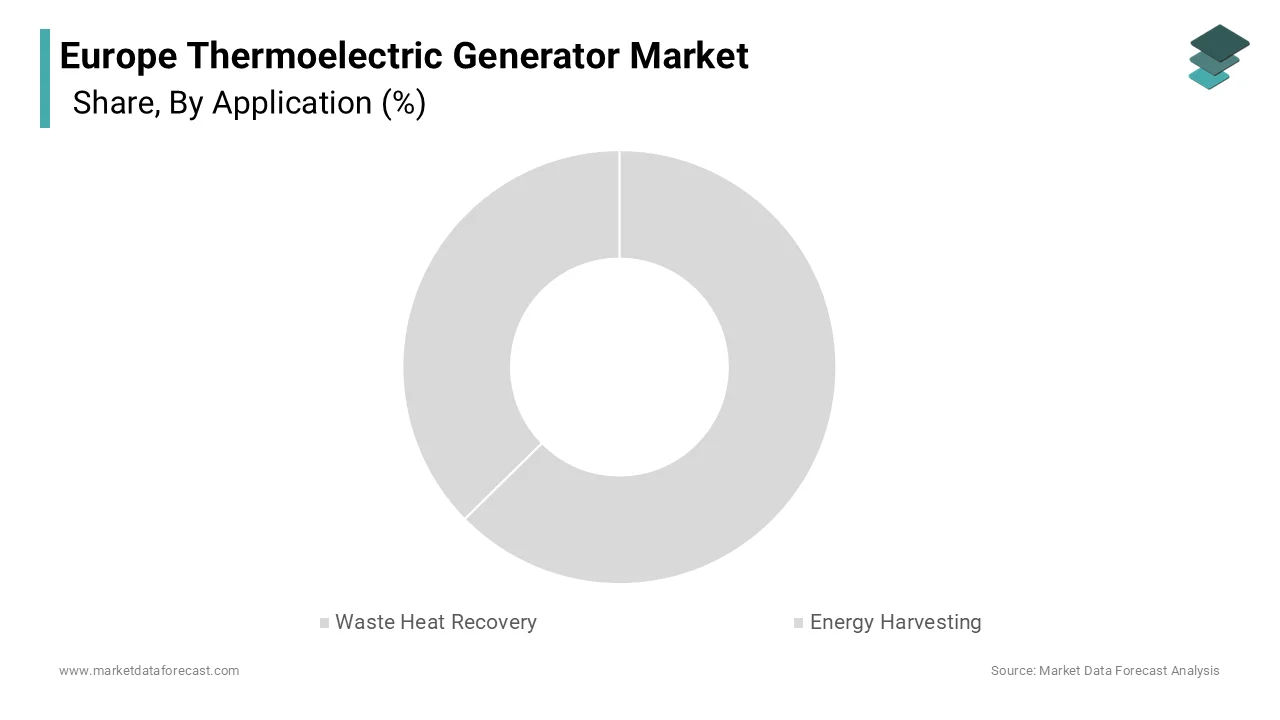
The energy harvesting segment is likely to experience the fastest CAGR of 12.4% from 2026 to 2034 due to the proliferation of wireless industrial sensor networks across Europe’s smart manufacturing base. As per the European DIGITAL SME Alliance, more than 60 percent of EU factories now utilize condition monitoring systems that require reliable micro power sources in inaccessible high temperature zones. Thermoelectric generators fulfill this need by converting localized heat from motors,s pipes, and compressors into milliwatt-level electricity, eliminating battery dependency. Thermoelectric-powered sensors in automotive, logistics, and tics environments demilliwatt-levelotential for prolonged, maintenance-free operational lifespans. Initiatives in Europe are directing substantial funding toward the advancement of autonomous industrial Internet of Things systems. Industrial deployments increasingly incorporate energy harvesting modules as part of their operational infrastructure. The convergence of predictive maintenance mandates rising labor costs for manual battery replacement and EU digital sovereignty goals collectively fuels rapid adoption in this segment.
By Temperature Insights
The low temperature segment dominated the European thermoelectric generator market by accounting for a 55.1% share in 2025. The dominance of the low temperature segment is primarily because the majority of industrial and automotive waste streams fall within this thermal range. A significant portion of recoverable waste heat in industrial manufacturing is found at lower temperature ranges, with notable contributions from food processing, chemical reactions, and electronic systems. Thermoelectric materials based on bismuth telluride are frequently used for energy harvesting in these lower temperature ranges because they offer high performance in that specific thermal window. These bismuth telluride materials are readily available from various European suppliers for industrial applications. Low-temperature thermoelectric modules are utilized in building energy systems, particularly for powering remote devices using the heat from district heating infrastructure. Additionally, the safety and reliability advantages of low temperature operation, minimal thermal stress, reduced sealing requirements and compatibi, compatibility with polymer substrates, and lower total cost of ownership. These technical and systemic factors ensure low-temperature applications remain the market’s backbone.
The mediumlow-tlow-temperatureent is on the rise and is expected to be the fastest growing segment in the market by witnessing a CAGR of 13.8% during the forecast period, owing to advancements in skutterudite and half Heusler materials that maintain stability and efficiency in this range. Large quantities of mid-temperature waste heat generated by industrial processes offer significant, underutilized, high-value energy recovery potential in heavy industry sectors. Recent pilot studies demonstrate that thermoelectric modules installed on exhaust systems can convert a portion of this waste heat into electrical energy. Environmental regulatory pressures regarding embedded carbon emissions are encouraging accelerated adoption of energy efficiency retrofits by industrial manufacturers. Advances in manufacturing techniques have improved the economic feasibility of medium-temperature module adoption. This combination of abundant thermal sources,s material innovation, on apolicy-inducedced cost sensitivity positions the medium temperature segment for accelerated growth.
By Wattage Insights
The low-power thermoelectric generators segment led the European thermoelectric generator market by holding a share of 62.1% in 2025. The leading position of the low power thermoelectric generators segment is credited to its widespread use in self-powered sensors, data loggers, and remote monitoring devices across industrial and infra, structure settings. These sub-10-watt systems align with the power budgets of modern ultra-low power electronics, which typically consume between 1 milliwatt and sub-10-watt during active operation. Many industrial wirelessultra-lowodes deployed in European factories function within lower power ranges, which aligns with the utilization of thermoelectric harvesters. Low-power modules, when incorporated into pipeline monitoring systems, have demonstrated high reliability, largely attributed to the absence of moving parts. The established standards for electromagnetic compatibility in sensitive environments, such as hospitals and laboratories, support the use of low-voltage, low-current thermoelectric outputs. As the number of connected industrial devices increases, there is a sustained, notable role for maintenance-free micro-power sources within this sector.
The medium power segment is expected to exhibit a noteworthy CAGR of 14.2% from 2026 to 2034. The rapid growth of the medium power segment is propelled by emerging applications in auxiliary power for electrified commercial vehicles and modular industrial cogeneration units. The adoption of electric commercial vehicles in Europe is expanding, accompanied by a rise in battery thermal management systems that produce consistent heat gradients, creating opportunities for low-power energy recovery. Pilot tests involving thermoelectric generators on electric vehicle power inverters indicate potential for modest, incremental improvements in net energy consumption. Hybrid energy systems in local district infrastructure are increasingly incorporating thermoelectric modules to enable independent, localized power for control systems. Advancements in thermoelectric material engineering and design are enhancing the power density and compactness of these devices, facilitating better integration into various systems. These cross-sectoral deployments and performance enhancements underpin the segment’s rapid ascent.
By Vertical Insights
The industrial verticross-sectorals the largest segment in the European thermoelectric generator market by accounting for a 45.8% share in 2025. The prominence of the industrial vertical segment is driven by its central role in heavy manufacturing energy recovery. Industries such as steel, chemicals, and cement operate continuously and emit vast quantities of process heat,t ideally suited for thermoelectric conversion. Many high-temperature industrial furnaces across the European Union operate for extended periods each year, creating consistent thermal environments suitable for energy generation applications. Industrial processes constitute a considerable part of total final energy consumption within Germany. The recovery of waste heat from these processes is considered a significant method for decreasing carbon emissions in manufacturing. Companies like ThyssenKrupp and BASF have integrated thermoelectric test arrays into pilot lines to offset sensor and control power needs, reducing auxiliary grid draw in isolated units. Furthermore, the EU’s Industrial Decarbonisation Roadmap explicitly endorses solid state heat recovery as a no regno-regretn for hard-to-abate sectors. This confluence of energy intensity, regulatory pressure,e and operational continuity ensures the industrial segment is hard to abate.
The healthcare segment is predicted to witness the highest CAGR of 15.6% over the forecast period. The swift expansion of the healthcare segment is driven by demand for reliable power in implantable and portable medical devices that cannot tolerate battery replacement or electromagnetic interference. Thermoelectric generators powered by body heat or sterilization autoclaves offer silent maintenance, ance free operation critical for life-supporting equipment. The need for micro power sources with ultra-stable characteristics is driven by the significa,nt number of life-supporting defibrillators used annually. Advancements in thermoelectric materials, such as bismuth telluride, show potential for generating continuous power from skin temperature differences, sufficient for low-energy wireless communication in wearable devices. Regulations within the EU promote device longevity and safety, suggesting a preference for passive energy solutions in medical technology. Hence, the need for autonomous health monitoring will intensify, accelerating adoption in this high-value niche.
COUNTRY LEVEL ANALYSIS
Germany Thermoelectric Generator Market Analysis
Germany was the top performer in the European thermoelectric generator market by accounting for a 24.3% share European5. The dominance of the German market is attributed to its advanced industrial base and aggressive energy transition policies. The country hosts Europe’s highest concentration of energy-intensive manufacturing, including automotive steel and chemical plants that collectively emit notable terawatt hours of waste energy-intensive per the German Energy Agency. Research institutions such as the Fraunhofer Society and the Technical University of Dresden maintain world-leading thermoelectric materials labs, fostering close industry-academia collaboration. Companies like BMW, Siemens, and Bosch actworld-leadingermoelectric prototypes for both the factory and vehicle industry-academia. Germany’s robust engineering ecosystem, stringent emissions standards, and strong public research funding ensure its continued leadership in this domain.
France Thermoelectric Generator Market Analysis
France followed closely in the European thermoelectric generator market by holding a 16.8% share in 2025. The growth of the French market is driven by its substantial nuclear and chemical infrastructure that generates consistent low-grade heat streams. Industrial sites in France with high thermal input capacity are required to undergo mandatory energy audits to comply with European regulations. Industrial entities are exploring thermoelectric trials at hydrogen production and refining facilities to enable remote, wireless corrosion sensors. France's national low-carbon strategy emphasizes reducing industrial energy consumption, driving interest in solid-state energy recovery technologies. The French Alternative Energies and Atomic Energy Commission has developed proprietary lead telluride modules with enhanced durability in humid environments common in coastal refineries. Because France’s electricity is already largely low-carbon, thermoelectric adoption focuses on improving process efficiency rather than greening the grid, leading to distinct deployment patterns.
United Kingdom Thermoelectric Generator Market Analysis
The United Kingdom is another key player in the European market due to its offshore energy sector and growing focus on industrial decarbonization post Brexit. Infrastructure in the North Sea often requires robust power solutions for subsea systems, where devices capable of operating without relying on complex battery logistics are frequently utilized. The design of these offshore power systems often prioritizes safety through explosion-proof technology, particularly for monitoring and telemetry needs. District heating initiatives are increasingly integrating advanced telemetry, which can be powered directly by the heat from return pipelines. The expansion of heating networks provides opportunities for self-powered monitoring systems, reducing the reliance on external power infrastructure for sensors. The Offshore Renewable Energy Catapult has also explored hybrid systems combining tidal turbines with thermoelectric topping cycles to maximize energy yield. Academic leadership from institutions like the University of Cambridge in nanostructured thermoelectrics further strengthens the innovation pipeline. Despite reduced EU funding access, the UK maintains strong private investment in energy harvesting, sustaining its market position.
Italy Thermoelectric Generator Market Analysis
Italy is moving ahead steadfastly in the European thermoelectric generator market owing to its ceramic, glass, ss and food processing industries that operate at medium temperatures for thermoelectric recovery. Sma,ller manufacturing businesses in the sector generate intermittent, high-temperature thermal waste, indicating an underutilized energy source. There is a shift towards integrating self-powered monitoring sensors into natural gas transport systems, eliminating the need for external power sources. Initiatives are piloting thermoelectric generator technologies aimed at low-wattage, localized power output for industrial applications. The focus is shifting toward practical, on-site energy harvesting from industrial waste heat to improve operational efficiency and monitor infrastructure integrity. This indicates growing adoption of specialized sensor technology to convert industrial heat into a resource for maintenance and monitoring, particularly in the region. Italy’s dense industrial fabric, rich regional energy cooperatives, and emphasis on distributed generation create fertile ground for modular thermoelectric deployment, particularly in Emilia Romagnaand Lombardy.
Sweden Thermoelectric Generator Market Analysis
Sweden is anticipated to expand in the European thermoelectric generator market from 2026 to 2034 due to its leadership in sustainable industrial innovation and electrification. A significant portion of industrial energy consumption in Sweden is derived from biomass and waste heat, with a notable amount existing at lower temperature ranges suitable for thermoelectric conversion technologies. Bismuth telluride-based thermoelectric modules are well-suited for capturing waste heat within these specific lower-temperature ranges. Manufacturing facilities have implemented thermoelectric generators to recover energy during the battery testing process, utilizing thermoelectric systems on testing equipment to provide power for data acquisition during high-speed charging activities. This application allows for the recovery of energy from the heat generated during the charging cycles at these specific test stations. Additionally, Sweden’s national strategy for fossil-free heavy transport has spurred the development of thermoelectric auxiliary systems for electric trucks operating in Arctic conditions. The Royal Institute of Technology has pioneered flexible thermoelectric textiles that harvest body heat for wearable health monitors, aligning with Sweden’s strong medtech sector. Thermoelectric technology reinforces Sweden’s holistic energy efficiency goals, building upon a foundation of high renewable energy consumption.
COMPETITIVE LANDSCAPE
The competition in the European thermoelectric generator market is characterized by a mix of specialized European engineering firms and global component manufacturers vying for niche industrial and transport applications. While the market remains fragmented due to the technology’s application-specific nature, leading players differentiate through material science capabilities, system integration expertise, and code application-specific with e, nd users. Intense focus on durability, cost per watt, and compatibility with digital monitoring platforms drives continuous R and D investment. Regulatory tailwinds from the European Green Deal amplify competitive intensity as companies position thermoelectric solutions as compliance tools for industrial decarbonization. Despite low volume production, the strategic importance of energy autonomy in critical infrastructure ensures sustained innovation and targeted consolidation among technologically aligned entities across Germany,y France, and the Nordic region.
KEY MARKET PLAYERS
Some of the companies that are playing a dominating role in the global europe thermoelectric generator market include
- BSST (Beijing Sinovel Science & Technology Co., Ltd.)
- Ferrotec Corporation
- Hi-Z Technology, Inc.
- II-VI Incorporated
- II-VI Scientific Solutions (Thermoelectric Materials)
- Laird Performance Materials
- Marlow Industries (II-VI brand)
- TEGpro (Thermoelectric Generator Specialists)
- TG London (Thermoelectric Generator Solutions)
- GreenTEG AG
- Marlow Thermoelectric
- Turboden (Mitsubishi Power)
- Qinhuangdao Tianchen S&T Co., Ltd.
- Alfa Thermal Engineering
- Zhongke Schuck Metallurgical Materials Co., Ltd.
- Royal Philips (thermoelectric research units)
- Viking Heat Engines Ltd.
- Midé Technology Corporation
- Thermoelectric Power Systems LLC
- Custom Thermoelectric, Inc.
TOP LEADING PLAYERS IN THE MARKET
- II VI Incorporated plays a pivotal role in the European thermoelectric generator market through its advanced materials engineering and vertically integrated manufacturing of high-performance thermoelectric modules. The company specializes in bismuth telluride alead telluride-basededd systems optimized for industrial and automotive waste heat recovery. In recent years, II VI has expanded its European otelluride-basedhancing its thermal management R and D center in Germany and forging partnerships with automotive Tier 1 suppliers to co-develop embedded power solutions for electric vehicle platforms. The firm is also actively co-developing in EU-funded Horizon Europe projects focused on energy harvesting in smart factories, reinforcing its commitment to regional innovation aEU-fundednability goals within the thermoelectric domain.
- TEGpro, a brand under Germany-based Micropelt GmbH, is a European pioneer in miniaturized thermoelectric generators tailored for wireless sensors, or networks andGermany-basednternet of Things applications. The company leverages proprietarythin-filmm thermoelectric technology to deliver milliwatt-scale power from low temperature gradients as small as 5 degrees Celsius. Tothin-filmen, its market position Micrope,lt has remilliwatt-scaleated with major industrial automation firms to integrate its TEGpro modules into condition monitoring systems for predictive maintenance.
- Laird Thermal Systems contributes significantly to the Europe tEuropeanlectric generator market by offering highly reliable standard and custom thermoelectric modules for energy harvesting and direct power generation. The company’s European footprint includes design centers in the UK and manufacturing support through its facility in Denmark, enabling rapid prototyping and localized customer service. The firm al, so intensified its engagement with European rail and automotive OEMs tdevelop self-powereddd telemetry solutions, reducing wiring complexity and maintenance costsin next-generationn electrified transport systems.
TOP STRATEGIES USED BY THE KEY MARKET PARTICIPANTS
Key players in the Europe thermoelenext-generation market primarily employ product innovation through advanced materials research,h strategic partnerships Europeanndustrial and automotive OEMs' participation in publicly funded sustainability initiatives, geographic expansion via localized engineering support, nd development of applications specific solutionss for high-value sectors such as healthcare and smart infrastructure. These strategiescollect high-valuee technological relevance, ensure regulatory alignment, and accelerate commercial deployment across diverse thermal recovery scenarios within theEuropean economicc area.
MARKET SEGMENTATION
This research report on the europe thermoelectric generator market is segmented and sub-segmented into the following categories.
By Application
- Waste Heat Recovery
- Energy Harvesting
By Temperature
- Low Temperature
- Medium Temperature
By Wattage
- Low Power
- Medium Power
By Vertical
- Industrial
- Healthcare
By Country
- Germany
- France
- United Kingdom
- Italy
- Sweden
- Rest of Europe