- Product Description Description
- Table of Contents TOC
- List of Table & Figure LOT
- Get Free Sample PDF Sample PDF
Market Size, 2025
$1.37 BnMarket Estimate, 2026
$1.46 BnMarket Forecast, 2034
$2.46 BnCAGR, 2026–2034
6.70%Europe Tissue Diagnostics Market Size, Growth, Trends & Forecast (2026–2034)
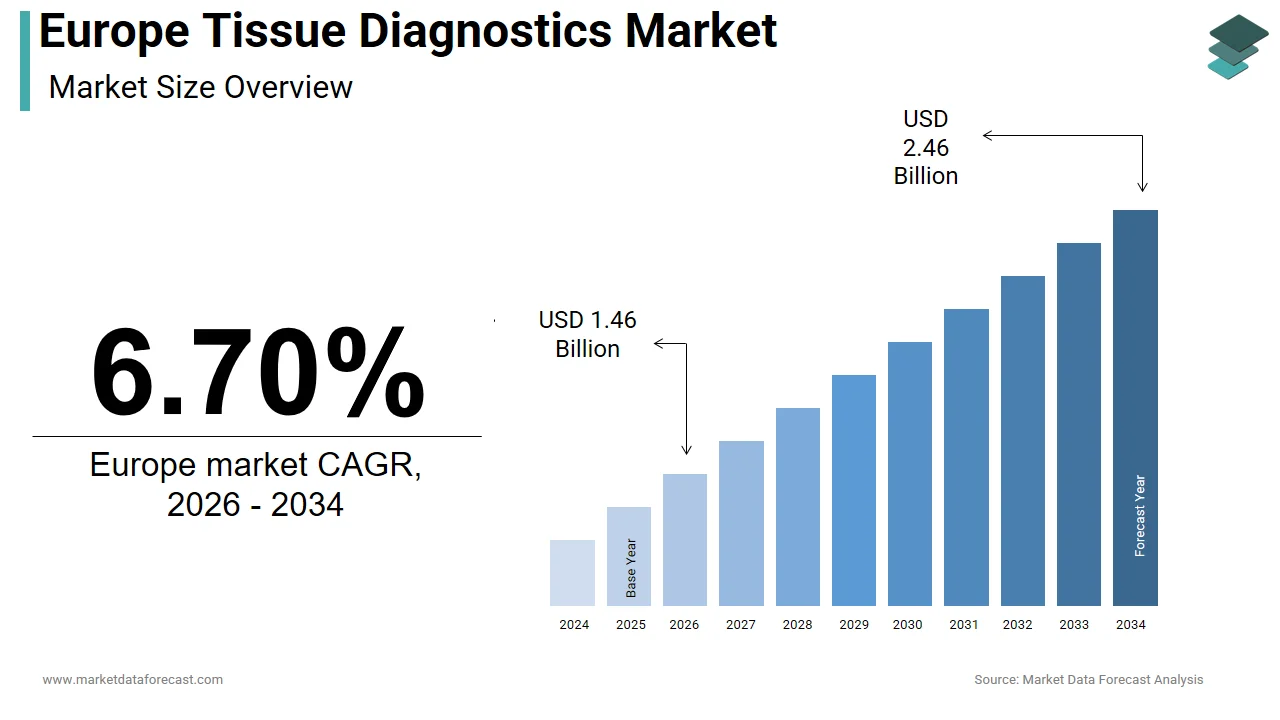
The Europe tissue diagnostics market size was valued at USD 1.37 billion in 2025, is estimated at USD 1.46 billion in 2026, and is anticipated to reach USD 2.46 billion by 2034, expanding at a compound annual growth rate (CAGR) of 6.70% during the forecast period from 2026 to 2034. Market growth is primarily driven by escalating cancer incidence rates, the widespread integration of digital pathology and AI-driven interpretation, companion diagnostic co-development, and a clinical shift toward precision oncology.
Key Executive Metrics (At-a-Glance)
- 2025 Base Valuation: USD 1.37 Billion
- 2026 Current Valuation: USD 1.46 Billion
- 2034 Forecast Valuation: USD 2.46 Billion
- Compound Annual Growth Rate (CAGR): 6.70% (2026–2034)
- Key Geographic Footprint: Germany, France, United Kingdom, Italy, Netherlands, Spain, Russia, Sweden, Denmark, Switzerland, Turkey, Czech Republic, and Rest of Europe
Europe Tissue Diagnostics Market Segmentation Breakdown
| Segment Category | Leading / Dominant Segment | Fastest-Growing Segment |
|---|---|---|
| By Product Type | Consumables (Dominant in 2024) | Instruments (CAGR of 7.9% from 2025–2033) |
| By Application | Immunohistochemistry (52.2% share in 2025) | In Situ Hybridization (CAGR of 9.3%) |
| By End User | Hospitals (58.5% share in 2024) | Biotechnology Companies (CAGR of 11.2% from 2025–2033) |
| By Country | Germany (22.4% share in 2024) | The Netherlands & France |
Major Industry Players Profiled
Key market participants shaping the European tissue diagnostics landscape include Roche Diagnostics (Ventana Medical Systems), Agilent Technologies, Thermo Fisher Scientific, Abbott Laboratories, Sigma-Aldrich Co. LLC, BioGenex, Danaher Corporation, and Cell Signaling Technology.
Europe Tissue Diagnostics Market Size
The size of the Europe tissue diagnostics market was valued at USD 1.37 billion in 2025. This market is expected to grow at a CAGR of 6.70% from 2026 to 2034 and be worth USD 2.46 billion by 2034 from USD 1.46 billion in 2026.
Tissue diagnostics refers to the laboratory analysis of human tissue specimens to detect and characterize diseases, primarily cancer, through histopathological, immunohistochemical, and molecular techniques. The field serves as a clinical cornerstone in oncology, guiding therapeutic decisions and prognostic evaluations. The Joint Research Centre estimates that millions of new cancer cases are diagnosed annually across the European Union, representing a persistent and heavy burden on healthcare systems. Pathological examination of tissue samples obtained through biopsies remains the primary, essential method for confirming solid tumor diagnoses in the European Union. The integration of digital pathology and artificial intelligence is accelerating diagnostic accuracy, with countries like the Netherlands and Sweden leading in whole slide imaging adoption. Furthermore, the European Reference Networks for rare diseases facilitate cross-border expert consultation on complex tissue samples, enhancing diagnostic consistency. Regulatory frameworks such as the strict EU regulatory updates for medical devices are driving laboratories to enhance quality standards by implementing validated diagnostic assays and improved data management practices. Amid rising cancer incidence, aging demographics, and personalized medicine mandates, tissue diagnostics remains an indispensable pillar of Europe’s precision healthcare infrastructure.
MARKET DRIVERS
Escalating Cancer Incidence and Diagnostic Imperatives
The rising burden of cancer across the region is a primary growth enabler for the Europe tissue diagnostics market. This is because histopathological confirmation remains the gold standard for malignancy classification. The European Union records a substantial number of cancer diagnoses, with lung, colorectal, and breast cancers among the most frequent forms. Clinical practice routinely requires tissue biopsies for initial identification and ongoing monitoring of advanced disease. A large proportion of surgical samples are subject to specialized staining to assess specific biological indicators. The evolution toward personalized medicine necessitates comprehensive molecular and genetic testing to inform therapeutic choices. A growing older population in the region indicates a sustained increase in the need for cancer-related diagnostic procedures. This epidemiological reality ensures sustained clinical reliance on tissue-based analysis, making it a non-substitutable element in the oncology care continuum.
Integration of Digital Pathology and AI-Driven Interpretation
Digital pathology platforms are being integrated with artificial intelligence, which fuels the expansion of the Europe tissue diagnostics market. This adoption enhances accuracy, efficiency, and scalability while transforming the field of tissue diagnostics. Many academic medical centers across Europe are adopting digital systems to replace traditional microscope slides. Certain European countries have transitioned their university hospital pathology workflows to a fully digital environment. Artificial intelligence tools are being utilized to help identify specific cell types, such as those indicating cancer spread, in laboratory samples. These tools reduce interobserver variability, a longstanding challenge in histopathology, particularly in grading prostate and breast cancers. Moreover, the European Health Data Space initiative supports secure cross-institutional data sharing, enabling AI model training on diverse, high-quality tissue datasets. Digital endpoints are gaining traction with the European Medicines Agency, driving a shift in diagnostic standards and operational capabilities through integrated digital analytics.
MARKET RESTRAINTS
Stringent Regulatory Requirements Under IVDR
The implementation of the European Union’s In Vitro Diagnostic Medical Devices Regulation has introduced significant compliance burdens for tissue diagnostics stakeholders, which restricts the growth of the Europe tissue diagnostics market. The regulatory framework for diagnostic assays now requires increased clinical evidence and post-market monitoring. The implementation of these new requirements has led to stricter oversight of diagnostic tests, including those used in tissue analysis. A substantial number of established diagnostic assays had not completed the full certification process within the initial transition period. This transition has introduced potential challenges for the availability of certain diagnostic tools. Many small and medium-sized diagnostic laboratories face resource constraints in compiling technical documentation or conducting performance evaluations required under the new framework. The regulatory barrier delays access to validated biomarkers, particularly for rare cancers where commercial kits are unavailable. The abrupt introduction of complex, mandatory classification rules has forced an undesirable pause in academic pathology's innovation cycles, disrupting the bespoke testing protocols crucial for patient care.
Shortage of Qualified Pathologists and Workforce Strain
The region faces a deficit in trained pathologists, which directly impedes the timely delivery and scalability of tissue diagnostics services. This ultimately hinders the expansion of the Europe tissue diagnostics market. Across various regions, there is a notable discrepancy between the available number of pathologists and the population requiring diagnostic services. Public healthcare sectors in several countries are experiencing significant vacancies within their pathology departments, contributing to staffing challenges. The pathology workforce is undergoing a demographic shift as a substantial portion of practitioners approaches retirement age, and high individual workloads are contributing to longer processing times. Digital tools provide opportunities for improvement, yet training in computational pathology remains sparse in medical education. Rising cancer rates and complex biomarkers will worsen the diagnostic bottleneck, limiting equitable access to precision care, unless we invest in education, cross-border telepathology, and task-shifting to trained biomedical scientists.
MARKET OPPORTUNITIES
Expansion into Companion Diagnostic Co-Development
Collaborative co-development of tissue-based companion diagnostics with pharmaceutical companies offers a major growth opportunity for the Europe tissue diagnostics market. As targeted and immuno-oncology therapies proliferate, regulatory agencies now require validated tissue assays to identify eligible patients. Regulatory bodies in Europe are increasingly reviewing a high volume of new oncology treatments that require accompanying diagnostic tests for targeted application. Diagnostics providers are creating specialized partnerships with drug developers to validate testing methods simultaneously with clinical trials. There is a trend toward developing advanced, multiplexed assays that allow for the detection of multiple tumor markers in a single analysis. Public-private collaborations for health innovation are being supported by significant funding initiatives to foster the development of these combined technologies. These integrations ensure diagnostic alignment with therapeutic mechanisms, accelerate regulatory approval, and secure market access. Hence, the demand for co-developed, tissue-anchored diagnostics will continue to expand, creating a symbiotic ecosystem between pharma and diagnostic innovators.
Adoption of Multiplex Spatial Profiling Technologies
The emergence of multiplex spatial profiling platforms is opening unprecedented insights into the tumor microenvironment, which is creating a potential prospect for the Europe tissue diagnostics market. Advanced imaging techniques allow the simultaneous detection of numerous protein markers on single tissue sections while preserving spatial architecture. High-throughput platforms are being implemented to rapidly analyze large volumes of tissue samples. The spatial patterns of biomarkers, such as immune cell proximity to tumor cells, are emerging as predictors of response to immunotherapy, potentially outperforming single-marker tests. Spatial profiling technology is transitioning from research to clinical validation with growing international adoption, and large-scale efforts are underway to standardize spatial biomarker protocols. Moving from the lab to clinical practice, these technologies are set to improve patient classification, identify new treatment avenues, and reinforce Europe's standing in the field of precision oncology.
MARKET CHALLENGES
Persistent Tissue Sample Quality and Pre-Analytical Variability
Pre-analytical inconsistencies in tissue handling remain a formidable challenge, which affects the diagnostic reliability across the region, and thereby constrains the growth of the Europe tissue diagnostics market. Factors such as ischemia time, fixation delay, and improper storage can alter protein and nucleic acid integrity, leading to false-negative or equivocal results. Observations across multiple European institutions indicate that a significant portion of biopsy samples are not fixed in formalin within the recommended timeframe, which can affect the validity of molecular testing. Audits of community hospitals in certain regions suggest that standardized protocols for tissue processing are not universally implemented. Even within developed healthcare systems, variations in the duration of tissue fixation can lead to differences in staining results, such as PD-L1, which may impact treatment decisions. Despite guidelines from the European Society of Pathology, enforcement is non-mandatory, and resource disparities between urban academic centers and rural clinics perpetuate inequity. Diagnostic accuracy, particularly for new biomarkers, remains at risk from upstream errors until pre-analytical phases are standardized through automation, training, and tracking.
Fragmented Reimbursement and Access Disparities
Reimbursement policies for advanced tissue diagnostics vary widely across the regional healthcare systems, which challenges the expansion of the Europe tissue diagnostics market. This creates significant access inequities and commercial uncertainty. In Germany and France, comprehensive coverage exists for established biomarkers like HER2 and EGFR, but newer assays such as tumor mutational burden or multiplex immunohistochemistry often face delayed or partial reimbursement. There are variations in the use of recommended diagnostic biomarker testing for lung cancer patients across different European regions. Regional differences are also noted in the adoption of comprehensive biomarker panels for non-small cell lung cancer patients. The lack of a unified European framework for diagnostic coverage means that manufacturers must navigate distinct, country-specific approval pathways. This fragmentation discourages investment in innovative assays for smaller markets and delays patient access to precision diagnostics. Personalized oncology will not reach its full potential across Europe without coordinated, clinically relevant reimbursement strategies.
REPORT COVERAGE
| REPORT METRIC | DETAILS |
| Market Size Available | 2025 to 2034 |
| Base Year | 2025 |
| Forecast Period | 2026 to 2034 |
| Segments Covered | By Product Type, Application, End User, Disease, and Country. |
| Various Analyses Covered | Global, Regional, and Country-Level Analysis, Segment-Level Analysis, Drivers, Restraints, Opportunities, Challenges; PESTLE Analysis; Porter’s Five Forces Analysis, Competitive Landscape, Analyst Overview of Investment Opportunities |
| Countries Covered | UK, France, Spain, Germany, Italy, Russia, Sweden, Denmark, Switzerland, Netherlands, Turkey, Czech Republic, and the Rest of Europe. |
| Market Leaders Profiled | Sigma-Aldrich Co. LLC, Abbott Laboratories, Roche Diagnostics, Agilent Technologies, BioGenex, Danaher Corporation, Thermo Fisher Scientific, Cell Signaling Technology, and Ventana Medical Systems. |
SEGMENTAL ANALYSIS
By Product Type Insights
The consumables segment led the Europe tissue diagnostics market by accounting for a substantial share in 2024. The supremacy of the consumables segment is attributed to its recurrent usage in every diagnostic workflow, ranging from reagents and antibodies to slides and fixation solutions, creating consistent, high-volume demand. Unlike instruments, which are capital-intensive and replaced infrequently, consumables generate recurring revenue as each tissue sample requires new assay kits and staining reagents. Immunohistochemistry continues to experience significant consumption growth across the European Union, driven by the increasing necessity for diagnostic antibody reagents in oncology. The shift toward multiplex and quantitative staining protocols has further increased reagent complexity and cost per test. Additionally, the implementation of the In Vitro Diagnostic Regulation has accelerated the replacement of laboratory-developed tests with CE-marked commercial kits, directly boosting branded consumable sales. Academic pathology departments in Germany and France are strengthening quality assurance by requiring strictly traceable reagent lots, which increases reliance on standardized, high-quality, regulated suppliers. This operational dependency, coupled with expanding test volumes due to rising cancer incidence, ensures consumables remain the financial backbone of the tissue diagnostics ecosystem.
The instruments segment is likely to experience the fastest CAGR of 7.9% from 2025 to 2033 due to the continent-wide transition from manual to automated and digital pathology platforms. Numerous healthcare institutions across several European countries have fully adopted digital histopathology, transitioning away from traditional glass slide methods. The implementation of automated staining and scanning technology is becoming standard practice in these regions. Slide scanners and automated systems are incorporating artificial intelligence algorithms designed to assist with pre-screening tasks. The integration of these AI tools is observed to alleviate a portion of the workload for pathologists, allowing for more efficient review processes. Furthermore, the European Health Data Space initiative incentivizes digital infrastructure investment by enabling cross-institutional data pooling for research and diagnostics. Major academic centers in Germany have allocated funds to upgrade tissue processing lines with smart instruments that log pre-analytical variables in real time. These advancements enhance reproducibility, support regulatory compliance, and future-proof laboratories against workforce shortages. A trend in strategic healthcare sees instrument modernization outstripping consumable growth, fueled by funding for diagnostic innovation, such as through Horizon Europe.
By Application Insights
The immunohistochemistry (IHC) segment held the largest share of 52.2% of the Europe tissue diagnostics application market in 2025. The dominance of the IHC segment is attributed to its indispensable role in cancer subtyping, prognostication, and therapy selection across solid tumors. Immunohistochemistry (IHC) testing for specific breast cancer receptors is a common practice across the European Union, with high volumes of panels performed within individual member countries. The versatility of IHC techniques allows for the integration of new biomarkers, enhancing the diagnostic value of the method. Clinical guidelines from oncology societies often rely on IHC for determining diagnoses in a wide range of cancer types, which helps to standardize its use across clinical settings. The use of automated platforms and validated antibody clones helps to reduce variability between different laboratories, increasing confidence in the results. A wide range of commercially available, approved IHC assays is available in Europe, providing laboratories with options under current regulatory frameworks. This combination of therapeutic relevance, protocol standardization, and regulatory endorsement solidifies IHC as the cornerstone application in European tissue diagnostics.
The in situ hybridization segment is expected to exhibit a noteworthy CAGR of 9.3% during the forecast period, owing to the rising demand for precise detection of gene amplifications, fusions, and rearrangements that guide targeted therapies. Molecular testing for specific biomarkers in lung cancer is widely implemented across European oncology centers to guide treatment decisions. The use of alternative in situ hybridization methods that work with standard bright-field microscopes has increased access to molecular diagnostics in smaller, community-based hospitals. The utilization of in situ hybridization testing for HER2 in gastric cancer has shown growth in France, indicating a broader application of this diagnostic approach. Furthermore, the integration of digital imaging allows quantitative signal analysis, improving reproducibility. In situ hybridization remains critical for identifying actionable genomic targets. Its synergy with next-generation sequencing, used for confirmation, creates a complementary diagnostic ecosystem that drives sustained growth.
By End User Insights
The hospitals segment dominated the Europe tissue diagnostics market by holding a 58.5% share in 2024. The prominence of the hospitals segment is supported by its dual role as primary sites of patient care and tissue sample origin. Every surgical oncology procedure generates specimens that undergo immediate histopathological evaluation, creating an integrated diagnostic loop within hospital pathology departments. University hospitals are processing a high volume of tissue blocks, and many require specialized testing. There is an increasing prevalence of molecular tumor boards across European cancer centers that integrate advanced tissue diagnostics into decision-making. Public funding initiatives are supporting the modernization of pathology laboratories. Hospitals continue to serve as the critical nexus for diagnostic-driven treatment in the era of standard-of-care precision oncology, bolstering their market dominance and strategic relevance.
The biotechnology companies segment is predicted to witness the highest CAGR of 11.2% from 2025 to 2033. The rapid growth of the biotechnology companies segment is fuelled by the intensifying co-development of therapeutics and companion diagnostics, where tissue analysis is essential for patient stratification in clinical trials. Companies like Oxford Biodynamics and Genmab have established in-house spatial biology labs to validate novel biomarkers using archived tissue microarrays. Access to high-quality annotated tissue banks, such as those managed by the UK’s National Institute for Health Research, enables robust assay development. The rising emphasis on cell therapy and immuno-oncology within the biotech sector is driving demand for specialized tissue analytics beyond traditional market needs.
COUNTRY-LEVEL ANALYSIS
Germany Tissue Diagnostics Market Analysis
Germany was the top performer in the Europe tissue diagnostics market by accounting for a 22.4% share in 2024. The dominance of the German market is driven by its advanced healthcare infrastructure, high cancer incidence, and robust academic pathology network. The large number of cancer diagnoses each year necessitates widespread tissue testing across many certified pathology facilities. A notable move towards entirely digital processes is occurring in academic medical centers. Regulatory adjustments are encouraging a shift from tests developed in-house to certified diagnostic products. Initiatives across the country are working to standardize biomarker analysis among different oncology centers. Considerable funding for diagnostic progress supports the integration of high patient numbers, technology, and research.
France Tissue Diagnostics Market Analysis
France followed closely in the Europe tissue diagnostics market by capturing a share of 17.8% in 2024. The country’s diagnostic ecosystem is supported by centralized cancer care networks and mandatory biomarker testing protocols. Numerous specialized multidisciplinary teams across France facilitate widespread, detailed molecular profiling for patients with specific types of lung cancer. The nation maintains a vast, organized collection of annotated biological samples, supporting research and the validation of diagnostic tests. Governmental initiatives are directing significant funding toward integrating digital imaging and artificial intelligence technologies into public healthcare facilities. Parisian academic centers lead in spatial biology adoption, collaborating with diagnostic firms to validate multiplex assays for immuno-oncology trials. France’s combination of centralized oncology guidelines, biobanking excellence, and strategic public investment sustains its position as a high-throughput, high-precision diagnostic market.
United Kingdom Tissue Diagnostics Market Analysis
The United Kingdom is another key player in the Europe tissue diagnostics market. Despite Brexit-related regulatory shifts, the UK maintains diagnostic leadership through its integrated National Health Service pathology structure and world-class research institutions. The national health landscape involves a substantial volume of annual tissue sample analysis, with cancer diagnostic procedures often requiring standardized immunohistochemical testing as guided by professional bodies. A major repository containing deeply phenotyped samples acts as a global resource for the development of new diagnostic assays. A national health service initiative is focused on digitizing major hospital trusts, supporting the deployment of digital pathology and artificial intelligence tools. Cambridge and Oxford host innovation hubs where biotech firms co-develop tissue-based companion diagnostics with academic pathologists. The UK’s strength lies in its fusion of universal healthcare access, research depth, and agile regulatory pathways under the MHRA, enabling rapid diagnostic implementation and international collaboration.
Italy Tissue Diagnostics Market Analysis
Italy grew steadily in the Europe tissue diagnostics market due to high cancer prevalence, particularly colorectal and prostate, and a dense network of regional pathology laboratories. Surgical biopsies constitute a significant volume of diagnostic procedures within the country, with immunohistochemistry serving as a primary tool for analyzing oncology samples. Major national health organizations are working to unify biomarker protocols, aiming to eliminate regional diagnostic variations and ensure consistent patient care. There is a notable adoption of bright-field technology for in situ hybridization, which allows for testing HER2 in facilities lacking specialized fluorescence microscopes. Investments are being directed toward upgrading laboratory infrastructure, particularly in the southern region, to address disparities in diagnostic capabilities. The presence of global diagnostics manufacturers further enhances local assay availability. Italy’s blend of clinical volume, regional standardization efforts, and targeted public investment ensures its continued relevance in the European diagnostic landscape.
Netherlands Tissue Diagnostics Market Analysis
The Netherlands is predicted to expand in the Europe tissue diagnostics market from 2025 to 2033. Despite its small population, the country exerts an outsized influence through technological leadership and collaborative healthcare models. The Netherlands has comprehensively implemented digital pathology across its academic medical centers. Nationwide initiatives centralize tissue analysis and data sharing among pathology laboratories to reduce inconsistencies in diagnostic outcomes. The country is a hub for advanced spatial biology, using detailed tissue imaging to inform the development of new therapies. Funding initiatives focus on integrating artificial intelligence into tissue diagnostics to support earlier disease detection. A high concentration of pathology professionals, coupled with digital infrastructure and research capabilities, supports the delivery of advanced diagnostic services.
COMPETITIVE LANDSCAPE
The diagnostics market is characterized by a mix of global diagnostics leaders, regional innovators, and specialized biotechnology firms. Multinationals such as Roche, Agilent, and Thermo Fisher dominate through vertically integrated platforms combining instruments, reagents, and software while maintaining strict adherence to the In Vitro Diagnostic Regulation. Simultaneously, smaller players differentiate via niche technologies like spatial transcriptomics or AI-powered image analysis, often developed in partnership with academic medical centers. The regulatory landscape intensifies competition as only compliant products can access reimbursement, creating barriers for legacy laboratory-developed tests. Hospitals and reference labs increasingly demand interoperable solutions that integrate with digital pathology ecosystems and electronic health records. Innovation cycles are accelerating with a focus on predictive biomarkers for immuno-oncology and minimal tissue consumption assays. Geographic disparities in infrastructure and reimbursement further segment the competitive field, favoring agile companies that balance standardization with local adaptability across Western and Eastern Europe.
KEY MARKET PLAYERS
The leading companies operating in the Europe tissue diagnostics market include:
- Sigma-Aldrich Co. LLC
- Abbott Laboratories
- Roche Diagnostics
- Agilent Technologies
- BioGenex
- Danaher Corporation
- Thermo Fisher Scientific
- Cell Signaling Technology
- Ventana Medical Systems
TOP PLAYERS IN THE MARKET
- Roche Diagnostics plays a pivotal role in the Europe tissue diagnostics market through its integrated portfolio of immunohistochemistry assays, automated staining platforms, and companion diagnostics. The company supports precision oncology by aligning its tissue tests with targeted therapies such as Herceptin and Tecentriq. In recent years, Roche has accelerated digital pathology adoption by enhancing its uPath software with AI-driven image analysis tools validated across European academic centers. It also expanded its CE-marked IHC menu under the IVDR framework, ensuring regulatory compliance. Collaborations with European molecular tumor boards and national cancer plans further embed its solutions into routine clinical pathways, demonstrating its commitment to diagnostic accuracy and therapeutic synergy across the continent.
- Agilent Technologies is a key contributor to the Europe tissue diagnostics landscape, offering advanced immunohistochemistry, in situ hybridization, and spatial biology solutions. Its Dako brand provides widely used PD-L1 and HER2 assays essential for immuno-oncology and breast cancer management. Agilent has strengthened its European footprint by launching the PhenoCycler Fusion platform, enabling high-plex spatial profiling in research and clinical labs. The company actively partners with EU-based biopharma firms to co-develop companion diagnostics and has invested in IVDR-compliant validation studies for its reagent portfolio. These initiatives reinforce Agilent’s role in advancing biomarker discovery and ensuring regulatory readiness across diverse European healthcare systems.
- Thermo Fisher Scientific significantly influences the Europe tissue diagnostics market through its comprehensive suite of instruments, reagents, and digital pathology solutions. The company’s PathScan multiplex IHC platform and Oncomine genomic assays support integrated tissue and molecular profiling. Thermo Fisher has enhanced its European presence by establishing a dedicated IVDR transition team to certify legacy assays and by expanding its laboratory information system integration capabilities. It also collaborates with academic hospitals in Germany and the UK to validate AI-powered image analysis workflows. Recent investments in automated tissue processors and sustainable packaging align with EU environmental standards, further solidifying its commitment to innovation, compliance, and operational excellence in diagnostic pathology.
TOP STRATEGIES USED BY THE KEY MARKET PARTICIPANTS
Key players in the Europe Tissue Diagnostics Market focus on achieving IVDR compliance by re-certifying legacy assays and developing new CE-marked kits. They invest in digital pathology and artificial intelligence to enhance diagnostic accuracy and workflow efficiency. Strategic collaborations with pharmaceutical companies for companion diagnostic co-development are central to their oncology strategy. Companies expand spatial biology and multiplex assay portfolios to meet demand for tumor microenvironment analysis. Additionally, they prioritize laboratory integration by offering end-to-end solutions from sample preparation to data interpretation, ensuring seamless adoption in hospital and reference lab settings across diverse European regulatory environments.
MARKET SEGMENTATION
This Europe tissue diagnostics market research report is segmented and sub-segmented into the following categories.
By Product Type
- Instruments
- Consumables
By Application
- Immunohistochemistry
- Hematoxylin and Eosin
- In Situ Hybridization
By End User
- Contract Research Organizations
- Hospitals
- Diagnostic Laboratories
- Research Organizations
- Biotechnology Companies
By Disease
- Lung Cancer
- Lymphoma
- Pancreatic Cancer
- Breast Cancer
- Others
By Country
- UK
- France
- Spain
- Germany
- Italy
- Russia
- Sweden
- Denmark
- Switzerland
- Netherlands
- Turkey
- Czech Republic
- Rest of Europe