- Product Description Description
- Table of Contents TOC
- List of Table & Figure LOT
- Get Free Sample PDF Sample PDF
Market Size, 2025
$15.67 BnMarket Estimate, 2026
$16.16 BnMarket Forecast, 2034
$20.63 BnCAGR, 2026–2034
3.1%Europe Tissue Paper Market Size
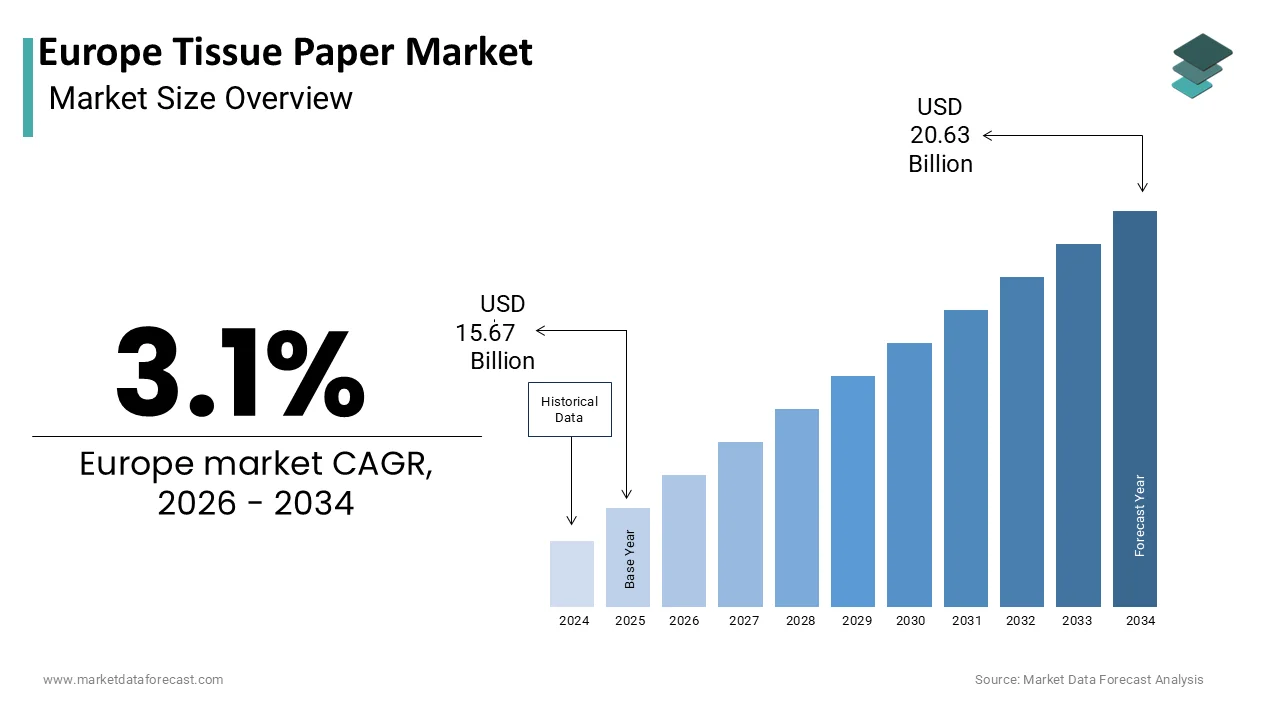
The Europe tissue paper market was valued at USD 15.67 billion in 2025, is estimated to reach USD 16.16 billion in 2026, and is projected to reach USD 20.63 billion by 2034, growing at a CAGR of 3.1% from 2026 to 2034.
Tissue papers are hygienic paper products, including toilet paper, facial tissues, hand towels, and napkins,s designed for both household and institutional use. This sector is defined by a mature consumption pattern where product differentiation relies heavily on softness, strength, absorbency, and increasingly, environmental sustainability credentials. The market operates within a stringent regulatory framework governed by European Union directives on hygiene, waste management, and forest stewardship. As per the European Tissue Symposium, the European Union has shown a strong culture of hygiene reflected in tissue paper consumption patterns. The definition of the market has expanded beyond mere utility to include premiumization trends where consumers seek bamboo-based or recycled content products that align with circular economy goals. As per Eurostat, the forestry sector in Europe manages a vast area of forest, which provides the critical raw material base for virgin fiber production while adhering to strict sustainability certifications like FSC and PEFC. The current scenario illustrates a shift towards "green hygiene," where procurement decisions in both retail and away-from-home sectors are heavily influenced by carbon footprint labels and biodegradability claims. The industry is characterized by a high degree of consolidation among major manufacturers who operate integrated mills across the region to ensure supply security and cost efficiency.
MARKET DRIVERS
Rising Hygiene Awareness and Institutional Protocols
The permanent elevation of hygiene standards across public and private sectors is propelling the expansion of the Europe tissue paper market. The collective experience of recent global health crises has ingrained a culture of rigorous hand hygiene and surface cleaning that persists well beyond emergency periods. As per surveys conducted by the European Consumer Organisation, Europeans report washing their hands more frequently than before 2020, which directly correlates with increased consumption of paper hand towels and toilet tissues in both domestic and public restrooms. This behavioural shift has been codified into institutional protocols where schools, offices, and healthcare facilities maintain higher stock levels of disposable hygiene products to ensure safety. As per facility management associations, commercial buildings in Germany and France have increased their monthly tissue procurement compared to pre-2020 levels to meet new sanitation expectations. The second critical driver is the growing awareness of cross-contamination risks, which is leading to a preference for single-use paper products over reusable cloth alternatives in high-touch areas. As per hospital hygiene audits, European healthcare institutions now mandate the exclusive use of disposable paper towels in patient care zones to minimize infection vectors. Furthermore, the tourism and hospitality sectors have adopted enhanced cleaning regimes as a competitive advantage, driving bulk purchases of premium tissue products. As per the European Hotel Association, hotels have upgraded their restroom amenities to include higher ply counts and stronger paper towels to signal cleanliness to guests. This entrenched focus on health security ensures a robust and inelastic demand baseline for tissue products across the continent.
Premiumization and Product Innovation
The consumer drive towards premiumization, characterized by a preference for softer, stronger, and multi-ply tissue products, is significantly propelling the Europe tissue paper market growth towards higher value segments. Modern European consumers increasingly view tissue paper not just as a utility but as a component of personal comfort and lifestyle quality, willing to pay a premium for enhanced tactile experiences. As per market research from NielsenIQ, sales of three-ply and four-ply toilet papers in Western Europe have grown, which is outpacing the growth of standard two-ply variants. This trend is driven by an aging population that requires gentler products for sensitive skin and a younger demographic that prioritizes luxury and comfort in daily routines. The innovation in embossing technologies and lotion-infused tissues that offer superior absorbency and skin care benefits is also supporting the regional market expansion. For instance, the introduction of aloe vera and vitamin-enriched tissues has captured a notable share of the facial tissue market in countries like Italy and Spain. Furthermore, the aesthetic appeal of packaging and product design plays a crucial role, with consumers selecting brands that align with their home decor and personal identity. For instance, premium SKUs occupy a significant portion of shelf space in major supermarkets, reflecting retailer confidence in this high-margin category. The shift towards "home spa" experiences during remote working periods has also sustained demand for high-end facial tissues and hand towels. This relentless pursuit of comfort and quality ensures that manufacturers continue to invest in R&D to deliver superior product attributes that command higher price points.
MARKET RESTRAINTS
Volatility in Raw Material and Energy Costs
The Europe tissue paper market faces significant headwinds due to the extreme volatility in the prices of wood pulp and recovered paper, which constitute the primary raw material costs for manufacturers. Global supply chain disruptions, geopolitical tensions, and climate-related forestry challenges have led to erratic pricing structures that squeeze profit margins. As per commodity market analysis from Fastmarkets RISI, the price of Northern Bleached Softwood Kraft pulp has fluctuated, creating immense uncertainty for production planning and budgeting. This volatility forces manufacturers to either absorb the costs, eroding profitability, or pass them on to consumers, risking demand destruction in price-sensitive segments. The dependency on imported pulp from North America and South America exposes European producers to currency exchange rate risks and freight cost spikes. As per the Confederation of European Paper Industries, raw material costs account for nearly 60% of total production expenses, making the sector highly vulnerable to upstream shocks. Furthermore, the competition for fiber between the tissue, packaging, and energy sectors intensifies during shortages, driving prices even higher. For instance, several mid-sized manufacturers reported margin contractions due to the inability to fully hedge against raw material price surges. This economic pressure stifles investment in capacity expansion and innovation, as capital is diverted to manage working capital and secure supply contracts. Until global supply chains stabilize, raw material cost volatility will remain a formidable restraint on market growth.
Environmental Regulations and Waste Management Pressures
The implementation of increasingly stringent environmental regulations regarding effluent discharge and air emissions is another significant restraint on the Europe tissue paper market by imposing heavy compliance costs. Manufacturers are required to invest heavily in advanced wastewater treatment plants and air filtration systems to meet the limits set by the Industrial Emissions Directive. As per the European Environment Agency, non-compliance fines for water pollution in the pulp and paper sector have increased, forcing companies to upgrade infrastructure continuously. These regulatory burdens raise the barrier to entry for new players and increase the operational overhead for existing manufacturers, potentially leading to plant closures if upgrades are not economically viable. The requirement to monitor and report emissions in real-time adds administrative complexity and cost. As per industry compliance audits, capital expenditure on environmental controls now accounts for a significant portion of total annual investment for major tissue producers. Furthermore, restrictions on the use of certain bleaching chemicals and additives limit the formulation options for manufacturers, potentially affecting product quality or increasing the cost of compliant alternatives. As per regulatory bodies, the approval time for new production lines has extended due to rigorous environmental impact assessments. This regulatory tightrope constrains the flexibility of manufacturers to respond quickly to market demands and increases the overall cost structure of the industry.
MARKET OPPORTUNITIES
Expansion of Private Label and Value Segments
The expansion of private label tissue products is a significant opportunity for the Europe tissue paper market as retailers leverage their bargaining power to offer high-quality, lower-cost alternatives to national brands. Economic pressures and inflation have driven consumers to switch to store brands, which now offer comparable quality to premium names at significantly lower price points. As per retail analysis from PLMA, private label tissue products in Europe have gained notable market share, with growth rates surpassing branded equivalents. This shift allows retailers to control margins and build customer loyalty while providing manufacturers with stable, high-volume contract opportunities. The ability of private label manufacturers to innovate rapidly, introducing eco-friendly and premium variants under retailer umbrellas without the heavy marketing overhead of national brands, is further contributing to the regional market growth. For instance, a majority of European shoppers now perceive private-label tissues as equal in quality to leading brands, which is removing the stigma previously associated with store brands. Furthermore, the consolidation of retail chains across Europe enables standardized procurement strategies that favor large-scale private label production runs. For instance, long-term contracts with major supermarket groups provide manufacturers with predictable revenue streams that buffer against market volatility. By focusing on private label production, manufacturers can optimize capacity utilization and achieve economies of scale, positioning themselves as essential partners to the retail sector.
Technological Advancements in Sustainable Manufacturing
The implementation of breakthrough technologies such as waterless pulping and low-energy drying systems presents a lucrative opportunity for the Europe tissue paper market to drastically reduce operational costs and environmental impact. Innovations like molded-fiber technology and advanced creping methods allow manufacturers to produce high-quality tissue with significantly less water and energy consumption. As per research from the European Institute of Innovation and Technology, adopting next-generation drying hoods can reduce energy usage, offering a rapid return on investment amidst high energy prices. This technological leap enables manufacturers to produce greener products that command premium prices while improving margin resilience. The second significant driver is the development of closed-loop water systems that recycle nearly all process water, minimizing discharge and securing supply against drought conditions. As per pilot plants in Sweden and Finland, these systems have demonstrated strong reductions in freshwater withdrawal, aligning perfectly with EU water stewardship goals. Furthermore, the integration of AI-driven process optimization allows for real-time adjustments that maximize fiber efficiency and reduce waste. As per early adopters, overall equipment effectiveness has improved following digital transformation. By leading in sustainable manufacturing tech, companies can future-proof their operations against tightening regulations and attract ESG-focused investors.
MARKET CHALLENGES
Intense Competition and Price Wars
The intense competition among tissue manufacturers, coupled with the aggressive bargaining power of large retail chains,s is challenging the expansion of the Europe tissue paper market, which is leading to persistent margin erosion and price wars. Retailers constantly demand lower prices to attract cost-conscious consumers, forcing manufacturers to engage in destructive pricing strategies that undermine profitability. As per financial analyses from major European paper groups, gross margins in the tissue sector have compressed due to promotional activities and price cuts. This pressure is exacerbated by the oversupply of capacity in certain regions, where new mill expansions have outpaced demand growth, creating a buyer's market. As per industry trade reports, price discounting frequency has increased as brands fought for shelf space. The inability to pass on rising raw material and energy costs to retailers without losing volume share creates a precarious financial situation for many producers. Furthermore, the rise of hard discounters who prioritize price over brand loyalty intensifies the race to the bottom. As per market monitoring firms, private label price gaps have narrowed, forcing branded players to cut prices further to remain competitive. This environment stifles investment in innovation and sustainability, as companies struggle to maintain basic operational viability. The constant threat of delisting by major retailers adds to the strategic instability, which is making long-term planning difficult.
Supply Chain Vulnerabilities and Logistics Bottlenecks
The Europe tissue paper market faces a critical challenge due to its heavy dependence on imported wood pulp and energy sources, making it vulnerable to global geopolitical shifts and trade disruptions. A significant portion of the virgin fiber required for high-quality tissue is sourced from North and South America, exposing the supply chain to transatlantic shipping delays and tariff fluctuations. As per trade data from the European Commission, pulp import volumes have faced disruptions due to port congestion and labor strikes in key exporting nations. This dependency creates bottlenecks that can halt production lines and lead to stockouts, damaging customer relationships. The reliance on imported natural gas for energy further compounds the risk, as seen during recent energy crises, where supply curtailments forced production cuts. As per energy security reports, a large share of the EU’s industrial gas supply is imported, creating a persistent vulnerability. The lack of sufficient domestic fiber reserves to meet total demand means that any global shock is immediately transmitted to the European market. As per supply chain risk assessments, lead times for fiber deliveries have become unpredictable. This instability forces manufacturers to hold costly safety stocks and diversify suppliers, increasing operational complexity and costs.
REPORT COVERAGE
| REPORT METRIC | DETAILS |
| Market Size Available | 2025 to 2034 |
| Base Year | 2025 |
| Forecast Period | 2026 to 2034 |
| Segments Covered | By Product Type, Distribution Channel, End Use, and Region. |
| Various Analyses Covered | Global, Regional, and Country-Level Analysis, Segment-Level Analysis, Drivers, Restraints, Opportunities, Challenges; PESTLE Analysis; Porter’s Five Forces Analysis, Competitive Landscape, Analyst Overview of Investment Opportunities |
| Countries Covered | UK, France, Spain, Germany, Italy, Russia, Sweden, Denmark, Switzerland, Netherlands, Turkey, Czech Republic, Rest of Europe |
| Market Leaders Profiled | Essity AB, Kimberly-Clark Corporation, Procter & Gamble Co., Sofidel Group, WEPA Group, Metsä Group, Industrie Cartarie Tronchetti S.p.A., Lucart S.p.A., Georgia-Pacific LLC, Clearwater Paper Corporation, Navigator Company, Cascades Inc. |
SEGMENTAL ANALYSIS
By Product Type Insights
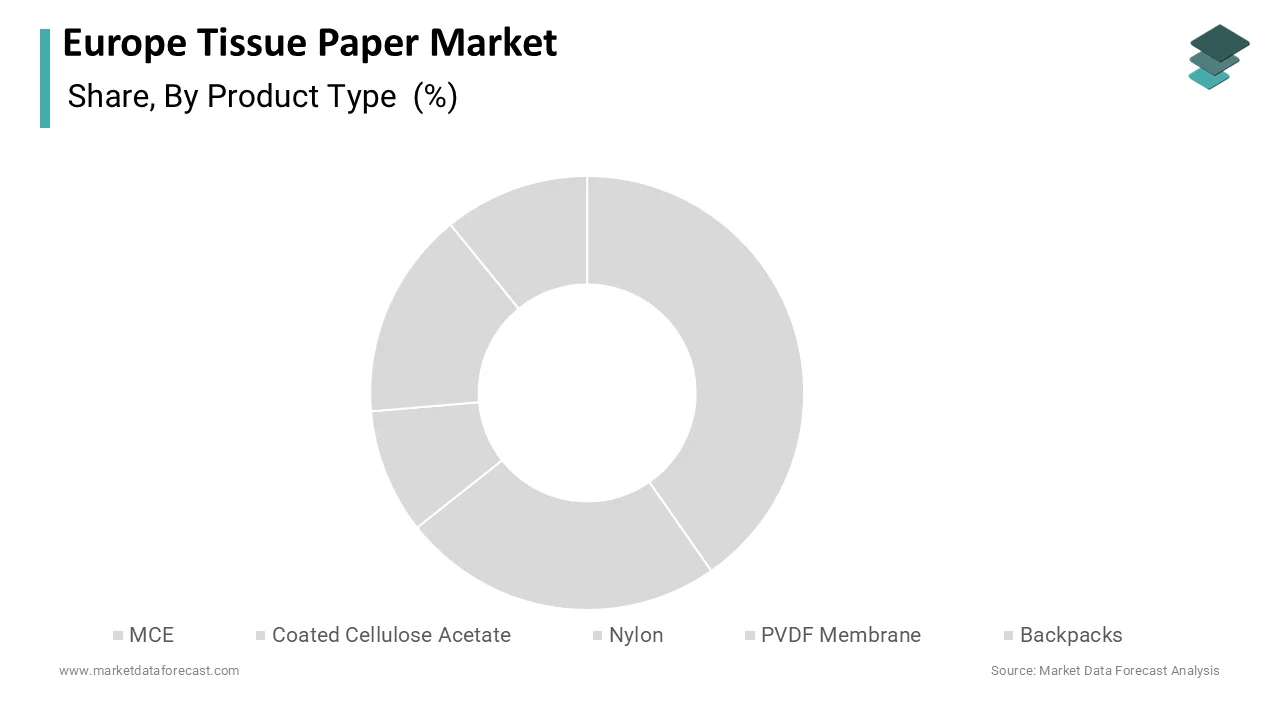
The toilet paper segment dominated the market by holding 47.7% of the European market share in 2025. The growth of the toilet paper segment in the European market is attributed to the non-discretionary nature of the product, which serves as a fundamental hygiene necessity for every household and commercial establishment across the continent. The consistent per capita consumption rates that remain resilient regardless of economic fluctuations, as toilet paper is considered an essential good with inelastic demand, which is further fuelling the dominance of the toilet paper segment in the European market. As per the European Tissue Symposium, Europeans consume tissue paper annually, with toilet rolls accounting for nearly half of this volume, reflecting deeply ingrained hygiene habits. The continuous innovation in product features,s such as multi-ply construction, embossing technologies, and lotion infusions that encourage consumers to trade up to premium variants, is also propelling the expansion of this segment in this regional market. As per retail sales analysis, premium three-ply and four-ply toilet papers now account for 35% of total sales volume in Western Europe, driven by consumer desire for enhanced softness and strength. Furthermore, the expansion of the away-from-home sector, including offices and public facilities, sustains bulk demand for large-format jumbo rolls. As per facility management reports, commercial toilet paper procurement has increased as businesses reopened and adopted stricter hygiene protocols. The ubiquity of the product and its status as a daily staple ensure that the toilet paper segment remains the financial backbone of the entire tissue industry.
However, the wipes segment is projected to be the fastest-growing category and record a CAGR of 7.4% over the forecast period, due to the evolving lifestyle needs of Europeans who increasingly prioritize convenience, portability, and specialized hygiene solutions for various daily activities. The surging demand for baby wipes and adult incontinence wipes due to the demographic shift, ts including both high birth rates in specific regions and a rapidly aging population requiring gentle care products, is propelling the wipes segment in the European market. As per Eurostat, the population aged 65 and over in Europe is expected to increase, which directly correlates with a surge in demand for moist toiletries and cleaning wipes. The diversification of wipe applications into personal care, household cleaning, and cosmetic removal, supported by innovations in biodegradable materials that address environmental concerns, is contributing to the expansion of the wipes segment in the European market. For instance, sales of flushable and compostable wipes have grown as manufacturers responded to regulatory pressure and consumer demand for sustainable options. Additionally, the post-pandemic increased awareness of surface hygiene has sustained demand for disinfectant wipes in both home and commercial settings. As per health agencies, a majority of European households now keep disinfectant wipes as a standard cleaning item, creating a new baseline for consumption. This versatility and alignment with demographic and hygiene trends position wipes as the most dynamic growth engine in the market.
By Distribution Channel Insights
The retail stores segment led the market in 2025 with 71.7% of the regional market share. The dominance of the retail stores segment in the European market can be credited to the established shopping habits of European consumers who prefer to purchase bulky, heavy tissue products during their routine weekly grocery trips. The immediate availability and the ability for consumers to physically inspect product attributes such as ply count, texture, and packaging size before purchase, which is crucial for a tactile product like tissue, is further boosting the growth of the retail stores segment in the European market. As per PLMA, a majority of tissue paper sales in Europe occur in physical stores, driven by the extensive network of discount chains like Aldi and Lidl that offer competitive pricing on private label brands. The second critical driver is the promotional power of brick-and-mortar retailers who utilize end-cap displays and bulk-buy offers to drive volume sales, leveraging the impulse buying behavior associated with household essentials. As per market research firms, promotional periods in supermarkets account for a significant portion of total tissue volume sold, highlighting the effectiveness of in-store marketing strategies. Furthermore, the logistical efficiency of established distribution networks ensures that shelves are consistently stocked, preventing stockouts that could drive customers to competitors. As per supply chain analyses, retail stores maintain a faster turnover rate of tissue products compared to other channels due to high foot traffic. The trust and convenience associated with traditional retail formats ensure their continued supremacy in the distribution landscape.
On the other hand, the e-commerce segment is experiencing the most rapid expansion and is expected to exhibit a CAGR of 6.2% over the forecast period, od owing to the shifting consumer preference for digital convenience, subscription models, and the ability to purchase bulky items without the physical burden of transport. The adoption of subscription-based services offered by major online retailers and direct-to-consumer brands that ensure automatic replenishment of tissue products and lock in customer loyalty is further propelling the expansion of the e-commerce segment in the European market. As per digital commerce associations, subscription sales for household essentials in Europe have grown, with tissue paper being a top category due to its predictable usage rate. The second major factor is the expanding range of premium and niche eco-friendly products available online that may not be stocked in local physical stores, attracting environmentally conscious consumers seeking specific certifications. As per online marketplace reports, sales of bamboo and recycled tissue brands are higher on e-commerce platforms compared to traditional retail, driven by detailed product information and reviews. Additionally, the improvement in last-mile delivery logistics and the reduction of shipping costs have made online purchasing of heavy goods more economically viable for consumers. As per logistics providers, delivery times for bulk household goods have decreased, enhancing the appeal of online shopping. The integration of smart home devices for automated reordering further accelerates this trend, making e-commerce the most agile and fast-scaling channel.
By End Use Insights
The home care segment led the market by accounting for 61.6% of the European market share in 2025. The dominance of the home care segment can be credited to the fundamental role of tissue products in daily domestic hygiene routines, where they are used extensively for personal cleansing, hand drying, and surface cleaning. The permanent shift in hygiene behaviors post-pandemic, where households have maintained higher frequencies of hand washing and surface disinfection, which is leading to increased per capita consumption within the home, is also contributing to the leading position of the home care segment in the European market. As per the European Consumer Organisation, Europeans report using more tissue products at home compared to pre-2020 levels, which is driven by a heightened awareness of germ transmission. The second critical driver is the trend towards premiumization in the household sector, where consumers are willing to invest in higher-quality, softer, and more absorbent tissues to enhance comfort and perceived luxury in their living spaces. As per retail sales data, premium home care tissue SKUs now represent a significant portion of shelf space in major European supermarkets, reflecting strong consumer demand for upgraded products. Furthermore, the rise of remote working has increased the time spent at home, thereby boosting the usage rates of toilet paper, facial tissues, and kitchen towels throughout the day. As per workplace trends, the hybrid work model has sustained higher daytime residential tissue consumption. The combination of behavioral changes and the desire for home comfort ensures that the home care segment remains the largest and most stable revenue source.
On the other hand, the healthcare segment is emerging as the fastest-growing end-use category and is estimated to grow at a CAGR of 8.4% over the forecast period, due to the increasing complexity of medical care, the rising prevalence of chronic diseases, and the stringent infection control protocols mandated in medical facilities across Europe. The aging population that requires more frequent medical interventions, long-term care, re and incontinence management, all of which rely heavily on specialized tissue products and wipes, is also propelling the growth of the healthcare segment in the European market. As per the World Health Organization Regional Office for Europe, the demand for long-term care services is projected to increase, directly driving the consumption of medical-grade tissues and patient care wipes. The second significant driving factor is the rigorous enforcement of hospital-acquired infection prevention guidelines, which mandate the use of single-use, high-absorbency paper products for hand hygiene and surface cleaning to minimize cross-contamination risks. As per hospital procurement records, spending on disposable hygiene products in European healthcare facilities has increased to comply with updated safety standards. Additionally, the expansion of outpatient clinics and home healthcare services has decentralized tissue consumption, creating new demand points outside traditional hospital settings. As per healthcare infrastructure reports, home care visits have grown,n and each requires portable and sterile tissue supplies. This convergence of demographic pressure and regulatory strictness positions the healthcare segment for exceptional growth.
COUNTRY LEVEL ANALYSIS
Germany Tissue Paper Market Analysis
Germany was the top-performing regional segment in the European tissue paper market in 2025, with 24.4% of the regional market share. The dominance of Germany in the European market is mainly driven by its large population, high standard of living, and robust manufacturing base. The German market is characterized by a strong preference for high-quality, multi-ply products and a well-developed retail infrastructure dominated by efficient discount chains. A key driving factor is the country's advanced hygiene culture, where consumers prioritize softness and durability, leading to higher per capita consumption rates compared to the European average. As per the German Paper Industry Association, domestic tissue consumption has remained high, supported by a dense network of production facilities that ensure a steady supply. The second critical driver is the aggressive expansion of private-label brands by major retailers like Aldi and Lidl, which offer high-quality tissues at competitive prices, driving volume sales across all income groups. As per retail analysts, private label tissues account for over 45% of total sales in Germany, influencing market dynamics and pricing strategies. Furthermore, the strong emphasis on sustainability has led to a rapid uptake of recycled and FSC-certified products, with German consumers showing a higher willingness to pay for eco-friendly options. The combination of industrial capacity, retail efficiency, and conscious consumerism cements Germany's position as the dominant force in the European tissue landscape.
France Tissue Paper Market Analysis
France held the second-largest share of the European tissue paper market in 2025. The growth of France in the European market is attributed to a sophisticated consumer base that values premium aesthetics and brand heritage in tissue products, a strong presence of international luxury brands, and a cultural inclination towards "art de vivre," which extends to everyday household items, including bathroom and kitchen tissues. The high demand for premium and scented tissue products, where French consumers often view these items as part of their home decor and personal caregiver routine,e is further boosting the French market growth. As per the French Hygiene and Maintenance Federation, sales of premium embossed and perfumed tissues have grown, outpacing standard varieties. The second significant driver is the robust tourism and hospitality sector, which generates substantial demand for commercial tissue products in hotels, restaurants, and cafes across the country. As per the tourism ministry, France welcomed millions of visitors, creating a sustained need for high-volume away-from-home tissue supplies. Additionally, the government's push for circular economy initiatives has spurred innovation in recycled fiber usage, with major manufacturers investing in local recycling loops. As per environmental agencies, a significant portion of tissue produced in France now utilizes recycled content, aligning with national sustainability goals. This blend of premium consumption, tourism-driven demand, and green innovation ensures France remains a pivotal pillar of the market.
Italy Tissue Paper Market Analysis
Italy is estimated to account for a promising share of the European tissue paper market over the forecast period. Factors such as a deep-seated culture of cleanliness, a thriving food service industry that drives commercial tissue usage, the high penetration of bide, ts which influences toilet paper consumption patterns, alongside a strong preference for elegant and design-led packaging in household products, are driving the Italian market growth. The vibrant restaurant and cafe culture, where the use of high-quality paper napkins and table towels is standard practice, is creating a massive institutional demand and propelling the market growth in Italy. As per the Italian Food Service Association, the sector comprises hundreds of thousands of establishments, each consuming significant volumes of tissue products daily, driving steady B2B sales. The second critical driver is the growing awareness of environmental issues among Italian consumers, leading to a surge in demand for biodegradable and plastic-free tissue options. As per consumer surveys, a majority of Italian shoppers actively seek out eco-labeled tissue products, prompting manufacturers to innovate in sustainable materials. Furthermore, the strong domestic manufacturing sector, particularly in the northern regions, ensures a reliable supply of high-grade tissues that cater to both local and export markets. As per industry exports, Italian tissue producers are key suppliers to neighboring Mediterranean countries. This synergy of culinary culture, environmental consciousness, and industrial strength sustains Italy's strong standing in the European market.
United Kingdom Tissue Paper Market Analysis
The United Kingdom is projected to witness a healthy CAGR in the European tissue paper market during the forecast period, owing to a highly competitive retail environment and a consumer base that is increasingly price-sensitive yet demanding of quality. The UK market is defined by the dominance of major supermarket chains that exert significant pressure on pricing while simultaneously driving innovation in private label ranges. A major driving factor is the rapid adoption of online shopping for household essentials, where subscription models for tissue delivery have gained significant traction among busy urban households. As per the British Retail Consortium, online sales of tissue products in the UK have grown, reflecting a shift in purchasing habits towards digital convenience. The second critical driver is the heightened focus on hygiene and health following recent global events, which has led to sustained elevated usage rates of antibacterial wipes and premium toilet papers in homes. As per health organizations, hand hygiene compliance in UK households remains at historic highs, supporting consistent demand. Additionally, the strong regulatory framework regarding plastic waste has accelerated the transition to paper-based packaging for tissue rolls, with UK retailers leading the charge in removing plastic wrappers. As per sustainability reports, a majority of tissue products sold in the UK now feature plastic-free packaging. This combination of digital adoption, hygiene awareness, and regulatory leadership keeps the UK as a key player in the European landscape.
Spain Tissue Paper Market Analysis
Spain is anticipated to account for a notable share of the European tissue paper market over the forecast period owing to its robust tourism industry, warm climate, and a social culture that emphasizes outdoor dining and hospitality. The extensive network of bars, tapas restaurants, and beach clubs that require constant replenishment of napkins, hand towels, and toilet rolls to serve both locals and visitors is further boosting the Spanish market expansion. As per the Spanish Confederation of Hotels and Tourist Accommodations, the hospitality sector employs millions of people and serves billions of covers annually, generating massive institutional tissue consumption. The second critical driver is the increasing urbanization and modernization of household infrastructure, which has led to higher per capita usage of tissue products as traditional cloth alternatives are replaced by disposable conveniences. As per national census data, urban household density has increased, correlating with rising residential tissue sales. Furthermore, the growing environmental awareness among Spanish consumers is driving demand for recycled and sustainably sourced tissues, with local manufacturers adapting quickly to these preferences. As per green certification bodies, certified sustainable tissue products launched in Spain have increased, aligning with consumer expectations. This unique blend of tourism dependency, urban growth, and eco-consciousness ensures Spain remains a vital component of the European market.
COMPETITIVE LANDSCAPE
The competition in the Europe tissue paper market is intensely fierce,e characterized by a rivalry between global giants and strong regional players vying for dominance through innovation and cost leadership. Major companies leverage their integrated supply chains and massive scale to offer diverse product portfolios ranging from value-oriented private labels to ultra-premium branded goods. Competitive pressure is heightened by the rising power of retail chains that demand lower prices and stricter sustainability credentials from suppliers. The market sees frequent launches of eco-friendly products and plastic-free packaging as brands race to align with the European Green Deal and changing consumer values. Price wars are common, particularly in the standard segment, forcing manufacturers to constantly optimize production efficiency and logistics. Sustainability has emerged as a critical differentiator where firms compete to prove their environmental stewardship through certifications and transparent reporting. This dynamic environment forces continuous investment in technology and green initiatives as participants strive to capture market share in a mature yet evolving sector driven by hygiene needs and ecological responsibility.
KEY MARKET PLAYERS
Some of the companies that are playing a dominating role in the global europe tissue paper market include
- Essity AB
- Kimberly-Clark Corporation
- Procter & Gamble Co.
- Sofidel Group
- WEPA Group
- Metsä Group
- Industrie Cartarie Tronchetti S.p.A.
- Lucart S.p.A.
- Georgia-Pacific LLC
- Clearwater Paper Corporation
- Navigator Company
- Cascades Inc.
TOP LEADING PLAYERS IN THE MARKET
- Essity AB stands as a global leader in hygiene and health products with a profound impact on the Europe tissue paper market through its extensive portfolio of consumer and professional brands. The company contributes globally by pioneering sustainable solutions and setting benchmarks for resource efficiency in pulp processing. Recently,tly Essity has strengthened its position by investing heavily in recycling technologies to increase the use of recovered fiber in its European mills. They have also launched innovative premium product lines featuring bamboo fibers to cater to growing environmental consciousness among consumers. These strategic moves ensure they maintain a competitive edge while adhering to strict European sustainability regulations. Their focus on digitalizing supply chains further enhances operational agility and customer responsiveness across the continent.
- The Procter & Gamble Company maintains a formidable presence in the Europe tissue paper market with iconic brands that define category standards for softness and strength. Their global contribution involves continuous research and development in fiber technology and embossing techniques that elevate user experience worldwide. To fortify their market stance, the company recently upgraded several European manufacturing facilities to improve energy efficiency and reduce carbon emissions significantly. They have also expanded their e-commerce capabilities to offer direct subscription services that ensure a consistent household supply for customers. Furthermore, P&G has intensified its commitment to plastic-free packaging,g aligning with EU directives and consumer demands for greener options. These initiatives demonstrate their dedication to innovation and sustainability, ty ensuring they remain a preferred choice for millions of European households.
- Metsä Group operates as a key player in the Europe tissue paper market, ket leveraging its integrated forest industry model to control the entire value chain from wood to finished product. The company plays a vital role globally by supplying high-quality virgin fiber and producing biodegradable tissue products that meet rigorous ecological standards. Recent efforts to strengthen their market presence include the construction of state-of-the-art tissue mills in Finland that utilize renewable energy and closed-loop water systems. They have also formed strategic partnerships with retailers to develop exclusive private label ranges that emphasize local sourcing and sustainability. Additionally, Ally Metsä Group has invested in advanced automation technologies to enhance production precision and reduce waste. These proactive measures underscore their focus on circular economy principles and operational excellence, thus positioning them as a forward-thinking leader in the European sector.
TOP STRATEGIES USED BY KEY MARKET PARTICIPANTS
Key players in the Europe tissue paper market primarily employ strategies focused on sustainability and circular economy practices to meet stringent regulatory requirements and consumer expectations. Companies are heavily investing in recycling infrastructure to increase the proportion of recovered fiber used in production while reducing reliance on virgin wood pulp. Another major strategy involves product premiumization through innovations in so, fitness strength, and eco-friendly materials like bamboo to capture higher margin segments. Brands are also expanding their direct-to-consumer channels via subscription models to build loyalty and ensure recurring revenue streams. Additionally, our participants are optimizing their energy consumption by upgrading mills with renewable power sources to lower costs and carbon footprints. These approaches collectively aim to enhance brand reputation, improve operational efficiency, and secure long-term growth in a competitive landscape.
MARKET SEGMENTATION
This research report on the europe tissue paper market is segmented and sub-segmented into the following categories.
By Product Type
- Toilet Paper
- Facial Tissues
- Paper Towels
- Napkins
- Wipes
By Distribution Channel
- Retail Stores (Supermarkets, Hypermarkets, Convenience Stores)
- E-commerce
By End Use
- Home Care
- Commercial (Hospitality, Offices, Public Facilities)
- Healthcare
By Country
- Germany
- France
- Italy
- United Kingdom
- Spain
- Rest of Europe