- Product Description Description
- Table of Contents TOC
- List of Table & Figure LOT
- Get Free Sample PDF Sample PDF
Market Size, 2025
$5.71 BnMarket Estimate, 2026
$6.21 BnMarket Forecast, 2034
$12.18 BnCAGR, 2026–2034
8.78%Europe Transport Management System (TMS) Market Report Summary
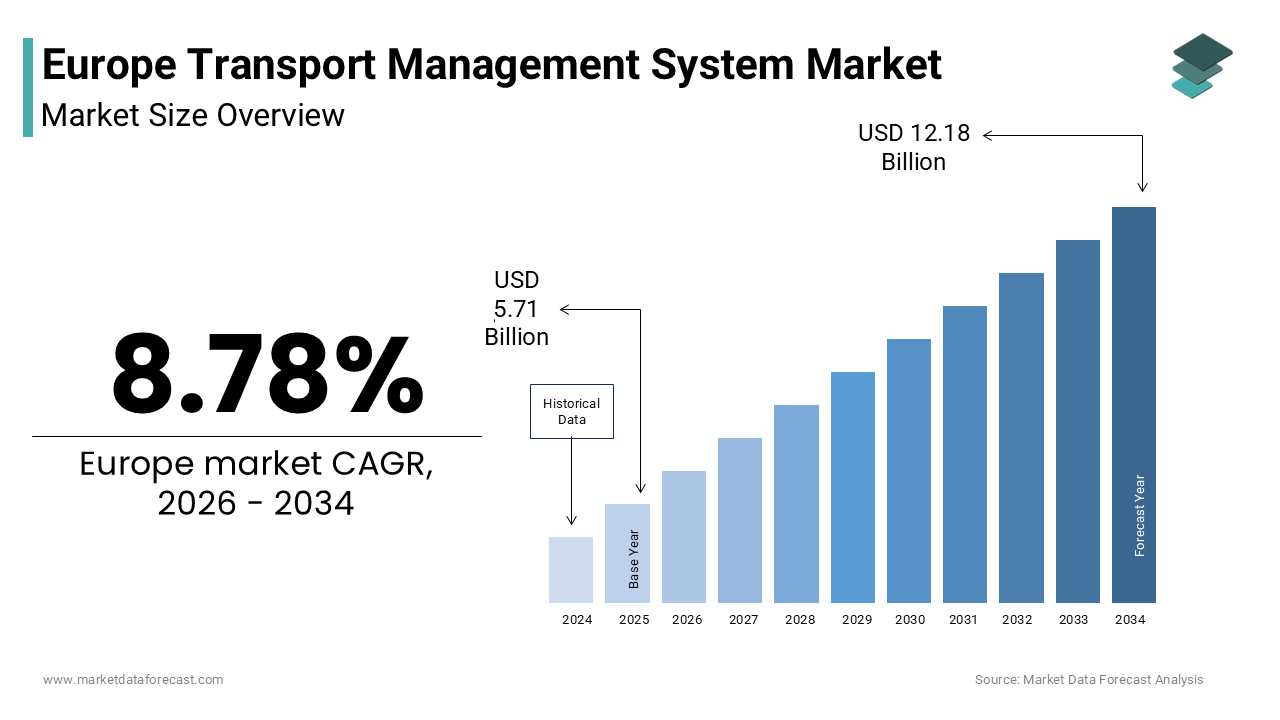
The Europe transport management system (TMS) market was valued at USD 5.71 billion in 2025, is expected to reach USD 6.21 billion in 2026, and is projected to grow to USD 12.18 billion by 2034, registering a CAGR of 8.78% during the forecast period from 2026 to 2034.
The growth of the Europe transport management system market is primarily driven by increasing digitalization of logistics operations, the need for real-time supply chain visibility, and stringent environmental regulations aimed at reducing transportation emissions. Transport management systems enable organizations to optimize freight operations, automate logistics processes, and improve route planning and carrier selection. Furthermore, the expansion of e-commerce, rising cross-border trade across the European Union, and growing demand for sustainable logistics solutions are accelerating the adoption of advanced TMS platforms across the region.
Key Market Trends
-
Increasing adoption of AI-driven logistics optimization platforms for predictive route planning and freight management.
-
Growing demand for cloud-based TMS solutions due to scalability, lower upfront costs, and real-time visibility.
-
Rising implementation of sustainability monitoring tools to track and reduce carbon emissions in transport operations.
-
Expansion of intermodal logistics solutions integrating road, rail, maritime, and air transport networks.
-
Increasing integration of IoT and telematics systems to enable real-time fleet tracking and shipment monitoring.
Segmental Insights
- By platform, the solutions segment held the largest share of the Europe transport management system market in 2025. The dominance of this segment is attributed to the growing need for route optimization, carrier management, and freight audit capabilities that improve operational efficiency in complex logistics environments.
- The services segment is projected to grow at the fastest CAGR of 11.4% during the forecast period. This growth is driven by the increasing demand for system integration, customization, consulting, and managed services associated with complex TMS deployments.
- By deployment type, the cloud-based (SaaS) segment accounted for the largest share of the market in 2025 and is also expected to register the fastest growth. The growth of cloud-based TMS solutions is supported by their scalability, lower infrastructure requirements, and ability to support cross-border logistics operations.
- By enterprise size, the large enterprises segment held the dominant share of the Europe TMS market in 2025 due to their large logistics networks and strong investment capabilities. Meanwhile, the SME segment is expected to grow at the fastest rate as cloud-based platforms make TMS solutions more accessible to smaller logistics providers.
- By end-use industry, the retail and e-commerce segment dominated the market in 2025 due to the high volume of shipments and complex last-mile delivery requirements generated by online retail operations. The healthcare and pharmaceuticals segment is expected to grow at the fastest rate due to increasing demand for temperature-controlled logistics and traceability in pharmaceutical supply chains.
Regional Insights
The Europe transport management system market is expanding across several countries due to growing logistics activity, digital transformation initiatives, and sustainability regulations.
-
Germany held the largest share of the Europe TMS market in 2025 due to its strong manufacturing sector, large logistics industry, and central position within European trade routes.
-
The United Kingdom represents a major market driven by the growth of e-commerce and increasing demand for digital logistics systems following post-Brexit customs requirements.
-
France is expected to experience significant growth due to government initiatives promoting sustainable logistics and digital transformation under national supply chain modernization programs.
-
Italy is witnessing increasing adoption of transport management systems due to expanding manufacturing exports and government investments in logistics infrastructure modernization.
-
The Netherlands plays a key role in the European logistics ecosystem due to the presence of major ports such as Rotterdam and strong third-party logistics operations.
Competitive Landscape
The Europe transport management system market is highly competitive, with major global software providers and specialized logistics technology companies competing to deliver advanced digital supply chain solutions. Market participants focus on integrating artificial intelligence, expanding cloud-based platforms, and enhancing real-time visibility capabilities to strengthen their competitive position. Major companies operating in the Europe transport management system market include SAP SE, Oracle Corporation, Blue Yonder Group Inc., Manhattan Associates Inc., The Descartes Systems Group Inc., Trimble Inc. (Transporeon), E2open (BluJay Solutions), C.H. Robinson Worldwide Inc., Infor Inc., and IBM Corporation.
Europe Transport Management System Market Size
The Europe transport management system market size was valued at USD 5.71 billion in 2025 and is anticipated to reach USD 6.21 billion in 2026 from USD 12.18 billion by 2034, growing at a CAGR of 8.78% during the forecast period from 2026 to 2034.
The transport management system is a software solution designed to plan, execute, and optimize the physical movement of goods across land, sea, and air within the European continent. These systems serve as the digital backbone for supply chain operations, integrating functions such as route planning, freight audit, carrier selection, and real-time visibility into a unified platform. The urgency for advanced digital orchestration is further amplified by the European Green Deal, which targets a 90% reduction in transport emissions by 2050, forcing logistics providers to adopt systems capable of calculating and minimizing carbon footprints. According to the European Environment Agency, transport accounts for approximately 25% of total EU greenhouse gas emissions by making the deployment of optimization software a compliance requirement rather than a mere efficiency tool.
MARKET DRIVERS
Stringent Regulatory Mandates for Carbon Emission Reduction
The implementation of rigorous regulatory mandates regarding carbon emission reduction serves is majorly driving the growth of Europe transport management system market. The European Union has established some of the world's most ambitious climate goals, compelling logistics operators to transition from intuition-based planning to data driven optimization to lower their environmental impact. The Fit for 55 package, adopted by the EU, aims to reduce net greenhouse gas emissions by at least 55% by 2030 compared to 1990 levels, with the transport sector bearing a significant portion of this burden. These regulations necessitate the use of software capable of real time monitoring and reporting of fuel consumption and idle times. Furthermore, the expansion of Low Emission Zones in major cities like Paris, London, and Berlin restricts access for older, high polluting vehicles by requiring dynamic routing capabilities to ensure compliance and avoid fines.
Shortage of Professional Truck Drivers Across the Region
The acute and persistent shortage of professional truck drivers for the adoption of transport management systems, as companies seek to maximize the productivity of their existing workforce. The shortage of professional truck drivers is attributed in elevating the growth of the Europe transport management system market. The demographic aging of the driver population combined with difficult working conditions has created a structural deficit that traditional recruitment cannot solve, forcing operators to rely on technology to do more with fewer resources. According to the International Road Transport Union, the European road transport sector faced a shortage of approximately 400000 qualified drivers in 2024, a figure that continues to strain supply chain reliability. In response, logistics providers are deploying transport management systems to automate administrative tasks, optimize load consolidation, and reduce empty runs, thereby allowing each driver to complete more deliveries per shift.
MARKET RESTRAINTS
High Implementation Costs and Complexity for SMEs
The high implementation costs and inherent complexity of advanced transport management systems for the vast number of small and medium sized enterprises is substantially hampering the growth of Europe transport management system market. While large multinational corporations possess the capital and IT infrastructure to deploy enterprise grade solutions, smaller fleet operators often find the initial licensing fees, customization costs, and integration expenses prohibitive. The complexity of integrating these systems with legacy hardware and disparate enterprise resource planning platforms further exacerbates the barrier, often requiring specialized technical expertise that smaller firms lack. Additionally, the fragmented nature of the European market, with its varying languages, currencies, and regulatory nuances, increases the customization effort and cost for vendors, which is passed down to the customer.
Fragmented Regulatory and Cross Border Compliance Issues
The fragmented regulatory and the complexities of cross border compliance on the seamless deployment and standardization is additionally hindering the growth of Europe transport management system market. The enforcement of the Mobility Package, which introduced stricter rules on cabotage, posting of drivers, and rest periods, has added layers of complexity that transport management systems must constantly update to maintain compliance. According to the European Freight and Logistics Leaders Forum, the administrative burden of cross border transport involves navigating over 27 different sets of national implementations of EU directives, leading to frequent errors and system incompatibilities. This regulatory patchwork forces software vendors to maintain multiple versions of their products or invest heavily in continuous updates, increasing costs and slowing down the rollout of new features. Furthermore, the lack of harmonization in digital freight documents across member states means that a system optimized for Germany may not fully comply with French or Italian electronic mandate requirements without significant modification.
MARKET OPPORTUNITIES
Integration of Artificial Intelligence for Predictive Logistics
The integration of artificial intelligence and machine learning into transport management systems by shifting logistics operations from reactive to predictive models is creating new opportunities for the growth of Europe transport management system market. Traditional systems rely on historical data and static rules, whereas AI driven platforms can analyze vast datasets in real time to forecast demand, predict traffic congestion, and anticipate maintenance needs before they cause disruptions. This capability is particularly valuable in Europe's volatile market environment, where sudden changes in consumer behavior or supply chain disruptions require rapid adaptation. Furthermore, AI enables dynamic pricing models for freight services, matching shippers with carriers instantly based on real time capacity and route efficiency, thereby maximizing asset utilization. The European Commission's Digital Europe Programme has allocated substantial funding to support the development of AI in key sectors including transport, recognizing its potential to enhance competitiveness and sustainability.
Expansion of Intermodal Transport Solutions
The expansion of intermodal transport solutions is additionally enhancing the growth of Europe transport management system market. The geographical density of Europe and its extensive rail and inland waterway networks make it an ideal region for intermodal logistics, yet the coordination of multiple transport modes requires sophisticated software to manage handovers, tracking, and documentation seamlessly. According to the International Union of Railways, shifting just 10% of freight from road to rail in Europe could reduce CO2 emissions by 4 million tons annually, a goal that drives policy support and commercial interest in intermodal options. Transport management systems that offer robust intermodal modules can automatically select the most efficient combination of transport modes based on cost, time, and carbon footprint, a feature that is becoming a key differentiator for logistics providers. The European Union's Trans European Transport Network policy aims to double the share of rail freight by 2030, creating a regulatory tailwind for software solutions that facilitate this transition. Additionally, the rise of short sea shipping as an alternative to long haul trucking along the European coastlines requires systems capable of managing complex maritime schedules and port operations.
MARKET CHALLENGES
Cybersecurity Vulnerabilities in Connected Logistics Networks
The escalating risk of cybersecurity vulnerabilities in connected logistics networks as the industry becomes increasingly digitized and interconnected is also one of the challenges for the growth of Europe transport management system market. As transport management systems integrate with Internet of Things devices, cloud platforms, and external partner networks, the attack surface for malicious actors expands exponentially, threatening the integrity of critical supply chain data. According to the European Union Agency for Cybersecurity, the transport sector witnessed a 45% increase in reported cyber incidents in 2024, with ransomware attacks targeting logistics firms becoming more frequent and sophisticated. A successful breach can lead to the paralysis of entire fleets, theft of sensitive customer data, and manipulation of cargo information, resulting in severe financial and reputational damage. The challenge is compounded by the fact that many transport management systems rely on third party APIs and legacy components that may not have been designed with modern security standards in mind. Furthermore, the shortage of cybersecurity professionals in Europe exacerbates the problem, leaving many logistics firms ill equipped to detect and respond to threats in real time.
Legacy Infrastructure and Interoperability Barriers
The prevalence of legacy infrastructure and persistent interoperability barriers with the seamless flow of information across the supply chain ecosystem is additionally degrading the growth of Europe transport management system market. Many established logistics companies and public infrastructure operators in Europe still rely on outdated software and hardware systems that were not designed to communicate with modern cloud-based transport management platforms. According to the Digital Transport and Logistics Forum, the lack of standardized data formats and communication protocols results in significant data silos, with an estimated 30% of logistics data remaining unstructured or inaccessible for real time analysis. This fragmentation forces companies to resort to manual data entry or costly custom integrations, negating the efficiency gains promised by advanced software solutions. The challenge is particularly acute in cross border scenarios where different countries and regions utilize incompatible digital systems for customs, tolling, and traffic management. The European Commission has acknowledged this issue, noting that interoperability gaps cost the European logistics sector billions of euros annually in lost productivity and administrative overhead. Moreover, the slow pace of upgrading physical infrastructure, such as telematics units in older truck fleets, limits the ability of new software to collect accurate real time data.
REPORT COVERAGE
| REPORT METRIC | DETAILS |
| Market Size Available | 2025 to 2034 |
| Base Year | 2025 |
| Forecast Period | 2026 to 2034 |
| CAGR | 8.78% |
| Segments Covered | By Platform, Deployment Type, Enterprise Size, Transportation Mode, End-Use Industry and Region. |
| Various Analyses Covered | Global, Regional & Country Level Analysis, Segment-Level Analysis, DROC, PESTLE Analysis, Porter’s Five Forces Analysis, Competitive Landscape, Analyst Overview of Investment Opportunities |
| Country Covered | UK, France, Spain, Germany, Italy, Russia, Sweden, Denmark, Switzerland, the Netherlands, Turkey, the Czech Republic, and the Rest of Europe. |
| Market Leaders Profiled | SGS S.A., Bureau Veritas S.A., Intertek Group plc, TÜV SÜD AG, TÜV Rheinland AG, DEKRA SE, Eurofins Scientific SE, DNV Group AS, Applus+, and ALS Limited. |
SEGMENTAL ANALYSIS
By Platform Insights
The solutions segment was the largest by holding a dominant share of the Europe transport management system market in 2025 owing to the fundamental necessity for core software capabilities that enable route optimization, freight auditing, and carrier management before any supplementary services can be effective. The escalating complexity of European supply chains, which demands robust algorithmic engines to handle multi-modal logistics and cross-border compliance automatically. According to Eurostat, road freight transport in the European Union covered 1489 billion tonne kilometers in 2023 by creating a massive volume of data that requires sophisticated software solutions to process efficiently. Furthermore, the integration of advanced technologies such as artificial intelligence and machine learning into standard TMS packages has increased the perceived value and necessity of the core solution itself. As per the European Commission, the push for digitalization under the Digital Europe Programme has accelerated the adoption of standalone software platforms that offer real-time visibility and predictive analytics, making the solution component the critical entry point for digital transformation. Stringent regulatory compliance mandates and the shift toward digital documentation serve as a powerful driver sustaining the leadership of the Solutions segment in the European market. The implementation of the EU Mobility Package and various e-freight initiatives requires logistics providers to maintain detailed, tamper-proof digital records of driving times, rest periods, and cargo movements, functionalities that are embedded directly within TMS software solutions. The transition from paper-based to electronic consignment notes, supported by EU-wide standards, further compels companies to invest in robust software platforms that can generate and manage these digital assets seamlessly.
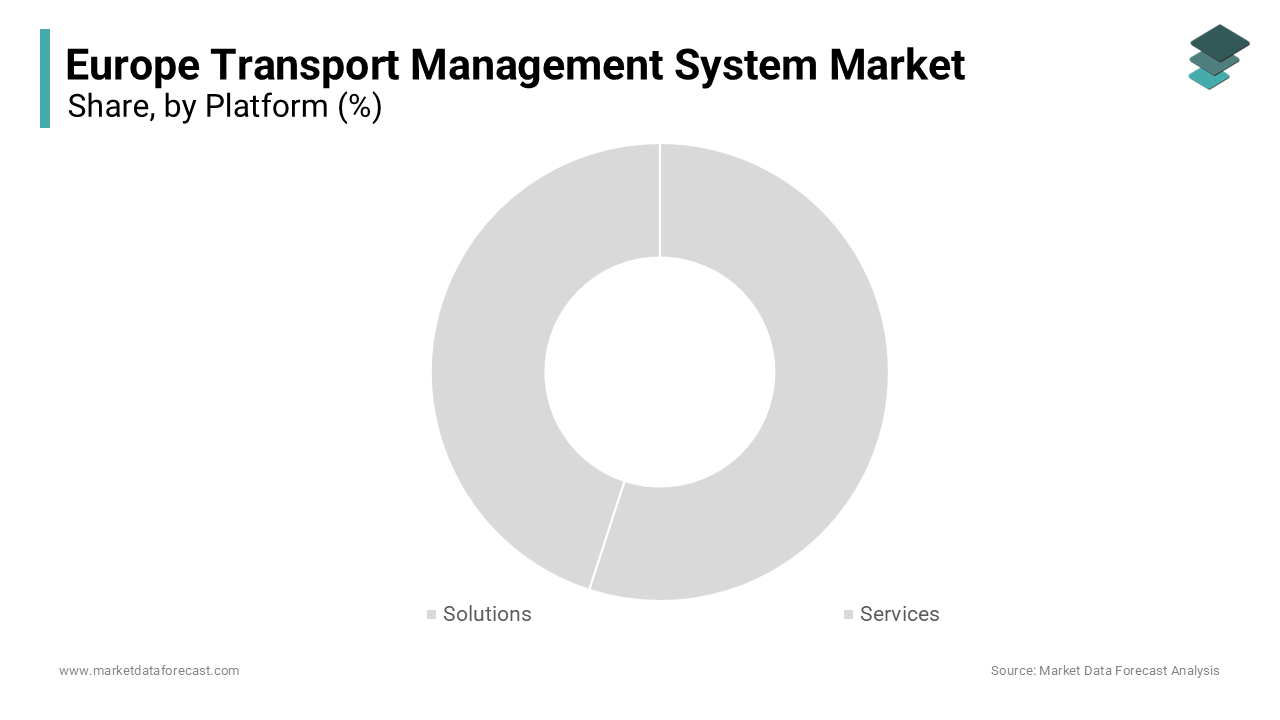
The services segment is projected to expand at a fastest CAGR of 11.4% from 2026 to 2034 owing to the increasing complexity of TMS deployments, the need for continuous system customization, and the rising demand for managed services to handle ongoing maintenance and updates. Unlike the one-time purchase nature of software licenses, services represent a recurring revenue stream that grows as systems become more integral to operations. As per the European Centre for the Development of Vocational Training, the EU faces a deficit of over 1 million ICT professionals, a gap that logistics companies fill by engaging external service providers for their TMS needs. Furthermore, the rapid evolution of technology requires frequent upgrades and reconfigurations to maintain compatibility with new telematics devices and ERP systems, sustaining long-term service contracts. The trend toward cloud migration also boosts the services sector, as moving legacy data to cloud environments requires extensive professional assistance.
By Deployment Type Insights
The Cloud-Based (SaaS) segment was the largest by capturing 58.3% of the Europe transport management system market share in 2025. The growth of the segment is driven by the inherent advantages of scalability, lower upfront capital expenditure, and ease of access, which align perfectly with the needs of the fragmented European logistics sector. Furthermore, the ability of cloud solutions to facilitate real-time collaboration across borders is crucial in a region characterized by complex cross-border trade. The rapid deployment capabilities of SaaS models also allow companies to respond quickly to market fluctuations and regulatory changes, a flexibility that on-premise systems struggle to match. The compelling cost efficiency and inherent scalability of Cloud-Based (SaaS) models serve as the fundamental force driving their dominance in the Europe TMS market, particularly among the vast SME sector.
The Cloud-Based (SaaS) segment is also deemed to witness a fastest CAGR of 12.8% during the forecast period owing to the aggressive migration of legacy on-premise systems to the cloud, fueled by the urgent need for remote accessibility and advanced analytics. Furthermore, the rapid pace of innovation in AI and machine learning, which is predominantly delivered via cloud platforms, forces companies to migrate to stay competitive. The European Commission's Digital Decade targets aim for 75% of EU enterprises to take up cloud computing services by 2030, providing a strong policy tailwind for this segment. The ease of integrating third-party APIs for traffic, weather, and fuel data in cloud environments also drives faster adoption rates compared to the rigid architecture of on-premise solutions. This confluence of technological necessity and policy support ensures that the Cloud segment maintains the highest growth momentum in the market.
By Enterprise Size Insights
The large enterprises segment was the largest by holding 55.4% of the Europe transport management system market share in 2025 owing to the sheer volume of logistics operations managed by multinational corporations and their ability to invest in comprehensive, enterprise-grade TMS suites. Furthermore, the stringent sustainability reporting requirements imposed on large public companies under the Corporate Sustainability Reporting Directive force them to adopt advanced TMS solutions with robust carbon tracking capabilities. As per the European Federation for Transport and Environment, large logistics providers are responsible for the majority of freight emissions, placing them under greater regulatory scrutiny to implement optimization tools. The availability of dedicated IT budgets and the strategic importance of supply chain resilience also enable large firms to undertake lengthy and expensive TMS implementations that smaller players cannot afford.
The Small & Medium Enterprises (SMEs) segment is swiftly emerging at a fastest CAGR of 13.2% throughout the forecast period owing to the democratization of technology through cloud-based SaaS models, which have lowered barriers to entry for smaller operators. The primary factor is the increasing competitive pressure on SMEs to match the efficiency and visibility offered by larger rivals, forcing them to digitize their operations. The shift from manual processes like spreadsheets and phone calls to digital platforms is accelerating as software vendors introduce tiered pricing and modular features tailored to smaller fleets. Additionally, the rise of e-commerce has forced even small logistics providers to offer real-time tracking and flexible delivery options, capabilities that are only possible with modern TMS. This combination of technological accessibility, competitive necessity, and government support positions the SME segment for the highest growth rate in the coming years.
By End-Use Industry Insights
The Retail & E-Commerce segment was accounted in holding 32.3% of the Europe transport management system market share in 2025 owing to the sheer volume of shipments generated by online retail, the complexity of last-mile delivery, and the need for reverse logistics management. According to Eurostat, e-commerce turnover in the EU reached 580 billion euros in 2024, representing a significant portion of total retail activity and generating millions of daily parcels that require systematic management . The fragmentation of delivery destinations and the demand for same-day or next-day delivery options create a logistical challenge that can only be addressed by sophisticated TMS solutions capable of dynamic routing and carrier selection. The intense competition among retailers to provide superior customer experiences further drives investment in systems that offer real-time visibility and proactive exception management. This combination of high volume, complexity, and customer-centric requirements secures the Retail & E-Commerce segment as the primary consumer of transport management technology.
The healthcare & pharmaceuticals segment is projected to expand at a CAGR of 14.5% from 2026 to 2034. The growth of the segment is attributed to grow with the stringent regulatory requirements for temperature-controlled logistics, the increasing volume of biological and pharmaceutical shipments, and the critical need for end-to-end traceability. The sensitivity of these goods to temperature excursions and handling conditions necessitates systems with advanced monitoring and alerting capabilities, which are becoming standard in modern TMS platforms. Additionally, the rise of personalized medicine and direct-to-patient delivery models adds layers of complexity that traditional logistics systems cannot handle. The high value and critical nature of healthcare cargo also justify the investment in premium TMS features, driving rapid adoption rates.
REGIONAL ANALYSIS
Germany Transport Management System Market Analysis
Germany was the top performer of the Europe transport management system market by holding 24.3% of share in 2025. The industrialized economy with a dense network of automotive and manufacturing hubs that generate massive freight volumes. According to the German Federal Statistical Office, the logistics sector in Germany generated a turnover of 290 billion euros in 2024, reflecting the scale of operations requiring advanced management systems. The country's central location in Europe makes it a critical transit hub, necessitating sophisticated TMS for managing complex cross-border flows and intermodal connections. Furthermore, the German government's strong push for Industry 4.0 and digital sovereignty encourages domestic firms to invest in homegrown or localized TMS solutions. The stringent environmental regulations regarding truck emissions and noise pollution in German cities also drive the adoption of optimization software to ensure compliance.
United Kingdom Transport Management System Market Analysis
The United Kingdom was ranked second by capturing 18.2% of the Europe transport management system market share in 2025. The mature e-commerce sector and a complex post-Brexit regulatory environment that demands robust customs and compliance management features in TMS. The logistical challenges introduced by new border controls and paperwork requirements following Brexit have further accelerated the adoption of digital systems capable of automating customs declarations and ensuring compliance. Additionally, the UK's in fintech and insurtech fosters an ecosystem, where TMS vendors can easily integrate payment and insurance services, adding value to their platforms.
France Transport Management System Market Analysis
France transport management system market growth is likely to witness a fastest CAGR in next coming years with its strong emphasis on sustainable logistics and state-supported digitalization initiatives. The government's "France Logistique 2025" plan, which aims to modernize the supply chain and promote the use of digital tools to reduce carbon emissions. According to the French Ministry of Ecological Transition, the transport sector is the largest source of greenhouse gas emissions in France, driving aggressive policies that mandate the use of optimization software to improve load factors and reduce empty runs. The country's extensive rail and inland waterway networks also create a unique demand for intermodal TMS solutions that can seamlessly coordinate between road, rail, and barge transport. The presence of large retail and luxury goods industries further fuels the market, as these sectors require high-visibility and secure transport solutions for their valuable cargo. Additionally, the French market sees strong adoption of TMS among agricultural and food & beverage companies due to the need for cold chain management and freshness preservation.
Italy Transport Management System Market Analysis
Italy transport management system market growth is likely to grow with a vibrant manufacturing base and a strategic role as a Mediterranean logistics gateway. The country's geographical shape and mountainous terrain present unique routing challenges that drive the adoption of advanced pathfinding and optimization algorithms within TMS platforms. Furthermore, the strong automotive and fashion industries in regions like Lombardy and Emilia-Romagna require specialized logistics solutions for just-in-time manufacturing and high-value garment transport. The Italian government's National Recovery and Resilience Plan includes significant funding for digital infrastructure and logistics modernization, providing financial incentives for SMEs to adopt TMS solutions. The increasing focus on port digitization in Genoa and Trieste also stimulates demand for systems that can integrate maritime and land transport data, fostering market growth.
Netherlands Transport Management System Market Analysis
The Netherlands transport management system market growth is likely to grow with the logistics heart of Europe and a pioneer in smart port technologies. According to the study, the logistics sector contributes over 10% to the national GDP, underscoring its critical importance and the corresponding investment in technology. The country's advanced digital infrastructure and high English proficiency make it an ideal testing ground for new TMS innovations and startups. Additionally, the strong presence of global third-party logistics providers headquartered in the Netherlands ensures a constant demand for state-of-the-art transport management solutions to serve their international networks.
COMPETITIVE LANDSCAPE
The competition in the Europe transport management system market is intense and characterized by the presence of established enterprise software giants alongside agile specialized vendors who compete on functionality and industry expertise. Large multinational corporations leverage their broad existing customer bases and integrated suites to offer comprehensive solutions that span the entire supply chain value chain. In contrast, niche players differentiate themselves through deep vertical specialization and superior user experiences tailored to specific logistics segments such as cold chain or hazardous materials. The market sees frequent mergers and acquisitions as companies seek to rapidly acquire advanced technologies like artificial intelligence and blockchain to stay ahead of technological curves. Price competition remains moderate as buyers prioritize reliability, compliance features, and scalability over low cost given the critical nature of transport operations.
KEY MARKET PLAYERS
Some of the companies that are playing a dominating role in the Europe transport management system market include
- SAP SE
- Oracle Corporation
- Blue Yonder Group, Inc.
- Manhattan Associates, Inc.
- The Descartes Systems Group Inc.
- Trimble Inc. (Transporeon)
- E2open (BluJay Solutions)
- C.H. Robinson Worldwide, Inc.
- Infor Inc.
- IBM Corporation
Top Players in the Market
SAP SE
SAP SE stands as a global leader in enterprise software with a profound impact on the Europe transport management system market through its integrated logistics suites. The company provides comprehensive solutions that connect planning, execution, and freight settlement within a unified digital core. SAP recently strengthened its market position by embedding artificial intelligence capabilities into its transportation management modules to enable predictive route optimization and automated carrier selection. Their commitment to sustainability is evident in new features that calculate carbon emissions for every shipment by helping European clients comply with strict environmental regulations. SAP continues to expand its ecosystem by partnering with telematics providers to ensure real time visibility across global supply chains. These innovations allow the firm to maintain its status as a critical enabler of digital transformation for logistics operators worldwide while addressing specific European regulatory needs.
Oracle Corporation
Oracle Corporation plays a pivotal role in the Europe transport management system market by offering cloud native applications that streamline complex supply chain operations for large enterprises. The company contributes globally by providing scalable platforms that integrate transportation management with broader enterprise resource planning and procurement functions. Oracle has recently focused on enhancing its logistics network modeling tools to help businesses design more resilient and cost effective distribution networks amidst geopolitical uncertainties. Their strategic push involves leveraging machine learning to automate freight audit processes and reduce payment discrepancies across international borders. Oracle also actively updates its software to align with evolving European Union digital freight documentation standards.
Blue Yonder Group Inc
Blue Yonder Group Inc operates as a specialized force in the Europe transport management system market with a strong focus on end to end supply chain orchestration and autonomous logistics. The company influences the global sector by delivering AI driven solutions that predict disruptions and recommend proactive mitigation strategies for freight movements. Blue Yonder recently enhanced its platform by integrating generative artificial intelligence to simplify user interactions and accelerate scenario planning for logistics managers. Their acquisition strategy and product development efforts prioritize seamless connectivity between warehouse management and transportation execution systems. The firm has also launched new sustainability dashboards that allow European shippers to monitor and reduce their carbon footprints in real time.
Top Strategies Used by Key Market Participants
Key players in the Europe transport management system market primarily focus on integrating artificial intelligence and machine learning to enable predictive analytics and autonomous decision making within logistics operations. Companies are increasingly adopting cloud native architectures to offer scalable and flexible solutions that accommodate the varying needs of diverse European supply chains. Strategic partnerships with telematics providers and Internet of Things device manufacturers are essential to ensure real time data visibility and accurate asset tracking across borders. Vendors are also prioritizing the development of sustainability modules that calculate and report carbon emissions to help clients meet stringent European Union environmental regulations. Furthermore, market participants are expanding their ecosystems through acquisitions of niche technology firms to enhance specific capabilities such as last mile delivery optimization and freight audit automation. These collective strategies aim to drive operational efficiency and resilience in a complex regulatory landscape.
MARKET SEGMENTATION
This research report on the Europe transport management system market has been segmented and sub-segmented based on the following categories.
By Platform
- Solutions
- Services
By Deployment Type
- Cloud-Based (SaaS)
- On-Premise
By Enterprise Size
- Large Enterprises
- Small & Medium Enterprises
By Transportation Mode
- Roadways
- Railways
- Airways
- Seaways
- Intermodal/Multimodal
By End-Use Industry
- Retail & E-Commerce
- Manufacturing
- Automotive
- Food & Beverages
- Healthcare & Pharmaceuticals
- Others
By Country
- UK
- France
- Spain
- Germany
- Italy
- Russia
- Sweden
- Denmark
- Switzerland
- Netherlands
- Turkey
- Czech Republic
- Rest of Europe