Europe Treadmill Market Size, Share, Trends, & Growth Forecast Report By Type (Electric Treadmill, Manual Treadmill), End-User, Distribution Channel and Country (UK, France, Spain, Germany, Italy, Russia, Sweden, Denmark, Switzerland, Netherlands, Turkey, Czech Republic and Rest of Europe), Industry Analysis From 2026 to 2034
Market Size, 2025
$6.32 BnMarket Estimate, 2026
$6.71 BnMarket Forecast, 2034
$10.78 BnCAGR, 2026–2034
6.11%Europe Treadmill Market Report Summary
The Europe treadmill market was valued at USD 6.32 billion in 2025, is estimated to reach USD 6.71 billion in 2026, and is projected to reach USD 10.78 billion by 2034, growing at a CAGR of 6.11% during the forecast period from 2026 to 2034. The growth of the Europe treadmill market is driven by increasing health awareness, rising sedentary lifestyles, and strong adoption of indoor fitness solutions across residential, commercial, and clinical environments. Expanding digital fitness ecosystems, integration of smart connectivity features, and growing institutional focus on preventive healthcare are further accelerating market expansion. Additionally, urbanization trends, limited outdoor space, and supportive public health initiatives promoting physical activity are strengthening demand for treadmills as accessible all-weather fitness infrastructure. While space constraints and regulatory compliance requirements present challenges, continued innovation in compact designs, immersive training platforms, and medical-grade connected treadmills is sustaining market growth across Europe.
Key Market Trends
-
Growing adoption of connected treadmills integrated with digital coaching and immersive training platforms.
-
Increasing use of treadmills in hybrid rehabilitation programs enabling remote patient monitoring.
-
Expansion of corporate wellness initiatives driving institutional procurement of commercial-grade treadmills.
-
Rising demand for compact and foldable treadmill designs is addressing urban housing space limitations.
-
Strong shift toward subscription-based fitness ecosystems, enhancing user engagement and retention.
Segmental Insights
- Based on type, the electric treadmill segment dominated the Europe treadmill market in 2025, supported by programmable features, biometric tracking capabilities, and compatibility with digital health platforms required for structured training and rehabilitation.
- Based on end-user, the residential segment held the leading share of the Europe treadmill market in 2025, driven by sustained consumer preference for home-based fitness solutions, urban living patterns, and public health incentives promoting preventive exercise.
- Based on distribution channel, The offline retail segment accounted for the largest share in 2025, as consumers prefer in-store product demonstrations, professional guidance, and installation services for high-value fitness equipment purchases.
Regional Insights
The Europe treadmill market demonstrates consistent growth across major countries supported by public health initiatives, fitness culture, and digital fitness adoption.
-
Germany represents a leading market, driven by strong preventive healthcare programs, high fitness participation, and advanced rehabilitation infrastructure.
-
The United Kingdom maintains significant demand, supported by high household spending on home fitness equipment and digital fitness platform penetration.
-
France continues to expand, fueled by national health promotion programs and growing female participation in fitness activities.
-
Italy contributes steadily, supported by wellness tourism growth, boutique fitness studio expansion, and premium fitness equipment demand.
-
Nordic countries exhibit rising adoption, particularly across elderly fitness programs and fall-prevention initiatives utilizing treadmills for supervised indoor exercise.
Competitive Landscape
The Europe treadmill market is characterized by a multi-tier competitive structure including premium clinical-grade manufacturers, digitally focused smart fitness brands, and price-competitive import suppliers. Leading companies are emphasizing software-enabled ecosystems, subscription-based coaching platforms, and integration with healthcare monitoring systems to differentiate offerings beyond hardware capabilities. Innovation priorities include compact designs for urban environments, enhanced connectivity features, and compliance with EU energy efficiency, safety, and noise regulations. Strategic collaborations with healthcare providers, insurers, corporate wellness programs, and digital fitness platforms are further strengthening market positioning. Prominent players operating in the Europe treadmill market include Technogym S.p.A., BH Fitness, Dyaco International Inc., Life Fitness, Precor Incorporated, Johnson Health Tech Co., Ltd., Nautilus, Inc., Woodway GmbH, Landice, Inc., SportsArt Fitness, Sole Fitness, Horizon Fitness, True Fitness Technology, Inc., Star Trac, and Impulse (Qingdao) Health Tech Co., Ltd.
Europe Treadmill Market Size
The Europe treadmill market size was valued at USD 6.32 billion in 2025 and is anticipated to reach USD 6.71 billion in 2026 from USD 10.78 billion by 2034, growing at a CAGR of 6.11% during the forecast period from 2026 to 2034.
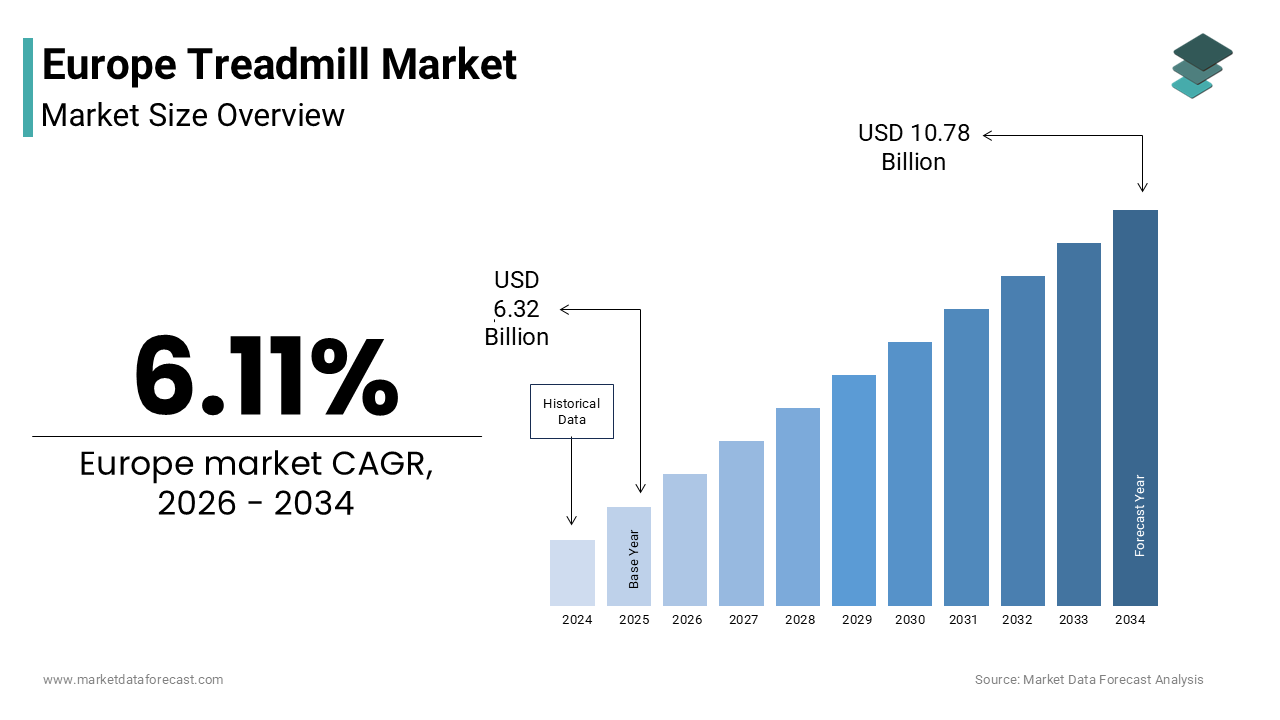
A treadmill is a motorized or manual exercise apparatus designed for walking running or climbing while remaining in a stationary position enabling cardiovascular training indoors regardless of weather or time constraints. In Europe the treadmill market spans residential commercial and clinical segments reflecting diverse usage patterns from home fitness to cardiac rehabilitation. The European treadmill ecosystem is shaped by high urbanization rates limited outdoor space and strong public health emphasis on physical activity as a preventive measure against chronic disease. A significant portion of the EU population lives in urban or intermediate regions, driving demand for accessible, all-weather, and safe fitness infrastructure, which remains a key focus for local planners, especially during winter months. A large portion of adults in Europe fail to meet recommended physical activity levels, driving a heightened demand for convenient indoor fitness alternatives. National health initiatives in European nations, such as Germany and France, are increasingly encouraging physical activity through incentives, including bonuses for fitness activities and the integration of digital health apps to promote healthier lifestyles. This confluence of demographic behavioral and policy factors positions the treadmill not merely as a consumer good but as a tool of public health infrastructure across the continent.
MARKET DRIVERS
Rising Prevalence of Sedentary Lifestyles and Cardiovascular Disease Drives Preventive Adoption
The region’s escalating burden of non communicable diseases linked to physical inactivity has enabled both individual and institutional investment in treadmills as preventive health tools, which fuels the growth of the Europe treadmill market. Cardiovascular diseases remain the leading cause of mortality in the European Union, with physical inactivity recognized as a major contributor to these preventable deaths. National health services are increasingly utilizing digital platforms to provide weight management and physical activity support for patients with chronic conditions like hypertension and diabetes. Similarly, Health authorities in Europe recommend a minimum weekly duration of aerobic activity to prevent non-communicable diseases, emphasizing the importance of creating environments that allow for regular exercise regardless of the setting. Major German health insurers offer bonus programs and subsidies for certified health-promotion activities and preventive courses to encourage policyholders to maintain a healthy lifestyle. Nordic countries are exploring digital interventions and specialized physical training protocols to improve balance and reduce the frequency of falls among the elderly population. This medicalization of fitness transforms treadmills from discretionary purchases into prescribed therapeutic devices supported by public funding and clinical validation.
Integration of Smart Connectivity and Immersive Training Platforms Enhances User Engagement
The convergence of digital health ecosystems and immersive content has revitalized treadmill demand and boosted the expansion of the Europe treadmill market. This shift addresses historical challenges like monotony and low adherence. Modern European treadmills increasingly feature embedded sensors Bluetooth connectivity and subscription based virtual coaching that transform routine workouts into interactive experiences. There is an increasing prevalence of connected fitness technology in the European market, with a growing number of home exercise machines featuring integration with interactive training applications and digital streaming services. These services leverage real time terrain mapping allowing users in Berlin or Barcelona to virtually run through the Alps or along the Amalfi Coast with resistance automatically adjusting to match elevation profiles. Fitness industry data suggests that individuals who utilize structured digital coaching or interactive programs tend to exercise more frequently compared to those who use equipment without guidance. Moreover, the European Data Protection Board’s certification framework for health data interoperability has enabled secure integration with national electronic health records allowing physicians to monitor patient activity remotely. Companies like Technogym and Sportstech have capitalized on this trend by embedding GDPR compliant biometric dashboards that sync with Apple Health and Google Fit. This fusion of entertainment personalization and clinical utility sustains long term engagement and justifies premium pricing in an otherwise mature product category.
MARKET RESTRAINTS
Limited Residential Space in Urban Housing Constrains Home Equipment Ownership
The physical footprint of treadmills presents a significant barrier in Europe’s densely populated urban centers, which hampers the growth of the Europe treadmill market. This is the case despite strong health motivations. In these areas, living spaces are among the smallest globally. Housing data indicates that residents in major European metropolitan areas typically live in smaller dwellings compared to those in less densely populated regions, reflecting the general trend of limited living space in urban centers. High rates of urban renting in Western Europe are associated with compact living arrangements, which often present challenges for residents wishing to accommodate large household items or hobby equipment. Surveys regarding urban lifestyle preferences often emphasize that limited square footage is a significant factor preventing city dwellers from investing in large-scale home exercise machinery. Folding mechanisms offer partial relief but add cost and mechanical complexity deterring budget conscious buyers. In response some municipalities have experimented with shared fitness pods in apartment basements yet adoption remains limited due to hygiene and scheduling concerns. This spatial reality forces consumers toward compact alternatives like resistance bands or outdoor running undermining the addressable market for full size treadmills particularly in high density rental markets that dominate Western and Central Europe.
Stringent EU Energy Efficiency and Noise Emission Regulations Increase Compliance Costs
The regional manufacturers and importers face escalating regulatory hurdles, which limit the expansion of the Europe treadmill market. These regulations elevate production costs and limit design flexibility for treadmills. European environmental regulations are tightening standby power requirements for a broad range of household electronic appliances to reduce passive energy consumption across the Union. Simultaneously Product safety standards in Europe require manufacturers to monitor and disclose the acoustic output of motorized equipment to ensure user safety and minimize residential disturbance. Manufacturers of fitness equipment must navigate increasingly complex technical standards during the design phase to ensure compliance with European safety and environmental benchmarks. Stricter technical regulations often present a higher relative financial and administrative burden for smaller manufacturers who rely on external facilities to verify product compliance. Furthermore, new European sustainability frameworks will eventually require products to carry digital documentation regarding their material makeup and ease of repair to support a circular economy. These policies promote sustainability but carry the unintended consequence of restricting innovation and raising prices, which limits accessibility for average consumers.
MARKET OPPORTUNITIES
Expansion of Corporate Wellness Programs Creates Institutional Procurement Channels
European employers are increasingly investing in on-site fitness infrastructure as part of holistic workplace wellness strategies, which creates new opportunities for the growth of the Europe treadmill market. These initiatives are aimed at reducing absenteeism and boosting productivity. A significant majority of large European corporations have integrated physical wellbeing initiatives into their corporate social responsibility frameworks, often providing employees with access to exercise facilities or subsidized health programs. Research published by national occupational health bodies in Germany indicates that comprehensive workplace health management, including opportunities for physical activity, is associated with improved mental wellbeing and lower rates of absenteeism. National policies amplify this trend. Labor regulations in Western Europe are evolving to mandate more comprehensive health insurance and profit-sharing schemes, while tax frameworks provide limited flexibility for employers to offer health-related perks as part of general employee benefit packages. Major corporations like Siemens SAP and Novo Nordisk have installed smart treadmills integrated with employee health platforms allowing anonymized aggregate tracking of participation rates. This institutional demand favors commercial grade models with durability remote diagnostics and multi user profiles creating a stable B2B segment less sensitive to consumer economic fluctuations and fostering long term service contracts for maintenance and software updates.
Growth of Hybrid Rehabilitation Models Integrates Treadmills into Clinical Pathways
The post-pandemic acceleration of telehealth has enabled innovative hybrid care models, which provide fresh prospects for the expansion of the Europe treadmill market. These models use treadmills as remote monitoring nodes in cardiac, pulmonary, and neurological rehabilitation protocols. Hospitals and physiotherapy clinics across Europe now prescribe connected treadmills that transmit gait speed heart rate and session duration to clinicians in real time facilitating personalized adjustments without in person visits. Leading cardiovascular organizations in Europe are increasingly endorsing remote rehabilitation models, noting that home-based exercise often results in higher patient engagement and more consistent participation compared to traditional hospital settings. Updated national clinical guidelines for stroke recovery now place a stronger emphasis on high-intensity aerobic exercise to enhance motor recovery and cardiovascular health during the rehabilitation process. Regulatory frameworks support this shift with the European Medicines Agency classifying certain connected treadmills as Class IIa medical devices when used in prescribed therapy enabling partial reimbursement through national health systems. Companies like h/p/cosmos and Woodway have developed CE marked clinical treadmills with emergency stop protocols and ECG synchronization catering specifically to this emerging segment. This medical integration elevates treadmills from fitness tools to regulated therapeutic devices opening new revenue streams and clinical validation pathways.
MARKET CHALLENGES
Intensifying Competition from Low Cost Asian Imports Undermines Price Premiums
Regional brands face mounting pressure from competitively priced imports, which challenges the growth of the Europe treadmill market. These imports, primarily from China and South Korea, replicate core functionalities at significantly lower price points. Trade data indicates that a significant portion of the European fitness equipment market is supplied by Asian manufacturers, who maintain a competitive pricing advantage over locally produced alternatives. These products often bypass rigorous durability testing yet meet baseline CE requirements through minimal compliance strategies such as temporary motor derating during certification. Consumer advocacy groups often observe that lower-priced exercise equipment may experience more frequent mechanical issues over time compared to higher-end models from established brands. However, price sensitivity among middle income households particularly in Southern and Eastern Europe drives strong demand for these alternatives. This dynamic compresses margins for domestic manufacturers who must justify higher costs through added features like quieter operation longer warranties or local service networks, advantages that are increasingly undervalued in online driven purchasing decisions dominated by upfront cost comparisons.
Consumer Skepticism Regarding Long Term Usage and Post Purchase Disengagement
Many European consumers abandon treadmill use within months due to perceived monotony, lack of measurable progress, or space conflicts, and thereby constrain the expansion of the European treadmill market. This leads to buyer remorse and secondary market saturation. Academic research into home exercise habits suggests that a significant number of individuals struggle to maintain long-term consistency with fitness equipment, with environmental factors in city dwellings often playing a role in how regularly the machines are used. The European Fitness Association identifies “fitness fatigue” as a key barrier where users exhaust preloaded programs and fail to sustain motivation without social accountability. This behavioral pattern discourages repeat purchases and fuels a robust second hand market on platforms like Vinted and Kleinanzeigen. Manufacturers attempt to counter this through gamification and community features yet retention remains elusive without continuous content innovation. Consequently retailers report high return rates during cooling off periods and reluctance among past buyers to upgrade even when models become obsolete. This cyclical disengagement constrains organic market growth and forces brands to focus on acquisition rather than loyalty, a costly and unsustainable strategy in a maturing category.
REPORT COVERAGE
| REPORT METRIC | DETAILS |
| Market Size Available | 2025 to 2034 |
| Base Year | 2025 |
| Forecast Period | 2026 to 2034 |
| CAGR | 6.11% |
| Segments Covered | By Type, End-User, Distribution Channel and Country. |
| Various Analyses Covered | Global, Regional & Country Level Analysis, Segment-Level Analysis, DROC, PESTLE Analysis, Porter’s Five Forces Analysis, Competitive Landscape, Analyst Overview of Investment Opportunities |
| Regions Covered | UK, France, Spain, Germany, Italy, Russia, Sweden, Denmark, Switzerland, the Netherlands, Turkey, the Czech Republic, and the Rest of Europe. |
| Market Leaders Profiled | S.p.A., BH Fitness, Dyaco International Inc., Life Fitness, Precor Incorporated, Johnson Health Tech Co., Ltd., Nautilus, Inc., Woodway GmbH, Landice, Inc., SportsArt Fitness, Sole Fitness, Horizon Fitness, True Fitness Technology, Inc., Star Trac, and Impulse (Qingdao) Health Tech Co., Ltd. |
SEGMENTAL ANALYSIS
By Type Insights
The electric treadmills segment dominated the Europe treadmill market and accounted for a substantial share in 2025. The dominance of the segment is driven by its superior functionality programmability and integration with digital health ecosystems. Unlike manual variants which rely solely on user propulsion and offer limited resistance control electric models provide consistent speed incline adjustment and real time biometric feedback essential for structured training. Consumer sales data indicates a strong and continued preference for motorized treadmills over manual versions, driven largely by the integration of digital tracking features and automated speed controls. Clinical guidelines for cardiac rehabilitation in Germany require exercise equipment to provide precise workload monitoring and data recording to ensure patient safety and protocol adherence during supervised therapy. Additionally national reimbursement schemes such as France’s Complémentaire Santé Solidaire only cover motorized models meeting specific medical device criteria further skewing adoption toward electric systems. This dominance is reinforced by urban lifestyles where predictable indoor workouts outweigh the marginal cost difference especially when bundled with virtual coaching subscriptions.
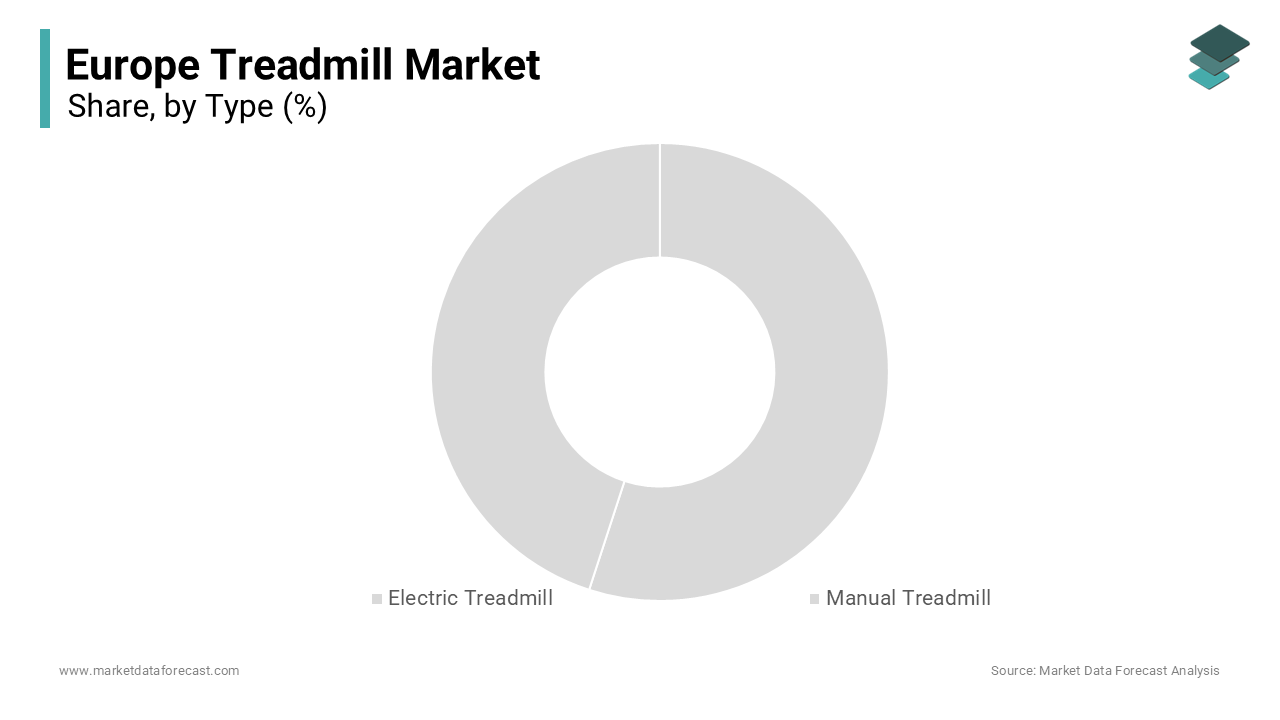
The manual treadmill segment is expected to exhibit a noteworthy CAGR of 8.7% from 2026 to 2034 due to rising demand among budget conscious consumers eco minded households and micro apartment dwellers seeking space efficient low maintenance alternatives. Economic pressures and rising living costs in various European regions have led some consumers to seek more affordable, non-electric fitness alternatives that do not contribute to household utility expenses. Significant fluctuations in energy costs across Eastern Europe have heightened consumer awareness regarding the power consumption of household appliances, influencing preferences for energy-efficient or non-powered products. Moreover, minimalist fitness influencers on platforms like Instagram and TikTok have popularized “quiet cardio” routines using compact manual treadmills that fit under beds or in closets. Major home fitness brands are continuing to evolve their product lines with a focus on compact, foldable designs and mechanical resistance systems to cater to users with limited space. This niche yet expanding segment appeals to urban renters students and sustainability focused buyers who prioritize zero operational cost and portability over advanced metrics.
By End User Insights
The residential segment led the European treadmill market in 2025. The leading position of the segment is attributed to long term behavioral shifts toward home based fitness accelerated by pandemic induced gym closures and sustained by ongoing convenience preferences. European statistical data reflects a growing shift toward home-based physical activity, with cardiovascular equipment representing a significant portion of consumer spending on sporting goods. German health policy supports preventive care by subsidizing certified fitness and wellness courses, encouraging citizens to engage in structured physical activity. Household expenditure on fitness equipment in the United Kingdom tends to be higher among families with greater disposable income, reflecting a broader trend of investment in personal health. Urbanization further drives adoption. With the majority of the European population residing in urban environments, many individuals choose indoor exercise options to maintain their fitness routines regardless of seasonal weather conditions or local outdoor infrastructure. This residential dominance is structural rather than cyclical supported by demographic density housing patterns and public health incentives that collectively sustain consistent demand independent of commercial gym fluctuations.
The commercial end user segment is predicted to witness the highest CAGR of 9.3% over the forecast period owing to corporate wellness mandates hybrid rehab models and premium boutique fitness expansion. Large European corporations are increasingly implementing physical health initiatives and providing on-site exercise options as part of a broader strategy to improve employee well-being and reduce work-related stress. Dutch tax regulations continue to offer flexible frameworks that allow businesses to provide tax-free health and wellness benefits to their staff, supporting a culture of corporate health investment. Simultaneously cardiac and neurological rehabilitation clinics are adopting connected commercial treadmills for remote monitoring with the European Society of Cardiology endorsing home based protocols that still rely on clinic grade hardware for data accuracy. Boutique studios specializing in running coaching such as Run Republic in Sweden and Mile High in Spain have also proliferated offering personalized treadmill sessions with gait analysis. These institutional applications demand durability remote diagnostics and multi user profiles creating a high value B2B channel insulated from consumer price sensitivity.
By Distribution Channel Insights
The offline stores segment held the majority share of the Europe treadmill market in 2025. The supremacy of the segment is supported by consumer preference for tactile evaluation professional guidance and immediate delivery particularly for high investment purchases. Specialty fitness retailers like Decathlon Intersport and Sportisimo offer in store demos allowing customers to test belt smoothness noise levels and console responsiveness, factors difficult to assess online. Consumer behavior for high-value fitness equipment often involves a preference for physical retail environments where shoppers can evaluate product quality and access personalized technical guidance. In Germany and France authorized dealers often bundle installation assembly and extended warranties creating full service experiences that online platforms struggle to replicate. Moreover, while many physical retailers in Northern Europe offer voluntary return periods to encourage showroom visits, European consumer law provides specific protection. These rights apply to those purchasing fitness equipment through digital channels. This channel dominance is especially pronounced among older demographics and first time buyers who prioritize hands on assurance over digital convenience.
The online stores e commerce channel segment is estimated to register the fastest CAGR of 11.2% between 2026 to 2034. The growth of the segment is propelled by digital native consumers subscription bundling and cross border price arbitrage. Digital retail platforms continue to expand their market share in the fitness equipment sector by providing integrated financial services and logistical support to simplify the purchase of bulky home gym machinery. Brands such as Sportstech and Fitifito leverage direct to consumer models to bypass retail markups while embedding smart features that require app activation, naturally aligning with digital purchasing journeys. The rise of “try before you buy” logistics partnerships enables home trials without upfront payment reducing perceived risk. Additionally, consumers in high VAT countries like Hungary and Finland increasingly import from lower tax jurisdictions such as Germany via online channels saving. Social media unboxing videos and influencer reviews further validate online choices creating a self reinforcing cycle of digital discovery purchase and engagement that is rapidly reshaping traditional retail dynamics.
REGIONAL ANALYSIS
Germany Treadmill Market Analysis
Germany led the European treadmill market and accounted for a share of 26.4% in 2025. The demand for treadmills in Germany is fuelled by a strong consumer preference for high durability engineering and smart connectivity features that integrate seamlessly with digital health ecosystems. German households have increasingly converted spare rooms into home gyms following a permanent shift in work from home patterns which has sustained demand even after pandemic restrictions lifted. Research shows that German buyers are increasingly investing in durable, high-end fitness machines that offer long-term reliability and professional-grade features. More people in Germany are joining organized sports clubs and gyms as physical health becomes a top priority for all age groups. Retail giants such as Decathlon and specialized online platforms report a year over year sales growth of 12% for connected treadmills featuring live streaming classes. Furthermore the robust second hand market on platforms like eBay Kleinanzeigen extends the product lifecycle while keeping entry level options accessible to students and young professionals. This combination of high disposable income and a deeply ingrained fitness culture ensures that Germany remains the primary revenue generator for manufacturers across the continent.
United Kingdom Treadmill Market Analysis
The United Kingdom was the second largest player in the Europe treadmill market and held a 18.9% share in 2025. The growth of the Uk market is driven by a rapid adoption of subscription based fitness models where hardware serves as a gateway to exclusive digital content and virtual coaching. London acts as a trendsetter for boutique fitness styles which has influenced home buyers to seek compact foldable treadmills that fit into smaller urban living spaces without compromising on performance. Recent statistics show that many new treadmill owners are opting for interactive screens, though the ongoing cost of monthly app fees remains a point of hesitation for some buyers. As some local fitness centers close their doors, people are choosing to spend their gym membership money on equipment they can use at home. Major retailers like Argos and John Lewis have expanded their fitness departments to cater to this surging demand while offering flexible financing options to make premium equipment more affordable. The British Heart Foundation campaigns promoting 150 minutes of moderate activity per week have also raised public awareness about the importance of consistent cardiovascular exercise. This synergy between technological innovation and health advocacy creates a dynamic environment where software features often drive hardware sales more than mechanical specifications.
France Treadmill Market Analysis
France is a major participant in Europe treadmill market. It displays a unique blend of traditional gym culture and growing home fitness adoption. The French market is propelled by national health policies that encourage preventive medicine and regular physical activity to reduce the burden on the healthcare system. Paris and other major cities have seen a rise in apartment sizes dedicated to wellness zones which has boosted the sales of silent and aesthetically pleasing treadmill models that complement modern interior design. Running remains the most popular way for French people to stay active, with a steady increase in people moving their workouts indoors when the weather turns cold. Social media personalities are successfully convincing French shoppers to buy large gym equipment through apps and websites instead of visiting traditional shops. The government tax credit scheme for home improvement projects occasionally includes energy efficient fitness equipment making it an attractive investment for middle class families. Additionally the strong presence of Decathlon headquarters in France ensures a steady supply of affordable yet reliable entry level machines that capture the mass market segment. This balanced approach between affordability and style keeps France as a stable and significant contributor to overall market volume.
Italy Treadmill Market Analysis
Italy is expected to be the most lucrative region in the Europe treadmill market due to a strong focus on health rehabilitation and lifestyle maintenance. The Italian market status is distinct due to the high utilization of treadmills in physiotherapy centers and private clinics which creates a steady B2B demand alongside the residential sector. Families in regions like Lombardy and Lazio prioritize long term health investments leading to a preference for commercial grade machines that offer superior stability and longer warranties. Recent industry reports indicate that the Italian elderly population is increasingly adopting walking pads for low impact exercise contributing to a niche but rapidly expanding demographic segment. The resurgence of tourism and hospitality has also prompted hotels and luxury resorts to upgrade their fitness facilities with state of the art equipment thereby stimulating the commercial market. Local manufacturing clusters in the north continue to produce high quality components that are exported globally while supplying domestic brands with cost effective parts. Consumer sentiment surveys show that 60% of Italian buyers consider energy consumption and noise levels as the top deciding factors when purchasing a new unit. This dual focus on medical utility and residential comfort ensures that Italy maintains a resilient demand profile even during periods of economic uncertainty.
Spain Treadmill Market Analysis
Spain exhibits one of the fastest growth rates in the European region owing to its vibrant tourism industry and active coastal lifestyle. The Spanish market is known for a seasonal fluctuation where sales peak before summer as residents prepare for beach season and hotels refurbish their amenities for incoming tourists. Major resort areas in the Balearic Islands and the Costa del Sol have become key procurement hubs for commercial treadmill suppliers looking to equip large scale fitness centers. Young people in Spain’s biggest cities are buying more high-tech exercise machines because they want to follow the same digital workout programs as their favorite online stars. The government push to combat sedentary lifestyles through public health campaigns has resulted in greater insurance coverage for preventive fitness equipment in certain autonomous communities. Local retailers are adapting by offering extended trial periods and home installation services to overcome space constraints in older apartment buildings. Furthermore, the growing expatriate community brings with them fitness habits from Northern Europe further diversifying the consumer base and raising expectations for product quality. This convergence of tourism driven commercial demand and evolving residential habits positions Spain as a critical emerging market for future expansion.
COMPETITIVE LANDSCAPE
The Europe treadmill market features a three tier competitive structure comprising premium medical grade brands mid range smart fitness companies and budget importers. At the top end firms like Technogym compete on clinical validation durability and integration with national health systems emphasizing long term value over price. The middle segment is dominated by digitally native brands such as Sportstech that leverage e commerce social proof and modular design to capture urban professionals. Meanwhile low cost Asian imports exert downward pressure on pricing particularly in Southern and Eastern Europe where disposable income is constrained. Competition is increasingly defined not by hardware alone but by software ecosystems service networks and compliance with EU regulations on energy noise and data privacy. Differentiation arises through user experience space efficiency and alignment with public health goals rather than raw specifications creating a nuanced landscape where innovation spans both engineering and behavioral science.
KEY MARKET PLAYERS
Some of the companies that are playing a dominating role in the Europe Treadmill Market include
- Technogym S.p.A.
- BH Fitness
- Dyaco International Inc.
- Life Fitness
- Precor Incorporated
- Johnson Health Tech Co., Ltd.
- Nautilus, Inc.
- Woodway GmbH
- Landice, Inc.
- SportsArt Fitness
- Sole Fitness
- Horizon Fitness
- True Fitness Technology, Inc.
- Star Trac
- Impulse (Qingdao) Health Tech Co., Ltd.
Top Players in the Europe Treadmill Market
Technogym S.p.A.
Technogym S.p.A. is a globally recognized Italian innovator in premium fitness equipment with a strong footprint across European residential commercial and clinical segments. The company integrates medical grade engineering with digital wellness platforms offering treadmills that sync with its proprietary MyWellness ecosystem for personalized training and health monitoring. Technogym supplies equipment to Olympic committees elite gyms and cardiac rehabilitation centers across Germany France and the UK. It also expanded partnerships with European health insurers to enable partial reimbursement for certified home models reinforcing its position at the intersection of fitness and medicine.
Sportstech GmbH
Sportstech GmbH has emerged as a leading direct to consumer treadmill brand in Europe known for smart connected equipment at accessible price points. Headquartered in Germany the company leverages e commerce and social media marketing to reach urban fitness enthusiasts across Western and Central Europe. Its treadmills feature integrated streaming compatibility with global platforms like Kinomap and Zwift alongside German engineered motors ensuring durability. It also enhanced its app with multilingual coaching and GDPR compliant health data tracking strengthening user retention and regional relevance.
NordicTrack Europe B.V.
NordicTrack Europe B.V. operates as the continental arm of a global fitness brand delivering high performance treadmills with immersive iFit guided workouts. The company has localized its content library to include European trails cities and coaching languages catering to users in Scandinavia the Benelux and Southern Europe. NordicTrack’s machines are widely adopted in hybrid home gym setups due to their automatic incline decline and live trainer interactivity. It also partnered with municipal wellness programs in Sweden and the Netherlands to offer subsidized units for chronic disease prevention further embedding its brand in public health initiatives.
Top Strategies Used by the Key Market Participants
Key players in the Europe treadmill market prioritize integration with digital health ecosystems offering subscription based virtual coaching and biometric tracking to enhance user retention. They localize content and language support to align with regional fitness cultures and regulatory requirements. Companies invest in compact foldable designs to address urban space constraints while maintaining performance standards. Strategic collaborations with health insurers corporate wellness providers and rehabilitation clinics create institutional demand beyond retail channels. Additionally manufacturers emphasize energy efficiency noise reduction and sustainable materials to comply with EU ecodesign directives and appeal to environmentally conscious consumers.
MARKET SEGMENTATION
This research report on the Europe Treadmill Market has been segmented and sub-segmented based on the following categories.
By Type
- Electric Treadmill
- Manual Treadmill
By End-User
- Residential
- Commercial
By Distribution Channel
- Offline Stores
- Online Stores/E-commerce
By Country
- UK
- France
- Spain
- Germany
- Italy
- Russia
- Sweden
- Denmark
- Switzerland
- Netherlands
- Turkey
- Czech Republic
- Rest of Europe
Frequently Asked Questions
What is driving the growth of the Europe treadmill market?
The growth of the Europe treadmill market is driven by rising health awareness, increasing gym memberships, growing home fitness adoption, and expanding rehabilitation applications across healthcare facilities.
Which end users dominate the Europe treadmill market?
Commercial gyms and fitness centers hold a significant share, while the home user segment is rapidly expanding due to remote fitness trends and smart connected equipment demand.
What types of treadmills are commonly used in Europe?
Motorized treadmills dominate the market, followed by manual treadmills and smart connected treadmills integrated with digital training platforms.
Which countries contribute most to the Europe treadmill market?
Germany, the UK, France, Italy, and Spain are major contributors due to strong fitness infrastructure and consumer spending on wellness products.
What challenges affect the Europe treadmill market?
High equipment costs, space constraints in urban homes, and competition from alternative fitness solutions such as outdoor training and multifunctional equipment act as market challenges.
What is the expected CAGR of the Europe treadmill market?
The Europe treadmill market is projected to grow steadily due to increasing fitness awareness and technological advancements in exercise equipment.
How is digital integration influencing treadmill demand in Europe?
Digital integration through app connectivity, virtual coaching, and performance tracking features is enhancing user engagement and supporting market growth.
Which distribution channels are prominent in the Europe treadmill market?
Specialty fitness stores, online retail platforms, and direct sales from manufacturers are the key distribution channels.
How does the commercial segment impact treadmill sales in Europe?
The commercial segment significantly contributes to revenue due to continuous equipment upgrades and expansion of fitness centers.
What opportunities exist for manufacturers in the Europe treadmill market?
Opportunities include smart equipment development, subscription fitness ecosystems, expansion into rehabilitation centers, and partnerships with fitness platforms.
Access the study in MULTIPLE FORMATS
Purchase options starting from
$ 2000
Didn’t find what you’re looking for?
TALK TO OUR ANALYST TEAM
Need something within your budget?
NO WORRIES! WE GOT YOU COVERED!
Call us on: +1 888 702 9696 (U.S Toll Free)
Write to us: sales@marketdataforecast.com