- Product Description Description
- Table of Contents TOC
- List of Table & Figure LOT
- Get Free Sample PDF Sample PDF
Market Size, 2025
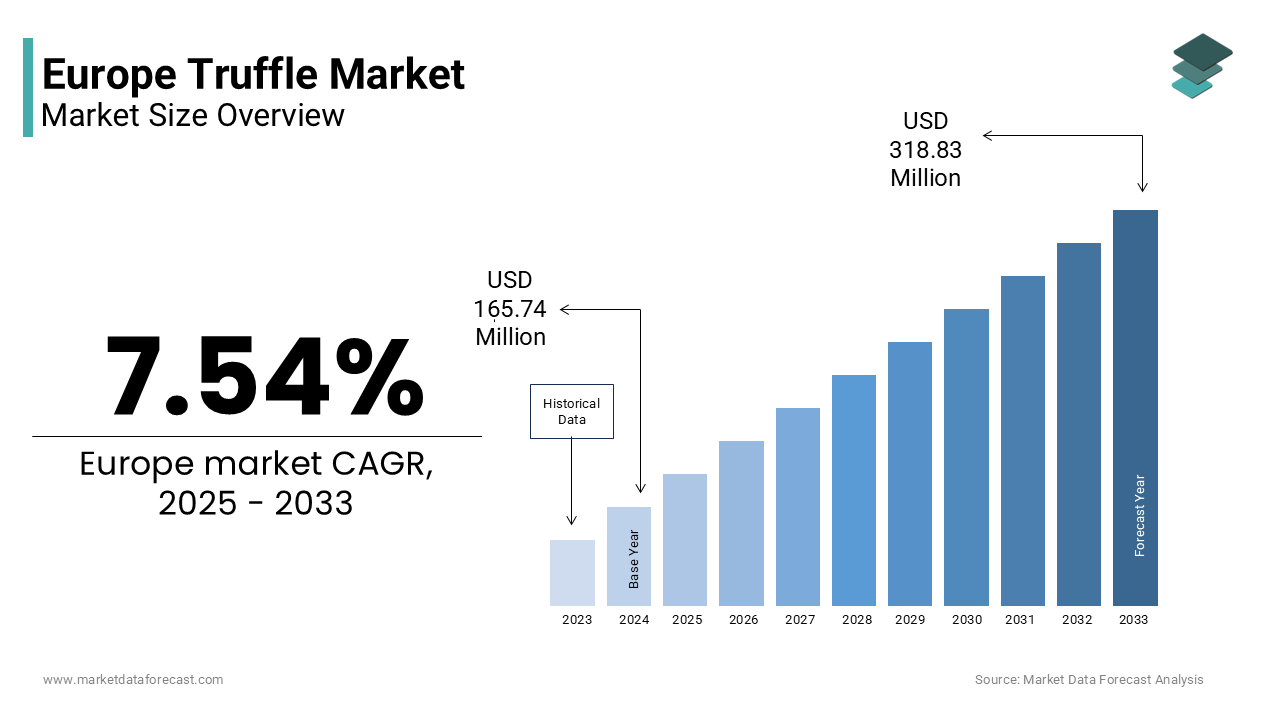
$178 MnMarket Estimate, 2026
$191 MnMarket Forecast, 2034
$342 MnCAGR, 2026–2034
7.54%Europe Truffle Market Size
The Europe truffle market size was valued at USD 178.24 million in 2025 and is projected to reach USD 342.88 million by 2034 from USD 191.68 million in 2026, growing at a CAGR of 7.54%.
The truffle is the cultivation harvesting distribution and culinary application of native hypogeous , primarily black Périgord truffle and white Alba truffle, across the continent’s gastronomic and agroforestry systems. Unlike commodity agricultural goods truffles are wild harvested or cultivated in symbiotic orchards known as truffieres, where host trees such as oak and hazelnut form mycorrhizal relationships with truffle spores. Europe remains the epicenter of global truffle heritage supplying both domestic fine dining and international luxury food channels. According to the European Commission, over 90% of the world’s commercially traded black truffles originate from France Spain and Italy where traditional harvesting methods using trained dogs persist. As per the Food and Agriculture Organization of the United Nations, approximately 40,000 hectares of truffle orchards were actively managed across Southern Europe in 2025, reflecting a resurgence in agroforestry investment. Additionally, the European Union’s Protected Designation of Origin scheme safeguards regional identities, such as Truffe Noire du Périgord and Tartufo Bianco d Alba ensuring authenticity and quality.
MARKET DRIVERS
Deepening Integration into High End Gastronomy and Luxury Food Experiences
The sustained demand for fundamentally anchored in their irreplaceable role in haute cuisine and premium culinary experiences is propelling the growth of Europe truffle market. Top tier restaurants across France, Italy, and Spain feature truffles as seasonal centerpieces with chefs using fresh shavings to elevate risottos pasta and meats during autumn and winter months. According to the European Hospitality Association, many Michelin starred establishments in Europe included truffle-based dishes on their winter menus in 2025 with average price premiums of 35 to 50% compared to non-truffle equivalents. The Alba White Truffle Fair in Italy attracted more than 120000 visitors in 2023, as reported by the Piedmont Regional Tourism Board reinforcing truffles as cultural tourism assets. Furthermore, luxury hotels and private chefs increasingly offer truffle tasting menus and foraging excursions in Tuscany and Provence, where experiential consumption drives secondary demand. This fusion of gastronomic prestige seasonal ritual and sensory uniqueness ensures truffles remain a non-substitutable luxury ingredient immune to conventional food price elasticity.
Expansion of Truffle Cultivation through Agroforestry and Rural Revitalization Programs
The government backed agroforestry initiatives are a revival of truffle cultivation across degraded rural landscapes in Southern Europe. The expansion of truffle cultivation through agroforestry and rural revitalization programs is additionally fuelling the growth of Europe truffle market. Unlike wild harvesting, which is vulnerable to climate and overexploitation cultivated truffieres offer a sustainable alternative that aligns with EU environmental and rural development goals. As per the European Agricultural Fund for Rural Development, many new hectares of truffle orchards were planted between 2020 and 2025 under the Common Agricultural Policy’s agroforestry subsidy scheme. Spain’s Ministry of Agriculture reported that Catalonia and Aragon alone added 3200 hectares of inoculated oak and hazelnut plantations in 2023 with yields expected to commence by 2027. These projects not only restore biodiversity but also generate high value income in depopulated regions where traditional farming is no longer viable. This policy driven cultivation expansion is transforming truffles from a wild foraged rarity into a structured agro ecological enterprise with long term supply stability.
MARKET RESTRAINTS
Climate Change Induced Decline in Natural Truffle Yields
The measurable decline in wild truffle production due to shifting climatic patterns, across traditional foraging zones is restraining the growth of Europe truffle market. Truffles require precise soil moisture temperature and symbiotic tree health conditions all of which are disrupted by prolonged droughts erratic rainfall and rising summer temperatures. Similarly, Italy’s National Research Council reported that Alba white truffle yields fluctuated annually between 2020 and 2025 due to unseasonal frosts and dry autumns. These climatic instabilities erode supply predictability increase price volatility and threaten the cultural continuity of traditional truffle fairs and foraging communities across Europe.
Stringent Regulations and Lack of Harmonized Truffle Authenticity Standards
The inconsistent regulatory frameworks governing truffle labeling origin verification and species declaration across member states is additionally degrading the growth of Europe ruffle market. While the EU protects specific truffle designations under PDO schemes many commercial products, especially truffle oils and pastes contain synthetic aromas like 2,4 dithiapentane rather than real truffle. According to the study, over 70% of truffle flavored products sold in EU supermarkets in 2025 did not disclose the absence of actual truffle content on primary packaging. This transparency gap undermines consumer trust and devalues authentic producers. Moreover, national regulations vary widely France mandates DNA testing for fresh truffle exports, while Spain lacks mandatory species verification leading to mislabeling of less valuable species as Tuber melanosporum. The European Commission’s 2023 food fraud report identified truffle products as a high-risk category with 22 documented cases of substitution in cross border trade.
MARKET OPPORTUNITIES
Development of Truffle Based Functional Food and Cosmetic Ingredients
The scientific validation of truffles’ bioactive compounds for use in nutraceutical and cosmetic applications, which is creating new opportunities for the growth of Europe truffle market. Recent phytochemical analyses have identified significant levels of antioxidants polysaccharides and ergosterol derivatives in European truffle species with demonstrated anti-inflammatory and skin regenerative properties. As per the European Federation of Cosmetics Ingredients, truffle extracts were incorporated into 87 new skincare formulations launched in the EU in 2025 primarily by luxury brands such as La Prairie and Sisley. Clinical studies published by the University of Turin in 2023 confirmed that Tuber magnatum extracts enhanced collagen synthesis in human dermal fibroblasts over a 21 day trial. Additionally, the European Food Safety Authority is reviewing a health claim submission for truffle polysaccharides as immune modulators, which could unlock functional food applications. This diversification beyond culinary use creates a high margin secondary market that leverages truffle rarity for scientific innovation rather than volume consumption.
Growth of Domestic Truffle Tourism and Experiential Agri Hospitality
The fusion of truffle foraging with rural tourism to monetize truffle culture beyond raw sales, which is additionally to enhance the growth of Europe truffle market. Across Italy, France, and Croatia, truffle hunting experiences combined with farm stays cooking classes and tasting menus have become significant rural income streams. The Italian National Institute of Statistics reported that truffle tourism contributed 240 million euros to regional economies in Piedmont and Umbria alone in 2025. Platforms like Airbnb and Plum Guide, now feature certified truffle farm stays with trained dog handlers enhancing accessibility for international visitors. Furthermore, the European Rural Development Network has funded over 45 truffle tourism clusters under its Smart Villages initiative linking orchards to local restaurants and artisanal product sales. This experiential model transforms truffles from a seasonal ingredient into a year-round cultural and economic asset that supports rural sustainability and brand storytelling.
MARKET CHALLENGES
Persistent Shortage of Trained Truffle Dogs and Skilled Harvesters
The acute shortage of qualified truffle hunting teams comprising trained dogs and experienced harvesters is one of the great challenges for the growth of Europe truffle market. Traditional truffle detection relies on canines with months of specialized scent training, yet fewer young people are entering this artisanal profession due to urban migration and low income predictability. According to France’s National Federation of Truffle Producers, the average age of truffle hunters exceeded 62 years in 2025 with fewer than 200 new certifications issued annually nationwide. Similarly, Italy’s Alba Truffle Consortium reported a decline in registered dog handler licenses between 2015 and 2025. Training a truffle dog-costs between 8000 and 12000 euros and takes 12 to 18 months, as confirmed by the European Canine Scent Association, yet reimbursement is uncertain due to yield volatility. This human capital gap restricts sustainable harvesting capacity even in areas with healthy truffle populations thereby constraining supply responsiveness and increasing reliance on unregulated or opportunistic collectors, who may damage ecosystems.
Illegal Harvesting and Lack of Enforcement in Protected Forest Zones
Unregulated and illegal truffle collection in ecologically sensitive woodlands poses a significant threat to long term truffle sustainability and forest health. Despite seasonal restrictions and protected area designations, poaching remains widespread due to high black market values and limited ranger oversight. According to the European Forest Institute, wild truffle harvests in Southern Europe in 2025 occurred outside legal windows or permits with diggers often damaging mycelial networks through aggressive excavation. In Italy, environmental police seized 450 kilograms of illegally harvested white truffles in 2025 but prosecution rates remain due to evidentiary challenges. This enforcement deficit not only depletes wild stocks but also undermines legitimate cultivators who adhere to ecological harvesting protocols creating an uneven competitive landscape that discourages legal investment.
REPORT COVERAGE
| REPORT METRIC | DETAILS |
| Market Size Available | 2025 to 2034 |
| Base Year | 2025 |
| Forecast Period | 2026 to 2034 |
| CAGR | 7.54% |
| Segments Covered | By Nature, Form, Distribution Channel, End Use, Product, and Region |
| Various Analyses Covered | Global, Regional, & Country Level Analysis; Segment-Level Analysis; DROC, PESTLE Analysis; Porter’s Five Forces Analysis; Competitive Landscape; Analyst Overview of Investment Opportunities |
| Regions Covered | UK, France, Spain, Germany, Italy, Russia, Sweden, Denmark, Switzerland, Netherlands, Turkey, and the Czech Republic |
| Market Leaders Profiled | Arotz Foods, SA, Old World Truffle, Truffle Hunter, Inc., Urbani Truffles (Urbani Tartufi S.r.l), Sabatino Tartufi, The Welsh Truffle Company, Truffle Hill, Tartufi Morra Srl, Angellozzi Tartuficoltura, and Great Southern Truffles |
SEGMENTAL ANALYSIS
By Nature Insights
The conventional segment was the largest by accounting for a dominant share of Europe truffle market in 2025 due to the predominance of wild harvested and non-certified cultivated output across traditional producing regions. The majority of truffle foragers and small orchard owners in France, Italy, and Spain, operate outside formal organic certification systems owing to the high cost and administrative burden of compliance. According to the European Commission, fewer than 15% of truffle growers in the EU hold valid organic certification despite many practicing low input agroforestry. The French National Institute for Origin and Quality confirmed that over 80% of black truffles traded at Périgord auctions in 2025 lacked organic labeling yet commanded premium prices based on origin and aroma rather than certification. Additionally, the absence of synthetic inputs in natural truffle ecosystems makes organic distinction less perceptible to buyers who prioritize species authenticity and harvest timing. This disconnect between production reality and certification economics sustains conventional truffles as the market norm even amid rising sustainability awareness.
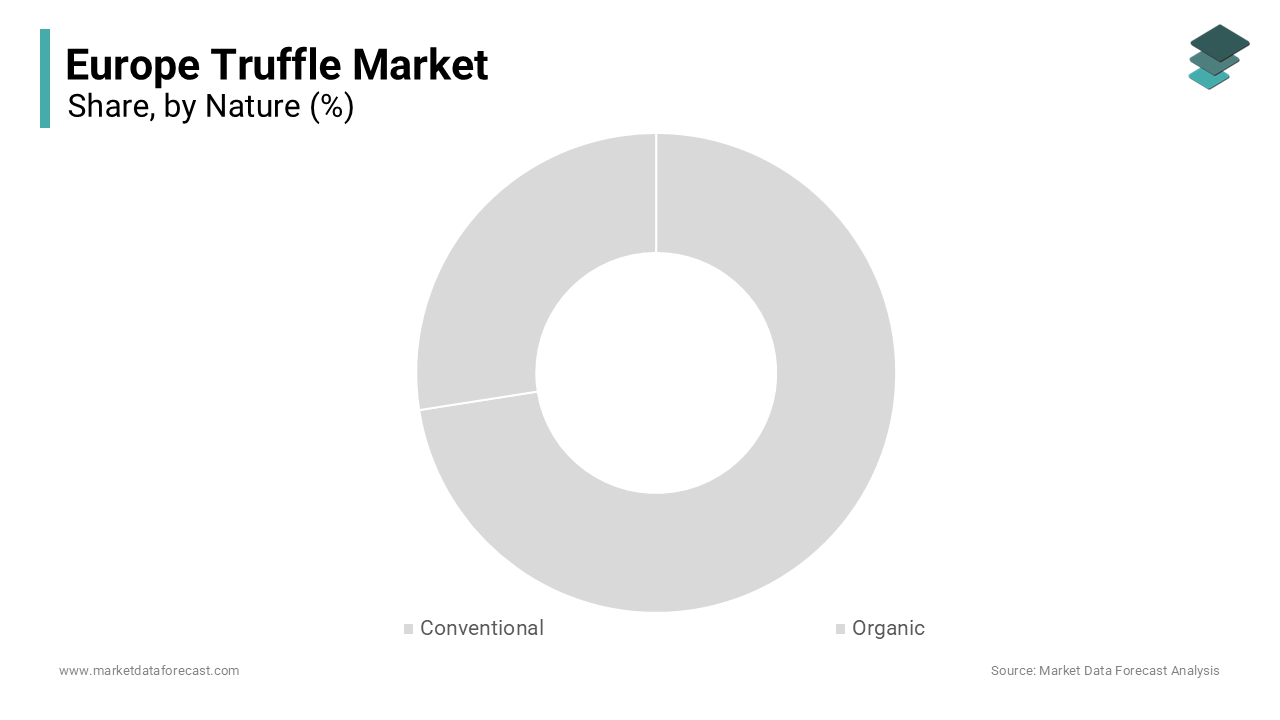
The organic truffle segment is expected to grow at a fastest CAGR of 8.7% throughout the forecast period owing to the rising demand from premium food retailers luxury cosmetics brands and eco conscious gastronomy. As per the European Organic Trade Association, organic truffle sales in EU specialty stores grew in 2025 with Germany and the Netherlands leading in certified product uptake. This shift is reinforced by the EU’s Farm to Fork Strategy which incentivizes agroforestry conversion through the Common Agricultural Policy with new organic truffle orchards registered in 2023, alone according to the European Network of Rural Development. Luxury skincare firms, such as Dr Hauschka and Weleda have launched certified organic truffle extract lines validated by Ecocert highTruffle antioxidant properties without synthetic solvents.
By Form Insights
The fresh segment held a prominent share of the Europe truffle market in 2025 with their irreplaceable role in fine dining seasonal gastronomy and cultural authenticity. The volatile aromatic compounds that define truffle flavor, such as dimethyl sulfide and androstanol degrade rapidly upon processing making fresh specimens the only acceptable form for high end culinary use. According to the Italian National Truffle Observatory, white Alba truffles sold in 2025 were consumed fresh within 72 hours of harvest due to extreme perishability. Similarly, France’s Périgord black truffle auctions transact exclusively in whole fresh tubers with average shelf life of 8 to 12 days, under refrigeration as verified by the French Agency for Food Safety. Michelin starred chefs across Europe consistently reject frozen or preserved alternatives citing loss of aroma complexity and texture.
The processed segment is anticipated to grow at a fastest CAGR of 9.2% throughout the forecast period from innovation in aroma stabilization and demand from industrial food service and cosmetics sectors. As per the European Flavour Association, advances in cryogenic grinding and nitrogen flushing have extended frozen truffle shelf life to 18 months, while retaining 85% of volatile compounds. Companies like Sabatino, Tartufi, and Urbani Tartufi, now supply pre sliced frozen black truffles to airline catering and hotel chains across Europe enabling consistent year round menu inclusion. Additionally, the EU Cosmetic Regulation now permits truffle extract labeling in certified natural products driving demand for standardized processed inputs.
By Distribution Channel Insights
The B2B channel segment was the largest with a significant share of the Europe truffle market in 2025 driven by the concentration of high value consumption in restaurants hotels caterers and food manufacturers. Fine dining establishments in France Italy and Spain purchase directly from truffle brokers or cooperatives during peak season to ensure freshness and origin traceability. According to the study, over 14,000 restaurants across the EU featured truffle dishes on their winter menus in 2025 with average order volumes of 2 to 5 kilograms per venue per season. Luxury hotel groups, such as Accor and Marriott source truffles through dedicated gourmet procurement networks for spa menus and private dining events. Additionally, food manufacturers use processed truffle forms in premium sauces pates and ready meals distributed under private labels in upscale retail. The reliance on professional kitchens as primary consumption points coupled with the need for bulk handling and culinary expertise ensures B2B remains the dominant channel despite growing consumer interest.
The B2C segment is expanding at a CAGR of 10.4% during the forecast period with the direct to consumer e-commerce platforms experiential retail and truffle subscription models. Companies like Tartufi Jim and TruffleHunter, now offer overnight refrigerated delivery of fresh truffles across Western Europe with real time harvest tracking and certificate of origin. The rise of truffle clubs, such as La Truffière in France provides members with monthly curated boxes featuring seasonal species and pairing guides fostering recurring engagement. Furthermore, pop up truffle boutiques in London Berlin and Amsterdam during autumn months have normalized direct retail consumption, among affluent urbanites. Social media influence particularly on Instagram and TikTok has amplified aspirational consumption with #truffle content generating over 2.1 billion impressions in Europe in 2025, according to Meta’s Brand Insights Report.
REGIONAL ANALYSIS
Italy Truffle Market Analysis
Italy was the largest contributor of the Europe truffle market by capturing 38.3% of share in 2025 with its global prestige in white Alba truffles and extensive black truffle production in Umbria and Marche. The country’s truffle culture is deeply institutionalized through regulated harvest seasons certified dog handler licenses and world-renowned fairs, such as the Alba International White Truffle Fair. According to Italy’s Ministry of Agricultural Food and Forestry Policies, over 12,000 hectares of truffle orchards were under cultivation in 2025 with yields rising due to national agroforestry subsidies. The Italian National Research Council has also pioneered DNA barcoding for truffle authentication reducing fraud in domestic markets.
France Truffle Market Analysis
France was ranked second by holding 28.3% of Europe truffle market share in 2025 with its dominance in Périgord black truffle production and integration into haute cuisine. France’s legal framework mandates truffle dog certification and seasonal harvest bans to prevent ecosystem damage a model emulated, across Europe. Additionally, the country’s culinary institutions, such as Le Cordon Bleu embed truffle handling in advanced gastronomy curricula reinforcing cultural continuity. This blend of ecological stewardship gastronomic tradition and regulatory discipline sustains France’s premium market position.
Spain Truffle Market Analysis
Spain truffle market growth is likely to grow with the rapid growth in cultivated black truffle output particularly in Aragon, Catalonia, and Teruel. According to Spain’s Ministry of Agriculture, the country produced over 35 tons of truffles in 2025, making it Europe’s largest volume producer primarily from irrigated truffieres using inoculated holm oak. The Spanish National Research Council confirmed that modern orchards achieve yields of 20 to 40 kilograms per hectare annually, among the highest globally. Government incentives under the Common Agricultural Policy have converted, over 8000 hectares of marginal land into truffle agroforestry systems, since 2020. Furthermore, Spain has developed export oriented processing facilities producing frozen slices and powders for European B2B clients. This strategic pivot from wild foraging to scalable cultivation positions Spain as the market’s volume engine and innovation frontier.
Germany Truffle Market Analysis
Germany truffle market growth is likely to grow with the high value B2C and B2B demand rather than domestic production. As Europe’s largest economy and home to over 300 Michelin starred restaurants, Germany is the primary import destination for Italian and French truffles. The rise of organic gourmet retail chains like Alnatura and Denn’s has also expanded direct consumer access with certified truffle oils and salts featuring prominently. Additionally, German cosmetic firms are major buyers of processed truffle extracts for anti-aging formulations.
United Kingdom Truffle Market Analysis
The United Kingdom truffle market growth is likely to be driven by luxury hospitality demand and emerging domestic cultivation efforts. According to the UK Truffle Association, truffle orchards are now under management in England and Wales with first commercial harvests of native summer truffles reported in 2023 from farms in Surrey and Herefordshire. London alone hosts more than 80 Michelin listed venues that feature seasonal truffle menus primarily sourcing from Italy and France. Furthermore, UK based e-commerce platforms, such as truffleuk.com have pioneered next day chilled delivery establishing a robust direct to consumer channel.
COMPETITIVE LANDSCAPE
Competition in the Europe truffle market is defined by authenticity provenance and sensory quality rather than price or volume. The market features a fragmented base of small foragers and orchardists alongside a handful of vertically integrated premium brands that control sourcing processing and distribution. Differentiation hinges on species verification harvest timing cold chain integrity and adherence to regional terroir identity. Large players compete through traceability technology sustainability credentials and direct chef engagement while smaller producers rely on Protected Designation of Origin status and local reputation. Barriers to entry include access to certified harvest zones trained dogs and rapid logistics infrastructure. Adulteration remains a persistent issue undermining trust and enabling unfair competition from synthetic truffle oil sellers.
KEY MARKET PLAYERS
Some of the notable key players in the European truffle market are
- Arotz Foods, SA
- Old World Truffle
- Truffle Hunter, Inc.
- Urbani Truffles (Urbani Tartufi S.r.l)
- Sabatino Tartufi
- The Welsh Truffle Company
- Truffle Hill
- Tartufi Morra Srl
- Angellozzi Tartuficoltura
- Great Southern Truffles
Top Players in the Market
- Urbani Tartufi is a globally recognized Italian truffle specialist headquartered in Spoleto with operations spanning cultivation processing and international distribution. The company sources fresh truffles from over 2000 certified foragers across Italy and manages proprietary truffle orchards in Umbria and Marche. Urbani supplies Michelin starred restaurants luxury hotels and gourmet retailers in over 60 countries while maintaining strict cold chain logistics to preserve aroma integrity. The company launched a blockchain enabled traceability platform allowing buyers to verify harvest date location and species authenticity via QR code. This innovation reinforces Urbani’s commitment to transparency and combats widespread adulteration in the global truffle trade.
- Sabatino Tartufi is a leading European truffle enterprise with deep roots in Italy and a robust international footprint in North America and Asia. The company operates one of Europe’s largest truffle processing facilities adhering to ISO 22000 standards for hygiene and aroma preservation. Sabatino partners directly with truffle hunters in Alba and Norcia ensuring first access to seasonal harvests. In early 2025 Sabatino introduced a line of certified organic frozen truffle slices using cryogenic vacuum sealing to extend shelf life without chemical additives. The company also expanded its B2B culinary ambassador program training chefs across Europe on proper truffle handling and pairing techniques to drive authentic usage.
- La Maison de la Truffe is a Paris based premium truffle brand renowned for its integration of truffles into fine dining retail and experiential commerce. Beyond selling fresh and processed truffles the company operates flagship boutiques in Paris and London offering truffle tastings cooking classes and seasonal discovery boxes. It supplies over 150 high end restaurants across France and the UK with same day delivery from its central Paris cold hub. La Maison de la Truffe launched a sustainability initiative certifying all its black truffles under France’s Haute Valeur Environnementale agroforestry standard. This move aligns the brand with Europe’s growing demand for ecologically responsible luxury food sourcing.
Top Strategies Used by the Key Market Participants
Key players in the Europe truffle market focus on origin traceability through digital verification systems to combat fraud and assure authenticity. They invest in cold chain and cryogenic preservation technologies to extend shelf life while maintaining volatile aroma compounds. Companies develop direct partnerships with certified foragers and truffle orchard owners to secure first harvest access and quality control. Strategic expansion into organic certification and agroforestry sustainability standards enhances premium positioning and meets EU green consumer demand. Additionally, they integrate experiential retail and chef education programs to cultivate authentic culinary usage and build brand loyalty beyond transactional sales.
MARKET SEGMENTATION
This research report on the European truffle market has been segmented and sub-segmented based on categories.
By Nature
- Conventional
- Organic
By Form
- Fresh
- Processed
By Distribution Channel
- B2C
- B2B
By End Use
- Food & Beverages
- Cosmetics & Personal Care Products
- Pharmaceuticals
By Product
- Black Truffles
- White Truffles
- Others
By Country
- UK
- France
- Spain
- Germany
- Italy
- Russia
- Sweden
- Denmark
- Switzerland
- Netherlands
- Turkey
- Czech Republic
- Rest of Europe