- Product Description Description
- Table of Contents TOC
- List of Table & Figure LOT
- Get Free Sample PDF Sample PDF
Market Size, 2025
$7.45 BnMarket Estimate, 2026
$7.83 BnMarket Forecast, 2034
$11.62 BnCAGR, 2026–2034
5.06%Europe Turbochargers Market Report Summary
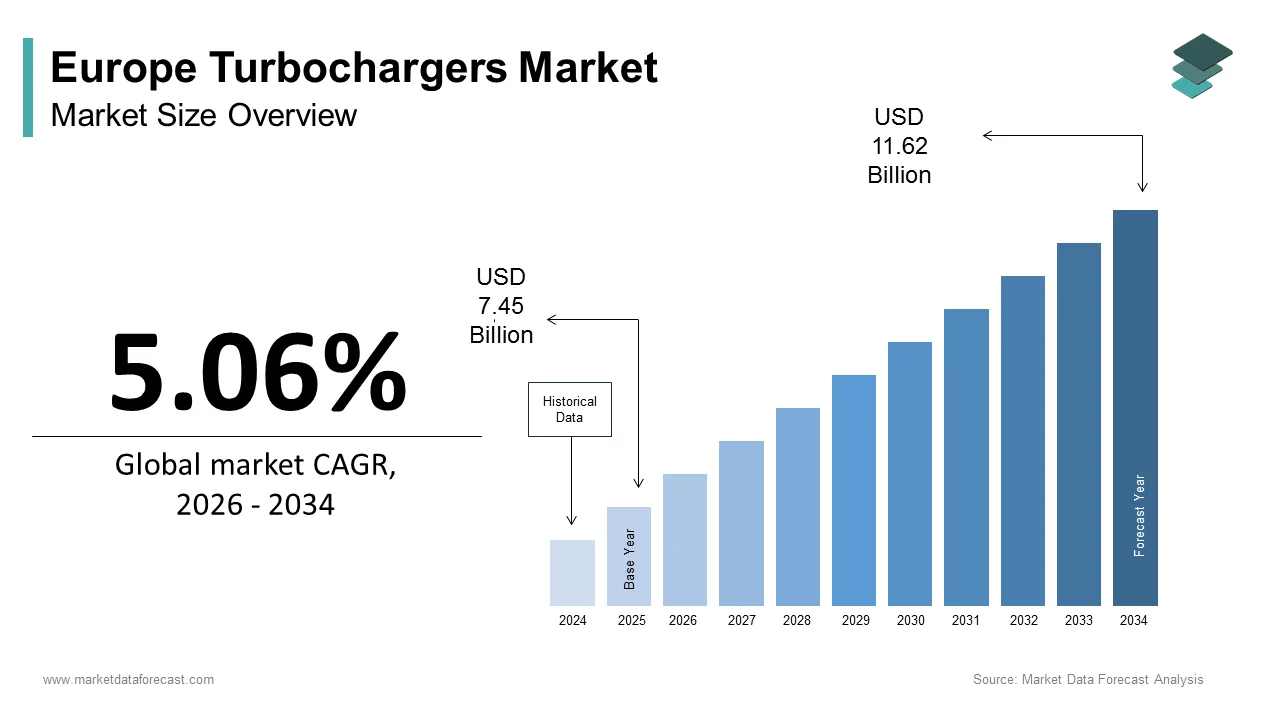
The Europe turbochargers market was valued at USD 7.45 billion in 2025 and is projected to reach USD 11.62 billion by 2034, growing from USD 7.83 billion in 2026 at a CAGR of 5.06% during the forecast period. Market growth is driven by stringent emission regulations, increasing demand for fuel-efficient engines, and the continued adoption of engine downsizing technologies. Turbochargers enhance engine performance while reducing fuel consumption and emissions, making them critical components in modern automotive and industrial engines. Rising production of passenger vehicles and commercial vehicles across Europe further supports the growth of the Europe turbochargers market.
Key Market Trends
- Increasing adoption of engine downsizing technologies
- Rising demand for fuel-efficient and low-emission vehicles
- Growing use of advanced turbocharger technologies in automotive engines
- Expansion of turbocharging systems in hybrid and performance vehicles
- Increasing demand for turbochargers in commercial vehicle applications
Segmental Insights
- Based on technology, the variable geometry technology segment dominated the Europe turbochargers market in 2025, supported by its ability to improve engine efficiency and performance across different speed ranges.
- Based on application, the light commercial vehicle segment led the market in 2025 by capturing the largest share, driven by increasing demand for fuel-efficient transport and logistics vehicles.
Regional Insights
- Germany led the Europe turbochargers market in 2025 by holding 27.7% of the regional market share, supported by strong automotive manufacturing and engineering capabilities.
- France ranked second in 2025, driven by a well-established automotive industry.
- Italy is expected to account for a notable share during the forecast period due to its performance in the automotive sector, commercial vehicle manufacturing, and marine engine industry
- United Kingdom is projected to witness healthy growth supported by aerospace, premium automotive manufacturing, and motorsport engineering.
- Spain is expected to grow steadily due to large-scale vehicle production, particularly in small cars and light commercial vehicles.
Competitive Landscape
The Europe turbochargers market is competitive, with leading automotive component manufacturers focusing on advanced turbocharging technologies, improved fuel efficiency, and electrified turbo systems. Companies are investing in R&D to develop next-generation turbochargers compatible with hybrid and low-emission engines.
Prominent players in the Europe turbochargers market include Garrett Motion Inc, BorgWarner Inc, Mitsubishi Heavy Industries Ltd, IHI Corporation, Cummins Inc, Continental AG, Robert Bosch GmbH, MAHLE GmbH, BMTS Technology, and ABB Ltd.
 Download Free Sample Report
Europe Turbochargers Market Size
The Europe turbocharges market size was calculated to be USD 7.45 billion in 2025 and is anticipated to be worth USD 11.62 billion by 2034, from USD 7.83 billion in 2026, growing at a CAGR of 5.06% during the forecast period.
Turbochargers comprise a specialized sector dedicated to the design, manufacturing, and integration of forced induction systems that enhance engine efficiency and power output across automotive, commercial vehicle, and industrial applications. This industry is defined by its critical role in enabling internal combustion engines to meet stringent European emission standards while maintaining performance metrics demanded by consumers. The region distinguishes itself through a rigorous regulatory environment that mandates significant reductions in carbon dioxide emissions and nitrogen oxides, forcing original equipment manufacturers to adopt downsized engines equipped with advanced turbocharging technology. As per the European Environment Agency, road transport accounts for nearly one quarter of total greenhouse gas emissions in the European Union, which indicates the urgency for technologies that optimize fuel combustion and reduce waste energy. Furthermore, as per the European Automobile Manufacturers Association, the average engine displacement in new passenger cars has decreased substantially over the past decade, a trend directly linked to the widespread adoption of turbochargers in modern powertrains. Unlike markets driven primarily by performance, the European landscape emphasizes fuel economy and emission compliance, which has accelerated innovation in variable geometry turbines and electrically assisted compressors.
MARKET DRIVERS
Stringent Emission Regulations Mandating Engine Downsizing
The strict enforcement of emission standards such as Euro 6d and the upcoming Euro 7 norms is primarily driving the growth of the Europe turbochargers market. These regulations compel automakers to adopt engine downsizing strategies paired with forced induction. As per the European Commission, fleet-wide CO₂ emission targets for new cars have been progressively lowered, making large naturally aspirated engines economically and technically unviable for mass-market vehicles. Turbocharging enables smaller engines to deliver the torque and performance of larger units while consuming less fuel and emitting fewer pollutants. As per the International Council on Clean Transportation, over 80% of new European passenger cars are now equipped with turbocharged engines, driven by compliance requirements. Real-driving emissions testing further reinforces demand, as precise boost control offered by modern turbo systems is essential for clean performance under diverse operating conditions. This regulatory pressure transforms turbochargers from optional performance enhancers into mandatory components for legal operation in the EU.
Rising Demand for Fuel Efficiency Amidst Volatile Energy Costs
The escalating demand for fuel efficiency, amplified by volatile energy prices and growing environmental awareness, is further contributing to the turbochargers market expansion in Europe. As per Eurostat, transport fuel prices have experienced sharp fluctuations in recent years, prompting both consumers and fleet operators to prioritize vehicles that maximize fuel economy. Turbochargers recover wasted exhaust energy and convert it into useful work, improving thermal efficiency and reducing fuel consumption. As per the European Association of Automotive Suppliers, downsized turbocharged engines can deliver up to 20% better fuel economy compared to naturally aspirated equivalents. This incentive is particularly strong in the commercial vehicle sector, where fuel represents a major portion of operating costs. Additionally, the link between fuel efficiency and reduced carbon footprints appeals to environmentally conscious consumers. The convergence of economic necessity and ecological responsibility ensures sustained demand for turbocharging solutions across passenger and commercial segments.
MARKET RESTRAINTS
Accelerated Transition to Battery Electric Vehicles
The rapid rise of battery electric vehicles (BEVs) acts as a fundamental restraint on the turbocharger market by gradually eliminating the internal combustion engine from passenger cars. As per the European Automobile Manufacturers Association, the share of fully electric cars in new registrations has reached double-digit percentages in major markets like Germany and France, signaling a structural shift away from combustion engines. With EU bans on new fossil fuel-powered vehicles set for 2035, the long-term addressable market for turbochargers faces inevitable contraction. Electric motors do not require exhaust gases or air compression, rendering turbochargers obsolete in pure EV applications. As per the International Energy Agency, projections show steady declines in ICE production over the next two decades, directly reducing turbocharger demand. While hybrids retain some relevance, the trajectory toward zero-emission fleets creates uncertainty for suppliers and dampens enthusiasm for next-generation conventional turbo systems.
High Complexity and Cost of Advanced Turbocharging Systems
The increasing technical complexity and cost of advanced turbocharging systems also restrain market growth, particularly in entry-level and cost-sensitive segments. Modern turbochargers with variable geometry mechanisms, electric assist motors, and sophisticated electronic controls require precision engineering and expensive materials to withstand extreme operating conditions. As per the European Association of Automotive Suppliers, the bill of materials for high-performance variable geometry turbos is significantly higher than for standard fixed-geometry units, impacting vehicle affordability. Supply chain constraints for rare earth magnets and high-grade superalloys further exacerbate cost pressures. Additionally, specialized maintenance requirements and higher repair costs deter some consumers and fleet operators, who prefer simpler naturally aspirated engines for heavy-duty applications. These financial and technical hurdles limit universal adoption of advanced turbo technologies, slowing overall market penetration and growth.
MARKET OPPORTUNITIES
Integration of Electrically Assisted Turbocharging in Hybrid Powertrains
The rise of electrified powertrains creates a promising opportunity for turbocharger manufacturers in Europe. Electrically assisted turbochargers eliminate lag and enhance efficiency in hybrid vehicles by using a small motor to spin the compressor independently of exhaust flow, delivering immediate boost pressure. As per the European Commission, hybrid vehicles are expected to remain a significant portion of the new car fleet for the next two decades, ensuring sustained demand for advanced turbo technologies. Research from the Fraunhofer Institute highlights that electric turbos improve transient response and reduce emissions during cold starts, addressing key limitations of conventional systems. This positions electrically assisted turbos as essential components for plug-in hybrids and range extenders, where synergy between electric drive and forced induction maximizes overall efficiency. Manufacturers who pioneer cost-effective and reliable solutions can capture a lucrative niche that bridges internal combustion and full electrification.
Expansion of Hydrogen and Synthetic Fuel Compatible Turbo Systems
The growing focus on alternative fuels such as hydrogen and synthetic e-fuels offers another substantial opportunity for the Europe turbochargers market. Heavy-duty transport, maritime, and stationary power generation sectors are exploring these fuels as decarbonization pathways that still rely on combustion engines. As per the European Hydrogen Backbone initiative, widespread hydrogen infrastructure deployment will require engines capable of burning low-density hydrogen efficiently, demanding turbochargers with modified compressor maps and materials resistant to hydrogen embrittlement. Hydrogen’s high flame speed and low energy density per volume necessitate higher boost pressures and precise air-fuel mixing, creating demand for next-generation turbo designs. As per the European Association of Internal Combustion Engine Manufacturers, adapting turbo technology for hydrogen blends represents a significant growth avenue, particularly for trucks and buses, where battery electrification faces range and weight challenges. Developing turbochargers optimized for clean fuels extends the lifecycle of combustion technology in hard-to-electrify sectors, aligning with Europe’s sustainability goals.
MARKET CHALLENGES
Supply Chain Vulnerabilities for Critical Raw Materials
The fragility in global supply chains for critical raw materials essential to turbocharger production, which is one of the major challenges to the Europe turbochargers market growth. Advanced turbochargers rely on nickel-based superalloys, cobalt, and rare earth elements for electric assist systems, much of which is imported from geopolitically unstable regions. As per the European Raw Materials Alliance, Europe depends heavily on imports for these strategic materials, leaving the industry exposed to trade disruptions and price volatility. Recent logistics crises have caused delays in castings and electronic components, while data from the European Steel Association shows that fluctuations in specialty metal prices squeeze supplier margins. Competition from the battery and renewable energy sectors further intensifies scarcity. Without resilient domestic refining capacity and diversified sourcing, turbocharger production remains vulnerable to external shocks.
Technical Limitations in Extreme Operating Conditions
Turbochargers also face significant technical challenges as engines become smaller yet more powerful. Higher exhaust temperatures, faster rotational speeds, and greater thermal cycling push the limits of current material science and bearing technologies. As per the Society of Automotive Engineers, extreme downsizing has led to increased turbo failures from oil coking and bearing wear, requiring costly redesigns and robust cooling systems. Integration with complex after-treatment systems creates backpressure issues that compromise efficiency and durability. OEM feedback highlights the difficulty of ensuring consistent performance across real-driving emissions tests. Developing materials capable of withstanding temperatures exceeding 1,000°C without degradation requires substantial R&D investment. Additionally, controlling noise, vibration, and harshness in high-boost systems adds complexity. These engineering hurdles increase development cycles and costs, slowing innovation and delaying next-generation solutions needed to meet future efficiency targets.
REPORT COVERAGE
| REPORT METRIC | DETAILS |
| Market Size Available | 2025 to 2034 |
| Base Year | 2025 |
| Forecast Period | 2026 to 2034 |
| CAGR | 5.06% |
| Segments Covered | By Technology, Application, And Region |
| Various Analyses Covered | Global, Regional & Country Level Analysis; Segment-Level Analysis; DROC, PESTLE Analysis; Porter’s Five Forces Analysis; Competitive Landscape; Analyst Overview of Investment Opportunities |
| Regions Covered | UK, France, Spain, Germany, Italy, Russia, Sweden, Denmark, Switzerland, Netherlands, Turkey, and the Czech Republic |
| Market Leaders Profiled | Garrett Motion Inc., BorgWarner Inc., Mitsubishi Heavy Industries Ltd., IHI Corporation, Cummins Inc., Continental AG, Robert Bosch GmbH, MAHLE GmbH, BMTS Technology, ABB Ltd. |
SEGMENTAL ANALYSIS
By Technology Insights
The variable geometry technology segment led the market by holding the major share of the Europe turbochargers market in 2025. The growth of the variable geometry technology segment in the European market is driven by its ability to optimize engine performance across a wide range of operating speeds while ensuring compliance with stringent emission norms. The defining feature of this technology is its movable vanes, which adjust the aspect ratio of the turbine housing to eliminate turbo lag at low speeds and prevent over-boosting at high speeds. As per the European Automobile Manufacturers Association, Euro 6d and the upcoming Euro 7 standards have made variable geometry turbines indispensable for diesel passenger cars and light commercial vehicles, particularly for managing exhaust gas recirculation and particulate filter regeneration. According to the International Council on Clean Transportation, over 90% of new diesel engines sold in Europe now utilize variable geometry systems, enabling significant downsizing without sacrificing torque or drivability. Their versatility across diverse driving cycles, proven reliability of electronic actuation, and mature supply chain cement their position as the standard solution for modern European powertrains, surpassing simpler wastegate designs in both value and volume.
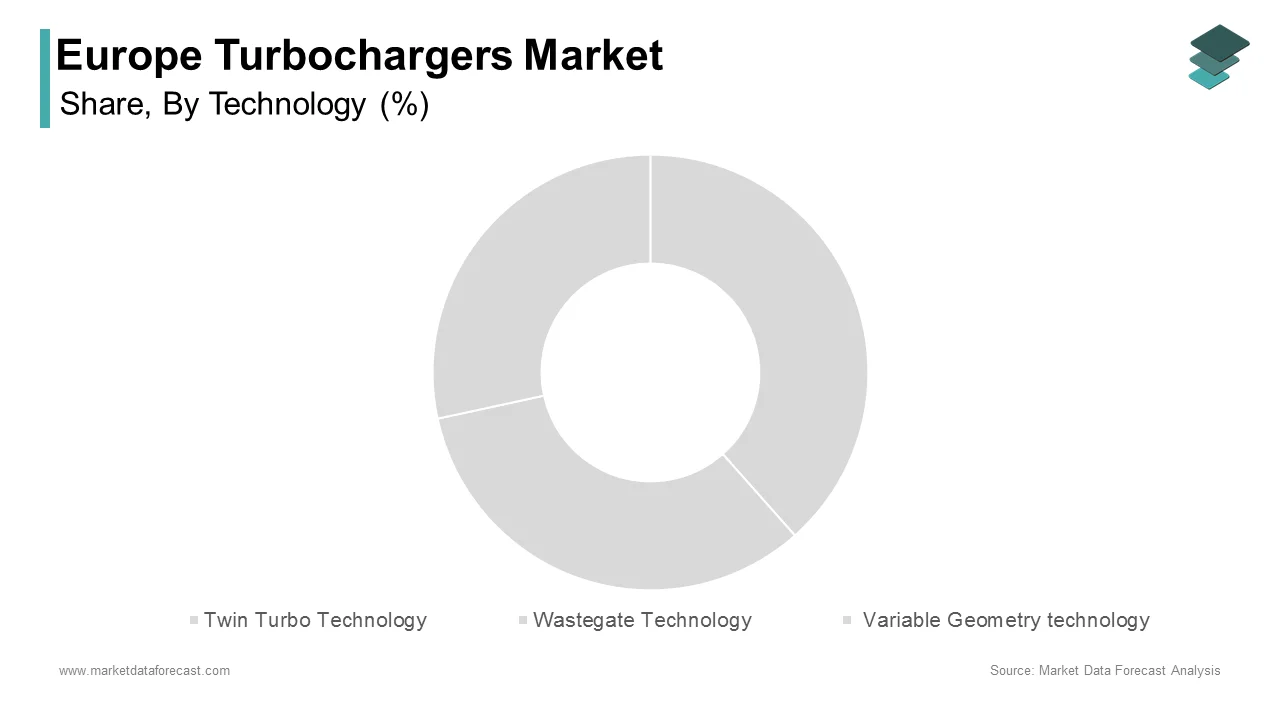
The twin turbo technology segment is estimated to witness a CAGR of 9.4% over the forecast period in the European market. The rising demand for high-performance yet fuel-efficient engines in premium passenger vehicles and heavy-duty commercial applications is driving the growth of the twin turbo technology segment in the European market. Sequential and parallel twin turbo setups allow smaller displacement engines to deliver the power of larger naturally aspirated units while reducing fuel consumption. As per the German Association of the Automotive Industry, penetration of twin turbo systems in the premium segment has surged as automakers balance performance expectations with strict emission limits. One smaller turbo provides immediate response at low speeds, while a larger unit engages at higher speeds for maximum power, flattening the torque curve. Research from the Society of Automotive Engineers confirms that twin turbo configurations improve thermal efficiency and reduce specific fuel consumption compared to single turbo alternatives. Adoption in heavy-duty trucks to meet future Euro VII standards further drives demand, positioning twin turbos as the most dynamic growth engine in this segment.
By Application Insights
The light commercial vehicle segment held the dominant position in the Europe turbochargers market in 2025 by accounting for the largest market share. This dominance is driven by the explosive growth of e-commerce, which has created massive demand for efficient, reliable delivery vans. Turbocharged diesel and gasoline engines maximize payload capacity and range, making them indispensable for logistics fleets. As per Eurostat, parcel delivery volumes in the EU have grown exponentially, prompting logistics companies to prioritize vehicles with superior fuel economy and low-end torque—attributes delivered by advanced turbocharging systems. According to the European Automobile Manufacturers Association, nearly all new LCVs registered in Europe are equipped with turbocharged engines to comply with strict CO₂ emission targets. Their frequent operation in urban stop-start traffic makes turbo responsiveness critical for efficiency. Engine downsizing trends in this sector further reinforce reliance on forced induction. The sheer scale of LCV fleets, combined with regulatory pressure, ensures this application remains the cornerstone of turbocharger demand.
The agriculture and construction segment is projected to register the fastest CAGR of 8.12% over the forecast period in this regional market, owing to the modernization of off-highway machinery to meet Stage V emission standards. Tractors, excavators, and harvesters require engines that deliver high torque at low RPMs, a demand perfectly met by variable geometry and high-efficiency turbochargers. As per the European Construction Equipment Federation, precision agriculture and automated construction equipment have increased demand for engines with precise air management systems. The European Association of Automotive Suppliers notes that retrofitting older fleets and producing new compliant machinery has created strong aftermarket and OEM demand. Transition to alternative fuels like biodiesel and renewable diesel also requires robust turbo systems capable of handling varying fuel qualities. This combination of regulatory compliance, performance needs, and technological modernization fuels rapid expansion, making agriculture and construction the fastest-growing application segments.
REGIONAL ANALYSIS
Germany Turbocharges Market Analysis
Germany stood as the undisputed leader in the Europe turbochargers market with 27.7% of the regional market share. The dominance of Germany in the European market can be credited to its role as the automotive heartland of Europe and home to major OEMs and tier-one suppliers. The presence of BMW, Mercedes-Benz, and Volkswagen ensures continuous demand for cutting-edge forced induction technologies to meet strict German and EU emission standards while maintaining performance. As per the German Federal Statistical Office, the automotive sector remains the largest industrial contributor to the national economy, with significant R&D investments in next-generation powertrains. Germany also hosts leading turbocharger manufacturers and specialized component suppliers, supported by a highly skilled workforce and advanced infrastructure. As per the German Association of the Automotive Industry, the push toward hybridization and synthetic fuels is accelerating the adoption of electrically assisted and hydrogen-compatible turbochargers. Strong integration between academia, research institutes, and industry ensures continuous innovation, cementing Germany’s position as the most influential market in the region.
France Turbocharges Market Analysis
France captured the second largest share of the Europe turbochargers market in 2025. The strong tradition in diesel technology and evolving focus on electrified, efficient combustion solutions are driving the French market growth. Stellantis and other major automotive groups drive significant demand for advanced turbocharging systems across passenger and commercial lines. As per the French Ministry of Ecological Transition, the mobility transformation plan prioritizes low-emission logistics vehicles, many of which rely on optimized turbocharged engines. France’s expertise in high-pressure diesel injection and turbo matching has historically made it a hub for efficient powertrain development. As per the French Automotive Industry Committee, the shift toward mild-hybrid architectures is creating opportunities for electrically assisted turbochargers that complement battery systems. A strong domestic supply chain and commitment to zero-emission compatible components reinforce France’s standing as a prominent market player.
Italy Turbocharges Market Analysis
Italy is anticipated to hold a notable share of the Europe turbochargers market during the forecast period due to its performance automotive sector, commercial vehicle manufacturing, and marine engine industry. Demand balances high-performance sports car requirements with practical fleet needs. Iconic brands like Ferrari, Lamborghini, and Iveco drive the adoption of bespoke, high-efficiency turbocharging solutions. As per the Italian Association of the Automotive Industry, the luxury and supercar segments are early adopters of twin-turbo and electric turbo technologies to meet emission rules without compromising driving dynamics. Italy’s logistics hub role drives demand for turbocharged delivery vans and trucks, while the marine sector contributes significantly with advanced turbo systems for racing and leisure boats. The craftsmanship and engineering precision associated with “Made in Italy” extend to turbocharger components, fostering a niche but high-value market.
UK Turbocharges Market Analysis
The UK is expected to exhibit a healthy CAGR in the Europe turbochargers market over the forecast period, owing to its aerospace industry, premium automotive manufacturing, and motorsport engineering. The market is influenced by global automotive headquarters and a dense network of high-tech engineering firms specializing in forced induction. As per the Society of Motor Manufacturers and Traders, the UK automotive sector is pivoting toward high-value, low-volume production, favoring complex twin-turbo and variable geometry systems. The aerospace sector contributes significantly, with gas turbine engines for regional aircraft and business jets relying on UK-manufactured turbo components. As per the Department for Business and Trade, motorsport serves as a testing ground for cutting-edge turbo technologies that later transfer to road cars. Strong intellectual property frameworks and collaboration between universities and industry stimulate rapid innovation, ensuring the UK remains a dynamic market.
Spain Turbocharges Market Analysis
Spain is estimated to showcase a steady CAGR in the Europe turbochargers market during the forecast period due to its massive vehicle production capacity, particularly in small cars and light commercial vehicles. Spain serves as a major manufacturing hub for European automotive groups, producing millions of turbocharged vehicles annually for export. As per the Spanish Association of Automobile and Truck Manufacturers, production volumes consistently rank among Europe’s highest, driving substantial OEM demand. The government’s automotive recovery plan includes investments in electrification and connected mobility, often incorporating turbocharged range extenders and hybrid systems. As per the National Statistics Institute, modernization of agricultural and construction fleets to meet EU Stage V norms boosts aftermarket and industrial demand. Competitive labor costs and established supply chains make Spain attractive for turbocharger component manufacturing. This combination of high-volume production, strategic investment, and industrial diversification ensures Spain remains a vital contributor to the European turbochargers market.
COMPETITION OVERVIEW
The competition in the Europe turbochargers market is characterized by intense rivalry among established global giants and specialized regional players who constantly innovate to capture market share through technological superiority and efficiency gains. Major players differentiate themselves by securing exclusive contracts for next-generation hybrid and hydrogen-powered vehicles while offering integrated systems that combine turbocharging with electric boosting capabilities. The market sees frequent launches of advanced variable geometry and twin-turbo units designed to meet strict Euro 7 emission norms and improve fuel economy across diverse driving cycles. Price competition is moderate since buyers prioritize reliability and performance metrics over cost savings, given the critical nature of these components in meeting legal standards. Regional specialists compete by providing highly customized solutions for niche applications such as motorsport, marine propulsion, and heavy-duty off-highway machinery. The barrier to entry remains high due to significant research costs and complex intellectual property landscapes surrounding aerodynamic design and material science. Collaboration between manufacturers and automotive OEMs is increasing to accelerate the development of sustainable propulsion technologies. Overall, the landscape is dynamic with companies vying to establish leadership in the transition towards electrified and alternative fuel-compatible turbocharging solutions across the continent.
KEY MARKET PLAYERS
A few major players of the Europe turbochargers market include
- Garrett Motion Inc
- BorgWarner Inc
- Mitsubishi Heavy Industries Ltd
- IHI Corporation
- Cummins Inc
- Continental AG
- Robert Bosch GmbH
- MAHLE GmbH
- BMTS Technology
- ABB Ltd
Top Strategies Used by Key Market Participants
Key players in the Europe turbochargers market primarily focus on product innovation and electrification to differentiate their offerings and meet evolving regulatory demands. Companies heavily invest in research and development to create electrically assisted turbochargers that eliminate lag and enhance hybrid powertrain efficiency. Strategic acquisitions of specialized technology firms enable manufacturers to rapidly expand their portfolios into emerging areas like hydrogen fuel systems and thermal management. Expanding local production facilities within Europe helps companies mitigate supply chain risks and comply with regional content requirements while reducing logistics costs. Firms increasingly collaborate with original equipment manufacturers to co-develop customized solutions that integrate seamlessly with next-generation engine architectures. Offering comprehensive digital services such as predictive maintenance and remote diagnostics helps build long-term relationships with industrial clients. Diversifying into non-automotive sectors like marine and power generation reduces dependency on the volatile automotive cycle. Continuous engagement with regulatory bodies ensures early adaptation to upcoming emission standards and maintains a competitive advantage.
Leading Players in the Market
- Garrett Motion Inc. stands as a global pioneer in the Europe turbochargers market, delivering advanced forced induction solutions that define efficiency and performance for leading automotive manufacturers. The company significantly contributes to the international landscape by spearheading the development of electrically assisted turbochargers and hydrogen-compatible systems essential for future mobility. Garrett recently strengthened its European position by expanding its research and development centers to accelerate the creation of next-generation technologies for hybrid and zero-emission powertrains. The firm actively collaborates with original equipment manufacturers to integrate smart connectivity features that optimize engine management in real time. By leveraging its extensive manufacturing footprint across the continent, Garrett ensures rapid delivery and robust supply chain resilience for critical components. Their commitment to sustainability drives the adoption of lightweight materials and energy-efficient production processes. This strategic focus on innovation and electrification solidifies their reputation as a leader in the global turbocharging industry.
- BorgWarner Inc. leverages its extensive engineering heritage to maintain a dominant presence in the Europe turbochargers market through a comprehensive portfolio of variable geometry and twin-turbo systems. The company contributes globally by providing critical propulsion technologies that enable cleaner and more efficient internal combustion engines alongside electrified solutions. BorgWarner recently enhanced its European footprint by acquiring specialized firms to bolster its capabilities in electric boosting and thermal management systems. The firm focuses on developing integrated modules that combine turbochargers with electric motors to eliminate lag and maximize fuel economy. Through strategic partnerships with major European automakers, BorgWarner secures long-term contracts for supplying advanced air handling systems for upcoming vehicle platforms. Their dedication to reducing carbon emissions drives the continuous evolution of high-efficiency turbomachinery. This customer-centric approach, combined with aggressive technological expansion, ensures the company remains a trusted partner for sustainable mobility worldwide.
- Mitsubishi Heavy Industries Engine Systems is a leading innovator in the Europe turbochargers market, distinguished by its precision engineering and reliability in both automotive and industrial applications. The company plays a pivotal role globally by supplying robust turbocharging solutions for passenger cars, commercial vehicles, and marine engines that meet stringent emission standards. Mitsubishi Heavy Industries recently strengthened its market position in Europe by launching a new series of turbochargers designed specifically for hydrogen combustion engines and synthetic fuels. The firm actively invests in digital twin technologies to simulate performance and predict maintenance needs, offering added value to industrial clients. By optimizing its European logistics network, the company ensures timely support and parts availability for diverse sectors ranging from agriculture to power generation. Their focus on durability and adaptability allows their products to thrive in harsh operating conditions. This holistic approach to combining traditional expertise with future-ready innovations allows the company to meet evolving energy demands. Their strong brand recognition and focus on quality continue to drive growth and influence in the European and global markets.
MARKET SEGMENTATION
This research report on the Europe turbochargers market has been segmented and sub-segmented based on technology, application & region.
By Technology
- Twin Turbo Technology
- Wastegate Technology
- Variable Geometry technology
By Application
- Light Commercial Vehicle
- Heavy Commercial Vehicle
- Ships and Aircrafts
- Agriculture and Construction
- Locomotives
By Region
- UK
- France
- Spain
- Germany
- Italy
- Russia
- Sweden
- Denmark
- Switzerland
- Netherlands
- Turkey
- Czech Republic
- Rest of Europe