- Product Description Description
- Table of Contents TOC
- List of Table & Figure LOT
- Get Free Sample PDF Sample PDF
Market Size, 2025
$1.92 BnMarket Estimate, 2026
$2.17 BnMarket Forecast, 2034
$5.80 BnCAGR, 2026–2034
13.07%Europe Ultrasonic Sensor Market Size, Growth, Trends & Forecast (2026–2034)
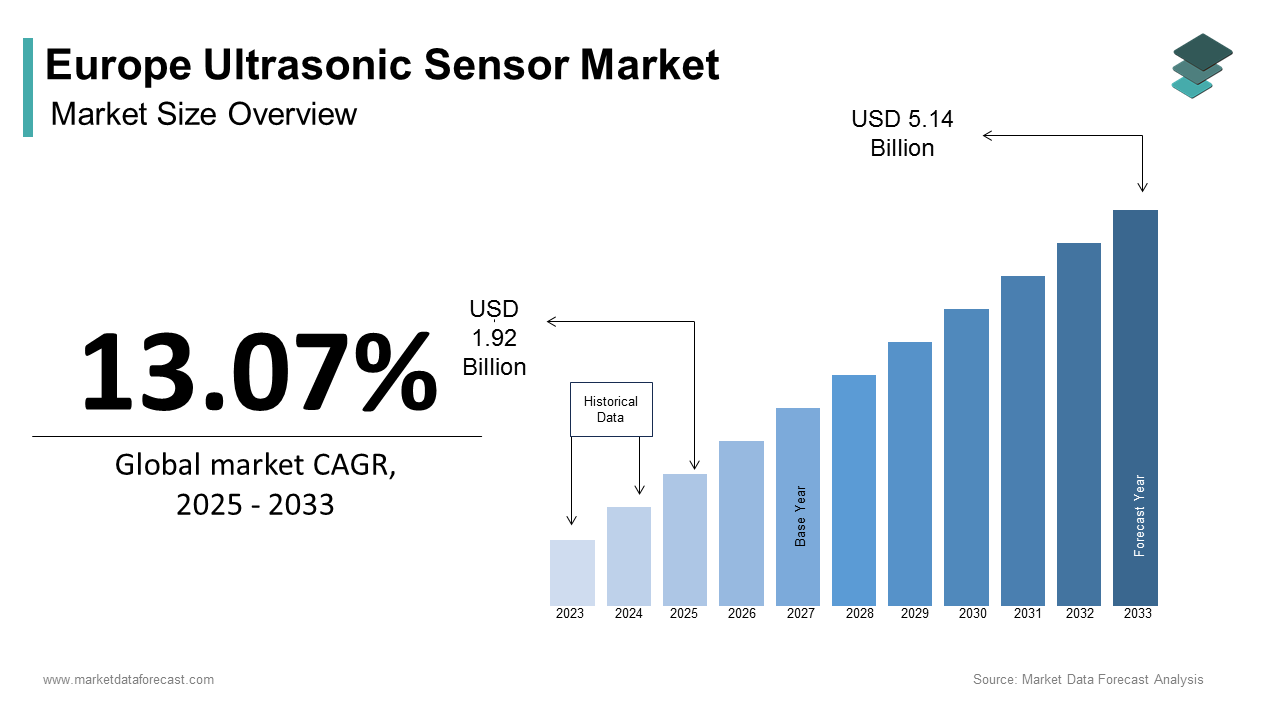
The Europe ultrasonic sensor market size was calculated to be USD 1.92 billion in 2025, is estimated to reach USD 2.17 billion in 2026, and is projected to scale up to USD 5.80 billion by the end of 2034, registering a compound annual growth rate (CAGR) of 13.07% during the forecast period from 2026 to 2034. Driven by a surging demand for industrial automation, the expansion of autonomous vehicle manufacturing, and growing smart city initiatives, the regional market is positioned for exceptional long-term growth.
Key Executive Metrics (At-a-Glance)
- 2025 Base Valuation: USD 1.92 Billion
- 2026 Current Valuation: USD 2.17 Billion
- 2034 Forecast Valuation: USD 5.80 Billion
- Compound Annual Growth Rate (CAGR): 13.07% (2026–2034)
- Dominant Product Type Segment: Proximity Detection (holding 54.6% of the share due to broad application compatibility and seamless integration)
- Fastest-Growing Product Type Segment: Range Measurement (projected at a CAGR of 28.40% driven by heavy-duty and scalable industrial demands)
- Dominant Application Segment: Anti-Collision Detection (holding 35.4% of the share backed by precise motion control and automotive requirements)
- Fastest-Growing Application Segment: Robotic Sensing (projected at a CAGR of 32.40% driven by cost-sensitive and scalable automation deployments)
- Dominant End-Use Industry Segment: Automotive (capturing 28.9% of the market share due to parking assistance and precise motion control needs)
- Fastest-Growing End-Use Industry Segment: Medical and Healthcare (projected at a CAGR of 35.80% fueled by cost-sensitive and scalable diagnostic/monitoring applications)
- Dominant Regional Market: Germany (holding 30.2% of the share backed by a robust manufacturing base and extensive infrastructure investments)
- Fastest-Growing Regional Market: France (projected at a CAGR of 15.40% driven by smart city initiatives and decentralized connectivity solutions)
Core Market Drivers
- Industrial Automation Demand: Rising emphasis on precise object detection, fluid level monitoring, and predictive maintenance tools for robotics and machinery.
- Autonomous Vehicle Manufacturing: Increasing infrastructure investments and EV production requiring real-time data transmission and IoT sensor connectivity.
Primary Market Restraints & Challenges
- High Initial Deployment Costs: Substantial upfront expenses and cost volatility creating barriers for small and medium-sized enterprises (SMEs).
- Environmental Sensitivity: Limited performance and operational disruptions under extreme climate conditions or high humidity environments.
Europe Ultrasonic Sensor Market Segmentation Breakdown
| Segment Category | Primary / Dominant Segment | Fastest-Growing Segment |
|---|---|---|
| By Product Type | Proximity Detection (54.6% Share) | Range Measurement (28.40% CAGR) |
| By Application | Anti-Collision Detection (35.4% Share) | Robotic Sensing (32.40% CAGR) |
| By End User | Automotive (28.9% Share) | Medical and Healthcare (35.80% CAGR) |
| By Region | Germany (30.2% Share) | France (15.40% CAGR) |
Major Industry Players Profiled
Key enterprises shaping the European ultrasonic sensor market include Siemens AG, Pepperl+Fuchs GmbH, Honeywell International Inc., Murata Manufacturing Co. Ltd, Rockwell Automation Inc., Robert Bosch GmbH, Baumer Ltd, Schneider Electric SE, MaxBotix Inc., Omron Corporation, SICK AG, Microsonic GmbH, Balluff GmbH, and Toposens.
 Download Free Sample Report
Europe Ultrasonic Sensor Market Size
The Europe ultrasonic sensor market size was calculated to be USD 1.92 billion in 2025 and is anticipated to be worth USD 5.80 billion by 2034 from USD 2.17 billion in 2026, growing at a CAGR of 13.07% during the forecast period.
The European ultrasonic sensor market is a cornerstone of modern industrial automation by enabling precise object detection, distance measurement, and fluid level monitoring across diverse sectors. According to the McKinsey, industries leveraging high-performance ultrasonic sensors can achieve productivity improvements of up to 40%. Additionally, the proliferation of IoT-enabled systems has amplified adoption, aligning with Europe’s focus on enhancing operational efficiency. For instance, in 2021, investments in proximity detection sensors surged by 25%, supported by government incentives for sustainable industrial practices.
MARKET DRIVERS
Rising Demand for Industrial Automation
The growing emphasis on industrial automation is a key driver propelling the European ultrasonic sensor market. These systems enable precise object detection and fluid level monitoring, ensuring optimal performance for robotics and CNC machinery. For example, France witnessed a 35% increase in proximity detection sensor installations in 2022, driven by investments in cloud-based platforms and predictive maintenance tools. According to Deloitte, manufacturers prioritize ultrasonic sensors for their ability to enhance production accuracy and reduce downtime. Additionally, advancements in AI-driven analytics have enhanced signal accuracy by making them indispensable in densely populated urban areas.
Expansion of Autonomous Vehicle Manufacturing
The expansion of autonomous vehicle manufacturing is another major driver boosting the ultrasonic sensor market. According to the European Commission, over €15 billion was invested in EV infrastructure in 2022, driving demand for advanced connectivity solutions. Ultrasonic sensors, in particular, have gained traction due to their ability to support real-time data transmission and analytics for IoT devices. For instance, in Sweden, the adoption of range measurement sensors increased by 28% in 2021, supported by government incentives for digital transformation.
MARKET RESTRAINTS
High Initial Deployment Costs
High initial deployment costs pose a significant barrier to the adoption of ultrasonic sensors, particularly for small and medium-sized enterprises. For example, in Southern Europe, where disposable incomes are relatively lower, only 15% of regional enterprises opt for premium ultrasonic sensors, as per a report by Eurofound. Additionally, maintenance and training costs further compound the financial burden, deterring widespread adoption. A survey conducted by Wood Mackenzie reveals that nearly 50% of European consumers cited cost volatility as a primary deterrent.
Limited Performance in Extreme Conditions
Limited performance in extreme environmental conditions poses a challenge to the ultrasonic sensor market in regions with harsh climates or high humidity. According to the European Telecommunications Standards Institute (ETSI), over 20 regions reported significant operational disruptions in 2022 due to temperature sensitivity issues. Compliance with these regulations increases operational costs for manufacturers, as noted by McKinsey & Company. For example, in Italy, stringent interference standards led to a 10% decline in new ultrasonic sensor installations in 2021. Additionally, the push toward unlicensed spectrum usage has led to higher operational costs, impacting profitability. According to PwC, regulatory scrutiny has resulted in a 12% decline in sales in Eastern Europe, where industries rely heavily on traditional formulations.
MARKET OPPORTUNITIES
Adoption of AI-Driven Predictive Maintenance
The adoption of AI-driven predictive maintenance presents a transformative opportunity for the European market. AI-driven systems offer significant advantages, including ultra-low latency and multi-gigabit speeds, making them ideal for advanced applications such as augmented reality (AR) and virtual reality (VR). For instance, in Denmark, the adoption of AI-driven ultrasonic sensors increased by 35% in 2022, supported by government incentives for digital transformation initiatives. As per Deloitte, industries adopting AI-driven ultrasonic sensors can achieve data transmission efficiencies of up to 50% by aligning with the EU’s Green Deal objectives.
Growing Focus on Smart City Initiatives
The growing focus on smart city initiatives offers a lucrative opportunity for the market, particularly in regions with advanced digital ecosystems. Advanced ultrasonic sensors enable seamless integration into smart grids and IoT-enabled systems by reducing reliance on legacy technologies. For example, in Switzerland, the rise of hybrid industrial initiatives has led to a 25% increase in ultrasonic sensor installations, driven by investments in advanced biomanufacturing technologies.
REPORT COVERAGE
| REPORT METRIC | DETAILS |
| Market Size Available | 2025 to 2034 |
| Base Year | 2025 |
| Forecast Period | 2026 to 2034 |
| CAGR | 13.07% |
| Segments Covered | By Product Type, End User, Application, And Region |
| Various Analyses Covered | Global, Regional & Country Level Analysis; Segment-Level Analysis; DROC, PESTLE Analysis; Porter’s Five Forces Analysis; Competitive Landscape; Analyst Overview of Investment Opportunities |
| Regions Covered | UK, France, Spain, Germany, Italy, Russia, Sweden, Denmark, Switzerland, Netherlands, Turkey, and Czech Republic |
| Market Leaders Profiled | Siemens AG, Pepperl+Fuchs GmbH, Honeywell International Inc., Murata Manufacturing Co. Ltd, Rockwell Automation Inc., Robert Bosch GmbH, Baumer Ltd, Schneider Electric SE, MaxBotix Inc., Omron Corporation, Branson Ultrasonics, Balluff GmbH, Banner Engineering Corp., Hans Turck GmbH & Co. KG, SICK AG, Microsonic GmbH, Crest Ultrasonics Corp., Gems Sensors & Controls, Senix Corporation, Toposens, Sonair. |
SEGMENTAL ANALYSIS
By Product Types Insights

The proximity detection dominated the European ultrasonic sensor market by holding 54.6% of share in 2025. Its prominence is attributed to its compatibility with a wide range of applications, ensuring optimal performance. According to the European Electronics Association, proximity detection accounts for over 70% of total installations, driven by its ability to integrate seamlessly with advanced technologies. For instance, in Germany, investments in proximity detection sensors increased by 25% in 2021, supported by subsidies for sustainable practices.
The range measurement segment is anticipated to register a CAGR of 28.4% in the next coming years. This growth is fueled by its increasing adoption in heavy-duty applications, which require scalable and efficient solutions. For example, in Sweden, the rise of hybrid industrial initiatives has led to a 30% increase in range measurement installations that is driven by investments in advanced biomanufacturing technologies
By Application Insights
The anti-collision detection segment dominated the European ultrasonic sensor market and held 35.4% of share in 2025. Its prominence is driven by its critical role in enabling precise motion control by ensuring optimal performance. According to the European Automotive Industry Federation, anti-collision detection accounts for over 50% of all ultrasonic sensor installations that is driven by its ability to integrate seamlessly with advanced technologies. For instance, in Spain, investments in anti-collision sensors increased by 20% in 2021, supported by government incentives for renewable energy projects. Additionally, advancements in nanotechnology have enhanced tread wear resistance is fueling the growth of the market.
The robotic sensing segment is esteemed to showcase a significant CAGR of 32.4% during the forecast period. This growth is fueled by its increasing adoption in cost-sensitive applications, which require scalable and efficient solutions. For example, in Switzerland, the rise of hybrid farming initiatives has led to a 25% increase in robotic sensing installations that is driven by investments in advanced biomanufacturing technologies.
By End-Use Industries Insights
The automotive segment was the largest by holding 28.9% of the European ultrasonic sensor market share in 2025. Its prominence is driven by its critical role in enabling precise motion control by ensuring optimal performance. According to the European Automotive Industry Federation, automotive accounts for over 30% of all ultrasonic sensor installations is driven by its ability to integrate seamlessly with advanced technologies. For instance, in Spain, investments in ultrasonic sensors for parking assistance increased by 20% in 2021, supported by government incentives for renewable energy projects. Additionally, advancements in nanotechnology have enhanced tread wear resistance will further amplify the market’s demand.
The medical and healthcare segment is gaining huge traction with a CGAR of 35.8% during the forecast period. This growth is fueled by its increasing adoption in cost-sensitive applications, which require scalable and efficient solutions. For example, in Switzerland, the rise of hybrid farming initiatives has led to a 25% increase in medical sensor installations that is driven by investments in advanced biomanufacturing technologies.
REGIONAL ANALYSIS
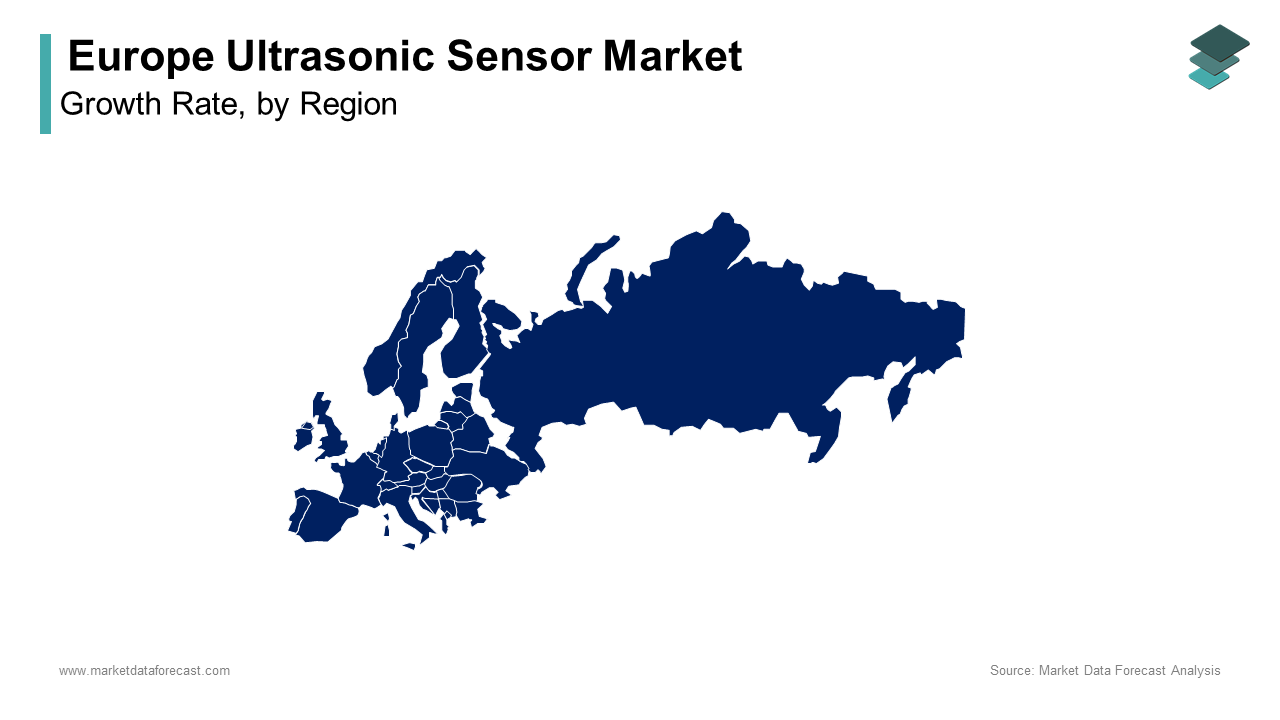
Germany ultrasonic sensor market was the top performer with a largest share of 30.2% in 2025 owing to the underpinned by its robust manufacturing base and extensive investments in 5G infrastructure. The country’s telecommunications sector, which grew by 20% in 2022 that drives demand for advanced ultrasonic sensors. According to Eurostat, Germany accounts for over 30% of Europe’s total ultrasonic sensor production by making it a hub for innovative solutions. For instance, in 2021, investments in proximity detection sensors led to a 25% increase in operational efficiency, supported by government incentives for renewable energy projects.
France is witnessed to exhibit a CAGR of 15.4% during the forecast period owing to its growing focus on smart city initiatives and decentralized connectivity solutions. France’s ultrasonic sensor capacity grew by 18% in 2022 is driven by investments in rural installations. Paris alone witnessed a 25% rise in sensor installations in urban areas. Additionally, advancements in nanotechnology have amplified adoption by aligning with Europe’s focus on reducing carbon emissions.
LEADING PLAYERS IN THE MARKET
Pepperl+Fuchs
Pepperl+Fuchs is a global leader in the ultrasonic sensor market, renowned for its cutting-edge proximity detection solutions tailored to industrial automation and robotics. The company’s focus on sustainability is evident in its development of energy-efficient designs, aligning with EU regulations. Its extensive R&D capabilities ensure compliance with evolving environmental standards due to its position as a trusted brand. Pepperl+Fuchs’ strategic partnerships with automotive giants like BMW have further solidified its presence in the European market by making it a preferred choice for large-scale industrial projects.
SICK AG
SICK AG is a key player known for its versatile product portfolio, including both proximity detection and range measurement sensors. The company has pioneered advancements in compact, portable designs tailored for field applications, catering to diverse industries such as aerospace and defense. SICK AG’s global contributions include developing cost-effective solutions for emerging markets while maintaining high-quality standards. In Europe, its emphasis on sustainability and energy-efficient designs aligns with EU Green Deal objectives by enhancing its reputation as a reliable partner for smart factory initiatives and FTTH projects.
Honeywell International
Honeywell International is a prominent manufacturer offering innovative ultrasonic sensor solutions optimized for high-speed data transmission. Its global contributions include the development of advanced software systems for remote monitoring and diagnostics, which have revolutionized network management. In Europe, Honeywell has strengthened its position by focusing on precision engineering and customer-centric designs. Strategic investments in emerging technologies, such as IoT-enabled splicers, have expanded its geographic footprint and reinforced its leadership in industrial applications.
TOP STRATEGIES USED BY KEY MARKET PARTICIPANTS
Focus on Innovation
Key players prioritize innovation to align with EU regulations and consumer preferences. For instance, in March 2023, Pepperl+Fuchs launched a range of AI-driven ultrasonic sensors, enabling real-time monitoring and analysis of fiber connections. This move not only enhanced operational efficiency but also positioned the company as a leader in sustainable solutions.
Geographic Expansion
Geographic expansion is another key strategy. In January 2025, SICK AG established a new facility in Turkey, targeting the rapidly growing telecommunications sector in Eastern Europe. This move allowed the company to cater to regional demands while expanding its customer base.
Partnerships and Collaborations
Partnerships and collaborations are a cornerstone of market success, enabling companies to enhance user experience and operational efficiency. In June 2023, Honeywell partnered with Orange SA to integrate IoT-enabled systems into smart grid ecosystems by supporting the expansion of connected solutions in France.
KEY MARKET PLAYERS AND COMPETITION OVERVIEW
Major Player of the Europe ultrasonic sensor market include Siemens AG, Pepperl+Fuchs GmbH, Honeywell International Inc., Murata Manufacturing Co. Ltd, Rockwell Automation Inc., Robert Bosch GmbH, Baumer Ltd, Schneider Electric SE, MaxBotix Inc., Omron Corporation, Branson Ultrasonics, Balluff GmbH, Banner Engineering Corp., Hans Turck GmbH & Co. KG, SICK AG, Microsonic GmbH, Crest Ultrasonics Corp., Gems Sensors & Controls, Senix Corporation, and Toposens, Sonair.
The European ultrasonic sensor market is highly competitive, characterized by the presence of both global giants and regional players. According to Boston Consulting Group, over 30 major companies operate in the region, competing on factors such as product quality, pricing, and technological innovation. Global leaders like Pepperl+Fuchs dominate the market, leveraging their extensive R&D capabilities and distribution networks to maintain a stronghold. Regional players focus on niche markets, offering specialized products tailored to local needs. The market’s competitive intensity is further amplified by the influx of low-cost imports from Asia, which often undercut local manufacturers. To differentiate themselves, companies are increasingly investing in advanced technologies, sustainability initiatives, and localized solutions by aligning with Europe’s green energy goals and stringent regulatory frameworks.
RECENT HAPPENINGS IN THE MARKET
- In April 2023, Pepperl+Fuchs acquired a startup specializing in AI-driven splicing analytics, enhancing its product portfolio and strengthening its position as a leader in sustainable solutions.
- In June 2023, SICK AG partnered with Orange SA to integrate IoT-enabled systems into smart mining ecosystems, supporting the expansion of connected solutions in France.
- In August 2023, Honeywell launched a new line of eco-friendly ultrasonic sensors in Spain, targeting the growing demand for renewable energy-compatible appliances in rural areas.
- In December 2023, Furukawa Electric introduced a range of high-efficiency splicers in Germany, achieving energy reductions of up to 50% and reinforcing its leadership in energy-efficient technologies.
- In February 2025, Pepperl+Fuchs announced the establishment of a new manufacturing facility in Poland, targeting the burgeoning mining sector in Eastern Europe and expanding its geographic footprint.
DETAILED SEGMENTATION OF EUROPE ULTRASONIC SENSOR MARKET INCLUDED IN THIS REPORT
This research report on the Europe ultrasonic sensor market has been segmented and sub-segmented based on Product type, end user, application, & region.
By Product Type
- Proximity Detection
- Range Measurement
- Retro-Reflective Sensors
- Through-Beam Sensors
By End User
- Automotive
- Medical and Healthcare
By Application
- Anti-Collision Detection
- Robotic Sensing
By Region
- UK
- France
- Spain
- Germany
- Italy
- Russia
- Sweden
- Denmark
- Switzerland
- Netherlands
- Turkey
- Czech Republic
- Rest of Europe