- Product Description Description
- Table of Contents TOC
- List of Table & Figure LOT
- Get Free Sample PDF Sample PDF
Market Size, 2025
$39.86 BnMarket Estimate, 2026
$50 BnMarket Forecast, 2034
$306.30 BnCAGR, 2026–2034
25.43%Executive Summary: Europe Unmanned Aerial Vehicle (UAV) Market
- Market Scope: Comprehensive market analysis of remotely piloted aircraft systems deployed across military, commercial, and civil domains in Europe, integrating advanced avionics, payload configurations, and autonomous navigation architectures.
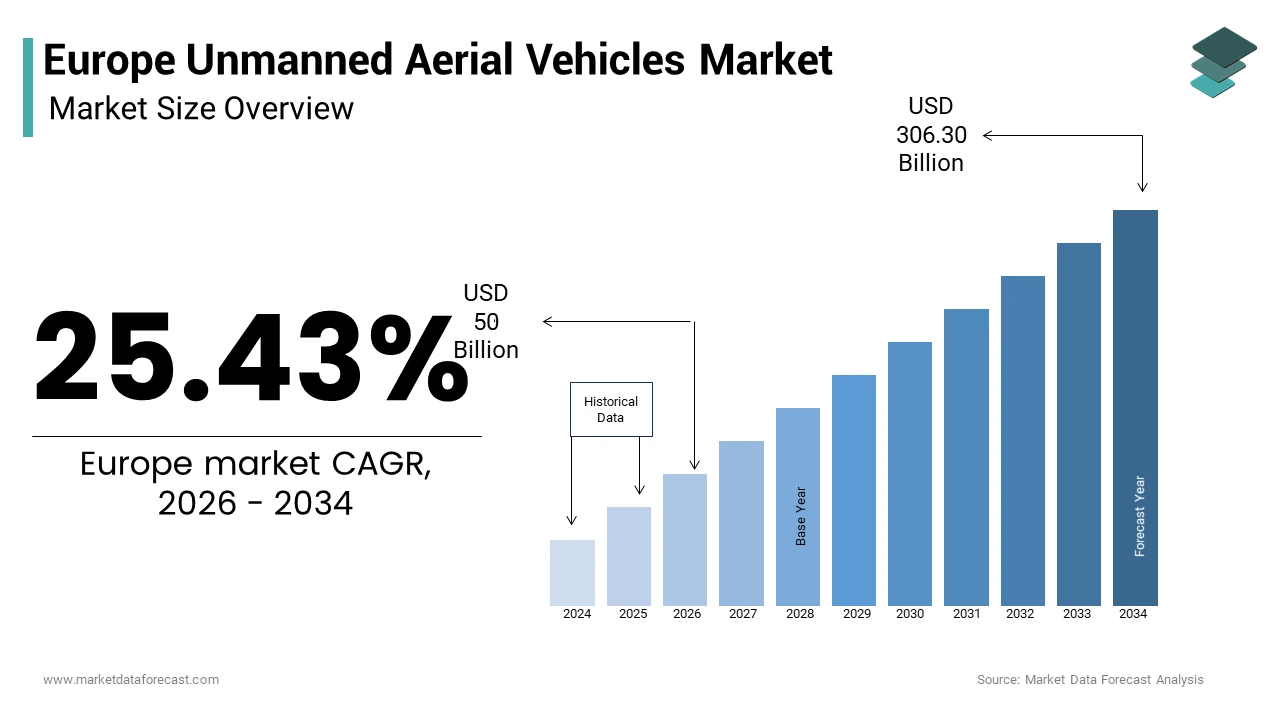
- Market Valuation: Valued at USD 39.86 billion in 2025, estimated at USD 50.00 billion in 2026, and projected to reach USD 306.30 billion by 2034, progressing at a rapid CAGR of 25.43% during the forecast period from 2026 to 2034.
- Primary Growth Drivers: Escalating geopolitical tensions and defense modernization initiatives; expanding integration of drones in precision agriculture and environmental monitoring; and rising demand for border surveillance, urban air mobility (UAM), and autonomous swarm technologies. Key restraints include a fragmented regulatory landscape (U-space complexities), cybersecurity vulnerabilities, and strict data privacy regulations (GDPR).
Key Market Segment Metrics (2026–2034)
| Category | Leading Segment (2025 Position) | Fastest-Growing Segment |
|---|---|---|
| By UAV Size | Small UAVs (dominated with the highest market share due to widespread commercial accessibility under open categories, versatility, and tactical micro-reconnaissance utility) | Large UAVs (projected at the highest CAGR of 13.4%, driven by strategic HALE/MALE procurement, border defense programs, and the Eurodrone initiative) |
| By Application | Military Sector (captured the leading market share due to heightened defense spending, NATO interoperability requirements, and intelligence/surveillance mandates) | Commercial Sector (anticipated to expand at a fastest CAGR of 15.5%, fueled by precision agriculture, infrastructure inspections, and logistics applications) |
| By Country | Germany (held the leading regional position with 23.2% market share backed by strong industrial manufacturing and defense funding) | France & United Kingdom (accelerating through active defense programs, aerospace R&D, and civil aviation regulatory testing) |
Major Market Players & Market Structure
Market Structure: A highly competitive, consolidated market characterized by established European aerospace prime contractors, international defense suppliers, and nimble technology startups focusing on autonomous platforms and sensor integration.
Key Companies: Airbus SE, Leonardo S.p.A., Baykar Technology, The Boeing Company, SZ DJI Technology, AeroVironment Inc., Lockheed Martin Corporation, Elbit Systems Limited, BAE Systems, Northrop Grumman Corporation, General Atomics, Parrot Drones SA, Thales SA, and Microdrones GmbH.
 Download Free Sample Report
Europe Unmanned Aerial Vehicle (UAV) Market Size
The European unmanned aerial vehicle (UAV) market was valued at USD 39.86 billion in 2025 and is anticipated to reach USD 50 billion in 2026 and USD 306.30 billion by 2034, progressing at a CAGR of approximately 25.43% over the forecast period 2026 to 2034.
Current Introduction of the Europe Unmanned Aerial Vehicle (UAV) Market
The Europe Unmanned Aerial Vehicle Market encompasses a sophisticated ecosystem of remotely piloted aircraft systems designed for defense, security, commercial, and civil applications across the continent. This domain integrates advanced avionics, artificial intelligence, and diverse payload capabilities to execute missions ranging from border surveillance to precision agriculture. According to Eurostat, the European Union manages a vast length of external borders, which is creating an immense operational requirement for persistent aerial monitoring that traditional manned aviation cannot cost effectively sustain. As per the European Union Aviation Safety Agency, the number of registered drone operators in Europe has grown rapidly, which is reflecting the democratization of access to unmanned technologies among commercial entities and private enthusiasts. According to the European Environment Agency, agricultural land covers a significant share of EU territory, presenting a wide canvas for deploying UAVs in crop health monitoring and resource optimization. Furthermore, the European Defence Agency emphasizes the critical need for indigenous unmanned systems to ensure strategic autonomy and reduce reliance on non-European suppliers. These converging factors of territorial management, regulatory evolution, and security imperatives define the current trajectory of the European UAV sector, which is positioning it as a cornerstone of future digital and physical infrastructure.
MARKET DRIVERS
Escalating Geopolitical Tensions and Defense Modernization Initiatives
The intensifying instability along Europe’s eastern flank has made military‑grade UAVs a central pillar of modernization strategies, which is primarily driving the growth of the European unmanned aerial vehicle (UAV) market. According to the European Defence Agency, defence expenditure rose significantly in 2023, with a notable share directed toward unmanned platforms for reconnaissance, target acquisition, and logistical support. According to NATO assessments, the Ukraine conflict reshaped doctrine, which is proving that small tactical drones can decisively influence battlefield outcomes by delivering real‑time intelligence and precision strikes at relatively low cost. As per the International Institute for Strategic Studies, European nations are accelerating programs for long‑endurance, medium‑altitude reconnaissance drones to enhance situational awareness in contested zones. Collaborative initiatives such as the European MALE (Medium Altitude Long Endurance) program underscore the drive for strategic autonomy and reduced reliance on non‑European suppliers. Maritime surveillance requirements in the Mediterranean and Baltic Seas further expand demand for naval‑compatible UAVs capable of anti‑submarine and surface vessel tracking. This paradigm shift ensures sustained government funding and robust procurement pipelines, strengthening Europe’s defence industrial base.
Expanding Integration of Drones in Precision Agriculture and Environmental Monitoring
Beyond defence, UAVs are transforming agriculture and environmental stewardship, which is further boosting the expansion of the European unmanned aerial vehicle (UAV) market. The European Commission’s Common Agricultural Policy now encourages digital technologies, which is prompting farmers to deploy drones for precision fertilization and pesticide application. According to the research from the Joint Research Centre, multispectral drone imaging can detect crop stress and disease weeks earlier than traditional scouting, boosting yields while reducing chemical use. Eurostat data highlights Europe’s aging farming population, intensifying the need for automation to sustain productivity across vast arable land. Environmental agencies increasingly rely on UAVs for biodiversity monitoring, illegal logging detection, and flood damage assessment. The European Space Agency collaborates with drone operators to validate satellite data, enhancing climate model accuracy. UAVs also provide safe access to hazardous zones, supporting wildlife conservation and pollution detection. This alignment with sustainability goals and efficiency imperatives drives strong demand for specialized agricultural and environmental UAV solutions.
MARKET RESTRAINTS
Fragmented Regulatory Landscape and Airspace Integration Complexities
Despite rapid adoption, regulatory fragmentation remains a major restraint for the growth of the European unmanned aerial vehicle (UAV) market. The European Union Aviation Safety Agency’s U‑Space framework aims to harmonize operations, but member states retain discretion over authorizations, creating a patchwork of rules. As per the surveys by the Association for Unmanned Vehicle Systems International, regulatory uncertainty is the top obstacle for operators seeking beyond‑visual‑line‑of‑sight missions. Approval processes for controlled airspace flights vary widely, sometimes taking months, which hampers cross‑border commercial operations. Requirements for remote identification and geo‑awareness systems add compliance burdens, particularly for smaller manufacturers. This fragmented environment slows the development of pan‑European drone logistics networks and discourages investment in large‑scale autonomous operations until a unified regulatory regime is established.
Critical Vulnerabilities in Cybersecurity and Data Privacy Protection
Cybersecurity and privacy concerns also constrain UAV adoption, which is further hampering the expansion of the European unmanned aerial vehicle (UAV) market. The European Union Agency for Cybersecurity warns that drones are increasingly targeted by malicious actors seeking to hijack control links or intercept video feeds. National security services have documented cases of signal jamming and spoofing, exposing vulnerabilities in current communication protocols. GDPR imposes strict rules on aerial imagery collection, creating legal risks for operators who inadvertently capture personal data. Privacy advocacy groups note strong public resistance to surveillance drones, driven by fears of unwarranted monitoring. The absence of standardized encryption across manufacturers exacerbates supply chain vulnerabilities. Moreover, the risk of weaponization by non‑state actors has prompted regulators to impose strict export controls and operational restrictions. Addressing these gaps requires investment in resilient architectures, standardized security protocols, and robust legal frameworks to build trust and unlock the full potential of the UAV market.
MARKET OPPORTUNITIES
Emergence of Advanced Urban Air Mobility and Passenger Drone Services
Urban Air Mobility (UAM) is rapidly emerging as a promising opportunity for the European unmanned aerial vehicle (UAV) market. According to the European Commission’s Sustainable and Smart Mobility Strategy, at least 100 climate‑neutral cities are expected to adopt automated and connected mobility solutions by 2030, including vertical takeoff and landing (VTOL) aircraft. Feasibility studies from the Single European Sky ATM Research initiative highlight that electric VTOL drones could ease congestion in major cities like Paris, London, and Berlin by utilizing vertical urban airspace. Venture capital data shows billions of euros invested in European eVTOL startups, signaling strong confidence in air taxi viability. Integration into public transport networks offers solutions for first‑ and last‑mile connectivity, especially in underserved areas. Electrification aligns with EU carbon reduction targets, positioning passenger drones as sustainable alternatives to helicopters. Pilot projects in Nice and Munich are already testing routes, paving the way for regulatory approval and public acceptance.
Development of Autonomous Swarm Technologies for Complex Missions
AI‑enabled drone swarms represent a major leap in UAV capabilities, which is offering coordinated operations across search and rescue, disaster response, and infrastructure inspection and is another potential opportunity for the European unmanned aerial vehicle (UAV) market. As per the research from the European Organisation for the Safety of Air Navigation, swarms can autonomously communicate, adapt to environments, and continue missions despite unit failures. Demonstrations funded by the European Defence Fund confirm resilience and efficiency, with swarms covering vast areas faster than single drones. Emergency response agencies report that swarms can locate survivors and assess damage within minutes during floods or earthquakes. Beyond defence, synchronized swarms enable commercial applications such as agricultural spraying, perimeter security, and entertainment displays. Miniaturization of sensors and processors reduces costs, while machine learning allows swarms to optimize patterns over time. This evolution transforms drones from isolated tools into intelligent collective systems, which is unlocking applications previously considered impossible.
MARKET CHALLENGES
Achieving Full Beyond Visual Line of Sight (BVLOS) Operational Capabilities
BVLOS operations remain a critical challenge for the European unmanned aerial vehicle (UAV) market growth. According to the European Union Aviation Safety Agency, BVLOS requires robust detect‑and‑avoid systems capable of autonomously maneuvering around aircraft, birds, and obstacles. Current radar and optical sensors struggle with false positives and limited range in adverse weather, posing safety risks. The absence of a unified low‑altitude traffic management system across Europe prevents autonomous long‑distance navigation and real‑time deconfliction. Infrastructure operators note that inspections of pipelines or power lines often still require visual observers or special waivers, reducing efficiency. Command‑and‑control links also face vulnerabilities from interference and latency. Overcoming these hurdles demands breakthroughs in sensor fusion, edge computing, and secure communication networks, alongside harmonized certification standards to ensure safety parity with manned aviation.
Ensuring Supply Chain Sovereignty and Component Availability
Supply chain resilience is a persistent challenge for the European unmanned aerial vehicle (UAV) market. According to the European Chips Act, over 80% of advanced processors are imported, wwhich is exposing the sector to shortages and geopolitical risks. The Aerospace and Defence Industries Association of Europe warns that disruptions in rare earth supplies for motors and sensors can delay production and inflate costs. Dependence on non‑European battery manufacturers limits customization and exposes operators to volatile raw material prices. Trade commission data shows export controls from global powers restrict access to dual‑use technologies, slowing indigenous platform development. Fragmentation of Europe’s industrial base means no single country controls the full UAV value chain, requiring complex cross‑border collaborations that are slow to coordinate. Building a self‑sufficient ecosystem demands heavy investment in local fabrication and raw material processing, a long‑term effort that conflicts with immediate market needs. Until these bottlenecks are resolved, European UAV producers face risks of constrained capacity and reduced competitiveness against global rivals.
REPORT COVERAGE
| REPORT METRIC | DETAILS |
| Market Size Available | 2025 to 2034 |
| Base Year | 2025 |
| Forecast Period | 2026 to 2034 |
| CAGR | 25.43% |
| Segments Covered | By UAV Size, Application, and Countries |
| Various Analyses Covered | Regional & Country Level Analysis, Segment-Level Analysis, DROC, PESTLE Analysis, Porter’s Five Forces Analysis, Competitive Landscape, Analyst Overview on Investment Opportunities |
| Regions Covered | UK, France, Spain, Germany, Italy, Russia, Sweden, Denmark, Switzerland, Netherlands, Turkey, Czech Republic, & Rest of Europe |
| Market Leaders Profiled | The Boeing Company, SZ DJI Technology, Aerovironment Inc., Lockheed Martin Corporation, Elbit Systems Limited, BAE Systems, Northrop Grumman Corporation, General Atomics, Parrot Drones SA, Thales SA, Airbus SE, Microdrones GmbH. |
SEGMENTAL ANALYSIS
By UAV Size Insights
The small UAV segment dominated the European unmanned aerial vehicle (UAV) market in 2025 with the highest market share due to the versatility, affordability, and ease of deployment across both civilian and tactical domains. Commercial adoption has surged for applications such as aerial photography, infrastructure inspection, and precision agriculture, where portability and low operating costs are critical. According to the European Union Aviation Safety Agency, more than 90% of registered drone operators in Europe utilize UAVs under 25 kilograms, which is indicating their accessibility to small businesses and individual entrepreneurs. Militaries have also embraced small tactical drones for reconnaissance and urban warfare, valuing their ability to be launched by individual soldiers without complex logistics. According to the European Defence Agency, a 40% increase is seen in the procurement of mini and micro UAVs, which is reflecting their utility in providing immediate situational awareness in contested environments. Favorable regulatory frameworks under the Open Category further support widespread use, minimizing bureaucratic hurdles compared to larger systems. This combination of commercial utility, tactical flexibility, and regulatory ease solidifies small UAVs as the market leader, which is sustaining demand for accessories, software, and replacement units.
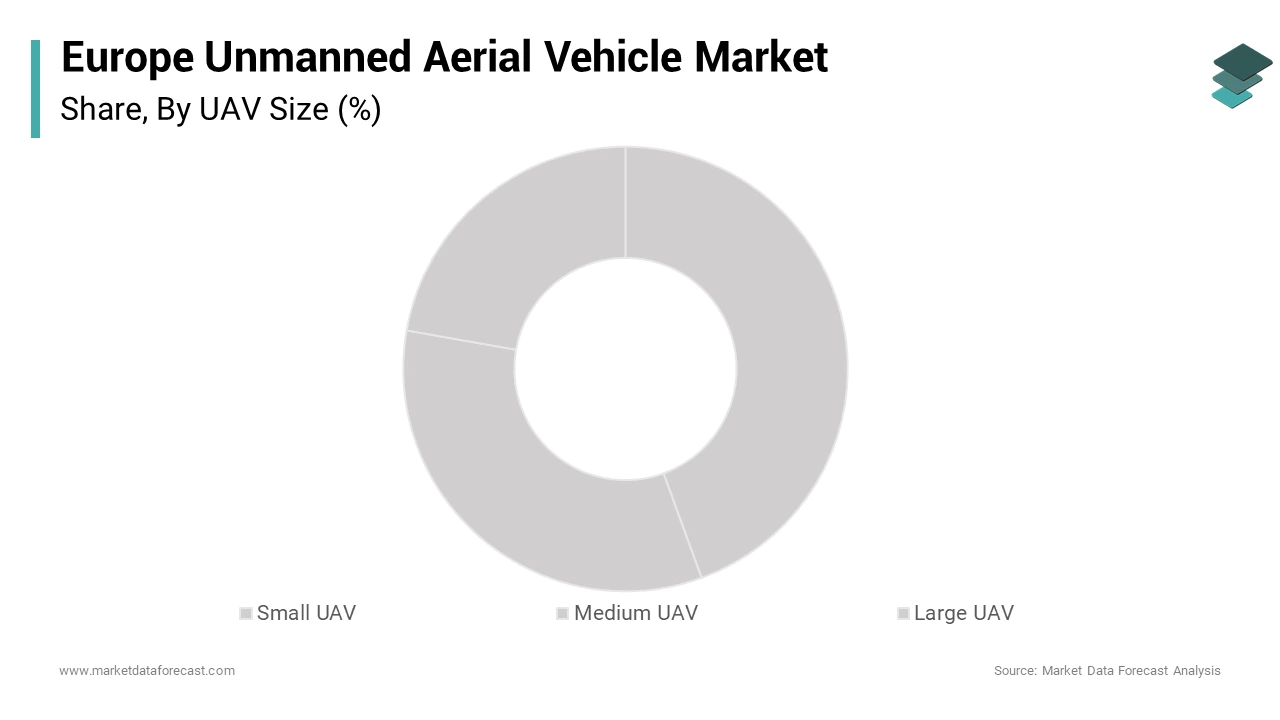
However, the large UAVs segment is expected to exhibit the highest CAGR of 13.4% over the forecast period in this regional market owing to the European nations’ strategic shift toward acquiring high‑altitude, long‑endurance platforms to bolster national security and border surveillance. According to the European Defence Fund, billions of euros are being invested in indigenous programs such as the Eurodrone to reduce reliance on foreign suppliers and ensure strategic autonomy. The International Institute for Strategic Studies highlights the need for persistent wide‑area monitoring over maritime domains and eastern borders, requiring platforms capable of carrying heavy sensor payloads and operating continuously for over 24 hours. Large UAVs also support emerging commercial applications, including heavy‑lift cargo drones for logistics, with pilot projects testing medical supply deliveries to remote areas. The convergence of defense modernization imperatives and commercial heavy‑lift potential positions large UAVs as the most dynamic segment in terms of value and technological advancement.
By Application Insights
The military segment led the market by capturing the leading share of the European unmanned aerial vehicle (UAV) market in 2025 due to the urgent need for advanced intelligence, surveillance, and reconnaissance capabilities to address evolving security threats. NATO members have significantly increased defense budgets, with a substantial portion allocated to unmanned systems that enhance force protection and operational efficiency. According to the Stockholm International Peace Research Institute, European military spending on UAV technologies reached record highs in 2023, reflecting lessons from recent conflicts that demonstrated drones’ decisive role in modern warfare. NATO strategic documents emphasize UAV integration into joint operations as a core competency, fueling procurement across tactical and strategic platforms. Military drones’ ability to operate in hazardous environments without risking pilot lives makes them indispensable for missions in contested airspace. Furthermore, interoperability requirements among allied forces encourage standardized fleets, driving multinational procurement contracts. The sustained demand for real‑time battlefield intelligence and precision strike capabilities ensures the military sector remains the primary revenue generator, overshadowing civil and commercial segments in contract value.
On the other side, the commercial segment is emerging as the fastest growing and is anticipated to expand at a CAGR of 15.5% over the forecast period owing to the rapid digitalization and the proven ROI of drone services. According to the European Commission, under the Common Agricultural Policy, drone use in agriculture has increased by 30% annually for crop monitoring and variable‑rate spraying. For instance, drones reduce project timelines by up to 50% and lower costs significantly compared to manned aviation or ground crews. The energy sector is deploying UAVs for inspecting wind turbines and solar farms, aligned with Europe’s aggressive renewable energy targets. Regulatory progress enabling beyond visual line of sight operations is unlocking new opportunities in logistics and delivery. Commercial drones’ ability to provide high‑resolution data and automate repetitive tasks creates compelling economic incentives, fueling explosive growth in this diverse and innovative segment.
COUNTRY LEVEL ANALYSIS
Germany Unmanned Aerial Vehicle (UAV) Market Analysis
Germany held the dominating position in the European unmanned aerial vehicle (UAV) market in 2025 with 23.2% of the regional market share due to its robust industrial base and strong commitment to sovereign defense technologies. The German market is expected to remain dominant with thriving collaborations between aerospace giants and startups on next generation unmanned systems. The German market is characterized by significant funding for the Eurodrone program and other initiatives to enhance strategic autonomy. According to the German Federal Ministry of Defence, investments in unmanned systems have increased substantially. A key driving factor is the presence of world class research institutions and engineering firms specializing in avionics, AI, and sensor fusion. As per the German Aerospace Center, Germany is actively testing urban air mobility solutions and integrating drones into national airspace management. The strong manufacturing sector also drives demand for industrial drones in logistics and smart factories. Furthermore, Germany’s central location and infrastructure make it an ideal testbed for cross border drone logistics projects.
France Unmanned Aerial Vehicle (UAV) Market Analysis
France is performing as a major force in the European UAV market due to the ambitious military modernization programs and a vibrant commercial drone sector. The French market reflects investments in combat drones and surveillance systems, including the Patroller and future combat air systems. According to the French Ministry of Armed Forces, unmanned assets are being integrated across military branches. A primary driving factor is the vast agricultural landscape, spurring adoption of precision farming drones. As per the French Civil Aviation Authority, regulations now support innovative commercial applications such as delivery trials. The presence of Airbus and Dassault strengthens the supply chain and fosters collaboration on European projects. Furthermore, government support for deep tech startups has led to breakthroughs in battery technology and autonomous navigation.
United Kingdom Unmanned Aerial Vehicle (UAV) Market Analysis
The United Kingdom is performing as a significant contributor to the European UAV market owing to the advanced defense research and a mature commercial sector. The UK market is defined by investments in programs like Mosquito and loyal wingman drones to maintain aerial warfare capabilities. According to the UK Ministry of Defence, funding is directed toward NATO contributions and advanced UAV development. A major driving factor is the reliance of energy infrastructure, including offshore wind farms, on drone inspections. As per the Civil Aviation Authority, the UK has pioneered test sites for beyond visual line of sight operations. The creative industries also drive demand for cinematography drones. Furthermore, the Future Flight Challenge provides funding for autonomous air taxis and cargo drones.
Italy Unmanned Aerial Vehicle (UAV) Market Analysis
Italy is performing as an important market in the European UAV market due to its aerospace heritage and growing adoption of drones for environmental monitoring and cultural preservation. The Italian market is influenced by participation in the Eurodrone program and upgrades to tactical UAV fleets. According to the Italian Ministry of Defence, Italy continues to modernize its Falco UAVs. A key driving factor is the use of drones for surveying and restoration of cultural heritage sites. As per ISTAT, agriculture in southern Italy is rapidly adopting drones for vineyard and olive grove management. The presence of Leonardo S.p.a. ensures advanced technology flows into the local market. Furthermore, Italy’s geographical position makes it a hub for monitoring migration routes and maritime traffic.
Spain Unmanned Aerial Vehicle (UAV) Market Analysis
Spain is performing as a notable market in the European UAV market and is driven by its focus on border security and expanding commercial applications in renewable energy and tourism. The Spanish market is characterized by acquisitions of medium altitude long endurance drones for maritime patrol and counter smuggling. According to the Spanish Ministry of Defence, UAVs are being deployed extensively for coastal monitoring. A primary driving factor is the booming renewable energy sector, where drones inspect solar panels and wind turbines. As per the State Aviation Safety Agency, Spain has established drone corridors to facilitate commercial flights. The tourism industry also leverages drones for promotional content and crowd management. Furthermore, Spain’s climate allows year-round testing, attracting international manufacturers to set up hubs.
COMPETITIVE LANDSCAPE
The competition within the Europe Unmanned Aerial Vehicle Market is characterized by intense rivalry between established aerospace giants and agile specialized manufacturers striving for technological superiority and strategic contracts. Market participants constantly vie for dominance through continuous innovation in autonomous navigation, sensor fusion, and endurance capabilities to meet the demanding requirements of modern defense and commercial applications. The landscape features high barriers to entry due to stringent regulatory standards and the need for extensive flight testing and certification by national aviation authorities. Companies differentiate themselves by offering comprehensive ecosystem solutions that include ground control stations, data analytics software, and training services alongside the aircraft platforms. Strategic alliances with government entities and participation in joint European development programs play a crucial role in securing large scale procurement deals and funding. The shift toward sovereign capabilities has intensified competition as nations seek to reduce reliance on external suppliers and foster domestic industrial bases. Price pressure from emerging global competitors forces European firms to optimize production efficiency while maintaining high quality and performance levels. This dynamic environment fosters rapid advancement in unmanned technologies ensuring that only the most innovative and adaptable companies thrive in the region.
KEY MARKET PLAYERS
Companies playing a notable role in the European UAV market include:
- Boeing Company
- Sz DJI Technology
- Leonardo S.p.A.
- Baykar Technology
- Aerovironment Inc.
- Lockheed Martin Corporation
- Elbit Systems Limited
- BAE Systems
- Northrop Grumman Corporation
- General Atomics
- Parrot Drones SA
- Thales SA
- Airbus SE
- Microdrones GmbH.
Top Players In The Market
- Airbus SE stands as a cornerstone of the European unmanned aerial vehicle landscape, leveraging its vast aerospace expertise to develop high altitude long endurance systems for defense and security applications. The company contributes significantly to the global market by leading multinational consortia such as the Eurodrone program, which aims to provide strategic autonomy for European nations. Recent actions to strengthen its position include securing major contracts from the German and French governments to accelerate the development of certified medium altitude platforms. Airbus actively invests in artificial intelligence and sensor fusion technologies to enhance the autonomous capabilities of its drones for complex missions. The firm also collaborates with startups to integrate advanced propulsion systems that reduce fuel consumption and extend operational range. By focusing on interoperability with NATO forces and adhering to strict cybersecurity standards, Airbus reinforces its reputation as a trusted supplier of critical defense assets. These strategic initiatives ensure the company remains at the forefront of innovation while addressing the evolving security needs of European allies and global partners.
- Leonardo S.p.A. is a dominant force in the Europe UAV sector, renowned for its Falco family of tactical unmanned aircraft systems that serve military and civil protection agencies worldwide. The company plays a pivotal role globally by exporting versatile drones capable of performing surveillance, reconnaissance, and target acquisition in diverse environments. Recent efforts to solidify its market standing involve upgrading the Falco Xplorer with enhanced payload capacities and extended endurance to meet modern battlefield requirements. Leonardo has strengthened its position through strategic partnerships with other European defense manufacturers to co develop next generation swarm technologies and loyal wingman concepts. The firm actively participates in European Defence Fund projects to foster indigenous innovation and reduce dependency on non European suppliers. Additionally, Leonardo focuses on integrating its UAVs with existing command and control networks to ensure seamless data sharing across joint operations. By prioritizing modularity and rapid deployment capabilities, the company delivers flexible solutions that address the dynamic needs of security forces. These continuous advancements in platform performance and system integration maintain Leonardo's leadership in the competitive global unmanned systems market.
- Baykar Technology has emerged as a transformative player in the European UAV market, gaining prominence through the widespread adoption of its combat proven armed drones by multiple NATO member states. The company contributes to the global landscape by demonstrating the effectiveness of cost effective medium altitude long endurance platforms in real world conflict scenarios. Recent actions to strengthen its market position include establishing final assembly lines and maintenance facilities in several European countries to comply with local content requirements and enhance logistical support. Baykar actively engages in technology transfer agreements with partner nations to build domestic drone manufacturing capabilities and foster long term strategic alliances. The firm continues to innovate by developing newer models with improved stealth features, higher payload capacities, and advanced electronic warfare resistance. By delivering reliable systems that offer superior operational value, Baykar has secured significant export contracts across the continent. These strategic expansions and continuous product enhancements enable the company to deepen its footprint in Europe while challenging traditional aerospace giants with agile and battle tested solutions.
Top Strategies Used By Key Market Participants
Key players in the Europe Unmanned Aerial Vehicle Market primarily focus on strategic collaborations and multinational consortia to share development costs and ensure interoperability among allied nations. Companies heavily invest in research and development to integrate artificial intelligence and autonomous swarm capabilities that enhance mission effectiveness without increasing human risk. Manufacturers are increasingly establishing local production facilities and maintenance hubs within customer countries to meet offset obligations and strengthen supply chain resilience. Another prevalent approach involves pursuing rigorous certification processes to enable beyond visual line of sight operations and integrate drones into regulated airspace safely. Firms also prioritize cybersecurity enhancements to protect data links and control systems from emerging digital threats. Expanding product portfolios to include hybrid propulsion systems and modular payloads allows suppliers to address diverse mission requirements efficiently. These combined strategies enable market participants to navigate complex regulatory environments and capture growth opportunities in the rapidly evolving defense and commercial sectors.
MARKET SEGMENTATION
This research report on the European unmanned aerial vehicle (UAV) market has been segmented and sub-segmented based on the following categories.
By UAV Size
- Small UAV
- Medium UAV
- Large UAV
By Application
- Military
- Civil
- Commercial
By Country
- UK
- France
- Spain
- Germany
- Italy
- Russia
- Sweden
- Denmark
- Switzerland
- Netherlands
- Turkey
- Czech Republic
- Rest of Europe