Europe Utility Poles Market Size, Share, Trends, & Growth Forecast Report By Material Type (Wooden Utility Poles, Steel Utility Poles, Concrete Utility Poles, Fiber-Reinforced Polymer (FRP) Composite Poles), Product, Pole Type and Country (UK, France, Spain, Germany, Italy, Russia, Sweden, Denmark, Switzerland, Netherlands, Turkey, Czech Republic and Rest of Europe), Industry Analysis From 2026 to 2034
Market Size, 2025
$13.82 BnMarket Estimate, 2026
$18.50 BnMarket Forecast, 2034
$189.94 BnCAGR, 2026–2034
33.80%Europe Utility Poles Market Report Summary
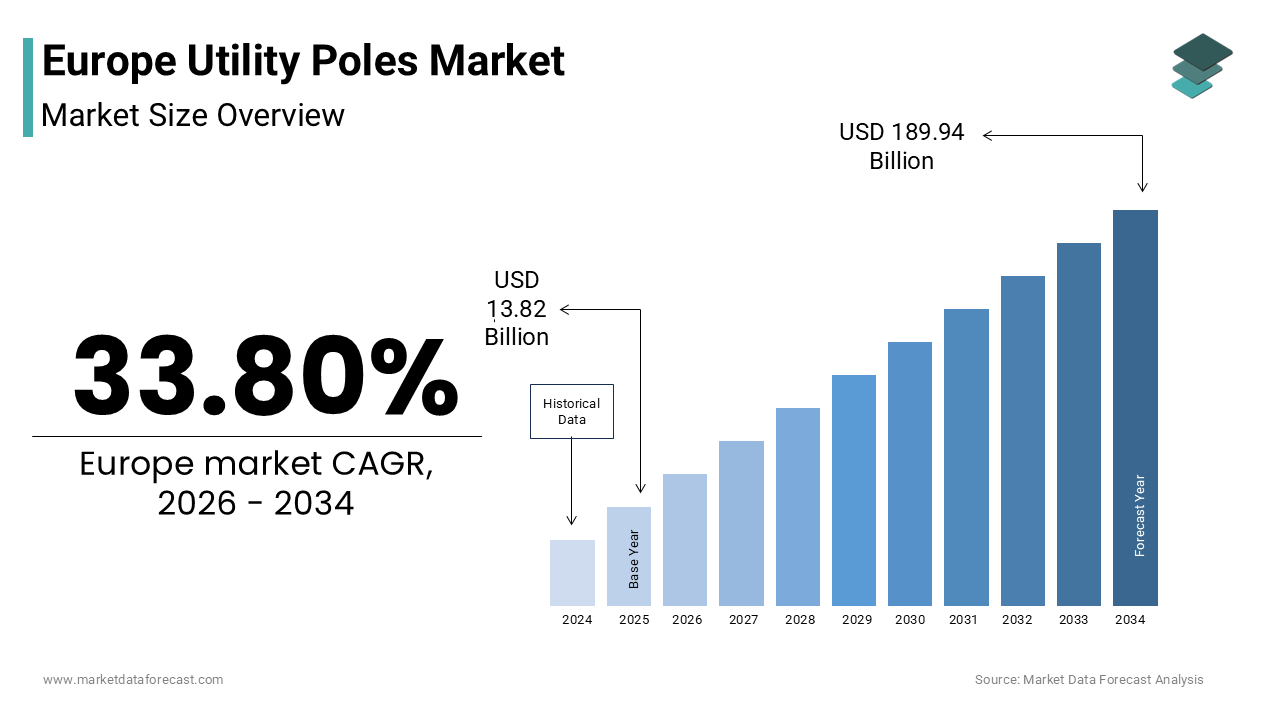
The Europe utility poles market was valued at USD 13.82 billion in 2025, is estimated to reach USD 18.50 billion in 2026, and is projected to reach USD 189.94 billion by 2034, growing at a CAGR of 33.80% during the forecast period from 2026 to 2034. The growth of the Europe utility poles market is driven by large-scale grid modernization programs, replacement of aging electricity distribution infrastructure, and expansion of rural and peri-urban electrification networks across the region. Rising investments in renewable energy integration, particularly solar and wind power, are increasing the need for new distribution and transmission poles to support decentralized generation. In addition, the growing deployment of fiber-optic cables, 5G infrastructure, and smart grid monitoring systems on overhead networks is transforming utility poles into multi-utility infrastructure assets. Moreover, increasing focus on storm resilience, climate adaptation, and pole-sharing regulations is accelerating the adoption of durable materials such as concrete, steel, and composite utility poles, thereby supporting long-term market growth in Europe.
Key Market Trends
-
Increasing replacement of aging wooden utility poles with concrete, steel, and composite alternatives to improve durability and climate resilience.
-
Rising adoption of multi-utility poles to support electricity distribution, telecommunications, fiber-optic networks, and smart city applications.
-
Growing emphasis on storm-hardening and grid resilience programs in response to extreme weather events across Europe.
-
Strong focus on sustainable materials and non-creosote wood preservatives to comply with EU environmental and biocidal regulations.
-
Expansion of pole-sharing frameworks to reduce infrastructure duplication and accelerate broadband and 5G deployment.
Segmental Insights
- Based on material type, the wooden utility poles segment was the largest and held a significant share of the Europe utility poles market in 2025. The segment’s dominance is attributed to cost-effectiveness, ease of installation, and the extensive legacy use of wooden poles in rural and peri-urban electricity distribution networks, particularly in Central and Eastern Europe.
- Based on product type, the distribution poles segment accounted for the largest share of the Europe utility poles market in 2025. This dominance stems from the vast geographic footprint of low-voltage distribution networks and the continuous need for pole replacement and reinforcement to support renewable energy connections, rural electrification, and last-mile power delivery.
- Based on end-user, the electricity distribution utilities segment was the largest, occupying a prominent share of the Europe utility poles market in 2025. The dominance of this segment is driven by regulatory obligations to maintain grid reliability, service continuity requirements, and ongoing investments in upgrading aging overhead distribution infrastructure.
Regional Insights
The Europe utility poles market is witnessing robust growth across major countries, supported by grid modernization initiatives, renewable energy expansion, and telecom infrastructure deployment.
- France was the largest contributor, accounting for a significant share of the Europe utility poles market in 2025, driven by extensive rural electrification networks, large-scale pole replacement programs, and aggressive grid reinforcement initiatives under national energy transition plans.
- Germany continues to perform strongly, fueled by decentralized renewable energy integration, strict technical standards, and increasing adoption of concrete and composite poles to comply with environmental and visual impact regulations.
- The United Kingdom is emerging as a high-growth market, supported by storm resilience programs, smart grid investments, and widespread pole-sharing arrangements for broadband and fiber deployment.
- Spain is also gaining momentum due to its vast rural distribution networks, rapid solar energy expansion, and regulatory mandates for fire-resistant and non-combustible utility poles.
Competitive Landscape
The Europe utility poles market is characterized by the presence of established manufacturers with strong expertise in material engineering, regulatory compliance, and large-scale infrastructure supply. Leading companies are focusing on sustainable wood treatment technologies, composite and hybrid pole development, and multi-utility pole designs to meet evolving grid, telecom, and smart city requirements. Strategic collaborations with electricity distribution operators and telecommunications providers are strengthening market positioning. Prominent players in the Europe utility poles market include Valmont Industries, Inc., Hill & Smith Holdings Plc, Fuchs Europoles GmbH, Stella-Jones Inc., El Sewedy Electric Company, Skipper Ltd., Nippon Concrete Industries Co., Ltd., Strongwell Corporation, Pelco Products, Inc., RS Technologies Inc., and KEC International.
Europe Utility Poles Market Size
The Europe utility poles market size was valued at USD 13.82 billion in 2025 and is anticipated to reach USD 18.50 billion in 2026 from USD 189.94 billion by 2034, growing at a CAGR of 33.80% during the forecast period from 2026 to 2034.
Utility poles are engineered vertical structures primarily constructed from wood concrete steel or composite materials deployed to support overhead electricity distribution lines, telecommunications, cables and increasingly smart grid sensors across urban, suburban, and rural landscapes. Unlike generic infrastructure components, utility poles in Europe are subject to stringent national safety standards, environmental regulations, and heritage considerations that shape material selection and lifecycle management. According to Eurostat, millions of utility poles are in service across the European Union, with the majority located in rural and peri-urban zones where underground cabling remains economically unfeasible. The European Committee for Standardization enforces rigorous load and durability requirements under EN 13148 for wooden poles and EN 13228 for concrete variants, ensuring resilience against wind, ice, and long-term decay. As per the European Environment Agency, the replacement cycle for wooden poles typically ranges between 35 and 45 years depending on climate and treatment methods, with northern countries such as Sweden and Finland using copper azole preservatives, while southern regions favor creosote alternatives compliant with EU Biocidal Products Regulation. This regulatory and climatic diversity defines the Europe utility poles market as a highly localized yet technically precise segment essential to the continent’s energy and digital backbone.
MARKET DRIVERS
Grid Modernization and Rural Electrification Expansion
Europe’s ongoing infrastructure upgrades to enhance grid reliability and extend power access in remote areas are propelling the growth of the European utility poles market. According to the European Commission’s Clean Energy for All Europeans package, millions of Europeans still experience frequent power interruptions due to aging rural networks, prompting national grid operators to replace or reinforce distribution lines. In 2023, the French energy regulator CRE approved a multi-billion-euro program to replace hundreds of thousands of wooden poles with composite or steel alternatives in storm-prone regions such as Brittany and Normandy. Similarly, the Polish Power Grid Company announced plans to install new poles by 2027 to support rural electrification under the EU’s Modernisation Fund. These investments are further accelerated by the REPowerEU initiative, which mandates grid reinforcement to accommodate decentralized renewable generation, requiring additional poles for new feeder lines from solar farms and wind clusters. This dual focus on resilience and inclusion ensures sustained demand for durable, long-life utility poles across the continent.
Integration of Smart Grid and Multi-Utility Infrastructure
The deployment of smart metering communication networks and fiber optic cables on existing pole assets is transforming utility poles into multifunctional digital corridors, which is boosting the expansion of the European utility poles market. According to the European Electronic Communications Code, member states must facilitate pole sharing to accelerate broadband rollout, leading to increased structural reinforcement and new pole installations where capacity is insufficient. In 2023, the German Federal Network Agency reported that a majority of new fiber-to-the-home deployments in Bavaria and Saxony utilized existing or upgraded utility poles rather than trenching. Similarly, National Grid in the UK mounted thousands of smart sensors on poles in 2023 for real-time line monitoring as part of its Low Carbon Networks Fund. The European Telecommunications Standards Institute now requires poles supporting 5G small cells to meet enhanced load and grounding specifications, necessitating upgrades or replacements. This convergence of energy, telecom, and digital infrastructure turns poles from passive supports into active network nodes, amplifying their strategic value and driving demand for higher-specification structures.
MARKET RESTRAINTS
Strict Environmental Restrictions on Wood Preservatives
Europe’s regulatory framework severely limits the use of traditional wood treatment chemicals, which constrains the supply and longevity of wooden utility poles and is one of the major restraints to the European utility poles market growth. According to the European Chemicals Agency, creosote was banned for new installations in 2023 under Annex XVII of REACH due to carcinogenic risks. Alternative preservatives such as copper azole and micronized copper are permitted but face increasing scrutiny, with Sweden and Denmark imposing additional groundwater protection buffers around treated pole sites. As per a study by the European Forest Institute, compliant wood treatment increases pole production costs while reducing average service life compared to traditional methods. Many utilities are responding by shifting to concrete or steel, though these materials face their own environmental hurdles. This regulatory tightening not only inflates costs but also accelerates replacement cycles, creating financial pressure on distribution system operators, particularly in cost-regulated markets.
Scarcity of Suitable Wood and Rising Timber Costs
The Europe utility poles market faces growing supply constraints due to declining availability of high-quality softwood and competing demand from construction and packaging sectors. According to Eurostat, EU softwood production has declined in recent years following forest management reforms in countries such as Germany and Sweden aimed at biodiversity conservation. At the same time, timber prices have risen significantly, driven by housing demand and bioenergy expansion. Utility pole manufacturers require straight-grained, defect-free logs over 8 meters long, which is a specification that now represents a small share of harvested timber, as noted by the European Wood Pole Association. Countries such as Italy and Greece increasingly import treated poles from North America, raising costs and carbon footprint. This raw material scarcity forces utilities to either pay premium prices for domestic poles or adopt alternative materials with higher upfront investment, slowing grid modernization in budget-constrained regions.
MARKET OPPORTUNITIES
Adoption of Fiber Reinforced Polymer and Composite Poles
Europe is witnessing growing interest in non-traditional composite utility poles made from fiberglass and resin that offer corrosion resistance, lightweight installation, and extended service life, which is a promising opportunity in the European utility poles market. According to the European Composite Industry Association, thousands of composite poles were installed in 2023 across the Netherlands, Belgium, and coastal Portugal as these regions are prone to salt-induced steel corrosion and fungal decay in wood. These poles are designed to last over 60 years with minimal maintenance and are significantly lighter than concrete, reducing transport emissions and installation time as verified by the Dutch Grid Operator TenneT. The European Investment Bank has included composite poles in its Sustainable Infrastructure Financing Window, offering favorable loan terms for projects that reduce lifecycle emissions. Furthermore, composite poles are non-conductive, enhancing safety for linemen and reducing wildfire risks in dry regions such as southern Spain. As EU Green Public Procurement criteria evolve to favor low-carbon infrastructure, this material shift presents a significant opportunity to align grid resilience with climate goals.
Pole Sharing and Multi-Utility Corridor Optimization
Regulatory mandates promoting infrastructure sharing are creating opportunities for the European utility poles market. According to the Body of European Regulators for Electronic Communications, most EU member states now enforce mandatory pole access rules requiring energy operators to lease space to telecom providers at regulated rates. In France, this policy enabled Orange to deploy over a million fiber connections in 2023 using existing Enedis poles, avoiding thousands of kilometers of new trenching. Similarly, in Finland, Fingrid and DNA jointly upgraded tens of thousands of poles to carry both high-voltage lines and 5G antennas, reducing deployment costs as per Finnish Energy Authority data. The European Commission’s Digital Decade targets further incentivize such co-deployment through the Connecting Europe Facility. By transforming poles into shared public assets, this model reduces visual clutter, land use, and carbon footprint, which is positioning utility poles as enablers of integrated sustainable infrastructure across Europe.
MARKET CHALLENGES
Aging Infrastructure and Deferred Replacement Backlogs
A significant portion of Europe’s utility pole inventory is nearing or exceeding its design life, which is creating urgent replacement needs that strain utility budgets and challenging the expansion of the European utility poles market. According to the European Distribution System Operators for Smart Grids, a large share of wooden poles in service across Western Europe were installed before 1990, predating modern preservative standards. In the UK, National Grid estimates that millions of poles will require replacement by 2030 to prevent failure under extreme weather events, which have increased in frequency as per the European Environment Agency. However, regulated tariff structures often delay capital expenditure, with German and Italian DSOs reporting average replacement approval lags of nearly two years. This backlog not only increases outage risks but also complicates grid upgrades for renewables integration, since weak poles cannot support additional conductors or transformers. Without accelerated regulatory recognition of infrastructure obsolescence, Europe’s distribution networks will remain vulnerable to climate shocks and digital transformation delays.
Fragmented National Standards and Certification Requirements
The absence of harmonized technical specifications for utility poles across European countries creates inefficiencies in procurement, design, and cross-border grid interconnection, which is further challenging the growth of the European utility poles market. According to the European Committee for Standardization, while EN standards exist, they are often supplemented by national annexes that require separate testing and certification. A 2024 audit by the European Distribution System Operators found that manufacturers must undergo multiple approval processes to sell poles in major EU markets, increasing time to market and costs. This fragmentation discourages innovation and scale, particularly for composite and hybrid designs that do not fit legacy categories. Furthermore, cross-border interconnectors such as the North Sea Link between Norway and the UK have faced delays due to incompatible pole grounding standards. Until the EU enacts truly unified performance and safety criteria, the utility poles market will remain fragmented, hindering cost efficiency and pan-European grid resilience.
REPORT COVERAGE
| REPORT METRIC | DETAILS |
| Market Size Available | 2025 to 2034 |
| Base Year | 2025 |
| Forecast Period | 2026 to 2034 |
| CAGR | 33.80% |
| Segments Covered | By Material Type, Product, Pole Type and Region |
| Various Analyses Covered | Regional & Country Level Analysis, Segment-Level Analysis, DROC, PESTLE Analysis, Porter’s Five Forces Analysis, Competitive Landscape, Analyst Overview on Investment Opportunities |
| Countries Covered | UK, France, Spain, Germany, Italy, Russia, Sweden, Denmark, Switzerland, the Netherlands, Turkey, the Czech Republic, and the Rest of Europe. |
| Market Leaders Profiled | Valmont Industries, Inc., Hill & Smith Holdings Plc, Fuchs Europoles GmbH, Stella-Jones Inc., El Sewedy Electric Company, Skipper Ltd., Nippon Concrete Industries Co., Ltd., Strongwell Corporation, Pelco Products, Inc., RS Technologies Inc., and KEC International |
SEGMENTAL ANALYSIS
By Material Type Insights
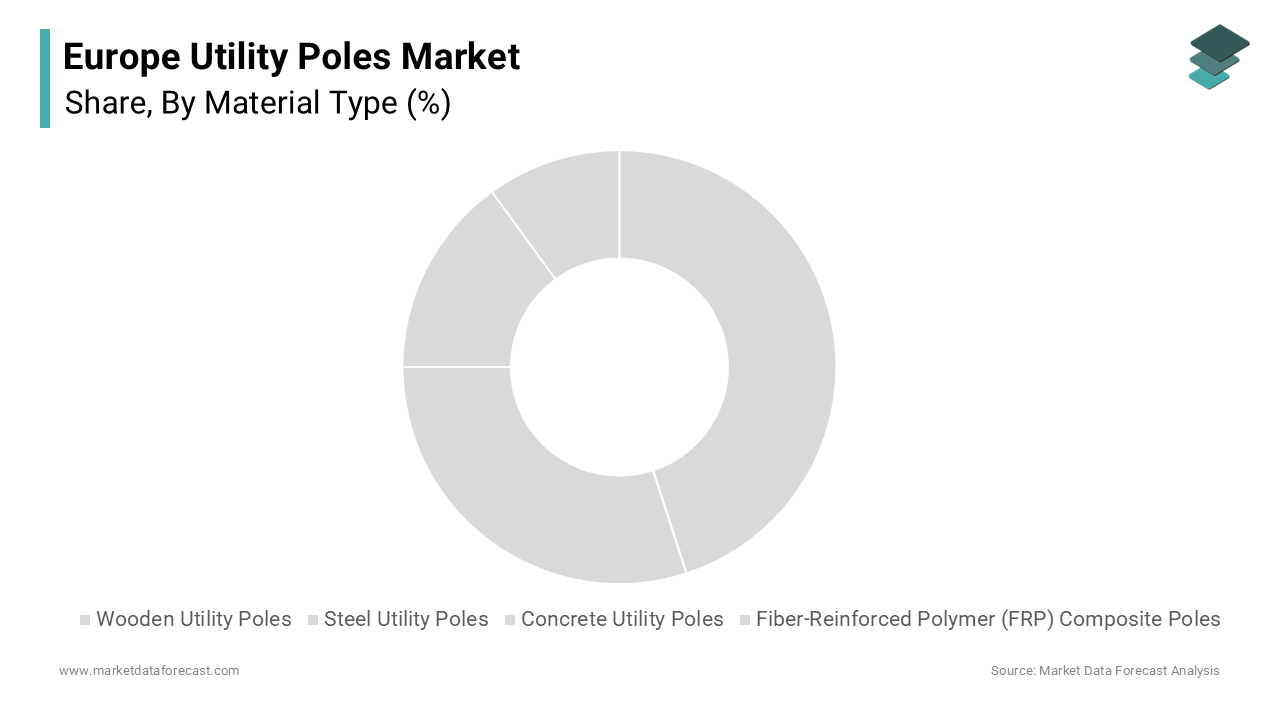
The wooden utility poles segment led the market and accounted for 56.5% of the regional market share in 2025. The growth of the wooden segment in the European market is attributed to the decades of infrastructure legacy, cost efficiency in rural deployment, and established treatment protocols despite increasing environmental scrutiny. Cost Effectiveness and Ease of Installation in Rural Networks Wood remains the preferred material for rural and peri-urban distribution due to its low upfront cost, lightweight handling, and simple on-site modification. According to the European Distribution System Operators for Smart Grids, the average installed cost of a treated wooden pole in Central Europe is significantly lower than concrete or steel alternatives. In countries such as Poland and Romania, where a majority of distribution networks are overhead, wooden poles enable rapid grid extension to dispersed communities without heavy machinery. Studies in Central Europe have shown that wooden pole installation requires less time than concrete due to manual handling and minimal foundation requirements. Additionally, utilities can easily drill or notch wood on-site to accommodate new conductors or telecom attachments, which is a flexibility not feasible with precast alternatives. This operational agility ensures wood remains indispensable for cost-sensitive and logistically challenging rural electrification.
The composite poles segment is a promising segment and is expected to showcase a CAGR of 15.1% over the forecast period owing to the climate resilience and lifecycle cost advantages. Superior Performance in Corrosive and High Wind Environments Composite poles made from fiberglass and resin excel in coastal, alpine, and urban settings where traditional materials degrade rapidly. According to the Dutch Grid Operator TenneT, composite poles installed along the North Sea coast show strong resistance to corrosion and fatigue despite salt spray and high wind exposure. In mountainous regions of Switzerland and Austria, utilities report fewer storm-related outages after replacing wooden poles with composites, as noted by the Swiss Federal Office of Energy. These poles offer tensile strength comparable to steel but with much less weight, enabling installation in ecologically sensitive zones without heavy equipment. Their non-conductive nature also eliminates grounding risks, making them ideal for dense urban areas with mixed utility corridors. This performance reliability in extreme conditions drives accelerated adoption across climate-vulnerable regions.
By Product Type Insights
The distribution poles segment led the market by holding 60.5% of the regional market share in 2025. The growth of the distribution poles segment in the European market can be credited to their ubiquitous presence in last-mile electrification across urban and rural landscapes. Vast Geographic Footprint of Low Voltage Networks Europe’s electricity distribution infrastructure spans millions of kilometers of low voltage lines, requiring poles at regular intervals in rural areas. According to Eurostat, distribution poles represent the majority of pole installations compared to transmission structures. In countries such as Spain and Greece, where mountainous terrain limits underground cabling, most rural households rely on overhead distribution fed by wooden or concrete poles. The EU’s Clean Energy Package further mandates grid reinforcement to connect prosumers, requiring new distribution poles for solar feed-in points and EV charging clusters. Reports from national energy authorities highlight large-scale installations of new distribution poles to support rural PV integration, underscoring their role as the backbone of decentralized energy.
The street/lighting poles segment is anticipated to register a CAGR of 11.9% over the forecast period. Factors such as the smart city initiatives and LED retrofits are majorly driving the growth of the street/lighting poles segment in this regional market. Smart City Integration and Multi-Functional Urban Infrastructure Modern Street poles now host LED luminaires, 5G antennas, EV chargers, environmental sensors, and digital signage require structural upgrades or new installations. According to the European Smart Cities Network, over a million street poles were replaced or retrofitted in 2023 across major cities such as Berlin, Milan, and Barcelona to support integrated urban services. In Copenhagen, most new street poles include pre-wired conduits for future technology add-ons as part of the city’s Digital Backbone Strategy. The European Committee for Standardization’s EN 40 series now mandates higher wind and vibration resistance for poles carrying multiple payloads, driving demand for steel or composite variants. This transformation from single-function lighting supports to intelligent urban nodes creates a high-growth niche that transcends traditional utility roles.
By End-User Insights
The electricity distribution utilities segment accounted for the biggest share of 70.5% of the regional market in 2025. The dominance of electricity distribution segment in the European utility poles segment in attributed to their responsibility for maintaining the vast low voltage networks that deliver power to over 240 million European households. Regulatory Obligations for Grid Reliability and Rural Access Distribution system operators are legally mandated to ensure continuous power supply even in remote areas where underground cabling is prohibitively expensive. According to the EU’s Electricity Directive, national regulators require DSOs to maintain service continuity metrics—prompting proactive pole replacement in aging networks. In Poland, the Energy Regulatory Office approved a multi-billion euro program in 2023 to replace hundreds of thousands of wooden poles in storm-prone regions to meet availability targets. Similarly, Romania’s Transelectrica plans to install new distribution poles under the Modernisation Fund to reduce rural outage durations. These regulatory and social obligations create predictable, consistent demand that defines the core of the utility poles market.
REGIONAL ANALYSIS
France Utility Poles Market Analysis
France stood as the largest utility poles market in Europe and occupied 20.5% of the regional market share in 2025. The dominance of France in the European market can be credited to its extensive rural electrification network and aggressive grid modernization under the France 2030 investment plan. With millions of wooden poles in service, Enedis is replacing large volumes annually to meet storm resilience standards. The government’s REPowerEU alignment strategy mandates that all new poles support fiber optic and smart grid sensors, creating multi-utility demand. Additionally, France’s overseas territories such as Réunion require salt-resistant composite poles, diversifying material adoption. This combination of legacy scale, regulatory urgency, and infrastructure convergence ensures France remains the anchor of Europe’s utility poles landscape.
Germany Utility Poles Market Analysis
Germany accounted for a promising share of the European utility poles market in 2025. The nation’s market is driven by the Energiewende policy, which decentralizes generation and requires extensive last-mile grid reinforcement. Hundreds of thousands of new distribution poles have been installed in recent years to connect agricultural solar farms and community wind projects, particularly in Bavaria and Schleswig-Holstein. Strict forestry laws have reduced domestic softwood supply, forcing utilities such as Bayernwerk to adopt concrete and steel alternatives. The Federal Immission Control Act also mandates visual impact assessments, accelerating composite pole trials in scenic regions. Germany’s technical rigor, regulatory complexity, and renewable push make it a high-volume, high-specification market that shapes European standards.
United Kingdom Utility Poles Market Analysis
The United Kingdom is estimated to witness a prominent CAGR in the European market during the forecast period. The country’s position is defined by urgent storm resilience programs following increased North Atlantic cyclone activity. National Grid’s Storm Plan approved in 2023 allocates billions of pounds to replace aging wooden poles with steel or composite variants by 2030. Simultaneously, the Low Carbon Networks Fund supports smart pole deployments with integrated sensors for real-time grid monitoring, with thousands installed in 2023 alone. The UK also leads in pole sharing, with Openreach leasing space on National Grid poles for fiber broadband, reducing trenching costs. Despite Brexit, the UK maintains alignment with EU grid codes, ensuring continued interoperability. This blend of climate adaptation, digitalization, and infrastructure sharing sustains the UK’s position as a dynamic and policy-driven market.
Spain Utility Poles Market Analysis
Spain is expected to account for a notable share of the European utility poles market during the forecast period. The country’s strength lies in its vast rural territories and leadership in solar energy deployment. A majority of Spain’s distribution network remains overhead due to mountainous terrain and cost constraints, requiring continuous pole maintenance and expansion. Red Eléctrica has installed large volumes of new distribution poles to connect utility-scale solar farms in Extremadura and Andalusia to the grid. The National Integrated Energy and Climate Plan mandates that all new poles in fire-risk zones be non-combustible, accelerating steel and concrete adoption. Additionally, Spain’s digital agenda promotes pole sharing for 5G rollout, creating multi-utility demand. This convergence of renewable ambition, geographic necessity, and climate adaptation ensures Spain remains a high-growth market in Southern Europe.
Sweden Utility Poles Market Analysis
Sweden is projected to grow at a healthy CAGR in the European utility poles market over the forecast period. The country’s market is anchored in its sustainable forestry model and boreal climate challenges. A majority of utility poles are domestically produced from PEFC-certified pine treated with copper azole, ensuring traceability and environmental compliance. Svenska Kraftnät’s Grid Resilience Program allocates significant funding to replace wooden transmission poles with steel in wildfire-prone northern regions. Simultaneously, Sweden pioneers circularity, with most end-of-life poles converted to biomass fuel for district heating as per the Swedish Energy Agency. The government’s Fossil Free Sweden initiative also funds composite pole trials for sensitive ecological zones. This balance of renewable resources, environmental stewardship, and climate adaptation positions Sweden as a high-integrity and innovation-leading market in the Nordic region.
COMPETITIVE LANDSCAPE
The Europe utility poles market features structured competition defined by material specialization regulatory compliance and regional supply chains. Large wood treaters dominate rural distribution segments through cost efficiency and established forestry links while steel and composite manufacturers target high resilience and multi utility applications in urban and coastal zones. Competition is rarely price based instead focusing on environmental credentials technical certification and lifecycle performance. Regulatory fragmentation particularly around wood preservatives and load standards creates high barriers that favor incumbents with national approvals. At the same time the rise of smart grids and telecom sharing is transforming poles into strategic assets requiring higher specifications and digital integration. Public procurement policies increasingly prioritize low carbon and circular solutions accelerating innovation in composites and recycling. Ultimately success in Europe hinges on a supplier’s ability to deliver certified locally sourced poles that meet climate resilience goals within a complex and evolving policy landscape.
KEY MARKET PLAYERS
Some of the companies that are playing a dominating role in the Europe Utility Poles Market include
- Valmont Industries, Inc.
- Hill & Smith Holdings Plc
- Fuchs Europoles GmbH
- Stella-Jones Inc.
- El Sewedy Electric Company
- Skipper Ltd.
- Nippon Concrete Industries Co., Ltd.
- Strongwell Corporation
- Pelco Products, Inc.
- RS Technologies Inc.
- KEC International
Top Players in the Market
Nordisk Træimpregnering A/S
Nordisk Træimpregnering A/S is a leading European producer of treated wooden utility poles with deep integration across Scandinavia and the Baltics. The company specializes in copper azole and micronized copper preservation systems compliant with EU Biocidal Products Regulation and PEFC sustainable forestry standards. Recently Nordisk expanded its Danish facility to include robotic handling and real time moisture monitoring to ensure consistent pole quality. It also launched a digital pole passport system that tracks timber origin treatment batch and expected service life—aligning with EU Green Public Procurement criteria. These innovations reinforce its position as a trusted provider of environmentally responsible and traceable wooden poles in Europe’s increasingly regulated infrastructure landscape.
Valmont Industries Inc.
Valmont Industries Inc maintains a strong presence in the Europe utility poles market through its advanced composite and steel pole solutions designed for extreme weather and multi utility applications. The company has prioritized sustainability by developing fiberglass poles with 40% lower lifecycle carbon emissions compared to traditional materials. Recently Valmont introduced a modular composite pole system in the Netherlands and Germany that supports co deployment of power lines fiber optics and 5G antennas with pre-engineered attachment points. It also partnered with European grid operators to validate pole performance under EN 40 and EN 13148 standards. Through this focus on resilience interoperability and decarbonization Valmont strengthens its relevance in Europe’s smart grid and climate adaptation initiatives.
Svenska Träimpregnerings AB
Svenska Träimpregnerings AB plays a pivotal role in the Europe utility poles market as Sweden’s largest treated wood pole producer serving Nordic and Central European utilities. The company leverages Sweden’s sustainable forestry ecosystem to supply poles made from certified boreal pine treated with non-creosote preservatives. Recently Svenska Träimpregnerings implemented a closed loop water recycling system at its Sollefteå plant reducing freshwater consumption by 85% and earning EU Eco Management and Audit Scheme certification. It also launched a pole take back program where end of life poles is converted into biomass fuel for district heating—supporting circular economy goals. These actions underscore its commitment to environmental stewardship while meeting the technical demands of Europe’s modernizing grid infrastructure.
Top Strategies Used by the Key Market Participants
Key players in the Europe utility poles market pursue strategies centred on sustainable material sourcing regulatory compliance digital traceability and multi utility integration. They invest in non-creosote wood preservation systems and closed loop treatment plants to meet EU Biocidal Products Regulation and circular economy mandates. Companies develop composite and hybrid poles with lower lifecycle emissions to align with Green Public Procurement criteria and climate resilience goals. Strategic partnerships with grid operators and telecom providers enable co deployment solutions that maximize pole utility and reduce infrastructure duplication. Simultaneously vendors implement digital pole passports using QR codes or RFID to provide full lifecycle data from forest origin to end of life recycling. These integrated approaches allow leading firms to balance performance durability and environmental responsibility in a market shaped by regulatory rigor and infrastructure transformation.
MARKET SEGMENTATION
This research report on the europe utility poles market has been segmented and sub-segmented based on following categories.
By Material Type
- Wooden Utility Poles
- Steel Utility Poles
- Stepped Steel Poles
- Swaged Steel Poles
- Concrete Utility Poles
- Fiber-Reinforced Polymer (FRP) Composite Poles
By Product
- Transmission Poles
- Distribution Poles
- Street / Lighting Poles
- High-Mast Poles
- Monopoles
- Smart Poles
- Others
By Pole Height
- Below 40 ft40-70 ft
- Above 70 ft
- By End-User
- Electricity Transmission Utilities
- Electricity Distribution Utilities
- Street and Area Lighting Agencies
- Telecommunication Operators
- Railways and Transport Infrastructure
- Others
By Country
- UK
- France
- Spain
- Germany
- Italy
- Russia
- Sweden
- Denmark
- Switzerland
- Netherlands
- Turkey
- Czech Republic
- Rest of Europe
Frequently Asked Questions
What are utility poles used for?
Utility poles are used to support overhead power transmission and distribution lines, telecommunication cables, and street lighting infrastructure.
What materials are commonly used for utility poles in Europe?
Utility poles are typically made from concrete, steel, wood, and composite materials, with concrete and steel being the most widely used in Europe.
Which sector primarily drives demand for utility poles in Europe?
The transmission and distribution (T&D) sector is the primary driver, supported by grid modernization and renewable energy integration.
What factors are driving the Europe utility poles market?
Key drivers include expansion of power grids, replacement of aging infrastructure, renewable energy projects, and increasing electrification.
What are the major challenges in the Europe utility poles market?
High installation costs, strict environmental regulations, and maintenance of aging networks are major challenges.
Which countries contribute significantly to market growth?
Germany, the UK, France, Italy, and Spain are major contributors due to strong grid infrastructure investments.
How does renewable energy impact the utility poles market?
Renewable energy projects increase demand for new transmission and distribution lines, directly boosting utility pole installations.
What is the future outlook of the Europe utility poles market?
The market is expected to grow steadily due to smart grid adoption, renewable energy expansion, and infrastructure upgrades.
What role does smart grid development play in the Europe utility poles market?
Smart grid projects require upgraded transmission and distribution infrastructure, increasing the demand for durable and advanced utility poles.
Are composite utility poles gaining adoption in Europe?
Yes, composite utility poles are gaining traction due to their lightweight nature, corrosion resistance, and longer service life compared to traditional materials.
Access the study in MULTIPLE FORMATS
Purchase options starting from
$ 2000
Didn’t find what you’re looking for?
TALK TO OUR ANALYST TEAM
Need something within your budget?
NO WORRIES! WE GOT YOU COVERED!
Call us on: +1 888 702 9696 (U.S Toll Free)
Write to us: sales@marketdataforecast.com