- Product Description Description
- Table of Contents TOC
- List of Table & Figure LOT
- Get Free Sample PDF Sample PDF
Market Size, 2025
$19.51 BnMarket Estimate, 2026
$20.53 BnMarket Forecast, 2034
$31.40 BnCAGR, 2026–2034
5.43%Executive Summary: Europe Vaccine Market
- Market Scope: Regional analysis of Europe's vaccine sector, breaking down data by vaccine type, disease indications, routes of administration, age groups, distribution channels, and country-level profiles.
- Market Valuation: Valued at USD 19.51 billion in 2025, reaching USD 20.53 billion in 2026, and projected to expand to USD 31.40 billion by 2034, growing at a steady CAGR of 5.43% from 2026 to 2034.
- Primary Growth Drivers: Strengthened regulatory and coordinated joint procurement frameworks alongside the rising health burden of vaccine-preventable diseases among Europe's aging population.
Key Market Segment Metrics
| Category | Leading Segment (Base Position) | Fastest-Growing / High-Growth Segment |
|---|---|---|
| By Type | Subunit Vaccines (accounted for a dominant 58.6% share in 2025, anchored by established safety profiles and inclusion in routine immunization programs) | mRNA Vaccines (projected at the fastest CAGR of 28.4% from 2026 to 2034, driven by pandemic platform validation and rapid seasonal pathogen adaptability) |
| By Disease Indication | Human Papillomavirus (HPV) Vaccines (led with a 24.5% share in 2025, supported by the EU's Beating Cancer Plan and gender-neutral school programs) | Respiratory Syncytial Virus (RSV) Vaccines (projected at a rapid CAGR of 34.1%, fueled by major senior approvals like Arexvy and Abrysvo) |
| By Age Group | Adults (held a leading 52.3% share in 2025, propelled by Europe's demographic aging, life-course immunization, and senior-focused campaigns) | Adolescent Vaccines (projected at a high CAGR of 19.7%, driven by expanded HPV and meningococcal coverage in structured school programs) |
| By Country | Germany (top performer with a 22.7% share in 2025, backed by universal healthcare, strong domestic R&D, and leadership in EU joint procurement) | France, United Kingdom, Italy, and Spain (key regional hubs driven by vaccine manufacturing, centralized health governance, and regional autonomous rollouts) |
Major Market Players & Industry Landscape
Market Structure: Highly regulated and collaborative ecosystem where legacy multinational developers and agile mRNA platform innovators compete on clinical efficacy, safety, and health sovereignty alignment.
Key Companies: Pfizer Inc., Sanofi S.A., GlaxoSmithKline plc (GSK), AstraZeneca plc, Valneva SE, Bavarian Nordic A/S, BioNTech SE, and Merck & Co., Inc.
 Download Free Sample Report
Europe Vaccine Market Size
The Europe vaccine market size was valued at USD 19.51 billion in 2025 and is anticipated to reach USD 20.53 billion in 2026 from USD 31.40 billion by 2034, growing at a CAGR of 5.43% during the forecast period from 2026 to 2034.

Vaccine refers to the immunobiological agents designed to prevent infectious diseases across the European Union and broader European region. Vaccines in this context range from routine pediatric and adult immunizations to pandemic responsive and emerging pathogen countermeasures. Europe is a major center for vaccine development. A significant portion of global clinical trials for new vaccines occurs there, according to research. The region’s public health infrastructure supports high immunization coverage for core diseases yet faces evolving pressures from antimicrobial resistance climate driven vector expansion and aging demographics. Vaccination efforts are crucial, as seasonal influenza causes a substantial number of premature deaths each year across European Union member states. Furthermore, Europe’s coordinated procurement mechanisms such as the EU Joint Action on Vaccination and the European Vaccine Initiative demonstrate institutional commitment to equitable access and supply chain resilience. These structural and epidemiological realities position vaccines not merely as medical commodities but as strategic instruments of health sovereignty public trust and transnational security in an era of biological uncertainty.
MARKET DRIVERS
Strengthened Regulatory and Procurement Frameworks Drive Vaccine Uptake
The institutionalization of coordinated vaccine procurement and harmonized regulatory pathways has bolstered the growth of the Europe vaccine market. The European Commission’s 2020 Pharmaceutical Strategy for Europe aimed to enhance crisis preparedness and security of supply. This strategy was a key component of building a stronger European Health Union and was developed in parallel with other initiatives, such as the EU Vaccines Strategy, both of which addressed vulnerabilities exposed by the COVID-19 pandemic. Moreover, the European Union has a voluntary Joint Procurement Agreement mechanism, signed by 38 countries as of April 2025, which allows participating members to jointly procure medical countermeasures to ensure security of supply and enhance preparedness against health crises. The EU Joint Action on Vaccination which concluded in 2023 laid the groundwork for a permanent coordination mechanism now operational under the European Health Union. This structure enables rapid deployment of stockpiles during outbreaks. Apart from these, the inclusion of vaccination coverage targets in national recovery and resilience plans has incentivized member states to modernize cold chain logistics and integrate immunization data into digital health records. These systemic enhancements transform vaccine access from a fragmented national responsibility into a collectively managed European public good thereby sustaining stable and predictable demand.
Rising Burden of Vaccine Preventable Diseases Among Aging Populations
The region’s demographic transition is amplifying the clinical and economic rationale for adult and elderly immunization, which accelerates the growth of the Europe vaccine market. This creates sustained vaccine demand beyond childhood programs. The continent is home to the world’s oldest population with a percentage of EU citizens aged 65 or older. This cohort faces heightened vulnerability to infections such as influenza pneumococcal pneumonia and shingles which account for disproportionate hospitalization and mortality. Countries have already integrated high dose influenza and recombinant zoster vaccines into publicly funded programs for seniors. The shift toward life course immunization is redefining vaccine demand as a core component of sustainable aging policy, instead of a pediatric afterthought, as national health systems grapple with escalating costs from preventable infections
MARKET RESTRAINTS
Fragmented Public Trust and Vaccine Hesitancy Undermine Program Effectiveness
Persistent skepticism toward vaccine safety and necessity continues to constrain the growth of the Europe vaccine market. This is despite scientific consensus and institutional backing. According to studies, a minority of EU citizens are concerned about vaccine side effects and doubt overall effectiveness. Confidence in vaccines varies across EU countries, with some like France and Bulgaria showing lower rates. This hesitancy contributes to lower immunization coverage, meaning many countries do not meet the target for community immunity for diseases like measles. The spread of online misinformation worsens public trust and coordinated campaigns target immunization programs. Public health authorities now allocate significant resources to community engagement and transparent risk communication yet the residual effect is delayed procurement decisions reduced tender volumes and increased administrative costs for outreach thereby acting as a structural drag on market expansion.
Stringent Manufacturing and Quality Control Requirements Increase Entry Barriers
Adherence to the region's highly rigorous manufacturing and pharmacovigilance standards ensures product safety but restrains competitive entry and the ability to scale innovation and thereby hinders the expansion of the Europe vaccine market. Regulatory bodies mandate strict monitoring, sterility assurance, and traceability throughout manufacturing, which often requires substantial investment for production facilities. Directives require unique serialization and verification for every unit, increasing supply chain complexity. Many new vaccine applications have documentation issues, causing approval delays. These regulatory hurdles disproportionately affect small biotech firms and non-European developers lacking established quality management systems. Consequently, market diversity remains concentrated among a handful of multinational manufacturers while promising platforms such as mRNA and viral vector vaccines face extended timelines to achieve commercial scale. The result is a high integrity but relatively inflexible production ecosystem that prioritizes safety over speed or accessibility.
MARKET OPPORTUNITIES
Expansion of mRNA and Platform Based Vaccine Technologies
The successful deployment of mRNA vaccines during the pandemic has caused a structural shift toward platform-based technologies, which offer unprecedented speed and adaptability in the region, and this is setting up fresh opportunities for the growth of the Europe vaccine market. In October 2025, the European Commission and the European Investment Bank committed up to €95 million in blended financing to support the establishment of a BioNTech mRNA manufacturing facility in Kigali, Rwanda, aimed at strengthening Africa's vaccine production capacity. The Coalition for Epidemic Preparedness Innovations (CEPI) has set a vision for the world to be able to respond to a pandemic threat with a new vaccine within 100 days. These platforms are now being repurposed for influenza cytomegalovirus and respiratory syncytial virus. The European Medicines Agency has introduced rolling review pathways specifically for platform technologies enabling simultaneous evaluation of manufacturing processes and clinical data. This technological leap transforms vaccines from static biological products into dynamic public health tools capable of rapid response to emerging threats thereby opening new therapeutic categories and procurement models previously constrained by traditional vaccine development timelines.
Integration of Vaccines into National Cancer and Antimicrobial Resistance Strategies
The region’s strategic health policies are increasingly incorporating vaccines as preventive tools against non-traditional indications such as oncogenic infections and antimicrobial resistance, which creates potential prospects for the expansion of the Europe vaccine market. The European Commission’s 2022 Europe’s Beating Cancer Plan explicitly targets 90 percent human papillomavirus vaccination coverage among adolescents by 2030 to prevent cervical and oropharyngeal cancers. As per the European Cancer Organisation, persistent HPV infection causes almost 100,000 cancer cases annually in Europe, making prophylactic vaccination a cost-effective intervention. Simultaneously, the EU One Health Action Plan Against Antimicrobial Resistance identifies pneumococcal and influenza vaccines as critical alternatives to antibiotic use by reducing secondary bacterial infections. National programs in some countries have already linked vaccine reimbursement to antimicrobial stewardship metrics. This policy convergence repositions vaccines from reactive infectious disease tools to proactive components of integrated health strategies thereby expanding their clinical relevance public funding eligibility and long-term demand sustainability across diverse therapeutic domains.
MARKET CHALLENGES
Persistent Cold Chain and Last Mile Delivery Gaps in Rural and Eastern Regions
Logistical disparities in vaccine delivery persist across Europe's remote and less affluent regions, compromising coverage and wasting valuable doses, despite the presence of advanced health systems. This continues to obstruct the growth of the Europe vaccine market. According to studies, a significant amount of temperature sensitive vaccines are discarded each year due to cold chain problems across Europe. Some clinics in the Balkans and Baltic states do not have continuous refrigeration or real time temperature tracking. These gaps are exacerbated by workforce shortages. The potential for integrated logistics was demonstrated by the EU’s Digital COVID Certificate infrastructure, but without a permanent pan-European vaccine delivery protocol, cold chain integrity relies solely on national capacity. The full public health and market potential of vaccines will remain unrealized across significant portions of the continent until systemic weaknesses are addressed through coordinated investment in refrigerated transport, digital tracking, and workforce training.
Intellectual Property and Technology Transfer Disputes Limit Regional Self Reliance
Unresolved tensions around intellectual property rights and limited technology transfer from leading manufacturers impede domestic production scaling, which hampers the expansion of the Europe vaccine market. The European Court of Auditors (ECA) published multiple reports in 2024, including an annual report on the EU budget and the Recovery and Resilience Facility (RRF), as well as special reports on specific topics like AI, healthcare digitalization, and the microchips strategy. The regulatory and commercial impasse leaves the region dependent on a narrow set of multinational suppliers despite having advanced biotech research capabilities. Consequently, strategic stockpiles remain vulnerable to global allocation decisions and export controls. Europe's vaccine market will struggle to balance innovation protection with public health resilience until enforceable frameworks for equitable technology access are established.
REPORT COVERAGE
| REPORT METRIC | DETAILS |
| Market Size Available | 2025 to 2034 |
| Base Year | 2025 |
| Forecast Period | 2026 to 2034 |
| Segments Analysed | By Type, Disease Indication, Route of Administration, Age Group, Distribution Channel and region |
| Various Analyses Covered | Global, Regional & Country Level Analysis; Segment-Level Analysis, Drivers, Restraints, Opportunities, Challenges; PESTLE Analysis; Porter's Five Forces Analysis, Competitive Landscape, Analyst Overview of Investment Opportunities |
| Regions Analysed | United Kingdom, France, Spain, Germany, Italy, Russia, Sweden, Denmark, Switzerland, the Netherlands, Turkey, and the Czech Republic. |
| Key Market Players | Pfizer Inc., Sanofi S.A., GlaxoSmithKline plc (GSK), AstraZeneca plc, Valneva SE, Bavarian Nordic A/S, BioNTech SE, Merck & Co., Inc. |
SEGMENTAL ANALYSIS
By Type Insights
The subunit vaccines segment was the largest segment in the Europe vaccine market and accounted for a 58.6% share in 2025. Factors such as established safety profiles, broad regulatory acceptance, and integration into national immunization programs for diseases such as hepatitis B, pertussis, and human papillomavirus, have mainly contributed to the growth of the subunit vaccines segment. Unlike live attenuated or whole virus platforms subunit vaccines contain only purified antigenic fragments minimizing reactogenicity and making them suitable for immunocompromised and elderly populations. Furthermore, most publicly procured pediatric combination vaccines in the EU. Public trust also plays a role. This entrenched clinical confidence combined with decades of manufacturing infrastructure ensures subunit vaccines remain the backbone of Europe’s routine and catch-up immunization strategies.
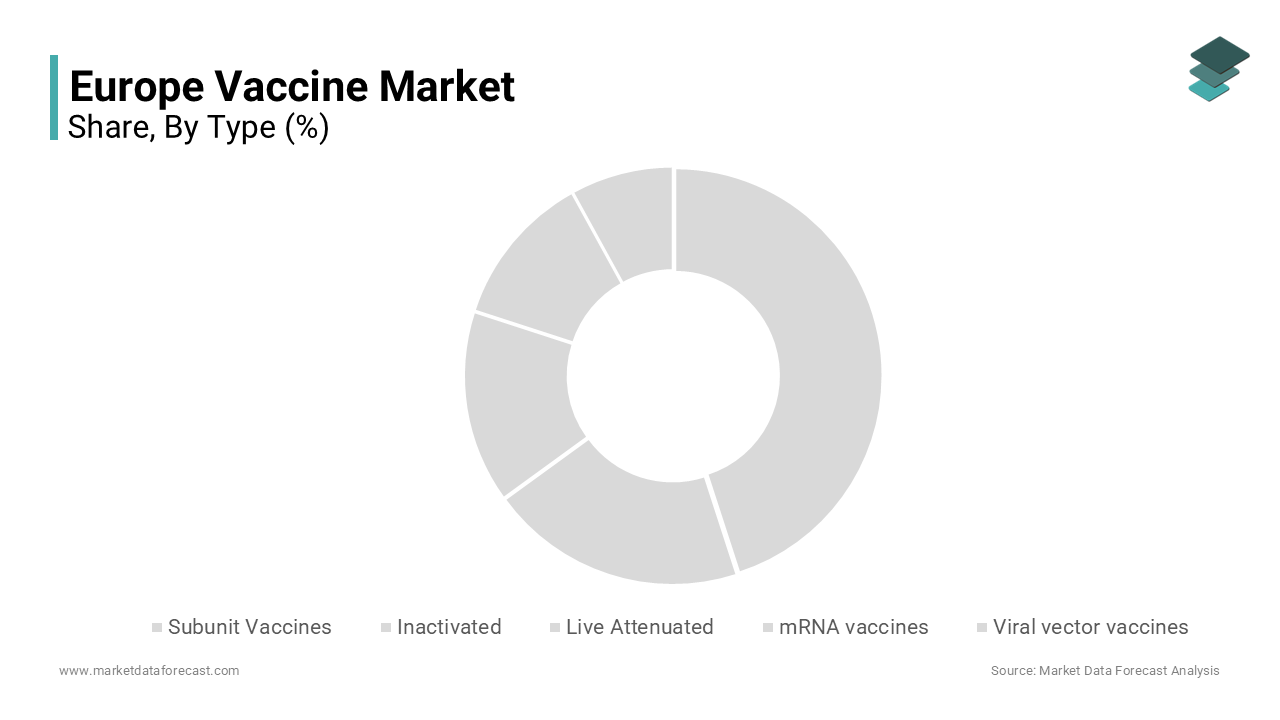
The mRNA vaccines segment is estimated to register the fastest CAGR of 28.4% between 2026 and 2034 due to successful platform validation during the pandemic and rapid repurposing for seasonal and emerging pathogens. Regulatory bodies began approving the first seasonal influenza vaccines utilizing mRNA technology. Major pharmaceutical companies expanded their mRNA vaccine research beyond COVID-19, initiating large-scale clinical trials for other viruses like cytomegalovirus. Government and health organizations committed significant financial resources to establish decentralized, high-volume mRNA vaccine manufacturing capabilities across various regions to improve pandemic preparedness. Unlike traditional platforms mRNA allows antigen updates within weeks of viral sequencing enabling dynamic response to variants. This agility combined with strong clinical efficacy data is transforming mRNA from an emergency tool into a core component of Europe’s long term vaccine architecture.
By Disease Indication Insights
The human papillomavirus vaccines segment led the Europe vaccine market and accounted for a 24.5% share in 2025. The supremacy of the human papillomavirus vaccines segment is attributed to the EU’s aggressive cancer prevention agenda which designates HPV vaccination as a cornerstone of its Europe’s Beating Cancer Plan. A goal has been established to achieve high vaccination coverage among adolescents by 2030. An increasing number of EU member states have been adopting gender-neutral HPV vaccination programs. As per sources, the number of HPV vaccine doses publicly procured across the EU has been rising. Clinical urgency further drives adoption. Countries have achieved HPV coverage exceeding notably through school based delivery and digital reminder systems. The inclusion of next generation nonavalent vaccines offering protection against nine HPV strains has also improved cost effectiveness ratios prompting reimbursement expansions even in fiscally constrained health systems.
The respiratory syncytial virus vaccines segment is anticipated to witness the fastest CAGR of 34.1% over the forecast period. This surge follows the approvals of Arexvy by GSK and Abrysvo by Pfizer for adults aged 60 and older marking the first RSV vaccines available in Europe. The clinical need is acute as RSV causes large number of hospitalizations annually among elderly Europeans with case fatality rates exceeding those of seasonal influenza in frail populations. National immunization technical advisory groups have already recommended routine RSV vaccination for seniors with public funding. Besides, maternal RSV vaccination programs are being piloted in the Netherlands and Sweden to protect newborns during their most vulnerable first six months. Market uptake is further accelerated by bundled procurement with influenza and pneumococcal vaccines simplifying delivery during seasonal campaigns. This segment is poised for sustained expansion beyond initial launch momentum, driven by millions of Europeans aged 60 or older and rising RSV awareness among clinicians.
By Age Group Insights
The adults segment was the leading share of 52.3% of the Europe vaccine market in 2025. The dominance of the adults segment is propelled by Europe’s demographic reality with a share of the EU population aged 65 or older and growing demand for life course immunization. Unlike childhood programs which are largely standardized adult vaccination spans influenza pneumococcal shingles RSV and travel related vaccines with coverage increasingly tied to national aging and antimicrobial resistance strategies. Germany administered millions of adult vaccine doses primarily through pharmacies and occupational health services as reported by the Robert Koch Institute. Furthermore, the integration of vaccination into chronic disease management has expanded access with diabetes and cardiovascular clinics routinely offering influenza and pneumococcal shots. The shift in health systems from treatment-focused care to prevention strategies means adult immunization is now a measurable indicator of primary care performance, which supports its centrality in Europe’s public health infrastructure.
The adolescent vaccines segment is likely to experience the fastest CAGR of 19.7% between 2026 and 2034 owing to the expansion of HPV and meningococcal vaccination to include both boys and girls under coordinated EU cancer and infectious disease strategies. School based delivery has proven highly effective. Digital health passports and integration with school health records have streamlined consent and tracking. This segment enjoys strong policy support, public funding, and high parental acceptance, especially when vaccines are delivered through trusted educational institutions, as adolescence is recognized as a critical window for preventing future cancers and invasive bacterial diseases.
REGIONAL ANALYSIS
Germany Vaccine Market Analysis
Germany was the top performer in the Europe vaccine market and held a 22.7% share in 2025. The domination of the German market is primarily driven by its robust universal healthcare system strong pharmaceutical manufacturing base and proactive public health policies. The country administers millions of vaccine doses annually with adult immunization rates for influenza and pneumococcal disease among the highest in Europe according to the Robert Koch Institute. Germany’s Standing Committee on Vaccination continuously updates recommendations based on real world evidence. The presence of global vaccine developers enables rapid clinical translation and domestic production capacity. Furthermore, Germany leads EU joint procurement efforts having coordinated a portion of bloc wide vaccine tenders. Germany's vaccine market is the region's most influential national ecosystem because it combines scale, innovation, and policy coherence, fueled by an aging population and a high level of public trust in scientific institutions.
France Vaccine Market Analysis
France followed closely in the Europe vaccine market and captured a 17.4% share in 2025. The demand for vaccine in the French market is fuelled by centralized public health governance and strong investment in vaccine research. The French National Authority for Health mandates vaccination against eleven diseases for children and fully reimburses adult vaccines including shingles and high dose influenza. The country hosts major R&D hubs for Sanofi Pasteur which supplies a share of Europe’s routine pediatric vaccines. Besides, France is a core participant in the EU mRNA manufacturing initiative with a substantial dose annual capacity facility under construction near Lyon. Vaccine confidence has also rebounded significantly with 81 percent of citizens expressing trust in immunization. This combination of regulatory clarity industrial capacity and restored public trust positions France as a key driver of market stability and innovation.
United Kingdom Vaccine Market Analysis
The United Kingdom is another key player in the Europe vaccine market by leveraging its world class public health infrastructure and agile regulatory framework. The National Health Service delivers one of the most comprehensive immunization programs globally covering everything from routine childhood vaccines to shingles and now RSV for the elderly. The UK also maintains strategic stockpiles through the Vaccine Network and partners with the Serum Institute of India for pandemic preparedness. Despite Brexit the country remains deeply integrated into European disease surveillance via the European Centre for Disease Prevention and Control associate status. This blend of scientific rigor operational excellence and forward-looking procurement ensures the UK’s outsized influence on vaccine policy and adoption trends.
Italy Vaccine Market Analysis
Italy experienced a moderate growth of the European vaccine market due to mandatory childhood vaccination laws and a renewed focus on adult immunization. Since 2017 Italy has required ten vaccines for school enrollment resulting in measles coverage rising. The National Prevention Plan expands free access to HPV pneumococcal and herpes zoster vaccines for adults over 65 addressing gaps in Southern regions. Italy also hosts key manufacturing sites for major multinationals including GSK’s vaccine facility in Siena which produces millions of doses annually for global distribution. Regional disparities persist but digital health reforms are standardizing vaccine registries across regions. Italy’s market serves as a critical barometer for Southern European adoption patterns because it balances regulatory enforcement with equitable access, a challenge heightened by high population density and an aging demographic.
Spain Vaccine Market Analysis
Spain is anticipated to expand in the Europe vaccine market between 2026 and 2034 due to its decentralized yet coordinated immunization approach across autonomous communities. The Interterritorial Council of the National Health System ensures uniform vaccine recommendations while allowing regional flexibility in procurement and delivery. Spain also participates in the EU’s mRNA scale up with a pilot facility in Barcelona supported by the Catalan government. Vaccine confidence has steadily improved. Spain serves as an example of how regional autonomy can align with national health objectives to drive consistent market growth by combining scientific leadership, localized implementation, and inclusive access.
COMPETITIVE LANDSCAPE
Competition in the Europe vaccine market is shaped by a dynamic interplay between established multinational developers and agile biotechnology innovators. Legacy players such as Sanofi GSK and Pfizer leverage decades of regulatory experience extensive distribution networks and deeply embedded relationships with national health systems to maintain dominance in routine immunization. Simultaneously mRNA pioneers like BioNTech and CureVac are redefining competitive boundaries through platform flexibility speed of development and strong public backing under the EU’s health sovereignty agenda. The market is further influenced by stringent quality requirements centralized procurement mechanisms and evolving public expectations around safety and transparency. Differentiation increasingly hinges on clinical innovation life cycle management and the ability to align with Europe’s strategic priorities including cancer prevention antimicrobial resistance and pandemic preparedness. While barriers to entry remain high due to manufacturing complexity and regulatory scrutiny the convergence of digital health data science and novel adjuvants is fostering a more pluralistic innovation landscape where scientific excellence and policy alignment jointly determine market influence.
KEY MARKET PLAYERS
Some of the companies that are playing a dominating role in the Europe Vaccine Market include
- Pfizer Inc.
- Sanofi S.A.
- GlaxoSmithKline plc (GSK)
- AstraZeneca plc
- Valneva SE
- Bavarian Nordic A/S
- BioNTech SE
- Merck & Co., Inc.
Top Players in the Market
Sanofi Pasteur
Sanofi Pasteur maintains a central role in the Europe vaccine market through its broad portfolio spanning influenza diphtheria tetanus pertussis polio and meningococcal diseases. As the vaccines division of Sanofi the company supplies pediatric combination vaccines such as Hexyon across all EU member states and operates major manufacturing facilities in France and Germany. The company partnered with GSK to co develop an adjuvanted recombinant COVID 19 vaccine and is advancing a universal influenza candidate into Phase II trials. Additionally, Sanofi expanded its digital pharmacovigilance capabilities across Europe to enhance real time safety monitoring aligning with EU regulatory expectations and strengthening trust among public health authorities.
GlaxoSmithKline
GlaxoSmithKline is a pivotal contributor to Europe’s vaccine ecosystem with leadership in adjuvant technology and established products for HPV shingles and respiratory infections. Headquartered in the UK GSK supplies Cervarix for human papillomavirus and Shingrix for herpes zoster to national immunization programs across the continent. GSK has also intensified its R and D collaboration with the University of Oxford and the European Vaccine Initiative to develop vaccines against Group B streptococcus and tuberculosis. Through its adjuvant system AS01b GSK enhances immune responses in elderly populations a strategic focus aligned with Europe’s aging demographic and public health priorities.
BioNTech
BioNTech has emerged as a transformative force in the Europe vaccine market through its pioneering mRNA platform originally validated with the Comirnaty COVID 19 vaccine developed in partnership with Pfizer. Based in Mainz Germany the company leverages European scientific talent and regulatory pathways to advance a pipeline targeting influenza cytomegalovirus melanoma and tuberculosis. The company also established the BioNTech Academy to train European biomanufacturing professionals and signed supply agreements with the European Commission for pandemic preparedness stockpiles reflecting its dual role as an innovator and strategic health security partner.
Top Strategies Used by the Key Market Participants
Key players in the Europe vaccine market employ a range of strategic initiatives to sustain leadership and drive innovation. Platform diversification is central with companies investing in mRNA viral vector and recombinant protein technologies to broaden therapeutic reach. Strategic partnerships with academic institutions public health agencies and global vaccine alliances accelerate clinical development and market access. Regulatory agility is prioritized through early engagement with the European Medicines Agency and adoption of rolling review pathways. Companies also enhance manufacturing sovereignty by establishing regional production facilities aligned with EU health security goals. Digital transformation supports pharmacovigilance supply chain transparency and patient adherence via electronic immunization registries. Finally sustainability and equity are integrated through tiered pricing vaccine donations and capacity building in underserved regions reinforcing both corporate responsibility and long term market stability.
MARKET SEGMENTATION
The research report on the Europe Vaccine Market has been segmented and sub-segmented based on categories.
By Type
- Subunit Vaccines
- Inactivated
- Live Attenuated
- mRNA vaccines
- Viral vector vaccines
By Route of Administration
- Oral
- Parenteral
- Nasal
By Disease Indication
- Viral Diseases
- Bacterial Vaccines
- Cancer Vaccines
- Allergy Vaccines
By Age Group
- Pediatric
- Adult
By Distribution Channel
- Hospital & Retail Pharmacies
- Government Suppliers
- Others
By Country
- UK
- France
- Spain
- Germany
- Italy
- Russia
- Sweden
- Denmark
- Switzerland
- Netherlands
- Turkey
- Czech Republic
- Rest of Europe