- Product Description Description
- Table of Contents TOC
- List of Table & Figure LOT
- Get Free Sample PDF Sample PDF
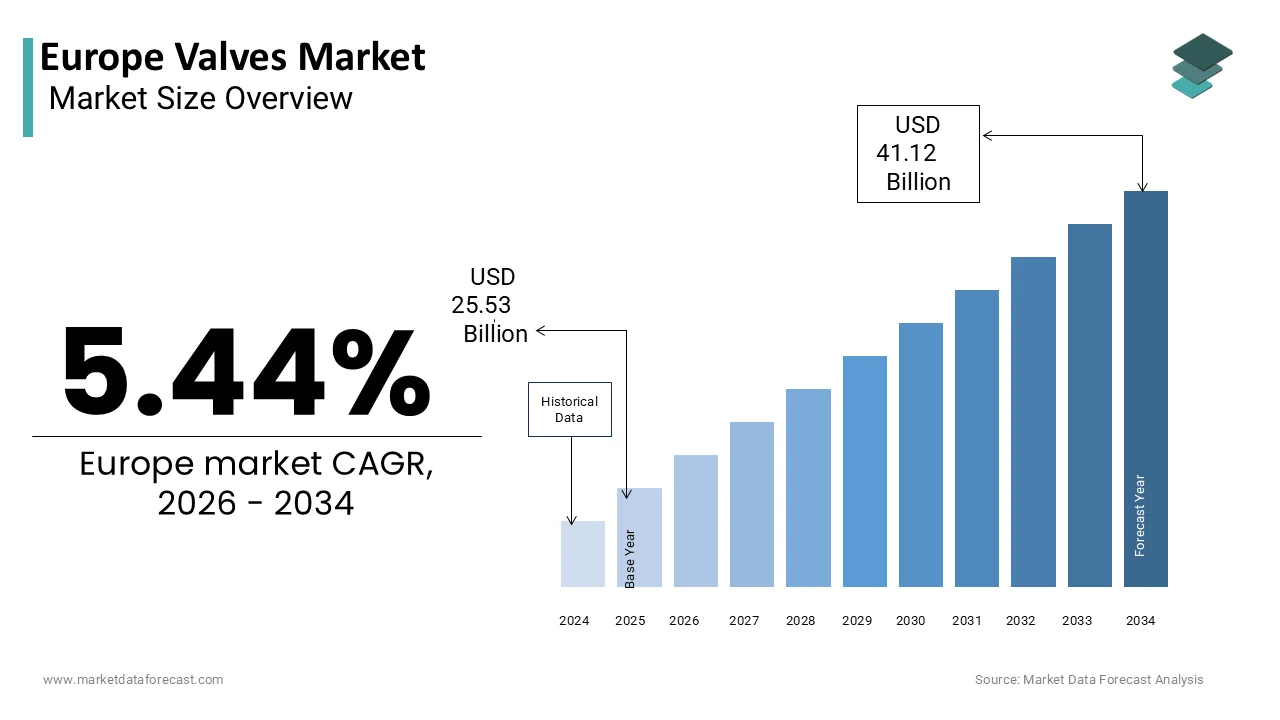
Market Size, 2025
$25.53 BnMarket Estimate, 2026
$26.92 BnMarket Forecast, 2034
$41.12 BnCAGR, 2026–2034
5.44%Europe Valves Market Size
The europe valves market was valued at USD 25.53 billion in 2025, is estimated to reach USD 26.92 billion in 2026, and is projected to reach USD 41.12 billion by 2034, growing at a CAGR of 5.44% from 2026 to 2034.
A valve is a mechanical device that regulates, directs,s or controls the flow of fluids, liquids, gases, slurries, or vapors, by opening, closing, or partially obstructing passageways within piping systems. In Europe, the valves market serves as a critical enabler across energy,gy water infrastructure,ure chemical processing, and manufacturing sectors, where precision reliability and compliance with stringent safety standards are non-negotiable. The European valve ecosystem is distinguished by its integration with industrial automation, digital monitoring, and circular economy principles, particularly in aging pipeline networks and decarbonizing energy systems. According to multiple sources, Extensive public water mains and natural gas pipeline infrastructure, requiring robust, reliable, and numerous valves for operational safety and integrity, are in place across the European Union. Data from the European Environment Agency confirms that roughly 33% of water abstracted for public supply in the EU is lost, with losses in certain Southern European nations exceeding 40%. This high rate of leakage has necessitated large-scale infrastructure investments, including the adoption of smart pressure-reducing valves to optimize distribution and reduce water loss. Furthermore, the European Commission’s Industrial Emissions Directive mandates real-time leak detection and automatic shut-off mechanisms in all new chemical plants, reinforcing demand for certified actuated valves. This regulatory and infrastructural context positions valves not as commodity components but as essential instruments of resource efficiencyshut-offsafety and industrial modernization.
MARKET DRIVERS
Modernization of Aging Water and Gas Infrastructure Drives Replacement Demand
The region’s extensive legacy pipeline networks are undergoing urgent rehabilitation to reduce leakage, enhance energy efficiency, and comply with environmental mandates, which are contributing to the growth of the European valves market. This process is creating sustained demand for advanced valves. According to research, European water networks are facing high levels of treated water losses, with significant pressure on infrastructure in Mediterranean countries and Romania due to aging, corroded pipes, and increased water scarcity. In response, the European Investment Bank is increasing its funding for water management to address water security, climate risk, and pollution, targeting projects that include modernizing infrastructure and deploying smart technology to manage water consumption. Similarly, Europe's gas transmission infrastructure is maturing, with a significant portion requiring modernization and maintenance to ensure the safety and security of supply. Following the sabotage of offshore pipelines, German authorities are increasing focus on the security and resilience of critical energy infrastructure, resulting in stricter safety reviews. France’s national water plan aims to enhance water efficiency and reduce leakage, pushing municipalities to adopt smart water management technologies and improve infrastructure maintenance. These systemic renewal programs ensure consistent procurement cycles independent of economic fluctuations.
Stringent Industrial Emissions and Process Safety Regulations Mandate High Integrity Valve Systems
The European Union’s rigorous regulatory framework for industrial operations compels continuous investment in certified high-performance valves to prevent fugitive emissions and ensure process safety, which in turn propels the expansion of the European valves market. Revised EU industrial emission legislation (entering into force in 2024) tightens requirements to adopt the most stringent available techniques (BAT) for controlling industrial leaks and enhancing safeEuropeaEuropeancluding improved valve technology. Seveso III regulation mandates that industrial sites handling large quantities of dangerous substances must implement comprehensive safety measures to prevent major accidents and, when necessary, employ automated, rapid-response isolation systems on key infrastructure. The ATEX Directive mandates that valve actuators operating within designated explosive atmospheres must possess certified explosion protection to ensure safety, impacting a broad range of petrochemical facilities across Europe. New 2024 EU methane regulations mandate that oil and gas operators implement rigorous, regular, and verified leak detection and repair programs (using optical imaging technology) to significantly reduce methane emissions from infrastructure. Companies like BASF, TotalEnergies, and Shell have responded by retrofitting thousands of legacy gate and globe valves with low-emission bellows seal alternatives. This compliance-driven demand creates a high-value niche insulated from price competition and anchored in legal obligation rather than discretionary spending.
MARKET RESTRAINTS
Supply Chain Fragmentation and Material Cost Volatility Constraincompliance-driven
European valve manufhigh-valueace persistent margin pressure from fragmented raw material sourcing and exposure to global metal price fluctuations, which is restricting the growth of the Europe valves market. Most industrial valves rely on specialized alloys such as stainless steel duplex grades and nickel-based superalloys, whose prices are subject to geopolitical and logistical disruptions. According to research, European stainless steel costs have been influenced by global raw material supply constraints, international trade, and nickel-based nickel ore export policies. Unlike integrated producers in Asia, European foundries often source billets from multiple suppliers, leading to inconsistent quality and batch delays. A significant portion of specialized metal component manufacturers in Europe relies on the spot market for procurement, increasing their exposure to price fluctuations in primary metals. Additionally, regional industrial output and furnace operations in Central Europe have been negatively impacted by energy market reliability and supply chain disruptions resulting from the conflict in Ukraine. These input instabilities force small and medium enterprises to either absorb cost increases or pass them to customers, both strategies risking competitiveness against vertically integrated Asian rivals. Structural vulnerabilities will continue to erode profitability across the mid-tier supplier base. This trend will persist without coordinated raw material pooling or strategic stockpiling.
Divergent National Certification Standards Increase Compliance Burden
Significant discrepancies that remain in national valve certification protocols despite EU harmonization efforts are hindering the expansion of the Europe valves market. Consequently, these differences create redundant testing costs and delayed market access. While the Pressure Equipment Directive provides a baseline framework, individual member states impose additional requirements. These requirements cover fire safe testing, fugitive emission validation, and seismic resilience. According to various sources, European valve manufacturers must often navigate multiple, sometimes overlapping, national and international certification, testing, and quality standards, such as CE, TA-Luft, and fire-safe standards, to gain approval for industrial ball valves in major European markets. Updated German technical guidelines for air pollution control (TA Luft) have aligned with international standards (ISO 15848-1) to regulate fugitive emissions from industrial valves, reducing previous, more significant variations in testing requirements between German and other national requirements. This fragmentation forces companies to maintain multiple test rigs and documentation sets, inflating time to market by up to nine months. According to recent studies, fragmentation within the Single Market, caused by diverging national regulations and inefficient implementation of EU law (gold-plating), continues to impose significant administrative burdens and compliance costs on the European mechanical engineering sector. Startups and SMEs are disproportionately affected, ed lacking resources to navigate jurisdictional nuances. Regulatory asymmetries will continue to hamper economies of scale and restrict innovation in capital-intensive industries until full mutual recognition is implemented.
MARKET OPPORTUNITIES
Integration of Digital Twins and Predictive Maintenance Unlocks Service Revenue
The convergence of Industrial Internet of Things and asset performance management is transforming valves from passive components into intelligent nodes within predictive maintenance ecosystems. This integration is anticipated to boost the growth of the European valves market. European industrial operators increasingly deploy smart valves equipped with position sensors, temperature gauges, and acoustic monitors that feed real-time data into digital twin platforms for anomaly detection. European refinery projects are increasingly adopting advanced communication protocols for valves to support remote diagnostics and predictive maintenance. Companies like Samson and KSB have launched cloud-based analytics suites that correlate valve stem friction torque signatures and cycle counts to predict seal wear or actuator failure weeks in advance. BASF is integrating digital solutions and structural changes at its primary production site to enhance operational efficiency and reduce costs. This shift enables valve manufacturers to offer outcome-based contracts, bundling hardware with software subscriptions and maintenance alerts, creating recurring revenue streams beyond initial sales. The European Commission’s Horizon Europe program has allocated 85 million euros to support outcome-based AI integrations, further accelerating adoption.
Expansion of Green Hydrogen and Carbon Capture Infrastructure Creates New Application Frontiers
The region’s aggressive decarbonization roadmap is generating unprecedented demand for specialized valves engineered for extreme purity, high pressure, and cryogenic conditions, which is anticipated to fuel the expansion of the European valves market. The European Hydrogen Backbone initiative plans to repurpose or construct 28000 kilometers of hydrogen pipelines by 2030, requiring valves with zero permeation, hydrogen embrittlement resistance andultra-cleann internal surfaces. Clean Hydrogen Partnership-funded projects are increasingly focusing on the development and deployment of advanced, standardized components, including certified hydrogen service valves, to support the expanding European hydrogen economy. Simultaneously, carbon capture, utilization, and storage projects like Norway’s Northern Lights and the Netherlands’ Porthos demand cryogenic valves rated for liquid CO2 at minus 50 degrees Celsius and 150 bar pressures. The European Commission's Inno a,tion Fund is investing heavily in carbon capture, utilisation, and storage (CCUS) projects, which directly accelerates the demand for specialized, high-pressure industrial valves. Companies like IMI Critical Engineering and Velan have already qualified new product lines for these applications. This policy led to industrial transformation, opens high margin niches where European engineering excellence in metallurgy and sealing technology offers a decisive competitive advantage.
MARKET CHALLENGES
Intensifying Competition from Low-Cost Asian Manufacturers Undermines Price Leadership
European valve producers face mounting pressure from Chinese and Indian exporters, which is inhibiting the growth of the Europe valves market. These competitors offer functionally Low-Costle products at lower prices, particularly in standard service applications. Valve imports from Asian markets, particularly China, remain a significant component of European supply chains despite a general cooling of trade volumes in recent periods. These imports often meet minimum CE marking requirements through third-party testing, yet lack the material traceability, long-termdurability, and technical support expected in European industrial environments. European valve manufacturers distinguish themselves through rigorous adherence to quality and safety standards, which operators often prefer to mitigate the risk of operational interruptions in complex industrial environments. However, tight capital budgets in Southern and Eastern Europe drive procurement officers toward upfront cost savings despite lifecycle risks. This dynamic compresses margins for domestic manufacturers who must justify premiums through added value services like local inventor,y rapid response teams, and digital integration, advantages increasingly undervalued in tender-based purchasing decisions dominated by initial price comparisons.
Shortage of Skilled Foundry and Machining Labor Threatens Production Capacity
A critical workforce deficit in core manufacturing disciplines essential for precision casting, machining, and final assembly is limiting the expansion of the European valves market. The European foundry industry faces a severe aging workforce crisis in key nations, with the number of new trainees falling short of industry demands. This gap is exacerbated by declining vocational training enrollment as younger generations pursue digital careers. Following a period of extreme supply chain disruption, lead times for specialized German industrial valves have stabilized due to a significant decrease in new orders and lower capacity utilization in the manufacturing sector. In Sweden and Finland, several small valve workshops have ceased production, entirely unable to replace retiring master patternmakers and welders. Automation offers partial relief to manufacturing processes. However, complex geometries and low-volume, high-mix production still require human expertise. The current labor shortage is driven by a lack of targeted reskilling initiatives and low vocational prestige. This shortage threatens to constrain output capacity and cede market share to industrial regions that maintain stable workforces, even those with less advanced technology.
REPORT COVERAGE
| REPORT METRIC | DETAILS |
| Market Size Available | 2025 to 2034 |
| Base Year | 2025 |
| Forecast Period | 2026 to 2034 |
| Segments Covered | By Type, End User Industry, and Region. |
| Various Analyses Covered | Global, Regional, and Country-Level Analysis, Segment-Level Analysis, Drivers, Restraints, Opportunities, Challenges; PESTLE Analysis; Porter’s Five Forces Analysis, Competitive Landscape, Analyst Overview of Investment Opportunities |
| Countries Covered | UK, France, Spain, Germany, Italy, Russia, Sweden, Denmark, Switzerland, Netherlands, Turkey, Czech Republic, Rest of Europe |
| Market Leaders Profiled | Emerson Electric Co., Flowserve Corporation, IMI plc, Weir Group, Danfoss A/S, Crane Co., KSB SE & Co. KGaA, Pentair plc, Schneider Electric SE, Siemens AG, Metso Outotec Corporation, AVK Holding A/S, CIRCOR International, Inc., Belimo Holding AG, Apollo Valves, Velan Inc., KITZ Corporation, Swagelok Company, GF Piping Systems AG |
SEGMENTAL ANALYSIS
By Type Insights
The ball valves segment dominated the European valves market in 2025. The dominance of the segment is driven by its superior sealing performance, low torque operation, and versatility across fluid types and pressure ranges. Their quarter-turn mechanism enables rapid isolation, critical in emergency shutdown systems, while full-bore designs minimize pressure drop in high-flow applications. Industrial valve manufacturers in Europe are seeing a sustained preference for ball valves due to their efficiency in fluid control across the energy and water treatment sectors. The European Union’s safety directives for hazardous substances require industrial operators to implement robust accident prevention systems and fail-safe containment measures. Additionally, European gas transmission operators collaborate through regional reports to ensure infrastructure resilience and the standardisation of safety-certified components across cross-border high-pressure networks. Municipal water operators also favor resilient seated ball valves for their bubble-tight shut-off and resistance to particulate wear, key attributes in aging networks with high sediment content. This combination of regulatory endorsement, operational reliability, and cross-sector applicability solidifies ball valves as the backbone of Europe’s fluid control infrastructure.
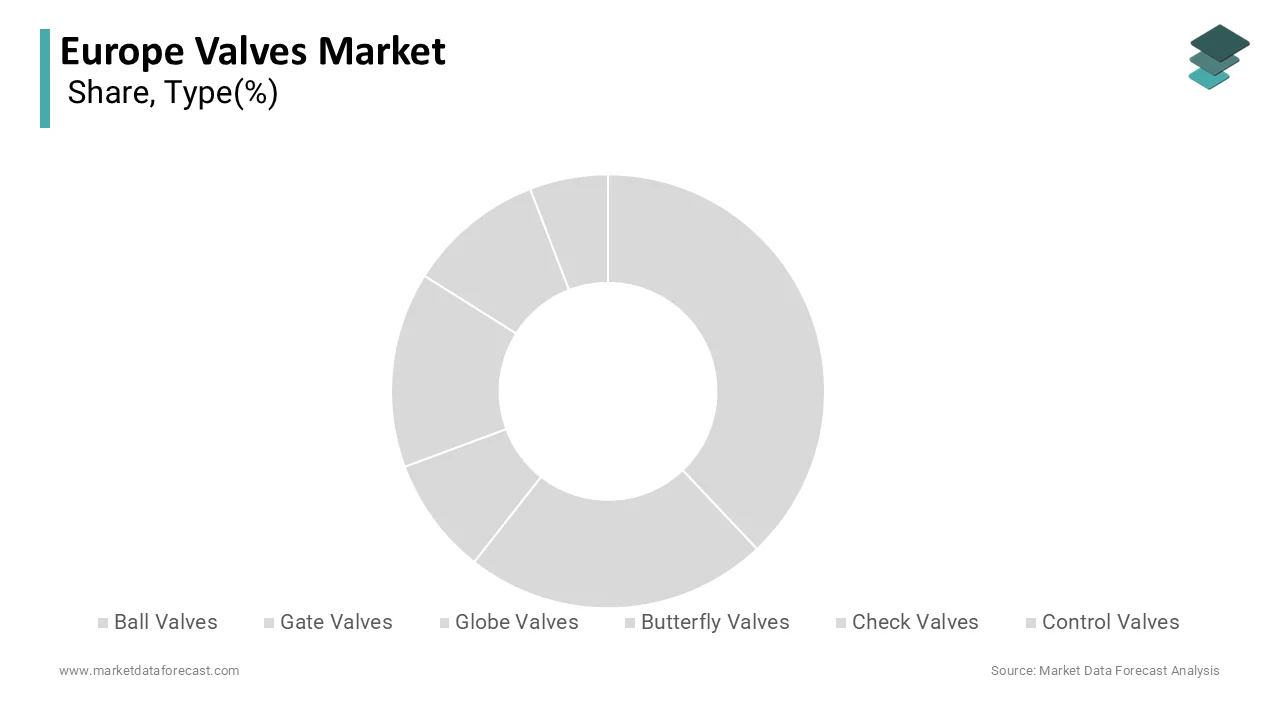
The control valves segment is likely to experience the fastest CAGR of 7.9% from 2026 to 2034 due to Europe’s industrial push toward automation, energy efficiency, and real-time process optimization. Control valves serve as the final control element in distributed control systems, modulating flow based on signals from sensors and programmable logic controllers to maintain precise temperature, pressure, or level setpoints. Modern industrial facilities in the chemical and pharmaceutical sectors are increasingly adopting digital communication protocols for control valves to support advanced diagnostic and maintenance capabilities. European regulatory frameworks now require major industrial sites to implement systems that continuously track energy performance, a move supported by technical upgrades to steam and air distribution networks to minimize operational waste. Companies like Samson and ABB have responded with digital positioners that self-calibrate and log performance metrics for compliance reporting. This convergence of regulatory mandates, digital transformation, and sustainability goals creates a structural growth vector unmatched by manual valve types.
By End User Industry Insights
The oil and gas segment led the European valves market in 2025. The leading position of the segment is attributed to extensive upstream, midstream, and downstream infrastructure requiring high-integrity isolation and safety systems. Despite energy transition pressures, Europe remains home to numerous offshore platforms, North Sea pipelines, and LNG terminals, all governed by stringent safety codes. The European high-pressure natural gas pipeline network is extensive, requiring thousands of specialized, fire-safe valves for safe operations and emergency shutdowns, as highlighted in technical reports on European energy infrastructure. The EU Methane Regulation requires energy companies operating in Europe to significantly improve methane leak detection and repair, prompting industry leaders like TotalEnergies, Shell, and Equinor to upgrade their infrastructure and adopt more stringent emission control measures to meet new, stricter standards. Furthermore, Norway’s safety regulations for subsea operations mandate that operators utilize high-performance, validated valve technologies to ensure sealing reliability, which has led to the adoption of advanced, high-pressure compliant valves like triple offset butterfly valves in subsea systems. Even as renewable investment grows, oil and gas infrastructure demands remain robust due to grid stability requirements and strategic reserves ensuring consistent high-value valve procurement across the continent.
The water and wastewater segment is on the rise and is expected to be the fastest-growing segment in the market by witnessing a CAGR of 8.3% during the forecast period, owing to urgent infrastructure renewal and smart water management mandates. European water utilities face high distribution losses, particularly in Southern regions where water management and infrastructure sustainability are critical, according to European Commission and European Environment Agency reports. Concurrently, the European Investment Bank is financing modernization projects to improve monitoring and enhance climate resilience in urban water systems. In response to climate risks, European national water policies are encouraging faster infrastructure renewal through smart technology implementation. Following extreme weather events, European regional and technical authorities are strengthening, updating, and revising infrastructure standards to improve wastewater resilience and prevent overflow during heavy rain. These policy-driven investments create a resilient public sector demand stream insulated from commodity cycles and increasingly focused on digital integration and resource conservation.
COUNTRY LEVEL ANALYSIS
Germany Valves Market Analysis
Germany was the top performer in the Europe Valves Market and accounted for a 22.1% share in 2025. The dominance of the German market is driven by its robust manufacturing base and engineering excellence. The country's position is also supported by its status as the primary exporter of industrial valves globally, serving critical sectors such as chemical processing, oil and gas, and water management. As per studies, the sector is experiencing high export demand, particularly in the US and China, alongside sluggish domestic investment, leading to a trend of stagnation in 2025 following a nominal increase in 2024. The presence of world-renowned manufacturers in regions like North Rhine-Westphalia ensures a continuous supply of high-pressure and high-temperature valves required for heavy industry. According to research, despite a difficult economic climate, companies are increasing investments in digital, automated, and "smart" valve solutions to enhance energy efficiency and safety in chemical and pharmaceutical production. Furthermore, the national strategy to transition towards green hydrogen production necessitates specialized valves capable of handling new media, creating a fresh wave of demand. The strong emphasis on research and development allows German firms to pioneer digital valve technologies that integrate with Industry 4.0 frameworks. This synergy of traditional manufacturing strength, export dominance, and technological innovation ensures Germany maintains its top position as the central engine of the European valve industry.
Italy Valves Market Analysis
Italy was the second largest country in the Europe Valves Market because of its exceptional capability in producing specialized valves for the oil and gas, petrochemical, and marine sectors. The Italian market shows a dense cluster of small and medium-sized enterprises in regions like Lombardy and Piedmont that excel in crafting high-performance alloy valves for extreme operating conditions. As per various sources, the country remains a pivotal player in downstream refining activities, driving consistent domestic demand for corrosion-resistant and high-integrity valves. The strong export orientation of Italian manufacturers allows them to capture significant market share in global energy projects, particularly in the Middle East and North Africa. The growing focus on liquefied natural gas infrastructure in the Mediterranean has further boosted orders for cryogenic valves designed to handle supercooled temperatures. Besides, the Italian shipbuilding industry contributes to the demand for marine-grade valves that meet stringent international safety standards. The combination of niche specialization, strong export networks, and strategic location ensures Italy remains a critical and dynamic market for valve technologies in Europe.
France Valves Market Analysis
France is another major player in the European Valves Market due to its massive nuclear energy program, extensive chemical industry, and ambitious plans for renewable energy integration. The French market is further propelled by the need for highly reliable and safety-critical valves that can operate within nuclear power plants, where regulatory standards are among the strictest in the world. As per the French Ministry of Ecological Transition, the national commitment to maintaining nuclear capacity while expanding renewable sources requires substantial upgrades to fluid control systems across the energy grid. The presence of major energy corporations and engineering firms fosters a local ecosystem that demands advanced valve solutions for both existing reactors and new generation projects. According to sources, the sector benefits from strong government support for reindustrialization, leading to increased capital expenditure in processing plants and water treatment facilities. The push for energy independence has accelerated investments in biogas and hydrogen projects, creating new opportunities for valves designed for these specific applications. Furthermore, the aerospace and defense sectors in France utilize precision valves for hydraulic and fuel systems, adding a layer of high-tech demand. The convergence of energy security goals, nuclear expertise, and industrial policy ensures France remains a key driver of value and innovation in the European valve landscape.
United Kingdom Valves Market Analysis
The United Kingdom grew steadily in the European valves market owing to its strong offshore oil and gas heritage, thriving chemical processing sector, and focus on water infrastructure renewal. The British market is also driven by the ongoing maintenance and decommissioning activities in the North Sea, which require robust subsea and topside valves capable of withstanding harsh marine environments. As per the Office for National Statistics, the manufacturing sector, including industrial valves,s continues to be a vital component of the economy, supported by significant investments in carbon capture and storage technologies. The UK government's net zero targets have spurred demand for valves used in hydrogen production and wind energy projects, shifting the focus from traditional fossil fuels to sustainable energy sources. The UK water industry is prioritizing infrastructure investment to drastically reduce leakage through technological modernization and asset replacement. The presence of leading engineering consultancies and project management firms facilitates the execution of large-scale industrial projects that incorporate advanced valve systems. Additionally, the pharmaceutical and food and beverage industries in the UK contribute to the demand for hygienic and sanitary valves. This diverse industrial base and strategic shift towards green technologies ensure the UK remains a significant and evolving market for valve solutions.
Russia Valves Market Analysis
Russia is a major part of the Europe Valves Market. It leverages its vast natural resource reserves and extensive pipeline network to sustain high demand for industrial valves across the energy sector. The Russian market is characterized by its reliance on domestic production to serve its massive oil and gas extraction and transportation industries, which span thousands of kilometers across diverse climatic zones. As per studies, the Russian energy sector is maintaining high-level investment in extraction and refining equipment to support infrastructure development and export needs. The government's import substitution policies have accelerated the development of local valve manufacturing capabilities to reduce dependence on foreign suppliers, particularly for critical infrastructure projects. Russian energy export infrastructure is pivoting toward Asian markets, stimulating demand for pipeline and control equipment. The harsh environmental conditions in Siberia and the Arctic require specialized valves made from high-grade steel alloys that can function reliably at extremely low temperatures. Furthermore, the chemical and petrochemical sectors are undergoing expansion to add value to raw materials, increasing the need for process control valves. Despite geopolitical challenges, the sheer scale of its energy infrastructure and the imperative for self-sufficiency ensure Russia remains a major volume driver in the regional valve market.
COMPETITIVE LANDSCAPE
The European valves market features a stratified competitive landscape where premium engineering firms dominate high-integrity applications, while standard product segments face pressure from low-cost imports. At the top-tier companies like Samson KSB and IMI compete on technical excellence, material science, and digital integration, serving regulated industries where failure is not an option. Mid-tier European manufacturers focus on regional water and HVAC markets, emphasizing local service networks and rapid delivery. Meanwhile, Asian exporters gain share in commodity gate ball and check valves through aggressive pricing, albeit with higher lifecycle costs. Competition is increasingly defined by compliance with EU directives on fugitive emissions, energy efficiency, and cybersecurity rather than price alone. Differentiation arises through certification traceability, smart functionality, and alignment with decarbonization infrastructure, creating a nuanced environment where innovation spans metallurgy, software, and sustainability policy engagement.
KEY MARKET PLAYERS
Some of the companies that are playing a dominating role in the global European Valves Market include
- Emerson Electric Co.
- Flowserve Corporation
- IMI plc
- Weir Group
- Danfoss A/S
- Crane Co.
- KSB SE & Co. KGaA
- Pentair plc
- Schneider Electric SE
- Siemens AG
- Metso Outotec Corporation
- AVK Holding A/S
- CIRCOR International, Inc.
- Belimo Holding AG
- Apollo Valves (Conbraco Industries)
- Velan Inc.
- KITZ Corporation
- Swagelok Company
- GF Piping Systems AG
TOP LEADING PLAYERS IN THE MARKET
- Samson AG is a German engineering leader specializing in control and regulating valves for demanding industrial applications across Europe and globally. The company supplies precision instrumentation to the chemical, power, oil, and gas sectors with a strong emphasis on digital integration and energy efficiency. Samson’s valves are integral to automated process systems in facilities operated by B, ASF Sie Ensns, and elsewhere where reliability under extreme conditions is critical. It also expanded its training academy in Frankfurt to certify engineers on digital valve management, aligning with Europe’s Industrial Digitalization Strategy and reinforcing its role as a technology enabler beyond hardware supply.
- KSB SE & Co KGaA is a major European manufacturer of industrial and building technology valves with a global footprint spanning over 100 countries. Headquartered in Germany,rmany the company excels in pumps and valves for water w waterte, wwaterte,r and energy applications,tions leveraging decades of hydraulic expertise. KSB’s products are deployed in municipal infrastructure r,,e including Berlin’s Rummelsburg wastewater plant and France’s Grand Paris Express metro cooling systems. The company also partnered with the European Investment Bank to support water loss reduction programs in Southern Europetherebype demonstrating strategic alignment with public sustainability mandates.
- IMI Critical EngineerinUK-basedK based global specialist in severe service valves for power g,,ener,,n oi,,l and gas and hydrogen applications. The company plays a pivotal role in Europe’s energy transition by providing high-integrity isolation and control solutions for nuclear fusion ppilot plantsnts car carbonn capture facilities,acilities and green hydrogen electrolyzers. Its valves meet stringent ASME and PED standards and are specified in projects like Norway’s Northern Lights CO2 transport system. It also established a digital twin validation lab in BiBirminghamNngham enabling customers to simulate valve performance under extreme conditions before deployment,trengthening itsmission-criticalsion critical segments.
TOP STRATEGIES USED BY THE KEY MARKET PARTICIPANTS
Key players iEuropeanEurope valves market focus on digital transformation by embedding sensors and communication protocols into valves for predictive maintenance and remote monitoring. They align product development with EU regulatory mandates on methane emissions,issions water efficiency,,fficiency and industrial safetycompliance-drivenance driven demand. Companies invest application-specificfic engineering for emerging sectors like green hydrogen and carbon capture,apture where performance requirements create high entry barriers. Strategic partnerships with public utilities, energy majors,gy majo,r,s and engineering firlong-term long term project pipelines.Additionallytionally manufacturersafter-salester sales value through training certification and digital twin, services shifting from transactional sales to lifecycle support models that deepen customer integration and reduce churn.
MARKET SEGMENTATION
This is a research report on the europe valves market, which is segmented and sub-segmented into the following categories.
By Type
- Ball Valves
- Gate Valves
- Globe Valves
- Butterfly Valves
- Check Valves
- Control Valves
- Others
By End User Industry
- Oil & Gas
- Water & Wastewater
- Power Generation
- Chemicals & Petrochemicals
- Pharmaceuticals
- Food & Beverages
- Others
By Country
- Germany
- France
- United Kingdom
- Italy
- Spain
- Netherlands
- Norway
- Rest of Europe