Europe Variable Refrigerant Flow System Market Size, Share, Trends & Growth Forecast Report, Segmented By Component, System, Application, and By Country (UK, France, Spain, Germany, Italy, Russia, Sweden, Denmark, Switzerland, Netherlands, Turkey, Czech Republic & Rest of Europe), Industry Analysis From 2026 to 2034
Executive Summary: Europe Variable Refrigerant Flow System Market
- Market Scope: Comprehensive European variable refrigerant flow (VRF) system market analysis covering component categories, system types, application sectors, national leadership shares, building energy benchmarks, and decarbonization targets.
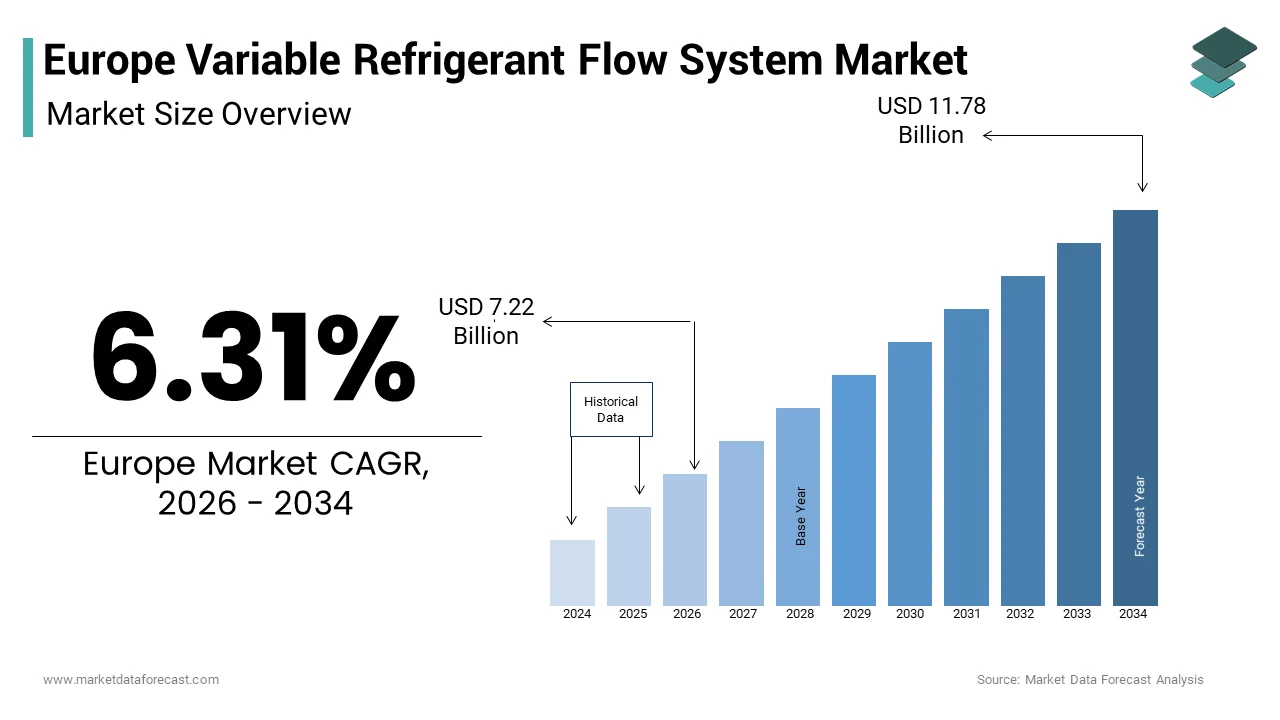
- Market Valuation: Valued at USD 6.79 billion (2025), rising to USD 7.22 billion (2026), and reaching USD 11.78 billion by 2034, registering a CAGR of 6.31% (2026–2034).
- Primary Growth Drivers: Stricter EU building energy efficiency directives and the push for reduced greenhouse gas emissions. Key structural and performance benchmarks include buildings accounting for ~40% of EU energy consumption and 36% of greenhouse gas emissions, VRF systems delivering up to 30% energy savings versus conventional systems, smart HVAC controls reducing commercial building energy usage by up to 20%, and the UK targeting 600,000 heat pump installations annually by 2028.
Key Market Segment Metrics (2026–2034)
| Category | Leading Segment (2025 Position) | Fastest-Growing Segment |
|---|---|---|
| By Component | Outdoor units (led with a 45.6% market share in 2025) | Control systems and accessories (projected to grow at a 9.2% CAGR) |
| By System Type | Heat pump systems (accounted for 60.3% of the market in 2025) | Heat recovery systems (forecast to grow at an 8.5% CAGR) |
| By Application | Commercial buildings (held 55.4% of the market in 2025) | Residential sector (projected to expand at a 7.8% CAGR) |
| By Country / Region | Germany (led Europe with a 21.6% share in 2025, followed by the United Kingdom at 16.4%) | High-growth European green-building hubs accelerating energy-efficient retrofits |
Major Market Players & Market Structure
Market Structure: Highly competitive European HVAC and climate control market featuring global engineering conglomerates and specialized thermal management providers competing intensely on low-GWP refrigerants, IoT-enabled smart controls, predictive maintenance capabilities, advanced energy optimization algorithms, localized manufacturing, and technician training programs.
Key Companies: Panasonic, Fujitsu General, Daikin Europe, Hitachi Johnson Controls Air Conditioning, Toshiba, Mitsubishi Electric, LG Electronics, Lennox International, Samsung Electronics, Johnson Controls, Emerson, Midea Group, and Carrier HVAC.
Europe Variable Refrigerant Flow System Market Size
The Europe variable refrigerant flow system market size was valued at USD 6.79 billion in 2025 and is anticipated to reach USD 7.22 billion in 2026 to reach USD 11.78 billion by 2034, growing at a CAGR of 6.31% during the forecast period from 2026 to 2034.
Introduction to the Europe VRF System Market
The variable refrigerant flow system is the design installation and maintenance of advanced heating ventilation and air conditioning technologies that utilize refrigerant as the primary cooling and heating medium. These systems are characterized by their ability to vary the flow of refrigerant to multiple indoor units based on specific zone requirements offering superior energy efficiency and individualized climate control. As per Eurostat, buildings account for approximately 40% of energy consumption and 36% of greenhouse gas emissions in the European Union highlighting the critical role of efficient HVAC systems in achieving climate goals. Furthermore, the European Commission’s Renovation Wave strategy aims to double the annual energy renovation rate of buildings by 2030 which directly stimulates demand for high efficiency solutions like VRF systems. According to the International Energy Agency, the adoption of heat pump technologies including VRF systems is essential for reducing reliance on fossil fuels for space heating. The integration of smart building management systems with VRF technology further enhances operational efficiency allowing for real time monitoring and optimization. This technological convergence supports the transition towards intelligent and sustainable urban environments. The market is also shaped by the increasing complexity of commercial and residential architectures which require flexible and scalable climate control solutions. Consequently, VRF systems are becoming the preferred choice for modern construction projects across the continent.
MARKET DRIVERS
Stringent Energy Efficiency Regulations and Green Building Standards Drive Adoption
The implementation of stringent energy efficiency regulations and green building standards s levelling up the growth of Europe VRF system market. The European Union has established ambitious targets under the Energy Performance of Buildings Directive which requires all new buildings to be nearly zero energy buildings by 2021 and all buildings to be zero emission by 2050. According to the European Commission these mandates necessitate the adoption of high efficiency heating and cooling solutions, such as VRF systems which offer superior seasonal energy efficiency ratios compared to traditional HVAC technologies. VRF systems can achieve energy savings of up to 30% over conventional systems due to their ability to modulate compressor speed and deliver precise cooling or heating only where needed. As per the European Partnership for Energy and the Environment, the construction sector is under increasing pressure to obtain certifications such as BREEAM and LEED, which favor technologies with low global warming potential and high operational efficiency. The phase out of hydrofluorocarbons with high global warming potential under the F Gas Regulation further drives innovation in VRF technology prompting manufacturers to develop systems using low GWP refrigerants like R32 and R290. These regulatory pressures create a favorable environment for VRF adoption as building owners and developers seek compliance while minimizing long term operational costs. The alignment of VRF technology with sustainability goals ensures sustained demand in both new constructions and retrofit projects.
Growing Demand for Individualized Climate Control in Commercial and Residential Sectors Fuels Growth
The growing demand for individualized climate control in both commercial and residential sectors is additionally propelling the growth of Europe VRF system market. Modern building occupants increasingly expect precise temperature regulation in different zones to enhance comfort and productivity. VRF systems excel in this regard by allowing independent control of multiple indoor units connected to a single outdoor unit. According to the World Green Building Council, occupant comfort and well-being are key drivers for sustainable building design with thermal comfort being a primary factor. In office environments, the ability to adjust temperatures in individual rooms or zones can improve employee satisfaction and productivity by up to 15% as noted by various workplace studies. In the residential sector the rise of luxury apartments and multi-family dwellings has increased the adoption of VRF systems due to their quiet operation and aesthetic flexibility. The flexibility of VRF systems allows for easy expansion and modification making them ideal for buildings with varying occupancy patterns. Furthermore, the integration of smart thermostats and mobile applications enables users to manage their climate settings remotely enhancing convenience. This trend towards personalized and intelligent climate management ensures that VRF systems remain a preferred choice for architects and developers aiming to meet modern lifestyle expectations.
MARKET RESTRAINTS
High Initial Installation Costs and Complex Retrofitting Requirements Restrain Market Penetration
The high initial cost of installation coupled with the complexity of retrofitting existing buildings is also degrading the growth of Europe VRF system market. VRF systems require specialized components such as variable speed compressors sophisticated control systems and extensive refrigerant piping networks, which are more expensive than traditional split or central HVAC systems. According to the European Construction Industry Federation, the cost of installing a VRF system can be 20 to 30% higher than conventional alternatives posing a barrier for budget conscious developers and homeowners. Additionally, retrofitting older buildings with VRF technology often involves significant structural modifications to accommodate refrigerant lines and indoor units which can be disruptive and costly. As per the European Bank for Reconstruction and Development many existing buildings in Europe lack the necessary infrastructure to support modern HVAC upgrades without extensive renovation. The shortage of skilled technicians trained in VRF installation and maintenance further exacerbates the issue leading to longer project timelines and higher labor costs. In countries with aging building stocks such as Italy and Spain the complexity of integrating VRF systems into historic structures presents additional regulatory and technical hurdles. These financial and logistical barriers slow down the replacement of inefficient legacy systems with high efficiency VRF units.
Strict Refrigerant Regulations and Environmental Compliance Challenges Limit Technology Options
The strict regulatory framework is governing the use of fluorinated gases, which is also limiting the growth of Europe VRF system market. The European Union’s F Gas Regulation aims to reduce the consumption of hydrofluorocarbons by 79% by 2030 compared to 2015 levels. According to the European Environment Agency, this phasedown requires manufacturers to transition to refrigerants with lower global warming potential, such as R32 R290 or CO2. While these alternatives are more environmentally friendly they often present technical challenges including higher flammability or operating pressures, which require redesigning system components and enhancing safety measures. As per the European Committee of Domestic Equipment Manufacturers the development and certification of VRF systems using new refrigerants involve substantial research and development costs which can delay product launches and increase prices. Additionally, the handling and maintenance of flammable refrigerants require specialized training and equipment for technicians limiting the pool of qualified service providers. In some cases, the performance of low GWP refrigerants may not match that of traditional HFCs in extreme weather conditions affecting system reliability. These regulatory and technical complexities create uncertainty for manufacturers and installers potentially slowing down the adoption of new VRF technologies.
MARKET OPPORTUNITIES
Integration with Smart Building Technologies and IoT Presents Significant Opportunities
The integration of VRF systems with smart building technologies and the Internet of Things is solely creating new opportunities for the growth of Europe VRF system market. Modern VRF units are increasingly equipped with sensors and connectivity features that allow for real time data collection and analysis. According to the International Data Corporation, the global spending on Internet of Things solutions in the building sector is expected to grow significantly driven by the need for energy efficiency and operational optimization. As per the research, smart HVAC controls can reduce energy usage in commercial buildings by up to 20% through predictive algorithms and automated adjustments. The use of artificial intelligence enables predictive maintenance by detecting anomalies in system performance before they lead to failures thereby reducing downtime and repair costs. This capability is particularly valuable for large commercial complexes and industrial facilities where uninterrupted climate control is critical. Furthermore, the data generated by smart VRF systems can be used to verify compliance with energy regulations and sustainability certifications. Manufacturers who offer integrated digital solutions can differentiate their products and provide added value to customers. The growing emphasis on digital twins and smart city initiatives further supports the adoption of connected VRF technologies creating new revenue streams and enhancing market competitiveness.
Expansion of Heat Pump Applications in Cold Climates Creates New Avenues
The expansion of VRF heat pump applications in cold climates is another factor to escalate the growth of Europe VRF system market. Traditionally, VRF systems were primarily used for cooling or mild heating but recent technological advancements have improved their performance in low temperature environments. Modern VRF heat pumps can operate efficiently at ambient temperatures as low as minus 20 degrees Celsius by making them suitable for regions with harsh winters, such as Scandinavia and Eastern Europe. As per the International Energy Agency, electrification of heating is a key strategy for decarbonizing the building sector in Europe. Government incentives and subsidies for renewable heating technologies further stimulate demand in these regions. For instance, countries like Sweden and Norway offer substantial grants for installing heat pump systems encouraging homeowners and businesses to switch from fossil fuels. The ability of VRF systems to provide both heating and cooling in a single unit adds to their appeal in regions with distinct seasonal variations. Manufacturers are developing specialized models with enhanced defrost cycles and compressor technologies to maximize efficiency in cold weather. This expansion into heating dominated markets diversifies the customer base and drives growth beyond traditional strongholds in Southern and Western Europe.
MARKET CHALLENGES
Supply Chain Disruptions and Raw Material Volatility Pose Operational Risks
The supply chain disruptions and raw material volatility is affecting production schedules and profit margins, which is one of the challenges for the growth of Europe VRF system market. The manufacturing of VRF systems relies heavily on components, such as semiconductors copper aluminum and rare earth metals, which have experienced price fluctuations and supply constraints in recent years. According to the European Copper Institute, the price of copper which is essential for motors and heat exchangers has remained volatile due to global demand and geopolitical tensions. As per the European Semiconductor Industry Association, the shortage of chips used in control boards and inverters has led to production delays for many HVAC manufacturers. These disruptions force companies to hold higher inventory levels increasing working capital requirements and storage costs. Additionally, transportation bottlenecks and logistics challenges have extended lead times for imported components affecting the timely delivery of finished products. In 2023, many manufacturers reported delays of several weeks to months in fulfilling orders due to supply chain issues. This uncertainty complicates project planning for contractors and developers potentially leading to contract disputes and customer dissatisfaction.
Shortage of Skilled Technicians and Installation Expertise Limits Service Quality
The shortage of skilled technicians and installation expertise is limiting the quality of service that is to impact negatively on the growth of Europe VRF system market. VRF systems are complex installations that require precise engineering knowledge regarding refrigerant piping electrical connections and control systems. According to the study, there is a growing skills gap in the HVAC sector with an estimated shortfall of hundreds of thousands of qualified technicians across the continent. As per the research, the aging workforce and lack of young entrants into vocational training programs exacerbate the problem. Incorrect installation can lead to reduced efficiency system failures and safety hazards undermining the benefits of VRF technology. The transition to new refrigerants with different safety profiles such as flammability requires additional training and certification which many existing technicians lack. This skills deficit results in longer waiting times for installations and repairs increasing operational costs for building owners. Furthermore, the lack of standardized training across European countries complicates the mobility of skilled labor. Manufacturers and industry associations are investing in training programs but the pace of upskilling lags behind market demand.
REPORT COVERAGE
| REPORT METRIC | DETAILS |
| Market Size Available | 2025 to 2034 |
| Base Year | 2025 |
| Forecast Period | 2026 to 2034 |
| CAGR | 6.31% |
| Segments Covered | By Component, System, Application, and Country |
| Various Analyses Covered | Global, Regional, and Country Level Analysis; Segment-Level Analysis; DROC, PESTLE Analysis; Porter’s Five Forces Analysis, Competitive Landscape; Analyst Overview of Investment Opportunities |
| Regions Covered | UK, France, Spain, Germany, Italy, Russia, Sweden, Denmark, Switzerland, Netherlands, Turkey, Czech Republic, the rest of Europe |
| Market Leaders Profiled | Panasonic (Japan), Fujitsu General Limited (Japan), Daikin Europe (Belgium), Toshiba (Japan), Mitsubishi Electric (Japan), LG Electronics (South Korea), Lennox International (United States), Samsung Electronics (South Korea), Johnson Controls (Ireland), Emerson (United States), Midea Group (Fortune Global 500 Company) (China), Carrier HVAC (United States) |
SEGMENTAL ANALYSIS
By Component Insights
The outdoor unit segment was the largest by holding 45.6% of Europe VRF system market share in 2025. According to the research, efficiency of the entire VRF system is largely determined by the performance of the outdoor unit which must adapt to varying ambient temperatures and load demands. The shift towards low global warming potential refrigerants such as R32 requires advanced compressor designs and safety mechanisms which increase the manufacturing cost and value of these units. As per Eurostat, the construction sector in the European Union invested over 100 billion Euros in energy efficient technologies in 2023 with a significant portion allocated to high efficiency HVAC systems. The outdoor unit is also the primary target for regulatory compliance regarding noise emissions and energy labels under the Ecodesign Directive. Manufacturers focus their research and development efforts on improving the seasonal coefficient of performance of outdoor units to meet stringent European standards. The replacement cycle for outdoor units is often synchronized with major building renovations further driving demand. Additionally, the integration of hybrid systems that combine VRF outdoor units with renewable energy sources enhances their appeal.
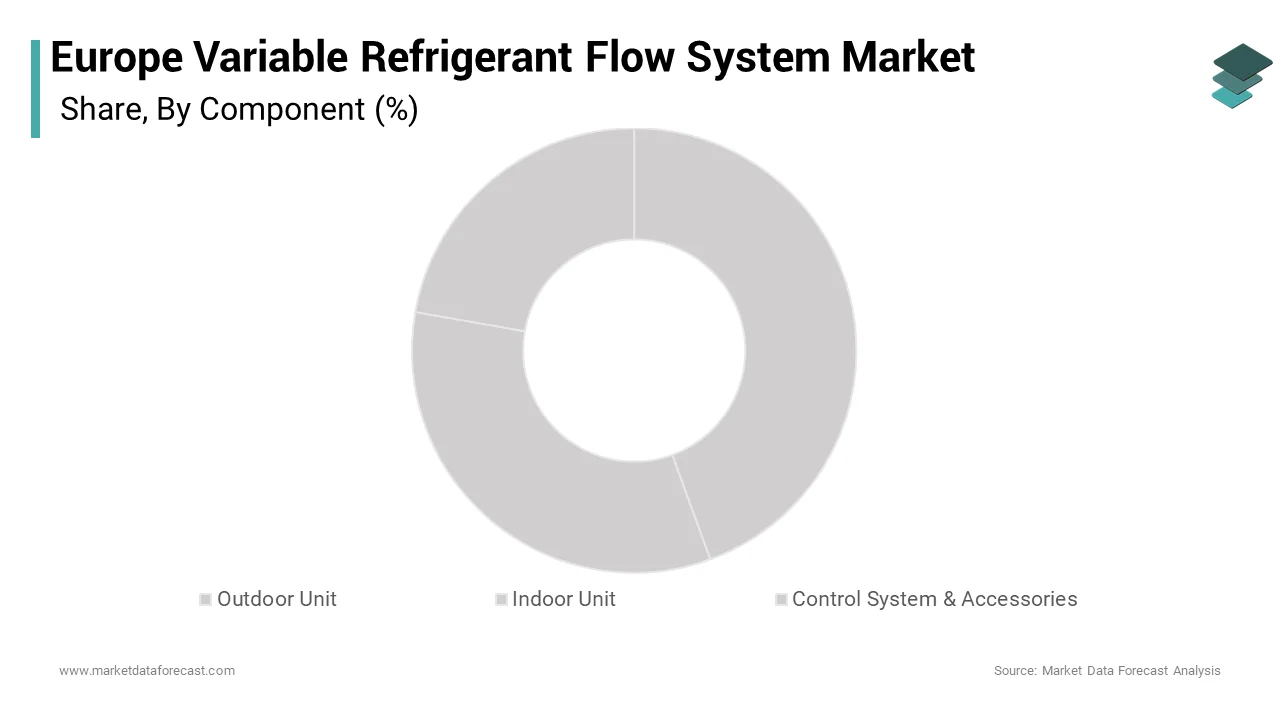
The control system and accessories segment is projected to expand at an anticipated CAGR of 9.2% from 2026 to 2034 owing to the increasing demand for intelligent climate control solutions that offer remote monitoring predictive maintenance and energy optimization. According to the International Data Corporation, the global spending on Internet of Things solutions for smart buildings is expected to reach 20 billion United States Dollars by 2025 with Europe being a key adopter. Modern VRF control systems utilize artificial intelligence algorithms to analyze usage patterns and adjust operations in real time reducing energy consumption by up to 25%. As per the European Innovation Partnership on Smart Cities and Communities, the adoption of smart thermostats and centralized management platforms is becoming standard in new commercial constructions. The ability to integrate VRF systems with broader building automation systems allows facility managers to achieve holistic energy management. Furthermore, the rise of touch panel controllers and mobile applications enhances user experience and convenience driving aftermarket sales. Regulatory incentives for digital energy monitoring also support this trend. The modular nature of accessories such as branch selectors and adapters allows for easy system expansion and customization. These technological advancements and the growing emphasis on data driven facility management ensure that the control system segment experiences robust growth outpacing hardware components.
By System Insights
The heat pump system segment was accounted in holding 60.3% of the Europe VRF system market owing to the widespread applicability of heat pump systems in regions with moderate climates where simultaneous heating and cooling demands are less frequent. According to the European Heat Pump Association, heat pump sales in Europe have grown consistently due to their ability to provide efficient heating and cooling using a single outdoor unit. These systems are particularly popular in residential complexes hotels and office buildings where zoning requirements are straightforward. As per Eurostat the majority of new residential constructions in countries like Spain, Italy, and France, utilize reverse cycle heat pumps for climate control due to their lower initial cost compared to heat recovery systems. The simplicity of installation and maintenance also contributes to their popularity among contractors and building owners. Government subsidies for electrification of heating further boost the adoption of heat pump VRF systems as they replace inefficient gas boilers. The energy efficiency ratios of modern heat pump VRF systems have improved significantly making them compliant with strict European energy labels. Additionally, the availability of skilled installers familiar with heat pump technology reduces deployment barriers.
The heat recovery system segment is likely to witness a fastest CAGR of 8.5% over the next five years with the increasing complexity of modern commercial buildings, such as shopping malls hospitals and office towers which often require simultaneous heating and cooling in different zones. As per the European Commission’s Energy Efficiency Directive, large non-residential buildings are required to implement advanced energy management systems, which favor the adoption of heat recovery technologies. In Northern European countries like Germany and the Netherlands, where internal heat gains from equipment and occupants are significant heat recovery systems optimize energy use throughout the year. The rising cost of energy further enhances the economic case for heat recovery systems despite their higher upfront cost. Technological advancements have also improved the reliability and efficiency of three pipe heat recovery systems making them more attractive to developers. The trend towards sustainable and net zero energy buildings supports the deployment of these high efficiency systems.
By Application Insights
The commercial application segment was the largest by holding 55.4% of the Europe VRF system market share in 2025 with the inherent advantages of VRF technology in managing diverse thermal loads in large multi zone environments typical of commercial real estate. According to the European Property Federation, the commercial real estate sector in Europe is increasingly prioritizing energy efficiency and tenant comfort to maintain asset value and occupancy rates. VRF systems offer the flexibility to control temperatures in individual offices meeting rooms and retail units independently which is crucial for tenant satisfaction. As per the Royal Institution of Chartered Surveyors green building certifications, such as BREEAM and LEED are becoming mandatory for prime commercial properties driving the specification of high efficiency HVAC systems. The ability of VRF systems to operate quietly and discreetly with minimal ductwork makes them ideal for retrofitting historic buildings and modern skyscrapers alike. In the hospitality sector, hotels utilize VRF systems to provide personalized comfort to guests while minimizing energy costs during low occupancy periods. The scalability of VRF technology allows for phased installations and expansions which aligns with the dynamic nature of commercial leasing. Furthermore, corporate sustainability commitments are accelerating the replacement of older chillers and boilers with VRF heat pumps.
The residential application segment is projected to register a fastest CAGR of 7.8% from 2026 to 2034, which aims to improve the energy performance of millions of homes. According to Eurostat, the renovation rate of residential buildings is increasing with homeowners seeking efficient heating and cooling solutions to reduce utility bills. VRF systems are gaining traction in high end apartments and villas due to their space saving design and aesthetic appeal. As per the European Construction Industry Federation, the demand for smart home technologies is rising with integrated VRF systems offering seamless control via smartphones. The phase out of gas boilers in several European countries is prompting residents to switch to electric heat pump based VRF systems. In urban areas where space is limited the compact outdoor units of VRF systems are preferred over bulky traditional HVAC equipment. Additionally, the growing awareness of indoor air quality has led to the incorporation of advanced filtration and ventilation features in residential VRF units. Government incentives for energy efficient home improvements further stimulate adoption. The shift towards all electric homes and the desire for year-round comfort ensure that the residential segment grows at an accelerated pace.
COUNTRY LEVEL ANALYSIS
Germany Variable Refrigerant Flow System Market Analysis
Germany was the top performer in the Europe VRF system market by holding 21.6% of share in 2025 with its robust construction industry and commitment to environmental sustainability. The country’s Energiewende policy promotes the transition to renewable energy sources encouraging the adoption of electric heating and cooling solutions. According to the survey, buildings are a key focus area for decarbonization with strict regulations on energy consumption. The presence of major HVAC manufacturers and technology providers in Germany fosters innovation and local supply chain resilience. As per the study, the demand for heat pumps including VRF systems has doubled in recent years due to rising fossil fuel prices and carbon taxes. The commercial sector in cities like Berlin Munich and Frankfurt is extensively upgrading existing infrastructure with high efficiency VRF systems to meet green building standards. Industrial facilities also utilize VRF technology for precise climate control in production areas. Government subsidies such as the Federal Funding for Efficient Buildings program provide financial incentives for installing efficient HVAC systems. The strong engineering culture and technical expertise in Germany support the complex installation and maintenance requirements of VRF systems.
United Kingdom Variable Refrigerant Flow System Market Analysis
The United Kingdom VRF system market was ranked second with 16.4% of share in 2025 by leveraging its ambitious net zero targets. The UK government’s Boiler Upgrade Scheme provides grants for installing heat pumps which includes VRF systems driving adoption in both residential and commercial sectors. According to the UK Heat and Building Strategy, the aim is to install 600000 heat pumps annually by 2028, creating substantial opportunities for VRF manufacturers. The commercial real estate sector in London and other major cities is increasingly adopting VRF technology to enhance energy efficiency and tenant comfort. As per the Carbon Trust, many organizations are implementing VRF systems as part of their corporate sustainability strategies to reduce carbon footprints. The phasing out of high global warming potential refrigerants under UK specific F Gas regulations is pushing manufacturers to introduce eco- friendly alternatives. The presence of skilled HVAC contractors and established distribution networks facilitates market growth. Additionally, the rising cost of natural gas is making electric VRF systems more economically attractive. These dynamics position the UK as a key growth engine for the European VRF market.
France Variable Refrigerant Flow System Market Analysis
France VRF system market growth is likely to grow with the proactive government policies and a strong construction sector. The French government’s MaPrimeRenov scheme offers financial aid for energy efficient renovations, including the installation of heat pumps and VRF systems. According to the French Environment and Energy Management Agency, the building sector is responsible for a significant portion of national energy consumption prompting aggressive efficiency measures. The commercial sector in Paris and other major cities is increasingly specifying VRF systems for new constructions and retrofits to comply with environmental regulations. As per the French Ministry of Ecological Transition, the ban on certain high GWP refrigerants is accelerating the transition to low GWP VRF technologies. The hospitality and retail sectors are also major adopters of VRF systems due to their ability to provide zoned comfort and reduce operational costs. The presence of local manufacturers and distributors ensures adequate supply and technical support.
Italy Variable Refrigerant Flow System Market Analysis
Italy VRF system market growth is driven by the warm climate, which increases the demand for efficient cooling solutions. The Superbonus 110% tax incentive although modified has significantly stimulated the renovation of residential and commercial buildings with energy efficient systems. According to the Italian National Institute of Statistics, the construction sector has seen a surge in investments related to energy efficiency upgrades. VRF systems are particularly popular in hotels resorts and office buildings where simultaneous heating and cooling are required. The tourism industry, which is a major economic driver relies heavily on comfortable indoor environments making VRF systems an attractive option. The geographic diversity of Italy from the Alps to the Mediterranean coast creates varied climate needs that VRF systems can address effectively. Local distributors and installers are expanding their capabilities to handle complex VRF installations. The increasing awareness of indoor air quality and energy costs further supports market growth. These factors ensure Italy continues to expand its share in the European VRF market.
Spain Variable Refrigerant Flow System Market Analysis
Spain VRF system market growth is likely to have a significant opportunity in coming years with its hot climate and growing tourism and real estate sectors. The demand for air conditioning is high throughout the summer months making efficient cooling systems essential. According to the Spanish Institute for Diversification and Saving of Energy, there is a strong push towards replacing old inefficient air conditioning units with high efficiency VRF systems. The construction boom in coastal areas and major cities like Madrid and Barcelona is fueling the installation of VRF systems in new residential and commercial projects. The hospitality industry which is vital to the Spanish economy utilizes VRF systems to ensure guest comfort while managing energy costs. Government incentives for renewable energy and energy efficiency are also contributing to market growth. The increasing frequency of heatwaves due to climate change is raising awareness about the need for reliable and efficient cooling solutions.
COMPETITIVE LANDSCAPE
The competition in the Europe VRF system market is characterized by intense rivalry among established global manufacturers and emerging regional players vying for dominance in the heating ventilation and air conditioning sector. Leading companies leverage their technological expertise and extensive distribution networks to offer high efficiency and reliable solutions. The market sees significant competition in the development of eco friendly refrigerants and smart control systems which are critical for meeting European sustainability standards. Price competition is moderate in the premium segment where performance and brand reputation are prioritized but remains significant in the mid range category. Strategic collaborations with construction firms and property developers help secure large scale projects and long term contracts. Companies differentiate themselves through superior after sales service comprehensive warranty packages and customized engineering support. The threat of new entrants is moderate due to high barriers related to technology patents and regulatory compliance.
KEY MARKET PLAYERS
A few of the market players in the Europe variable refrigerant flow system market include
- Panasonic (Japan)
- Fujitsu General Limited (Japan)
- Daikin Europe (Belgium)
- Hitachi Johnson Controls Air Conditioning
- Toshiba (Japan)
- Mitsubishi Electric (Japan)
- LG Electronics (South Korea)
- Lennox International (United States)
- Samsung Electronics (South Korea)
- Johnson Controls (Ireland)
- Emerson (United States)
- Midea Group (Fortune Global 500 Company) (China)
- Carrier HVAC (United States)
Top Players In The Market
- Daikin Industries stands as a global leader in the Europe VRF system market renowned for its pioneering VRV technology and commitment to sustainability. The company offers a comprehensive portfolio of energy efficient heating and cooling solutions tailored for commercial and residential applications. Daikin has recently strengthened its position by launching next generation systems using low global warming potential refrigerants such as R32. They have expanded their manufacturing capabilities in Europe to ensure supply chain resilience and faster delivery. Their focus on digital integration allows seamless connectivity with building management systems enhancing operational efficiency. Daikin actively collaborates with local partners to provide specialized training and support ensuring high quality installations.
- Mitsubishi Electric is a prominent player in the Europe VRF system market known for its reliable City Multi series and advanced inverter technology. The company provides robust and efficient solutions for diverse building types including offices hotels and retail spaces. Mitsubishi Electric has recently focused on enhancing the energy performance of its VRF units through improved compressor designs and smart control algorithms. They have invested in expanding their service network across Europe to offer timely maintenance and technical support. The company emphasizes user friendly interfaces and remote monitoring capabilities enabling facility managers to optimize energy usage. Mitsubishi Electric also participates in various sustainability initiatives promoting the transition to low carbon HVAC systems. Their dedication to quality and innovation ensures they remain a trusted choice for architects engineers and building owners seeking high performance climate control solutions in the competitive European market.
- Hitachi Johnson Controls Air Conditioning is a key contributor to the Europe VRF system market leveraging strong engineering expertise and a broad product range. The company delivers innovative VRF solutions that combine high efficiency with flexible design options suitable for modern architectural requirements. Hitachi has recently strengthened its market presence by introducing advanced heat recovery systems that maximize energy savings in large commercial buildings. They have enhanced their digital offerings with cloud-based monitoring tools that provide real time insights into system performance. The company focuses on reducing the environmental impact of its products by adopting eco-friendly refrigerants and materials. Strategic partnerships with local distributors ensure widespread availability and professional installation services. Hitachi Johnson Controls continues to invest in research and development to improve system reliability and comfort. Their proactive approach to meeting regulatory standards and customer needs solidifies their reputation as a leading provider of sustainable HVAC technologies in Europe.
Top Strategies Used By Key Market Participants
Key players in the Europe VRF system market primarily employ strategies focused on technological innovation and sustainability compliance to maintain competitive advantage. Companies are heavily investing in research and development to create systems using low global warming potential refrigerants such as R32 and R290. This aligns with stringent European environmental regulations and enhances brand reputation. Manufacturers are also integrating Internet of Things capabilities into their products enabling remote monitoring predictive maintenance and energy optimization. Strategic partnerships with local distributors and installation contractors ensure reliable service delivery and market penetration. Additionally, firms are expanding their production facilities within Europe to mitigate supply chain risks and reduce lead times. Marketing efforts emphasize energy efficiency and total cost of ownership to appeal to cost conscious commercial clients. Training programs for technicians are expanded to address the skills gap and ensure proper installation.
MARKET SEGMENTATION
This research report on the Europe variable refrigerant flow system market is segmented and sub-segmented into the following categories.
By Component
- Outdoor Unit
- Indoor Unit
- Control System & Accessories
By System Type
- Heat Pump System
- Heat Recovery System
By Application
- Residential
- Commercial
- Industrial
By Country
- UK
- France
- Spain
- Germany
- Italy
- Russia
- Sweden
- Denmark
- Switzerland
- Netherlands
- Turkey
- Czech Republic
- Rest of Europe
Frequently Asked Questions
What is currently driving growth in the Europe VRF system market?
Rising demand for energy-efficient HVAC solutions and green building initiatives is driving growth.
Why are VRF systems gaining popularity in Europe’s construction sector?
They offer flexible, efficient, and customizable heating and cooling solutions.
How would you explain a VRF system in simple terms?
It is an HVAC system that adjusts refrigerant flow to provide precise temperature control.
Where are VRF systems most commonly used across Europe?
They are widely used in commercial buildings, offices, hotels, and residential complexes.
What makes VRF systems important for modern buildings?
They improve energy efficiency and provide individual zone temperature control.
From a cost perspective, are VRF systems a worthwhile investment?
Yes, they reduce energy consumption and lower long-term operating costs.
What challenges are affecting the Europe VRF system market?
High initial installation costs and technical complexity are key challenges.
How are energy efficiency regulations influencing this market?
Strict regulations are encouraging adoption of advanced HVAC technologies.
Which sectors contribute the most to VRF system demand?
Commercial and hospitality sectors are major contributors.
Is the Europe VRF system market growing steadily?
Yes, it is expanding with increasing focus on energy-efficient infrastructure.
Access the study in MULTIPLE FORMATS
Purchase options starting from
$ 2000
Didn’t find what you’re looking for?
TALK TO OUR ANALYST TEAM
Need something within your budget?
NO WORRIES! WE GOT YOU COVERED!
Call us on: +1 888 702 9696 (U.S Toll Free)
Write to us: sales@marketdataforecast.com