Europe Video Surveillance Market Size, Share, Trends, & Growth Forecast Report By Component (Hardware, Software), Application, Vertical, System and Country (UK, France, Spain, Germany, Italy, Russia, Sweden, Denmark, Switzerland, Netherlands, Turkey, Czech Republic and Rest of Europe), Industry Analysis From 2025 to 2033
Europe Video Surveillance Market Report Summary
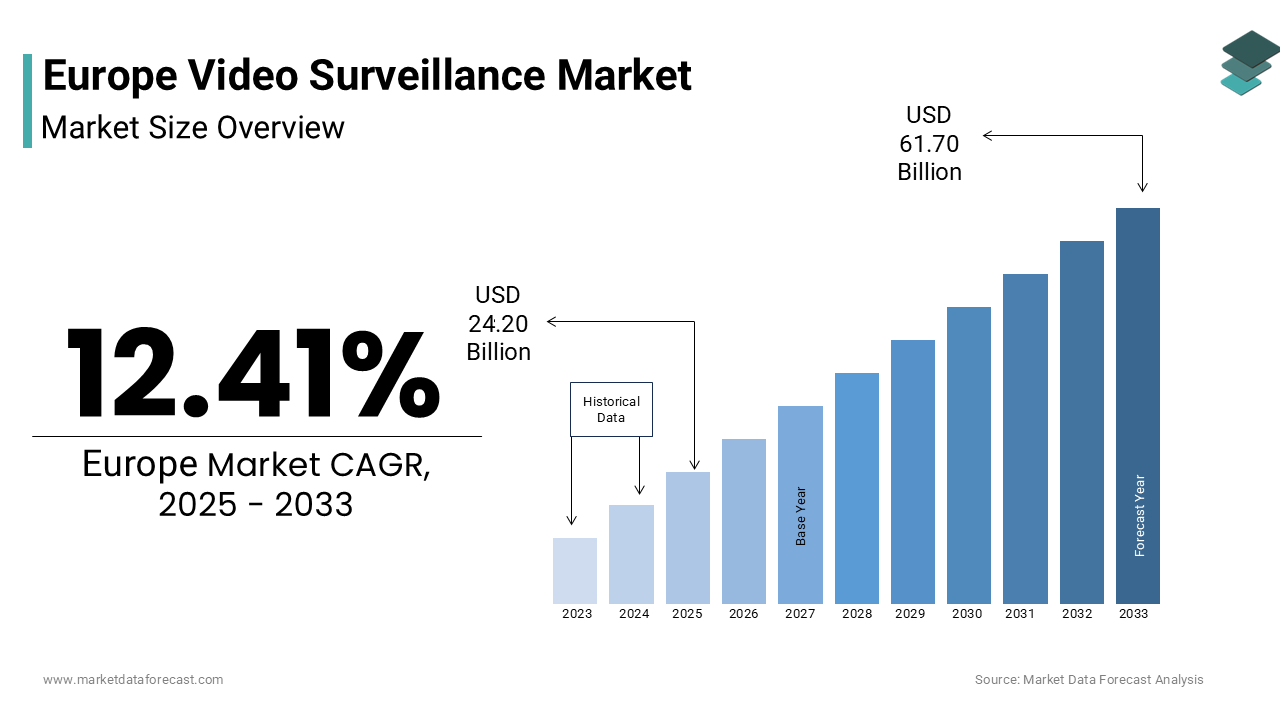
The Europe video surveillance market was valued at USD 21.53 billion in 2024, is estimated to reach USD 24.20 billion in 2025, and is projected to reach USD 61.70 billion by 2033, growing at a CAGR of 12.41% during the forecast period from 2025 to 2033. The growth of the Europe video surveillance market is driven by rising urban crime rates, increasing demand for public safety infrastructure, and expanding adoption of smart city initiatives. The integration of artificial intelligence, edge computing, and IP-based surveillance systems is further accelerating market expansion. Moreover, mandatory security upgrades across critical infrastructure and transport networks, along with increasing commercial and residential security concerns, are strengthening the demand for advanced and compliant video surveillance solutions across Europe.
Key Market Trends
- Increasing deployment of AI-powered video analytics for real-time monitoring, anomaly detection, and crowd management.
- Rapid transition from analog to IP-based surveillance systems with encrypted data transmission and remote accessibility.
- Growing adoption of video surveillance in smart city projects for traffic management, urban safety, and infrastructure monitoring.
- Rising use of edge-based processing to reduce bandwidth costs and ensure privacy-by-design compliance.
- Expanding residential demand is driven by smart home integration and growing concerns over theft and package security.
Segmental Insights
- Based on component, the hardware segment held the largest share of the Europe video surveillance market in 2024. The segment’s dominance is attributed to the continuous replacement of legacy systems with high-resolution IP cameras, secure recording devices, and advanced networking equipment across public and private sectors.
- Based on vertical, the commercial segment accounted for the leading share of the Europe video surveillance market in 2024. High adoption across retail, transportation, banking, logistics, and public infrastructure, along with regulatory requirements for monitoring high-risk environments, continues to drive demand.
- Based on system type, the IP video surveillance segment dominated the market in 2024. Its leadership stems from superior image quality, integration with AI analytics, cloud compatibility, and compliance with modern cybersecurity and data protection standards.
Regional Insights
The Europe video surveillance market is witnessing steady growth across major economies, supported by urban security programs, smart city investments, and regulatory-driven modernization of surveillance infrastructure.
The United Kingdom was the largest contributor in 2024, driven by high camera density, strong public safety funding, and widespread adoption of AI-enabled surveillance across retail and transportation networks.
Germany continues to play a critical role due to strong industrial security requirements, workplace safety regulations, and large-scale deployments across railways, manufacturing facilities, and logistics hubs.
France and Italy are experiencing robust growth supported by urban security initiatives, transport infrastructure upgrades, and increasing investments in public surveillance systems aligned with data protection regulations.
Competitive Landscape
The Europe video surveillance market is characterized by the presence of established global manufacturers and strong regional players focusing on regulatory compliance, cybersecurity, and ethical AI adoption. Companies are emphasizing privacy-by-design architectures, edge analytics, and seamless integration with smart building and city platforms. Strategic partnerships with governments, transport authorities, and commercial enterprises, along with investments in secure and sustainable technologies, are shaping competitive differentiation across the European market. Prominent players in the Europe video surveillance market include Axis Communications AB, Bosch Security Systems (Robert Bosch GmbH), Hikvision, Dahua Technology, Hanwha Vision (Hanwha Techwin), Motorola Solutions (Avigilon), Honeywell International Inc., Johnson Controls (Tyco), Schneider Electric (Pelco), TKH Group (TKH Security), Mobotix AG, i-PRO, IDIS Co., Ltd., Verint Systems Inc., and Genetec Inc.
Europe Video Surveillance Market Size
The europe video surveillance market size was valued at USD 21.53 billion in 2024 and is anticipated to reach USD 24.20 billion in 2025 from USD 61.70 billion by 2033, growing at a CAGR of 12.41% during the forecast period from 2025 to 2033.
Video surveillance is designed to monitor, record, and analyse visual data for security, operational, and public safety purposes. Unlike generic observation tools, modern European video surveillance integrates edge computing, encrypted data transmission, and privacy by design principles to comply with the region’s rigorous legal frameworks. The technology serves critical functions across urban infrastructure, transportation hubs, industrial sites, and retail environments, where situational awareness directly impacts safety, efficiency, and regulatory compliance. According to Eurostat, the European Union recorded millions of reported criminal offenses in 2023, with property‑related crimes accounting for the majority, which is reinforcing the societal demand for preventive monitoring. As per the European Union Agency for Law Enforcement Cooperation (Europol), a large share of investigations in 2023 relied on video evidence from public and private surveillance systems, which is indicating the technology’s central role in modern policing. Furthermore, the EU’s Urban Mobility Framework mandates intelligent transport systems in cities with populations exceeding 100,000, many of which depend on video analytics for traffic flow management and safety optimization. In this context, video surveillance transcends traditional security to become a foundational layer of smart governance, public order, and resilient urban planning across Europe.
MARKET DRIVERS
Rising urban crime rates and demand for preventive public safety infrastructure
Persistent increases in property and public-order crime across European cities are driving the video surveillance market growth in Europe. According to Eurostat, police-recorded crimes against property rose in 2023 across the EU, with thefts up 4.8%, robberies up 2.7%, and burglaries up 4.2% versus 2022, alongside continued rises in sexual violence offences, which is indicating municipal pressure to enhance situational awareness in high-footfall areas such as transit hubs and shopping districts. Cities like Paris, London, and Rome are expanding camera networks and analytics capacity within broader urban security strategies; France’s debate and oversight over AI-assisted public surveillance continued beyond the 2024 Olympics, which is indicating a national pivot to algorithmic video surveillance with safeguards and time limits. In the UK, the Home Office’s 2023–24 accounts reflect substantial public safety and security spend, including funding streams that cover local CCTV upgrades aligned to data protection standards. As per the European Commission’s Internal Security policy framework, smart surveillance is viewed as an enabler for safety in public spaces when combined with privacy-by-design, minimization, and proportionality requirements, helping police respond faster with finite personnel. This combination of rising crime indicators, policy prioritization, and budgetary momentum raises demand for intelligent, compliant video systems that enhance deterrence and post-incident resolution without expanding headcount. The national public safety initiatives support increased municipal investment in compliant video surveillance, which is directly driving the European market growth.
Mandatory security upgrades in critical infrastructure under the NIS2 directive
The implementation of NIS2 and its national transpositions is further fuelling the video surveillance market growth in Europe. As per ENISA, NIS2 strengthens cybersecurity obligations and broadens scope, with EU-level implementing measures adopted in October 2024, pushing operators to upgrade monitoring, logging, encryption, and incident response capabilities across digital and physical domains. Guidance and sectoral notes highlight continuous monitoring needs, secure data handling, and evidence frameworks for compliance audits, which is effectively phasing out insecure, legacy systems and catalysing investment in tamper-resistant recording, encrypted video streams, and integrations with intrusion detection and SIEM platforms. In Germany, NIS2 transposition progressed through 2024–2025, culminating in passage of the NIS2 Implementation Act in November 2025, which sets out BSI-led oversight and regulatory specifics and prompting utility and transport operators to align physical surveillance with broader cyber controls. By linking physical security telemetry (perimeter cameras, access points, control rooms) with cybersecurity baselines, NIS2 elevates video surveillance from a discretionary layer to a compliance-relevant component of resilience strategies. As deadlines tighten and national guidance matures, operators of energy, water, transport, health, and digital infrastructure are accelerating modern surveillance deployments to satisfy auditability, encryption, and integration requirements embedded in NIS2’s regime. The ENISA guidance and national transposition milestones show NIS2 pushing systematic upgrades, which is making advanced surveillance a compliance and resilience imperative and favouring the regional market expansion.
MARKET RESTRAINTS
Stringent data protection regulations limiting data retention and processing capabilities
The strict enforcement of GDPR principles coupled with heightened oversight via Data Protection Impact Assessments for high-risk processing are hindering the European video surveillance market growth. According to the European Data Protection Board’s DPIA guidelines, controllers must assess risks and adopt mitigations before rolling out surveillance that may systematically monitor public areas or employees, which is tightening approval processes and increasing baseline compliance costs. Courts and regulators have constrained biometric applications: Germany’s legal framework and scholarship underscore the narrow legal bases for facial recognition in public spaces and emphasize proportionality and dignity protections under constitutional and data protection law, which is limiting real-time identification deployments beyond exceptional contexts. Enforcement action has intensified as in January 2024, France’s CNIL imposed a €32 million fine on Amazon France Logistique for excessive monitoring and related CCTV violations, which is indicating significant penalties for non-compliant video/data handling. These boundaries force vendors to invest in on-device anonymization, dynamic blurring, fine-grained access control, and audit logging to achieve compliance and raising complexity and total cost of ownership. While privacy-preserving architectures can mitigate risk, they also limit persistent tracking and behavioural analytics in commercial and municipal settings, slowing adoption of next-generation capabilities despite technical readiness. This regulatory guidance, case law context, and CNIL enforcement demonstrate strict data protection constraints that materially limit analytics scope and raise compliance costs.
Fragmented national interpretations of surveillance legality across member states
Another major restraint is the fragmented legal interpretation of surveillance rules across EU member states, driving variability in where cameras may operate, what features are permitted, and how notice/consent must be managed. The Commission’s Single Market and Competitiveness Scoreboard illustrate persistent divergences in digital and regulatory implementation across the single market, including privacy and market surveillance regimes, which is creating compliance uncertainty for cross-border deployments. National and local authorities often impose distinct approval pathways and signage/audio capture rules as French CNIL’s late-2024 formal notices to communes for smart camera use reflect national-level scrutiny on “augmented” camera software, while Spain and Sweden maintain differing authorization models for public space monitoring. Case law also diverges across jurisdictions and courts, which is shaping limits and proportionality tests in ways that complicate standardization. The result is a costly patchwork: multinational retailers, transport operators, and logistics firms must maintain country-specific configurations and policies to remain compliant, which is raising deployment friction and delaying upgrades. These variations inflate certification efforts, hamper vendor interoperability, and increase legal risk, which is ultimately frustrating scale economies and innovation diffusion across the region’s surveillance ecosystem.
MARKET OPPORTUNITIES
Integration of artificial intelligence for real-time anomaly detection in transport hubs
The integration of AI into surveillance systems presents a significant opportunity to enhance safety and operational efficiency in Europe’s dense transportation networks—while aligning with privacy-preserving designs like on-edge processing. Europe’s Rail highlights AI’s role as a gamechanger in optimizing complex rail systems, improving security in urban networks, and reducing lifecycle costs through automation and smart analytics. Pan-European rail data initiatives such as the Rail Data Factory enable training and certification of AI models for operations, setting foundations for standardized analytics across operators. At airports, Amsterdam Schiphol is actively piloting AI baggage screening with Pangiam, which is leveraging computer vision to improve checkpoint efficiency and detection quality within controlled, privacy-conscious workflows. Horizon Europe is also funding privacy-preserving AI in public safety contexts as the PRESERVE project launched in 2024 to demonstrate regulatory-compliant AI use in criminal investigations, emphasizing ethical big data platforms and responsible analytics that can complement video systems in public spaces. By shifting from passive recording to intelligent event triggering and edge inference, operators can minimize personal data processing while boosting responsiveness to unattended objects, crowd surges, or perimeter breaches, which is meeting safety goals without expanding personnel or violating minimization mandates.
Expansion of smart city initiatives driving multi-purpose surveillance deployment
Smart city programs are creating multi-purpose video infrastructures that serve both security and urban management, which is unlocking new funding streams and cross-department adoption. The EU Mission for Climate-Neutral and Smart Cities aim to deliver 100 climate-neutral smart cities by 2030, with designated cities receiving tailored support to deploy integrated digital solutions that improve transport, energy, and public services. As of the Mission roster, 112 cities across EU and associated countries are engaged via NetZeroCities, building shared capabilities that can incorporate video analytics within digital twins and traffic management systems where privacy safeguards like purpose limitation and data segregation are enforced. Eurocities and the Barcelona Supercomputing Center have trained municipalities on digital twins for planning and governance, illustrating how video-derived mobility data can inform signals, flow, and infrastructure planning without biometric capture. Copenhagen’s long-running intelligent transport initiatives demonstrate real-time traffic regulation improvements and data-driven management that integrate sensors and analytics into urban platforms as these patterns that cameras can complement when deployed within strict data-protection boundaries. With EU and city-level funding prioritizing interoperable platforms, video surveillance evolves from a siloed tool into a foundational sensor layer in sustainable urban governance, broadening use-cases and accelerating adoption.
MARKET CHALLENGES
Shortage of skilled personnel to manage and maintain advanced surveillance systems
A shortage of skilled personnel capable of securing and optimizing modern IP-based and AI-integrated surveillance systems is primarily challenging the regional market growth. ENISA’s Threat Landscape 2023 underscores persistent cyber risks and operational failures that demand stronger security practices, incident handling, and system hardening as these skills often lacking among non-specialist staff tasked with camera administration. National reporting indicates many incidents stem from misconfiguration, poor update hygiene, and human error during system changes; Sweden’s Civil Contingencies Agency noted that technical failures and mistakes accounted for nearly half of reported IT incidents, stressing the need for better routines and resources as these issues that equally affect networked camera deployments. Vocational education and training data show broad gaps between workforce needs and specialized curricula, with substantial shares of training occurring outside physical-security domains, exacerbating integration and cybersecurity skill deficits. Consequently, municipalities and SMEs frequently outsource design and hardening to external consultants, raising costs and slowing response to vulnerabilities. Without coordinated upskilling, certification pathways, and standardized best practices for encryption, certificates, VLANs, and secure firmware management, availability and data integrity will remain at risk, which is undermining stakeholder trust.
Cybersecurity vulnerabilities in networked camera infrastructure
Cybersecurity vulnerabilities in connected surveillance systems are another major challenge, with attackers exploiting default credentials, unpatched firmware, and exposed services to pivot into broader organizational networks. ENISA’s Threat Landscape 2023 documents rising cyber threats across Europe, recommending stronger vulnerability management, secure-by-design practices, and robust incident response—controls that many legacy or consumer-grade cameras lack. Europe is moving to strengthen baselines: the EU’s Cyber Resilience Act introduces mandatory cybersecurity requirements for products with digital elements, with obligations taking effect across 2026–2027, pushing vendors to implement secure development, vulnerability handling, and lifecycle documentation for connected devices, including cameras. Yet thousands of legacy endpoints remain online without upgrade paths, leaving critical infrastructure and retail sites exposed to credential stuffing, botnet enrollment, or feed hijacking. SMEs face affordability and usability constraints that slow migration to hardened systems, while mixed fleets complicate patching and certificate management. Until organizations treat cameras as high-value cyber assets, the exposure will persist. Regulatory pressure will help, but remediation hinges on procurement discipline, workforce capability, and vendor support cycles aligned to CRA timelines.
REPORT COVERAGE
| REPORT METRIC | DETAILS |
| Market Size Available | 2024 to 2033 |
| Base Year | 2024 |
| Forecast Period | 2025 to 2033 |
| Segments Covered | By Component, Vertical, System & Region |
| Various Analyses Covered | Global, Regional & Country Level Analysis; Segment-Level Analysis, Drivers, Restraints, Opportunities, Challenges; PESTLE Analysis; Porter's Five Forces Analysis, Competitive Landscape; Analyst Overview of Investment Opportunities |
| Regions Covered | United Kingdom, France, Spain, Germany, Italy, Russia, Sweden, Denmark, Switzerland, the Netherlands, Turkey, and the Czech Republic. |
| Key Market Players | Axis Communications AB, Bosch Security Systems (Robert Bosch GmbH), Hikvision, Dahua Technology, Hanwha Vision (Hanwha Techwin), Motorola Solutions (Avigilon), Honeywell International Inc., Johnson Controls (Tyco), Schneider Electric (Pelco), TKH Group (TKH Security), Mobotix AG, i-PRO (i-PRO Co., Ltd.), IDIS Co., Ltd., Verint Systems Inc., and Genetec Inc. |
SEGMENTAL ANALYSIS
By Component Insights
The hardware segment captured 68.5% of the Europe video surveillance market share in 2024. The leading position of the hardware segment in this European market is attributed to the foundational role of physical devices such as cameras, recording units, servers, and networking equipment in enabling surveillance deployments. According to the European Security Association, the average lifecycle of a professional surveillance camera in the EU is just over five years, with more than 70% of enterprises planning upgrades within 6 years due to image quality or cybersecurity limitations. As per the European Rail Agency, major railway operators replaced tens of thousands of analog and early IP cameras in 2023 to comply with EU Railway Safety Directive standards. The European Union Agency for Cybersecurity reported that more than 60% of breached surveillance systems in 2023 ran on end‑of‑life firmware with known vulnerabilities. This segment is expected to remain dominant over the forecast period as performance and security imperatives sustain hardware replacement demand across public and private sectors.
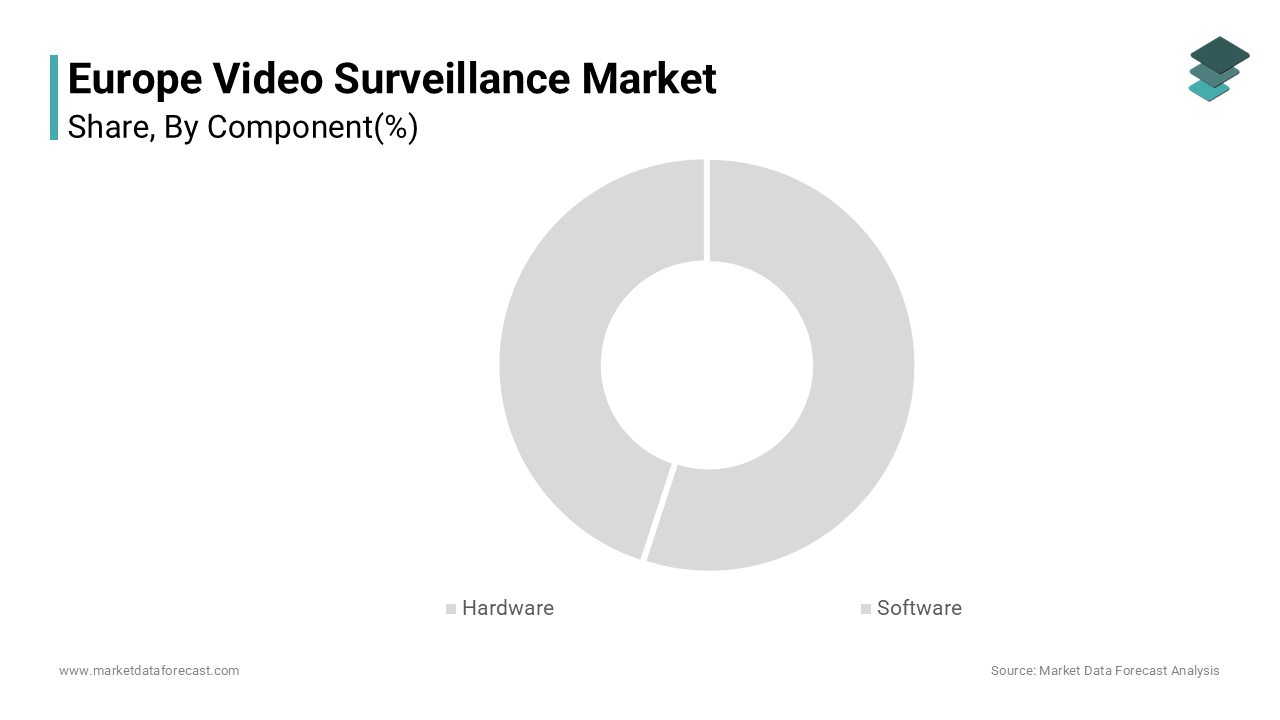
The software segment is expected to register the fastest CAGR of 13.6% over the forecast period in the European market owing to the growing adoption of video management systems with AI‑powered analytics. According to the European Commission’s Digital Europe Programme, more than half of public transport operators in the EU implemented AI‑based video analytics in 2023 for crowd monitoring and object detection. As per the European Retail Roundtable, nearly 70% of major retailers now use software platforms that integrate video with point‑of‑sale data to analyze foot traffic and conversion rates. Vendors compliant with the EU’s Ethics Guidelines for Trustworthy AI are gaining preference, embedding privacy safeguards such as data minimization and purpose limitation. This segment is expected to expand rapidly over the forecast period as intelligent interpretation replaces passive recording and drives subscription revenues.
By Vertical Insights
The commercial segment held the leading position in the Europe video surveillance market in 2024 and occupied 82.1% of the regional market share. The dominance of the commercial segment in this European market is driven by high security requirements, regulatory obligations, and operational scale across retail, logistics, banking, and public infrastructure. According to the European Agency for Safety and Health at Work, more than three‑quarters of EU member states mandate video monitoring in high‑risk workplaces to investigate accidents. As per the European Banking Authority, credit institutions must maintain 90 days of encrypted video records for branch transactions. The European Retail Federation reported that organized retail crime caused losses of nearly €19 billion in 2023, with surveillance used by almost 90% of major chains to combat theft. This segment is expected to remain dominant over the forecast period as overlapping legal drivers and insurance requirements sustain demand across Europe’s 24 million enterprises.
The residential segment is anticipated to grow at a promising CAGR of 11.2% over the forecast period in the European market. Rising homeownership and demand for smart home integration are supporting the growth of the residential segment in this European market. According to Eurostat, the EU homeownership rate reached 69.3% in 2023, with strong growth in Poland, Spain, and Romania. As per the European Smart Home Alliance, more than half of new single‑family homes in Germany and the Netherlands featured smart doorbells or outdoor cameras in 2023. A study by the European Consumer Organisation in 2024 found that over 60% of homeowners cited package theft as a top security concern, fueling adoption of video doorbells with cloud storage. This segment is expected to expand rapidly over the forecast period as smart home penetration grows and residential surveillance shifts from luxury to expectation.
By System Insights
The IP video surveillance segment dominated the Europe video surveillance market by holding 74.2% of the market in 2024. The dominance of the IP segment in this European market is attributed to superior image quality, remote accessibility, and seamless integration with digital infrastructure and analytics platforms. According to the European Commission’s Urban Security Initiative, 68 cities replaced more than 40,000 analog cameras with IP systems in 2023 as part of EU‑funded safety upgrades. As per the UK’s College of Policing, surveillance guidelines updated in 2023 require encrypted video streams and minimum resolution standards unattainable with analog technology. Germany’s Federal Police mandated IP migration for all federal facilities by 2025 to enable integration with national incident management systems. This segment is expected to remain dominant over the forecast period as public sector modernization programs drive large‑scale replacement waves.
The IP video surveillance segment is expected to register the fastest CAGR of 12.1% over the forecast period in the European market. Deployment of edge AI cameras reducing bandwidth and storage costs is favouring the growth of the IP segment in this European market. According to the European Institute for Innovation and Technology, more than 60% of new IP camera shipments in 2023 included on‑board object detection and classification capabilities. As per the Port of Antwerp, edge AI cameras reduced video storage costs by more than 50% by uploading only anomaly clips. The European Commission’s Horizon Europe program allocated €64 million to support privacy‑preserving edge analytics that automatically blur faces and delete non‑relevant data. This segment is expected to expand rapidly over the forecast period as edge intelligence addresses cost, scalability, and compliance simultaneously, accelerating IP adoption across Europe.
REGIONAL ANALYSIS
United Kingdom Video Surveillance Market Analysis
The United Kingdom dominated the European video surveillance market in 2024 by capturing 20.8% of the European market share. The high camera density, strong legal frameworks, and retail innovation are driving the dominance of the UK in the European market. According to the British Security Industry Association, the UK operates millions of surveillance cameras, which is giving it one of the highest ratios per capita in Europe. The Home Office’s Safer Streets Fund has financed thousands of local security projects since 2021. Major retailers such as Tesco and Sainsbury’s deploy AI‑powered systems to combat organized retail crime, which the British Retail Consortium estimates costs businesses billions annually. London’s transport network integrates tens of thousands of cameras with privacy‑compliant facial blurring. With insurance incentives, cybersecurity mandates, and public acceptance, the UK sets benchmarks for scale and sophistication in surveillance.
Germany Video Surveillance Market Analysis
Germany captured a promising share of the European video surveillance market in 2024. The growth of Germany in the European market is attributed to its industrial base, workplace safety laws, and cautious adoption of intelligent public systems. According to the Federal Ministry of Labour, most manufacturing and logistics facilities use video surveillance to investigate workplace incidents, as mandated by occupational safety regulations. Deutsche Bahn operates tens of thousands of cameras across its rail network with real‑time analytics for platform safety. Privacy concerns limit facial recognition, but the Federal Police mandated IP camera upgrades at airports and border crossings under the National Security Strategy. The VDMA reports that a majority of German industrial firms integrate surveillance with access control systems to protect intellectual property. Germany is expected to remain a high‑value market emphasizing quality, cybersecurity, and functional integration.
France Video Surveillance Market Analysis
France is estimated to hold a prominent share of the European video surveillance market over the forecast period. Factors such as the state‑led urban security programs and transport infrastructure upgrades are propelling the French market expansion. According to the Ministry of Interior, the “Safe Cities” initiative deployed thousands of new cameras across municipalities with real‑time monitoring centers in Paris, Lyon, and Marseille. SNCF upgraded station cameras to IP with edge analytics for crowd management ahead of the 2024 Olympics. CNIL permits surveillance in public spaces when paired with dynamic blurring and limited retention periods, creating a privacy‑compliant model. The French Banking Federation requires encrypted video records for anti‑fraud compliance. France is expected to remain a balanced ecosystem merging security efficacy with democratic oversight.
Italy Video Surveillance Market Analysis
Italy accounted for a notable share of the European video surveillance market in 2024 due to the rising urban crime, retail losses, and infrastructure projects tied to EU funding. According to the Interior Ministry, thefts and robberies in major cities increased in 2023, prompting expansion of municipal camera networks. The Italian Retail Association reports organized retail crime caused billions in losses, leading chains such as Conad and Esselunga to adopt AI‑powered surveillance. Italy is upgrading port security under EU maritime safety directives, requiring 24/7 monitoring of cargo areas. The National Anti‑Corruption Authority mandates video oversight in procurement sites to prevent fraud. Italy is expected to remain a rapidly modernizing market transitioning from fragmented analog setups to coordinated intelligent systems.
Netherlands Video Surveillance Market Analysis
The Netherlands is estimated to witness a healthy CAGR in the European video surveillance market over the forecast period. The smart city initiatives, logistics hubs and regulated public monitoring are driving the market growth in Netherlands. According to the Dutch National Police, thousands of new cameras were installed in urban centers with strict rules requiring signage, data minimization, and retention limits. The Port of Rotterdam uses tens of thousands of cameras integrated with AI for container tracking and incident response. Retailers such as Ahold Delhaize deploy privacy‑preserving analytics to measure foot traffic without identifying individuals, complying with Dutch Data Protection Authority guidelines. Amsterdam’s Smart City Program embeds video sensors into traffic management, reducing congestion in pilot districts. The Netherlands is expected to remain a model for balancing safety with civil liberties.
COMPETITVE LANDSCAPE
The Europe video surveillance market features intense competition among global innovators and regional specialists each navigating a complex landscape of security demands privacy regulations and technological evolution. The market is highly fragmented with no single vendor dominating all sectors yet leaders distinguish themselves through regulatory alignment technical reliability and ethical AI practices. European buyers prioritize vendors that offer transparent data handling certified cybersecurity and local compliance support over pure cost advantages. Public sector tenders often mandate strict adherence to General Data Protection Regulation and national security directives creating high entry barriers for non compliant suppliers. Meanwhile commercial clients seek seamless integration with smart building and loss prevention ecosystems. The rise of edge computing and cloud platforms has intensified software competition with video management systems becoming key differentiators. As cities and industries digitize surveillance is evolving from a hardware centric function to an intelligent service layer making software expertise partnerships and trust the new currencies of competitive advantage in Europe’s high scrutiny environment.
KEY MARKET PLAYERS
Some of the companies that are playing a dominating role in the Europe Video Surveillance Market include
- Axis Communications AB
- Bosch Security Systems (Robert Bosch GmbH)
- Hikvision
- Dahua Technology
- Hanwha Vision (Hanwha Techwin)
- Motorola Solutions (Avigilon)
- Honeywell International Inc.
- Johnson Controls (Tyco)
- Schneider Electric (Pelco)
- TKH Group (TKH Security
- Mobotix AG
- i-PRO (i-PRO Co., Ltd.)
- IDIS Co., Ltd.
- Verint Systems Inc.
- Genetec Inc.
Top Players in the Market
Axis Communications AB
Axis Communications AB is a Swedish multinational and a global pioneer in network video technology with a deeply embedded presence across the Europe video surveillance market. The company is renowned for its innovation in IP cameras edge AI and cybersecurity by design, aligning closely with European regulatory expectations. Axis contributes to the global market through its open platform approach which enables integration with third party software and systems fostering ecosystem collaboration. In recent years the company has strengthened its European position by achieving EU Cyber Resilience Act readiness for its entire product line and launching cameras with on device privacy masking that automatically blurs bystanders. It also established a dedicated data protection compliance center in Brussels to support public sector clients in meeting General Data Protection Regulation requirements for video processing.
Bosch Security Systems GmbH
Bosch Security Systems GmbH is a leading German provider of intelligent video surveillance solutions serving critical infrastructure transport and commercial sectors across Europe. The company differentiates itself through robust hardware built for industrial environments and advanced behavioral analytics that operate without facial recognition. Globally Bosch drives innovation in edge computing and secure video management systems compliant with international cybersecurity standards. To reinforce its European foothold the company integrated its video platform with national emergency response protocols in Germany and the Netherlands and introduced cameras with local data storage options to address sovereignty concerns. In 2023 Bosch also launched a sustainability initiative reducing the carbon footprint of its camera production by 22% through renewable energy and circular design principles.
Hikvision Europe B.V.
Hikvision Europe B.V. operates as the European arm of a major global surveillance technology provider with a significant footprint in commercial and logistics applications across the region. The company offers a broad portfolio of high resolution IP cameras and intelligent video management software tailored for retail warehouse and city surveillance needs. Hikvision contributes to the global market through scalable AI analytics and cost efficient deployment models. In response to European regulatory expectations the company established a European data governance office in Amsterdam in 2023 and achieved ISO 27001 certification for its EU based cloud services. It also introduced a line of cameras with GDPR compliant features including scheduled recording manual activation and EU hosted storage options to support responsible deployment in sensitive environments.
Top Strategies Used by the Key Market Participants
Key players in the Europe video surveillance market prioritize privacy by design by embedding features such as automatic blurring dynamic masking and data minimization directly into camera firmware. They achieve compliance with emerging regulations like the EU Cyber Resilience Act through secure boot encrypted communications and vulnerability disclosure programs. Companies invest heavily in edge AI to reduce bandwidth storage and cloud dependency while enabling real time analytics without personal data processing. Strategic partnerships with local system integrators public authorities and cybersecurity agencies enhance trust and facilitate large scale deployments. Vendors also emphasize sustainability by reducing product carbon footprints using recyclable materials and renewable energy in manufacturing. These strategies collectively address Europe’s unique balance of security needs democratic values and environmental responsibility.
MARKET SEGMENTATION
This research report on the Europe Video Surveillance Market is segmented and sub–segmented into the following categories.
By Component
- Hardware
- Software
By Vertical
- Commercial
- Residential
By System
- Analog Video Surveillance
- IP Video Surveillance
By Country
- UK
- France
- Spain
- Germany
- Italy
- Russia
- Sweden
- Denmark
- Switzerland
- Netherlands
- Turkey
- Czech Republic
- Rest of Europe
Frequently Asked Questions
What is the Europe video surveillance market?
The Europe video surveillance market comprises systems and solutions such as cameras, recording devices, software, and analytics used for monitoring, security, and safety across residential, commercial, industrial, and public infrastructure sectors.
What factors are driving the growth of the Europe video surveillance market?
Rising security concerns, increasing urbanization, growing smart city projects, and the adoption of advanced technologies such as AI-based video analytics are major factors driving market growth.
Which technologies are commonly used in the Europe video surveillance market?
The market widely uses IP cameras, analog cameras, network video recorders (NVRs), digital video recorders (DVRs), cloud-based surveillance, and AI-enabled video analytics.
What challenges does the Europe video surveillance market face?
Data privacy concerns, strict regulations such as GDPR, high installation costs, and cybersecurity risks are major challenges affecting market growth.
.What is the trend toward cloud-based video surveillance in Europe?
Cloud-based surveillance is gaining traction due to its scalability, remote access, reduced hardware dependency, and lower maintenance costs compared to traditional on-premise systems.
Which countries are leading the Europe video surveillance market?
Countries such as the UK, Germany, France, Italy, and Spain are leading the market due to strong infrastructure development, higher security investments, and technological adoption.
What future trends are expected in the Europe video surveillance market?
Future trends include increased use of AI and machine learning, integration with IoT devices, edge computing adoption, and higher demand for privacy-compliant surveillance solutions.
Is residential surveillance contributing to market growth in Europe?
Yes, rising crime awareness, smart home adoption, and affordability of smart cameras are driving increased demand for residential video surveillance solutions.
How do smart city initiatives impact the Europe video surveillance market?
Smart city initiatives significantly boost demand for video surveillance systems to manage traffic, enhance public safety, monitor public spaces, and support law enforcement activities.
What is the outlook for the Europe video surveillance market during the forecast period?
The market is expected to grow steadily during the forecast period, supported by technological advancements, expanding smart infrastructure, and continuous investments in public and private security systems.
Access the study in MULTIPLE FORMATS
Purchase options starting from
$ 2000
Didn’t find what you’re looking for?
TALK TO OUR ANALYST TEAM
Need something within your budget?
NO WORRIES! WE GOT YOU COVERED!
Call us on: +1 888 702 9696 (U.S Toll Free)
Write to us: sales@marketdataforecast.com