- Product Description Description
- Table of Contents TOC
- List of Table & Figure LOT
- Get Free Sample PDF Sample PDF
Market Size, 2025
$58.21 BnMarket Estimate, 2026
$61.71 BnMarket Forecast, 2034
$98.45 BnCAGR, 2026–2034
6.01%Europe Vision Insurance Market Report Summary
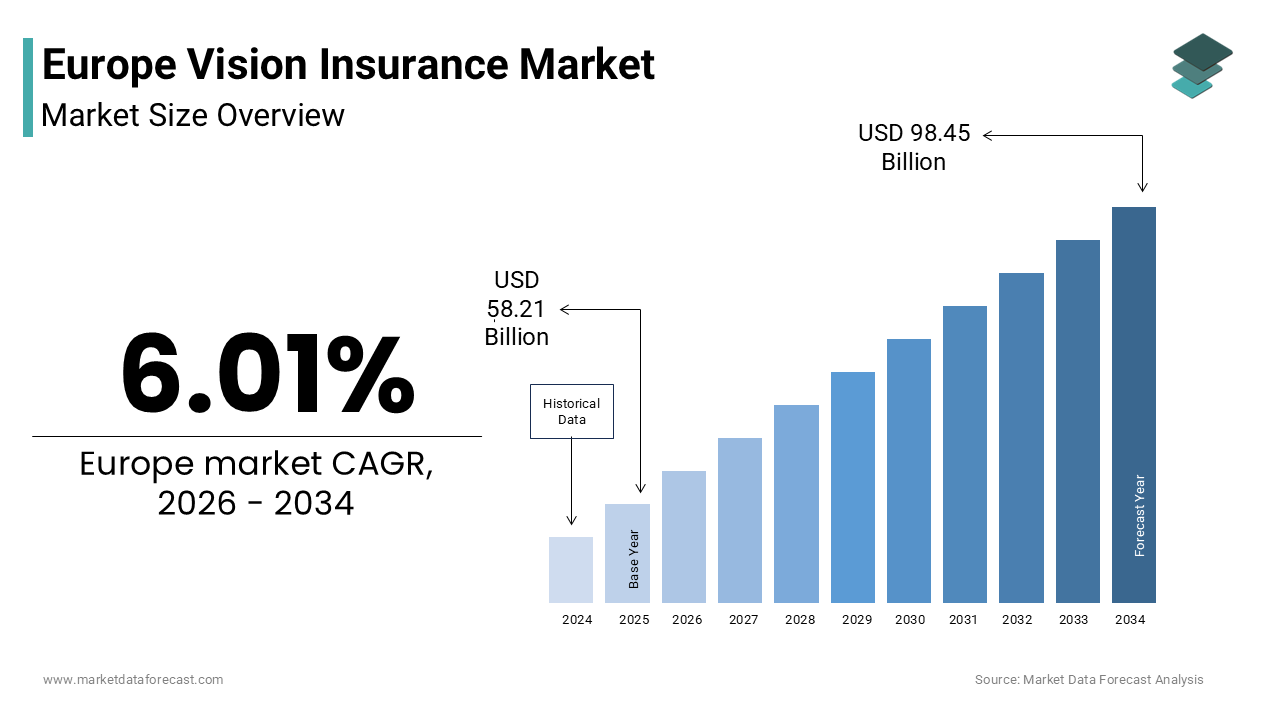
The Europe vision insurance market was valued at USD 58.21 billion in 2025, is estimated to reach USD 61.71 billion in 2026, and is projected to reach USD 98.45 billion by 2034, growing at a CAGR of 6.01% during the forecast period from 2026 to 2034. The growth of the Europe vision insurance market is driven by the rising prevalence of myopia and digital eye strain, increasing aging population, and growing awareness regarding preventive eye care. Expanding employer-sponsored vision benefit programs, increasing demand for premium eyewear, and the integration of tele-ophthalmology services are further fueling market growth. Moreover, advancements in digital health platforms, growing adoption of managed vision care plans, and rising investments in preventive healthcare are supporting the expansion of the Europe vision insurance market.
Key Market Trends
-
Rising prevalence of myopia and digital eye strain driven by prolonged screen exposure across all age groups.
-
Growing adoption of tele-ophthalmology and digital health platforms for remote eye examinations and claims management.
-
Increasing employer-sponsored vision insurance programs as part of corporate wellness initiatives.
-
Strong focus on preventive eye care through regular screenings and early detection of ocular diseases.
-
Growing demand for premium eyewear, advanced lens technologies, and personalized vision care benefits.
Segmental Insights
- Based on product type, the eyewear segment was the largest and held a significant share of the Europe vision insurance market in 2025. The segment’s dominance is attributed to the widespread prevalence of refractive errors, increasing demand for prescription spectacles and contact lenses, frequent eyewear replacement cycles, and rising consumer preference for premium optical products.
- Based on distribution channel, the retail store segment accounted for 56.8% of the Europe vision insurance market share in 2025. The dominance of this segment stems from consumers' preference for in-store eye examinations, personalized optical consultations, professional frame fitting services, and the extensive presence of optical retail chains across Europe, while online platforms continue to gain momentum through virtual try-on technologies and digital insurance integration.
Regional Insights
The Europe vision insurance market is witnessing steady growth across major economies, supported by increasing awareness of preventive eye care, expanding supplementary health insurance coverage, and rising demand for affordable optical services.
- Germany was the largest contributor, accounting for 24.4% of the Europe vision insurance market share in 2025, driven by its well-established supplementary health insurance system, strong private insurance penetration, growing demand for premium eyewear, and extensive network of optical care providers.
- The United Kingdom continues to perform strongly, fueled by increasing employer-sponsored vision benefits, rising out-of-pocket expenditure on optical care, and growing adoption of private vision insurance alongside NHS services.
- France remains a major market due to its comprehensive complementary health insurance system, high penetration of mutual insurance schemes, and increasing reimbursement for optical care services.
- Italy is witnessing notable growth supported by increasing awareness of preventive eye care, rising private health insurance enrollment, and growing demand for vision coverage among the aging population.
- Spain is also emerging as an important market, driven by expanding private health insurance adoption, increasing demand for affordable vision care plans, and growing utilization of digital eye care services.
Competitive Landscape
The Europe vision insurance market is characterized by the presence of leading insurance providers, optical retailers, and integrated vision care companies competing through digital innovation, extensive provider networks, and customized insurance solutions. Leading companies are focusing on expanding tele-ophthalmology services, strengthening partnerships with optical retail chains, introducing flexible vision insurance plans, and investing in digital claims management platforms. The integration of artificial intelligence, preventive eye care programs, and personalized customer experiences continues to strengthen competition across the Europe vision insurance market. Prominent players in the Europe vision insurance market include Allianz SE, AXA SA, Aviva plc, Zurich Insurance Group, Assicurazioni Generali S.p.A., Cigna Healthcare, UnitedHealth Group, MetLife Inc., Aflac Incorporated, Sun Life Financial, Helsana Group, and CNP Assurances.
 Download Free Sample Report
Europe Vision Insurance Market Size
The Europe vision insurance market size was valued at USD 58.21 billion in 2025 and is anticipated to reach USD 61.71 billion in 2026 from USD 98.45 billion by 2034, growing at a CAGR of 6.01% during the forecast period from 2026 to 2034.
Vision insurance comprises a specialized segment of the health insurance industry dedicated to covering the costs associated with routine eye examinations, corrective lenses, contact lenses, and specific ocular treatments that fall outside standard national healthcare provisions. This sector functions as a critical supplementary layer in a region where public systems often prioritize acute medical interventions over preventive optical care. The market is characterized by a diverse mix of standalone policies, employer-sponsored group benefits, and riders attached to comprehensive health plans. According to Eurostat, a significant portion of the European population wears corrective lenses, highlighting a massive underlying demand for affordable visual aids. The European Bureau of Vision Care emphasizes that while many nations provide basic coverage for children or the elderly, significant gaps remain for the working age population regarding premium lens technologies and frequent replacements. As per the World Health Organization, uncorrected refractive errors continue to be a leading cause of visual impairment in Europe, which is driving the necessity for accessible insurance mechanisms that reduce out of pocket barriers. The definition now extends beyond simple reimbursement to include managed care networks that negotiate discounted rates with optometry chains and independent practitioners. This evolution reflects a shift toward preventive health strategies where regular screenings detect systemic conditions like diabetes and hypertension early. The market operates within a complex regulatory framework where national health mandates intersect with private supplemental offerings to ensure comprehensive visual wellness across the continent.
MARKET DRIVERS
Rising Prevalence of Myopia and Digital Eye Strain
The escalating incidence of myopia and computer vision syndrome driven by prolonged screen exposure is majorly driving the European vision insurance market growth. Modern lifestyles involving remote work and digital entertainment have drastically increased the time individuals spend focusing on near objects, leading to a surge in refractive errors requiring correction. According to the European Society of Ophthalmology, the prevalence of myopia among young adults in Europe has risen significantly over the last two decades, with projections suggesting that half of the population could be affected by 2050. This demographic shift creates a sustained demand for regular eye examinations and frequent updates to prescription eyewear, which can become financially burdensome without insurance support. As per the International Labour Organization, European workers spend long hours daily in front of digital screens, exacerbating symptoms of dry eyes and blurred vision known as digital eye strain. Employers are increasingly recognizing these occupational health risks and incorporating vision benefits into corporate wellness packages to maintain productivity and reduce absenteeism. The need for specialized lenses such as blue light filters and progressive additions further drives the value proposition of insurance plans that cover advanced optical technologies. This epidemiological trend ensures that vision insurance transitions from a luxury perk to a fundamental component of personal and occupational health management.
Aging Population and Age-Related Ocular Conditions
The demographic transition toward an older population structure in Europe is further contributing to the vision insurance market expansion in Europe. As life expectancy increases, the prevalence of age-related ocular diseases such as cataracts, glaucoma, and macular degeneration rises sharply, necessitating frequent monitoring and often costly interventions. According to Eurostat, a significant portion of the European Union population is aged 65 or older, a demographic that requires considerably more optical services than younger cohorts. Public healthcare systems in many European countries often impose long waiting times or limit coverage for certain elective procedures and premium intraocular lenses, prompting seniors to seek supplemental private insurance. The European Eye Epidemiology Consortium notes that cataracts affect millions of people in Europe, making it the most common cause of blindness and a major driver for surgical volume. Vision insurance plans that offer coverage for annual dilated exams and discounts on surgical upgrades provide essential financial protection for this vulnerable group. Furthermore, the correlation between vision loss and reduced quality of life or increased fall risk in the elderly motivates families to secure comprehensive coverage. The growing silver economy thus fuels demand for policies that ensure timely access to high-quality ophthalmic care and assistive devices.
MARKET RESTRAINTS
Comprehensive Public Healthcare Coverage Limitations
The existence of robust state-funded healthcare systems in many European nations is primarily hampering the regional market growth. In countries with universal health coverage, citizens often assume that all eye care needs are met by the government, leading to low awareness of the gaps in public provision regarding routine exams and fashionable eyewear. According to the Commonwealth Fund, public systems in nations like France and Germany cover basic optical needs for specific groups, but they frequently exclude adult routine exams or limit reimbursements to low-cost frame options. This partial coverage creates a misconception among the population that additional private insurance is redundant, stifling market growth. As per the Organisation for Economic Co-operation and Development, out-of-pocket spending on optical goods in Europe remains high despite public subsidies, yet consumers often prefer paying sporadically rather than committing to monthly premiums. The bureaucratic complexity of navigating dual systems where public and private coverage overlap can also deter potential subscribers who fear claim rejections or administrative hurdles. Furthermore, strong labor unions in some regions negotiate extensive optical benefits directly within collective bargaining agreements, reducing the individual drive to purchase standalone policies. This reliance on state mechanisms and employer-negotiated deals limits the addressable market for direct-to-consumer vision insurance products.
High-Cost Sensitivity and Economic Volatility
Persistent economic uncertainty and inflationary pressures across Europe create a formidable barrier to the adoption of voluntary vision insurance plans, particularly among middle and lower-income households. As the cost of living rises, consumers prioritize essential expenditures such as housing, energy, and food, often viewing supplemental health insurance as a discretionary expense that can be deferred or cancelled. According to the European Central Bank, inflation rates impacting household budgets have led to reductions in spending on non-essential financial services, including optional insurance riders. For many individuals, the immediate out-of-pocket cost of a pair of glasses every few years appears lower than the cumulative cost of annual insurance premiums, especially if they perceive their vision as stable. As per Eurostat, the proportion of households reporting difficulty in making ends meet has increased in several Southern and Eastern European member states, directly correlating with lower penetration rates of supplemental health products. Insurers face the challenge of pricing policies competitively while covering rising operational costs and claims frequencies, often resulting in premiums that exceed the willingness to pay for price-sensitive consumers. The lack of tax incentives for purchasing private vision insurance in many jurisdictions further diminishes its financial attractiveness. This economic fragility constrains market expansion and forces insurers to constantly justify the value proposition against tight household budgets.
MARKET OPPORTUNITIES
Integration of Tele-Ophthalmology and Digital Health Platforms
The rapid advancement of telemedicine and digital health technologies is a prominent opportunity for the European vision insurance market. By integrating tele-ophthalmology services into their offerings, insurers can facilitate remote eye screenings, follow-up consultations, and prescription renewals without the need for physical clinic visits, thereby lowering administrative and operational expenses. According to the European Commission’s Digital Decade policy program, a large majority of citizens are expected to gain access to digital health services by 2030, creating a favorable regulatory environment for such innovations. As per the European Telemedicine Association, remote diagnostic tools using artificial intelligence can detect conditions such as diabetic retinopathy with accuracy comparable to in-person exams, enabling earlier intervention and reduced claim costs. Insurers can leverage these platforms to offer value-added services such as virtual second opinions and continuous monitoring for chronic eye conditions, enhancing customer retention. The ability to reach underserved rural areas where optometrists are scarce opens new market segments previously considered too costly to serve. Furthermore, digital platforms enable seamless claims processing and direct-to-consumer eyewear ordering, improving the user experience and reducing friction. This technological convergence allows insurers to differentiate their products through convenience and proactive care management. The shift toward digital-first models positions vision insurance as a modern, tech-enabled service rather than a traditional reimbursement mechanism.
Expansion of Corporate Wellness and Employee Benefit Programs
The growing emphasis on employee well-being and productivity offers a lucrative avenue for the European vision insurance market. Companies are increasingly recognizing that poor vision leads to decreased work performance, increased error rates, and higher accident risks, prompting them to enhance their benefit packages with comprehensive vision coverage. According to the European Agency for Safety and Health at Work, visual fatigue is a leading cause of discomfort among office workers, driving demand for employer-sponsored eye care solutions. Insurers can partner with corporations to offer tailored group policies that include regular screenings, blue light filtering lenses, and ergonomic assessments as part of a holistic health strategy. As per Deloitte, organizations that invest in employee health benefits report higher retention rates and lower absenteeism, making vision insurance an attractive component of total reward packages. The rise of flexible benefit plans allows employees to customize their coverage, increasing the likelihood of opting for vision add-ons. Insurers can also provide data analytics to employers regarding the visual health of their workforce, helping to identify trends and prevent occupational eye injuries. This B2B approach bypasses individual price sensitivity and leverages the purchasing power of large organizations. The alignment of vision health with corporate productivity goals ensures a steady growth trajectory for group vision insurance products.
MARKET CHALLENGES
Fragmented Regulatory Landscape Across Member States
The lack of harmonization in healthcare regulations and insurance standards across European Union member states is challenging the growth of the European vision insurance market. Each country maintains its own distinct rules regarding mandatory coverage, reimbursement rates, and licensing of insurance providers, creating a complex patchwork that hinders operational efficiency. According to the European Insurance and Occupational Pensions Authority, navigating numerous regulatory frameworks increases compliance costs and slows down product launches for multinational insurers. Differences in data privacy laws, specifically the implementation nuances of the General Data Protection Regulation regarding health data, further complicate the administration of cross-border claims and digital health services. As per the Centre for European Policy Studies, this fragmentation prevents the realization of economies of scale, forcing insurers to maintain separate operational units for each market. The uncertainty surrounding future regulatory changes, such as potential expansions of public coverage, adds strategic risk to long-term investment decisions. Insurers must constantly adapt their products to local idiosyncrasies, limiting their ability to innovate rapidly. This regulatory heterogeneity remains a structural barrier to the creation of a unified and efficient European vision insurance market.
Adverse Selection and Rising Claims Frequency
The phenomenon of adverse selection, where individuals with existing or anticipated eye conditions are more likely to purchase insurance than those with healthy vision, which is further challenging the vision insurance market expansion in Europe. This imbalance skews the risk pool, leading to higher claim frequencies and severities that can erode profit margins and force premium increases. According to the Geneva Association, voluntary vision insurance schemes often attract a disproportionate number of high-risk participants without robust underwriting mechanisms or mandatory enrollment. As the prevalence of chronic conditions such as diabetes rises, the associated ocular complications drive up the cost of claims for treatments like anti-VEGF injections and laser therapies. As per Swiss Re, claims related to corrective lens replacements have increased due to shorter replacement cycles influenced by fashion trends and technological advancements in lens materials. Insurers face the difficult task of balancing affordability with solvency, often resorting to waiting periods or coverage caps that may make policies less attractive to healthy consumers. The inability to accurately predict long-term ocular health trends complicates actuarial modeling and pricing strategies. If premiums rise too high to cover claims, healthier individuals drop out, exacerbating the spiral. Managing this risk dynamic while maintaining competitive pricing remains a critical hurdle for the sustainable growth of the vision insurance sector.
REPORT COVERAGE
| REPORT METRIC | DETAILS |
| Market Size Available | 2025 to 2034 |
| Base Year | 2025 |
| Forecast Period | 2026 to 2034 |
| CAGR | 6.01% |
| Segments Covered | By Product Type, Distribution Channel and Region. |
| Various Analyses Covered | Global, Regional & Country Level Analysis, Segment-Level Analysis, DROC, PESTLE Analysis, Porter’s Five Forces Analysis, Competitive Landscape, Analyst Overview of Investment Opportunities |
| Country Covered | UK, France, Spain, Germany, Italy, Russia, Sweden, Denmark, Switzerland, the Netherlands, Turkey, the Czech Republic, and the Rest of Europe. |
| Market Leaders Profiled | Allianz SE, AXA SA, Aviva plc, Zurich Insurance Group, Assicurazioni Generali, Cigna Healthcare, UnitedHealth Group, MetLife, Aflac, Sun Life Financial, Helsana Group, and CNP Assurances |
SEGMENTAL ANALYSIS
By Product Type Insights
The eyewear segment dominated the market by accounting for 61.2% of the regional market share in 2025 due to the universal necessity of corrective lenses for the majority of the population and the frequent replacement cycles associated with fashion and prescription changes. The exceptionally high prevalence of refractive errors such as myopia, hyperopia, and astigmatism across all age groups in Europe is also contributing to the dominance of eyewear segment in the European market. Unlike surgical interventions, which are one-time events, the need for glasses or contact lenses is continuous and often lifelong, creating a steady stream of recurring claims. According to the European Society of Ophthalmology, more than 70% of adults in Europe require some form of vision correction, establishing a massive addressable base for eyewear benefits. The rising incidence of myopia among children and young adults due to increased screen time further expands this demographic, ensuring long-term demand. As per Eurostat, households in Western Europe allocate a significant portion of their health budgets to optical goods, making insurance coverage for these items highly valued. The necessity of having multiple pairs for different activities such as driving, reading, and computer work drives up the volume of claims per insured individual. Insurance policies that cover frames and lenses annually align perfectly with this constant need, making eyewear the core component of most vision plans. This widespread dependency on corrective devices ensures that the eyewear segment remains the financial backbone of the vision insurance industry.
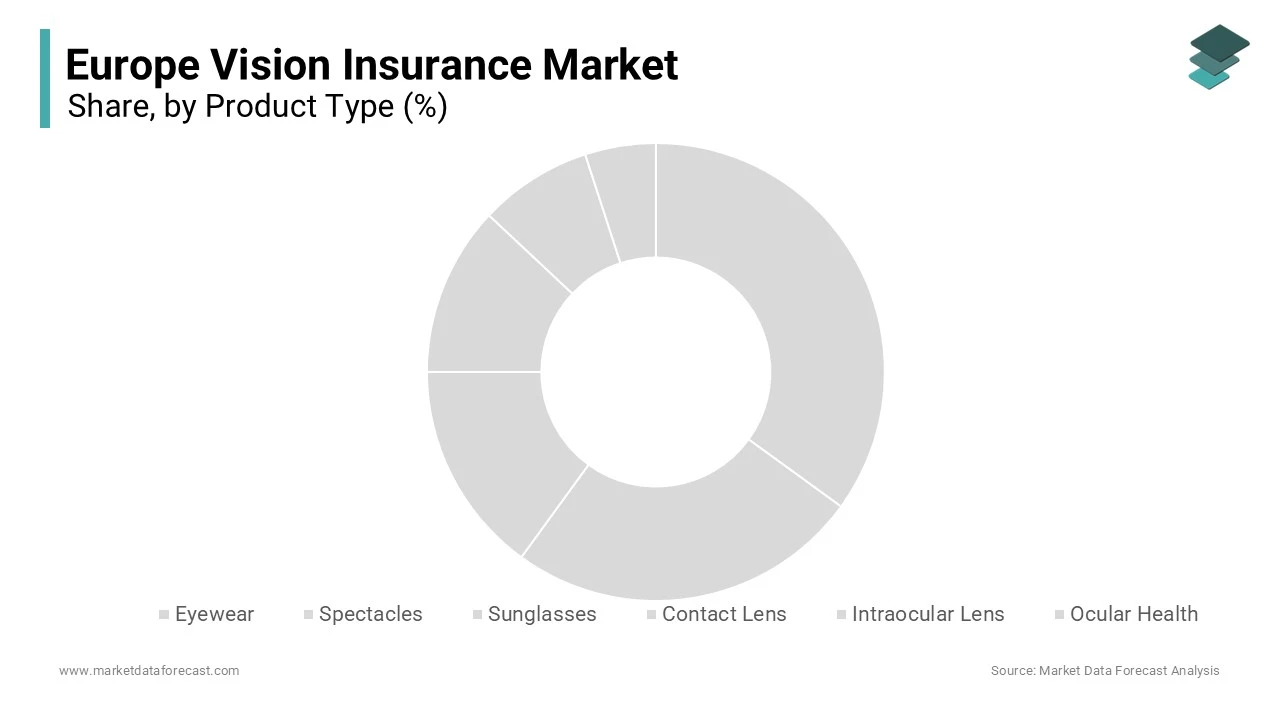
However, the ocular health segment is poised to grow at the highest CAGR of 8.84% over the forecast period in the European market owing the growing aging population and a strategic shift toward preventive care and early detection of chronic eye diseases. The rapidly aging population in Europe that correlates directly with a higher incidence of sight-threatening conditions requiring ongoing management is also propelling the growth of the ocular health segment in the European market. As life expectancy increases, the prevalence of diseases such as glaucoma, diabetic retinopathy, and age-related macular degeneration rises sharply, necessitating regular monitoring and expensive treatments. According to Eurostat, nearly 22% of the EU population is aged 65 or older, a group that requires frequent dilated exams and potential therapeutic interventions. Vision insurance plans are increasingly expanding coverage to include diagnostic services and non-surgical treatments to prevent blindness and reduce long-term healthcare costs. The European Eye Epidemiology Consortium states that early detection through regular screening can reduce the risk of severe vision loss by up to 50%, prompting insurers to incentivize preventive visits. As public systems face capacity constraints, private insurance fills the gap by offering quicker access to specialists and advanced imaging technologies. This demographic shift ensures that spending on ocular health services will grow faster than routine corrective needs. The focus on preserving vision quality in later life drives sustained investment in this segment.
By Distribution Channel Insights
The retail store segment led the market by holding 56.8% of the regional market share in 2025. The leading position of retail segment in the European market can be credited to the consumer preference for physical interaction when selecting eyewear and the extensive network of optical chains across the continent. The inherent need for customers to physically try on frames and receive professional fitting services before purchasing corrective eyewear is also aiding the dominance of the retail store segment in this regional market. Unlike other consumer goods, glasses require precise adjustments to ensure comfort and optimal optical performance, tasks that cannot be fully replicated online. According to the European Optical Industry Association, more than 80% of consumers prefer visiting a physical store to test multiple frame styles and receive immediate feedback from trained opticians. Insurance networks heavily favor established retail chains that can guarantee quality assurance and standardized pricing, reinforcing the channel’s dominance. As per Statista, customer satisfaction scores for eyewear purchases are significantly higher when conducted in person due to personalized service and instant resolution of fitting issues. The trust built through face-to-face interactions with healthcare professionals also encourages patients to utilize their insurance benefits more frequently. The inability of digital channels to fully replicate the nuances of physical fitting ensures that retail stores remain the primary point of redemption for vision insurance.
However, the online store segment is anticipated to witness the fastest CAGR of 13.1% over the forecast period in the European market owing to the digitalization of eye care services and changing consumer behaviors favoring convenience and home delivery. The emergence of tele-optometry and innovative home try-on services that mitigate the traditional barriers to buying glasses digitally is further fuelling the growth of the online segment in this regional market. Advances in smartphone technology and augmented reality now allow users to upload prescriptions, undergo remote refraction tests, and virtually visualize how frames look on their faces with high accuracy. According to the European Telemedicine Association, adoption of remote eye examination tools has doubled since 2022, enabling insurers to approve claims and issue digital vouchers for online redemption seamlessly. Startups and established retailers alike are offering home try-on programs where customers can select multiple frames to test at home before purchasing, bridging the gap between physical and digital experiences. As per YouGov, over 40% of European consumers under 35 are now willing to purchase prescription eyewear online if supported by virtual fitting tools and flexible return policies. Insurance platforms are integrating directly with these e-commerce sites to offer instant discounts and cashless transactions, enhancing the user experience. The convenience of browsing vast inventories and comparing prices from home appeals to busy professionals and digital natives. This technological enablement transforms the online channel from a niche option into a mainstream distribution force.
REGIONAL ANALYSIS
Germany Vision Insurance Market Analysis
Germany shown the dominance in the European vision insurance market in 2025 with 24.4% of the regional market share. The dominating position of Germany in the European market is attributed to its unique dual system of statutory and private health coverage. The nation serves as a model for supplementary insurance, where mandatory public schemes cover basic needs but leave significant gaps for premium eyewear and advanced treatments, driving robust demand for private add-ons. The German Federal Ministry of Health mandates that statutory insurance only covers glasses for children and severe cases in adults, creating a massive market for voluntary supplemental policies among the working population. As per Destatis, nearly half of Germans hold some form of additional health insurance specifically to cover optical costs and regular eye exams. The strong culture of preventive care and high disposable income supports the uptake of comprehensive vision plans that include high-index lenses and designer frames. The presence of major optical chains and a dense network of independent optometrists facilitates easy access to insured services. The regulatory environment encourages competition among private insurers to offer attractive vision riders, fostering innovation in coverage options. This structural reliance on supplementary coverage, combined with a health-conscious populace, solidifies Germany’s position as the dominant market force.
United Kingdom Vision Insurance Market Analysis
The United Kingdom had the second largest share of the European vision insurance market in 2025. The growth of the UK in the European market is driven by a mature private medical insurance sector and the specific limitations of the National Health Service regarding adult optical care. While the NHS provides free eye tests for certain vulnerable groups, the majority of adults must pay for examinations and the full cost of glasses, creating fertile ground for private vision insurance. The Association of British Insurers notes that employer-sponsored health benefits increasingly include vision coverage as a standard perk to attract talent in a competitive labor market. As per the Office for National Statistics, spending on optical appliances remains a significant household expense, prompting many to seek insurance solutions to manage costs. The UK market is characterized by a strong presence of large optical retailers who partner directly with insurers to offer cashback schemes and discount cards. The rise of corporate wellness programs has further accelerated the adoption of group vision policies. The clear distinction between state-provided emergency care and private routine care drives individuals to secure their own coverage. This dynamic interplay between public limitations and private sector agility ensures the UK remains a critical growth engine.
France Vision Insurance Market Analysis
France is estimated to account for a promising share of the European vision insurance market during the forecast period due to its highly developed complementary health insurance system known as Mutuelles, which extensively covers optical expenses. The French healthcare model relies heavily on these mutual societies to reimburse the portion of costs not covered by the state security system, making vision insurance almost ubiquitous among the employed population. The French government has implemented reforms such as the One Hundred Percent Health initiative, which aims to improve reimbursement rates for glasses and hearing aids, further stimulating the insurance market. As per INSEE, nearly 90% of the population holds complementary health insurance, with optical care being one of the top reasons for subscription. The regulatory framework mandates minimum coverage levels for employers, ensuring a steady baseline of insured individuals. French consumers place high value on frequent updates to eyewear for fashion purposes, driving high claim frequencies. The strong cooperation between mutuelles and optical providers ensures streamlined claims processing. This institutionalized approach to supplementary coverage creates a stable and high-volume market. The cultural emphasis on style and the supportive regulatory environment maintain France’s strong position in the regional landscape.
Italy Vision Insurance Market Analysis
Italy is estimated to register a healthy CAGR in the European vision insurance market over the forecast period owing to a growing awareness of preventive eye care and an expanding private insurance sector amidst pressures on the public health system. The Italian National Health Service provides limited optical coverage primarily for children and specific medical conditions, leaving a substantial gap for adults that private insurers are increasingly filling. The Italian Insurance Institute notes a notable increase in the uptake of supplemental health policies, with vision care being a key component of new packages. The aging population in Italy drives demand for coverage related to cataracts and other age-related conditions, pushing insurers to broaden their product offerings. As per ISTAT, out-of-pocket spending on health services remains high, motivating families to seek insurance protection against unexpected eye care costs. The market is also influenced by a strong tradition of family-owned optical businesses that are beginning to integrate with digital insurance platforms. The rise of corporate bargaining agreements including health benefits is another driving factor. The combination of demographic shifts and evolving consumer habits positions Italy as a significant and growing market in Southern Europe.
Spain Vision Insurance Market Analysis
Spain is anticipated to record a notable CAGR in the European vision insurance market during the forecast period due to the proliferation of low-cost insurance models and the integration of vision care into broader health packages. The Spanish public health system offers universal coverage but often involves long waiting times for specialist appointments and limited choices for eyewear, prompting many citizens to opt for private alternatives. The Spanish Confederation of Business Organizations highlights that the penetration of private health insurance has reached record levels, with vision benefits being a major selling point for younger demographics. As per INE, demand for contact lenses and refractive surgery coverage is particularly high in urban areas like Madrid and Barcelona. Insurers are responding with flexible modular plans that allow customers to add vision coverage at affordable price points. The tourism sector also influences the market, with expatriates and long-term visitors seeking comprehensive private health solutions that include eye care. The competitive landscape features numerous insurers vying for market share through aggressive pricing and extensive provider networks. This dynamic environment, characterized by increasing privatization and consumer choice, ensures Spain remains a key growth market in the region.
COMPETITIVE LANDSCAPE
The competition in the Europe vision insurance market is intense and characterized by a dynamic mix of specialized vision care providers, large multinational insurers, and integrated optical giants vying for dominance in a fragmented regulatory environment. Incumbent players leverage their extensive provider networks and brand recognition to secure lucrative contracts with corporations and individual consumers seeking reliable coverage. Meanwhile new entrants and insurtech startups disrupt the status quo by offering fully digital experiences and flexible pay as you go models that appeal to younger demographics. The rivalry intensifies as firms strive to differentiate their offerings through unique value propositions such as instant claims processing exclusive access to premium eyewear brands or comprehensive tele optometry services. Strategic alliances between insurers and optical retailers have become essential to create closed loop ecosystems that maximize customer retention and control costs. Competitors constantly monitor each other moves to quickly replicate successful digital features or counter new product launches with improved benefit structures. The pressure to comply with varying national healthcare regulations and data privacy laws further shapes competitive strategies significantly. Companies that can demonstrate superior ease of use broad network access and transparent pricing while maintaining robust financial stability gain a distinct advantage. This fierce yet collaborative environment drives continuous innovation in product design and service delivery ensuring that European consumers benefit from increasingly sophisticated vision care solutions.
KEY MARKET PLAYERS
Some of the companies that are playing a dominating role in the Europe Vision Insurance Market include
- Allianz SE
- AXA SA
- Aviva plc
- Zurich Insurance Group
- Assicurazioni Generali S.p.A.
- Cigna Healthcare
- UnitedHealth Group
- MetLife Inc.
- Aflac Incorporated
- Sun Life Financial
- Helsana Group
- CNP Assurances
Top Players in the Europe Vision Insurance Market
EssilorLuxottica
EssilorLuxottica stands as a dominant force in the Europe vision insurance market by leveraging its unique position as both a leading lens manufacturer and a major owner of optical retail chains. The company integrates its manufacturing prowess with insurance services to create seamless ecosystems where policyholders receive direct benefits at affiliated stores. Globally EssilorLuxottica drives innovation in corrective lens technology and sets standards for visual health coverage models. Recently the company expanded its partnership networks with major European insurers to offer exclusive digital vouchers and streamlined claims processing through its proprietary platforms. This strategic move strengthens its ability to capture value across the entire supply chain from production to final reimbursement. The firm also invests heavily in tele optometry solutions that allow remote prescriptions to be filled instantly within its network. By focusing on vertical integration and digital connectivity EssilorLuxottica ensures that customers experience minimal friction when utilizing their vision benefits. Their commitment to advancing eye care accessibility through integrated insurance models solidifies their leadership role in shaping the future of the European market.
Bupa Global
Bupa Global plays a critical role in the Europe vision insurance market by offering comprehensive international health plans that include robust vision care benefits for expatriates and high net worth individuals. The company specializes in providing flexible coverage options that cater to diverse needs ranging from routine exams to complex surgical procedures. Globally Bupa contributes by setting benchmarks for customer service excellence and rapid claims settlement in the private health insurance sector. Recent actions include the launch of enhanced digital health apps that allow members to book eye appointments and manage vision claims entirely online across multiple European countries. This digital transformation improves user experience and reduces administrative overhead significantly. Bupa also collaborates with premium optical providers to offer members access to high end frames and advanced lens technologies without excessive out of pocket costs. Their focus on preventive care programs encourages regular eye screenings which helps in early detection of systemic diseases. By prioritizing flexibility and digital innovation Bupa maintains strong loyalty among its multinational clientele. This dedication to high quality accessible care ensures their continued influence in the European vision insurance landscape.
AXA Partners
AXA Partners is a key contributor to the Europe vision insurance market through its specialized assistance and insurance solutions that are often embedded within broader employee benefit packages. The company excels in designing tailored vision products for corporate clients that balance cost efficiency with comprehensive coverage for employees. Globally AXA Partners leads in developing innovative risk management tools and data driven insights that help employers optimize their health spending. Recently the company introduced new modular vision plans that allow businesses to customize coverage levels based on specific workforce demographics and regional requirements. This flexibility addresses the varying regulatory environments and consumer expectations across different European nations. AXA Partners also leverages its extensive network of healthcare providers to negotiate favorable rates for glasses and contact lenses thereby reducing premiums for policyholders. Their investment in artificial intelligence for fraud detection and claims automation enhances operational efficiency and speeds up reimbursement times. By focusing on customization and technological advancement AXA Partners delivers value to both insurers and end users. This strategic approach ensures their position as a trusted partner for vision care solutions in Europe.
Top Strategies Used by Key Market Participants
Key players in the Europe vision insurance market primarily employ strategic partnerships with large optical retail chains and independent practitioners to create extensive provider networks that offer convenience and discounted rates to policyholders. Companies frequently invest in digital health platforms and mobile applications to streamline the claims process enable remote eye examinations and facilitate direct billing which enhances customer satisfaction. Another prevalent strategy involves developing modular and flexible insurance products that allow corporate clients and individuals to customize coverage levels according to specific needs and budget constraints. Market participants also focus on integrating preventive care initiatives such as free annual screenings and educational campaigns to encourage early detection of eye diseases and reduce long term claim costs. Expanding into telemedicine services allows firms to reach underserved rural populations and offer cost effective consultations that complement traditional in person visits. Furthermore insurers are utilizing data analytics to identify usage patterns and optimize pricing models ensuring competitiveness while maintaining profitability. These collaborative and technology driven approaches enable stakeholders to navigate complex regulatory landscapes and meet evolving consumer demands effectively.
MARKET SEGMENTATION
This research report on the Europe Vision Insurance Market has been segmented and sub-segmented based on the following categories.
By Product Type
- Eyewear
- Spectacles
- Sunglasses
- Contact Lens
- Intraocular Lens
- Ocular Health
By Distribution Channel
- Retail Store
- Online Store
- Hospital and Clinics
By Country
- UK
- France
- Spain
- Germany
- Italy
- Russia
- Sweden
- Denmark
- Switzerland
- Netherlands
- Turkey
- Czech Republic
- Rest of Europe