- Product Description Description
- Table of Contents TOC
- List of Table & Figure LOT
- Get Free Sample PDF Sample PDF
Market Size, 2025
$13.16 BnMarket Estimate, 2026
$15.36 BnMarket Forecast, 2034
$52.85 BnCAGR, 2026–2034
16.70%Europe VPN Market Size, Growth, Trends & Forecast (2026–2034)
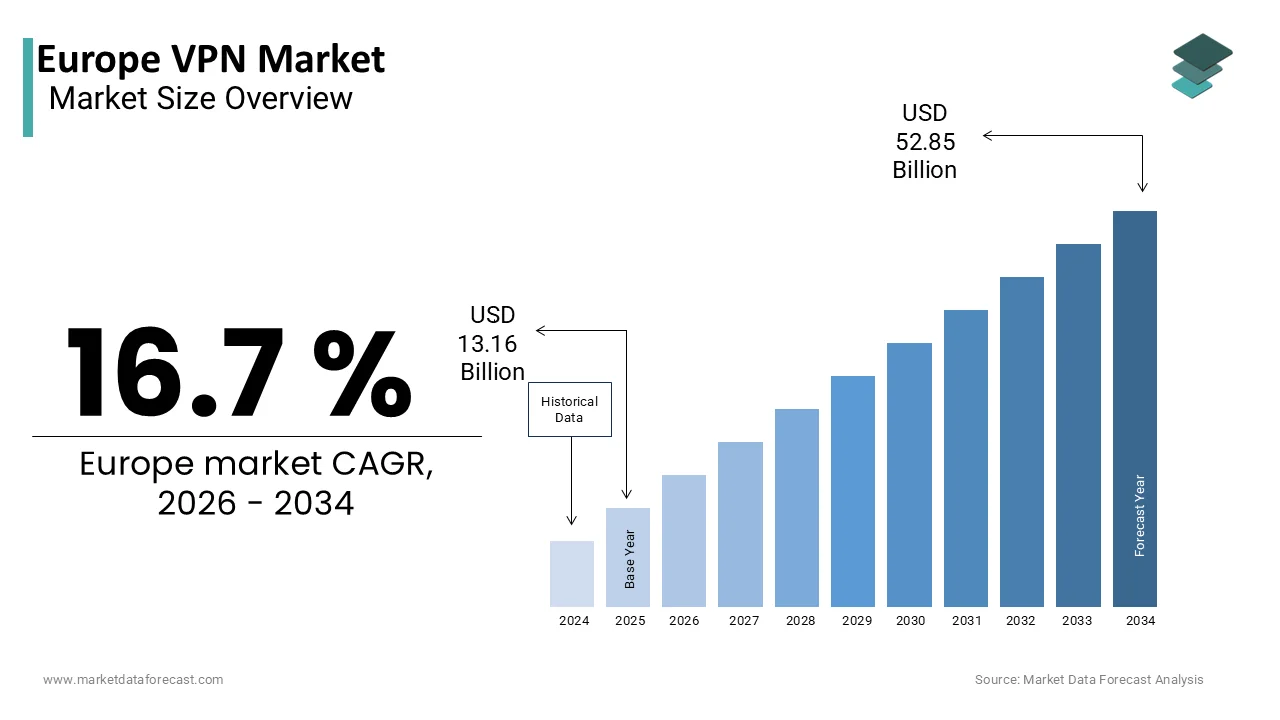
The Europe VPN market size was valued at USD 13.16 billion in 2025, is estimated to reach USD 15.36 billion in 2026, and is projected to reach USD 52.85 billion by 2034, registering a compound annual growth rate (CAGR) of 16.7% during the forecast period. Driven by strict data protection regulations (GDPR), rising cybersecurity incidents, and the mainstream adoption of remote/hybrid work models, the regional market continues to experience robust expansion.
Key Executive Metrics (At-a-Glance)
- 2025 Base Valuation: USD 13.16 Billion
- 2026 Current Valuation: USD 15.36 Billion
- 2034 Forecast Valuation: USD 52.85 Billion
- Compound Annual Growth Rate (CAGR): 16.7% (2026–2034)
- Leading Country Market: Germany (anchored by robust Industry 4.0 initiatives, early enterprise-grade adoption, and strong cybersecurity mandates)
- Fastest-Growing Country Market: France (propelled by state-backed digital sovereignty policies and ANSSI cybersecurity strategies)
Core Market Drivers
- Escalating Cybersecurity Threats: Rising frequency of ransomware attacks, data breaches, and phishing attempts prompting stronger organizational and consumer digital defense.
- Remote & Hybrid Work Models: Widespread telework infrastructure requirements ensuring secure, encrypted connections for corporate access across distributed workforces.
Primary Market Restraints & Challenges
- Regulatory & Surveillance Policies: Government proposals on metadata retention, decryption cooperation, and potential backdoors creating legal ambiguities for user anonymity.
- Performance Limitations & Free Alternatives: Reduced connection speeds, server latency issues, and market flooding by low-quality or insecure free VPN applications.
Market Segmentation: Largest and Fastest-Growing Segments
| Segment Category | Largest Segment | Fastest-Growing Segment |
|---|---|---|
| By Component | Software (58.3% share in 2025) | Services (CAGR of 16.4%) |
| By Type | Remote Access (47.5% share in 2025) | Site-to-Site (CAGR of 14.9%) |
| By Country | Germany (19.3% share in 2025) | France |
Major Industry Players Profiled
Key market participants shaping the European VPN landscape include Gen Digital Inc., BlackBerry Ltd., Cisco Systems Inc., Kape Technologies (ExpressVPN, CyberGhost), Nord Security (NordVPN), Surfshark, Alphabet Inc., IBM Corp., Crosspoint Capital Partners, and Opera Ltd.
Europe VPN Market Size
The europe VPN market size was valued at USD 13.16 billion in 2025, is expected to have 16.7 % CAGR from 2026 to 2034, and be worth USD 52.85 billion by 2034 from USD 15.36 billion in 2026.
A Virtual Private Network (VPN) enables users to securely access the internet by encrypting their data and masking their IP addresses, thereby safeguarding personal information from cyber threats and surveillance. According to Eurostat, internet penetration in the EU has reached nearly 92%, with a corresponding rise in remote work, e-commerce transactions, and digital content consumption. This heightened online activity has amplified the need for secure browsing solutions, especially among individuals and businesses seeking to protect sensitive data from unauthorized access.
Moreover, the General Data Protection Regulation (GDPR), enforced across the EU since 2018, has significantly raised awareness about digital privacy rights. As per the European Data Protection Board (EDPB), GDPR compliance has prompted both enterprises and individual users to adopt cybersecurity tools like VPNs to ensure data confidentiality and regulatory adherence. Additionally, geopolitical tensions and surveillance concerns have further propelled interest in anonymized internet usage. The University of Oxford’s Internet Institute reported that search interest for “best VPN services” in Europe increased by over 40% during periods of political unrest or restrictive policy announcements.
MARKET DRIVERS
Rising Cybersecurity Threats and Data Breaches
One of the primary drivers fueling the European VPN market is the escalating frequency and sophistication of cybersecurity threats, including ransomware attacks, phishing attempts, and large-scale data breaches. According to ENISA (European Union Agency for Cybersecurity), the number of reported cyber incidents across EU member states rose by 37% between 2021 and 2023, which is prompting both individuals and organizations to seek stronger online protection measures.
Businesses, particularly in finance, healthcare, and legal sectors, are increasingly adopting VPNs to secure remote access for employees working outside corporate networks. In the consumer space, growing awareness around identity theft and unsecured Wi-Fi usage has led to a surge in personal VPN subscriptions. Research from the European Consumer Organisation (BEUC) indicates that nearly half of surveyed Europeans expressed concern over data tracking by websites and advertisers, reinforcing the appeal of privacy-focused browsing tools.
Increasing Demand for Secure Remote Work Solutions
The second key driver behind the expansion of the European VPN market is the widespread adoption of remote and hybrid work models, which necessitate secure and encrypted internet connections for accessing corporate resources. As per Eurofound’s 2023 report on working conditions, approximately 41% of employed Europeans engaged in some form of telework, which is a significant increase from pre-pandemic levels.
To support this shift, companies across Germany, France, and the Netherlands have implemented mandatory use of corporate-grade VPNs to ensure data integrity and prevent unauthorized access to internal systems. The European Commission’s Digital Economy and Society Index (DESI) notes that business investment in secure networking infrastructure grew by 29% between 2021 and 2023, with SMEs also embracing cost-effective cloud-based VPN solutions. Furthermore, independent professionals and freelancers are opting for premium personal VPN services to maintain secure communications while using public or shared networks. A survey by the European Freelancers Union (EFU) found that 62% of self-employed workers considered a reliable VPN essential for client confidentiality and digital safety.
As remote collaboration becomes a permanent fixture in Europe's labor landscape, the reliance on secure connectivity tools like VPNs continues to grow, which is reinforcing their strategic importance in both professional and personal digital environments.
MARKET RESTRAINTS
Regulatory Restrictions and Government Surveillance Policies
A major restraint affecting the European VPN market is the implementation of stringent regulations and government surveillance policies that limit the use of anonymizing technologies. While the European Union upholds digital privacy as a fundamental right under the Charter of Fundamental Rights, certain national governments have introduced laws requiring telecom providers and internet service operators to retain user metadata, potentially undermining the anonymity offered by VPNs.
According to the European Digital Rights (EDRi) network, several countries, including France and Belgium,m have proposed legislation that would require internet intermediaries to cooperate with law enforcement agencies in decrypting communications when necessary. Such provisions create ambiguity around the legality and effectiveness of using third-party VPN services, discouraging potential users who prioritize complete digital anonymity.
Additionally, in response to counter-terrorism and crime prevention initiatives, the European Parliament has debated proposals that could mandate backdoor access to encrypted communications, raising concerns among privacy advocates. The Council of Europe’s Convention on Cybercrime, commonly known as the Budapest Convention, has also been cited as a mechanism that may compel service providers to disclose user data upon request.
Performance Issues and User Experience Limitations
Another critical constraint impacting thEuropeanpe VPN market is the performance-related limitations associated with using virtual private networks, including reduced internet speeds, latency issues, and inconsistent server availability. Users in Nordic and Eastern European countries often face connectivity challenges due to limited regional server coverage by international providers. A report by the Swedish Post and Telecom Authority (PTS) reported that users in rural areas experienced higher ping times and frequent disconnections when utilizing offshore servers, which is diminishing the practicality of continuous VPN usage.
Moreover, free-tier or low-cost VPN applications frequently suffer from overcrowded servers, leading to slower response times and compromised encryption protocols. The Norwegian Consumer Council (NCC) issued warnings in 2023 about certain free apps failing to provide promised security features and misleading users about their actual level of protection.
MARKET OPPORTUNITIES
Expansion of Streaming and Geo-Restricted Content Consumption
A significant opportunity emerging in the European VPN market is the increasing demand for bypassing geo-restrictions on digital entertainment platforms such as Netflix, Amazon Prime Video, and Disney+. According to Statista, over 65% of European households subscribed to at least one video-on-demand service in 2023, yet content availability varies widely across regions due to licensing agreements. Consumers are turning to VPNs to access exclusive content libraries from other countries, effectively circumventing regional restrictions. Research conducted by the European Audiovisual Observatory found that media enthusiasts in Poland, Spain, and Italy were particularly active in using location-spoofing tools to view US or UK-specific streaming content.
This trend has spurred innovation among VPN providers, who are optimizing servers specifically for high-speed streaming and developing proprietary protocols to evade platform detection mechanisms. In response to growing consumer demand, some European telecom firms have even begun offering bundled services that include integrated streaming-friendly VPN subscriptions.
Integration of VPN Services with IoT and Smart Home Devices
Another promising avenue for growth in the European VPN market is the integration of virtual private network services with Internet of Things (IoT) and smart home ecosystems. According to the European Telecommunications Standards Institute (ETSI), over 40% of European homes now contain at least five IoT-enabled devices, ranging from smart speakers to security cameras. These gadgets often lack built-in encryption or advanced security protocols, which makes them susceptible to hacking and unauthorized access. To address these concerns, leading VPN providers have introduced router-level encryption solutions and dedicated mobile apps designed to protect entire home networks. Some manufacturers of smart home appliances have begun partnering with cybersecurity firms to offer embedded or compatible VPN functionalities, ensuring end-to-end protection for consumers. Consumer Reports from the UK and Sweden indicate that awareness of IoT security risks has risen sharply, with over 50% of respondents expressing willingness to invest in additional protections. As digital homes evolve, the convergence of privacy tools and smart technology presents a substantial growth opportunity for the European VPN market.
MARKET CHALLENGES
Growing Competition from Free and Low-Cost Alternatives
One of the most pressing challenges facing the European VPN market is the proliferation of free and low-cost alternatives that undermine the value proposition of premium services. According to a 2023 report by AV-TEST Institute, over 300 distinct free VPN applications were available on app stores, many of which claimed to offer full encryption and unlimited bandwidth without subscription fees.
However, multiple studies, including those by the German Federal Office for Information Security (BSI), have exposed serious security flaws in many of these free offerings, including data logging, intrusive advertising, and even malicious behavior. Despite these risks, price sensitivity remains a dominant factor influencing consumer choices, particularly among younger demographics and budget-conscious users.
Premium providers struggle to differentiate themselves in a crowded marketplace where trust and transparency are not always clearly communicated. Marketing efforts must overcome skepticism and demonstrate tangible benefits such as no-log policies, multi-device support, and superior server infrastructure, an uphill battle in an ecosystem flooded with seemingly attractive but often insecure options.
Technological Countermeasures by Streaming Platforms and Authorities
Another significant challenge confronting thEuropeanpe VPN market is the development of advanced detection and blocking technologies by streaming platforms and regulatory authorities aimed at preventing unauthorized access via virtual private networks. Major content providers such as Netflix and BBC iPlayer have deployed sophisticated geolocation verification techniques that identify and restrict traffic originating from known VPN IP ranges. Simultaneously, law enforcement agencies across Europe have collaborated with internet service providers to track and block illegal activities linked to anonymized browsing. The European Public Prosecutor’s Office (EPPO) has intensified investigations into cybercriminals exploiting encrypted tunnels, indirectly affecting legitimate users' perception of VPN reliability and legitimacy.
REPORT COVERAGE
| REPORT METRIC | DETAILS |
| Market Size Available | 2025 to 2034 |
| Base Year | 2025 |
| Forecast Period | 2026 to 2034 |
| Segments Covered | By Component, Type, and Country. |
| Various Analyses Covered | Global, Regional, & Country Level Analysis; Segment-Level Analysis, DROC, PESTLE Analysis, Porter’s Five Forces Analysis, Competitive Landscape, Analyst Overview of Investment Opportunities |
| Country Covered | UK, Germany, Italy, France, Spain, Sweden, Denmark, Poland, Switzerland, the Netherlands, and the rest of Europe. |
| Market Leaders Profiled | Gen Digital Inc, BlackBerry Ltd, Cisco Systems Inc, Kape Technologies. |
SEGMENT ANALYSIS
By Component Insights
The software segment dominated the European VPN market by capturing 58.3% of the market share in 2025. One key factor behind this dominance is the widespread reliance on software-based security tools in remote work environments. According to Eurofound’s 2023 report on digital labor trends, over 40% of European employees engaged in hybrid or fully remote work, necessitating secure access to corporate networks through software-based VPN clients. This shift has led enterprises to prioritize scalable and easy-to-deploy software solutions that can be integrated seamlessly into existing IT infrastructures. Moreover, leading cybersecurity firms have expanded their offerings with multi-platform compatibility, including mobile apps and browser extensions, which further enhances the accessibility and appeal of software-based solutions.

The services segment is projected to grow with a CAGR of 16.4% during the forecast period. According to the European Telecommunications Network Operators’ Association (ETNO), more than 60% of large corporations in Germany and France have adopted managed security services, including outsourced VPN administration, to reduce operational burdens and enhance compliance with regulatory frameworks such as GDPR. Another driving force is the integration of advanced threat intelligence and endpoint management within service packages. As per a study by Gartner, enterprises investing in holistic cybersecurity ecosystems were more likely to procure bundled service offerings that include real-time monitoring, incident response, and policy enforcement capabilities.
By Type Insights
The remote access segment held 47.5% of the European VPN market share in 2025. Eurostat reported that as of 2023, over 40% of employed Europeans worked remotely at least once a week, with a structural shift in employment patterns that necessitates encrypted communication channels. Enterprises across Germany, the Netherlands, and Sweden have mandated the use of remote access VPNs to safeguard sensitive business data transmitted outside corporate firewalls. Additionally, independent professionals, freelancers, and consultants are increasingly using remote access solutions to maintain secure connections while working from public or shared networks.
The site-to-site segment is likely to witness a CAGR of 14.9% from 2025 to 2033. This acceleration is fueled by the increasing need for secure interconnectivity between geographically dispersed corporate offices among multinational enterprises operating across multiple EU jurisdictions. This trend is especially pronounced in industries such as banking, legal services, and logistics, where confidential document sharing and real-time database synchronization require stable and secure site-to-site tunnels. The European Banking Authority (EBA) emphasized the importance of encrypted intra-organizational communications in mitigating financial fraud risks, which reinforces the relevance of this deployment model.
COUNTRY LEVEL ANALYSIS
Germany was the largest contributor in the European VPN market with 19.3% of the share in 2025. German enterprises in automotive, manufacturing, and finance have been early adopters of advanced cybersecurity measures, including enterprise-grade virtual private networks. According to the Federal Office for Information Security (BSI), over 70% of German companies with more than 500 employees had implemented secure remote access protocols by mid-2023 by aligning with national guidelines on digital resilience.
In addition, the rise of Industry 4.0 and smart factory initiatives has amplified the need for secure machine-to-machine communication, often facilitated through encrypted tunneling mechanisms provided by site-to-site and managed service-based VPNs. The German government has also supported these efforts through funding programs aimed at strengthening national cyber defense capabilities.
The United Kingdom VPN market growth is likely to be driven by high digital literacy, strong consumer awareness regarding online privacy, and a well-developed cybersecurity ecosystem. Despite Brexit-related uncertainties, the UK remains a major hub for cybersecurity research, digital commerce, and remote work infrastructure.
A survey conducted by Ofcom revealed that over 50% of UK internet users were familiar with the concept of virtual private networks, with many citing concerns around online tracking and data breaches as primary motivators for adoption. Additionally, the Information Commissioner’s Office (ICO) has reinforced data protection expectations under the post-Brexit Data Protection and Digital Information Bill, encouraging both individuals and businesses to enhance their digital safeguards.
The French VPN market is gearing up to grow with the fastest CAGR in the coming years by a combination of state-backed cybersecurity policies, enterprise modernization efforts, and rising digital sovereignty concerns. The French government has taken a proactive stance in promoting secure digital transformation across both public institutions and private enterprises.
Under the National Cybersecurity Strategy launched by ANSSI (Agence Nationale de la Sécurité des Systèmes d'Information), significant investments have been made in securing critical infrastructure, including energy grids, transportation networks, and financial systems. This has resulted in heightened adoption of encrypted communication channels, including site-to-site and remote access VPNs. French enterprises in sectors such as aerospace, defense, and pharmaceuticals have also prioritized secure data transmission due to the sensitivity of intellectual property and regulatory requirements.
The Netherlands VPN market growth is bolstered by its reputation as a digital hub with strong internet freedoms, a privacy-conscious population, and a well-established telecom infrastructure. Amsterdam serves as one of Europe’s primary internet exchange points, which is making it a natural epicenter for cybersecurity service providers and international data centers. According to the Dutch Data Protection Authority (Autoriteit Persoonsgegevens), the Netherlands consistently ranks high in terms of GDPR compliance and digital rights awareness. This has fostered a culture where both individuals and businesses actively seek out privacy-enhancing tools by including virtual private networks.
Sweden VPN market is esteemed to have steady growth opportunities with the highly digitized society, a strong emphasis on digital rights, and proactive national cybersecurity strategies. Swedish citizens are among the most digitally connected in Europe, with a high level of trust in online transactions and digital services.
According to the Swedish Post and Telecom Authority (PTS), over 95% of households in Sweden had internet access in 2023, with a significant proportion utilizing secure browsing tools to protect personal data. The country’s population exhibits a strong preference for privacy-focused applications, which include encrypted email services and virtual private networks.
COMPETITIVE LANDSCAPE
- The competition in the European VPN market is intense and multifaceted, shaped by a diverse mix of global leaders, emerging challengers, and niche service providers. Established players dominate due to their extensive infrastructure, brand recognition, and feature-rich offerings, yet new entrants continue to disrupt the space by introducing specialized services tailored to specific use cases—ranging from ultra-fast streaming to decentralized networking models. Consumer demand remains highly fragmented, with varying priorities such as price sensitivity, privacy assurance, and ease of use influencing purchasing decisions.
- The regulatory environment in Europe further intensifies competition, as companies must navigate complex data protection laws like GDPR while maintaining user anonymity. This balancing act often leads to product differentiation based on legal compliance, transparency practices, and audit credibility. Additionally, the rise of bundled cybersecurity packages offered by telecom operators and internet service providers introduces a new layer of competition outside traditional standalone VPN vendors.
- As digital threats evolve and public awareness around online privacy grows, the battle for market share is increasingly centered on innovation, ethical business practices, and technological agility. While some companies focus on scaling infrastructure, others emphasize community-driven values or open-source development, creating a dynamic and ever-shifting competitive landscape.
KEY MARKET PLAYERS
Companies playing a prominent role in the European VPN Market are
- Gen Digital Inc,
- BlackBerry Ltd,
- Cisco Systems Inc.
- Kape Technologies,
- Alphabet Inc Class A,
- International Business Machines Corp,
- Crosspoint Capital Partners,
- Opera Ltd ADR.
Top Players in the Market
ExpressVPN
ExpressVPN is a leading global provider that has established a strong presence in the European VPN market through its emphasis on privacy, speed, and user-friendly applications. The company operates a vast network of servers across multiple European countries, ensuring low latency and high performance for both individual and business users. ExpressVPN’s commitment to a strict no-logs policy and advanced encryption standards has made it a preferred choice among privacy-conscious consumers and journalists. Its continuous investment in server infrastructure and digital rights advocacy reinforces its influence not only in Europe but also globally.
NordVPN
NordVPN, headquartered in Lithuania, is one of the most recognized names in the European virtual private network landscape. Known for pioneering features such as double encryption and dedicated IP options, NordVPN caters to both personal and enterprise users seeking enhanced online security. The company has actively expanded its footprint through strategic partnerships with cybersecurity firms and digital rights organizations across Europe. NordVPN’s transparency reports and support for digital freedom initiatives have bolstered consumer trust by making it a key player shaping the continent’s evolving cybersecurity culture.
Surfshark
Surfshark has rapidly gained traction in the European VPN market by offering unlimited simultaneous device connections, competitive pricing, and robust security protocols. Despite being a relatively new entrant, Surfshark has distinguished itself through innovative features like CleanWeb, which blocks ads and malware. The company's expansion into local language support and regional customer service has significantly boosted adoption across diverse European markets. By combining affordability with enterprise-grade security, Surfshark appeals to both budget-conscious individuals and small businesses, which is contributing to its growing international reputation and expanding user base beyond Europe.
Top Strategies Used by Key Market Participants
One of the primary strategies employed by leading players in the European VPN market is enhancing privacy features and transparency practices. Top providers are continuously refining their no-log policies, undergoing independent audits, and publishing transparency reports to build trust among privacy-conscious users who seek accountability and verifiable commitments from service providers.
Another crucial approach is the expansion of server networks and localization capabilities. Companies are investing heavily in establishing more regional data centers across Europe to reduce latency, improve streaming compatibility, and offer localized IP addresses. This strategy enhances user experience while also complying with regional data protection expectations, particularly under GDPR.
The major players are increasingly integrating advanced cybersecurity tools within their platforms, such as ad blockers, anti-malware protection, and secure DNS services. These bundled offerings provide added value to users, positioning premium VPNs as comprehensive digital privacy solutions rather than just tunneling services, thereby strengthening brand loyalty and competitive differentiation in an overcrowded market.
RECENT HAPPENINGS IN THE MARKET
- In February 2025, ExpressVPN launched a new server cluster in Warsaw, Poland, aimed at improving connection speeds and bypassing regional restrictions for Eastern European users, reinforcing its commitment to regional accessibility and performance optimization.
- In May 2025, NordVPN introduced a dedicated corporate cybersecurity suite tailored for SMEs in Germany and France, offering centralized management, multi-user control, and GDPR-compliant data routing, addressing the rising need for affordable enterprise-level security solutions.
- In July 2025, Surfshark partnered with a leading European ISP to integrate its privacy tools directly into home routers, enabling seamless network-wide encryption for residential customers across Sweden and Denmark.
- In September 2025, ProtonVPN announced the release of its open-source Linux client with native support for Debian-based distributions, targeting tech-savvy users in Finland and Austria who prioritize transparency and code verification in digital privacy tools.
- In November 2025, a coalition of European digital rights NGOs endorsed a joint initiative led by Mullvad and Brave to promote decentralized, privacy-first internet access models by signaling a shift toward community-backed alternatives to mainstream commercial VPN services.
MARKET SEGMENTATION
This research report on the europe vpn market has been segmented and sub-segmented into the following categories.
By Component
- software
- services
By Type
- remote access
- site-to-site
By Country
- UK
- France
- Spain
- Germany
- Italy
- Russia
- Sweden
- Denmark
- Switzerland
- Netherlands
- Turkey
- Czech Republic
- Rest of Europe.