Europe VR Game Market Size, Share, Trends, & Growth Forecast Report By Device (Head-Mounted Display (HMD), Gesture-Tracking Device (GTD), Projectors & Display Wall (PDW)), Technology, Application and Country (UK, France, Spain, Germany, Italy, Russia, Sweden, Denmark, Switzerland, Netherlands, Turkey, Czech Republic and Rest of Europe), Industry Analysis From 2026 to 2034
Market Size, 2025
$9.84 BnMarket Estimate, 2026
$11.35 BnMarket Forecast, 2034
$35.45 BnCAGR, 2026–2034
15.3%Europe VR Game Market Report Summary
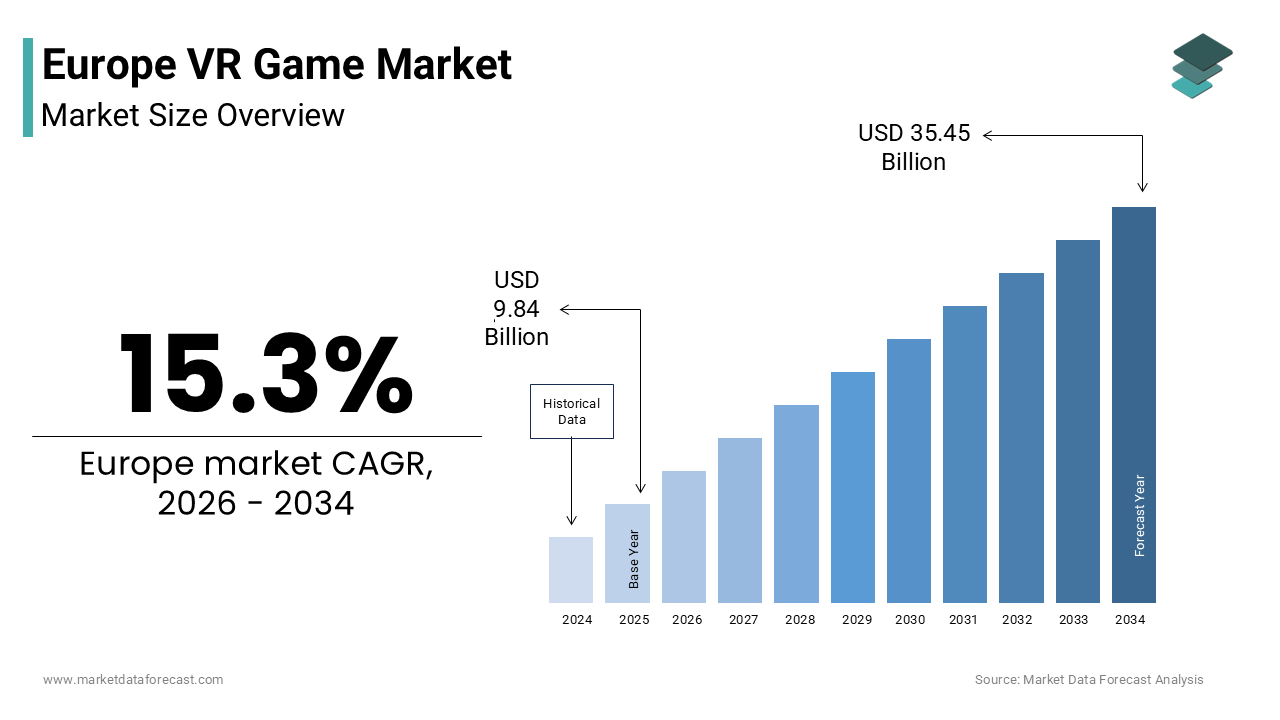
The Europe VR game market was valued at USD 9.84 billion in 2025, is estimated to reach USD 11.35 billion in 2026, and is projected to reach USD 35.45 billion by 2034, growing at a CAGR of 15.3% during the forecast period from 2026 to 2034. The growth of the Europe VR game market is driven by the increasing adoption of standalone virtual reality headsets, rising demand for immersive gaming experiences, and advancements in broadband and fiber connectivity across the region. The expansion of social VR platforms, fitness-oriented gaming, and location-based entertainment venues is further accelerating market growth. Moreover, the shift toward wireless and user-friendly devices is transforming VR gaming from a niche segment into a mainstream entertainment ecosystem across Europe.
Key Market Trends
-
Growing adoption of standalone VR headsets that eliminate the need for high-end PCs and simplify user experience.
-
The rising popularity of immersive social and multiplayer VR environments enables real-time interaction.
-
Increasing demand for VR fitness and gamified exercise experiences among health-conscious consumers.
-
Expansion of location-based VR entertainment centers and arcades offering premium experiences.
-
Advancements in hand-tracking, haptic feedback, and mixed reality technologies are enhancing gameplay realism.
Segmental Insights
Based on device, the head-mounted display (HMD) segment dominated the Europe VR game market in 2025. This dominance is attributed to the ability of HMDs to provide full immersion by isolating users from the physical environment and delivering a highly realistic gaming experience.
Based on technology, the semi & fully immersive segment held the largest share of the Europe VR game market in 2025. The segment’s leadership is driven by its capability to create strong user presence and emotional engagement, making it the preferred choice for advanced gaming experiences.
Based on application, the consumer segment accounted for the largest share of the Europe VR game market in 2025. The growth of this segment is supported by the strong gaming culture in Europe, increasing household adoption of VR devices, and rising demand for interactive home entertainment.
Regional Insights
The Europe VR game market is expanding across major countries due to strong developer ecosystems, advanced digital infrastructure, and growing consumer interest in immersive technologies.
-
The United Kingdom dominated the Europe VR game market in 2025, supported by a strong independent developer community, government support for creative industries, and high adoption of emerging gaming technologies.
-
Germany continues to grow steadily due to its large gaming population, strong technological infrastructure, and integration of VR technologies across both entertainment and industrial applications.
-
France remains a key contributor driven by government incentives for digital content creation, a strong artistic gaming culture, and increasing investment in immersive storytelling experiences.
-
Sweden is emerging as a high-growth market due to its globally recognized game development industry and strong export-oriented gaming ecosystem.
-
The Netherlands is witnessing rapid growth supported by advanced digital infrastructure, high consumer adoption of gaming technologies, and a growing startup ecosystem in immersive technologies.
Competitive Landscape
The Europe VR game market is highly competitive, with a mix of global technology companies and innovative gaming studios competing to deliver immersive experiences. Market players focus on hardware innovation, exclusive content development, and ecosystem expansion to strengthen their market position. Strategic partnerships, developer funding programs, and advancements in mixed reality technologies are further intensifying competition. Companies are also investing in social VR platforms and cross-platform compatibility to enhance user engagement and retention. Key players in the Europe VR game market include Sony Interactive Entertainment, Meta Platforms, Inc., Microsoft Corporation, Valve Corporation, Ubisoft Entertainment SA, Electronic Arts Inc., Crytek GmbH, nDreams Ltd., Vertigo Games, and Resolution Games.
Europe VR Game Market Size
The Europe VR Game Market was valued at USD 9.84 billion in 2025 and is estimated to reach USD 11.35 billion in 2026, further projected to reach USD 35.45 billion by 2034, growing at a CAGR of approximately 15.3% during the forecast period from 2026 to 2034.
VR game represents a specialized sector within the interactive entertainment industry where users engage with immersive digital environments through head mounted displays and motion tracking systems. This ecosystem transcends traditional gaming by offering six degrees of freedom that allow players to physically interact with virtual worlds, creating a sense of presence unattainable on flat screens. The region distinguishes itself through a robust developer community focused on narrative depth and artistic innovation rather than purely hardware specifications. According to Eurostat, households in the European Union widely have broadband internet access, which serves as the critical infrastructure for downloading large scale virtual reality titles and enabling cloud rendering. The European Games Developer Federation emphasizes that independent studios in countries like Sweden and France are pioneering new genres specifically designed for virtual reality mechanics. As per the International Telecommunication Union, fiber optic coverage in Western Europe has expanded significantly, which is facilitating the low latency required for seamless wireless VR experiences. The definition now includes location-based entertainment venues where consumers access high end hardware without personal ownership costs. This evolution transforms the market from a niche hardware enthusiast segment into a mainstream cultural phenomenon, where social interaction and physical activity merge within digital spaces. The landscape is characterized by a shift toward standalone devices that remove tethering constraints and lower entry barriers for mass adoption.
MARKET DRIVERS
Proliferation of Standalone Headsets and Lower Entry Barriers
The widespread availability of affordable standalone virtual reality headsets is one of the major factors driving the growth of the European VR game market. Historically, the requirement for powerful graphics cards and complex setup procedures limited the audience to a small fraction of tech enthusiasts, but modern all in one device have democratized access. According to the European Consumer Organisation, entry level standalone headsets have become more affordable in recent years, making them accessible to middle income households across the continent. These devices offer plug and play simplicity that appeals to casual gamers who lack technical expertise or space for dedicated gaming rigs. As per Statista, sales of standalone VR units in Europe have surpassed tethered models, reflecting a decisive shift in consumer preference toward convenience and portability. The removal of cables enhances safety and freedom of movement, which is crucial for active gaming experiences that simulate sports or dance. Manufacturers are increasingly bundling popular software titles with hardware purchases to provide immediate value and encourage daily usage. This hardware evolution removes the most significant friction points regarding cost and complexity, ensuring that virtual reality gaming transitions from a luxury novelty to a standard household entertainment option.
Rising Demand for Immersive Social and Fitness Experiences
A fundamental transformation in consumer expectations regarding interactivity and physical engagement drives the adoption of virtual reality games across diverse demographic groups in Europe, which is further boosting the European VR game market expansion. Modern users seek experiences that combine entertainment with social connection or physical well-being, something that traditional console gaming struggles to deliver effectively. According to the European Health and Fitness Association, participation in gamified fitness activities has increased significantly, with virtual reality boxing and rhythm games leading the surge among young adults. These applications transform sedentary screen time into active workouts, addressing growing public health concerns related to obesity and inactivity. Social platforms within virtual reality allow friends to meet in shared digital spaces regardless of physical distance, fostering a sense of community that resonated deeply during and after pandemic restrictions. As per Ofcom, many VR users in the United Kingdom cite social interaction as their primary motivation for using the technology regularly rather than solitary gameplay. The ability to attend virtual concerts, compete in esports tournaments, or collaborate on creative projects within immersive environments creates sticky ecosystems that retain users long term. This dual appeal of health benefits and social connectivity expands the addressable market beyond traditional gamers to include fitness enthusiasts and social seekers. The psychological reward of embodied presence ensures sustained engagement and drives recurring software purchases.
MARKET RESTRAINTS
Persistent Issues with Motion Sickness and Physical Discomfort
The physiological phenomenon of cybersickness remains a formidable barrier preventing widespread adoption of virtual reality gaming among a significant portion of the European population, which is primarily impeding the growth of the European VR game market. Many users experience nausea, dizziness, and eye strain when exposed to certain types of virtual movement, particularly in games that simulate locomotion without corresponding physical motion. According to the European Agency for Safety and Health at Work, a considerable share of first time VR users report some level of discomfort, which often leads to immediate discontinuation of use and negative word of mouth. Despite advancements in display refresh rates and latency reduction, the fundamental conflict between visual cues and vestibular signals continues to affect sensitive individuals. As per the University of Greenwich, research indicates that prolonged sessions significantly increase symptom severity, limiting the depth of gameplay experiences developers can offer. The physical weight of head mounted displays also causes neck fatigue during extended play sessions, discouraging older demographics or those with existing musculoskeletal issues. Developers must invest heavily in comfort modes such as teleportation mechanics and vignetting, which can compromise the intended immersive design and gameplay flow. This biological constraint restricts the potential audience size and forces the industry to prioritize comfort over innovation in movement mechanics. Until hardware becomes lighter and software algorithms better mitigate sensory conflict, motion sickness will remain a critical restraint on mass market penetration.
Scarcity of High-Quality Exclusive Content Libraries
The limited availability of AAA tier exclusive titles specifically designed to leverage the unique capabilities of virtual reality hinders the justification of hardware purchases for many potential consumers, which is further hampering the regional market expansion. While the library of VR games has grown substantially, it still lacks the depth and breadth of content available for traditional consoles and personal computers, leading to perceptions of limited value. According to the European Games Developer Federation, only a small portion of major European studios have dedicated resources to full scale virtual reality production due to high development costs and uncertain return on investment. Many existing titles are short experiences or technical demos rather than deep narrative driven adventures that justify hundreds of euros in hardware expenditure. As per Newzoo, average playtime per VR title in Europe is lower compared to flat screen games, indicating a lack of engaging long form content that retains user interest over months. Consumers often hesitate to invest in ecosystems where the pipeline of blockbuster releases appears sparse compared to established platforms. The fragmentation of hardware standards further complicates development, as studios must optimize for multiple devices with varying processing powers and control schemes. This content drought creates a chicken and egg scenario where low install bases discourage big budget investments, which in turn fails to attract new users. The absence of system selling franchises remains a structural weakness that slows market momentum.
MARKET OPPORTUNITIES
Integration of Location Based Entertainment Venues
The expansion of location-based entertainment centers is a promising opportunity in the European VR game market. These dedicated venues offer access to high end enterprise grade equipment and large-scale free roam experiences that are impossible to replicate in home environments due to space and cost constraints. According to the European Association of Amusement Parks and Attractions, the number of VR arcades and immersive experience centers in major European cities has increased significantly as operators seek to diversify their offerings beyond traditional attractions. These facilities allow users to try premium titles risk free, serving as effective trial grounds that can convert sceptics into future home owners. As per Deloitte, revenue from location-based VR experiences in Europe is expected to grow at a faster rate than the consumer hardware market over the next five years. Operators can charge premium prices for unique multiplayer scenarios involving physical props and haptic feedback suits that enhance immersion beyond what home users can achieve. The social nature of visiting these venues with friends or family aligns perfectly with European leisure culture centred around shared outings. Furthermore, these centers provide valuable data on user preferences and behavior that developers can use to refine future home releases. The synergy between commercial venues and home markets creates a complementary ecosystem that broadens the overall reach of virtual reality gaming.
Adoption of Enterprise Training and Educational Gamification
The increasing utilization of virtual reality technology for corporate training and educational purposes offers a lucrative opportunity in the European VR game market. Technologies developed for simulating complex industrial procedures or historical recreations often share underlying assets and mechanics with entertainment titles, creating opportunities for cross pollination. According to the European Centre for the Development of Vocational Training, a majority of large European corporations now use VR simulations for employee onboarding and safety training, driving demand for realistic physics engines and interactive environments. As per the European Commission, digital education action plans encourage schools to adopt immersive learning tools that make abstract concepts tangible through gamified experiences. This institutional adoption provides steady revenue streams for developers, allowing them to take creative risks on pure gaming projects that might otherwise be deemed too risky. The high-fidelity graphics required for professional training push hardware manufacturers to improve resolution and tracking accuracy, which directly benefits the gaming experience. Educational institutions are increasingly purchasing bundles of hardware and software that include both curriculum modules and recreational games, maximizing utility. The blurring lines between serious applications and entertainment create a larger total addressable market for VR content creators. This diversification reduces reliance on volatile consumer spending cycles and fosters a more stable growth trajectory for the entire ecosystem.
MARKET CHALLENGES
High Development Costs and Technical Complexity
The exorbitant cost and technical difficulty associated with creating high quality virtual reality games is a primary challenge to the growth of the European VR game market. Building immersive environments requires specialized skills in 3D modeling, spatial audio design, and optimization for multiple hardware configurations, which drives up production budgets significantly. According to the European Independent Game Developers Association, developing a full-length VR title can cost considerably more than a comparable flat screen game due to the need for higher frame rates and intricate interaction systems. Small and medium sized studios often struggle to secure funding for such ambitious projects as investors remain cautious about the relatively small installed base of VR headsets. As per Unity Technologies, the shortage of developers proficient in virtual reality specific engines creates a talent bottleneck that delays projects and inflates salary costs. The necessity to maintain high frame rates to prevent motion sickness imposes strict performance constraints that limit artistic scope and world complexity. Ports from traditional platforms often fail to meet these rigorous standards, requiring ground up rewrites that further escalate expenses. The financial risk of launching a VR exclusive title in a fragmented market discourages innovation and leads to a prevalence of safe, repetitive concepts. Balancing artistic vision with technical feasibility and budget realities remains the most significant hurdle for creators aiming to push the boundaries of the medium.
Fragmentation of Hardware Standards and Ecosystems
The lack of unified hardware standards and the proliferation of competing proprietary ecosystems is further challenging the expansion of the European VR game market. Users face a wide array of headsets with different controllers, tracking methods, and store fronts, which complicates the decision-making process and fragments the player base. According to the European Consumer Organisation, this incompatibility prevents multiplayer cross play between users of different devices, severely limiting the social potential of virtual reality gaming. As per the International Organization for Standardization, efforts to create universal protocols for VR input and output have stalled due to competitive interests among major technology manufacturers. Developers must dedicate substantial resources to optimizing their games for each specific platform, which dilutes the quality of the final product and increases time to market. The existence of walled gardens where content purchased on one device cannot be used on another lock’s consumers into single vendor ecosystems and reduces overall software sales volume. This fragmentation hampers the formation of a cohesive community and slows the network effects that drive mainstream adoption. The inability to guarantee a consistent experience across devices undermines consumer confidence and trust in the technology. Until greater interoperability is achieved, the market will struggle to realize its full potential for unified growth and shared experiences.
REPORT COVERAGE
| REPORT METRIC | DETAILS |
| Market Size Available | 2025 to 2034 |
| Base Year | 2025 |
| Forecast Period | 2026 to 2034 |
| CAGR | 15.3% |
| Segments Covered | By Device, Technology, Application and Region. |
| Various Analyses Covered | Global, Regional & Country Level Analysis, Segment-Level Analysis, DROC, PESTLE Analysis, Porter’s Five Forces Analysis, Competitive Landscape, Analyst Overview of Investment Opportunities |
| Country Covered | UK, France, Spain, Germany, Italy, Russia, Sweden, Denmark, Switzerland, the Netherlands, Turkey, the Czech Republic, and the Rest of Europe. |
| Market Leaders Profiled | Sony Interactive Entertainment, Meta Platforms, Inc., Microsoft Corporation, Valve Corporation, Ubisoft Entertainment SA, Electronic Arts Inc., Crytek GmbH, nDreams Ltd., Vertigo Games, and Resolution Games. |
SEGMENTAL ANALYSIS
By Device Insights
The head-mounted display segment dominated the European VR game market in 2025 by holding 70.4% of the regional market share. The dominance of head-mounted display segment in the European market is attributed to the device's ability to provide a fully enclosed visual field that isolates the user from the physical world, which is creating an unparalleled sense of presence essential for immersive gaming. The unique capability of HMDs to block out external visual distractions and fill the entire field of view with stereoscopic 3D imagery, which is critical for achieving psychological presence is also contributing to the dominance of the segment in the European market. Unlike other devices that allow users to see their real surroundings, HMDs trick the brain into believing it is physically located within the virtual environment, a phenomenon known as proprioceptive drift. According to the European Games Developer Federation, most critically acclaimed VR titles in recent years were designed specifically for head-mounted displays to leverage this total immersion. As per the University of Manchester, studies on user engagement show that players using HMDs report stronger emotional responses and memory retention compared to those using projection-based systems. The integration of high-resolution OLED panels and wide field-of-view optics in modern European-manufactured headsets further enhances this effect. The inability of gesture trackers or projectors to offer this complete sensory replacement ensures that HMDs remain the preferred choice for core gamers seeking deep immersion. This fundamental advantage in delivering a convincing alternate reality secures the dominant market position of head-mounted displays.
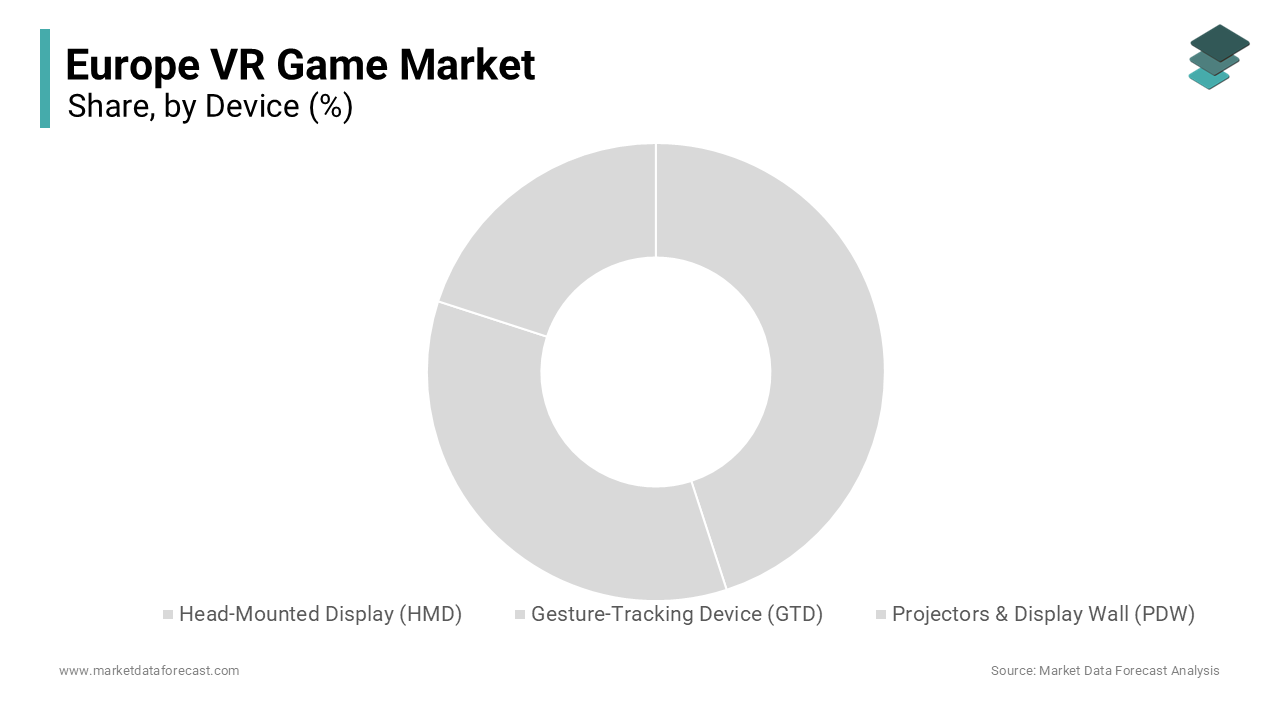
The gesture-tracking device segment is projected to register the highest CAGR of 25.2% over the forecast period owing to the growing demand for natural human-computer interaction and the rise of social VR platforms that rely on non-verbal communication. The increasing consumer expectation for intuitive control schemes that mimic real-world hand movements rather than relying on abstract button presses is further boosting the expansion of gesture-tracking device segment in the regional market. Modern VR games are shifting towards physics-based interactions where players grab, throw, and manipulate objects using their bare hands, requiring precise finger tracking capabilities. According to the European Institute for Human Machine Interaction, games utilizing full hand tracking have seen notable increases in user session duration compared to controller-based titles. As per Sony Interactive Entertainment, the integration of haptic feedback gloves and wristbands that simulate texture and resistance is becoming a standard feature in high-end European arcades, driving hardware upgrades. The ability to express complex emotions through hand gestures in social VR spaces adds a layer of depth to multiplayer experiences that buttons cannot replicate. Developers are prioritizing hand-tracking APIs to create more immersive puzzles and crafting systems. This shift towards embodied interaction ensures that gesture-tracking technology will grow faster than any other device category as it becomes essential for next-generation gameplay mechanics.
By Technology Insights
The semi & fully immersive technology segment dominated the market by holding the highest share of the European VR game market in 2025 due to the core value proposition of virtual reality, which is to transport users into entirely digital worlds that feel authentic and engaging. The ability of semi and fully immersive technology to induce a strong psychological state of presence where the user's brain accepts the virtual environment as reality is further contributing to the leading position of the semi and fully immersive technology segment in the European market. Semi-immersive systems using large curved screens and fully immersive setups with head-mounted displays both work to suppress awareness of the physical world, allowing for intense narrative experiences. According to the European Psychology of Media Association, immersive VR triggers stronger empathetic responses and fear reactions than non-immersive media, making it the preferred choice for storytelling and horror genres. As per the University of Oxford, research demonstrates that users in fully immersive environments exhibit physiological stress responses such as elevated heart rates during dangerous game scenarios, proving the effectiveness of the technology. This deep connection keeps players engaged for longer periods and fosters brand loyalty to specific franchises. Game developers prioritize immersive tech because it allows for unique mechanics like looking around corners or crouching behind cover that are impossible on flat screens. The inability of non-immersive technologies to replicate this level of sensory envelopment ensures that the vast majority of VR gaming revenue comes from immersive setups. The pursuit of true presence remains the holy grail of the industry, securing the dominant position of this segment.
On the other side, the non-immersive segment is anticipated to showcase a promising CAGR of 19.1% over the forecast period in the European market owing to the accessibility of augmented reality overlays and the integration of VR elements into existing mobile gaming ecosystems. The ubiquity of smartphones and tablets that can run augmented reality and basic VR applications without requiring dedicated expensive hardware is also aiding the expansion of the non-immersive segment in the European market. Millions of Europeans already own compatible devices, which is removing the financial barrier to entry that hinders immersive VR adoption. According to the European Mobile Market Observatory, downloads of AR-enabled games on mobile devices have surged significantly, driven by titles that blend virtual objects with the real world through camera feeds. As per Niantic Labs, location-based games that use non-immersive technology have achieved mainstream success by encouraging outdoor activity and social gathering. The lower development costs for non-immersive apps attract a wider range of indie developers who can experiment with new ideas quickly. The ability to pivot between real and virtual elements appeals to casual gamers who may feel overwhelmed by fully enclosed headsets. This massive installed base of mobile devices ensures that the non-immersive segment will expand at the fastest rate as it leverages existing consumer electronics.
By Application Insights
The consumer segment led the market by capturing 63.6% of the regional market share in 2025 due to the direct-to-consumer sales of hardware and software driven by the thriving home entertainment culture. The deeply entrenched gaming culture across Europe, where households view interactive entertainment as a primary leisure activity is further boosting the dominance of consumer segment in the European market. Countries like Germany, the UK, and France have millions of dedicated gamers who regularly upgrade their equipment to access the latest experiences. According to the Interactive Software Federation of Europe, tens of millions of people in Europe played video games regularly in 2024, with a growing subset adopting VR as their preferred medium. The availability of diverse content ranging from action shooters to relaxing puzzle games caters to a wide demographic spectrum, ensuring broad market appeal. As per GfK, consumer spending on gaming hardware in Western Europe reached record levels in 2024, with VR headsets being a significant contributor to this growth. The social aspect of gaming, including online multiplayer and streaming, further fuels demand as users want to participate in trending virtual experiences. The shift towards standalone devices has made VR accessible to families, expanding the user base beyond hardcore enthusiasts. The continuous release of blockbuster titles drives hardware cycles and software purchases. This robust domestic demand ensures that the consumer segment remains the financial backbone of the European VR market.
On the other hand, the healthcare segment is anticipated to record a CAGR of 30.3% over the forecast period in the European market due to the proven efficacy of VR in pain management, surgical training, and mental health therapy and the growing body of clinical evidence supporting the use of VR for distraction therapy, pain reduction, and treating psychological conditions like PTSD and anxiety. Hospitals and clinics across Europe are increasingly integrating VR headsets into treatment protocols to reduce reliance on opioids and improve patient outcomes. According to the European Pain Federation, VR distraction techniques have shown significant reductions in perceived pain levels among patients undergoing painful procedures. Mental health professionals are utilizing immersive exposure therapy to help patients confront fears in controlled, safe environments, a method shown to be highly effective. As per the National Health Service in the UK, pilot programs deploying VR for anxiety disorders have reported notable improvements in patient recovery times. The ability to customize therapeutic environments to individual needs makes VR a versatile tool for clinicians. Reimbursement policies in several European countries are beginning to cover VR-based therapies, incentivizing adoption. The convergence of medical validation and technological accessibility ensures that the healthcare application of VR games and simulations will grow at an unprecedented rate.
REGIONAL ANALYSIS
United Kingdom VR Game Market Analysis
The United Kingdom dominated the VR game market in Europe in 2025 with 23.5% of the regional market share. The dominance of the UK in the European market is attributed to its vibrant independent development scene and early adoption of new technologies. The nation serves as a global hub for creative innovation, with studios in London and Brighton pioneering narrative-driven VR experiences that set international standards. The UK government's Creative Sector Vision provides tax reliefs and grants specifically for immersive technology projects, fostering a supportive environment for startups. As per UKIE, the British games industry contributed billions of pounds to the economy in 2024, with VR titles accounting for a rapidly growing portion of exports. The presence of major hardware distributors and a tech-savvy consumer base ensures rapid uptake of new headsets. The strong academic sector collaborates closely with industry to research human-computer interaction, driving technical advancements. The cultural acceptance of gaming as a mainstream hobby fuels consistent domestic demand. The combination of policy support, creative talent, and robust infrastructure solidifies the UK’s position as the dominant market force in Europe.
Germany VR Game Market Analysis
Germany was another promising regional segment in the European VR game market in 2025. The growth of Germany in the European market can be credited to its powerful industrial base and the integration of VR gaming technologies into serious applications and entertainment. The German market is characterized by a high demand for high-quality engineering and realistic simulations, which influences the types of games that succeed locally. The Federal Ministry for Economic Affairs and Climate Action funds initiatives that bridge the gap between gaming and industrial training, creating a unique hybrid market. As per Game – the German Games Industry Association, domestic revenue from VR content has grown significantly, supported by a large installed base of PC gamers. The country’s strong manufacturing sector drives demand for haptic devices and precision tracking systems that benefit the gaming ecosystem. German consumers prioritize data privacy and quality, pushing developers to adhere to high standards. The extensive network of LAN parties and gaming conventions promotes community engagement and hardware trials. The synergy between industrial prowess and gaming enthusiasm ensures Germany maintains a critical and influential position in the regional landscape.
France VR Game Market Analysis
France is estimated to account for a prominent share of the European VR game market during the forecast period owing to its rich cultural heritage and strong state support for the arts to produce visually stunning and artistically ambitious VR games. The French government views video games as a cultural exception and offers substantial tax credits through the CNC to encourage local production of immersive content. According to the Centre National du Cinéma et de l'Image Animée, funding for VR projects has increased significantly, enabling studios to take creative risks. As per Sellaf, the French gaming market is one of the largest in Europe, with a particular affinity for narrative and artistic experiences. The presence of major animation schools provides a steady stream of talented 3D artists who excel in creating immersive worlds. Paris hosts key industry events that attract global investors and publishers. The strong tradition of bande dessinée and storytelling translates well into the narrative potential of VR. The combination of financial incentives, artistic talent, and cultural appreciation ensures France maintains a strong and distinctive position in the European market.
Sweden VR Game Market Analysis
Sweden is expected to register a healthy CAGR in the European VR game market over the forecast period owing to its disproportionately large number of successful game development studios relative to its population and its early embrace of digital distribution. The Swedish ecosystem is renowned for producing hit franchises that successfully transition into virtual reality, leveraging existing fan bases. According to the Swedish Games Industry organization, export revenues from Swedish games reached record highs in 2024, with VR adaptations contributing significantly. As per Statistics Sweden, high broadband penetration and a tech-literate population facilitate the download and play of large-scale VR titles. The collaborative culture among developers fosters knowledge sharing and rapid iteration of new ideas. Government agencies provide innovation grants that support experimental VR projects. The success of companies like Rovio and King has created a virtuous cycle of investment and talent attraction. The focus on quality and global appeal ensures that Swedish VR games perform well internationally. This dynamic environment of innovation and export orientation positions Sweden as a key growth market in Northern Europe.
Netherlands VR Game Market Analysis
The Netherlands emerges as a rapidly growing segment in the European VR game market due to its strategic location as a logistics hub for hardware distribution and a thriving startup ecosystem. The Dutch market benefits from excellent digital infrastructure and high English proficiency, which facilitates the rapid adoption of global VR titles. The Netherlands Enterprise Agency supports tech startups through incubators and funding programs focused on extended reality applications. As per CBS, the percentage of Dutch households owning gaming consoles and VR headsets is among the highest in Europe, driving strong domestic sales. The proximity to major manufacturing centers in Germany and Belgium ensures quick availability of new hardware releases. The country’s progressive approach to digital health and education creates opportunities for applied gaming solutions. The dense urban population supports location-based VR venues and arcades in city centers. The combination of logistical advantages, digital readiness, and supportive policies ensures the Netherlands remains a vital and expanding market in the region.
COMPETITIVE LANDSCAPE
The competition in the Europe VR game market is intense and characterized by a strategic battle between global technology giants and innovative independent studios vying for dominance in a rapidly evolving landscape. Incumbent players leverage their extensive hardware ecosystems and vast content libraries to secure market share while new entrants disrupt the status quo with niche genres and novel interaction mechanics. The rivalry intensifies as firms compete to attract top tier developers through lucrative funding deals and revenue sharing models that ensure a steady stream of high quality exclusives. Differentiation is achieved through superior hardware specifications such as field of view and refresh rates or through unique software features like eye tracking and passthrough capabilities. Strategic alliances with content creators and location based entertainment venues have become essential for expanding reach beyond individual consumers. Competitors constantly monitor each other moves to quickly replicate successful innovations or counter price reductions with value added bundles. The pressure to comply with varying data privacy regulations across European nations further shapes competitive strategies significantly. Companies that can demonstrate superior user experience robust content pipelines and strong community engagement gain a distinct advantage. This dynamic landscape drives continuous technological advancement and ensures that European consumers benefit from increasingly sophisticated immersive entertainment options.
KEY MARKET PLAYERS
Some of the companies that are playing a dominating role in the Europe VR Game Market include
- Sony Interactive Entertainment
- Meta Platforms, Inc.
- Microsoft Corporation
- Valve Corporation
- Ubisoft Entertainment SA
- Electronic Arts Inc.
- Crytek GmbH
- nDreams Ltd.
- Vertigo Games
- Resolution Games
Top Players in the Europe VR Game Market
Meta Platforms Inc
Meta Platforms Inc stands as a pivotal force in the Europe VR game market by driving the adoption of standalone headsets through its Quest series which removes the need for expensive gaming PCs. The company contributes globally by establishing the largest ecosystem of virtual reality content and fostering social interaction within metaverse environments. Recently Meta launched advanced mixed reality features in European markets allowing users to blend physical spaces with digital game elements seamlessly. This strategic move strengthens its position by appealing to consumers seeking versatile entertainment experiences beyond pure gaming. The firm also invests heavily in developer grants for European studios to create exclusive titles that showcase the hardware capabilities. By focusing on wireless freedom and intuitive hand tracking Meta ensures its devices remain the preferred choice for both casual and hardcore gamers. Their commitment to lowering entry barriers through competitive pricing and bundled software drives widespread market penetration across the continent.
Sony Interactive Entertainment
Sony Interactive Entertainment plays a critical role in the Europe VR game market by leveraging its PlayStation brand to deliver high fidelity immersive experiences to millions of console owners. The company differentiates itself by offering premium first party titles that set industry standards for narrative depth and graphical quality in virtual reality. Globally Sony drives innovation in haptic feedback and adaptive trigger technology which enhances the tactile sensation of gaming interactions. Recent actions include the full scale rollout of PlayStation VR2 across European territories featuring eye tracking and foveated rendering for optimized performance. This expansion addresses consumer demand for cutting edge visuals and deeper immersion in blockbuster franchises. Sony also partners with local European developers to produce region specific content that resonates with diverse cultural audiences. Their focus on seamless integration with existing gaming consoles creates a sticky ecosystem that encourages long term engagement. By prioritizing quality and technological advancement Sony solidifies its status as a leader in the premium VR segment.
Valve Corporation
Valve Corporation exerts significant influence in the Europe VR game market through its Steam platform which serves as the primary distribution channel for PC based virtual reality games. The company empowers developers by providing robust software development kits and maintaining an open ecosystem that encourages innovation and experimentation. Globally Valve sets benchmarks for hardware precision with its Index headset and tracking base stations favored by enthusiasts for their accuracy. Recent strategies involve enhancing SteamVR software with improved compatibility layers and performance tools to support a wider range of hardware configurations. This initiative strengthens its position by ensuring smooth experiences for users regardless of their specific equipment setup. Valve also collaborates with European hardware manufacturers to promote open standards and interoperability within the industry. Their dedication to community driven content and modding support fosters a vibrant ecosystem where user generated extensions extend the lifespan of popular games. By championing openness and technical excellence Valve remains a cornerstone of the PC VR landscape.
Top Strategies Used by Key Market Participants
Key players in the Europe VR game market primarily employ aggressive content exclusivity strategies to secure flagship titles that drive hardware sales and create loyal user bases. Companies frequently invest substantial capital in acquiring or funding European development studios to produce unique experiences unavailable on competing platforms. Another prevalent strategy involves the continuous enhancement of hardware capabilities through iterative releases that offer higher resolution displays and improved tracking accuracy. Market participants also focus on building comprehensive social ecosystems that allow users to interact share content and play together thereby increasing retention rates. Expanding into mixed reality applications allows firms to blur the lines between physical and digital worlds offering versatile use cases beyond gaming. Furthermore companies are actively pursuing partnerships with telecommunications providers to bundle VR headsets with high speed internet packages. These diversified approaches enable stakeholders to overcome adoption barriers and stimulate sustained growth in a competitive environment.
MARKET SEGMENTATION
This research report on the Europe VR Game Market has been segmented and sub-segmented based on the following categories.
By Device
- Head-Mounted Display (HMD)
- Gesture-Tracking Device (GTD)
- Projectors & Display Wall (PDW)
By Technology
- Semi & Fully Immersive
- Non-immersive
By Application
- Consumer
- Healthcare
By Country
- UK
- France
- Spain
- Germany
- Italy
- Russia
- Sweden
- Denmark
- Switzerland
- Netherlands
- Turkey
- Czech Republic
- Rest of Europe
Access the study in MULTIPLE FORMATS
Purchase options starting from
$ 2000
Didn’t find what you’re looking for?
TALK TO OUR ANALYST TEAM
Need something within your budget?
NO WORRIES! WE GOT YOU COVERED!
Call us on: +1 888 702 9696 (U.S Toll Free)
Write to us: sales@marketdataforecast.com