- Product Description Description
- Table of Contents TOC
- List of Table & Figure LOT
- Get Free Sample PDF Sample PDF
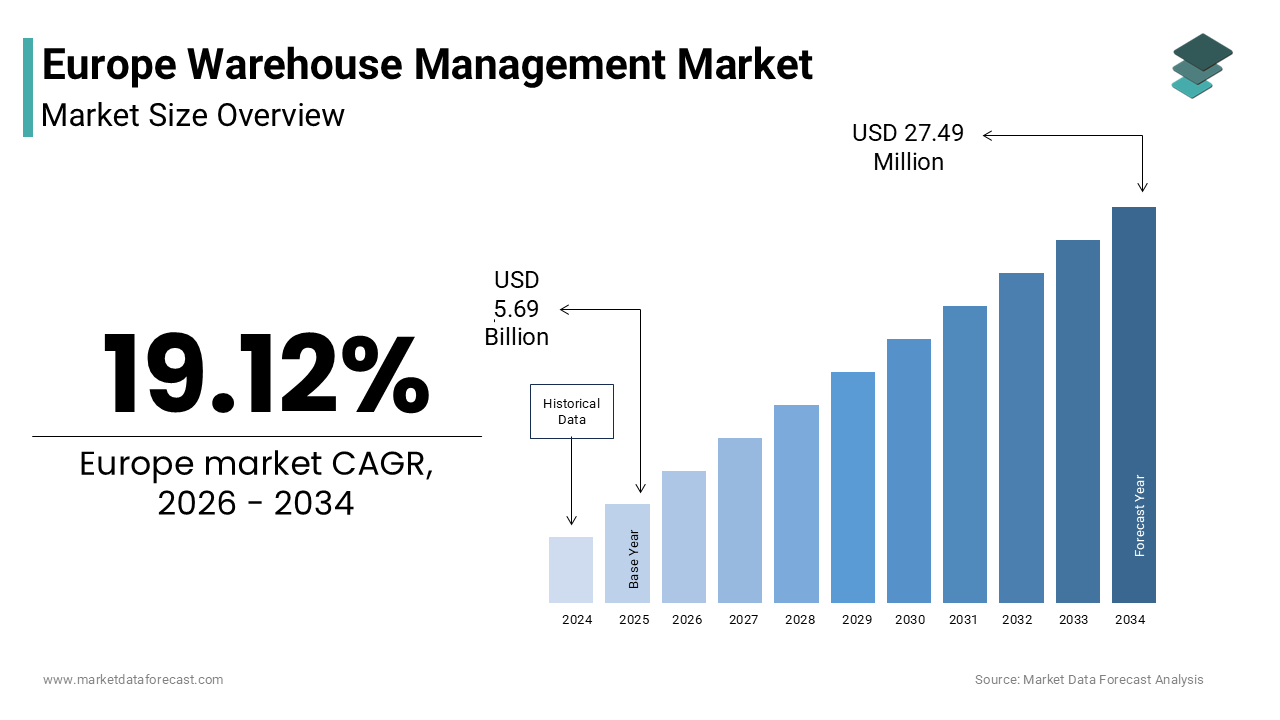
Market Size, 2025
$5.69 BnMarket Estimate, 2026
$6.78 BnMarket Forecast, 2034
$27.49 BnCAGR, 2026–2034
19.12%Europe Warehouse Management Market Report Summary
The Europe warehouse management market was valued at USD 5.69 billion in 2025, is estimated to reach USD 6.78 billion in 2026, and is projected to reach USD 27.49 billion by 2034, growing at a CAGR of 19.12% during the forecast period from 2026 to 2034. The growth of the Europe warehouse management market is driven by the rapid expansion of e-commerce, increasing supply chain complexity, and the growing need for automation and real-time inventory management in logistics facilities. Businesses across Europe are adopting advanced warehouse management systems to improve operational efficiency, optimize storage capacity, and enhance order fulfillment speed. Furthermore, regulatory requirements related to supply chain transparency, sustainability reporting, and product traceability are encouraging companies to replace legacy systems with advanced digital warehouse management solutions.
Key Market Trends
-
Increasing adoption of automation and robotics in warehouse operations to improve productivity and reduce labor dependency.
-
Growing demand for real-time inventory tracking and predictive analytics using artificial intelligence technologies.
-
Expansion of micro-fulfillment centers in urban areas to support same-day and instant delivery models.
-
Rising integration of Internet of Things (IoT) devices and sensors for real-time monitoring of warehouse operations.
-
Strong focus on sustainability and carbon footprint tracking in logistics operations.
Segmental Insights
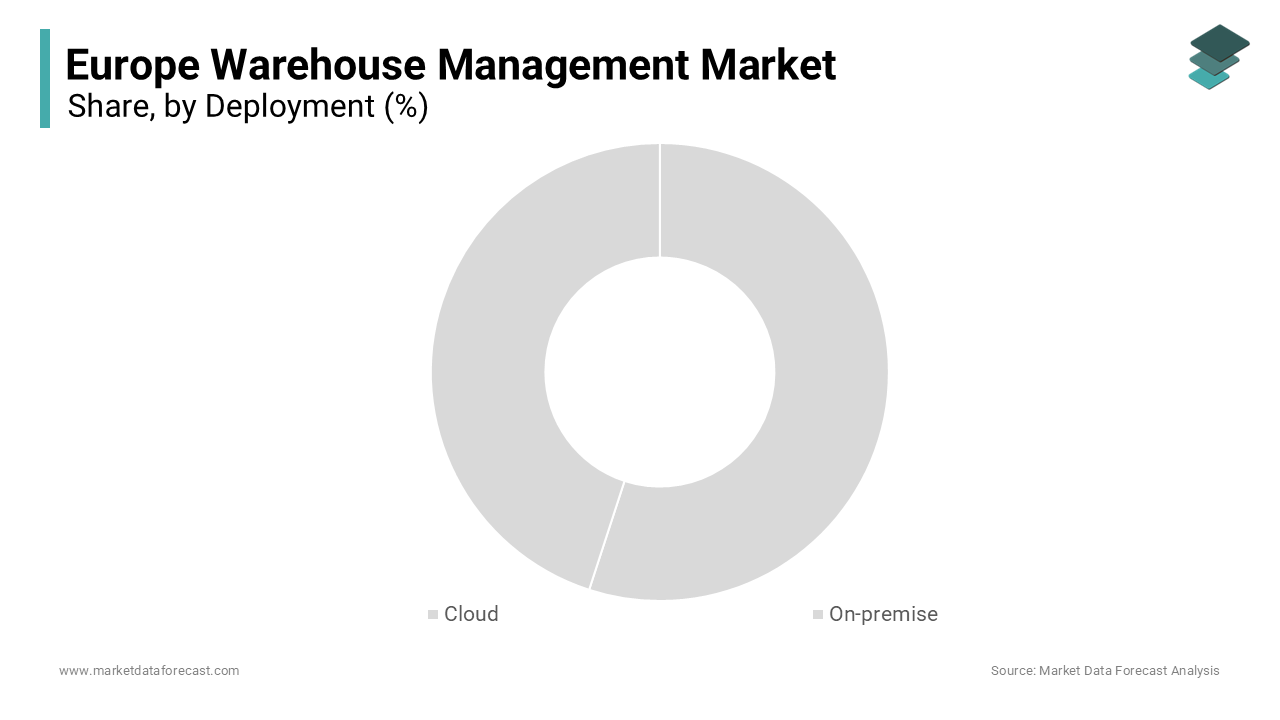
- Based on deployment, the on-premise segment held the largest share of the Europe warehouse management market in 2025. The dominance of this segment is attributed to strict data sovereignty regulations and the need for ultra-low latency communication in highly automated warehouse facilities.
- Based on component, the software segment accounted for a significant share of the Europe warehouse management market in 2025. The growth of this segment is driven by the increasing need for advanced digital tools to optimize inventory management, automate order fulfillment processes, and improve operational visibility across supply chains.
- Based on application, the retail segment occupied the largest share of the Europe warehouse management market in 2025. The dominance of this segment stems from the rapid growth of e-commerce, which requires efficient warehouse operations capable of handling high volumes of small orders and complex return management processes.
Regional Insights
The Europe warehouse management market is witnessing strong growth across major countries due to expanding logistics infrastructure, increasing automation in supply chain operations, and the rapid rise of online retail.
-
Germany held the largest share of the Europe warehouse management market in 2025, supported by its strong manufacturing base, extensive logistics network, and widespread adoption of Industry 4.0 technologies in warehouse automation.
-
The United Kingdom ranked second in the market, driven by its rapidly growing e-commerce sector and increasing investment in robotics and AI-driven warehouse systems to address labor shortages.
-
France continues to witness steady growth due to government initiatives aimed at modernizing logistics infrastructure and increasing demand from sectors such as aerospace, cosmetics, and agriculture.
-
The Netherlands plays a critical role as a major European logistics hub due to the presence of the Port of Rotterdam and Schiphol Airport, which drive demand for advanced warehouse management platforms to manage high cargo volumes.
-
Italy is experiencing increasing adoption of warehouse management solutions as manufacturers and logistics providers modernize operations to support exports and improve supply chain efficiency.
Competitive Landscape
The Europe warehouse management market is highly competitive and includes global enterprise software providers, automation solution companies, and specialized logistics technology firms. Major companies compete by offering advanced solutions integrating artificial intelligence, robotics, and real-time analytics to optimize warehouse operations. Prominent players in the Europe warehouse management market include SSI Schaefer Group, Dematic (KION Group), Swisslog Holding AG, KNAPP AG, Vanderlande Industries B.V., Mecalux S.A., WITRON Logistik + Informatik GmbH, Körber Supply Chain GmbH, Honeywell International Inc., and Siemens AG.
 Download Free Sample Report
Europe Warehouse Management Market Size
The Europe warehouse management market size was valued at USD 5.69 billion in 2025 and is anticipated to reach USD 6.78 billion in 2026 from USD 27.49 billion by 2034, growing at a CAGR of 19.12% during the forecast period from 2026 to 2034.
The warehouse management is the sophisticated software and hardware ecosystems designed to optimize the storage, movement, and tracking of goods within logistics facilities. The urgency for such advanced systems has intensified as the European Union pushes for greater supply chain resilience and digital sovereignty. According to Eurostat, the logistics sector employs over 10 million people in the European Union, representing a significant portion of the workforce that increasingly relies on automated guidance to maintain productivity. Data from the European Commission indicates that e-commerce sales accounted for 26% of total retail turnover in 2023, creating unprecedented pressure on warehousing operations to handle higher order volumes with faster turnaround times. As per the European Logistics Association, the average cost of logistics in Europe represents approximately 9% of the gross domestic product, highlighting the economic imperative to reduce inefficiencies through better management tools. The shift towards nearshoring production facilities closer to consumer markets further complicates operations by demanding flexible warehouse solutions that can adapt to fluctuating inventory profiles.
MARKET DRIVERS
Surge in E-Commerce Volume Driving Operational Complexity
The relentless expansion of online retail, which has fundamentally altered the volume and complexity of order fulfilment requirements is fuelling the growth of Europe warehouse management market. Traditional bulk handling methods are no longer sufficient to manage the millions of individual parcel shipments generated daily by digital commerce platforms. According to the European E-commerce Report, the number of online shoppers in Europe reached 457 million in 2023, with each consumer placing an average of 28 orders per year. This fragmentation of demand forces warehouses to process significantly more stock keeping units with tighter delivery windows, making manual tracking prone to errors and delays. Data from the International Post Corporation reveals that cross-border e-commerce parcels in Europe grew by 15% in the last year alone, requiring sophisticated systems to manage diverse customs documentation and carrier integrations. As per industry analysis by major logistics consultancies, the cost of picking and packing individual items can account for up to 55% of total warehouse operating expenses, driving the urgent adoption of warehouse management systems that optimize pick paths and automate sorting. Consequently, operators are investing heavily in software capable of orchestrating complex workflows by integrating with robotics, and providing real-time inventory accuracy to meet the expectations of next-day and same-day delivery services that have become the new standard.
Regulatory Mandates for Supply Chain Transparency and Sustainability
The tightening regulatory framework, which mandates rigorous tracking of product origins, carbon footprints, and labor conditions throughout the supply chain is fuelling the growth of Europe warehouse management market. New legislation,, such as the Corporate Sustainability Reporting Directive and the upcoming Digital Product Passport requires companies to maintain immutable and detailed records of every item moving through their facilities. According to the European Commission, over 50000 large companies will soon be required to disclose comprehensive environmental data, necessitating warehouse management systems that can capture and report granular sustainability metrics automatically. Data from the European Environment Agency shows that the transport and storage sector contributes nearly 5% of total greenhouse gas emissions in the EU, prompting regulators to demand precise measurement of energy usage and waste generation within warehouses. This regulatory pressure compels organizations to replace legacy spreadsheets and disconnected systems with integrated platforms that ensure full traceability from raw material to final delivery. As per the European Federation for Transport and Environment, failure to comply with these emerging standards could result in substantial fines and reputational damage by making advanced warehouse management technology a compliance necessity rather than a discretionary upgrade. Furthermore, the push for circular economy principles requires warehouses to manage reverse logistics flows efficiently, tracking returned goods for refurbishment or recycling, a task that demands high-level digital coordination and data integrity.
MARKET RESTRAINTS
High Implementation Costs and Resource Intensity for SMEs
The widespread adoption of advanced warehouse management solutions is the prohibitive initial investment and ongoing operational costs associated with deploying enterprise-grade systems. This factor is hindering the growth of Europe warehouse management market. Small and medium-sized enterprises, which constitute a vast majority of logistics providers in the region, often lack the capital reserves required for comprehensive software licensing, hardware upgrades, and specialized staff training. According to the European Small Business Alliance, nearly 40% of small logistics firms cite high upfront technology costs as the primary barrier to digital transformation initiatives. Data from the European Investment Bank indicates that access to financing for digital infrastructure projects remains constrained for smaller players, with interest rates and collateral requirements deterring many from pursuing modernization. This financial strain forces numerous operators to rely on outdated manual processes or fragmented legacy systems that cannot compete with the efficiency of automated competitors. As per analysis by industry associations, the total cost of ownership for a robust warehouse management system can exceed 200000 euros for a mid-sized facility when including customization, integration, and maintenance fees over five years. Furthermore, the scarcity of skilled IT professionals capable of managing these complex systems drives up labor costs by sadding another layer of financial burden.
Fragmentation of Legacy Infrastructure and Integration Challenges
The pervasive presence of disparate legacy systems and heterogeneous hardware environments that resist seamless integration with modern software platforms is also impeding the growth of Europe warehouse management market. Many established warehouses operate on decades-old infrastructure with proprietary protocols that do not communicate effectively with contemporary cloud-based management solutions or automated guided vehicles. According to the European Logistics Association, over 60% of existing warehouse facilities in Western Europe utilize legacy warehouse control systems that lack open application programming interfaces, creating significant technical debt. Data from technology integrators reveals that migration projects often face delays of up to 18 months due to the complexity of mapping old data structures to new formats without disrupting ongoing operations. This fragmentation leads to data silos where critical information regarding inventory levels or order status remains trapped in isolated systems, undermining the real-time visibility that modern management tools promise. As per the European Committee for Standardization, the lack of unified communication standards across different equipment manufacturers exacerbates the issue, forcing companies to invest heavily in custom middleware to bridge gaps.
MARKET OPPORTUNITIES
Expansion of Micro-Fulfillment Centers in Urban Hubs
The rapid proliferation of micro-fulfillment centers located within dense urban areas to support ultra-fast delivery models is certainly creating new opportunities for the growth of Europe warehouse management market. As consumers demand shorter delivery windows, retailers are shifting from massive centralized distribution hubs to networks of smaller, highly automated facilities situated closer to end users. According to the European Urban Logistics Observatory, the number of micro-fulfillment sites in major European cities is projected to triple by 2027 to meet the needs of instant commerce. This decentralization creates a massive demand for lightweight, agile warehouse management software capable of orchestrating inventory across hundreds of small nodes rather than a single large facility. Data from real estate consultancies indicates that vacancy rates for small industrial units in city centers have dropped to record lows, signaling intense competition for space that must be utilized with maximum efficiency. As per industry projections by supply chain innovators, these micro-hubs require advanced algorithms to predict local demand patterns and automate restocking processes dynamically, offering a lucrative niche for software vendors specializing in distributed inventory management. The shift also enables the integration of autonomous delivery robots and drones, which rely on precise digital coordination provided by next-generation management platforms, which is opening new revenue streams for technology providers who can solve the unique complexities of urban logistics.
Integration of Artificial Intelligence for Predictive Analytics
The burgeoning capability of artificial intelligence and machine by transforming reactive operations into proactive, predictive ecosystems., which is also creating new opportunities for the growth of Europe warehouse management market. Modern systems are increasingly leveraging AI to forecast demand spikes, optimize slotting strategies, and predict equipment maintenance needs before failures occur. According to the European Artificial Intelligence Alliance, over 30% of logistics companies plan to integrate AI-driven analytics into their core operations by 2025 to gain competitive advantages. Data from leading software developers shows that AI-enhanced warehouse management systems can reduce picking errors by up to 40% and improve inventory accuracy to 99.9% through continuous learning algorithms. This technological evolution allows operators to simulate various scenarios and adjust workflows in real time based on changing variables such as weather conditions or traffic disruptions. As per research from academic institutions specializing in operations management, the ability to analyze vast datasets from Internet of Things sensors enables unprecedented levels of efficiency in energy consumption and labor allocation. Furthermore, the rise of generative AI offers new possibilities for natural language interfaces that simplify system interactions for warehouse staff by reducing training times and human error.
MARKET CHALLENGES
Acute Shortage of Skilled Technical Workforce
The severe deficit of qualified professionals possessing the specialized skills required to implement, customize, and operate advanced digital logistics systems, which is one of the challenges for the growth of Europe warehouse management market. The rapid pace of technological innovation has outstripped the ability of educational institutions and vocational training programs to produce enough engineers, data analysts, and system administrators. According to the European Centre for the Development of Vocational Training, the logistics sector faces a shortage of over 500000 skilled workers across the European Union, with digital competencies being the most critical gap. Data from industry recruitment firms reveals that vacancy rates for roles involving warehouse automation and software management have reached 20% Germany and the Netherlands. This talent scarcity forces companies to delay expansion projects or operate new systems below their optimal capacity due to a lack of internal expertise. As per the European Logistics Association, the aging workforce exacerbates the issue as experienced managers retire without adequate replacement pipelines trained in modern digital tools. The competition for limited talent drives up salary expectations, increasing operational costs for providers and end-users alike. Without significant investment in upskilling initiatives and attractive career pathways, this human capital constraint will remain a critical bottleneck limiting the market's ability to fully realize the potential of advanced warehouse technologies.
Cybersecurity Vulnerabilities in Connected Logistics Ecosystems
The escalating cybersecurity threats targeting increasingly connected and data-dependent logistics infrastructures is also to limit the growth of Europe warehouse management market. As warehouses become more integrated with external supply chain partners, cloud platforms, and Internet of Things devices, the attack surface for malicious actors expands dramatically. According to the European Union Agency for Cybersecurity, the logistics and transport sector experienced a 45% increase in cyberattacks in 2023, with ransomware incidents causing substantial operational disruptions. Data from security research groups indicates that a single successful breach can halt warehouse operations for days, leading to millions of euros in losses and compromising sensitive customer data. This vulnerability creates hesitation among potential adopters who fear that connecting their critical operations to cloud-based management systems expose them to unacceptable risks. As per the General Data Protection Regulation enforcement reports, fines for data breaches in the logistics sector have risen sharply, adding legal liability to the operational risks. The complexity of securing a heterogeneous environment comprising robots, sensors, and legacy servers requires specialized expertise that many warehouse operators lack.
REPORT COVERAGE
| REPORT METRIC | DETAILS |
| Market Size Available | 2025 to 2034 |
| Base Year | 2025 |
| Forecast Period | 2026 to 2034 |
| CAGR | 19.12% |
| Segments Covered | By Deployment, Component, Application and Region. |
| Various Analyses Covered | Global, Regional & Country Level Analysis, Segment-Level Analysis, DROC, PESTLE Analysis, Porter’s Five Forces Analysis, Competitive Landscape, Analyst Overview of Investment Opportunities |
| Country Covered | UK, France, Spain, Germany, Italy, Russia, Sweden, Denmark, Switzerland, the Netherlands, Turkey, the Czech Republic, and the Rest of Europe. |
| Market Leaders Profiled | SSI Schaefer Group, Dematic (KION Group), Swisslog Holding AG, KNAPP AG, Vanderlande Industries B.V., Mecalux S.A., WITRON Logistik + Informatik GmbH, Körber Supply Chain GmbH, Honeywell International Inc., and Siemens AG. |
SEGMENTAL ANALYSIS
By Deployment Insights
The on-premise segment was the largest by capturing 58.2% of the Europe warehouse management market share in 2025 owing to the stringent data sovereignty regulations and security concerns prevalent across the European Union, which compel many large enterprises to keep sensitive supply chain data within their own physical infrastructure. According to the European Union Agency for Cybersecurity, over 65% of large manufacturing firms in Germany and France, mandate that operational data remains on-site to ensure full compliance with national security protocols. Another critical driver is the need for ultra-low latency in highly automated facilities, where milliseconds matter for robot coordination, a feat often better guaranteed by local networks than internet-dependent cloud solutions. Data from the European Logistics Association indicates that 70% of fully automated warehouses with high-speed sorting systems rely on on-premise servers to maintain uninterrupted real-time communication with machinery. Furthermore, existing legacy infrastructure in mature European markets represents a significant sunk cost that organizations are reluctant to abandon, favoring incremental upgrades to current on-site systems rather than complete cloud migrations. As per industry surveys by major IT integrators, the perceived reliability and independence from internet connectivity outages remain the top reasons for retaining on-premise deployments in mission-critical logistics hubs.
The cloud segment is projected to register a fastest CAGR of 14.2% during the forecast period with the rising demand from small and medium-sized enterprises for scalable, cost-effective solutions that eliminate the need for heavy upfront capital investment in hardware. The shift toward subscription-based operating expense models, which allow businesses to align software costs directly with revenue fluctuations and seasonal demand spikes. According to the European Small Business Alliance, over 55% of SMEs in the logistics sector have adopted cloud-based tools in the last two years due to the lower barrier to entry compared to traditional on-premise systems. Another significant factor is the ease of integration with other cloud-native ecosystems such as e-commerce platforms and transport management systems, facilitating seamless end-to-end visibility across the supply chain. Data from the European Commission's Digital Economy and Society Index shows that cloud adoption among European enterprises grew by 18% in 2023, with logistics being a leading vertical. Additionally, the ability to deploy updates and new features instantly without downtime appeals to operators seeking agility in a fast-changing market. As per analysis by leading software vendors, cloud solutions enable remote management and monitoring from any location, a capability that became essential following the widespread adoption of hybrid work models and the need for decentralized oversight in multi-site operations.
By Component Insights
The software segment was accounted in holding a significant share of the Europe warehouse management market in 2025 with the core necessity of digital intelligence to orchestrate complex inventory movements, optimize storage space, and manage order fulfillment workflows efficiently. The increasing complexity of modern supply chains, which renders manual management or basic spreadsheet tracking entirely inadequate for maintaining competitiveness. According to the European Logistics Association, companies utilizing advanced warehouse management software report a 25% improvement in inventory accuracy and a 30% reduction in labor costs compared to those relying on manual processes. The integration of advanced technologies such as artificial intelligence and machine learning directly into the software core by enabling predictive analytics and autonomous decision-making capabilities that hardware alone cannot provide. Data from the International Federation of Robotics indicates that the value of software controlling robotic systems now exceeds the hardware cost in many modern automated facilities with the shift toward intelligence-driven operations. Furthermore, regulatory requirements for traceability and reporting necessitate sophisticated software modules capable of generating compliant documentation automatically.
The services segment is anticipated to grow at a CAGR of 12.8% in the coming years with the need for specialized expertise to implement, customize, and maintain increasingly complex warehouse management systems amidst a severe shortage of skilled internal IT staff. The intricacy of integrating new software with diverse legacy systems, robotics, and Internet of Things devices, which requires extensive professional consulting and system integration efforts. According to the European Centre for the Development of Vocational Training, the logistics sector faces a deficit of over 500000 skilled workers, forcing companies to rely heavily on external service providers for deployment and ongoing support. The rising demand for managed services, where providers take full responsibility for system performance, updates, and security, allowing warehouse operators to focus on their core business activities. Data from leading IT service firms reveals that spending on implementation and consulting services has increased by 20% annually as organizations recognize that successful digital transformation depends more on proper configuration than the software itself. Additionally, the need for continuous training programs to upskill warehouse staff on new digital interfaces drives growth in the education and support sub-segment. As per the study, the trend toward outcome-based contracts where service providers guarantee specific efficiency gains is further expanding the scope and value of professional services in the European market.
By Application Insights
The retail segment was the largest by accounting 35.4% of the Europe warehouse management market share in 2025 with the explosive growth of e-commerce and the consequent pressure on retailers to fulfill millions of individual orders with speed and precision while managing vast arrays of stock keeping units. The shift from bulk distribution to piece-picking operations, which requires highly sophisticated software to optimize pick paths, manage returns, and synchronize inventory across online and physical store channels. The consumer expectation for same-day or next-day delivery, which forces retailers to adopt real-time inventory visibility and automated replenishment systems to prevent stockouts and delays. Furthermore, the high rate of product returns in fashion and electronics sectors necessitates robust reverse logistics capabilities embedded within the software to process refunds and restocking quickly. The competitive landscape of European retail ensures that investment in advanced warehouse technology remains a priority for survival by making this sector the largest adopter of management solutions.
The healthcare segment is projected to grow at a fastest of CAGR of 15.5% during the forecast period. The stringent regulatory requirements for tracking pharmaceutical products, medical devices, and temperature-sensitive biologics throughout the supply chain to ensure patient safety. The primary driver is the enforcement of the Falsified Medicines Directive and emerging serialization mandates which require granular traceability of every single unit from manufacturer to patient, necessitating advanced warehouse management capabilities. According to the European Medicines Agency, the verification system for medicines processes billions of scans annually, requiring warehouses to operate with near-perfect accuracy and detailed audit trails that only specialized software can provide. The rise of personalized medicine and cold chain logistics for vaccines and gene therapies, which demand precise environmental monitoring and expiration date management to prevent spoilage of high-value goods. Additionally, the aging population is increasing the consumption of healthcare products, expanding the scale of distribution networks that require modernization. As per reports from healthcare logistics specialists, the penalty for errors in this sector includes severe legal consequences and risks to human life by making investment in top-tier warehouse management systems an imperative rather than an option.
REGIONAL ANALYSIS
Germany Warehouse Management Market Analysis
Germany was the largest contributor of the Europe warehouse management systems market in 2025. The position as the manufacturing and logistics heartland of the continent by hosting a dense network of automotive, chemical, and industrial goods distribution centers. The strong tradition of Industry 4.0 adoption, where German manufacturers lead globally in integrating cyber-physical systems and automation into their warehousing operations. According to the German Federal Ministry for Economic Affairs and Climate Action, the logistics sector contributes over 8% to the national GDP, sustaining massive investment in digital infrastructure to maintain efficiency. Another critical element is the rigorous regulatory environment regarding product safety and environmental standards, which compels companies to deploy sophisticated software for compliance tracking and reporting. Data from the German Logistics Association shows that over 60% of large warehouses in Germany utilize fully automated storage and retrieval systems controlled by advanced management software. Furthermore, the country's central geographic location makes it a pivotal hub for pan-European distribution, requiring systems capable of handling complex cross-border workflows and multi-language operations.
United Kingdom Warehouse Management Market Analysis
The United Kingdom warehouse management market was ranked second by holding 18.7% of share in 2025 owing to its influence through a highly developed e-commerce sector and a strategic focus on post-Brexit supply chain resilience. The rapid adaptation to new trade barriers and customs procedures, which has accelerated the demand for software capable of managing complex documentation and inventory segregation. The severe labor shortage in the logistics sector following changes in immigration rules, which has spurred investment in robotics and AI-driven software to reduce reliance on manual workforce. Additionally, the proliferation of micro-fulfillment centers in urban areas like London and Manchester is driving demand for agile, cloud-based management solutions.
France Warehouse Management Market Analysis
France warehouse management market growth is likely to grow with its robust agricultural processing industry, luxury goods sector, and government-led initiatives to modernize national logistics infrastructure. The presence of large multinational corporations in the cosmetics and aerospace sectors, which require highly secure and precise inventory control systems to manage high-value and regulated products. According to the French Ministry of Ecological Transition, new regulations mandating carbon footprint reporting for logistics activities have compelled thousands of warehouses to adopt software with advanced analytics capabilities. Data from the French Federation of Logistics and Supply Chain shows that the cold chain sector expanded by 12% in 2023, which is driving specific demand for specialized management modules. Furthermore, government grants available for digital transformation projects under the France 2030 investment plan are encouraging small and medium-sized enterprises to upgrade from legacy systems.
Netherlands Warehouse Management Market Analysis
The Netherlands warehouse management market growth is likely to grow with a primary gateway for goods entering and leaving the European Union through the Port of Rotterdam and Schiphol Airport. The consolidation and distribution hub, where goods are frequently stored temporarily before being shipped to other European destinations, necessitating highly efficient cross-docking and transshipment management. The extreme density of logistics facilities in the Randstad region, which forces operators to maximize vertical storage space and throughput speeds through advanced software optimization. According to the Port of Rotterdam Authority, over 14 million containers were handled in 2023, each requiring precise tracking and coordination within adjacent warehousing zones. The early adoption of autonomous mobile robots and drone technology in Dutch warehouses, which relies entirely on sophisticated management platforms for navigation and task allocation. Furthermore, the nation's commitment to becoming a fully circular economy by 2050 is driving innovation in software that tracks materials for reuse and recycling.
Italy Warehouse Management Market Analysis
Italy warehouse management market growth is likely to be driven by its strong manufacturing base in fashion, machinery, and food and beverage, alongside its strategic role as a Mediterranean trade hub. The mix of large modern distribution centers serving international brands and a vast network of smaller family-run warehouses undergoing gradual digital transformation. According to the Italian National Institute of Statistics, the logistics sector grew by 5% in 2023, driven by increased exports to non-EU markets that demand complex documentation and tracking. Data from the Italian Confederation of Transport and Logistics shows that investment in digital tools has risen sharply among SMEs to compete with larger European players. Additionally, the booming tourism industry drives seasonal spikes in demand for consumer goods, requiring warehouses to scale operations rapidly using cloud-based systems.
COMPETITIVE LANDSCAPE
The competition within the Europe warehouse management market is intense and characterized by the presence of large multinational enterprise software vendors alongside specialized niche providers and emerging startups. Major global entities leverage their extensive resources and broad product suites to secure long-term contracts with large corporations while smaller firms often compete through superior specialization or agile deployment models. The landscape sees constant evolution as companies strive to differentiate themselves via advanced artificial intelligence features and seamless robotics integration. Regulatory complexity regarding data privacy and sustainability reporting across different European nations adds layers of challenge requiring participants to maintain strict compliance standards. Strategic collaborations between software providers and automation hardware manufacturers are common tactics employed to offer comprehensive turnkey solutions. Furthermore, there is a growing emphasis on sustainability which has prompted vendors to develop tools for tracking and reducing carbon footprints within warehouse operations. This shift towards green logistics creates new battlegrounds where environmental metrics become as crucial as operational efficiency. Price competition remains relevant but service quality and technological sophistication increasingly dictate selection decisions among sophisticated buyers.
KEY MARKET PLAYERS
Some of the companies that are playing a dominating role in the Europe warehouse management market include
- SSI Schaefer Group
- Dematic (KION Group)
- Swisslog Holding AG
- KNAPP AG
- Vanderlande Industries B.V.
- Mecalux S.A.
- WITRON Logistik + Informatik GmbH
- Körber Supply Chain GmbH
- Honeywell International Inc.
- Siemens AG
Top Players in the Europe Warehouse Management Market
SAP SE
SAP SE stands as a global leader in enterprise application software with a profound impact on the Europe warehouse management market through its integrated supply chain solutions. The company contributes to the global sector by providing scalable platforms that connect warehousing operations with broader enterprise resource planning systems seamlessly. Their involvement includes offering advanced cloud-based tools that utilize artificial intelligence for predictive inventory management and automated replenishment. Recently SAP has focused on enhancing its sustainability features to help clients track carbon emissions within logistics networks effectively. They launched updated modules that support real-time data analytics and seamless integration with autonomous mobile robots.
Oracle Corporation
Oracle Corporation operates as a premier provider of cloud infrastructure and applications with a strong footprint in the Europe warehouse management market. The company plays a vital role globally by delivering comprehensive logistics execution systems that optimize storage utilization and order fulfillment accuracy. Their extensive portfolio supports complex distribution networks through intelligent automation and machine learning driven insights. Recent actions include significant investments in expanding their cloud infrastructure across European data centers to ensure data sovereignty and low latency performance. They also introduced new features for managing omnichannel inventory and streamlining reverse logistics processes for retail clients. These efforts demonstrate their commitment to innovation and operational resilience ensuring they remain at the forefront of industry developments in the rapidly evolving supply chain technology sector.
Manhattan Associates Inc
Manhattan Associates Inc is a leading specialized provider of supply chain and omnichannel commerce solutions with substantial operations throughout Europe. The company contributes to the global market by delivering best-of-breed warehouse management systems designed specifically for high-volume distribution environments. Their involvement spans diverse industries including retail, third-party logistics, and manufacturing where precision and speed are paramount. To strengthen their market position Manhattan Associates recently enhanced their cloud native platform to support deeper integration with Internet of Things devices and edge computing technologies. They also expanded their professional services teams to assist clients with complex digital transformation journeys and system optimizations.
Top Strategies Used by the Key Market Participants
Key players in this sector primarily focus on transitioning their product portfolios to cloud-native architectures to offer greater scalability and flexibility for customers. Companies frequently pursue strategic acquisitions to integrate emerging technologies such as artificial intelligence and robotics control into their existing platforms. Another major strategy involves developing industry-specific solutions tailored to the unique regulatory and operational requirements of sectors like healthcare and retail. Market participants also prioritize forming ecosystem partnerships with hardware manufacturers and system integrators to provide end-to-end automated warehouse solutions. Additionally, organizations invest heavily in research and development to enhance predictive analytics capabilities and improve user experience through intuitive interfaces. These approaches collectively help businesses maintain competitive advantages and adapt rapidly to evolving supply chain dynamics within the European region.
MARKET SEGMENTATION
This research report on the Europe Warehouse Management Market has been segmented and sub-segmented based on the following categories.
By Deployment
- Cloud
- On-premise
By Function
- Analytics & Optimization
- Systems Integration & Maintenance
- Labor Management System
- Consulting Services
- Billing & Yard Management
By Component
- Services
- Software
By Application
- Manufacturing
- Transportation & Logistics
- Healthcare
- Retail
- Food & Beverage
- Other Application
By Country
- UK
- France
- Spain
- Germany
- Italy
- Russia
- Sweden
- Denmark
- Switzerland
- Netherlands
- Turkey
- Czech Republic
- Rest of Europe