Europe Water Treatment Market Size, Share, Trends, & Growth Forecast Report By Technology (Membrane Filtration, Reverse Osmosis, Ultraviolet Disinfection, Activated Carbon Filtration, Chemical Treatment), Application, Installation Type and Country (UK, France, Spain, Germany, Italy, Russia, Sweden, Denmark, Switzerland, Netherlands, Turkey, Czech Republic and Rest of Europe), Industry Analysis From 2026 to 2034
Market Size, 2025
$3.50 BnMarket Estimate, 2026
$3.74 BnMarket Forecast, 2034
$21.78 BnCAGR, 2026–2034
7.09%Europe Water Treatment Market Report Summary
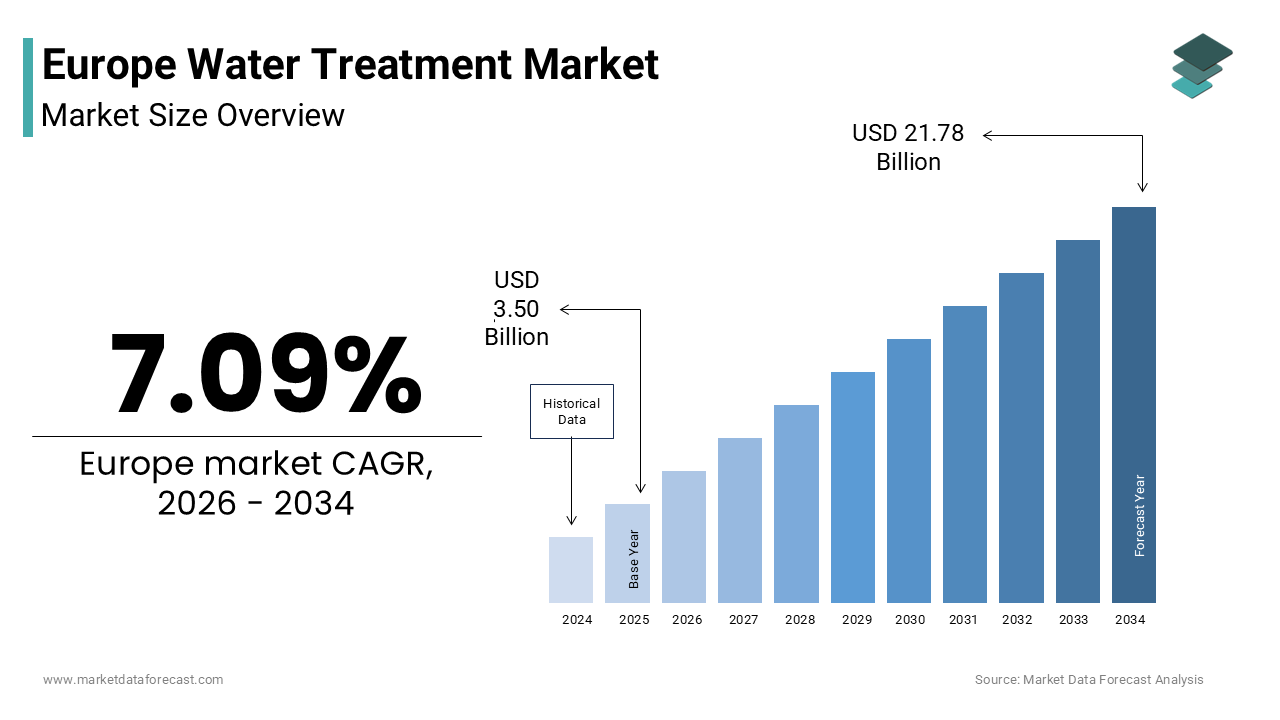
The Europe water treatment market was valued at USD 3.50 billion in 2025, is estimated to reach USD 3.74 billion in 2026, and is projected to reach USD 21.78 billion by 2034, growing at a CAGR of 7.09% during the forecast period from 2026 to 2034. The growth of the Europe water treatment market is driven by stringent environmental regulations, increasing water scarcity across several regions, and rising demand for sustainable water management solutions. Governments and industries across Europe are investing heavily in advanced water treatment technologies to ensure safe drinking water, improve wastewater recycling, and meet strict discharge standards. Furthermore, the growing focus on circular water economies and industrial water reuse initiatives is accelerating the adoption of advanced treatment systems across municipalities and industrial facilities.
Key Market Trends
-
Increasing adoption of advanced filtration technologies such as membrane filtration and reverse osmosis to meet strict water quality standards.
-
Rising demand for water recycling and reuse systems due to increasing water stress in Southern Europe.
-
Growing deployment of smart water management systems using IoT and artificial intelligence for real-time monitoring and leak detection.
-
Expansion of industrial water reuse programs driven by sustainability goals and environmental regulations.
-
Increasing investment in advanced contaminant removal technologies to address emerging pollutants such as microplastics and pharmaceuticals.
Segmental Insights
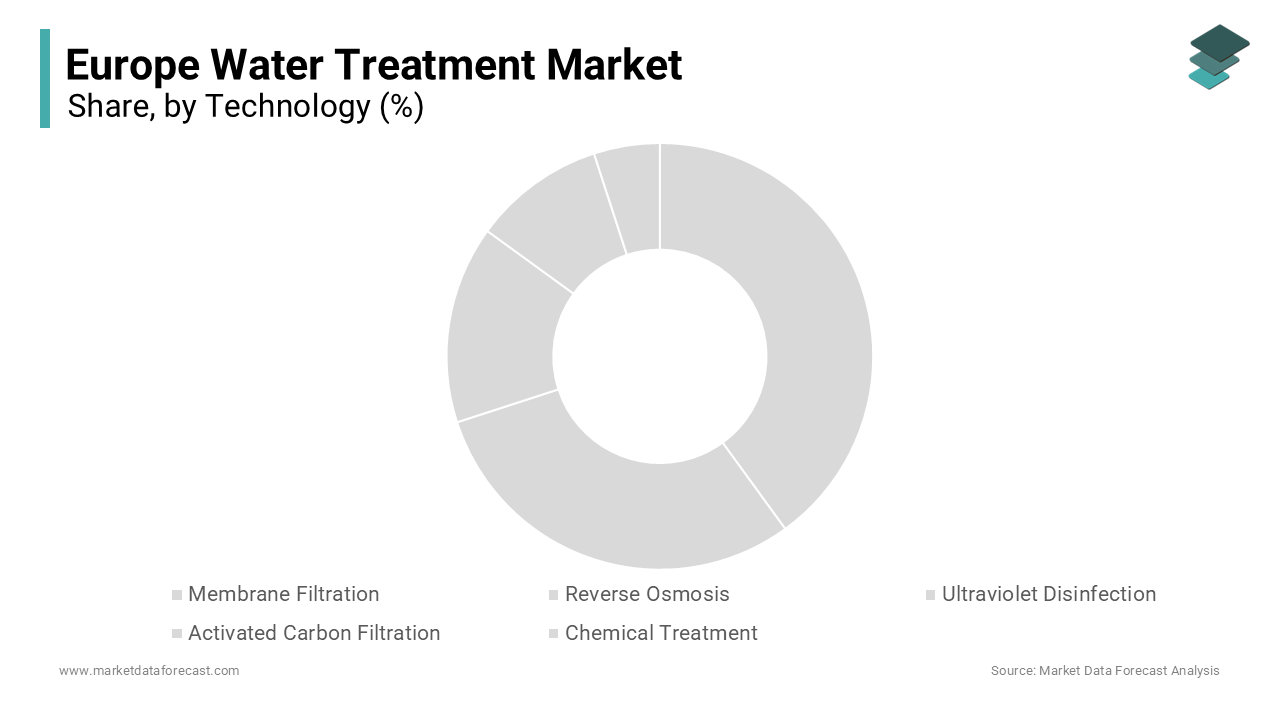
Based on technology, the membrane filtration segment held the largest share of the Europe water treatment market in 2025. The dominance of this segment is attributed to its high efficiency in removing contaminants such as bacteria, viruses, and suspended particles while meeting stringent regulatory requirements for wastewater discharge and water reuse.
Based on application, the municipal water treatment segment accounted for the largest share of the Europe water treatment market in 2025. The growth of this segment is driven by increasing urbanization, strict wastewater treatment regulations, and large-scale investments by governments to upgrade aging water infrastructure.
Based on installation type, the whole-house installation segment occupied a prominent share of the Europe water treatment market in 2025. The dominance of this segment stems from rising consumer awareness regarding water quality and the growing adoption of comprehensive water filtration systems for residential properties.
Regional Insights
The Europe water treatment market is expanding across several countries due to rising environmental regulations, increasing industrial water demand, and growing concerns about water scarcity.
-
Germany held the largest share of the Europe water treatment market in 2025, supported by its advanced industrial base, strict environmental regulations, and strong investments in wastewater treatment infrastructure.
-
The United Kingdom remains a significant market due to the presence of major water utilities and strict regulatory frameworks requiring advanced wastewater treatment and nutrient removal technologies.
-
France is experiencing steady growth due to government initiatives promoting water reuse and sustainability under national environmental programs.
-
The Netherlands plays a key role in the market due to its expertise in water management and investments in circular water economy initiatives, including wastewater resource recovery.
-
Italy is witnessing increasing demand for water treatment solutions driven by water scarcity issues and the need to modernize aging municipal water infrastructure.
Competitive Landscape
The Europe water treatment market is highly competitive, with major global companies and regional specialists focusing on technological innovation, sustainability, and integrated water management solutions. Companies compete by offering advanced filtration technologies, digital water management platforms, and long-term service contracts for municipal and industrial water treatment projects. Prominent players in the Europe water treatment market include Veolia Environnement S.A., SUEZ S.A., Xylem Inc., Pentair plc, Kemira Oyj, BWT AG, Danaher Corporation, Ecolab Inc., Acciona S.A., and BASF SE.
Europe Water Treatment Market Size
The Europe water treatment market size was valued at USD 3.50 billion in 2025 and is anticipated to reach USD 3.74 billion in 2026 from USD 21.78 billion by 2034, growing at a CAGR of 7.09% during the forecast period from 2026 to 2034.
Water treatment represents a critical infrastructure sector dedicated to the purification, desalination, and management of water resources to ensure safety for human consumption, industrial processes, and environmental preservation. This ecosystem encompasses a wide array of technologies including membrane filtration, chemical disinfection, and advanced biological treatments designed to remove contaminants from wastewater and surface water sources. The urgency of this sector is underscored by the region's hydrological reality where climate change has drastically altered precipitation patterns leading to frequent droughts in Southern Europe. According to the European Environment Agency, a significant portion of the European Union territory experiences water stress conditions during summer months which necessitates robust treatment solutions to maximize water reuse. The European Commission has mandated that member states must treat all collected urban wastewater to strict standards by 2030 under the revised Urban Wastewater Treatment Directive. According to Eurostat, agriculture consumes a large share of total water abstraction in the EU, which is creating immense pressure on available freshwater supplies. The market is defined not just by equipment sales but by the integrated service of ensuring water security amidst a shrinking resource base. As per the Joint Research Centre, many rivers in Europe fail to meet good ecological status due to pollution which drives the demand for advanced remediation technologies. This sector serves as the backbone for public health and industrial continuity across the continent.
MARKET DRIVERS
Stringent Regulatory Frameworks Mandating Advanced Wastewater Purification Standards
The legislative push from the European Union to eliminate pollutants and protect aquatic ecosystems through binding legal requirements is primarily driving the growth of the European water treatment market. The revised Urban Wastewater Treatment Directive explicitly requires all agglomerations with more than one thousand people equivalent to collect and treat wastewater by 2030. This regulatory shift forces thousands of smaller municipalities to invest heavily in new treatment plants or upgrade obsolete facilities to meet stricter discharge limits for nutrients like nitrogen and phosphorus. According to the European Commission, the implementation of these rules will require significant annual investments across member states to bridge the infrastructure gap. Additionally, the directive introduces obligations to monitor emerging contaminants such as microplastics and pharmaceutical residues which were previously unregulated. Industries facing heavy fines for non-compliance are proactively installing zero liquid discharge systems to recycle process water and minimize effluent volume. As per the European Investment Bank, water infrastructure remains a top priority for public funding with substantial allocations specifically for projects that enhance treatment capacity and efficiency. The drive to achieve good chemical status for all water bodies by 2027 under the Water Framework Directive further accelerates the adoption of tertiary and quaternary treatment stages.
Escalating Industrial Water Scarcity and the Imperative for Circular Water Economies
Industries across Europe are increasingly viewing water not as a commodity but as a strategic asset critical for survival due to recurring droughts and restrictive abstraction licenses, which is further contributing to the expansion of the European water treatment market. The chemical, pharmaceutical, and food and beverage sectors which are water intensive are leading the transition towards circular water models where treated wastewater is reused within the production cycle. According to the European Chemical Industry Council, water scarcity has become a top risk factor for operations with many sites located in river basins that experience seasonal low flow conditions. Companies are investing in advanced membrane bioreactors and reverse osmosis systems to recover large portions of their process water thereby reducing reliance on municipal supplies. As per the Confederation of European Paper Industries, the sector has already achieved significant reductions in specific water consumption over the last two decades through aggressive recycling initiatives. The economic logic is compelling as the cost of treating and reusing water internally often undercuts the rising tariffs for fresh industrial water in stressed regions. Furthermore, corporate sustainability goals driven by Environmental Social and Governance criteria push firms to demonstrate tangible reductions in freshwater withdrawal. The European Green Deal reinforces this trend by promoting industrial symbiosis where effluent from one plant becomes the input for another.
MARKET RESTRAINTS
Prohibitive Capital Expenditure and Escalating Operational Energy Costs
The financial barrier to entry remains a formidable restraint for the European water treatment market as modern water treatment technologies such as reverse osmosis and ultraviolet disinfection require substantial capital outlays for installation and commissioning. Small and medium-sized municipalities often struggle to secure the necessary funding to replace aging infrastructure with energy-intensive advanced systems despite regulatory pressures. According to the International Water Association, energy costs account for a significant portion of the total operating expenses for a wastewater treatment plant, making them highly vulnerable to electricity price spikes. The energy crisis triggered by geopolitical tensions in Europe caused natural gas and electricity prices to soar which directly increased the cost of pumping and treating water. This economic pressure forces some operators to delay upgrades or opt for less efficient conventional methods that may not meet future regulatory standards. As per Eurostat, inflation in the construction sector has risen sharply, increasing the cost of materials like steel and polymers essential for building treatment facilities. The long payback periods associated with water infrastructure projects deter private investors who seek quicker returns on capital.
Aging Infrastructure Legacy and Complex Integration Challenges with Modern Systems
Much of the water infrastructure in Europe was constructed decades ago and suffers from deterioration leading to leaks, inefficiencies, and compatibility issues with new technologies, which is further impeding the European water treatment market growth. According to the European Federation of National Associations of Water Services, non-revenue water losses due to leaking pipes remain high across the continent, which is representing a massive waste of treated water and financial resources. Integrating advanced treatment modules into these legacy systems often requires extensive retrofitting which is technically complex and disruptive to ongoing operations. Older plants were not designed to handle the hydraulic loads or chemical compositions required by modern membrane processes leading to frequent failures or suboptimal performance. The fragmentation of ownership between local municipalities and private operators complicates coordinated upgrade efforts resulting in piecemeal implementations that lack systemic efficiency. As per the World Bank, the cost of rehabilitating old infrastructure can be significantly higher than building new facilities due to unforeseen complications encountered during excavation and connection. Furthermore, the lack of standardized digital interfaces in older equipment hinders the adoption of smart water management systems that rely on real-time data for optimization. The sheer scale of the renewal backlog means that progress is slow and capital is spread thin across maintenance rather than innovation.
MARKET OPPORTUNITIES
Expansion of Direct Potable Reuse and Advanced Water Recycling Initiatives
The emerging acceptance and regulatory support for direct potable reuse offer a promising opportunity for the European water treatment market. As freshwater sources become increasingly unreliable due to climate variability, European nations are turning to treated wastewater as a viable source of drinking water through direct potable reuse schemes. This paradigm shift opens a lucrative market for ultra-advanced treatment trains combining microfiltration, reverse osmosis, and advanced oxidation processes to ensure water safety meets drinking standards. According to the European Commission, several member states are drafting specific regulations to facilitate the safe implementation of potable reuse which will unlock significant infrastructure investments. Countries such as Belgium and Spain have already launched pilot projects demonstrating the technical feasibility and public acceptance of turning sewage into tap water. The opportunity lies in providing end-to-end solutions that include not just treatment hardware but also rigorous monitoring and public engagement strategies to overcome psychological barriers. As per Global Water Intelligence, the number of potable reuse projects in Europe is expected to grow considerably by 2030 driven by urban water deficits. The integration of artificial intelligence for real-time quality assurance further enhances the viability of these systems by ensuring constant compliance with strict health standards.
Digitalization and Deployment of Smart Water Management Ecosystems
The integration of Internet of Things sensors and artificial intelligence into water networks offers vast opportunities for the European water treatment market. The digitization of water infrastructure enables utilities to transition from reactive maintenance to predictive operations, creating significant value through improved resource management. Smart water systems utilize networks of connected sensors to monitor flow rates, pressure, and water quality in real time, allowing for immediate detection of leaks and contamination events. According to the Digital Water Alliance, implementing smart metering and analytics can reduce non-revenue water losses and lower energy consumption. This technological evolution creates a booming market for software platforms, data analytics services, and intelligent control systems that complement physical treatment assets. Utilities are increasingly seeking partners who can offer holistic digital twins of their networks to simulate scenarios and optimize treatment processes dynamically. The European Union supports this transition through funding programs aimed at modernizing critical infrastructure with digital technologies to enhance resilience. As per McKinsey, digital transformation in the water sector could generate substantial annual value for European utilities through efficiency gains. The opportunity also extends to cybersecurity services as connected networks become vulnerable to digital threats requiring robust protection protocols.
MARKET CHALLENGES
Emergence of Persistent Contaminants of Emerging Concern and Regulatory Uncertainty
The detection of complex pollutants such as pharmaceuticals and microplastics poses significant technical and regulatory challenges for the European water treatment market. Water treatment facilities face the daunting task of removing contaminants of emerging concern which are not effectively captured by conventional processes and for which regulatory limits are still evolving. Substances like endocrine disruptors, antibiotics, and perfluoroalkyl substances persist in the environment and pose long-term risks to human health and ecosystems requiring specialized removal techniques. According to the European Environment Agency, hundreds of these substances have been detected in European water bodies, yet standardized testing methods and discharge limits remain inconsistent across member states. This regulatory ambiguity creates uncertainty for investors and operators who hesitate to commit to expensive upgrade projects without clear compliance targets. As per research institutions, current removal efficiencies for certain pharmaceuticals vary widely depending on the specific compound and treatment configuration. The lack of harmonized European standards leads to a fragmented market where solutions valid in one country may not suffice in another. Furthermore, the continuous discovery of new pollutants means that today’s state-of-the-art solution may become obsolete tomorrow, which is requiring constant innovation.
Public Resistance and Social Acceptance Barriers to Recycled Water Projects
Despite the technical feasibility and economic benefits of water recycling, public perception often acts as a formidable barrier to the implementation of large-scale projects, particularly those involving potable reuse, which is further challenging the regional market expansion. The “yuck factor” associated with the idea of drinking treated wastewater leads to strong opposition from local communities and consumer groups who fear health risks regardless of scientific assurances. According to the European Consumer Organisation, a significant portion of the population remains sceptical about the safety of recycled water, citing concerns about residual contaminants and long-term effects. This social resistance can delay or even cancel major infrastructure projects, causing financial losses for developers and prolonging water scarcity issues. The challenge is compounded by the spread of misinformation on social media which amplifies fears and erodes trust in regulatory authorities and utility providers. Data from behavioral studies suggests that trust in local institutions is a key determinant of acceptance, yet this trust has been eroded in some regions by past water quality scandals. Bridging the gap between scientific reality and public perception requires sustained engagement and education efforts that go beyond technical specifications. Until social license is secured, the full potential of water recycling as a solution to Europe’s water crisis will remain constrained by human psychology rather than technological limitations.
REPORT COVERAGE
| REPORT METRIC | DETAILS |
| Market Size Available | 2025 to 2034 |
| Base Year | 2025 |
| Forecast Period | 2026 to 2034 |
| CAGR | 7.09% |
| Segments Covered | By Technology, Application, Installation Type and Region. |
| Various Analyses Covered | Global, Regional & Country Level Analysis, Segment-Level Analysis, DROC, PESTLE Analysis, Porter’s Five Forces Analysis, Competitive Landscape, Analyst Overview of Investment Opportunities |
| Country Covered | UK, France, Spain, Germany, Italy, Russia, Sweden, Denmark, Switzerland, the Netherlands, Turkey, the Czech Republic, and the Rest of Europe.. |
| Market Leaders Profiled | Water Treatment Market include Veolia Environnement S.A., SUEZ S.A., Xylem Inc., Pentair plc, Kemira Oyj, BWT AG, Danaher Corporation, Ecolab Inc., Acciona S.A., and BASF SE. |
SEGMENTAL ANALYSIS
By Technology Insights
The membrane filtration segment accounted for the major share of the European water treatment market in 2025 due to its efficiency in removing diverse contaminants and compliance with strict discharge standards. The technology's ability to physically separate particles, bacteria, and viruses without extensive chemical additives, which is aligning with European environmental goals is also driving the growth of the membrane filtration segment in the regional market. According to the European Desalination Society, membrane technologies account for a significant portion of new desalination capacity installed in the Mediterranean region to combat drought conditions. The revised Urban Wastewater Treatment Directive mandates the removal of microplastics and specific organic pollutants, where ultrafiltration and reverse osmosis membranes excel. According to the European Commission, the push for water reuse in agriculture requires treated effluent to meet stringent microbiological criteria which membrane systems consistently deliver. Industrial sectors such as pharmaceuticals and food processing rely heavily on these systems to produce high purity process water. The versatility of membrane configurations allows retrofitting into existing plants, making them a preferred choice for upgrades. Furthermore, advancements in membrane materials have reduced fouling rates and energy consumption. As per the International Water Association, membrane bioreactors are increasingly becoming the standard for municipal upgrades in densely populated areas.
The ultraviolet disinfection segment is estimated to witness a promising CAGR of 9.5% during the forecast period in the European market owing to the shift away from chemical disinfectants, the aversion to chlorine-based disinfection due to harmful byproducts strictly regulated under European drinking water directives. UV technology offers a chemical-free alternative that effectively inactivates pathogens resistant to chlorine, which is ensuring safer drinking water supplies. According to the World Health Organization Regional Office for Europe, the incidence of waterborne diseases linked to chlorine-resistant organisms has prompted utilities to adopt multi-barrier approaches incorporating UV. The technology is also gaining traction in industrial applications where high purity water is required without chemical residue. Energy efficiency improvements in LED UV systems have lowered operational costs, making the technology accessible for smaller municipalities. As per the European UV Technology Association, adoption of UV systems in wastewater treatment plants has increased significantly to meet new nutrient removal and pathogen reduction targets. The compact footprint of modern UV reactors allows easy integration into space-constrained facilities, further accelerating deployment.
By Application Insights
The municipal segment occupied the leading share of the European water treatment market in 2025. The growth of the municipal segment in the European market is attributed to the statutory obligation of local governments to provide safe drinking water and treat wastewater for millions of residents. The scale of urbanization in Europe ensures that municipal utilities remain the primary consumers of water treatment technologies. According to Eurostat, a large majority of the European population lives in urban areas, creating immense pressure on city infrastructure to deliver compliant water services. The European Union’s Urban Wastewater Treatment Directive imposes legally binding targets on member states to collect and treat wastewater from all agglomerations, driving substantial public investment annually. Recent updates require removal of emerging contaminants such as pharmaceuticals and microplastics, forcing municipalities to upgrade facilities with advanced tertiary treatment stages. As per the European Investment Bank, water and wastewater infrastructure receives the largest portion of environmental funding within the EU cohesion policy framework. Municipalities are also adopting smart water grids to reduce non-revenue water losses, which remain high across the continent according to the European Federation of National Associations of Water Services.
The industrial segment is estimated to record a CAGR of 10.5% in the European water treatment market over the forecast period owing to the critical need for process water reliability, zero liquid discharge compliance and the increasing water intensity of industries such as chemicals, pharmaceuticals, and food and beverage, coupled with stricter effluent limits. The European Green Deal and the Industrial Emissions Directive are pushing manufacturers towards circular water models where wastewater is recycled back into production processes. According to the Confederation of European Paper Industries, the sector has committed to significant reductions in specific water consumption by 2030, driving investments in closed-loop treatment systems. Water scarcity in industrial hubs has made water security a top strategic priority, compelling firms to install on-site treatment plants. As per the European Chemical Industry Council, water stress is now considered a material risk for a large share of chemical production sites, accelerating adoption of advanced recycling technologies. Rising water tariffs and abstraction fees strengthen the economic case for internal recycling. Corporate sustainability reports increasingly highlight water stewardship as a key performance indicator, which is influencing investor decisions and brand reputation.
By Installation Type Insights
The whole-house installation type segment commanded for the leading share of the European water treatment market in 2025. The dominance of whole-house installation type segment is driven by the consumer preference for comprehensive water quality protection throughout the entire property. Homeowners and property managers across Europe are increasingly installing whole-house systems to ensure that every tap delivers filtered water, which is addressing concerns about hardness, chlorine taste, and potential pipe corrosion. According to the European Water Softener Association, hard water affects a large proportion of households in regions such as the United Kingdom, France, and Germany, leading to widespread adoption of whole-house softeners to protect appliances and plumbing. The rise in health consciousness has also spurred demand for whole-house filtration units that remove sediments, heavy metals, and microplastics from the main incoming line before distribution. Real estate data suggests that properties equipped with comprehensive water treatment systems often command higher market values and sell faster due to the perceived added benefit of improved water quality. The trend towards smart home integration has further boosted this segment, with modern whole-house systems offering remote monitoring and automatic regeneration capabilities via smartphone apps. Manufacturers are responding by developing compact, high-capacity units that fit easily into utility rooms or basements of typical European homes. Additionally, rental housing regulations in countries such as the Netherlands and Sweden are beginning to encourage landlords to install basic filtration to meet tenant health expectations. The convenience of having a single system maintain water quality for bathing, laundry, and cooking eliminates the need for multiple point-of-use devices, making it the most practical and popular choice for consumers seeking total water management solutions.
The under-sink installation segment is anticipated to register a CAGR of 8.8% in the European market during the forecast period due to the growing demand for high-purity drinking water and space-saving designs and the specific consumer focus on drinking and cooking water quality, which is leading to the adoption of specialized under-sink filters that offer superior purification compared to pitcher filters or faucet attachments. Increasing awareness of contaminants such as lead from old pipes, pesticide residues, and pharmaceutical traces in tap water has prompted households to seek dedicated point-of-use solutions for consumption. According to the European Consumer Organisation, surveys show that many Europeans express concern about tap water safety, driving sales of under-sink reverse osmosis and carbon block systems. The compact nature of these units makes them ideal for smaller kitchen layouts common in European apartments and urban homes where space is limited. Advances in filter technology have extended cartridge lifespans and improved flow rates, addressing previous complaints about slow dispensing and frequent maintenance. The rise of direct-chill water dispensers integrated with under-sink filtration in both residential and office settings is also contributing to market expansion. As per retail associations, consumer spending has shifted significantly from bottled water to filtered tap water, motivated by environmental concerns regarding plastic waste and cost savings. As certification standards for drinking water filters become more rigorous, consumer confidence in under-sink systems continues to grow, positioning this segment as the fastest-growing installation type in the market.
REGIONAL ANALYSIS
Germany Water Treatment Market Analysis
Germany accounted for 21.5% of the European market share in 2025. The dominance of Germany in the European water treatment market is driven by its advanced industrial base, strong regulatory frameworks, and emphasis on sustainability. Germany operates extensive municipal wastewater treatment infrastructure, with more than 10,000 plants meeting EU standards. Industrial demand is equally strong, particularly in chemicals, automotive, and pharmaceuticals, where water reuse and zero‑liquid discharge systems are increasingly adopted. The Federal Ministry for the Environment has prioritized circular water use, allocating significant funding to advanced membrane and biological treatment technologies. Germany also leads in decentralized treatment solutions, with SMEs providing modular systems for rural and industrial applications. With its combination of regulatory rigor, industrial demand, and technological leadership, Germany remains the anchor of Europe’s water treatment market and is expected to drive innovation in reuse and resource recovery.
UK Water Treatment Market Analysis
The UK captured a prominent share of the European water treatment market in 2025. The centralized water utilities, strict environmental regulations, and growing investment in resilience are driving the promising position of the UK in the European market. Thames Water, United Utilities, and Severn Trent dominate the sector, operating large‑scale treatment plants that serve millions of households. The Environment Agency enforces stringent discharge standards, driving adoption of advanced nutrient removal and sludge management technologies. Post‑Brexit, the UK has introduced its own water quality targets, aligning with EU directives but allowing faster implementation of innovation pilots. Industrial demand is rising, particularly in food processing and pharmaceuticals, where water reuse is critical. The UK also leads in digital water management, with smart sensors and AI‑driven monitoring integrated into treatment networks. With its blend of regulatory oversight, utility scale, and digital innovation, the UK is expected to remain a high‑value water treatment market.
France Water Treatment Market Analysis
France is expected to exhibit a prominent CAGR in the European water treatment market during the forecast period. Factors such as the strong municipal infrastructure and emphasis on ecological restoration are propelling the French market expansion. Veolia and Suez, headquartered in France, are global leaders in water services, operating advanced treatment plants across Europe and beyond. The French government’s Plan Eau 2023 prioritizes water reuse, aiming to recycle 10 percent of treated wastewater by 2030. France’s agricultural sector, which consumes significant water resources, is a key driver of demand for irrigation reuse systems and decentralized treatment. The country also invests heavily in river basin restoration, with projects targeting nitrate and pesticide reduction. Advanced technologies such as membrane bioreactors and UV disinfection are widely deployed in urban centers. With its combination of global corporate leadership, national policy support, and ecological priorities, France remains a pivotal market for water treatment and is expected to expand its role in reuse and sustainability.
Netherlands Water Treatment Market Analysis
The Netherlands is estimated to hold a notable share of the European water treatment market during the forecast period owing to its expertise in flood management, wastewater reuse, and circular economy integration. As a low‑lying country, the Netherlands has invested heavily in water infrastructure, with advanced treatment plants integrated into dike and flood protection systems. Dutch water boards operate some of Europe’s most innovative facilities, recovering phosphorus, cellulose, and bioplastics from wastewater streams. The government’s Delta Programme emphasizes resilience and reuse, with targets to recycle 15% of treated wastewater by 2030. Industrial demand is strong in food processing, chemicals, and logistics, where water efficiency is critical. The Netherlands also leads in decentralized solutions, with modular systems deployed in greenhouses and horticulture. With its combination of infrastructure expertise, circular innovation, and policy support, the Netherlands remains a high‑influence water treatment market and is expected to expand its role in resource recovery and reuse.
COMPETITIVE LANDSCAPE
The competition in the Europe water treatment market is intense and characterized by a mix of global giants and specialized regional players vying for dominance in a highly regulated environment. Major competitors differentiate themselves through technological innovation, particularly in digital water management and advanced filtration capabilities that address emerging pollutants like microplastics and pharmaceutical residues. The market sees frequent consolidation activities as large corporations acquire smaller firms to gain access to niche technologies or expand their service territories across different European nations. Price competition remains fierce in commoditized segments such as basic chemical dosing or standard pump supply, forcing companies to shift focus toward high-value integrated solutions and long-term service contracts. Regulatory compliance acts as a significant barrier to entry while simultaneously driving demand for sophisticated treatment systems that meet strict European Union directives. Companies that successfully combine operational excellence with sustainable practices and digital transformation tend to secure the most lucrative public and private sector contracts. This dynamic landscape forces all participants to continuously evolve their business models and invest heavily in research to maintain relevance and capture market share amidst growing environmental challenges.
KEY MARKET PLAYERS
Some of the companies that are playing a dominating role in the Europe Water Treatment Market include
- Veolia Environnement S.A.
- SUEZ S.A.
- Xylem Inc.
- Pentair plc
- Kemira Oyj
- BWT AG (Best Water Technology Group)
- Danaher Corporation
- Ecolab Inc.
- Acciona S.A.
- BASF SE
Top Players in the Europe Water Treatment Market
Veolia Environnement
Veolia Environnement stands as a global pioneer in optimized resource management with a profound footprint across the European water treatment sector. The company designs and operates comprehensive solutions for drinking water production, wastewater treatment, and sludge valorization for thousands of municipalities and industrial clients. Recently, Veolia has strengthened its market position by aggressively acquiring specialized firms focused on digital water management and advanced contaminant removal technologies. Their strategic push involves deploying artificial intelligence driven platforms to enhance network efficiency and reduce non-revenue water losses for utility partners. Veolia also leads global initiatives in circular economy practices by transforming wastewater treatment plants into resource recovery hubs that generate energy and recycled materials. This commitment to innovation and sustainability solidifies their role as a critical partner for European nations aiming to meet stringent environmental directives while ensuring water security for growing populations through cutting-edge technological integration.
Suez SA
Suez SA remains a cornerstone of the European water industry by delivering essential services that ensure public health and environmental protection across numerous countries. The company excels in providing tailored solutions for complex industrial water challenges and municipal infrastructure modernization projects throughout the region. Recent actions to fortify their market stance include significant investments in smart water technologies that utilize real-time data analytics for predictive maintenance and leak detection. Suez has also expanded its portfolio in desalination and water reuse sectors to address increasing scarcity issues in Southern Europe driven by climate change. Globally, the firm contributes expertise in large-scale infrastructure development and operational excellence that sets industry benchmarks for efficiency and reliability. Their focus on developing proprietary filtration membranes and biological treatment processes enables clients to meet rigorous regulatory standards. By fostering strategic partnerships with local governments and industrial giants, Suez continues to drive the transition towards resilient and sustainable water systems that safeguard communities against emerging hydrological threats.
Xylem Inc.
Xylem Inc. is a leading global water technology company that plays a vital role in addressing critical water challenges across Europe through innovative equipment and digital solutions. The corporation provides a vast array of products including pumps, treatment systems, and testing instruments that form the backbone of modern water infrastructure. To strengthen their European presence, Xylem has recently focused on integrating advanced digital capabilities such as machine learning algorithms into their hardware to optimize energy consumption and operational performance. Their acquisition of specialized software firms has enabled them to offer holistic smart water networks that empower utilities to make data-driven decisions instantly. Xylem actively supports global sustainability goals by helping customers reduce carbon footprints and improve water quality in underserved regions. The company's commitment to research and development ensures continuous advancement in technologies capable of removing emerging contaminants like microplastics and pharmaceuticals. Through these strategic moves, Xylem reinforces its reputation as an indispensable partner for building resilient water systems capable of withstanding future environmental pressures.
Top Strategies Used by Key Market Participants
Key players in the Europe water treatment market primarily employ strategies centered on aggressive mergers and acquisitions to rapidly expand their technological portfolios and geographic reach. Companies frequently target niche startups specializing in digital water solutions or advanced membrane technologies to integrate cutting-edge innovations into their existing service offerings seamlessly. Another major strategy involves heavy investment in research and development to create proprietary solutions that address emerging contaminants and improve energy efficiency in treatment processes. Firms are increasingly forming strategic public-private partnerships to secure long-term contracts for managing municipal infrastructure and implementing large-scale reuse projects. Participants also focus on digitizing their operations by deploying Internet of Things sensors and artificial intelligence platforms to offer predictive maintenance and real-time monitoring services that enhance client value. Sustainability drives many corporate strategies as companies align their goals with the European Green Deal to promote circular water economies and carbon neutrality. These combined approaches enable market leaders to maintain competitive advantages and drive growth in a highly regulated and evolving landscape.
MARKET SEGMENTATION
This research report on the Europe Water Treatment Market has been segmented and sub-segmented based on the following categories.
By Technology
- Membrane Filtration
- Reverse Osmosis
- Ultraviolet Disinfection
- Activated Carbon Filtration
- Chemical Treatment
By Application
- Municipal Water Treatment
- Industrial Water Treatment
- Wastewater Treatment
- Desalination
- Point of Use
By Installation Type
- Whole-House Installation
- Under-Sink Installation
By Country
- UK
- France
- Spain
- Germany
- Italy
- Russia
- Sweden
- Denmark
- Switzerland
- Netherlands
- Turkey
- Czech Republic
- Rest of Europe
Access the study in MULTIPLE FORMATS
Purchase options starting from
$ 2000
Didn’t find what you’re looking for?
TALK TO OUR ANALYST TEAM
Need something within your budget?
NO WORRIES! WE GOT YOU COVERED!
Call us on: +1 888 702 9696 (U.S Toll Free)
Write to us: sales@marketdataforecast.com