- Product Description Description
- Table of Contents TOC
- List of Table & Figure LOT
- Get Free Sample PDF Sample PDF
Europe Waterjet Cutting Machine Market Report Summary
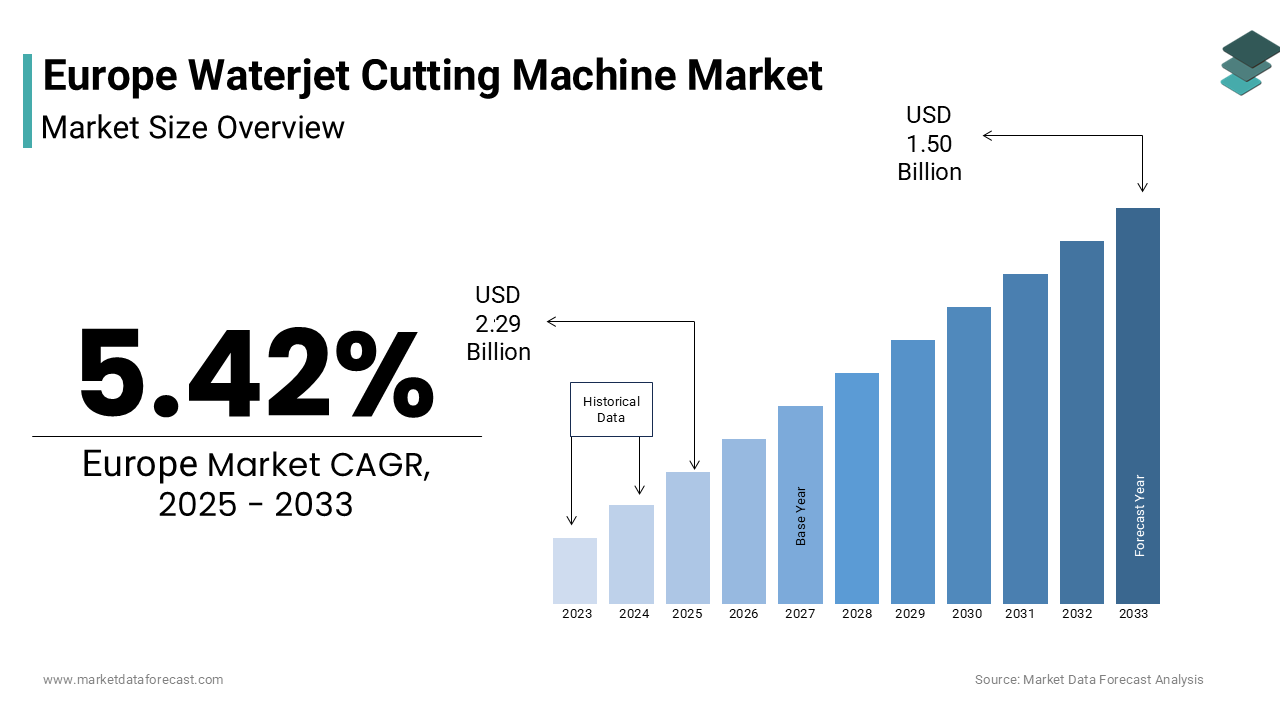
The Europe waterjet cutting machine market was valued at USD 1.42 billion in 2024, is estimated to reach USD 1.50 billion in 2025, and is projected to reach USD 2.29 billion by 2033, growing at a CAGR of 5.42% during the forecast period from 2025 to 2033. The growth of the Europe waterjet cutting machine market is driven by rising demand for high-precision, non-thermal cutting solutions across aerospace, automotive, metal fabrication, and renewable energy industries. Waterjet cutting machines enable precise processing of metals, composites, stone, glass, and heat-sensitive materials without creating heat-affected zones, aligning well with Europe’s emphasis on material integrity, sustainability, and advanced manufacturing. Increasing adoption of Industry 4.0 practices, stringent environmental regulations, and the region’s focus on clean and flexible fabrication technologies continue to reinforce the strategic relevance of waterjet cutting systems across European manufacturing ecosystems.
Key Market Trends
- Growing adoption of non-thermal cutting technologies to meet EU sustainability and safety regulations
- Rising use of waterjet systems for composite and lightweight material processing in EVs and aerospace
- Integration of robotic and CNC waterjet systems in automated production lines
- Expanding role of waterjet cutting in renewable energy and hydrogen infrastructure fabrication
- Increasing demand for micro and precision waterjet systems in medical and electronics applications
Segmental Insights
- Based on type, the robotics waterjet cutting machine segment held the largest share of the Europe waterjet cutting machine market in 2024. This dominance is attributed to its ability to deliver high precision, automation compatibility, and multi-axis cutting capabilities required in aerospace, automotive, and energy applications.
- Based on technology, the abrasive waterjet cutting segment led the market in 2024 due to its versatility in cutting thick and hard materials such as steel, titanium, stone, and advanced composites without thermal distortion. Meanwhile, the pure waterjet cutting segment is expected to register the fastest growth during the forecast period, driven by rising use in plastics, rubber, food processing, and layered materials.
- Based on industry, the metal fabrication segment accounted for the largest share of the market in 2024, supported by the widespread use of waterjet systems in SMEs for high-mix, low-volume production. The energy and power segment is projected to grow at the fastest CAGR owing to increasing demand from wind energy, hydrogen infrastructure, and nuclear decommissioning projects across Europe.
Regional Insights
- Germany dominated the Europe waterjet cutting machine market in 2024, supported by its strong mechanical engineering base, advanced automotive manufacturing, and early adoption of Industry 4.0 technologies.
- Italy holds a significant market share, driven by extensive use of waterjet systems in stone processing, architectural fabrication, and luxury automotive manufacturing.
- France maintains a prominent position due to demand from aerospace, defense, and nuclear industries, where cold cutting and high material integrity are critical.
- The United Kingdom is expected to witness steady growth, supported by offshore energy, defense engineering, and high-precision manufacturing applications.
- Spain is emerging as a growing market, fueled by expansion in renewable energy infrastructure, shipbuilding, and metal fabrication industries.
Competitive Landscape
The Europe waterjet cutting machine market is moderately consolidated and characterized by strong competition between global manufacturers and regional specialists. Market participants compete on parameters such as cutting precision, system automation, energy efficiency, digital integration, and after-sales support rather than price alone. Increasing focus on sustainability, abrasive recycling, and smart factory compatibility is shaping product development strategies. Companies that align their offerings with Europe’s decarbonization goals and advanced manufacturing initiatives continue to gain a competitive advantage. Major companies operating in the Europe waterjet cutting machine market include Flow International Corporation, OMAX Corporation, KMT Waterjet Systems, Bystronic Group, Hypertherm Inc., Biesse Group, WardJet Inc., Resato International BV, CMS Industrie S.p.A., Techni Waterjet, Jet Edge Inc., Water Jet Sweden AB, MicroStep Europa GmbH, and PTV spol. s.r.o.
Europe Waterjet Cutting Machine Market Size
The europe waterjet cutting machine market size was valued at USD 1.42 billion in 2024 and is anticipated to reach USD 1.50 billion in 2025 from USD 2.29 billion by 2033, growing at a CAGR of 5.42% during the forecast period from 2025 to 2033.
substances, to slice through materials such as metal, stone, glass, and composites with exceptional precision and minimal heat distortion. In Europe, this technology has become integral to advanced manufacturing processes where dimensional accuracy, edge quality, and material versatility are paramount. The European adoption of waterjet systems is closely tied to the region’s industrial modernization agenda, particularly within aerospace, automotive, and architectural sectors that prioritize clean and flexible cutting solutions. According to Eurostat, the European Union recorded over two million enterprises in the manufacturing sector in 2023, with small and medium‑sized enterprises (SMEs) constituting nearly all of that total. Many of these firms are increasingly integrating precision cutting tools to remain competitive in global markets. As per the European Environment Agency (EEA), the push for cleaner industrial technologies aligns with the cold‑cutting nature of waterjet systems, which avoid hazardous fumes and thermal stress. Unlike plasma or laser alternatives, waterjet technology produces no heat‑affected zones, which is making it uniquely suited for sensitive or heat‑prone materials commonly used across European engineering landscapes. This capability positions waterjet systems not merely as production tools, but as enablers of material innovation and sustainability objectives embedded in the European Green Deal framework.
MARKET DRIVERS
Surge in Demand for High Precision Component Fabrication Across Aerospace and Automotive Industries
The aerospace and automotive sectors in Europe consistently require components manufactured to extremely tight tolerances, which is often from advanced alloys and composites that are difficult to machine using conventional thermal methods and this is primarily driving the growth of the European waterjet cutting machine market. Waterjet cutting meets this need by enabling intricate cuts without altering material properties through heat exposure. According to the European Automobile Manufacturers Association (ACEA), passenger car production in the EU reached 12.2 million units in 2023, an 11.6% increase compared to 2022, driven largely by electric vehicle expansion. This growth intensifies demand for lightweight yet durable materials such as carbon fiber reinforced polymers and titanium alloys, which are ideally processed via abrasive waterjet systems. Similarly, as per the Aerospace and Defence Industries Association of Europe (ASD), the European aerospace and defense industry generated turnover exceeding €250 billion in 2023. Waterjet technology is heavily relied upon for wing spars, fuselage panels, and engine components where dimensional stability is non‑negotiable. The absence of thermal distortion ensures that composite laminates retain their structural integrity during machining, a critical factor in aircraft safety certification. Moreover, the complexity of modern automotive and aeronautical designs necessitates multi‑axis waterjet systems capable of three‑dimensional contouring, further accelerating equipment upgrades across European Tier 1 and Tier 2 suppliers. This precision‑driven demand is not substitutable by alternative cutting methods, which is solidifying waterjet as a strategic asset in Europe’s high‑value manufacturing ecosystem.
Growing Emphasis on Sustainable and Non‑Thermal Industrial Processes Aligned with EU Regulatory Frameworks
European industrial policy increasingly favours manufacturing technologies that minimize environmental impact and energy consumption, a trend that strongly benefits waterjet cutting systems due to their non‑thermal, low‑emission operational profile. Unlike laser or plasma cutting, waterjet systems do not generate toxic fumes, require shielding gases, or produce hazardous slag, thereby simplifying workplace safety compliance and waste management. According to the European Commission’s Industrial Forum Report (2023), more than 75% of EU manufacturing firms have adopted sustainability action plans that include cleaner production technologies. Waterjet cutting aligns directly with these initiatives by eliminating the need for post‑processing deburring and reducing material waste through narrow kerf widths. As per the European Environment Agency (EEA), industrial processes accounted for roughly 18% of the EU’s total greenhouse gas emissions in 2022, prompting stricter enforcement of the EcoDesign for Sustainable Products Regulation. Waterjet machines, which primarily consume water and garnet abrasive offer a compelling pathway to compliance. Additionally, the REACH and RoHS directives restrict the use of substances that emit volatile organic compounds during thermal cutting, indirectly promoting cold‑cutting alternatives. As European manufacturers strive to meet carbon border adjustment mechanism requirements and achieve circular economy benchmarks, the adoption of waterjet technology gains both regulatory and economic momentum, reinforcing its role in the continent’s decarbonization roadmap.
MARKET RESTRAINTS
High Operational and Maintenance Costs Associated with Advanced Waterjet Systems
Despite their technical advantages, waterjet cutting machines entail substantial ongoing expenses that constrain broader adoption, particularly among small and medium enterprises across Europe, which is majorly inhibiting the waterjet cutting machines market growth in Europe. The primary cost drivers include high‑pressure pump maintenance, abrasive garnet consumption, and water filtration systems necessary to sustain cutting performance and equipment longevity. According to Fraunhofer Institute research (2023), annual operating costs for a five‑axis abrasive waterjet system in Germany average €80,000–€90,000, with abrasives accounting for nearly 40% of the total. Garnet, the most commonly used abrasive, must be replenished continuously and cannot be fully recycled without significant loss of cutting efficiency. Furthermore, the ultra‑high‑pressure intensifier pumps, which operate at pressures exceeding 6,000 bar, require specialized servicing every 400 to 600 operating hours as per VDMA manufacturer guidelines. These maintenance intervals disrupt production schedules and necessitate trained technicians, adding labor costs that smaller firms often cannot absorb. Electricity consumption is another concern; according to Eurostat (2023), average industrial electricity prices in the EU were €0.18 per kilowatt‑hour. A standard industrial waterjet system draws between 37 and 75 kilowatts during operation, translating to considerable energy expenditures. Consequently, while waterjet technology offers unmatched precision, its total cost of ownership remains a significant barrier in price‑sensitive segments of the European manufacturing landscape.
Limited Cutting Speed Compared to Thermal Alternatives in High‑Volume Production Settings
Waterjet cutting, though precise and versatile, operates at significantly slower speeds than laser or plasma systems when processing thin to medium‑thickness metals, which is limiting its suitability for high‑throughput manufacturing environments prevalent in Europe’s mass production sectors and hindering the regional market expansion. According to comparative studies (Xometry, 2023), fiber lasers can cut 1 mm stainless steel at speeds exceeding 30–40 meters per minute, while abrasive waterjets typically achieve 0.5–2 meters per minute under similar conditions. This performance gap becomes more pronounced in industries like consumer electronics and appliance manufacturing, where cycle time directly impacts profitability. As per the European Metalworkers’ Federation, more than 60% of fabrication shops in Western Europe prioritize throughput over edge quality for non‑critical components. Additionally, the multi‑pass cutting required for thicker materials further extends processing time, reducing machine utilization rates. Although recent advances in pump technology and nozzle design have improved waterjet speeds by approximately 15% since 2020 according to CECIMO (2024), the fundamental physics of abrasive erosion impose inherent speed limitations. Consequently, many European manufacturers reserve waterjet systems for prototyping, low‑volume batches, or materials incompatible with thermal processes, thereby capping market penetration in sectors driven by economies of scale and rapid production cycles.
MARKET OPPORTUNITIES
Expansion of Additive Manufacturing Ecosystems Creating Hybrid Production Opportunities
The integration of waterjet cutting with additive manufacturing platforms is a novel and high‑potential opportunity for the European waterjet cutting machine market. As 3D printing gains traction for creating complex near‑net‑shape metal parts, post‑processing remains a critical bottleneck, particularly for removing support structures and achieving final dimensional accuracy without damaging delicate geometries. Waterjet technology offers a non‑thermal, mechanically gentle solution ideal for this stage. According to Wohlers Associates (2023), the European additive manufacturing market grew by more than 20% year‑on‑year, with Germany, France, and Italy accounting for the majority of industrial metal printer installations. These systems often produce components from nickel‑based superalloys or titanium aluminides that are highly sensitive to heat, making traditional milling or grinding risky. Waterjet trimming eliminates such risks while enabling rapid removal of excess material. As per the European Commission’s Horizon Europe program (2024), €340 million was allocated to hybrid manufacturing projects combining additive and subtractive techniques, with cold cutting technologies explicitly cited as enablers. Companies like Siemens Energy and Safran are already piloting integrated workflows where waterjet units follow 3D printers in automated cells, reducing post‑processing time by up to 60% according to efficiency reports presented at Hannover Messe 2023. This synergy not only enhances production efficiency but also unlocks new design freedoms, positioning waterjet systems as complementary rather than competing technologies in Europe’s advanced manufacturing value chain.
Rising Adoption in Renewable Energy Infrastructure Fabrication
The European push toward renewable energy deployment has catalysed demand for specialized fabrication capabilities to produce components for wind, solar, and hydrogen infrastructure, many of which are ideally suited for waterjet processing. Offshore wind turbine foundations, for instance, require thick steel plates with precisely cut flanges and bolt patterns that must withstand extreme marine conditions. Waterjet cutting ensures burr‑free edges and zero heat‑affected zones, critical for weld integrity and corrosion resistance. According to WindEurope (2024), the EU installed 17 GW of new wind capacity in 2023, including 4.2 GW offshore, which is requiring millions of tons of structural steel. Similarly, hydrogen electrolyzer stacks employ bipolar plates made from titanium or coated stainless steel, often less than 1 millimeters thick, where thermal cutting risks compromising surface coatings essential for conductivity and gas sealing. Waterjet systems can machine these plates without delamination or microcracking. As per the European Solar Manufacturing Council (2023), aluminum alloys are increasingly used in photovoltaic mounting systems, with complex perforation patterns best achieved through abrasive waterjet due to softness and reflectivity issues with lasers. With the EU targeting 45% renewable energy in its final consumption mix by 2030 according to the REPowerEU plan, the associated fabrication demand creates a durable growth corridor for waterjet technology, particularly in shipyards, heavy steel workshops, and green‑tech component suppliers across the North Sea and Baltic regions.
MARKET CHALLENGES
Skilled Labor Shortage Impeding Optimal Machine Utilization and Technological Uptake
The effective deployment of advanced waterjet cutting systems in Europe is increasingly hampered by a shortage of skilled technicians capable of programming, operating, and maintaining these complex machines, which is a major challenge to the European waterjet cutting machine market growth. Unlike simpler mechanical tools, modern waterjet units require expertise in CAD/CAM software, material science, and high‑pressure hydraulics to achieve optimal cutting parameters and minimize waste. According to CEDEFOP (2023), the EU engineering and metalworking sectors faced a shortage of more than 1 million qualified workers, with Germany, Italy, and Poland reporting the most acute gaps. This deficit is exacerbated by the aging workforce. As per Eurofound (2023), the average age of machine operators in EU manufacturing is 46 years, with insufficient younger entrants possessing digital fabrication competencies. Consequently, many firms underutilize their waterjet systems, running them below capacity or reverting to less efficient manual methods. Training programs specific to waterjet technology remain limited, with according to the European Federation of Education Employers (2024), only 14% of EU technical schools offering dedicated modules. This human capital bottleneck not only delays return on investment but also discourages smaller workshops from adopting advanced systems altogether, stifling innovation diffusion. Without targeted upskilling initiatives and industry‑academia partnerships, the full potential of waterjet cutting in Europe’s precision manufacturing base will remain unrealized.
Fragmented Regulatory and Safety Standards Across European Jurisdictions
The Europe waterjet cutting machine market operates within a fragmented regulatory environment where safety, noise, and water discharge standards vary significantly between member states, complicating compliance and increasing operational overhead for both manufacturers and end users. Although the EU Machinery Directive 2006/42/EC provides a baseline framework, national interpretations and supplementary requirements differ markedly. For instance, Germany enforces stringent noise emission limits under the Technical Instructions on Noise Control, which requires waterjet booths to operate below 80 decibels, while France mandates on‑site filtration of used water to remove garnet particles before discharge, as per the 2022 Arrêté du 15 mars. According to the Confederation of European Environmental Consultants (2023), more than two‑thirds of European manufacturers using waterjet systems reported encountering conflicting local regulations during facility expansions between 2021 and 2023. These inconsistencies delay installation timelines, inflate capital costs for compliance adaptations, and deter cross‑border equipment standardization. Moreover, the lack of harmonized recycling protocols for spent abrasive media—classified as non‑hazardous waste in some countries but regulated as industrial residue in others—creates logistical and legal uncertainties. As per the European Agency for Safety and Health at Work (2023), incident rates were 20–25% higher in jurisdictions lacking specific high‑pressure waterjet handling guidelines. This regulatory patchwork undermines the scalability of waterjet adoption and necessitates costly legal and engineering consultations, particularly for multinational operators seeking uniform production standards across Europe.
REPORT COVERAGE
| REPORT METRIC | DETAILS |
| Market Size Available | 2024 to 2033 |
| Base Year | 2024 |
| Forecast Period | 2025 to 2033 |
| Segments Analysed | By Type, Technology, Pressure Range, Pump Type, Industry and Region |
| Various Analyses Covered | Global, Regional & Country Level Analysis, Segment-Level Analysis, Drivers, Restraints, Opportunities, Challenges; PESTLE Analysis; Porter's Five Forces Analysis, Competitive Landscape, Analyst Overview of Investment Opportunities |
| Regions Analysed | United Kingdom, France, Spain, Germany, Italy, Russia, Sweden, Denmark, Switzerland, the Netherlands, Turkey, and the Czech Republic. |
| Market Leaders Profiled | Flow International Corporation, OMAX Corporation, KMT Waterjet Systems, Bystronic Group, Hypertherm Inc., Biesse Group, WardJet Inc., Resato International BV, CMS Industrie S.p.A., Techni Waterjet, Jet Edge Inc., Water Jet Sweden AB, MicroStep Europa GmbH, and PTV spol. s r.o. |
SEGMENTAL ANALYSIS
By Type Insights
The robotics waterjet cutting machine segment accounted for 65.5% of the Europe waterjet cutting machine market share in 2024. The dominance of robotics waterjet cutting machine segment in the European market is attributed to its superior adaptability, precision, and integration capabilities within automated manufacturing environments across high value industries such as aerospace, automotive, and energy. The primary driver is the continent-wide shift toward Industry 4.0 principles, which prioritize automation, data exchange, and smart production systems. According to CECIMO, more than 70% of large manufacturers in Germany, France, and Italy adopted robotic machining and processing systems between 2022 and 2024. Robotics waterjet systems enable six axis motion control, real time path correction, and seamless interfacing with enterprise resource planning platforms as these features significantly reduce human error and enhance repeatability. Additionally, collaborative robotics frameworks endorsed under the EU’s Horizon Europe program have accelerated the deployment of adaptive waterjet cells that operate safely alongside human workers. As per the International Federation of Robotics, Europe installed over 40,000 industrial robots in 2023, with material processing applications accounting for nearly one fifth of that total. The ability to execute complex contour cuts on composites and thick metals without manual intervention solidifies robotics waterjet systems as the cornerstone of modern European precision manufacturing.
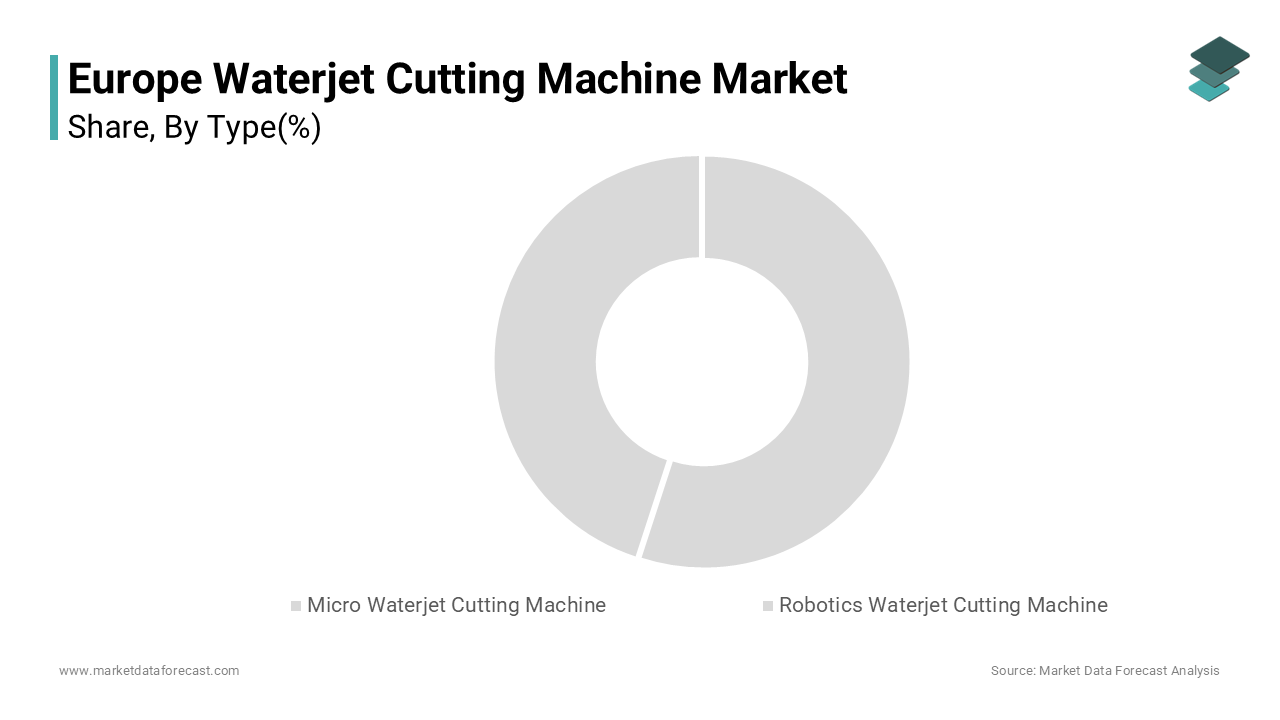
The micro waterjet cutting machine segment is projected to record a CAGR of 10.7% over the forecast period in this regional market owing to the rising demand for micron level precision in medical device manufacturing, semiconductor packaging, and microelectronics as these sectors are experiencing rapid expansion across Western and Northern Europe. Micro waterjet systems operate at nozzle diameters below 100 micrometres and utilize ultra fine abrasives or pure water streams to cut features as narrow as 20 micrometres without microcracking or delamination. According to MedTech Europe, the EU medical technology market reached €165 billion in 2023, with minimally invasive surgical tools and implantable components requiring fine machining capabilities. Furthermore, as per the European Semiconductor Industry Association, the EU’s Chips Act mobilized more than €43 billion in public and private investment through 2030, spurring domestic production of advanced packaging substrates. Unlike laser methods, micro waterjet avoids thermal damage to thin polymer films and ceramic wafers, ensuring structural fidelity. As European manufacturers push into high margin micro engineering domains, adoption of these niches yet transformative systems are accelerating beyond traditional industrial bases.
By Technology Insights
The abrasive waterjet cutting technology segment captured the most dominating share of the Europe waterjet cutting machine market by technology in 2024. This overwhelming dominance of the segment in this regional market is driven by its unmatched versatility in cutting hard and thick materials, including stainless steel, titanium, stone, and advanced composites commonly used in European heavy industry and infrastructure. The key factor behind its dominance is the continent’s reliance on multi material fabrication across aerospace, defense, and renewable energy sectors, where thermal cutting methods pose risks of warping or phase transformation. According to the European Materials Handling Federation, more than 65% of metal fabrication workshops in Germany and Italy processed materials thicker than 25 millimeters in 2023. Additionally, as per the European Construction Federation, architectural cladding and façade projects increasingly specified natural stone and engineered ceramics. The technology’s compatibility with recycled garnet—reused up to three times in closed loop systems—also aligns with EU circular economy mandates. According to the VDMA, nearly 80% of new waterjet installations in 2023 were abrasive variants, underscoring sustained industrial preference for robust, material agnostic cutting solutions.
The pure waterjet cutting technology segment is expected to register a CAGR of 8.02% over the forecast period and emerging as the fastest growing segment in the technology classification. This acceleration stems from its ideal suitability for soft, heat sensitive, and layered materials widely used in automotive interiors, medical disposables, and sustainable packaging. Unlike abrasive systems, pure waterjets use only deionized water at high pressure, leaving no embedded particles and enabling immediate downstream processing. According to Plastics Europe, the EU produced 58.4 million tons of plastic in 2023, with more than 30% allocated to flexible packaging requiring clean edge cutting. Additionally, as per the European Rubber Journal, tire manufacturers in France and Sweden adopted pure waterjet for cutting uncured rubber plies, reducing scrap rates by nearly 20% compared to mechanical die cutting. The rise of bio based and biodegradable polymers further amplifies demand for cold cutting. As the EU enforces stricter material traceability and purity standards under the Packaging and Packaging Waste Regulation, pure waterjet’s contamination free process offers a strategic compliance advantage, propelling its adoption in emerging green material value chains.
By Industry Insights
The metal fabrication segment held the largest share of the Europe waterjet cutting machine market in 2024 and accounted for 35.3% of the regional market share due to the sector’s foundational role in supplying machined components to nearly every other industrial vertical, from construction to machinery. Metal fabrication shops across Europe increasingly adopt waterjet systems to handle diverse alloys without retooling or thermal degradation. A critical driver is the demand for just in time, low volume, high mix production, particularly among small and medium enterprises that constitute the majority of EU metalworking firms. According to Eurostat, SMEs represent more than 99% of EU manufacturing businesses, many of which rely on waterjet’s flexibility to switch between jobs rapidly. These businesses minimize setup time and material waste. As per EUROFER, the EU produced 136 million tons of crude steel in 2023, with structural and sheet forms widely processed via waterjet for architectural, marine, and industrial applications. Furthermore, according to the VDMA, more than 60% of German metal fabricators upgraded to multi head abrasive waterjet systems between 2022 and 2024. As European infrastructure renewal programs intensify under the NextGenerationEU recovery plan, metal fabrication remains the bedrock of waterjet adoption.
The energy and power segment is the fastest growing segment in the Europe waterjet cutting machine market and is predicted to grow at a CAGR of 10.8% over the forecast period owing to the continent’s aggressive transition toward renewable and hydrogen based energy infrastructure, which demands high integrity components fabricated from corrosion resistant and thermally sensitive materials. Offshore wind turbine transition pieces, hydrogen electrolyzer bipolar plates, and geothermal heat exchanger manifolds all require burr free, distortion free cuts that only waterjet technology reliably delivers. According to WindEurope, the EU added 18.3 gigawatts of wind capacity in 2023, with each offshore turbine foundation requiring more than 100 precisely cut steel profiles. Similarly, as per the European Clean Hydrogen Partnership, 32 green hydrogen projects reached final investment decision in 2023, collectively requiring more than a million titanium and coated stainless steel plates for electrolysis stacks. Additionally, nuclear decommissioning activities in the UK and France necessitate remote operated waterjet systems for cutting radioactive piping without sparking or fumes. As the EU channels hundreds of billions of euros into clean energy under REPowerEU, the energy and power sector’s reliance on cold, precise, and safe cutting methods positions waterjet as an indispensable enabler of the energy transition.
REGIONAL ANALYSIS
Germany Waterjet Cutting Machine Market Analysis
Germany dominated the waterjet cutting machines market in Europe by commanding 28.5% of the regional market share in 2024. The leading position of Germany in the European market is attributed to its world class engineering base, particularly in automotive, machinery, and industrial equipment manufacturing. Germany’s commitment to technological sovereignty and advanced production under Industry 4.0 has made it a hub for high end waterjet adoption. According to the Federal Statistical Office of Germany, the mechanical engineering sector generated more than €230 billion in revenue in 2023, with thousands of firms actively investing in smart factory upgrades that include robotic waterjet cells. As per the Fraunhofer Institute, German automotive suppliers increasingly deploy five axis waterjet systems for prototyping lightweight electric vehicle chassis components. Additionally, stringent environmental regulations enforced by the Umweltbundesamt favor cold cutting technologies that minimize emissions and waste. Germany’s robust vocational training system also ensures a steady pipeline of technicians skilled in operating and maintaining complex waterjet installations, mitigating labor bottlenecks. As per the Federal Ministry of Education and Research, the High Tech Strategy 2025 directed billions of euros in 2024 to support green manufacturing, reinforcing Germany’s position in advanced cutting.
Italy Waterjet Cutting Machine Market Analysis
Italy held a promising position in the Europe waterjet cutting machine market in 2024. The growth of Italy in the European market is driven by its globally competitive design and fabrication ecosystem in furniture, luxury automotive, and architectural stone. Italian manufacturers prioritize aesthetic precision and material integrity, particularly when working with marble, granite, and aluminum composites—materials ideally suited for abrasive waterjet processing. According to Confindustria, Italy’s manufacturing sector includes more than 400,000 small enterprises, many of which specialize in custom cutting for high end clients. As per the Italian Marble Consortium, exports of processed natural stone exceeded €5.5 billion in 2023, with intricate inlays and zero tolerance joints increasingly achieved via multi head waterjet systems. Furthermore, the luxury automotive segment home to Ferrari, Lamborghini, and Maserati—relies on waterjet for carbon fiber trimming and titanium exhaust components where thermal distortion is unacceptable. As per the Polytechnic University of Milan, many stone workshops in Tuscany and Emilia Romagna upgraded to CNC waterjet platforms in recent years to meet digital design specifications from international architects. Italy’s fusion of artisan tradition with digital fabrication cements its position as a key adopter of precision waterjet technology.
France Waterjet Cutting Machine Market Analysis
France holds a prominent share of the Europe waterjet cutting machine market due to its strong aerospace, nuclear, and defense industrial complexes. The country’s strategic focus on technological independence and sovereign manufacturing has accelerated investment in advanced cutting systems capable of processing high performance alloys. According to the French Aerospace Industries Association (GIFAS), aerospace exports exceeded €60 billion in 2023, with Safran and Dassault Aviation extensively using robotic abrasive waterjet for turbine blades and radar absorbing composite panels. As per RTE, nuclear energy supplies roughly two thirds of the nation’s electricity, requiring remote waterjet cutting for maintenance and decommissioning in radioactive environments, a capability developed through state backed research at the CEA. According to the French government’s France 2030 investment plan, more than €1 billion has been allocated to advanced manufacturing equipment, including cold cutting platforms for green hydrogen and space applications. As per INSEE, industrial equipment orders in the precision engineering segment grew year on year in 2024, with waterjet systems cited as critical for maintaining material certification standards. France’s emphasis on strategic autonomy and high reliability manufacturing ensures sustained demand for sophisticated waterjet solutions.
United Kingdom Waterjet Cutting Machine Market Analysis
The United Kingdom is expected to exhibit a healthy CAGR in the Europe waterjet cutting machine market during the forecast period. Factors such as specialized strength in defense, offshore energy, and high precision engineering are likely to drive the waterjet cutting machine market growth in the UK. Despite Brexit related trade adjustments, the UK maintains a robust industrial base that values flexibility and material versatility in fabrication. According to the Society of Motor Manufacturers and Traders, UK automotive production exceeded 1 million vehicles in 2023, with premium brands like Rolls Royce and Aston Martin utilizing waterjet for bespoke interior trims and lightweight chassis elements. As per Offshore Energies UK, thousands of kilometers of subsea pipelines require maintenance cutting annually, a task increasingly performed by portable abrasive waterjet systems that operate safely in explosive environments. Additionally, the UK’s National Nuclear Laboratory has pioneered underwater waterjet cutting for reactor core dismantling, minimizing radiation exposure to personnel. According to the Department for Business and Trade, advanced manufacturing received billions of pounds in innovation grants in 2023, with cold cutting technologies highlighted for their role in net zero compliance. The UK’s niche focus on high margin, low volume production ensures continued investment in waterjet capabilities despite macroeconomic headwinds.
Spain Waterjet Cutting Machine Market Analysis
Spain is anticipated to account for a notable share of the Europe waterjet cutting machine market over the forecast period owing to its expanding renewable energy sector and revitalized metalworking industry. The country has emerged as a European leader in solar thermal and wind component manufacturing, both of which require large scale precision cutting of stainless steel and aluminum alloys. According to Red Eléctrica de España, renewable sources supplied more than half of the nation’s electricity in 2023, spurring domestic production of mounting structures, heat exchangers, and tower flanges processed via abrasive waterjet to ensure corrosion resistance. As per the Spanish Metal Federation, the metal fabrication sector employed nearly 300,000 workers in 2023 and invested about €1.7 billion in digital transformation, including CNC waterjet adoption. Furthermore, Spain’s shipbuilding industry uses waterjet systems for cutting hull plates and interior panels from high strength steel without compromising weldability. As per the Polytechnic University of Catalonia, more than half of metal workshops in Catalonia and the Basque Country now operate waterjet machines, citing faster changeovers and reduced scrap as key benefits. According to the Spanish government’s PERTE Industrial Strategy, billions of euros have been allocated for green manufacturing, positioning Spain’s waterjet market for continued expansion.
COMPETITIVE LANDSCAPE
The Europe waterjet cutting machine market features intense competition among global innovators and regional specialists each vying for technological leadership and customer trust. Established players differentiate themselves through proprietary motion control algorithms advanced pump architectures and seamless integration with digital factory ecosystems. The competitive landscape is further shaped by a strong emphasis on service responsiveness with companies expanding local training centers spare parts inventories and remote support capabilities. New entrants face high barriers due to stringent safety standards material certification requirements and the need for application specific expertise. Competition is not solely price based but centers on total cost of ownership precision repeatability and sustainability credentials. Manufacturers that align their product development with Europe’s decarbonization goals and Industry 4.0 mandates gain preferential access to high growth sectors such as renewable energy and electric mobility. This dynamic environment drives continuous innovation and strategic agility across the market.
KEY MARKET PLAYERS
Some of the companies that are playing a dominating role in the europe waterjet cutting machine market include
- Flow International Corporation
- OMAX Corporation
- KMT Waterjet Systems
- Bystronic Group
- Hypertherm Inc.
- Biesse Group
- WardJet Inc.
- Resato International BV
- CMS Industrie S.p.A.
- Techni Waterjet
- Jet Edge Inc.
- Water Jet Sweden AB
- MicroStep Europa GmbH
- PTV spol. s r.o.
Top Players in the Market
Flow International Corporation
Flow International Corporation is a globally recognized pioneer in waterjet cutting technology with a significant footprint across Europe. The company specializes in high precision abrasive and pure waterjet systems tailored for aerospace, automotive, and energy sectors. Flow has consistently advanced its portfolio through innovations in pump efficiency and motion control software. In recent years, the company has expanded its European service network to support Industry 4.0 integration, offering remote diagnostics and predictive maintenance solutions. It has also deepened partnerships with technical universities in Germany and Italy to co develop next generation cutting heads. These initiatives reinforce Flow’s commitment to performance reliability and digital readiness, strengthening its influence not only in Europe but also in North America and Asia.
Jet Edge Inc
Jet Edge Inc maintains a strong presence in the Europe waterjet cutting machine market through its customizable and compact waterjet systems designed for small to medium enterprises. The company differentiates itself with modular designs that allow seamless integration into existing production lines. Jet Edge has recently enhanced its European operations by launching a digital configurator tool that enables real time machine customization and pricing. It also introduced energy efficient intensifier pumps compliant with EU Ecodesign standards. Collaborations with vocational training centers in Spain and the Netherlands have further solidified its local support infrastructure. These strategic moves position Jet Edge as a responsive and adaptable player in a market increasingly driven by sustainability and digital accessibility.
KMT Waterjet Systems GmbH
KMT Waterjet Systems GmbH is a key German manufacturer renowned for its robust and high throughput waterjet cutting machines used in heavy industrial applications. The company serves automotive, shipbuilding, and metal fabrication industries across Europe with systems engineered for continuous operation under demanding conditions. KMT recently upgraded its controller software to support seamless data exchange with MES platforms, aligning with EU smart factory initiatives. It also launched a closed loop garnet recycling module that reduces abrasive consumption by up to 40%. These innovations reflect KMT’s focus on operational efficiency and resource conservation. Its engineering centric approach and deep integration with European industrial supply chains underscore its enduring relevance in both regional and global markets.
Top Strategies Used by the Key Market Participants
Key players in the Europe waterjet cutting machine market prioritize technological differentiation through software integration and automation compatibility. They invest heavily in research and development to enhance cutting speed while maintaining precision. Strategic collaborations with academic institutions and industrial consortia help them stay aligned with evolving material science trends. Many companies expand their aftersales service networks to ensure rapid technical support and machine uptime. Sustainability initiatives including energy efficient pump designs and abrasive recycling systems are actively promoted to meet EU environmental standards. Digital tools such as remote monitoring, predictive maintenance, and online machine configurators are increasingly deployed to improve customer experience. These strategies collectively reinforce brand loyalty and accelerate adoption across diverse manufacturing sectors throughout Europe.
MARKET SEGMENTATION
This research report on the europe waterjet cutting machine Market has been segmented and sub–segmented into the following categories.
By Type
- Micro Waterjet Cutting Machine
- Robotics Waterjet Cutting Machine
By Technology
- Pure
- Abrasive
By Pressure Range
- Less Than 4200
- 4200 and Above
By Pump Type
- Direct Drive Pump
- Hydraulic Intensifier Pump
By Industry
- Aerospace & Defense
- Automotive
- Electronics
- Energy & Power
- Metal Fabrication
- Rubber & Plastic
- Others
By Country
- UK
- France
- Spain
- Germany
- Italy
- Russia
- Sweden
- Denmark
- Switzerland
- Netherlands
- Turkey
- Czech Republic
- Rest of Europe