- Product Description Description
- Table of Contents TOC
- List of Table & Figure LOT
- Get Free Sample PDF Sample PDF
Market Size, 2025
$8,490.93 MnMarket Estimate, 2026
$8,754.15 MnMarket Forecast, 2034
$11,175.93 MnCAGR, 2026–2034
3.1%Executive Summary: Europe Wax Market
- Market Scope: Comprehensive regional analysis of the Europe wax market covering wax types, application sectors, packaging solutions, clean beauty formulations, and regulatory frameworks.
- Market Valuation: Valued at USD 8,490.93 million (2025), estimated at USD 8,754.15 million (2026), and projected to reach USD 11,175.93 million by 2034, registering a steady CAGR of 3.1% (2026–2034).
- Primary Growth Drivers: Stringent EU regulations favoring sustainable bio-based waxes and the rising demand for clean beauty formulations across premium personal care sectors. Key opportunities persist in functional biowaxes for recyclable packaging and cosmetic-grade purification advancements.
Key Market Segment Metrics (2026–2034)
| Category | Leading Segment (2025 Position) | Fastest-Growing Segment |
|---|---|---|
| By Wax Type | Petroleum Wax (dominated with a 38.8% share in 2025) | Animal and Plant Wax (estimated to register a 9.8% CAGR from 2025 to 2033) |
| By Application | Candles (captured the prominent application share of 29.6% in 2025) | Packaging (anticipated to witness the fastest CAGR of 11.2%) |
| By Form / Technology | Flakes, Granules & Standard Industrial Blends (core processing formats) | Functional Biowaxes & Cosmetic-Grade Purification Technologies |
| By Region / Country | Germany (led the regional market with a 19.6% share in 2025, followed by France at 15.3%) | EU Member States Aligning with Circular Economy & Low-Carbon Mandates |
Major Market Players & Market Structure
Market Structure: Highly competitive European specialty chemical and wax landscape featuring leading corporations competing intensely on ethical supply chain security, ISCC Plus certification, low-carbon footprint portfolios, and EU sustainability compliance.
Key Companies: Brenntag AG, Clariant AG, BASF SE, Eastman Chemical Company, Shell plc, ExxonMobil Corporation, Sasol Limited, Koster Keunen, Paramelt B.V., Croda International Plc, and Honeywell International Inc.
 Download Free Sample Report
Europe Wax Market Size
The Europe Wax Market is projected to grow from USD 8,490.93 million in 2025 to USD 8,754.15 million in 2026 and reach USD 11,175.93 million by 2034, registering a CAGR of 3.10% from 2026 to 2034.
Wax refers to a broad category of organic, lipophilic compounds that are typically solid and malleable at room temperature and liquid when heated. It serves as a vital raw material and additive in diverse industrial sectors, valued for its unique properties like water repellency, high gloss, and chemical resistance. Far from being a commoditized input, wax functions as a performance-enhancing agent that imparts gloss, moisture resistance, texture, and stability. Europe’s regulatory and sustainability frameworks have profoundly shaped wax usage, with a marked shift toward bio-based and circular alternatives. The European Union continues to generate large amounts of packaging waste, driving manufacturers to seek out sustainable barrier coatings like functional biowaxes for use in paper and cardboard materials. Simultaneously, European Union regulatory efforts, including the broad Chemicals Strategy for Sustainability and the new Packaging and Packaging Waste Regulation, are increasingly focused on restricting hazardous substances in materials, accelerating the innovation and adoption of compliant, safer alternatives. The cultural emphasis on clean beauty and natural personal care further drives demand for ethically sourced beeswax and plant-derived waxes, particularly in France, Germany, and the Nordic countries. This confluence of environmental policy, industrial performance needs, and consumer preference defines the nuanced trajectory of the European wax market.
MARKET DRIVERS
Stringent EU Regulations Driving Demand for Sustainable and Bio-Based Waxes
The region’s progressive chemical and environmental legislation boosts the adoption of sustainable wax alternatives, which in turn drives the growth of the European wax market. The European Green Deal and its accompanying Chemicals Strategy for Sustainability have redefined material safety standards, directly influencing wax formulation across sectors. There has been an increase in the identification of petroleum-derived wax additives as substances of great concern, prompting industries to look for compliant alternatives. Restrictions on certain paraffin-based ingredients within the cosmetics sector have created opportunities for natural substitutes, such as carnauba and sunflower waxes. The packaging industry is increasingly adopting bio-wax coatings for fiber-based food containers as a replacement for conventional plastic laminates. Regulatory momentum encouraging packaging reusability or recyclability is accelerating the transition away from conventional, non-compliant wax materials. This regulatory pressure, rather than stifling innovation, has spurred investment in European biorefineries, such as Neste’s renewable wax pilot in Finland, which positionsbio-basedd waxes not as niche alternatives but as industrial necessities shaped by policy foresight.
Expansion of Premium Personal Care and Clean Beauty Formulations
The continent’s leadership in premium personal care and the clean beauty movement, where natural waxes are prized for texture, stability, and sensory appeal, contributes to the expansion of the European wax market. European consumers exhibit a strong preference for transparent, plant or insect-derived ingredients, directly influencing product development. Consumers in certain European regions are increasingly choosing lip care products formulated with plant-derived or insect-based waxes over those containing synthetic alternatives. There is a notable trend among shoppers to scrutinize ingredient lists for the presence of synthetic polymers. The beauty industry in specific nations demonstrates a significant concentration of brands that prioritize the use of natural raw materials. A substantial portion of the demand for natural wax within the regional beauty landscape is driven by countries with a high density of cosmetic manufacturers. The rise of “cosmetic minimalism” further amplifies demand. Minimalist formulations rely on multifunctional ingredients like beeswax, which acts as an emulsifier, thickener, and gloss enhancer in a single component. Moreover, the European Pharmacopoeia now includes monographs for purified natural waxes, enabling their use in dermo-cosmetic and over-the-counter medicinal products. This convergence of regulatory acceptance, formulation efficiency, and consumer trust solidifies natural waxes as indispensable in Europe’s high-value personal care ecosystem.
MARKET RESTRAINTS
Volatility in Raw Material Supply for Natural Waxes
Persistent supply instability, particularly for key natural waxes such as beeswax and carnauba, is subject to climatic, high-value, and geopolitical risks, which negatively impact the growth of the European wax market. The availability of beeswax is closely linked to the vitality and stability of honeybee populations. Environmental stressors and specific parasitic pressures have been observed to impact colony survival rateEuropeanertain regions of Europe. The production of carnauba wax is geographically concentrated, making the supply chain sensitive to regional climate patterns. Shifts in weather conditions, such as prolonged dry spells, can hinder harvest yields and disrupt the flow of botanical waxes to international markets. Regulatory and ecological challenges continue to influence the consistency of wax distribution across global trade routes. Unlike synthetic waxes, which can be scaled through petrochemical infrastructure, natural waxes lack elastic supply chains. European manufacturers are thus forced to maintain high inventory buffers or reformulate under pressure, increasing costs and delaying product launches. Furthermore, ethical concerns around manual harvesting conditions in Brazil have triggered scrutiny under the EU’s upcoming Deforestation Regulation, adding compliance complexity. This dual vulnerability, environmental and regulatory, affects the reliability of natural wax sourcing despite strong end-market demand.
High Production Costs and Energy Intensity of Synthetic Wax Alternatives
High energy costs and significant capital investment hinder the production of compliant synthetic and bio-based waxes within the regiend-marketfurther obstructs the expansion of the European wax market. The manufacturing of polyethylene and Fischer-Tropsch waxes requires sustained high-temperature catalytic processes, making them acutely sensitive to the EU’s energy pricing landscape. Industrial electricity prices in two specific European nations are observed to Fischer-Tropschghest relative to other high-temperature regions. This pattern in high energy costs creates economic challenges for energy-intensive manufacturing processes, such as wax production, making some operations financially marginal during periods of price instability. The broader transition to exclusively renewable energy sources within specialty chemical production facilities in one major economic area currently appears to be at a low level. Capital constraints further slow the adoption of next-generation bio wax technologies, which require new reactor systems and feedstock handling infrastructure. Consequently, despite strong demand for sustainable alternatives, European wax manufacturers struggle to scale economically viable production, which creates a gap between policy ambition and industrial reality.
MARKET OPPORTUNITIES
Growth in Bio-Based Packaging Coatings for Paper and Board
The rapid expansion of recyclable and compostable packaging offers a potential opportunity forbio-basedd waxes in the region, which is expected to propel the growth of theEuropeane wax market. Driven by the EU Packaging and Packaging Waste Regulation, brands are urgently replacing plastic films withwax-coatedd paper solutions for food service, bakery, and dry goods. Plant-derived waxes, particularly from rice bran, sunflower, and tall oil, offer water and grease resistance without compromising compostability. Major paper and packaging companies, such as Finland’s Stora Enso, are increasingly commercializing paperboard products designed to be industrially compostable, with some certified according to the European standard EN 13432, providing a more sustainable alternative to traditional materials. Life cycle assessments in the bioplastics and bio-based materials sector generally indicate that using certified compostable paper coated with certain bio-based materials can offer significant environmental advantages, including a reduced carbon footprint, compared to conventional plastic laminates. The EU's impending mandate that all food contact packaging must be recyclable by 2030 is driving structural growth in the segment, effectively elevating wax from a minor additive to a central element in Europe's circular packaging economy.
Advancements in Cosmetic Grade Wax Purification Technologies
Innovations in purification and standardization are opening new applications for natural waxes in high-performance European cosmetics, which ultimately pave the way for fresh prospects for theEuropeane wax market. Historically, variability in color, odor, and contaminant levels limited the use of beeswax and carnauba in high-performance products. However, recent advances in molecular distillation and supercritical CO2 extraction have enabled consistent, pharma-grade wax outputs. The supply chain has seen an increase in the availability of refined beeswax ingredients designed to meet specific natural origin criteria. The improved stability and clarity of these waxes address critical formulation requirements for sensitive skin products and color cosmetics. A notable trend is the introduction of certified sustainable wax options featuring verifiable traceability throughout the supply chain. The updated official standards for purified natural waxes are facilitating their broader inclusion in specialized skincare and medical products. This technological maturation elevates natural waxes from traditional thickeners to precision ingredients, aligning with Europe’s dual mandate of efficacy and sustainability in beauty innovation.
MARKET CHALLENGES
Regulatory Fragmentation Across EU Member States
Inconsistent national implementation creates compliance ambiguities that challenge wax manufacturers across the region, which challenges the growth of theEuropeane wax market. This challenge is despite harmonized frameworks like REACH. The European Chemicals Agency establishes general standards, but the power to regulate specific areas like cosmetics and food contact materials, including their classification, labeling, and allowable concentrations, remains with individual member states. Regulatory classifications for natural wax ingredients can differ between neighboring jurisdictions, with some regions requiring more extensive consumer disclosures regarding potential sensitivities. Administrative oversight of synthetic wax components in materials meant for contact with consumables demonstrates a lack of regional uniformity. The permissible concentrations of specific wax additives are subject to varying thresholds based on localized safety assessments. Compliance requirements for product labeling and ingredient safety margins reflect distinct national approaches to risk management within the same continent. This patchwork forces multinational brands to maintain multiple formulations or restrict distribution, increasing complexity and cost. Small and medium-sized wax suppliers lack the regulatory affairs capacity to navigate these discrepancies, limiting their market access. Regulatory fragmentation continues to hinder seamless market integration and the scaling of innovamedium-sizedthe European wax sector, a situation that will persist until complete harmonization is reached.
Competition from Silicon and Polymer-Based Alternatives
High-performance silicones and synthetic polymers offer superior functional properties in demanding applications. This creates intense substitution pressure that impedes the expansion of the European wax market. In cosmetics, volatile silicones provide silky texture and long wear without the greasiness sometimes associated with natural waxes. There is a notable shift in cosmetic formulations where traditional natural waxes are being substituted with synthetic polymer components to improve the performance of long-wear lip products. This transition toward advanced polymer ingredients aims to enhance the functional properties of cosmetics, such as increasing their resistance to smudging and transfer. The availability of these synthetic materials has increased due to an expansion in regional manufacturing capabilities. Similarly, in industrial coatings, fluoropolymers outperform waxes in extreme moisture and abrasion resistance, capturing share in automotive and electronics sectors. Although silicones face growing scrutiny over environmental persistence, their immediate performance advantages delay wax adoption in premium segments. Moreover, Greater accessibility to polymer ingredients has influenced their widespread adoption by making them more cost-effective for formulators. Regional production trends suggest a growing reliance on laboratory-engineered materials over conventional organic bases in the beauty industry. Engineered alternatives offer greater technical versatility than waxes, which, though biodegradable and sensorily appealing, struggle to compete in high-value applications where immediate performance requirements dominate purchasing decisions over sustainability considerations.
REPORT COVERAGE
| REPORT METRIC | DETAILS |
| Market Size Available | 2025 to 2034 |
| Base Year | 2025 |
| Forecast Period | 2026 to 2034 |
| Segments Covered | By Product Type, Application, and Region. |
| Various Analyses Covered | Global, Regional, and Country-Level Analysis, Segment-Level Analysis, Drivers, Restraints, Opportunities, Challenges; PESTLE Analysis; Porter’s Five Forces Analysis, Competitive Landscape, Analyst Overview of Investment Opportunities |
| Countries Covered | UK, France, Spain, Germany, Italy, Russia, Sweden, Denmark, Switzerland, Netherlands, Turkey, Czech Republic, Rest of Europe |
| Market Leaders Profiled | Brenntag AG, Clariant AG, BASF SE, Eastman Chemical Company, Shell plc (Shell Chemicals), ExxonMobil Corporation, H&R Group, Sasol Limited, Waxie Sanitary Supply (industrial waxes), Strahl & Pitsch GmbH, Humble Oil & Refining Co., Stern Chemicals, Paramelt B.V., IOI Group, Meltasol Wax Corp., Croda International Plc, Honeywell International Inc., Zschimmer & Schwarz GmbH & Co. KG, New Phase Technologies, Inc. |
SEGMENTAL ANALYSIS
By Product Type Insights
The petroleum wax segment dominated theEuropeane wax market by accounting for a 38.8% share in 2025. The dominance of the petroleum wax segment is driven by its cost efficiency, consistent performance, and entrenched use in high-volume applications such as candles, packaging, and hot melt adhesives. According to research, a notable share of mass market candles produced in Europe still utilize paraffin wax due to its excellent scent throw, moldabhigh-volumelow melting point. In the packaging sector, petroleum waxes remain prevalent in moisture barrier coatings for corrugated boxes, especially in industrial and logistics settings where performance under stress outweighs sustainability considerations. As per sources, petroleum-based wax emulsions account for a portion of all industrial coating formulations used in Central Europe. Furthermore, existing petrochemical infrastructure across the EU, particularly in the Rhine River industrial corridor, ensures a stable supply and competitive pricing. Despite regulatory headwinds, the functional reliability and scalability of petroleum waxes sustain their leadership in applications where bioalternatives have yet to match technical parity.
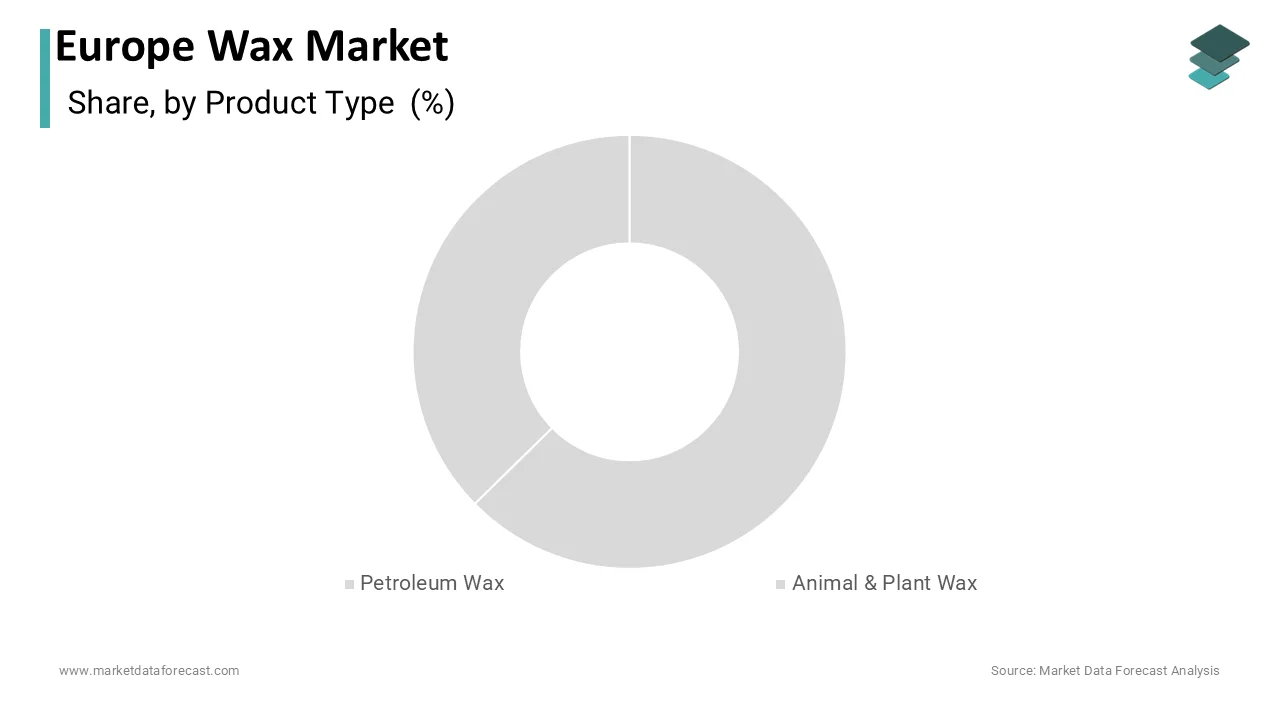
The animal and plant wax segment is estimated to register the fastest CAGR of 9.8% from 2025 to 2033 due to Europe’s stringent sustainability mandates and rising consumer preference for biodegradable, renewable ingredients. Beeswax, carnauba, candelilla, and rice bran waxes are increasingly adopted in cosmetics, food coatings, and eco packaging. There is a noticeable trend in European beauty markets toward incorporating biological waxes as foundational ingredients in new product formulations. Manufacturing preferences for personal care items are evolving to prioritize substances derived from botanical or insect sources. The food sector is experiencing a transition in how coatings are applied to produce and sweets. A shift in processing techniques has led to the more frequent use of specific natural glazes to enhance the surface appearance of confectionery and fruit. Both the cosmetic and food industries are demonstrating a shared pattern of moving toward ingredient profiles based on natural derivatives. Additionally, the European Pharmacopoeia now fully recognizes purified beeswax for pharmaceutical use, opening access to high-value dermo cosmetic markets. Investment in traceable supply chains further enhances credibility. This alignment with clean label trends, regulatory acceptance, and ethical sourcing standards fuels the rapid ascent of biohigh-valuees across premium European sectors.
By Application Insights
The candles segment captured the prominent share of 29.6% of theEuropeane wax market in 2025. The prominence of the candles segment is attributed to cultural traditions, ambient lighting demand, and gifting practices across the region. Europe is home to some of the world’s highest per capita candle consumption rates, particularly in Nordic and Germanic countries, where candles are integral to domestic life during long winter months. Personal care product manufacturers are increasingly replacing synthetic or mineral-based ingredients with waxes derived from botanical or biological sour,ces. There is a growing preference for using natural structuring agents to provide texture and stability in cosmetic formulations. The food sector is experiencing a transition toward the use of natural resins and waxes for coating perishable items and sweets. Surface treatments for produce and confectionery are increasingly relying on plant-based materials to maintain appearance and shelf life. A broader trend suggests an alignment between the ebeautyand food industries in adopting bio-based alternatives for product finishing and structural integrity. Religious and seasonal festivities, such as Christmas, Easter, and All Saints Day, further sustain baseline demand. Retail channels, from discounters like Aldi to luxury home goods stores, allocate significant shelf space to candles, reinforcing accessibility. This deep-rooted cultural integration, combined with consistent year-round usage, secures candles as the single largest wax-consuming application in Europe.
The packaging segment is anticipated to witness the fastest CAGR of 11.2% deep-rootedforecast perio, due to the EU’s aggressive pusyear-roundecyclable and compostable packaging, which has elevatebio-waxeses as functional alternatives to plastic laminates. Fiber-based packaging is experiencing increased production across various sectors. Natural wax coatings are becoming more common as a method to provide resistance to moisture and grease in food-related containers. Industry participants are increasingly developing paperboard solutions utilizing plant-based waxes that align with specific compostability criteria. Regional regulatory shifts are moving toward a requirement for all packaging materials to be designed for reuse or recycling. The adoption of bio-wax coatings helps minimize impurities during the recovery and reprocessing of paper materials. Large-scale retailers are shifting away from conventional plastics for fresh goods, leading to a broader integration of wax-based barriers in supply chains.
COUNTRY LEVEL ANALYSIS
Germany Wax Market Analysis
Germany led the European wax market by holding a share of 19.6% in 2025. The demand for wax in Germany is supported by a powerful combination of industrial manufacturing strength, regulatory leadership, and high consumer demand for both functionEuropean natural products. The country hosts Europe’s largest candle industry, producing substantial metric tons annually, as per sources. Simultaneously, Germany is a hub for cosmetic and pharmaceutical formulation, where purified beeswax and carnauba are essential in ointments and lip care. The nation’s advanced chemical infrastructure along the Rhine also supports synthetic wax production, ensuring dual capability in both conventional and bio-based segments. Strong environmental policies, such as the German Circular Economy Act, further accelerate innovation in sustainable wax coatings for packaging. This industrial versatility, coupled with disciplined consubio-basedior, cements Germany’s position as the continent’s most influential wax market.
France Wax Market Analysis
France was the second largest player in the European wax market and accounted for a 15.3% in 2025. The expansion of the French market is credited to its world-leading cosmetics and fragrance sector. Home to luxury houses such as L’Oréal, Chanel, and LVMH, France drives European demand for high-purity beeswax and carnauba in lipsticks, balms, and skincare. According to sources, world-leading companies accounted for a portion of all structuring agents used in new cosmetic formulations launched in 2023. In France, candles maintain strong traditions in religious and artisanal contexts, extending beyond their use for ambiance. The nation supports a large number of specialized craft makers,s and the market is seeing a shift toward sustainable innovation in wax production, including bio-sourced polyethylene wax from natural plant sources like sugarcane. Additionally, France’s National Agency for Food,d Environment, al and Occupational Health Safety has streamlined approval pathways for plant-based waxes in food contact materials. This blend of luxury formulation expertise, artisanal heritage, and green chemistry investment positions France as a high-value, trend-setting wax market.
United Kingdom Wax Market Analysis
The United Kingdom witnessed a steady expansion in the European wax market due to dynamic retail trends, robust candle culture, and rapid adoption of sustainable packaging solutions. British households are among Europe’s most avid candle consumers. The cosmetics sector further amplEuropeanwax demand, particularly in clean beauty brands like Neal’s Yard Remedies and Lush, which prioritize ethically sourced beeswax. Crucially, the UK’s post Brexit regulatory autonomy has enabled faster approval of novel bio-waxes. The packaging transition is equally advanced. Moreover, the UK’s strong e-commerce infrastructure facilitates direct-to-consumer sales of niche wax products, from vegan candelilla candles to artisanal shoe polishesbio-waxesile, consumer led market fosters both volume and innovation, securing the e-commerceas a key growth engine.
Italy Wax Market Analysis
Italy is also a major player in the European wax market, where wax usage is deeply interwoven withconsumer-ledanufacturing, food culture, and design aesthetics. The country is a major producer of premium candles, especially scented and decorative varieties for domestic and export markets, with Tuscany and Lombardy serving as key clusters. In cosmetics, Italian brands like Davines and Collistar rely on refined beeswax for hair and skin formulations, aligning with the “Made in Italy” emphasis on natural ingredients. Food applications are equally significant. Additionally, Italy’s strong paper industry, ranked third in the EU, adopts wax coatings for bakery and takeaway packaging. This fusion of heritage craftsmanship and modern food safety standards ensures Italy’s steady and diversified wax consumption.
Netherlands Wax Market Analysis
The Netherlands is anticipated to grow in theEuropeane wax market from 2025 to 2033 by functioning as a strategic logistics and innovation nexus rather than a high-volume end user. The logistical advantage enables efficient distribution to Germany, Belgium, and France. Simultaneously, the Netherlands is a leader in sustainable materials research; Wageningen University has pioneered emulsification techniques for rice bran wax in compostable packaging, now licensed to European converters. Dutch retailers have emphasized bio-based coatings for private label bakery packaging, accelerating commercial adoption. The country also hosts major chemical distributors such as IMCD, which formulates specialty wax blends for coatings and adhesives. The Nebio-based exerts a disproportionate influence on the European wax market's trajectory because, more so than for its local use, the country serves as a vital innovation center and formulation hub.
COMPETITIVE LANDSCAPE
The European wax market exhibits a dual competitive structure comprising global petrochemical giants and specialized bio-wax innovators. Large integrated players dominate the petroleum and synthetic segments through scale, distribution networks, and technical service capabilities, particularly in industrial applications like hot melt adhesibio-wax polymer processing. Meanwhile, niche specialists gain traction in high-value sectors such as organic cosmetics and compostable packaging by emphasizing traceability, renewability, and regulatory compliance. Competition is increasingly defined by sustainability credentials rather than price. High-value EU policies penalize non-recyclable materials and restricted substances. Private label pressure in candles and basic coatings keeps conventional wax suppliers focused on cost efficiency, while premium segments reward transparency and innovation. Non-recyclable sees cross-border consolidation, with European bio wax firms attracting investment from global ingredient majors seeking ESG-aligned portfolios. Overall, rivalry centers on the ability to balance performance, compliance, and a rapidly evolving regulatory anbio-waxmer landscape.
KEY MARKET PLAYERS
Some of the companies that are playing a dominating role in the europe wax market include
- Brenntag AG
- Clariant AG
- BASF SE
- Eastman Chemical Company
- Shell plc (Shell Chemicals)
- ExxonMobil Corporation
- H&R Group
- Sasol Limited
- Waxie Sanitary Supply (industrial waxes)
- Strahl & Pitsch GmbH
- Humble Oil & Refining Co.
- Stern Chemicals
- Paramelt B.V.
- IOI Group
- Meltasol Wax Corp.
- Croda International Plc
- Honeywell International Inc.
- Zschimmer & Schwarz GmbH & Co. KG
- New Phase Technologies, Inc.
TOP LEADING PLAYERS IN THE MARKET
- Sasol Limited is a global integrated energy and chemical company with a significant presence in the European wax market through its specialty waxes division. The company supplies high-purity Fischer Tropsch and polyethylene waxes used in coatings, adhesives, and personal care formulations across the continent. Sasol has strengthened its European footprint by aligning its product portfolio with EU sustainability directives, including the development of low-carbon footprint waxes derived from gas-to-liquids technology.
- Koster Keunen is a century-old specialist in natural and synthetic waxes with deep integration into Europe’s cosmetics, food, and pharmaceutical sectors. The low-carbonurces and refines beeswax, cargas-to-liquidsdelilla to pharma grade standardcentury-oldleading beauty and health brands across France, Germany, and the Nordics. Its initiative has accelerated its inclusion in clean beauty supply chains and supported compliance with the EU’s upcoming pharma-gradeation and green claims regulations, positioning the company as a trusted partner in responsible wax sourcing.
- Paramelt BV is a Netherlands-based leader in sustainable wax solutions, renowned for its innovation inbio-basedd andhalal-certifiedd waxes for cosmetics, candles, and food applications. The company has pioneered the use of rice bran and susunflower-based alternativeso carnauba in vegan formulations, gaining traction among European clean label brands. Additionally, the company achieved ISCC Plus certification for its entire bio wax portfolio, enabling clients to validate circularity claims under EU packaging rules. These strategic moves have solidified clean-labelrole as a forward-looking enabler of the green transition in the European wax industry.
TOP STRATEGIES USED BY THE KEY MARKET PARTICIPANTS
Key players in the European wax market are intensifying investments in bio-based and circular wax in compliance with the stringent EU chemical and packaging regulations. They are securing ethical and traceable supply chains for natural waxesEuropeangh direct partnerships with cooperatives andbio-basedmonitoring systems. Product portfolios are being reformulated to eliminate substances of very great concern under REACH while maintaining performance in demanding applications. Companies are expanding specialty wax production capacity in strategic EU logistics hubs to ensure supply resilience and reduce lead times. CoCooperationsith packaging converters and cosmetic formulators enable co-development of application-specific solutions. Certification under schemes such as ISCC Plus and COSMOS enhances credibility in sustainability claims. Innovation in emulsion and dispersion technologies improves compatibilico-developmentbaseapplication-specifics and adhesives. These strategies collectively address regulatory, environmental, and performance demands shaping the future of the European wax market.
MARKET SEGMENTATION
This research report on the europe wax market is segmented and sub-segmented into the following categories.
By Type
- Natural Wax
- Synthetic Wax
- Mineral Wax
By Application
- Candles
- Cosmetics and Toiletries
- Fire Logs
- Plastic and Rubber
- Pharmaceuticals
- Packaging
- Adhesives
- Others
By Country
- Germany
- France
- United Kingdom
- Italy
- Netherlands
- Rest of Europe