- Product Description Description
- Table of Contents TOC
- List of Table & Figure LOT
- Get Free Sample PDF Sample PDF
Market Size, 2025
$1.12 BnMarket Estimate, 2026
$1.31 BnMarket Forecast, 2034
$4.67 BnCAGR, 2026–2034
17.22%Europe Website Builders Market Report Summary
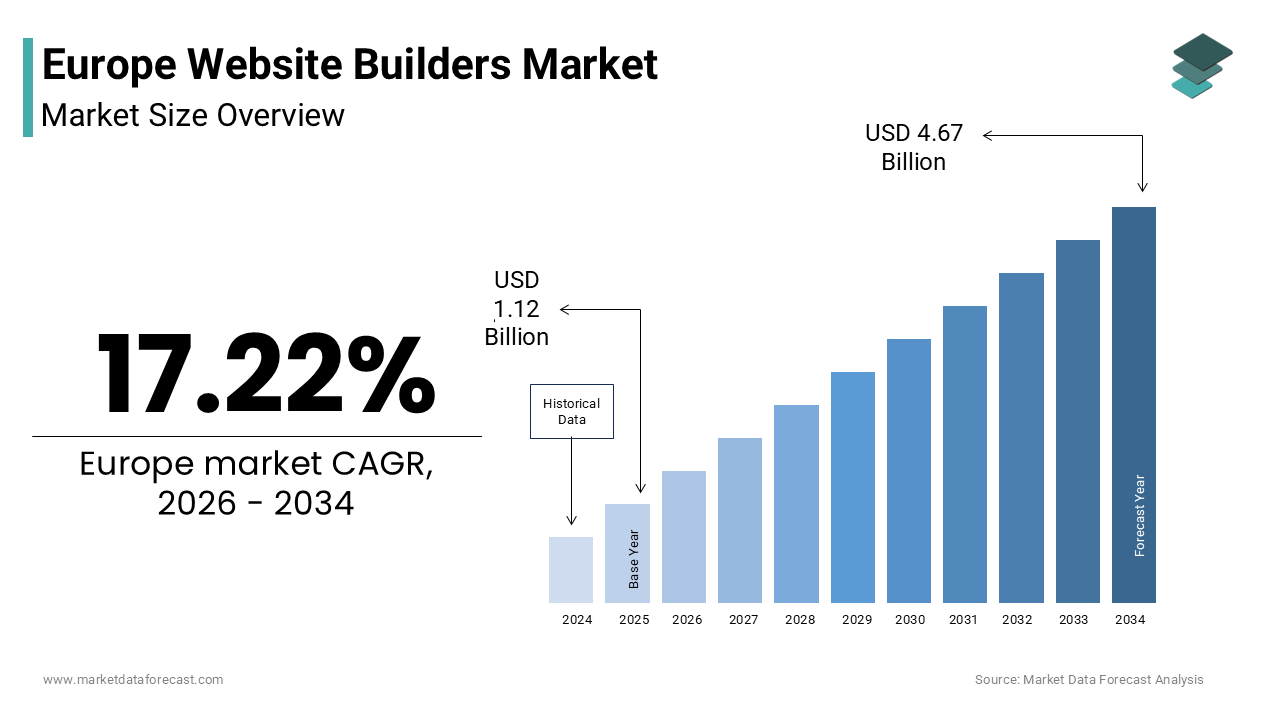
The Europe website builders market was valued at USD 1.12 billion in 2025, is estimated to reach USD 1.31 billion in 2026, and is projected to reach USD 4.67 billion by 2034, growing at a CAGR of 17.22% during the forecast period from 2026 to 2034. The growth of the Europe website builders market is driven by the rapid digitalization of small and medium-sized enterprises, increasing demand for cost-effective online presence solutions, and advancements in artificial intelligence-powered design tools. The expansion of e-commerce, no-code development platforms, and cloud-based solutions is further accelerating market growth. Moreover, the integration of AI-driven automation, SEO tools, and omnichannel capabilities is transforming website builders into comprehensive digital business platforms across Europe.
Key Market Trends
-
Rising adoption of AI-powered website builders is enabling automated design, content generation, and optimization.
-
Increasing demand for no-code and low-code platforms simplifying web development for non-technical users.
-
Growth of e-commerce integration with multi-channel selling and payment gateway support.
-
Expansion of mobile-first website building tools catering to solopreneurs and digital creators.
-
Strong focus on data privacy, compliance, and localized hosting solutions across European markets.
Segmental Insights
- Based on builder type, the PC website builders segment dominated the Europe website builders market in 2025. The segment’s dominance is attributed to the need for advanced design control, better interface capabilities, and efficient management of complex business websites.
- Based on deployment, the cloud segment held the largest share of the Europe website builders market in 2025. This is driven by the flexibility, scalability, and accessibility offered by cloud-based platforms, enabling users to manage websites from anywhere.
- Based on end user, the business segment accounted for the largest share of the Europe website builders market in 2025. The dominance of this segment is due to the growing reliance of enterprises on websites as primary sales channels, branding tools, and digital commerce hubs.
Regional Insights
The Europe website builders market is witnessing strong growth across major countries, supported by increasing digital adoption, government initiatives, and expanding online business ecosystems.
-
The United Kingdom dominated the Europe website builders market in 2025, driven by its advanced digital economy, strong startup ecosystem, and high adoption of e-commerce platforms.
-
Germany continues to expand steadily due to the digital transformation of its SME sector, increasing adoption of compliant cloud solutions, and demand for advanced customization capabilities.
-
France is emerging as a key market supported by government-led digitalization initiatives, strong creative industries, and increasing adoption of omnichannel business strategies.
-
Italy is witnessing significant growth driven by rising entrepreneurship, high mobile usage, and increasing reliance on digital platforms in the tourism and retail sectors.
-
Spain is gaining traction due to rapid SME digitization, strong mobile internet penetration, and increasing demand for multilingual website solutions in the tourism industry.
Competitive Landscape
The Europe website builders market is highly competitive and characterized by intense rivalry among global platforms and regional providers. Companies are focusing on AI-driven innovation, ease of use, and comprehensive digital ecosystems to differentiate themselves. Strategic initiatives such as expanding data center infrastructure, enhancing e-commerce capabilities, and integrating marketing tools are strengthening market positions. Additionally, compliance with European data privacy regulations and localization of services play a critical role in competitive advantage. Key players in the Europe website builders market include Wix.com Ltd., Squarespace, Inc., GoDaddy Inc., Shopify Inc., Automattic, Inc., Webflow, Inc., Duda, Inc., Weebly, Inc., Jimdo GmbH, and BigCommerce Holdings, Inc.
Europe Website Builders Market Size
The Europe website builders market size was valued at USD 1.12 billion in 2025 and is anticipated to reach USD 1.31 billion in 2026 from USD 4.67 billion by 2034, growing at a CAGR of 17.22% during the forecast period from 2026 to 2034.
Website builders represent a dynamic ecosystem of software as a service platform that empower users to design, deploy, and manage digital presences without requiring extensive coding knowledge or technical infrastructure management. This sector has evolved from simple drag-and-drop templates into comprehensive digital commerce hubs integrating artificial intelligence, search engine optimization tools, and multi-channel sales capabilities. The region is distinct due to its fragmented linguistic landscape and stringent data privacy regulations which shape how these platforms operate and localize their services. According to Eurostat, enterprises in the European Union with ten or more employees generally maintain a website or homepage, which is reflecting a widespread baseline for online presence. The European Commission emphasizes that digitalization is critical for the competitiveness of small and medium-sized enterprises, which is driving initiatives to lower barriers to entry for online business creation. As per the International Telecommunication Union, broadband penetration in Western Europe is broadly established to ensure connectivity for cloud-based editing and high-resolution media hosting. The definition now encompasses no-code development environments that allow for complex logic and database integration, blurring the lines between simple site creators and full-scale application development platforms. This evolution transforms the market from a tool for static information display into a strategic engine for digital transformation across all industry verticals.
MARKET DRIVERS
Proliferation of Small and Medium-Sized Enterprises, Digitalization Initiatives
The aggressive push towards digital transformation among small and medium-sized enterprises is a key factor propelling the growth of the European website builders market. Traditional brick-and-mortar businesses are increasingly recognizing the necessity of a robust online presence to survive economic fluctuations and reach broader customer bases beyond their immediate geographical locations. According to the European Commission, small and medium-sized enterprises make up the overwhelming majority of businesses in the European Union, which is creating a massive addressable market for accessible web development tools. Many of these entities lack the financial resources to hire professional web development agencies, making do-it-yourself website builders the most viable solution for establishing an online footprint. As per Eurostat, small businesses are increasingly adopting online sales, driven by the need to diversify revenue streams and adapt to changing consumer behaviours. These platforms offer cost-effective subscription models that include hosting, security, and maintenance, removing the technical burden from business owners. The ability to launch a professional-looking site within hours rather than weeks allows entrepreneurs to react quickly to market opportunities. Government grants and digital vouchers in countries like France and Germany further subsidize the adoption of these tools, accelerating the rate of digitization. This structural shift ensures that website builders remain the foundational technology for European small business growth.
Integration of Artificial Intelligence and Automated Design Capabilities
The incorporation of advanced artificial intelligence and machine learning algorithms into website building platforms serves as a powerful driver of the regional market expansion by significantly lowering the skill threshold required to create sophisticated digital experiences. Modern users expect personalized, high-performance websites that are optimized for search engines and mobile devices, tasks that were previously too complex for non-technical individuals. According to the European Laboratory for Learning and Intelligent Systems, AI-driven design tools can now generate complete website layouts, write compelling copy, and select appropriate imagery based on simple user prompts. This automation democratizes high-quality web design, allowing individuals with zero creative background to produce results comparable to professional agencies. As per Gartner, new websites in Europe are expected to increasingly utilize generative AI for content or layout generation. Features such as automated search engine optimization analysis, chatbot integration, and predictive user behavior analytics provide immediate value that static templates cannot offer. The continuous improvement of natural language processing enables users to edit sites using conversational commands, further simplifying the workflow. This technological leap transforms website builders from passive tools into active collaborators, driving adoption among users who previously felt intimidated by the complexity of web publishing. The promise of effortless professionalism ensures sustained demand for AI-enhanced platforms.
MARKET RESTRAINTS
Stringent Data Privacy Regulations and Compliance Complexity
The rigorous enforcement of data protection laws, particularly the General Data Protection Regulation is impeding the growth of the European website builders market. These regulations mandate strict controls over how personal data is collected, stored, and processed, requiring platforms to build sophisticated compliance features into their core architecture. The European Data Protection Board has issued multiple guidelines emphasizing that website owners are fully responsible for the data handled by their sites, including third-party cookies and tracking scripts embedded via builders. As per the International Association of Privacy Professionals, non-compliance fines can be severe, creating a climate of fear among small business owners who may avoid launching sites due to liability concerns. Website builder companies must constantly update their systems to adhere to evolving national interpretations of EU laws, which is increasing development costs and slowing down feature rollouts. The requirement for explicit consent mechanisms and detailed privacy policies often complicates the user experience, leading to higher abandonment rates during the site setup process. Smaller platform providers may struggle to afford the legal expertise and technical infrastructure needed to guarantee full compliance, leading to market consolidation. This regulatory burden acts as a restraint on innovation and slows the adoption rate among risk-averse entrepreneurs who perceive legal compliance as an insurmountable hurdle.
Limitations in Scalability and Customization for Growing Businesses
The inherent architectural constraints of many website builder platforms regarding scalability and deep customization is further hindering the expansion of the European website builders market. While these tools are excellent for launching initial sites, they often struggle to support complex enterprise-level requirements such as advanced database integrations, custom API connections, or highly specific user journey mappings. According to the European Software Industry Association, many businesses eventually outgrow their initial website builder, forcing them to undertake costly and disruptive migrations to more flexible content management systems or custom-coded solutions. This ceiling effect discourages ambitious startups from investing heavily in builder ecosystems, knowing they may eventually hit a wall. The reliance on proprietary code and closed ecosystems makes it difficult to export data or replicate designs elsewhere, creating vendor lock-in that limits strategic flexibility. As per Forrester, the total cost of ownership for a growing business can escalate significantly when factoring in the need for premium plugins and workarounds to achieve basic functionality available in open-source alternatives. The inability to fully control server-side performance or implement bespoke security protocols also deters organizations in regulated industries. This limitation on long-term viability restricts the market potential to the lower end of the business spectrum, preventing deeper penetration into the mid-market and enterprise segments.
MARKET OPPORTUNITIES
Expansion of Headless Commerce and Omnichannel Integration
The rising adoption of headless commerce architectures presents a promising opportunity for the European website builders market. This approach allows businesses to decouple their presentation layer from their commerce engine, enabling them to deliver consistent content across websites, mobile apps, smart watches, and Internet of Things devices simultaneously. According to the European E-commerce Association, many retailers are planning to adopt omnichannel strategies, creating a surge in demand for builders that support headless configurations via robust application programming interfaces. By offering headless capabilities, website builder providers can attract larger enterprises that require the ease of use of a drag-and-drop editor but the flexibility of a custom tech stack. This shift opens new revenue streams through enterprise-tier subscriptions and specialized integration services. As per McKinsey, companies utilizing headless commerce generally experience improved conversion rates due to faster page loads and personalized experiences across touchpoints. The ability to integrate with various enterprise resource planning and customer relationship management systems without compromising the user interface makes these platforms indispensable for modern digital ecosystems. Embracing headless technology positions website builders as central hubs in the composable commerce landscape, which is driving significant growth and relevance.
Penetration of Underserved Rural and Traditional Industries
The vast potential of digitizing traditional industries and rural businesses that have historically lagged in technology adoption offers a lucrative avenue for market expansion across less urbanized regions of Europe. Sectors such as agriculture, local craftsmanship, and rural tourism often lack the digital literacy and resources to establish an online presence, representing a massive untapped customer base. According to the European Rural Development Network, rural enterprises in Southern and Eastern Europe have lower levels of website adoption compared to urban counterparts, highlighting a significant gap. Website builder companies can capitalize on this by developing hyper-localized solutions featuring industry-specific templates, simplified interfaces in regional dialects, and bundled marketing services tailored to local needs. Partnerships with local chambers of commerce and government digitization programs can facilitate trust and distribution in these communities. As per the European Commission, bridging the digital divide is a top priority, with significant funding allocated to support rural digitalization initiatives. By positioning their platforms as essential tools for economic survival and growth in these sectors, providers can unlock millions of new users. The low competition in these niches allows for higher customer retention and loyalty. This focus on inclusivity and regional development ensures long-term sustainable growth for the market.
MARKET CHALLENGES
Intense Market Saturation and Price Wars
The extreme saturation of the website builders market with numerous global and local players has led to fierce price competition that erodes profit margins and complicates customer acquisition strategies. The barrier to entry for launching a basic website builder is relatively low, resulting in a crowded landscape where hundreds of platforms compete for the same pool of small business customers. According to the European Consumer Organisation, entry-level website builder subscriptions have become more affordable due to aggressive discounting and freemium models. This race to the bottom forces companies to slash prices to attract users, making it difficult to recoup the high costs of research and development, security compliance, and customer support. Differentiation becomes increasingly challenging as core features like drag-and-drop editors and mobile responsiveness become commoditized standards. As per Statista, churn rates in the website builder sector remain high, as users frequently switch platforms in search of better deals or slightly different feature sets. The heavy reliance on paid advertising to acquire customers in such a noisy market further strains financial resource. Companies struggle to maintain profitability while investing in innovation, leading to a cycle where only the largest players with deep pockets can survive. This hyper-competitive environment stifles creativity and threatens the long-term stability of smaller niche providers.
Security Vulnerabilities and Trust Deficits
The increasing frequency of cyberattacks targeting small business websites hosted on builder platforms is further challenging the expansion of the European website builders market. As website builders host millions of sites, they become attractive targets for hackers seeking to exploit vulnerabilities in shared infrastructure, inject malware, or steal customer data. According to the European Union Agency for Cybersecurity, attacks on small business websites have been rising, with many incidents traced back to compromised accounts on popular builder platforms. A single high-profile breach can devastate the reputation of a provider, leading to mass exodus of users and legal repercussions. Ensuring robust security measures such as automatic SSL certificates, daily backups, and advanced threat detection requires significant ongoing investment which some lower-cost providers may skimp on. As per the SANS Institute, many small business owners lack the knowledge to configure security settings correctly, relying entirely on the platform's default protections which may not be sufficient against sophisticated threats. The complexity of managing third-party plugins and integrations further expands the attack surface, creating potential entry points for malicious actors. Building and maintaining user confidence in an era of escalating cyber threats requires constant vigilance and transparency, which is difficult to communicate effectively to non-technical users. This persistent security risk remains a critical hurdle for market growth.
REPORT COVERAGE
| REPORT METRIC | DETAILS |
| Market Size Available | 2025 to 2034 |
| Base Year | 2025 |
| Forecast Period | 2026 to 2034 |
| CAGR | 17.22% |
| Segments Covered | By Builder Type, Deployment, End-User and Region. |
| Various Analyses Covered | Global, Regional & Country Level Analysis, Segment-Level Analysis, DROC, PESTLE Analysis, Porter’s Five Forces Analysis, Competitive Landscape, Analyst Overview of Investment Opportunities |
| Country Covered | UK, France, Spain, Germany, Italy, Russia, Sweden, Denmark, Switzerland, the Netherlands, Turkey, the Czech Republic, and the Rest of Europe. |
| Market Leaders Profiled | Key players in the Europe Website Builders Market include Wix.com Ltd., Squarespace, Inc., GoDaddy Inc., Shopify Inc., Automattic, Inc., Webflow, Inc., Duda, Inc., Weebly, Inc., Jimdo GmbH, and BigCommerce Holdings, Inc |
SEGMENTAL ANALYSIS
By Builder Type Insights
The PC website builders segment dominated the market by holding 66.5% of the European market share in 2025. The dominance of PC website builders segment in the European market can be credited to the necessity for comprehensive design control and the complexity of managing full-scale business websites which are difficult to execute on smaller screens. The growth of the PC-based builders segment is also driven by the superior interface real estate and processing power offered by desktop computers, which are essential for intricate layout adjustments and multi-element management. Professional web designers and business owners require precise pixel-level control, advanced typography settings, and the ability to manage complex navigation structures that are often cumbersome or impossible to replicate on mobile devices. According to the European Software Industry Association, professional web development tasks in Europe are still primarily performed on desktop or laptop computers due to the need for dual monitor setups and keyboard shortcuts. As per Statista, editing sessions on PCs typically last longer than on mobile devices, indicating deeper engagement and more substantial project completion. The ability to integrate third-party plugins, manage large media databases, and perform detailed search engine optimization analysis relies heavily on the robust operating systems found on personal computers. This functional superiority ensures that serious business projects remain anchored to PC environments. The limitation of mobile screens in displaying complex backend dashboards further cements the PC segment as the standard for professional web creation.
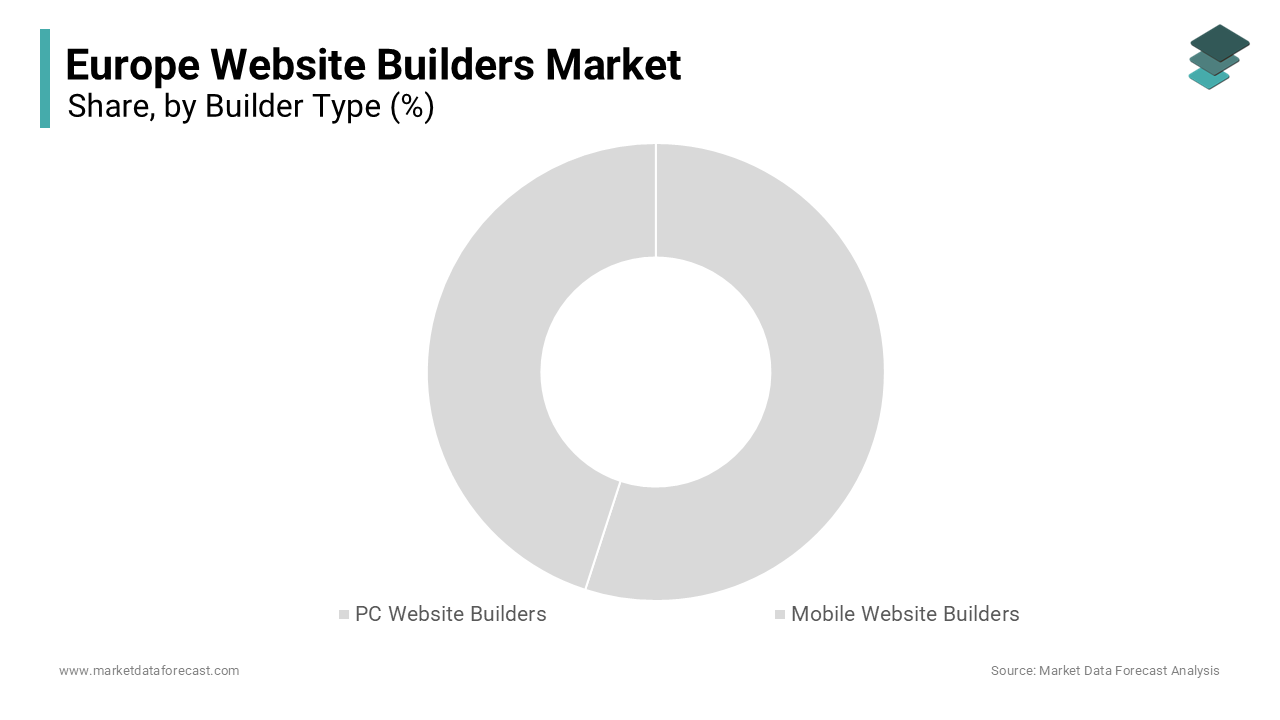
However, the mobile website builders segment is a promising segment and is estimated to witness a CAGR of 23.2% over the forecast period owing to the ubiquity of smartphones and the rising trend of micro-entrepreneurship among younger demographics and the surge in micro-entrepreneurship and the shift towards social commerce where individuals manage entire businesses directly from their smartphones. A new generation of solopreneurs and gig workers in Europe prefers to create and update their online presence on the go, leveraging mobile-first platforms to sell products via Instagram and TikTok without needing a traditional computer. According to the European Commission, self-employed individuals in the EU increasingly rely on mobile devices for business operations. As per GSMA Intelligence, internet traffic in Southern and Eastern Europe predominantly originates from mobile devices, prompting builders to prioritize mobile editing capabilities. These platforms often integrate seamlessly with mobile payment solutions and shipping apps, creating a closed-loop ecosystem for mobile-native businesses. The ability to capture photos of products and upload them directly to the site eliminates the need for intermediate file transfers. This alignment with the lifestyle of modern digital nomads and small vendors drives unprecedented adoption rates. The convenience of managing a business entirely from a pocket device ensures this segment will grow faster than any other.
By Deployment Insights
The cloud deployment segment held the highest share of the European website builders market in 2025 owing to the inherent nature of website builders as software-as-a-service solutions that require constant connectivity and centralized hosting. The foremost driver for the dominance of cloud deployment is the unparalleled accessibility it offers, allowing users to access, edit, and publish their websites from any device with an internet connection. This flexibility is crucial for modern businesses where teams are often distributed across different locations or working remotely. According to the European Foundation for the Improvement of Living and Working Conditions, remote work is widespread across Europe, making cloud-based tools essential for collaborative web development. As per Microsoft, adoption of cloud collaboration tools in Europe has significantly increased, reflecting a permanent shift in work dynamics. Cloud platforms eliminate the need for local software installation, version control conflicts, and manual backups, streamlining the entire workflow. Users benefit from automatic updates that ensure they always have access to the latest features and security patches without downtime. The ability to scale resources dynamically based on traffic spikes ensures consistent performance without user intervention. This ease of access and seamless collaboration makes cloud deployment the default choice for the vast majority of users.
By End User Insights
The business end-user segment had the leading share of 71.7% of the European market share in 2025. The dominance of business segment in the European market can be credited to the critical role websites play as primary sales channels and brand hubs for commercial entities. The relentless expansion of e-commerce and the absolute necessity for companies to maintain a professional and functional digital storefront to compete in the modern economy is further driving the dominance of the business segment in the European market. According to the European E-commerce Association, online retail sales in the EU have reached significant volumes, with small and medium-sized enterprises increasingly contributing through their own direct-to-consumer sites. As per McKinsey, companies with optimized e-commerce websites generally achieve higher conversion rates compared to those relying solely on third-party marketplaces. The ability to control branding, customer data, and marketing strategies drives businesses to invest in dedicated website solutions rather than simple social media pages. The complexity of managing product catalogs, customer accounts, and order fulfillment necessitates advanced features found in business-tier builders. The ongoing digitization of supply chains and customer service further entrenches the website as the central hub of business operations.
The individual end user segment is a promising segment and is anticipated to register a CAGR of 17.5% over the forecast period owing to the rise of the creator economy and the increasing need for personal branding in the digital age. The burgeoning creator economy where influencers, freelancers, artists, and professionals build personal brands to monetize their skills and content is also aiding the expansion of the individual end-user segment in the European market. Platforms like YouTube, Instagram, and TikTok have empowered individuals to become entrepreneurs who need dedicated websites to host portfolios, sell merchandise, or offer consulting services. According to the European Creator Economy Report, the number of full-time content creators in Europe has been rising, creating a massive new demographic of individual website owners. As per Patreon, many creators now view a personal website as essential for owning their audience data and reducing reliance on algorithm-driven social media platforms. Website builders offer affordable plans tailored to individuals, including features like booking systems, digital download stores, and newsletter integrations. The desire for creative expression and autonomy drives individuals to launch personal blogs, photography galleries, and resume sites. The low barrier to entry enables anyone to establish a digital identity quickly. This cultural shift towards personal entrepreneurship ensures that the individual segment will grow at the fastest pace. The democratization of web publishing fuels this sustained expansion.
REGIONAL ANALYSIS
United Kingdom Website Builders Market Analysis
The United Kingdom dominated the website builders market in Europe in 2025 with 23.2% of the regional market share. The leading position of the UK in the European market is attributed to its mature digital economy and high concentration of small and medium-sized enterprises. The nation serves as a primary testing ground for global website builder platforms launching new features and artificial intelligence tools before wider European rollouts. The UK government Digital Strategy aims to make the country a global tech superpower, driving massive investment in digital skills and online business creation. As per the Office for National Statistics, e-commerce penetration in the UK is among the highest globally, creating a saturated but highly active market for advanced builder features. The presence of a vibrant startup ecosystem in London and Manchester fosters innovation in web design and digital marketing. British consumers are early adopters of new technologies, pushing providers to offer cutting-edge functionalities like headless commerce and AI integration. The strong regulatory framework regarding data privacy also sets high standards for compliance features within builders. The cultural emphasis on entrepreneurship and the availability of venture capital ensure sustained demand for professional web tools.
Germany Website Builders Market Analysis
Germany held a promising share of the European website builders market in 2025 due to its robust industrial base and the rapid digitalization of its renowned Mittelstand sector. The German market was historically slower to adopt cloud-based tools due to data sovereignty concerns but has recently surged as providers offer compliant local hosting solutions. The Federal Ministry for Economic Affairs and Climate Action supports digital infrastructure projects ensuring that rural areas gain access to high-speed internet necessary for cloud editing. As per Statista, online shops in Germany have been increasing, marking a significant shift towards direct-to-consumer models among traditional manufacturers. German audiences show a strong preference for detailed, information-rich websites and strict adherence to legal imprint requirements, prompting platforms to localize their compliance features heavily. The high level of technical expertise among German users drives demand for advanced customization and integration capabilities. The thriving freelance and agency sector also contributes to the market by utilizing professional-tier builder tools for client projects.
France Website Builders Market Analysis
France is estimated to account for a prominent share of the European website builders market over the forecast period owing to its strong state-led digitalization initiatives and vibrant creative industries to drive website builder adoption. The French government views digital sovereignty as a strategic priority, encouraging the use of platforms that guarantee data residency within national borders. The "France 2030" investment plan dedicates significant resources to supporting small businesses in their digital transition, often providing vouchers for website creation services. As per INSEE, digital spending in the French retail sector has been rising, reflecting the push for omnichannel strategies. The country's strong fashion, luxury, and gastronomy sectors drive demand for visually stunning and highly customized website templates that reflect brand prestige. French users place a high value on design aesthetics and storytelling, influencing the feature sets offered by builders in the region.
Italy Website Builders Market Analysis
Italy is predicted to showcase a healthy CAGR in the European website builders market during the forecast period owing to a passionate entrepreneurial spirit and a tourism sector that heavily relies on digital presence to attract international visitors. The Italian website builder market has transformed rapidly with the entry of global players and the consolidation of local digital agencies offering builder-based solutions. The Italian Communications Authority notes that mobile usage is particularly high in Italy, driving demand for mobile-first website building tools among small business owners. As per ISTAT, time spent on e-commerce platforms in Italy has been increasing, surpassing traditional retail growth among younger demographics. Local productions focusing on food, wine, and travel have achieved remarkable success online, retaining subscribers who value cultural relevance. Infrastructure improvements in the south of the country are expanding the addressable market beyond the wealthy northern regions.
Spain Website Builders Market Analysis
Spain emerges as a rapidly growing market due to its role as a major tourist destination and the rapid digitization of its small business sector. Spanish website builder platforms have successfully exported locally produced templates to global audiences, creating a feedback loop that boosts domestic pride and subscriptions. The Institute of Tourism Studies highlights that Spain attracted record foreign visitors in 2024, enhancing the local content library and driving demand for multilingual website capabilities. As per ComScore, mobile internet usage in Spain is among the highest in Europe, with users frequently switching between devices to manage their online presence. The competitive pricing strategies of local telecom operators bundling website builder services have democratized access for lower-income households. The youthful demographic profile of the country aligns perfectly with the digital native preferences of modern builders.
COMPETITIVE LANDSCAPE
The competition in the Europe website builders market is fiercely intense and characterized by a complex battle between global hyperscalers and agile regional providers vying for dominance in a highly regulated environment. Incumbent players leverage their extensive template libraries and brand recognition to secure market share while new entrants disrupt the status quo with niche specific solutions and superior artificial intelligence capabilities. The rivalry intensifies as firms engage in feature wars offering increasingly sophisticated design tools and e-commerce functionalities to attract and retain users. Strategic partnerships with telecommunications providers have become essential for bundling services and reducing customer acquisition costs in saturated markets. Competitors constantly monitor each other moves to quickly replicate successful innovations or counter price reductions with value added packages. The pressure to comply with stringent European Union laws regarding data privacy and cookie consent further shapes competitive strategies significantly. Companies that can demonstrate superior ease of use robust security compliance and localized support gain a distinct advantage. This dynamic landscape drives continuous innovation in user experience and automation ensuring that European businesses benefit from increasingly powerful and accessible web creation tools.
KEY MARKET PLAYERS
Some of the companies that are playing a dominating role in the Europe Website Builders Market include
- Wix.com Ltd.
- Squarespace, Inc.
- GoDaddy Inc.
- Shopify Inc.
- Automattic, Inc. (WordPress)
- Webflow, Inc.
- Duda, Inc.
- Weebly, Inc.
- Jimdo GmbH
- BigCommerce Holdings, Inc.
Top Players in the Europe Website Builders Market
Wix.com Ltd
Wix.com Ltd stands as a pioneering force in the Europe website builders market by delivering an intuitive cloud based platform that empowers millions of users to create professional websites without coding knowledge. The company revolutionized global web design through its drag and drop editor and extensive template library catering to diverse industries. Recently Wix significantly expanded its artificial intelligence capabilities by launching an AI site generator that builds complete websites from simple text prompts, streamlining the creation process for European small businesses. This strategic innovation strengthens its position by reducing the time required to launch an online presence. The platform also introduced advanced e-commerce tools and booking systems tailored to local European payment methods and regulations. Wix continues to invest heavily in mobile optimization ensuring seamless editing experiences on smartphones. Its commitment to accessibility and multilingual support ensures it remains a dominant choice for users across the continent. By focusing on automation and user empowerment Wix helps entrepreneurs navigate the digital landscape with ease and efficiency.
Hostinger International
Hostinger International plays a critical role in the Europe website builders market by offering affordable high performance hosting solutions integrated with an easy to use AI powered website builder. The company differentiates itself by providing exceptional value through bundled services that include domain registration and security features at competitive price points. Globally Hostinger drives adoption among budget conscious startups and individuals seeking reliable infrastructure without compromising on speed. Recent actions include the expansion of its data center footprint in Western Europe to ensure low latency and strict compliance with General Data Protection Regulation requirements. This localization strategy enhances trust among European users concerned about data sovereignty. The company also upgraded its builder interface with smart design suggestions and automated content generation tools. Hostinger utilizes advanced caching technologies to deliver fast loading times which are crucial for search engine ranking. Their focus on customer support in multiple European languages fosters strong loyalty. By balancing cost efficiency with robust technical performance Hostinger solidifies its status as a formidable competitor in the region.
Squarespace Inc
Squarespace Inc exerts significant influence in the Europe website builders market through its award winning design templates that appeal to creatives and lifestyle brands seeking aesthetic excellence. The company capitalizes on its reputation for visual sophistication to attract photographers artists and boutique retailers across the continent. Globally Squarespace sets benchmarks for integrated commerce solutions that blend storytelling with selling capabilities seamlessly. Recent strategies involve the introduction of comprehensive marketing suites including email campaigns and social media integration within the builder ecosystem. This holistic approach allows European businesses to manage their entire digital presence from a single dashboard. The company also enhanced its analytics tools to provide deeper insights into visitor behavior and sales performance. Squarespace has begun introducing localized currency and tax calculation features to simplify cross border trade within the European Union. The studio continues to produce high quality educational resources to help users maximize the platform potential. This combination of design leadership and functional depth ensures Squarespace remains a central pillar of the creative economy in Europe.
Top Strategies Used by Key Market Participants
Key players in the Europe website builders market primarily employ aggressive artificial intelligence integration strategies to automate design processes and content creation thereby lowering barriers for non technical users. Companies frequently invest in developing generative AI tools that can build entire websites from simple text descriptions to accelerate time to market. Another prevalent strategy involves expanding local data center infrastructure to ensure strict compliance with European data privacy regulations and reduce latency for regional users. Market participants also focus on bundling comprehensive digital marketing suites including email automation and search engine optimization tools to increase customer retention and lifetime value. Expanding into specialized e-commerce functionalities such as multi currency support and local payment gateway integration allows firms to capture the growing online retail sector. Furthermore companies are actively pursuing partnerships with domain registrars and hosting providers to offer all in one solutions that simplify the setup process. These diversified approaches enable stakeholders to navigate regulatory complexities and meet the evolving demands of digital entrepreneurship effectively.
MARKET SEGMENTATION
This research report on the Europe website builders market has been segmented and sub-segmented based on the following categories.
By Builder Type
- PC Website Builders
- Mobile Website Builders
By Deployment
- Cloud
- On-Premises
By End User
- Individuals
- Businesses
By Country
- UK
- France
- Spain
- Germany
- Italy
- Russia
- Sweden
- Denmark
- Switzerland
- Netherlands
- Turkey
- Czech Republic
- Rest of Europe