- Product Description Description
- Table of Contents TOC
- List of Table & Figure LOT
- Get Free Sample PDF Sample PDF
Market Size, 2025
$2.04 BnMarket Estimate, 2026
$2.12 BnMarket Forecast, 2034
$2.91 BnCAGR, 2026–2034
4.04%Executive Summary: Europe Wheat Seed Market
- Market Scope: Comprehensive regional market analysis covering product types, application segments, regulatory frameworks, digital agricultural integrations, and country-level breakdowns across Europe.
- Market Valuation: Valued at USD 2.04 billion (2025), estimated at USD 2.12 billion (2026), and projected to reach USD 2.91 billion by 2034, registering a steady CAGR of 4.04% (2026–2034) backed by stringent EU seed certification standards and agrifood sovereignty initiatives.
- Primary Growth Drivers: EU policy emphasis on food security and self-sufficiency, rising incidence of climate-induced biotic and abiotic stresses driving demand for climate-resilient varieties, and the convergence of digital precision agriculture with seed technology. Market constraints include strict GMO restrictions and fragmented variety registration systems across member states.
Key Market Segment Metrics (2026–2034)
| Category | Leading Segment (2025 Position) | Fastest-Growing Segment |
|---|---|---|
| By Type | Hard red winter wheat (captured a dominant 42.3% share in 2024, valued for autumn sowing and yield stability) | Durum wheat (estimated to register the fastest CAGR of 6.8% from 2025 to 2033 due to semolina demand and import reduction goals) |
| By Application | Bakery (captured a 58.6% market share in 2024, driven by Europe's bread culture and clean label requirements) | Nutritional supplements (anticipated to witness the fastest CAGR of 9.3% due to rising demand for plant-based protein isolates and wheat germ oil) |
| By Country / Region | France (dominated with a 22.4% share in 2024, driven by extensive arable land, high seed replacement rates, and breeding leadership) | United Kingdom & Eastern European nations (expanding through specialized science-led seed registration systems and local production scale-up) |
Major Market Players & Market Structure
Market Structure: Highly regulated and scientifically rigorous market landscape comprising major cooperative breeders, national research institutions (such as INRAE and Julius Kühn Institute), and multinational agribusinesses competing on genetic performance, disease resistance, and value chain integration under EU Directive 2002/53/EC.
Key Companies: Limagrain, KWS Saat, Bayer AG, Syngenta, Monsanto Company, E. I. du Pont de Nemours and Company, Advanta, Pro Harvest, RAGT, Agrovegetal, Northern Seeds, C & M Seeds, and China National Seed Group.
 Download Free Sample Report
Europe Wheat Seed Market Size
The European wheat seed market was valued at USD 2.04 billion in 2025 and is anticipated to reach USD 2.12 billion in 2026 to reach USD 2.91 billion by 2034, growing at a CAGR of 4.04% during the forecast period from 2026 to 2034.

A wheat seed is the reproductive unit of the wheat plant, typically in the form of a kernel, used for planting new crops. Wheat is the dominant cereal crop in the European Union, serving as a strategic pillar of regional food security and grain export competitiveness. Data from sources like the European Commission indicate that the area sown with common wheat in the EU-27 is typically around 21-24 million hectares. Unlike commodity grain, wheat seed is a biologically advanced input subject to stringent certification under EU Directive 2002/53/EC, ensuring genetic purity, germination r,ate and disease resistance. According to the OECD Review of the Netherlands' seed sector and related sources, over 92 percent of the wheat area in the EU is sown with officially certified seed, reflecting a deep integration of improved genetics into mainstream agriculture. The market is further shaped by the EU’s Common Agricultural Policy, which mandates crop diversification and supports seed innovation through Horizon Europe funding. Recent climatic volatility and geopolitical disruptions in Black Sea grain flows have intensified focus on high-performance locally adapted wheat varieties capable of sustaining yield under water stress and pathogen pressure, thereby elevating the strategic value of advanced seed systems in Europe’s agrifood sovereignty agenda.
MARKET DRIVERS
EU Policy Emphasis on Food Security and Agrifood Sovereignty
The European Union’s strategic pivot toward agrifood sovereignty has boosted the growth of the Europe wheat seed market. As per sources, the EU is reducing its reliance on wheat imports, moving toward greater self-sufficiency through increased domestic production. This shift elevated certified seed as a foundational input, with significant EU funds dedicated to helping farms adopt crop varieties that can better withstand climate challenges. Apart from these, Regulatory changes are making it faster to approve new seed types that are resistant to drought or disease. According to sources, a majority of farmers in key EU nations (France, Germany, and Poland) are investing more in seeds that offer specific, improved qualities like better protein content and disease resistance. This policy-driven recalibration positions certified wheat seed not as a commodity but as a national security asset, which supports its centrality in Europe’s post-crisis agricultural strategy.
Rising Incidence of Climate-Induced Biotic and Abiotic Stresses
Escalating climatic unpredictability in the region has intensified selection pressure, which fuels the expansion of the Europe wheat seed market. According to reports like the European Climate Risk Assessment (EUCRA), the frequency and intensity of extreme weather events, including heatwaves and erratic rainfall, are increasing and pose significant risks to agriculture by disrupting key crop development stages like flowering and grain filling. Simultaneously, fungal pathogens such as yellow rust and Fusarium head blight have expanded their geographic range. Climate change is altering the geographical distribution of agricultural pests and diseases, with some outbreaks now occurring in previously unaffected Nordic and other regions due to warming temperatures. These pressures have driven the rapid adoption of genetically improved seed with integrated resistance. Farmers increasingly view advanced seed as insurance against climatic volatility, making trait-enhanced varieties essential rather than optional in Europe’s evolving risk landscape.
MARKET RESTRAINTS
Stringent GMO Restrictions Limiting Access to Advanced Breeding Tools
The European Union’s de facto moratorium on genetically modified wheat severely constrains the deployment of precision breeding technologies that could accelerate trait development and ultimately propel the expansion of the Europe wheat seed market. EU rules prohibit the commercial farming of GM wheat. Regulatory uncertainty for newer techniques such as CRISPR remains. Despite a 2023 proposal by the European Commission to relax some rules, this uncertainty persists. Due to legal and market risks, very few European public wheat breeding programs use transgenic or gene editing methods. This regulatory bottleneck extends development cycles with conventional breeding requiring several years to release a new variety compared to that in countries permitting biotech tools. Consequently, European farmers lack access to traits common elsewhere, such as herbicide tolerance or enhanced nitrogen use efficiency, which limits both productivity and sustainability gains in a competitive global grain market.
Fragmented Variety Registration and Certification Systems Across Member States
National disparities in variety evaluation and certification procedures restrict the growth of the Europe wheat seed market. Each member state maintains its own Distinctness Uniformity and Stability testing protocols and national list requirements, creating duplication and delays. The need for harmonization of standards and mutual recognition among national certification agencies is a persistent challenge for the global organic sector and agricultural biodiversity. Furthermore, Regulatory frameworks and approval processes, such as those within the EU (managed by entities like the Community Plant Variety Office), often involve complex procedures and significant timeframes due to the need for thorough evaluation and compliance with specific national requirements. These inefficiencies inflate compliance costs and discourage small seed companies cross-border commercialization. The resulting market fragmentation undermines economies of scale and slows the dissemination of superior genetics precisely when rapid adaptation to climate and disease threats is most critical.
MARKET OPPORTUNITIES
Advancement of Digital and Precision Agriculture Integration
The convergence of digital agronomy and seed technology is creating new opportunities in the Europe wheat Seed Market. Leading seed companies now embed digital traceability and agronomic advisory services into their offerings, enabling farmers to match varieties with micro field conditions. Companies have launched mobile applications that recommend optimal wheat varieties based real-time field analytics and historical yield performance. Apart from these, blockchain-enabled seed traceability allows millers to verify protein content and origin, enhancing premium contracting opportunities. This digital layer transforms seed from a static input into a dynamic decision support tool, aligning.
Development of Wheat Varieties for Specialized End Use Markets
Growing demand for fohigh-proteinin durum for pasta, premium bread wheat for artisanal baking, and spelt for organic health foods is generating major opportunities for the expansion of the Europe wheat seed market. According to Eurostat data from 2024, the EU produced 6.0 million tonnes of pasta. Simultaneously, the artisanal bakery sector expanded with bakers seeking heritage or high-gluten-strength varieties. According to a FiBL report released in February 2025, Spain had the largest organic farmland area in the EU in 2023, with 3.0 million hectares, while France had 2.8 million hectares. Seed companies are responding with targeted breeding for niche traits.
MARKET CHALLENGES
Geopolitical Disruptions Amplifying Input Cost Volatility
The acute pressure from energy and fertilizer price instability challenges the growth of the Europe wheat seed market. This is due to geopolitical tensions, which indirectly inflate seed production and treatment costs. This directly impacts seed conditioning as certified wheat seed requires chemical or biological seed treatments to meet phytosanitary standards. Apart from these, logistics disruptions in Eastern Europe have raised transport costs for foundation seed. These compounded input shocks compress breeder margins and delay reinvestment in varietal development, particularly for small and medium seed enterprises, which lack hedging capacity, thereby threatening long-term innovation pipelines in a strategically vital sector.
Declining Arable Land Availability and Urban Encroachment
Urban expansion and land use change are progressively shrinking the arable base available for wheat seed multiplication. This creates barriers in the Europe wheat seed market. These areas also host elite seed production farms due to favorable soil and isolation requirements. Furthermore, the EU’s Soil Health Law proposal targets 2030, aims to reduce land take to net zero, intensifying competition for prime agricultural land between food, feed, and seed uses. This spatial pressure not only constrains seed production scalability but also elevates land rental costs. Europe's ability to quickly scale up certified seed production during climate or disease emergencies is fundamentally constrained without dedicated zoning for this purpose.
REPORT COVERAGE
| REPORT METRIC | DETAILS |
| Market Size Available | 2025 to 2034 |
| Base Year | 2025 |
| Forecast Period | 2026 to 2034 |
| CAGR | 4.04% |
| Segments Covered | By Type, Application, And Region |
| Various Analyses Covered | Global, Regional, and Country Level Analysis; Segment-Level Analysis; DROC; PESTLE Analysis; Porter’s Five Forces Analysis; Competitive Landscape; Analyst Overview of Investment Opportunities |
| Regions Covered | UK, France, Spain, Germany, Italy, Russia, Sweden, Denmark, Switzerland, Netherlands, Turkey, the Czech Republic, and the Rest of Europe |
| Market Leaders Profiled | Syngenta, Monsanto Company, E. I. du Pont de Nemours and Company, Bayer Crop Science AG, Advanta, Pro Harvest, RAGT, Agrovegetal, Lima grain, Northern Seeds, KWS Saat, C & M Seeds und China National Seed Group. |
SEGMENTAL ANALYSIS
By Type Insights
The hard red winter wheat segment captured the majority share of 42.3% of the Europe wheat seed market in 2024. The prominence of the hard red winter wheat segment is fuelled by its agronomic versatility and alignment with major cropping systems across Germany, France,e Pola, nd and the Czech Republic. This variety occupies millions of hectares of arable land in the EU due to its autumn sowing win,, dow which optimizes moisture use and reduces spring workload pressure. Apart from these, hard red winter wheat delivers protein content, which makes it suitable for both bread and blended flour applications. National seed certification agencies also prioritize winter types due to their higher yield stability. This combination of climate, fit disease resi, and milling functionality cements hard red winter wheat as the backbone of Europe’s commercial seed landscape.
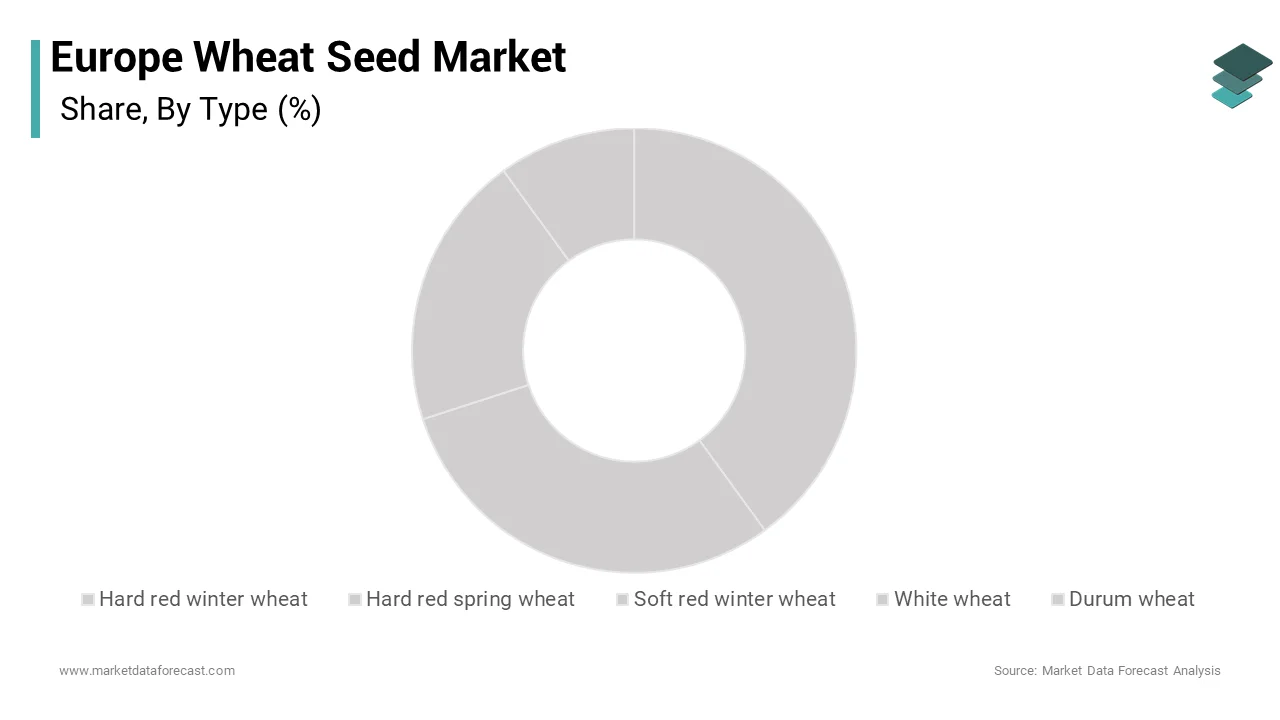
The durum wheat segment is estimated to register the fastest CAGR of 6.8% from 2025 to 2033 due to rising domestic demand for high-quality semolina and EU efforts to reduce reliance on Black Sea and North African imports. The European Union aims to improve its durum wheat self-sufficiency, though recent data indicate that Italy, a major producer, has seen its self-sufficiency rate decline in 2023 and 2024, leading to increased imports. The European Commission's Common Agricultural Policy (CAP) provides substantial funding and incentives to help farmers adopt more sustainable and resilient practices, aiming for greater overall EU food security and self-sufficiency across various products. These agronomic and policy-driven tailwinds position durum not as a niche crop but as a strategic grain in Europe’s food security recalibration.
By Application Insights
The bakery segment led the Europe wheat seed market by capturing a 58.6% share in 2024. The growth of the bakery segment is attributed to Europe’s deeply rooted bread culture and the technical requirements of industrial and artisanal baking. Thousands of bakeries operate across the EU, with many relying on flour milled from hard wheat witha a protein content. Furthermore, the EU’s clean label movement has intensified demand for flour without additives, necessitating inherently strong dough performance from the grain itself. This linkage between seed genetics and final product quality ensures that the bakery remains the central driver of wheat seed selection and innovation across the continent.
The nutritional supplements segment is anticipated to witness the fastest CAGR of 9.3% during the forecast period, owing to rising demand for plant-based protein isolate, wheat germ oil, il fiber-enriched nutraceuticals. As per sources, wheat germ oil consumption in dietary supplements rose due to its high tocopherol and octacosanol content linked to endurance support. Apart from these, wheat protein isolates are increasingly used in vegan protein blends. This shift necessitates specialized wheat seed with elevated germ size or protein concentration. This high-value application, despite covering only a small area of the total wheat crop, creates a premium niche that encourages seed developers to diversify beyond traditional milling traits by boosting market resilience and farmer profitability.
COUNTRY ANALYSIS
France Wheat Seed Market Analysis
France dominated the Europe wheat seed market by occupying a 22.4% share in 2024. The dominance of the French market is driven by its vast arable expanse, high seed replacement rates, and leadership in bread wheat breeding. Farmers widely use certified seed for soft wheat cultivation, following national quality standards. The Grand Est and Hauts de France regions are major centers for bread-making wheat production due to the favorable soil and climate. This synergy of agronomic advantage, policy support, and breeding infrastructure solidifies France’s role as Europe’s wheat seed innovation and volume leader.
Germany Wheat Seed Market Analysis
Germany followed closely in the Europe wheat seed market by capturing an 18.7% share in 2024, with its precision farming culture, strict seed certification standards, and integrated grain value chains. Millions of hectares of winter wheat are cultivated annually, with certified seed usage exceeding due to mandatory traceability under the Seed Marketing Act. As per research, wheat varieties dominate EU registration lists. Furthermore, Germany’s milling industry demands consistent protein and sedimentation value, driving farmers to select seed based on end-use contracts. This tight alignment between seed genetics processing requirements and regulatory oversight makes Germany a benchmark for quality-driven wheat production in Central Europe.
Italy Wheat Seed Market Analysis
Italy is also a key player in the Europe wheat Seed Market due to durum in the south for pasta and soft wheat in the north for bakery. Durum wheat cultivation in Italy covers a significant area, primarily concentrated in the regions of Apulia, Sicily, and Sardinia. The use of certified seed increased substantially. This rise was encouraged by incentives from the European Union, which aimed to decrease imports of semolina. In the Po Valle,, soft wheat for panettone and ciabatta requires specific starch damage and enzymatic profiles, leading mills to contract directly with seed producers. This dual focus on durum sovereignty and specialty bakery quality ensures Italy’s enduring influence in Europe’s wheat seed landscape.
Russia Wheat Seed Market Analysis
Russia grew steadily in the European wheat seed market due to increased domestic production. Despite geopolitical tensions,, Russa remains a major wheat producer with millions of hectares under cultivation. Western regions like Krasnodar and Rostov supply seed for both domestic use and limited exports to neighboring Belarus and Kazakhstan. Russia's internal seed infrastructure is expanding despite international restrictions, positioning it as a self-contained but significant player in the broader European agro-ecological zone.
United Kingdom Wheat Seed Market Analysis
The United Kingdom is predicted to grow in the Europe wheat Seed Market from 2025 to 2033 due to its specialization in high-yielding bread wheat for its dense milling and baking sector. Large hectares of wheat are sown annually with certified seed usage driven by AAHDB-recommendedvariety lists that link genetics to end-use premiums. Post Brexit,,the UK accelerated its own seed registration syssystemthe ttheagency approving new wheat types in 2024, focused on nitrogen use efficiency and early maturity to mitigate harvest rainfall risks. This science-led seed system ensures the UK remains a high-performance niche within the European market despite its smaller land area.
COMPETITIVE LANDSCAPE
Competition in the Europe Wheat Seed Market is characterized by scientific rigor, regulatory compliancee ,and regional specialization rather than price rivalry. The landscape includes large cooperative breeders, national research institutions, and multinational agribusinesses,sses all operating under the EU’s stringent seed marketing and variety registration framework. Differentiation occurs through genetic performance, disease resi,e yield consistency, and alignment end end-use quality parameters demanded by millers and food processors. Public institutions such as INRAE in France and Julius Kühn Institute in Germany continue to influence variety development through pre-breeding, while private firms lead in commercialization and distribution. Barriers to entry are high due to the thedecade-longg breeding cycle, mmandatory multi-locationtrials, and certification costs. Nevertheless, collaboration is common with competitorss often sharing germplasm through European research consortia funded by Horizon Europe. This ecosystem fosters incremental innovation and ensures that wheat seed remains a strategic public-private asset central to Europe’s food security and agronomic sustainability.
KEY MARKET PLAYERS
Key players that are dominating the Europe wheat seed market include
- Syngenta
- Monsanto Company
- E. I. du Pont de Nemours and Company
- Bayer Crop Science AG
- Advanta
- Pro Harvest
- RAGT
- Agrovegetal
- Lima grain
- Northern Seeds
- KWS Saat
- C & M Seeds
- China National Seed Group.
Top Players In The Market
- Limagrain is a leading cooperative seed company headquartered in France with deep roots in European wheat breeding. It operates one of the largest cereal research programs in the EU focusing on disease resistance yield stability and end use quality for both bread and durum wheat. The company supplies certified seed across Western and Central Europe and contributes significantly to global wheat genetics through its international subsidiaries in North America and Eastern Europe. It also expanded its digital seed advisory platform to provide real time variety recommendations based on soil and climate data further strengthening its integration into precision farming systems across the continent.
- KWS SAAT is a German-based global plant breeding company with a strong focus on wheat seed innovation in Europe. The company invests heavily in genomic selection and field phenotyping to accelerate the development of climate resilient wheat varieties. KWS maintains an extensive network of trial stations across Europe enabling localized adaptation of its seed portfolio. In recent years the company has intensified its work on disease tolerant genetics particularly against yellow rust and septoria tritici blotch which are increasingly prevalent due to warmer growing seasons. It also partnered with millers to co develop varieties meeting specific protein and dough stability benchmarks reinforcing its position in value chain oriented seed supply.
- Bayer AG leverages its global crop science division to deliver integrated wheat seed and trait solutions across Europe. Through its acquisition of legacy breeding assets and ongoing R and D in genetic resilience Bayer offers a diversified portfolio of certified wheat seed tailored to regional agronomic challenges. The company emphasizes sustainability by developing varieties that require fewer inputs while maintaining yield. It also launched a blockchain-based seed traceability pilot in the Netherlands, linking farm level performance data to varietal genetics. These initiatives reflect Bayer’s strategy of embedding seed within a holistic agronomic ecosystem that supports Europe’s Farm to Fork and soil health objectives.
Top Strategies Used By The Key Market Participants
Key players in the Europe Wheat Seed Market focus on trait driven breeding digital integration and value chain collaboration to maintain competitive advantage. Companies invest in advanced phenotyping and genomic tools to shorten breeding cycles and embed resistance to emerging diseases and climate stresses. They develop region specific varieties aligned with local soil types disease pressures and end use requirements ensuring agronomic relevance. Digital platforms that offer variety selection support agronomic advice and performance tracking are increasingly deployed to enhance farmer engagement. Strategic partnerships with millers bakers and pasta producers enable seed developers to tailor genetics to processing specifications creating premium contracting opportunities. Additionally, firms comply rigorously with EU seed certification and registration protocols while advocating for science-based policies on new breeding techniques. These strategies collectively reinforce product differentiation technical leadership and long-term market resilience in a highly regulated and climate challenged environment.
MARKET SEGMENTATION
This research report on the Europe wheat seed market is segmented and sub-segmented into the following categories.
By Type
- Hard red winter wheat
- Hard red spring wheat
- Soft red winter wheat
- White wheat
- Durum wheat
By Application
- Bakery
- Dairy
- Confectionary
- Nutritional supplements
- Others
By Country
- UK
- France
- Spain
- Germany
- Italy
- Russia
- Sweden
- Denmark
- Switzerland
- Netherlands
- Turkey
- Czech Republic
- Rest of Europe