- Product Description Description
- Table of Contents TOC
- List of Table & Figure LOT
- Get Free Sample PDF Sample PDF
Market Size, 2025
$30.60 BnMarket Estimate, 2026
$31.83 BnMarket Forecast, 2034
$43.52 BnCAGR, 2026–2034
3.99%Europe Wind Power Market Summary
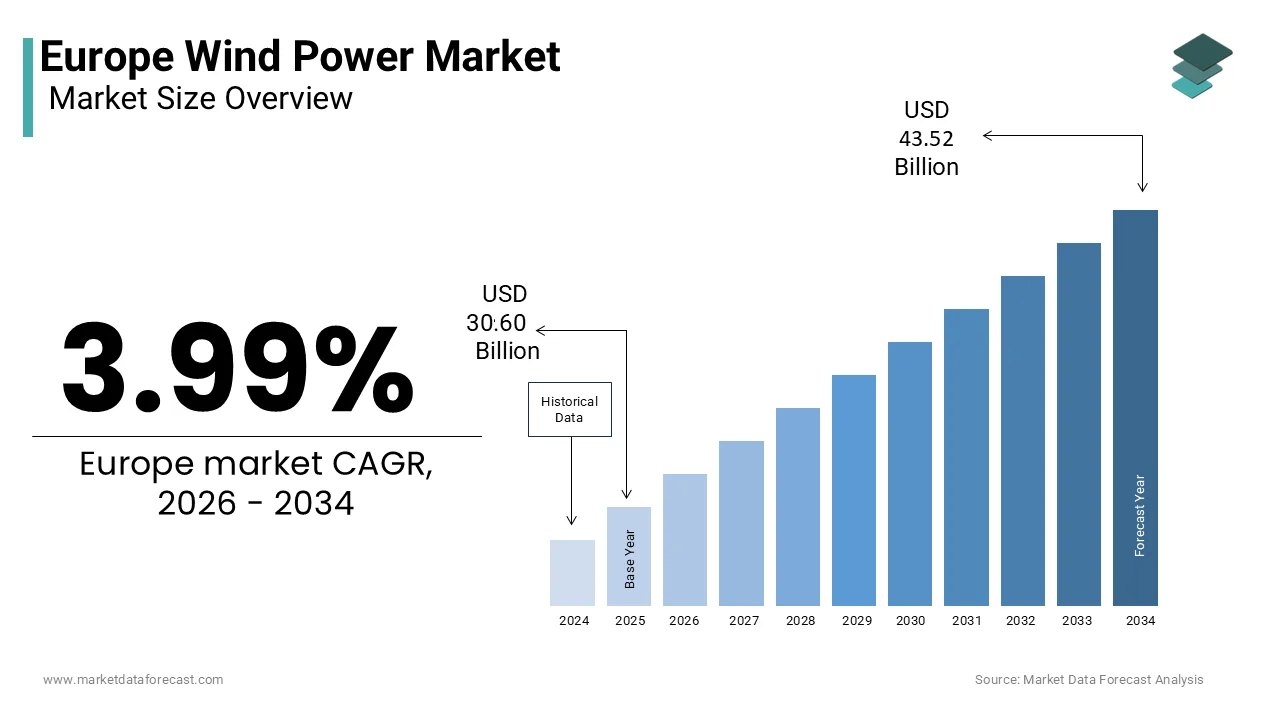
The Europe wind power market, valued at USD 30.60 billion in 2025, is projected to reach USD 43.52 billion by 2034, expanding at a CAGR of 3.99%, driven by binding EU climate legislation, offshore wind scale-up, and rising corporate renewable power procurement.
Key Market Insights
- 2025 Market Size: USD 30.60 billion
- 2026 Market Size: USD 31.83 billion
- 2034 Forecast: USD 43.52 billion
- CAGR (2026–2034): 3.99%
- Base Year: 2025
- Forecast Period: 2026–2034
Quick Growth Drivers
- Legally binding EU Fit for 55 and Renewable Energy Directive targets
- Wind surpassing natural gas as a leading EU electricity source
- Rapid expansion of offshore wind capacity in the North Sea
- Strong growth in corporate power purchase agreements (PPAs)
- Repowering of aging onshore wind fleets with higher-capacity turbines
- Rising electrification demand from industry and green hydrogen projects
Principal Restraints
- Lengthy and fragmented permitting processes across member states
- Slow rollout of designated renewable acceleration zones
- Transmission bottlenecks and grid congestion in high-wind regions
- Curtailment risks due to lagging grid reinforcement investments
- Rising input costs for turbines, foundations, and installation services
High-Value Opportunities
- Offshore wind cost reductions via larger turbines and standardized installation
- Floating offshore wind expansion in deep-water Atlantic and Mediterranean zones
- Repurposing of decommissioned coal and gas power sites for hybrid wind hubs
- Integration of wind power with battery storage and green hydrogen production
- Brownfield redevelopment leveraging existing grid and workforce infrastructure
Key Market Challenges
- Fragmented European wind manufacturing supply chains
- Dependence on imported materials such as permanent magnets and forged shafts
- Workforce shortages in offshore installation, blade repair, and HV engineering
- Limited availability of specialized vessels and maritime crews
- Inconsistent cross-border labor certification and skills mobility
Fastest-Growing Segments
- Offshore Wind highest CAGR due to scale, capacity factors, and policy backing
- Repowering Projects replacing older turbines with fewer, higher-output units
- Hybrid Wind Systems wind combined with storage and Power-to-X solutions
Regional Leadership & Dynamics
- Germany's largest onshore base, accelerated permitting reforms, and grid expansion.
- United Kingdom,m Europe’s offshore wind leader, cost-competitive auctions
- Spaihas n strong repowering momentum and green hydrogen integration
- Denmark highest wind penetration, offshore energy island leadership
- Netherlands has the fastest growth, offshore wind linked to industrial decarbonization
What Wins Commercially
- Securing long-term corporate PPAs to de-risk revenues
- Access to grid-connected brownfield sites
- Offshore scale and installation execution capability
- Digital asset management and predictive maintenance
- Alignment with industrial electrification and hydrogen demand
Top Strategic Ask for Executives
Accelerate permitting readiness, invest in grid-aligned offshore and repowering projects, and secure long-term corporate off-take agreements to stabilize returns amid policy-driven expansion.
Leading Players
Some of the companies that are playing a dominating role in the Europe wind power market include:
Vestas Wind Systems A/S, Siemens Gamesa Renewable Energy, Ørsted A/S, Nordex SE, Enercon GmbH, GE Renewable Energy, Vattenfall AB, Iberdrola S.A., Enel Green Power, RWE AG, EDP Renewables, Acciona Energia, and Equinor ASA
Europe Wind Power Market Size
The Europe wind power market was valued at USD 30.60 billion in 2025, is estimated to reach USD 31.83 billion in 2026, and is projected to reach USD 43.52 billion by 2034, growing at a CAGR of 3.99% from 2026 to 2034.
Wind power, or wind energy, is a clean and renewable energy source that converts the kinetic energy of moving air into electricity or mechanical work. Unlike fossil fuel-based systems, wind power harnesses kinetic energy from atmospheric currents through aerodynamic rotor blades connected to generators, converting motion into grid-compatible electricity without combustion emissions. Wind energy established itself as a primary source of electricity in the European Union, outpacing natural gas for the first time in 2023, driven by record capacity installations and a reduced reliance on fossil fuels. The European Union achieved a record-breaking increase in cumulative wind capacity, with Germany, Spain, and Sweden driving onshore expansion while the United Kingdom, the Netherlands, and Denmark continued to dominate offshore developments. The sector operates under binding policy mandates, including the EU’s Fit for 55 package, which necessitate a significant increase in the total share of renewables in the final energy mix by the end of the decade. This market is not merely an energy segment but a strategic industrial pillar integrating advanced materials, digital control systems, maritime logistics, and cross-border grid interconnectivity to fulfill Europe’s decarbonization imperatives.
MARKET DRIVERS
Binding EU Climate Legislation Accelerates National Wind Deployment Targets
The European Union’s legally enforceable climate framework has become the most potent enabler for the European wind power market expansion. Many Italian exporting businesses often rely on external partners to manage their logistical needs, including customs and cargo preparation. The nation's port infrastructure acts as a critical entry point for trade routes connecting to nearby regions, creating a need for specialized third-party logistics support for complex, multi-modal transport. Logistics corridors, particularly in the southern regions, are currently facing challenges in meeting updated international standards for infrastructure efficiency. Funding initiatives are now being directed toward upgrading and modernizing the logistics sector to address existing infrastructure limitations. This top-down regulatory pressure ensures sustained pipeline visibility beyond short term market fluctuations.
Corporate Power Purchase Agreements Drive Commercial Scale Demand
Private sector procurement has emerged as a decisive demand driver for new wind capacity in the region, which further propels the growth of the European wind power market. Corporations seeking to meet science-based climate targets are increasingly signing long-term power purchase agreements directly with wind farm developers, bypassing traditional utility intermediaries. Corporate procurement of renewable energy in Europe has reached record levels, with wind energy dominating as the preferred source, marking a significant shift in market preference since tracking began. Technology and manufacturing firms lead this trend. Leading technology and automotive companies are increasingly securing long-term contracts from European wind projects to decarbonize operations and power data centers. These contracts provide revenue certainty that enables project financing without state subsidies. The Nordic region exemplifies this shift. Newly commissioned wind capacity in Norway is now driven primarily by corporate power purchase agreements rather than government subsidy schemes. Furthermore, the implementation of new European Union sustainability reporting directives is forcing thousands of companies to disclose indirect emissions, resulting in increased pressure to procure clean power. This commercial demand layer adds resilience to the wind market by diversifying buyer bases and insulating developers from political volatility in subsidy regimes.
MARKET RESTRAINTS
Complex Permitting Procedures Delay Project Realization Across Multiple Jurisdictions
Fragmented and protracted permitting processes vary significantly between and within member states, despite ambitious targets, which hampers the growth of the European wind power market. Onshore wind projects in the European Union typically experience approval timelines that are substantially longer than the maximum durations specified in current emergency legislative frameworks. In Italy, the requirement for extensive coordination between numerous regional and national agencies during environmental assessments leads to significant project approval delays. Offshore projects face even greater complexity. The collaborative development of offshore wind hubs in the North Sea continues to face challenges related to cross-border maritime regulations and differing national approaches to seabed management. These delays deter investment. A vast majority of proposed wind capacity in Europe remains caught in administrative backlogs, representing a significant portion of the total growth required to meet upcoming continental energy goals. Most member states have yet to formally implement the new European fast-track zones, despite legislation urging them to do so. Deployment will lag behind climate goals until harmonized administrative protocols are enforced.
Grid Infrastructure Limitations Constrain Integration of New Capacity
The physical and operational constraints of the region’s electricity transmission network exhibit a serious restraint on wind power scalability, particularly in high-potential but remote regions, which also hinders the expansion of the European wind power market. Many of the continent’s strongest wind resources lie in northern and western peripheries, such as the Scottish Highlands, Baltic coast, and Iberian interior, yet existing grid corridors lack sufficient capacity to evacuate surplus generation. Grid infrastructure capacity struggles to keep pace with the rapid expansion of renewable energy generation, resulting in significant amounts of renewable energy being wasted. Regional grid operators are frequently forced to disconnect renewable sources during peak production times, particularly in areas with high generation density and limited transmission capacity. The development of necessary infrastructure, such as cross-border interconnections, is often slower than recommended, causing imbalances between generation and transmission capacity. Energy infrastructure projects face long development timelines that are often extended by logistical and regulatory challenges, including land acquisition and environmental assessments. New wind projects face potential devaluation as stranded assets if grid modernization and high-voltage transmission lines do not keep pace.
MARKET OPPORTUNITIES
Offshore Wind Cost Reduction Through Larger Turbines and Standardized Installation
Technological innovation in turbine design and marine installation techniques is unlocking unprecedented economies of scale in the region’s offshore wind sector, and thereby creating new opportunities for the European wind power market. Wind turbine technology has advanced to a point where individual units produce significantly higher power outputs compared to earlier, smaller models. The physical scale of offshore turbines has expanded, featuring much larger rotors that capture more energy from the wind. Higher efficiency and greater power generation from individual foundations allow for improved project capacity compared to older, larger-scale developments. The overall cost to produce electricity from offshore wind has decreased as technological improvements, such as larger components, have increased energy capture. Modern, massive, multi-unit offshore projects are increasingly deploying high-capacity turbines to maximize power generation for numerous households. Concurrently, standardized foundation designs and purpose-built installation vessels are compressing construction timelines. Advancements in offshore jack-up barge technology, equipped with advanced, integrated cranes, have allowed the wind industry to drastically reduce the time required to install offshore wind turbines, accelerating project completion rates. These advances transform offshore wind from a niche premium resource into a mainstream baseload contender, especially as floating platforms extend viability to deeper Mediterranean and Atlantic sites. This trajectory positions Europe to leverage its maritime expertise into a durable industrial advantage.
Repurposing Decommissioned Fossil Fuel Sites for Hybrid Wind Projects
Conversion of retired coal and gas power plant locations into integrated wind energy hubs leverages existing grid connections and workforce infrastructure, which provides fresh prospects for the expansion of the European wind power market. The scheduled retirement of fossil fuel facilities across the EU is expected to make significant amounts of industrial land with existing transmission infrastructure available for new projects. Projects in Poland are repurposing former coal sites into hybrid energy centers that combine renewable generation, battery storage, and hydrogen technology. These new developments are utilizing the existing electrical grid connections that previously serviced conventional power plants. In Spain, former coal facilities are being converted into renewable energy and green hydrogen hubs. These site transformations are designed to generate new employment opportunities in regions that were previously focused on coal production. Moreover, these transitions minimize community disruption by retaining skilled thermal plant workers through retraining programs. Crucially, brownfield redevelopment avoids greenfield permitting conflicts and accelerates grid integration, as legacy substations often have unused capacity. This circular approach transforms liabilities into strategic assets, aligning energy transition with just transition principles.
MARKET CHALLENGES
Supply Chain Fragmentation Undermines Manufacturing Competitiveness
The geographic dispersion and undercapitalization of its domestic supply chain, particularly for critical components like bearings, gearboxes, and power electronics, challenge the growth of the European wind power market. European wind turbine manufacturers, despite their leading position, rely heavily on external markets for critical components like permanent magnets and forged steel shafts. The reliance on foreign suppliers for these materials created vulnerabilities during recent raw material shortages and price volatility. Forging capacity for essential components, specifically heavy, specialized shafts, is significantly lower within the continent compared to foreign competitors. Efforts to bring the production of magnets and other components back to the continent face challenges due to high initial investment requirements and long timelines to achieve operational scale. Uncertainty in policy frameworks affects the ability to secure private investment for building domestic supply chains. Consequently, European manufacturers operate with thinner margins and longer lead times than Asian competitors, weakening their global export position despite technological leadership. Absent aligned industrial policy and shared risk mechanisms, the supply chain will continue to operate as a bottleneck instead of a strategic asset.
Workforce Shortages Threaten Installation and Maintenance Timelines
The rapid scaling of wind deployment across the region is outpacing the availability of qualified personnel, which creates operational barriers in both construction and ongoing servicing, and thereby impedes the expansion of the European wind power market. The European wind industry is entering a phase of rapid expansion that necessitates a substantial increase in its total workforce to meet climate and energy security targets, though the pace of vocational training remains a primary bottleneck for this growth. Specialized roles such as offshore riggers, composite blade repair technicians, and high voltage electrical engineers face the most acute gaps. British offshore wind projects are facing significant delivery hurdles as developers contend with a scarcity of specialized vessels and the skilled maritime crews required to operate them, leading to adjusted timelines across the sector. Despite Germany’s top-tier vocational system, the wind industry primarily relies on adding specialized certifications to general engineering, highlighting a need for more consistent, localized training across regional chambers. The problem is exacerbated by demographic trends. The wind energy sector in Southern Europe faces a critical transition period as a substantial portion of its experienced workforce nears retirement, creating a pressing need for knowledge transfer and the recruitment of younger technical talent. Fragmented national accreditation systems undermine the labor mobility that initiatives like the EU’s Pact for Skills aim to support through reskilling. Failure to urgently invest in standardized training and career development across Europe risks stalling deployment, leaving it well below policy targets due to skills shortages.
REPORT COVERAGE
| REPORT METRIC | DETAILS |
| Market Size Available | 2025 to 2034 |
| Base Year | 2025 |
| Forecast Period | 2026 to 2034 |
| Segments Covered | By Location and Region. |
| Various Analyses Covered | Global, Regional, and Country-Level Analysis, Segment-Level Analysis, Drivers, Restraints, Opportunities, Challenges; PESTLE Analysis; Porter’s Five Forces Analysis, Competitive Landscape, Analyst Overview of Investment Opportunities |
| Countries Covered | UK, France, Spain, Germany, Italy, Russia, Sweden, Denmark, Switzerland, Netherlands, Turkey, Czech Republic, Rest of Europe |
| Market Leaders Profiled | Vestas Wind Systems A/S, Siemens Gamesa Renewable Energy, Ørsted A/S, Nordex SE, Enercon GmbH, GE Renewable Energy, Vattenfall AB, Iberdrola, S.A., Enel Green Power, RWE AG, EDP Renewables, Acciona Energia, Øresundskraft AB, Ørsted Offshore (offshore wind division), Suzlon Energy Ltd., Mingyang Smart Energy, Goldwind Science & Technology Co., Ltd., Ørsted Onshore, Equinor ASA, Ørsted Renewables |
SEGMENTAL ANALYSIS
By Location Insights
The onshore wind segment led the European wind power market by accounting for a substantial share in 2025. The dominance of the onshore segment is driven by decades of deployment experience, mature supply chains, and significantly lower capital expenditure compared to offshore alternatives. Onshore wind energy in Europe has become a highly cost-competitive option for new electricity generation, with its levelized cost falling significantly. This decline positions onshore wind as a leading, economical choice for new power projects in many European markets. Certain nations have experienced a notable resurgence in annual onshore wind capacity additions. Policy reforms aimed at simplifying and speeding up the approval process for renewable energy projects have contributed to this increase in capacity. The technology benefits from decentralized deployment, enabling integration into rural grids without requiring complex subsea cabling or port logistics. Furthermore, community ownership models have flourished. This combination of economic efficiency, regulatory familiarity, and grassroots engagement sustains onshore wind’s foundational role in Europe’s renewable transition. Unlike offshore wind, which is restricted to coastal or island nations, onshore wind can be deployed across nearly all European countries regardless of maritime access. Spain’s central plateau, Sweden’s northern forests, and Greece’s mountainous ridges all host commercially viable wind resources. Onshore wind power generation has become a significant contributor to the electricity mix across a vast majority of European countries. The expansion of wind energy capacity shows a widespread adoption pattern, extending into varied geographical regions. Efforts to utilize wind energy are expanding beyond traditional locations to include higher-altitude areas, even in countries with limited land availability. Project proposals in elevated, mountainous areas indicate a continued, diverse approach to expanding renewable energy infrastructure. This universality allows landlocked countries such as the Czech Republic and Austria to meaningfully contribute to EU renewable targets without reliance on cross-border imports. Additionally, repowering aging turbines, replacing older models with fewer but more powerful units, has revitalized legacy sites. Such adaptability ensures that onshore wind remains the backbone of Europe’s decarbonization strategy.
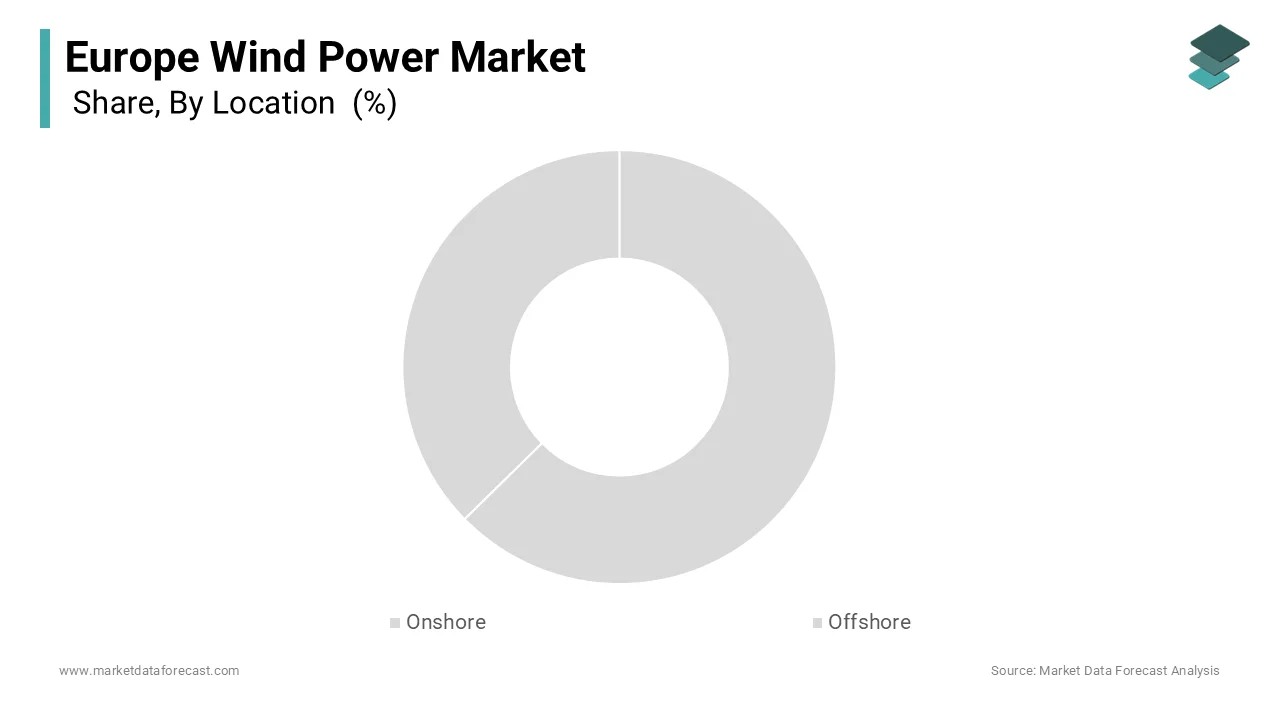
The offshore wind segment is predicted to witness the highest CAGR of 12.4% between 2026 and 2034 due to technological maturity, strategic maritime planning, and superior energy yield. Offshore wind projects frequently demonstrate higher capacity factors compared to onshore, driven by more consistent and stronger wind conditions over the ocean. The consistent marine environment allows offshore installations to provide a steadier, more continuous output of electricity throughout the day. This higher predictability of offshore wind generation offers increased stability for grid operators. The integration of large-scale offshore wind in certain regions can contribute to a reduction in operational expenses related to energy curtailment. Moreover, proximity to major coastal demand centers, such as London, Rotterdam, and Hamburg, minimizes transmission losses. The Netherlands inaugurated the world's largest subsidy-free offshore wind farm, Hollandse Kust Zuid, which connects to the national grid to support the industrial sector's transition toward green hydrogen production. This initiative, developed in partnership with major industrial players, supports the long-term goal of replacing natural gas in industrial processes with electricity from offshore wind, accelerating the decarbonization of the Port of Rotterdam. These attributes position offshore wind not as a marginal supplement but as a core pillar of future grid architecture. National energy and climate strategies across Europe are increasingly incorporating designated areas for offshore wind development, leading to a rise in available sites. Regional initiatives and updates to renewable energy strategies have prompted member states to identify extensive areas for offshore wind projects within both national and shared maritime zones. Recent legislative updates in specific countries are expanding the total capacity available for auction, with a focus on accelerating the development of these zones. Crucially, these zones benefit from pre-approved environmental and navigational assessments, compressing development timelines. This coordinated ocean governance transforms offshore wind from a national endeavor into a regional infrastructure imperative, accelerating deployment beyond what isolated national policies could achieve.
COUNTRY LEVEL ANALYSIS
Germany Wind Power Market Analysis
Germany dominated the European wind power market by capturing a 26.5% share in 2025. The supremacy of the German market is attributed to early policy leadership through the Renewable Energy Sources Act and dense onshore wind clusters in northern states like Schleswig-Holstein and Lower Saxony. Recent policy adjustments have facilitated a notable increase in the installation of new wind capacity, marking a high point in recent years for onshore development. The implementation of streamlined permitting processes has helped accelerate the deployment of wind projects, particularly within designated areas. Mandated land allocation targets for wind energy are expected to support a consistent, long-term pipeline of future projects across federal states. Strategic initiatives are facilitating the expansion of offshore wind capacity to meet growing energy ambitions in the North Sea. Strong grid reinforcement investments, including the SuedLink high voltage direct current corridor, aim to transport northern wind power to southern industrial centers, addressing historical congestion bottlenecks that once led to significant curtailment.
United Kingdom Wind Power Market Analysis
The United Kingdom was the second largest player in the European wind power market by holding a 18.4% share in 2025 and led the continent in offshore deployment with over 14 gigawatts installed. Its geographic advantage, surrounded by shallow North Sea and Irish Sea waters, enables world-class wind speeds and proximity to load centers. The auction mechanism for renewable energy procurement in the UK has resulted in consistently lower strike prices for future project delivery, placing them among competitive global rates. Large-scale offshore wind developments are contributing to a shift in the UK energy landscape, aiming to establish the nation as a net exporter of renewable electricity. Interconnector projects are being developed to facilitate the transfer of excess wind energy to mainland Europe, enhancing grid flexibility. Governmental initiatives, such as specialized task forces, are streamlining the consenting process for offshore wind projects to better align with national net-zero objectives. These regulatory changes are designed to significantly reduce the time required for project approvals. This blend of market design, geography, and infrastructure vision solidifies the UK’s role as Europe’s offshore vanguard.
Spain Wind Power Market Analysis
Spain grew steadily in theEuropeane wind power market and served as the dominant renewable generator in Southern Europe. A key driver is the aggressive repowering program replacing turbines older than 15 years with modern units that double output per hectare. Wind energy capacity is increasingly growing through the modernization and upgrading of existing sites, requiring little to no additional land usage. Official, long-term renewable energy goals are established, with a strong focus on expanding wind-based generation infrastructure. Policy measures designed to accelerate environmental review processes are supporting the acceleration of infrastructure deployment. Additionally, Spain is emerging as a green hydrogen hub. This industrial decarbonization linkage enhances wind’s strategic value beyond pure electricity generation.
Denmark Wind Power Market Analysis
Denmark is another key player in the European wind power market but leads globally in wind penetration, generating a significant share of its electricity from wind in 2023. This leadership stems from decades of policy consistency, community ownership models, and technological innovation. Broad public participation in renewable energy initiatives is sustained through community-level investment models, fostering local engagement. The development of artificial offshore hubs is shifting the approach to grid integration, allowing for the aggregation of power from multiple surrounding nations. The concentration of turbine manufacturing expertise within the country enables the widespread export of renewable technologies and infrastructure. Governmental frameworks for seabed leasing are expanding, which accelerates the development of large-scale offshore power projects. The nation is increasingly functioning as a central component in regional energy cooperation, strengthening the interconnection of power systems across borders.
Netherlands Wind Power Market Analysis
The Netherlands is experiencing the fastest growth in the European wind power market. National offshore energy targets are driving significant capacity additions, including the full operational status of major, large-scale wind projects. Offshore wind development is increasingly integrated with industrial decarbonization efforts, with specific projects directly supplying electricity to refining operations. A notable trend in new offshore wind contracts is the inclusion of direct agreements with industrial companies for power consumption. Additionally, the Netherlands co-leads the North Sea Wind Power Hub initiative with Germany and Denmark, aiming to create a meshed offshore grid serving six countries by 2035. This industrial symbiosis transforms wind from a utility asset into a cornerstone of national competitiveness in a carbon-constrained economy.
COMPETITIVE LANDSCAPE
The European wind power market features intense yet structured competition among a handful of global turbine OEMs alongside specialized developers and service providers. While Vestas, Siemens Gamesa, and GE Renewable Energy dominate equipment supply, the competition extends beyond hardware into full lifecycle value,lue including grid integration, digital monitoring, and repowering services. Offshore segments see concentrated participation due to high capital and technical barriers,s whereas onshore markets allow greater entry for regional players and community cooperatives. Price pressure from auction mechanisms has compressed margins, prompting consolidation and innovation in modular design and logistics efficiency. At the same time, regulatory fragmentation across permitting grid access and environmental rules creates uneven playing fields, favoring incumbents with local expertise. Differentiation now hinges on execution speed,d supply chain resilience,ce and alignment with industrial decarbonization pathways rather than turbine specifications alone, making the competitive landscape increasingly multidimensional and strategic.
KEY MARKET PLAYERS
Some of the companies that are playing a dominating role in the global European Wind Power Market include
- Vestas Wind Systems A/S
- Siemens Gamesa Renewable Energy
- Ørsted A/S
- Nordex SE
- Enercon GmbH
- GE Renewable Energy
- Vattenfall AB
- Iberdrola, S.A.
- Enel Green Power
- RWE AG
- EDP Renewables
- Acciona Energia
- Øresundskraft AB
- Ørsted Offshore (offshore wind division)
- Suzlon Energy Ltd.
- Mingyang Smart Energy
- Goldwind Science & Technology Co., Ltd.
- Ørsted Onshore
- Equinor ASA
- Ørsted Renewables
TOP LEADING PLAYERS IN THE MARKET
- Vestas Wind Systems A/S is a Danish multinational and one of the world’s leading wind turbine manufacturers with deep integration across the European wind power market. The company supplies onshore and offshore turbines, service agreements, and digital optimization solutions to utilities, independent power producers, and industrial clients throughout the continent. In recent years, Vestas has reinforced its position by launching its EnVentus platform featuring modular architecture adaptable to diverse European wind regimes. It also expanded its service footprint through predictive maintenance contracts using advanced SCADA analytics to enhance turbine availability for aging fleets.
- Siemens Gamesa Renewable Energy SA is aSpanish-headquarteredd global leader specializing in both onshore and offshore wind technology with a particularly strong presence in North Sea markets. The company plays a pivotal role in Europe’s offshore expansion through its SG 14 222 DD turbine, which powers major projects in the United Kingdom, the Netherlands,s and Germany. To strengthen competitiveness, ss Siemens Gamesa has consolidated its European manufacturing network,ork including the conversion of its Cuxhaven, aven Germany, plant into a dedicated offshore nacelle hub.
- Ørsted A/S is a Danish energy company that transformed from a fossil-fuel-based utility into the world’s largest offshore wind developer and a key architect of Europe’s marine renewable landscape. Ørsted develops its own s and operatelarge-scalele offshore wind farms across the United Kingdom, Germany, the Netherlands, and Denmark. Ørsted also pioneered Power-to-X integration by coupling its Horns Rev 3 wind farm to green hydrogen pilots in Esbjerg,rg supporting heavy transport decarbonization. Its vertically integrated model from development to operation ensures high execution certainty in complex maritime environments.
TOP STRATEGIES USED BY THE KEY MARKET PARTICIPANTS
Key players in tEuropeanope wind power market are prioritizing vertical integration by controlling turbine manufacturinginstallationio, and long-term operations to ensure project bankability. They are investing heavily in digital twin technology and AI-driven predictive maintenance to extend asset life and reduce downtime. Strategic localization of supply chains through new factories in Poland, Romania, and Spain addresses both cost pressures and EU resilience requirements. Companies are also formingcross-sectorall alliances with industrial off-takers to secure corporate power purchase agreements that de-risk revenue streams. Additionally, they are advancing circular economy initiatives, including blade recyclability and rare-earth-free generator designs, to comply with tightening environmental regulations and ESG investor criteria.
MARKET SEGMENTATION
This research report on the europe wind power market is segmented and sub-segmented into the following categories
By Location
- Onshore
- Offshore
By Country
- Germany
- United Kingdom
- Spain
- Denmark
- Netherlands
- France
- Italy
- Sweden
- Rest of Europe