- Product Description Description
- Table of Contents TOC
- List of Table & Figure LOT
- Get Free Sample PDF Sample PDF
Market Size, 2025
$524 MnMarket Estimate, 2026
$549 MnMarket Forecast, 2034
$787 MnCAGR, 2026–2034
4.61%Europe Window Films Market Size
The Europe window films market size was valued at USD 524.86 million in 2025 and is projected to reach USD 787.42 million by 2034 from USD 549.06 million in 2026, growing at a CAGR of 4.61%.
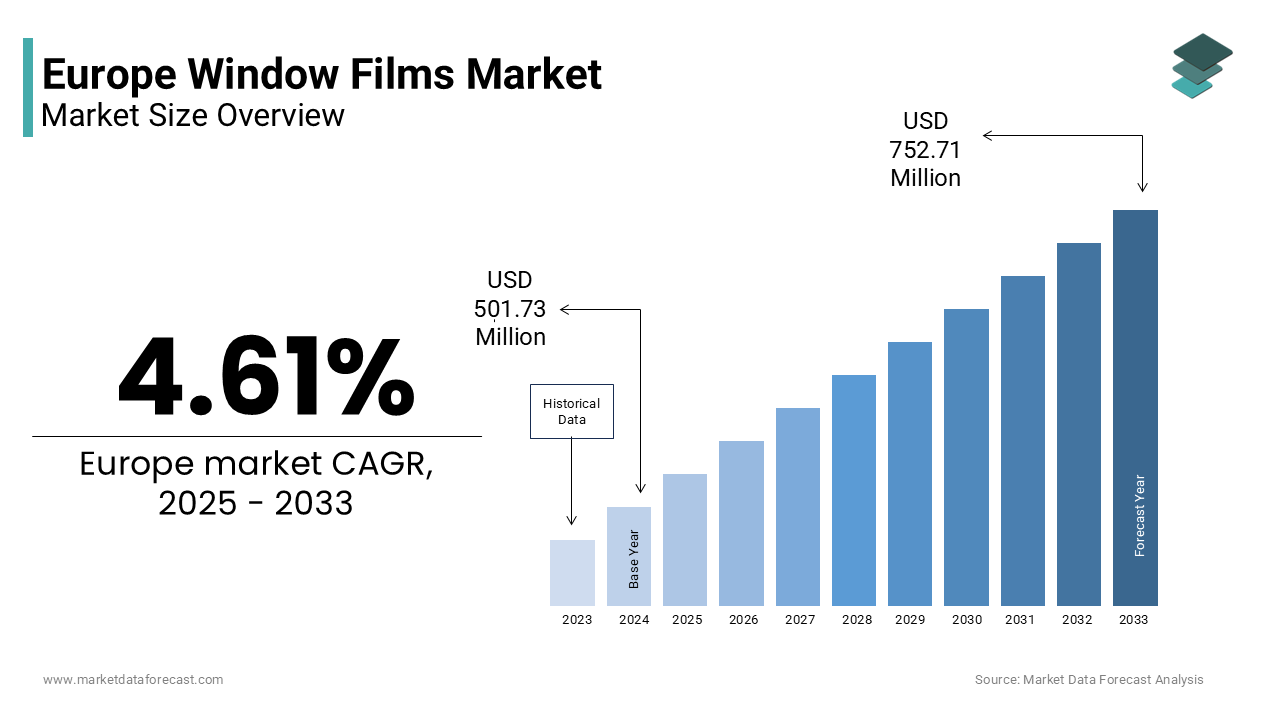
Window films are advanced laminates applied to glass surfaces to modulate solar heat gain, enhance occupant comfort, reduce energy consumption, improve safety, and provide aesthetic or privacy benefits. In Europe, these films have evolved from niche automotive accessories into strategic building envelope solutions aligned with the continent’s climate neutrality and energy efficiency mandates. Unlike conventional glazing upgrades, window films offer a cost-effective retrofit option for the region’s vast stock of historic and energy-inefficient buildings. According to Eurostat, more than a third of the European Union’s building stock was constructed before 1970, with single-glazed windows still present in a notable share of residential structures. According to the European Commission, buildings account for around 40% of final energy consumption and over one-third of greenhouse gas emissions in the EU, making envelope retrofits critical to achieving the Fit for 55 targets. The Energy Performance of Buildings Directive (EPBD) now encourages non-structural energy-saving measures, which explicitly recognises solar control films as eligible interventions. At the same time, urban heat island effects have intensified across major cities, with the European Environment Agency (EEA) noting that summer temperatures in Paris, Madrid, and Athens exceeded historical averages by more than 3°C in 2023. In this context, window films serve not merely as comfort enhancers but as scalable, reversible, and heritage-sensitive tools within Europe’s decarbonization and climate adaptation toolkit.
MARKET DRIVERS
Stringent EU Energy Efficiency Regulations Driving Building Retrofit Demand
The European Union’s binding energy performance legislation is acceleratinthe the adoption of window films as a low-disruption thermal upgrade for existing buildings, which is majorly driving the European window films market growth. The Energy Performance of Buildings Directive requires all residential and commercial buildings undergoing major renovation to meet minimum energy efficiency standards, and window films provide a viable alternative to full window replacement, which is especially in protected or historic structures. According to the European Commission, more than 220 million square meters of inefficient glazing exist in EU public buildings, with retrofitting identified as a priority under the Renovation Wave Strategy targeting 35 million building upgrades by 2030. As per the Buildings Performance Institute Europe (2023), solar control window films reduced cooling energy demand by approximately 18 to 26% in southern European office buildings without altering façade aesthetics. National programs reinforce this trend; France’s MaPrimeRénov scheme now includes window films in its list of subsidised energy-saving measures, while Germany’s KfW Bank offers low-interest loans for film installations in commercial properties. As building owners seek cost-effective paths to Energy Performance Certificate upgrades, window films emerge as a compliant, rapid, and reversible solution aligned with EU decarbonization timelines.
Rising Urban Heat Stress and Demand for Thermal Comfort in Residential Sectors
Escalating summer temperatures across European cities are driving homeowners to seek affordable and non-invasive cooling solutions, with window films gaining traction as a primary response, which is contributing to the expansion of the European window films market. According to the European Environment Agency, heat-related emergency room visits in the EU rose by nearly 30% in 2023 compared to the 2010–2020 average, with urban populations most affected. In response, residents in Spain, Italy and Greece are increasingly installing solar control films to reduce indoor heat gain without compromising natural light. As per the European Consumer Organisation (2023), 64% of southern European households cited excessive solar glare and overheating as top summer discomfort factors, with 41% having invested in window treatments within the past two years. Unlike air conditioning, window films offer a passive one-time solution that lowers indoor surface temperatures by up to 12 degrees Celsius. Municipalities like Barcelona and Rome now promote films through urban cooling grants, recognising their role in reducing peak electricity demand and mitigating heat vulnerability among elderly populations.
MARKET RESTRAINTS
Restrictive Heritage Conservation Laws Limiting Application in Historic Districts
The stringent preservation regulations that govern modifications to historic buildings, particularly in city centres designated as UNESCO sites or national heritage zones, are one of the major restraints to the growth of the European window films market. According to the European Federation of Historic Towns, more than 1,800 urban areas in the EU are legally protected under national monument laws that often prohibit any alteration to the original glazing appearance, including the application of tinted or reflective films. In cities like Vienna, Prague, and Edinburgh, local conservation officers routinely reject film installation permits on grounds of visual integrity, even for clear safety or low-emissivity variants. The Council of Europe’s Granada Convention emphasises the maintenance of authentic architectural character, leading many municipalities to ban films that alter reflectivity or colour. As per the European Association of Architectural Heritage (2023), 68% of heritage property owners in France and Italy abandoned planned film retrofits after regulatory denial. While some regions permit internal application of optically neutral films, the lack of harmonised guidelines creates uncertainty and legal risk. This regulatory fragmentation suppresses a major segment of potential demand in Europe’s culturally rich but thermally inefficient urban cores.
Lack Of Standardised Performance Certification and Consumer Awareness
The European window films market suffers from inconsistent product labelling and limited public understanding of technical specifications, hindering informed purchasing and broader adoption. Unlike insulation or windows, window films are not uniformly covered under the EU Energy Labelling Framework, leading to varied claims about solar heat gain coefficient, visible light transmission and emissivity. According to the European Committee Standardisation, only three EU member states have adopted national testing protocols aligned with ISO 9050 for glazing films, which is leaving consumers in other markets vulnerable to exaggerated performance claims. As per the European Consumer Organisation (2023), 52% of window film advertisements in Eastern Europe made unverified assertions about energy savings, with no third-party validation. Additionally, building professionals often lack training on film integration; according to the Federation of European Heating and Ventilation Associations (2025), only 29% of energy auditors routinely recommend films as a retrofit measure. Without harmonised certification, professional education, and transparent metrics, market growth remains constrained by scepticism and information asymmetry.
MARKET OPPORTUNITIES
Integration With Smart Glass and Dynamic Glazing Ecosystems
The convergence of static window films with smart building technologies presents a high potential opportunity through hybrid solutions that combine cost efficiency with adaptive performance. While electrochromic and thermochromic smart glass remains prohibitively expensive for mass retrofitting, manufacturers are developing switchable film overlays that can be applied to existing glass at a fraction of the cost. According to the European Technology and Innovation Platform on Smart Buildings, pilot projects in Sweden and the Netherlands demonstrated that hybrid systems using static solar control base films with add-on PDLC (polymer-dispersed liquid crystal) layers reduced annual cooling loads by around 31% while enabling on-demand privacy. As per the European Investment Bank (2025), approximately 120 million euros have been allocated under its Smart Sustainable Buildings program to support such layered retrofits in public housing. Furthermore, the European Committee for Electrotechnical Standardisation is finalising EN 50862, a new standard for dynamic film performance that will facilitate market entry. As building automation systems increasingly demand responsive envelope components, window films are evolving from passive barriers to programmable interfaces - unlocking new value in Europe’s digital and energy-efficient built environment.
Expansion Into Safety and Security Applications Beyond Solar Control
Window films are gaining traction in Europe for their life safety and security benefits, which is creating demand beyond thermal comfort in both public and private sectors and is a promising opportunity for the European window films market. Safety and security films are designed to hold glass fragments together upon impact and are increasingly mandated in schools, transportation hubs, and high-rise buildings to mitigate injury from accidental breakage, explosions, or forced entry. According to the European Committee Standardisation, EN 12600 glass safety requirements now influence building codes in 19 EU countries, with laminated or filmed glazing required in doors glazed partitions and overhead installations. In the wake of recent civil unrest, cities like Paris and Brussels have retrofitted municipal buildings with anti-smash films. As per the European School Safety Network (2023), 58% of new school construction projects included security film specifications. Additionally, according to the European Insurance Federation, commercial property insurers offer premium discounts of up to about 12% for verified safety film installations. As resilience planning becomes integral to urban policy, window films are repositioned as essential protective infrastructure, diversifying their market base and ensuring demand even in cooler northern climates where solar control is less critical.
MARKET CHALLENGES
Shortage Of Certified Installers and Inconsistent Application Quality
The European window films market contends with a critical gap in skilled labour, leading to subpar installations that undermine product performance and consumer trust. Unlike factory sealed glazing, window films require precise surface preparation, tensioning and curing—processes highly sensitive to installer expertise. According to the European Window Film Association, fewer than 1,500 professionals across the EU hold manufacturer-certified installation credentials, despite an estimated annual demand for over 2 million square meters of film. As per the German Institute for Building Technology (2023), approximately 44% of inspected film installations in Berlin exhibited delamination or edge lifting due to improper technique, reducing thermal performance by up to 35%. In Southern Europe, the proliferation of unlicensed vendors offering low-cost installations exacerbates the problem. The lack of standardised vocational training means that even qualified glaziers often lack film-specific competencies. Without a coordinated upskilling initiative tied to national retrofit programs, poor application quality will continue to limit market credibility and hinder large-scale adoption despite strong policy tailwinds.
Price Sensitivity and Competition from Low-Cost Non-Compliant Imports
The European window films market faces mounting pressure from inexpensive imports, which are primarily from Asia, that bypass EU safety and environmental standards, distorting price expectations and eroding trust in legitimate products. According to the European Commission’s Market Surveillance Report 2023, about 38% of window films seized at EU borders failed REACH compliance due to restricted phthalates and volatile organic compounds exceeding permissible limits. These non-compliant films often retail at 40 to 60% lower prices than certified European alternatives, attracting budget-conscious consumers and contractors. As per the European Consumer Organisation (2023), 57% of online film purchases originated from non-EU sellers with no local warranty or performance data. This influx undermines investments by compliant manufacturers in sustainable materials and third-party testing. Moreover, price competition discourages innovation in high-performance segments like low-emissivity or spectrally selective films. Until enforcement of CE marking and chemical regulations is harmonised across member states, the market will remain vulnerable to unfair competition that prioritises short-term cost over durability, health, safety and long-term energy savings.
REPORT COVERAGE
| REPORT METRIC | DETAILS |
| Market Size Available | 2025 to 2034 |
| Base Year | 2025 |
| Forecast Period | 2026 to 2034 |
| CAGR | 4.61% |
| Segments Covered | By Type, Application, and Region |
| Various Analyses Covered | Global, Regional, & Country Level Analysis; Segment-Level Analysis; DROC, PESTLE Analysis; Porter’s Five Forces Analysis; Competitive Landscape; Analyst Overview of Investment Opportunities |
| Regions Covered | UK, France, Spain, Germany, Italy, Russia, Sweden, Denmark, Switzerland, Netherlands, Turkey, and the Czech Republic |
| Market Leaders Profiled | 3M (US), Eastman Chemical Company (US), Madico (US), Solar Gard (US), Llumar (US), Avery Dennison (US), Hanita Coatings (IL), Suntek (CN), V-KOOL (SG) |
SEGMENTAL ANALYSIS
By Type Insights
The sun control film segment led the market by capturing 47.4% of the regional market share in 2025. The dominance of the uncontrolled film segment in the European market is attributed to its direct alignment with the continent’s energy efficiency mandates and rising thermal stress in urban environments. Mandatory building energy retrofit policies under the EU Renovation Wave. According to the European Commission’s Renovation Wave Strategy, the EU targets upgrading 35 million buildings by 2030, with solar heat gain reduction identified as a key intervention for cooling load mitigation. According to the Buildings Performance Institute Europe, sun control films can lower peak cooling demand by up to 26% in southern European office buildings without altering façade integrity, which is critical for historic structures. As per France’s MaPrimeRénov scheme, solar films are explicitly included in subsidised measures, while as per Germany’s KfW Bank, financing is available for commercial retrofits incorporating high-performance glazing films. According to the Energy Performance of Buildings Directive, nonstructural envelope upgrades are recognised, enabling public and private building owners to meet Energy Performance Certificate thresholds through cost-effective film application. As per Eurostat, electricity prices for cooling averaged 0.24 euros per kilowatt hour in 2023, intensifying the economic incentive for passive cooling and making sun control film a policy-favoured solution across the region.
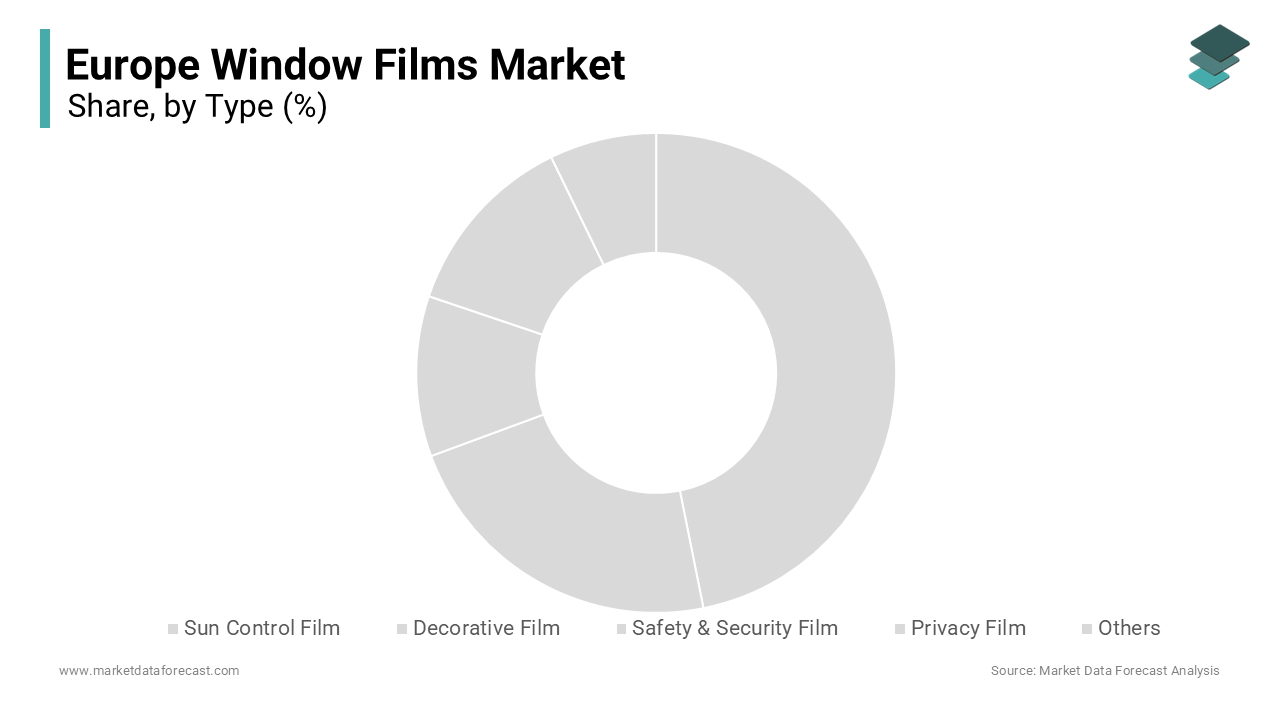
The safety and security film segment is projected to record a CAGR of 9.8% over the forecast period, which is making it the fastest-expanding type category. Strengthened building safety codes following civil unrest and extreme weather events. According to the European Committee Standardisation, the EN 12600 safety glazing standard now influences national building codes in 21 EU countries, requiring laminated or filmed glass in doors, overhead glazing, and partitions. According to municipal retrofit programs in cities like Paris, Brussels, and Amsterdam, public buildings and transport hubs were upgraded with anti-smash-and-grab films following civil disturbances in 2023. As per the European School Safety Network, 61% of new school projects in 2023 included safety film specifications to protect against breakage during accidents or vandalism. According to the European Insurance Federation, verified safety film installations qualify for up to 12% premium reductions on commercial property policies. As resilience planning becomes integral to urban policy, safety films transition from optional to essential protective infrastructure.
By Application Insights
The building and construction segment occupied 68.5% of the European window films market share in 2025. This dominance of the building and construction segment in the European market is driven by the sector’s scale, regulatory exposure, and alignment with EU decarbonization priorities. Vast stock of energy-efficient glazing in existing buildings. According to Eurostat, over 35% of Europe’s building stock was constructed before 1970. According to national energy audits referenced by the European Commission, single-glazed windows remain prevalent in 22% of residential structures and 18% of public buildings, creating immense retrofit potential. According to the European Commission, buildings account for 40% of final energy use in the EU, with glazing responsible for up to 30% of summer cooling loads. According to the Renovation Wave Strategy and the Recovery and Resilience Facility, 36 billion euros have been unlocked for envelope retrofits, explicitly endorsing nonstructural upgrades. As per Italy’s Superbonus 110 and Spain’s PREE 2023, certified solar control films are eligible expenses. This policy infrastructure transforms window films from aesthetic accessories into strategic energy assets across millions of European buildings.
The automotive segment is estimated to showcase a CAGR of 9.15% over the forecast period, owing to the stringent EU glazing standards for occupant thermal and UV protection. According to the European Commission’s General Safety Regulation (2022 framework), new passenger vehicles are required to address solar heat gain and UV exposure to reduce driver fatigue and air conditioning reliance, indirectly promoting spectrally selective films. According to the European Automobile Manufacturers’ Association, 63% of new cars sold in the EU in 2023 featured factory-applied solar control glazing or film layers. As per the European Consumer Organisation, 58% of car owners in Southern Europe install UV-blocking films within six months of purchase to protect interiors and reduce cabin temperatures, which can exceed 65 degrees Celsius in summer. According to industry specifications adopted across EU member states, films that reject 99% of UV radiation while maintaining 70% visible light transmittance are increasingly standard in premium and electric vehicle segments where battery range is affected by cooling loads.
REGIONAL ANALYSIS
Germany Window Films Market Analysis
Germany occupied 23.5% of the European window films market share in 2025. The country’s position is anchored in its rigorous energy efficiency policies, dense building stock, and strong industrial manufacturing base. According to the German Energy Agency (dena), more than 18 million residential buildings require energy efficiency upgrades to meet 2030 climate targets, with glazing identified as a priority intervention. As per KfW Bank, €4.8 billion was allocated in 2023 for building retrofit programs, including nonstructural upgrades such as certified solar control films. Germany’s Technical Rule for Workplaces mandates safety films in commercial partitions and stairwells to prevent injury during evacuations. According to the Fraunhofer Institute for Building Physics, municipal cooling action plans in Berlin and Munich have driven widespread installation of sun control films in public buildings between 2021 and 2023. Additionally, Germany hosts Europe’s largest automotive industry, with OEMs like BMW and Mercedes integrating advanced films into premium and electric models. With a culture of engineering precision, policy compliance, and sustainability, Germany sets the benchmark for high-performance window film adoption across technical and regulatory dimensions.
France Window Films Market Analysis
France holds the second-largest share in the European window films market. The growth of France in the European market is driven by aggressive national retrofit incentives and urban heat mitigation strategies. According to the French Ministry of Ecological Transition, the MaPrimeRénov scheme subsidised more than 850,000 building energy upgrades in 2023, with solar control films explicitly listed as eligible glazing measures. As per Santé Publique France, heatwaves caused 6,200 excess deaths in 2023, prompting urban cooling plans in Paris, Lyon, and Marseille that included film installation in social housing. The French Building Code now requires new public buildings to limit solar heat gain through passive means, favouring film retrofits in historic districts where façade alteration is prohibited. Additionally, France’s automotive sector, with brands like Renault and Stellantis, promotes UV-protective films in electric vehicle models to enhance cabin comfort and battery efficiency. This blend of public policy, climate adaptation, and industrial alignment ensures France remains a high-growth market for both solar and safety films.
Spain Window Films Market Analysis
Spain is expected to exhibit a promising CAGR in the European window films market over the forecast period. The extreme summer temperatures, high solar exposure, and robust residential retrofit programs are fuelling the Spanish market growth. According to Spain’s National Meteorological Agency (AEMET), average summer temperatures in Madrid and Seville exceeded 38°C in 2023, with urban heat islands intensifying indoor discomfort. As per the PREE 2023 program, €1.2 billion was allocated for building envelope upgrades, with window films recognised as compliant interventions under Royal Decree 577/2023. According to the Spanish Consumer Association, more than 70% of households in Andalusia and Valencia installed solar control films in 2023 to reduce reliance on air conditioning, which accounts for about one-third of household summer electricity use as per Red Eléctrica de España. Additionally, Spain’s booming tourism sector drives demand in hotels and vacation rentals, where guest comfort and interior protection are critical. With more than 250,000 new residential units completed in 2023 and strong southern climate pressures, Spain’s market prioritises high-performance sun control solutions with rapid payback periods.
Italy Window Films Market Analysis
Italy is predicted to account for a prominent share of the European window films market over the forecast period due to its vast historic building stock, rising energy costs, and generous tax incentives. According to ISTAT, more than 60% of residential buildings were constructed before 1980, with single glazing still common in historic centres such as Rome, Florence, and Venice. As per the Italian Revenue Agency, the Superbonus 110 scheme has driven more than 420,000 film installations since 2021. The Italian National Fire Corps now requires safety films in schools and public buildings to prevent glass fragmentation during emergencies. Additionally, Italy’s luxury automotive sector, with brands like Ferrari, Lamborghini, and Maserati, uses high-end ceramic films for UV protection and interior preservation. According to ARERA, electricity prices averaged €0.26 per kilowatt hour in 2023, intensifying demand for both thermal and heritage-sensitive film solutions.
United Kingdom Window Films Market Analysis
The United Kingdom is projected to grow at a healthy CAGR during the forecast period in the European market, owing to the tightening building regulations, growing commercial security needs, and climate adaptation pressures. According to the UK Department for Levelling Up, more than 28 million homes require energy upgrades to meet 205net-zeroro targets, with the Future Homes Standard mandating reduced solar heat gain from 2026. As per the British Insurance Association, verified safety film installations qualify for up to 15% premium discounts on commercial property policies, following a rise in ash-and-grab thefts, which increased by 22% in 2023 according to the Office for National Statistics. Transport for London reports that solar control films have been installed on bus shelters and underground station windows to mitigate urban heat island effects, with summer temperatures exceeding 34°C in 2023. Additionally, the UK’s strong automotive aftermarket culture supports demand for UV and glare-reducing films in private and fleet vehicles. Despite Brexit, the UK maintains alignment with EU technical standards, ensuring continued access to high-quality certified products and reinforcing its role as a mature and resilient market.
COMPETITIVE LANDSCAPE
The European window films market features intense competition among global material science leaders and regional specialists, each navigating a complex interplay of energy policy, heritage constraints and consumer expectations. The market is moderately consolidated with major players leveraging technological superiority, brand recognition, and regulatory compliance to maintain premium positioning. Competition centres not on price but on performance, transparency, sustainability credentials, and professional support ecosystems. European buyers—ranging from public housing agencies to luxury automotive brands—demand certified products with verifiable energy and safety data, often requiring local installation networks and warranty backing. The lack of harmonised labelling creates opportunities for educated vendors who can demystify technical specifications for architects and energy auditors. Meanwhile, the threat of low-cost non-compliant imports persists, particularly in Southern and Eastern Europe, pressuring legitimate players to invest in consumer education and enforcement advocacy. As the Renovation Wave accelerates, the ability to integrate films into holistic retrofit strategies and demonstrate measurable impact on carbon and comfort will determine competitive leadership in this policy-driven yet highly fragmented market.
KEY MARKET PLAYERS
Some of the notable key players in the European window films market are
- 3M (United States)
- Eastman Chemical Company (United States)
- Madico (United States)
- Solar Gard (United States)
- Llumar (United States)
- Avery Dennison (United States)
- Hanita Coatings (Israel)
- Suntek (China)
- V-KOOL (Singapore)
TOP PLAYERS IN THE MARKET
- Eastman Chemical Company, through its LLumar brand, is a global leader in high-performance window films with a strong and established presence across the European window films market. The company supplies solar control, safe, ty and automotive films that meet stringent European environmental and building standards. Eastman contributes to the global market through advanced sputtering and nano ceramic technologies that deliver superior heat rejection without compromising visible light. In Europe, the company has strengthened its position by achieving certification under the EU Construction Products Regulation and aligning its product portfolio with the Energy Performance of Buildings Directive. In 2023, Eastman expanded its distribution network in Southern Europe and launched a digital energy savings calculator to help building owners quantify retrofit benefits, reinforcing its role as a sustainability partner in the region’s decarbonization efforts.
- 3M Company is a major innovator in the European window films market, offering a comprehensive portfolio of sun control, safety and decorative films under its 3M™ Sun Control and Safety & Security Film lines. The company leverages its global materials science expertise to develop spectrally selective low-emissivity films that support energy efficiency in both buildings and vehicles. Globally, 3M drives industry standards in optical clarity and durability testing. In Europe, the company has deepened its market engagement by certifying its films under national energy incentive schemes in France, Germany and Italy. In 2023, 3M partnered with European architectural firms to integrate its films into BREEAM LEED-certified projects and launched a training program for installers to ensure consistent application quality across the region.
- AGC Inc., through its European subsidiary AGC Flat Glass Europe, is a key player in the European window films market, uniquely positioned as both a glass manufacturer and film solutions provider. The company integrates window films into its broader glazing systems, offering hybrid solutions for historic retrofits and new energy-efficient constructions. AGC contributes to the global market through its proprietary anti-reflective and UV-blocking technologies developed in its European R&D centres. To strengthen its regional presence, AGC aligned its film offerings with the EU Taxonomy for Sustainable Activities and achieved CE marking under the Construction Products Regulation. In 2023, the company launched a safety film line compliant with EN 12600 for schools and public buildings and collaborated with municipal authorities in Spain and Italy on urban cooling pilot programs using solar control films.
TOP STRATEGIES USED BY THE KEY MARKET PLAYERS
Key players in the European window films market prioritise regulatory alignment by certifying products under the EU Construction Products Regulation, Energy Performance of Buildings Directive, and national retrofit incentive schemes. They invest in advanced materials such as nano ceramics and spectrally selective coatings to maximise solar heat rejection while maintaining visible light transmission. Companies develop digital tools like energy savings calculators and carbon footprint trackers to demonstrate quantifiable benefits to building owners and ESG reporters. Strategic partnerships with architects, installers and public authorities enhance credibility and facilitate large-scale deployments. Vendors also emphasise installer training and certification to ensure consistent application quality and uphold product performance claims. These strategies collectively address Europe’s unique convergence of climate policy, heritage preservation, and consumer demand for comfort and safety.
MARKET SEGMENTATION
This research report on the European window films market has been segmented and sub-segmented based on categories.
By Type
- Sun Control Film
- Decorative Film
- Safety & Security Film
- Privacy Film
- Others
By Application
- Automotive
- Building & Construction
- Residential
- Commercial
- Marine
- Others
By Country
- UK
- France
- Spain
- Germany
- Italy
- Russia
- Sweden
- Denmark
- Switzerland
- Netherlands
- Turkey
- Czech Republic
- Rest of Europe