- Product Description Description
- Table of Contents TOC
- List of Table & Figure LOT
- Get Free Sample PDF Sample PDF
Market Size, 2025
$2.72 BnMarket Estimate, 2026
$2.95 BnMarket Forecast, 2034
$5.72 BnCAGR, 2026–2034
8.62%Europe Workforce Management Market Report Summary
The Europe workforce management market was valued at USD 2.72 billion in 2025, is estimated to reach USD 2.95 billion in 2026, and is projected to reach USD 5.72 billion by 2034, growing at a CAGR of 8.62% during the forecast period from 2026 to 2034. The growth of the Europe workforce management market is driven by increasing regulatory complexity, rising labor shortages, and the rapid adoption of digital HR technologies across industries. Workforce management platforms enable organizations to optimize scheduling, time tracking, compliance, and labor cost forecasting while aligning with frameworks such as the EU Working Time Directive and GDPR. Additionally, the expansion of hybrid work models, AI-driven staffing analytics, and cloud-based workforce solutions is transforming workforce operations across European enterprises.
Key Market Trends
-
Growing adoption of AI-driven predictive scheduling and skills-based workforce planning solutions.
-
Rising implementation of cloud-based workforce platforms to ensure regulatory compliance and scalability.
-
Expansion of hybrid and remote workforce coordination tools supporting flexible work models.
-
Increasing demand for real-time labor analytics to manage staffing shortages and optimize productivity.
-
Strong focus on GDPR-compliant workforce platforms with embedded privacy and consent management features.
Segmental Insights
-
Based on deployment mode, the cloud segment held the dominant share of the Europe workforce management market in 2025, driven by operational flexibility, automated compliance updates, and reduced infrastructure costs.
-
Based on organization size, the large enterprises segment accounted for a significant share of the Europe workforce management market in 2024, supported by complex compliance requirements and cross-border workforce operations.
-
The small and medium enterprises segment is expected to register the fastest growth due to increasing regulatory pressures and the availability of modular SaaS-based workforce solutions.
Regional Insights
The Europe workforce management market shows strong regional adoption supported by regulatory enforcement, digital transformation initiatives, and evolving labor practices.
-
Germany led the Europe workforce management market with a 23.3% share in 2024, driven by strict labor regulations, advanced digital infrastructure, and large-scale enterprise adoption of AI-based scheduling platforms.
-
The United Kingdom holds a significant position due to the early adoption of flexible work models and strong demand from the healthcare and retail sectors.
-
France is expected to witness robust growth supported by state-led digitalization initiatives and complex labor codes requiring automated compliance solutions.
-
The Netherlands and Sweden are expanding steadily due to progressive labor policies, high digital maturity, and increasing adoption of employee-centric scheduling platforms.
Competitive Landscape
The Europe workforce management market is highly competitive, featuring global enterprise software providers, regional HR technology vendors, and emerging startups focused on workforce optimization solutions. Leading companies are investing in cloud-first architectures, AI-powered analytics, and localized compliance capabilities to address diverse regulatory environments across Europe. Prominent players operating in the Europe workforce management market include Oracle Corporation, SAP SE, Automatic Data Processing, Inc. (ADP), Ultimate Kronos Group (UKG Inc.), Workday Inc., Ceridian HCM Holding Inc., IBM Corporation, NICE Ltd., Infor Global Solutions, Inc., ATOSS Software AG, SD Worx NV, Quinyx AB, Blue Yonder Group, Inc., Calabrio, Inc., and Zebra Technologies Corporation.
Europe Workforce Management Market Size
The Europe workforce management market size was valued at USD 2.72 billion in 2025 and is anticipated to reach USD 2.95 billion in 2026 from USD 5.72 billion by 2034, growing at a CAGR of 8.62% during the forecast period from 2026 to 2034.
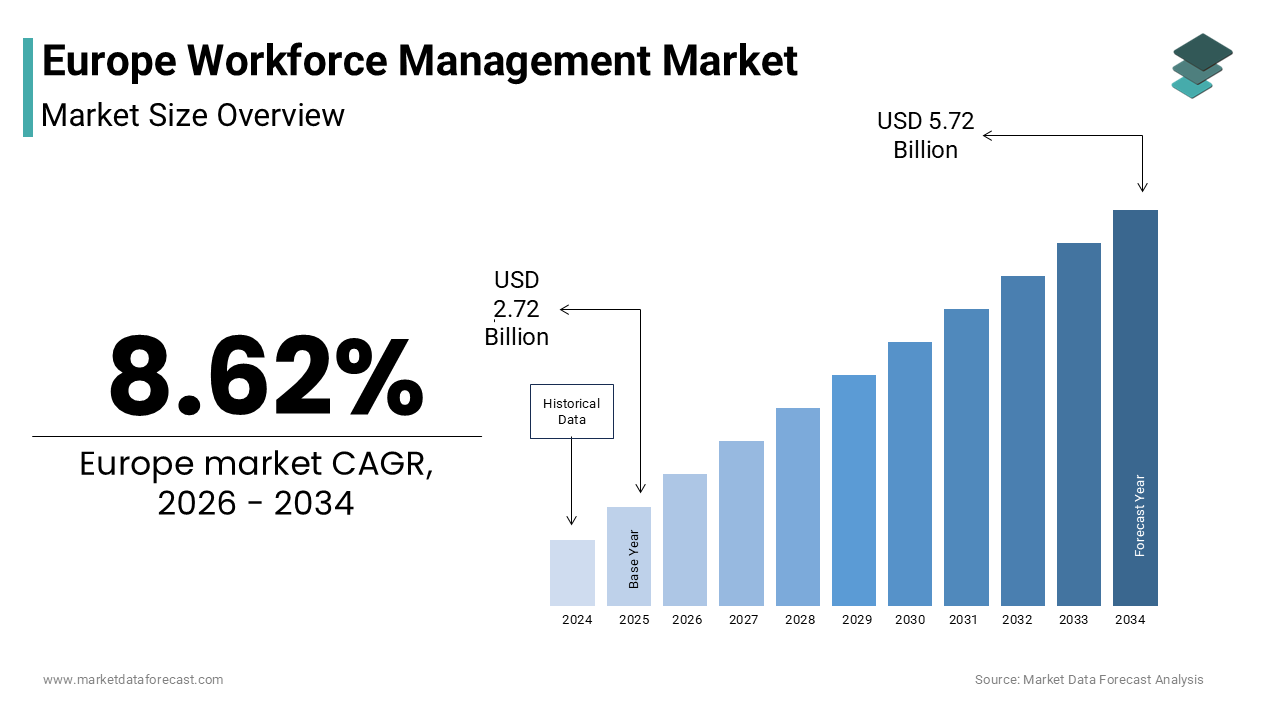
The workforce management is an integrated software and service solutions designed to optimize employee scheduling, time tracking, absence management, compliance, and labor cost forecasting across diverse industries. These systems align operational staffing needs with regulatory frameworks such as the EU Working Time Directive, which mandates maximum weekly working hours, rest periods, and annual leave entitlements. The emphasis on data privacy under the General Data Protection Regulation, requiring workforce platforms to embed strict consent mechanisms and anonymization protocols for employee data. According to Eurostat, the European Union recorded a labor force of 245 million people in 2024, with services accounting for 75 % of employment and high volatility in sectors like retail, healthcare, and logistics. As per the European Foundation for the Improvement of Living and Working Conditions, 68 % of European organizations with more than 250 employees reported using digital tools for shift planning and attendance monitoring in 2023. This convergence of regulatory complexity, labor mobility, and digital transformation defines the strategic importance of workforce management as a critical enabler of operational efficiency and legal compliance across the European countries.
MARKET DRIVERS
Stringent Labor Regulations and Compliance Requirements Across EU Member States
The proliferation of national and supranational labor laws is a primary driver for the growth of the Europe workforce management market. The EU Working Time Directive establishes baseline standards, such as a 48 hour average workweek and 11 consecutive hours of daily rest but individual countries layer additional rules. For instance, France’s Labour Code mandates mandatory rest breaks after six hours of work and restricts Sunday trading in most sectors, while Germany’s Working Hours Act prohibits work between 10 PM and 6 AM for most industries. According to the International Labour Organization, European countries enacted over 120 new labor law amendments between 2022 and 2024, particularly around gig worker classification and remote work rights. Non-compliance carries significant penalties, Spain’s Labour Inspectorate imposed fines totaling 287 million euros in 2023 for violations related to unrecorded overtime and improper shift scheduling. Workforce management platforms address this complexity by embedding country specific rule engines that auto adjust schedules, calculate statutory pay, and generate audit trails.
Persistent Labor Shortages and Rising Demand for Operational Efficiency
The chronic labor shortages are accelerating investment in workforce management technologies to maximize productivity from limited human resources is also propelling the growth of Europe workforce management market. According to the European Centre for the Development of Vocational Training, vacancies reached a record 3.8 million in the EU services sector in 2024, with healthcare, hospitality, and warehousing most affected. In Germany alone, the Federal Employment Agency reports a deficit of 210,000 skilled care workers, forcing providers to optimize shift coverage through predictive scheduling. Similarly, the UK’s Office for National Statistics notes that retail absenteeism averaged 6.2 days per employee in 2023, well above pre pandemic levels by necessitating real time rescheduling capabilities. Workforce management systems respond by integrating AI driven forecasting that aligns staffing with demand patterns derived from sales data, foot traffic, or patient admissions. A 2024 study by the Copenhagen Institute for Future Studies found that hospitals using dynamic scheduling reduced nurse overtime by 27 % while maintaining patient satisfaction scores.
MARKET RESTRAINTS
Fragmented Data Privacy Interpretations Under GDPR
The divergent national interpretations of employee data handling create significant implementation barriers for workforce management vendors is majorly restricting the growth of Europe workforce management market. While GDPR permits processing of workforce data for legitimate business purposes, supervisory authorities in countries like France and Germany impose stricter consent requirements for biometric time clocks or location tracking. According to the European Data Protection Board, 31 % of cross border workforce platform deployments in 2023 faced delays due to conflicting guidance from national regulators on permissible data retention periods and automated decision making. For example, Sweden’s Data Protection Authority permits algorithmic shift assignment if employees can request human review, whereas Austria requires explicit opt in for any AI driven scheduling. These inconsistencies force vendors to maintain multiple compliance configurations, increasing development costs and complicating updates. As per the Confederation of European Business, multinational employers reported abandoning unified workforce systems in favor of country specific solutions to avoid legal risk.
Resistance to Digital Transformation in Traditional Industries
Deeply entrenched manual processes and cultural resistance in sectors like manufacturing, construction, and public administration constrain the adoption of modern workforce management systems across parts of Europe. The resistance to digital transformation in traditional industries is also hampering the growth of Europe workforce management market. Many small and medium enterprises continue to rely on paper timesheets or legacy payroll software due to perceived complexity, cost, or lack of digital literacy. In Italy, a 2024 survey by Confindustria found that 58 % of family owned factories view scheduling software as unnecessary overhead, preferring informal supervisor based coordination. Union skepticism also plays a role in Belgium and Greece, collective bargaining agreements often restrict automated rostering to protect worker autonomy. This inertia delays productivity gains and increases compliance exposure, yet vendors struggle to overcome trust deficits without substantial change management support.
MARKET OPPORTUNITIES
Integration with AI Driven Predictive Staffing and Skills Matching
The incorporation of artificial intelligence for predictive staffing and internal talent mobility is likely to set up new opportunities for the growth of Europe workforce management market. Advanced platforms now analyze historical demand patterns, weather data, local events, and even social media sentiment to forecast staffing needs with 90 % accuracy, as demonstrated in a 2024 pilot by a major Dutch retail chain. Beyond scheduling, AI engines map employee skills certifications and career aspirations to recommend internal gigs or training pathways, supporting the EU’s Pact for Skills initiative. According to the European Centre for the Development of Vocational Training, 61 % of large European employers plan to deploy skills intelligence modules by 2026 to address reskilling gaps. Companies like Siemens and L’Oreal are already using these systems to reduce external hiring by 22 % through internal redeployment.
Expansion of Hybrid and Remote Workforce Coordination Capabilities
The institutionalization of hybrid work models has created urgent demand for workforce management systems that coordinate distributed teams, while ensuring fairness and productivity, which is additionally to escalate growth of the Europe workforce management market. As per Eurofound, 42 % of European knowledge workers now follow hybrid arrangements, requiring tools that balance office occupancy, meeting room availability, and team collaboration rhythms. Leading platforms respond with desk hoteling integrations, commute time analytics, and equity dashboards that flag disparities in remote versus in office promotion rates. In Finland, the government’s “Workplace 2030” program mandates public agencies to adopt digital coordination tools that minimize unnecessary commuting, a policy driving adoption across 180 municipalities. Similarly, France’s El Khomri Law amendments require employers to document hybrid work agreements, creating demand for audit ready digital records.
MARKET CHALLENGES
Lack of Interoperability with Legacy HR and Payroll Systems
The technical incompatibility between modern cloud platforms and legacy HRIS and payroll infrastructures prevalent in public sector and industrial enterprises, which is attributed in slowing down the growth of the Europe workforce management market. Many organizations operate on decades old systems such as SAP ECC or Oracle E Business Suite that lack open APIs or real time data exchange capabilities. According to the European Federation of Public Service Unions, 67 % of municipal governments in Southern Europe still use batch-based payroll processing, making seamless integration with live attendance data impossible without costly middleware. This disconnect forces manual data reconciliation, increasing error rates and delaying wage payments. Vendors attempt to bridge this gap with pre-built connectors, but national variations in payroll tax codes and social contribution rules further complicate automation.
Inconsistent Adoption of Real Time Labor Analytics Across Management Tiers
The inconsistent use of real time labor analytics by middle management is also to inhibit the growth of Europe workforce management market. Frontline supervisors often lack training or incentives to act on predictive alerts or productivity dashboards, defaulting to intuition-based decisions. According to a 2024 survey by the Chartered Institute of Personnel and Development, only 29 % of European line managers regularly consult workforce analytics when making staffing decisions, citing information overload or distrust in algorithmic recommendations. In unionized environments, concerns about surveillance further suppress engagement; a works council in a major German automotive plant blocked the rollout of fatigue prediction alerts, deeming them intrusive. This implementation gap means organizations invest in sophisticated platforms but fail to realize ROI through behavioral change. Vendors are responding with simplified mobile interfaces and gamified coaching, but cultural transformation remains slower than technological advancement.
REPORT COVERAGE
| REPORT METRIC | DETAILS |
| Market Size Available | 2025 to 2034 |
| Base Year | 2025 |
| Forecast Period | 2026 to 2034 |
| CAGR | 8.62% |
| Segments Covered | By Deployment Mode, Organization Size, Software Function, End-User Industry and Region |
| Various Analyses Covered | Regional & Country Level Analysis, Segment-Level Analysis, DROC, PESTLE Analysis, Porter’s Five Forces Analysis, Competitive Landscape, Analyst Overview on Investment Opportunities |
| Countries Covered | UK, France, Spain, Germany, Italy, Russia, Sweden, Denmark, Switzerland, the Netherlands, Turkey, the Czech Republic, and the Rest of Europe. |
| Market Leaders Profiled | Oracle Corporation, SAP SE, Automatic Data Processing, Inc. (ADP), Ultimate Kronos Group (UKG Inc.), Workday Inc., Ceridian HCM Holding Inc., IBM Corporation, NICE Ltd., Infor Global Solutions, Inc., ATOSS Software AG, SD Worx NV, Quinyx AB, Blue Yonder Group, Inc., Calabrio, Inc., and Zebra Technologies Corporation. |
SEGMENTAL ANALYSIS
By Deployment Mode Insights
The cloud deployment segment was the largest by holding a dominant share of the Europe workforce management market in 2025 with the operational agility, cost efficiency, and automatic regulatory updates that cloud platforms provide advantages in a region with rapidly evolving labor laws. According to the European Commission’s Digital Economy and Society Index, European enterprises with more than 10 employees, now use cloud services for HR functions, citing reduced IT maintenance and faster scalability as key benefits. The General Data Protection Regulation has further accelerated cloud adoption, as leading vendors embed GDPR compliant data residency, encryption, and audit trails directly into their architecture features difficult for on premise systems to replicate affordably.

The cloud segment is projected to expand at a CAGR of 13.8% from 2026 to 2034 with the emergence AI integration, interoperability standards, and public sector digitalization mandates. Modern cloud platforms now offer embedded machine learning for demand forecasting and skills matching capabilities that require scalable compute resources only feasible in cloud environments. As per the European Centre for the Development of Vocational Training, 52 % of large European employers plan to adopt AI powered scheduling by 2026, all of which rely on cloud infrastructure. Furthermore, the European Interoperability Framework has standardized APIs for HR systems, enabling seamless data exchange between workforce platforms and national social security or tax portals. In France, the “France Travail” reform mandates digital time tracking for all companies by 2026, driving SMEs toward compliant cloud solutions. Nordic countries lead adoption, WHERE Sweden’s Digital Agency reports that public healthcare providers now use cloud based rostering to manage nurse shortages.
By Organization Size Insights
The large enterprises segment was accounted in holding a dominant share of the Europe workforce management market in 2024 with their complex operational footprints, stringent compliance obligations, and capacity to invest in integrated platforms. Organizations with over 1,000 employees often operate across multiple EU jurisdictions, each with distinct labor codes, collective agreements, and reporting requirements. According to the European Foundation for the Improvement of Living and Working Conditions, large European firms use unified workforce systems to manage cross border compliance, reducing legal risk and administrative duplication. Industries, such as healthcare logistics and retail, which employ vast hourly workforces are particularly dependent on real time scheduling and absence management. Germany’s Federal Ministry of Labour notes that DAX 30 companies collectively invested 1.2 billion euros in workforce optimization technologies between 2022 and 2024 to address chronic staffing gaps. Moreover, large enterprises benefit from economies of scale, enabling them to justify premium platforms with advanced analytics and AI features.
The small and medium enterprises segment is expected to grow at fastest CAGR of 15.2% from 2025 to 2033 with the regulatory pressures, digital upskilling initiatives, and the availability of affordable modular SaaS solutions. The EU’s Directive on Transparent and Predictable Working Conditions, transposed into national law across member states by 2023, requires even small businesses to provide written schedules and track working hours prompting widespread adoption of digital tools. According to Eurostat, 4.8 million SMEs in the EU employ hourly workers, many of whom previously relied on spreadsheets or paper logs. National programs are accelerating change, Italy’s “Digital SME Voucher” scheme subsidized software costs for 120,000 small firms in 2024 alone. Vendors respond with simplified interfaces and bundled compliance packs, such as Spain specific overtime calculators or Polish leave accrual rules.
REGIONAL ANALYSIS
Germany Workforce Management Market Analysis
Germany was the top performer of the Europe workforce management market by capturing 23.3% of share in 2024 owing to its dense industrial base, strict labor regulations, and advanced digital infrastructure. The country’s Works Constitution Act mandates co determination in scheduling decisions, requiring transparent digital systems that log employee input and shift changes. According to the Federal Employment Agency, over 1.2 million vacancies existed in 2024 in manufacturing and elder care, driving demand for predictive staffing tools. The German government’s “Digital Now” initiative has subsidized workforce software adoption for 85 000 SMEs since 2022. Major corporations like Siemens and Volkswagen deploy AI driven platforms to manage multi-shift operations across 200+ plants.
UK Workforce Management Market Analysis
The United Kingdom was ranked second by holding 19.2% of the Europe workforce management market share in 2024 with its early adoption of flexible work models and service sector dominance. The 2023 Worker Protection Act strengthened rights to predictable hours, compelling even small businesses to implement digital time tracking. London serves as a hub for HR tech innovation, companies like Deputy and Zelt have scaled globally from UK roots. The NHS’s workforce crisis facing a deficit of 110 000 staff has accelerated deployment of intelligent rostering in hospitals.
France Workforce Management Market Analysis
France workforce management market growth is likely to be driven with fastest CAGR in coming years with the strong state led digitalization and complex labor codification. The French Labour Code contains over 3,800 articles governing work hours rest periods and Sunday work, necessitating rule based software for compliance. According to France Strategie, enterprises with more than 50 employees adopted digital time tracking in 2024 following the nationwide rollout of the “DGT Controle” mobile inspection app. The government’s “France Relance” recovery plan allocated 500 million euros to SME digital transformation including workforce tools. With high union activity and frequent labor reforms companies prioritize platforms that auto update with legal changes. France’s blend of regulatory intensity and public investment sustains robust demand across both private and public domains.
Netherlands Workforce Management Market Analysis
The Netherlands workforce management market growth is propelled with the progressive labor policies and high digital maturity. The country’s “Wet Arbeid en Zorg” law mandates advance notice of schedules and compensation for last minute changes requirements easily managed through cloud platforms. The logistics and horticulture sectors, key economic drivers operate 24/7 with seasonal labor spikes, necessitating real time coordination. Companies like Picnic and Ahold Delhaize use AI driven systems to match delivery demand with driver availability. The Dutch Data Protection Authority enforces strict GDPR compliance but supports innovation through regulatory sandboxes.
Sweden Workforce Management Market Analysis
Sweden workforce management market growth is eventually growing with the advanced welfare state and focus on employee well-being. The Swedish Work Environment Authority requires documented risk assessments for shift work by prompting healthcare and transport sectors to adopt platforms that monitor fatigue and rest compliance. According to the Swedish Agency for Digital Government, many public agencies use integrated workforce systems to manage staffing amid chronic shortages in elder care. The country’s “Flexicurity” model combining flexible hiring with strong social protection encourages digital transparency in scheduling. Stockholm based startups like Qlean and StaffCircle have gained traction by emphasizing fairness algorithms and employee self-service.
COMPETITIVE LANDSCAPE
The competition in the Europe workforce management market is characterized by a mix of global enterprise vendors specialized regional providers and emerging HR tech startups. Dominant players like Workday SAP and UKG leverage scale integration and regulatory expertise to serve large multinationals while niche firms such as Deputy and Quinyx focus on user centric design for retail and hospitality SMEs. The market is highly fragmented below the top tier with dozens of local vendors offering language and law specific solutions particularly in Southern and Eastern Europe. Regulatory complexity acts as both a barrier and differentiator as only vendors with robust compliance engines can navigate the patchwork of national labor codes. Innovation is increasingly centered on ethical AI employee well being and interoperability with national digital identity systems.
KEY MARKET PLAYERS
Some of the companies that are playing a dominating role in the Europe Workforce Management Market include
- Oracle Corporation
- SAP SE
- Automatic Data Processing, Inc. (ADP)
- Ultimate Kronos Group (UKG Inc.)
- Workday Inc.
- Ceridian HCM Holding Inc.
- IBM Corporation
- NICE Ltd.
- Infor Global Solutions, Inc.
- ATOSS Software AG
- SD Worx NV
- Quinyx AB
- Blue Yonder Group, Inc.
- Calabrio, Inc.
- Zebra Technologies Corporation
Top Players in the Europe Workforce Management Market
Workday Inc.
Workday Inc. is a major contributor to the Europe workforce management market through its unified cloud platform that integrates human capital management, time tracking, and scheduling with advanced analytics. The company serves large enterprises across finance, healthcare, and public sectors in Germany France and the UK, offering GDPR compliant data residency and localized labor rule engines. Workday has strengthened its European position by expanding its Amsterdam data center to support real time processing for EU clients and launching industry specific modules for retail and healthcare staffing. The company enhanced its Skills Cloud feature to support internal mobility and reskilling aligned with the EU Pact for Skills. Its continuous investment in AI driven forecasting and regulatory updates ensures relevance in Europe’s complex and evolving labor landscape.
UKG (Ultimate Kronos Group)
UKG plays a pivotal role in the Europe workforce management market with its Kronos Workforce Ready and Dimensions platforms tailored for hourly workforces in retail logistics and healthcare. The company maintains strong footholds in the UK Germany and the Netherlands through partnerships with local payroll providers and compliance experts. UKG has reinforced its presence by achieving ISO 27001 certification for its European cloud infrastructure and introducing dynamic scheduling tools that align with national working time directives. UKG launched a fatigue risk management module validated by occupational health authorities in Sweden and France. Its focus on frontline employee experience mobile self service and real time labor cost visibility resonates deeply with European employers navigating labor shortages and hybrid work models.
SAP SE
SAP SE contributes significantly to the Europe workforce management market through its SuccessFactors Employee Central and SAP Fieldglass solutions which embed workforce optimization within broader ERP ecosystems. Headquartered in Germany the company leverages deep integration with SAP S/4HANA to offer real time labor analytics for manufacturing and utilities sectors across the continent. SAP has enhanced its competitive stance by embedding AI powered shift bidding and skills matching into its Human Experience Management suite and ensuring full alignment with EU Working Time Directive requirements. SAP partnered with national social security agencies in Italy and Spain to automate statutory reporting directly from its platform. This native compliance and enterprise integration solidify SAP’s role as a strategic backbone for large European organizations.
Top Strategies Used by the Key Market Participants
Key players in the Europe workforce management market pursue several strategic priorities to address regulatory complexity and labor market volatility. Localization is critical with vendors embedding country specific labor laws collective agreements and payroll integrations directly into their platforms. Cloud first architecture enables automatic regulatory updates real time analytics and mobile accessibility essential for hybrid and frontline workforces. Strategic partnerships with national tax authorities social security bodies and union representatives enhance compliance credibility and accelerate adoption. Investment in AI and machine learning drives predictive scheduling skills intelligence and internal mobility features that align with EU reskilling initiatives.
MARKET SEGMENTATION
This research report on the Europe Workforce Management Market has been segmented and sub-segmented based on the following categories.
By Deployment Mode
- On-premise
- Cloud
By Organization Size
- Small and Medium Enterprises
- Large Enterprises
By Software Function
- Workforce Scheduling and Analytics
- Time and Attendance Management
- Performance and Goal Management
- Absence and Leave Management
- Task / Fatigue Management
By End-User Industry
- HealthcareBFSIManufacturing
- Consumer Goods and Retail
- Transportation and Logistics
- Hospitality
By Country
- UK
- France
- Spain
- Germany
- Italy
- Russia
- Sweden
- Denmark
- Switzerland
- Netherlands
- Turkey
- Czech Republic
- Rest of Europe