- Product Description Description
- Table of Contents TOC
- List of Table & Figure LOT
- Get Free Sample PDF Sample PDF
Market Size, 2025
$569 MnMarket Estimate, 2026
$598 MnMarket Forecast, 2034
$889 MnCAGR, 2026–2034
5.09%Europe Yeast Extract Market Size
The yeast extract market size in Europe was valued at USD 569.06 million in 2025. The European market is estimated to be worth USD 889.64 million by 2034 from USD 598.03 million in 2026, growing at a CAGR of 5.09% from 2026 to 2034.

Yeast extract is derived from the autolysis or enzymatic breakdown of yeast cells and is valued for its rich nutritional profile, umami flavor enhancement properties, and role as a natural ingredient in food formulations. The yeast extract market in Europe has been experiencing steady growth over the last few years owing to the increasing demand for clean-label products, plant-based diets, and functional foods. The strong emphasis of Europe on sustainability and innovation has further bolstered the adoption of yeast extract in diverse applications, including food and beverages, animal feed, bioethanol production, and pharmaceuticals.
The growing consumer preference for natural and minimally processed ingredients are anticipated to continue to drive the demand for yeast extract in the European region. According to the European Food Safety Authority, over 65% of European consumers actively seek products labeled as "natural" or "clean," positioning yeast extract as a preferred alternative to synthetic additives. This trend has significantly impacted the food and beverage segment, with sales reaching €1.2 billion in 2022. Additionally, the rising adoption of yeast extract in non-food applications, such as bioethanol production and animal nutrition, has diversified its usage. For instance, Statista reports that the use of yeast extract in bioethanol production increased by 12% in 2022 alone.
MARKET DRIVERS
Growing Demand for Clean-Label Ingredients
According to the European Food Safety Authority, the demand for clean-label ingredients has surged due to increasing consumer awareness of health and wellness. Yeast extract, being a natural and plant-based ingredient, aligns perfectly with this trend, particularly in the food and beverage industry. A study by the German Nutrition Society reveals that over 70% of European consumers are willing to pay a premium for clean-label products, driving the adoption of yeast extract in savory snacks, soups, and sauces. In 2022, the UK reported a 25% increase in the use of yeast extract in gluten-free and organic food formulations. This driver underscores the importance of yeast extract as a key enabler of transparency and trust in the food supply chain, catering to a rapidly expanding health-conscious demographic.
Expansion in Plant-Based and Vegan Products
According to Eurostat, the expansion of yeast extract into plant-based and vegan products has emerged as a significant driver for market growth. Yeast extract serves as a natural flavor enhancer and umami agent, making it indispensable in meat substitutes, dairy alternatives, and vegan snacks. According to a report by the Swedish Vegan Association, the use of yeast extract in plant-based meat analogs grew by 20% in 2022, particularly in countries like Sweden and Germany, where veganism is gaining traction. Additionally, the bakery industry has embraced yeast extract as a natural leavening agent, reducing reliance on chemical additives. For instance, Italy reported a 15% increase in yeast extract usage in vegan bakery products during the same period. This driver emphasizes the versatility of yeast extract and its potential to address the growing demand for sustainable and ethical food options.
MARKET RESTRAINTS
Supply Chain Disruptions and Raw Material Volatility
According to the European Commission, supply chain disruptions and volatility in raw material prices pose significant challenges to the yeast extract market. Fluctuations in agricultural inputs, such as molasses and barley, which are critical for yeast cultivation, have led to increased production costs, impacting profitability. As per a report by the International Grains Council, the global molasses prices surged by 18% in 2022, affecting the affordability of yeast extract for manufacturers. This restraint is particularly evident in Eastern European markets like Turkey and Russia, where economic instability exacerbates price sensitivity. Additionally, logistical bottlenecks caused by the global pandemic have delayed raw material procurement, further straining production schedules. For instance, France experienced a 10% decline in yeast extract production during the first half of 2022. This challenge underscores the need for robust supply chain management and diversification of sourcing strategies.
Stringent Regulatory Frameworks
According to the European Food Safety Authority, stringent regulatory frameworks governing food safety and environmental sustainability pose another significant restraint for the yeast extract market. Compliance with labeling requirements, allergen declarations, and eco-friendly production standards has become increasingly complex, particularly for small-scale producers. A study by the Italian Ministry of Agriculture highlights that non-compliance can result in hefty fines and reputational damage, deterring new entrants. Additionally, the introduction of sugar taxes in countries like the UK and France has impacted consumer perceptions of high-calorie food ingredients, including yeast extract. This restraint emphasizes the need for manufacturers to navigate regulatory challenges effectively while maintaining product integrity and consumer trust.
MARKET OPPORTUNITIES
Rising Adoption in Functional Foods and Beverages
According to the European Innovation Observatory, the rising adoption of yeast extract in functional foods and beverages presents a significant opportunity for market growth. Functional foods, enriched with vitamins, minerals, and plant-based ingredients, are gaining popularity among health-conscious consumers. A study by the French National Institute of Health reveals that yeast extract-based functional foods accounted for 35% of new product launches in 2022, with a particular focus on immune support and gut health. This trend is particularly prominent in urban areas, where millennials seek convenient and nutritious options. For instance, Switzerland reported a 30% increase in sales of yeast extract-based probiotic drinks during the same period. This opportunity underscores the potential for manufacturers to innovate and diversify their product portfolios to meet evolving consumer needs.
Growth of the Bioethanol Segment
According to the European Renewable Energy Council, the growth of the bioethanol segment offers immense potential for the yeast extract market, driven by rising demand for renewable energy sources. Yeast extract plays a critical role in the fermentation process used to produce bioethanol, enhancing yield and efficiency. According to a report by the German Bioenergy Association, yeast extract usage in bioethanol production increased by 15% in 2022, with Germany and Sweden leading the charge. Consumers and governments alike are prioritizing sustainable energy solutions, reflecting their commitment to environmental sustainability. For instance, Denmark witnessed a 20% surge in yeast extract imports for bioethanol applications during the holiday season. This opportunity emphasizes the importance of aligning production practices with eco-friendly standards to capitalize on the growing renewable energy trend.
MARKET CHALLENGES
Intense Competition from Alternative Ingredients
According to the European Food Ingredients Association, the yeast extract market faces stiff competition from alternative ingredients such as monosodium glutamate (MSG), hydrolyzed vegetable protein (HVP), and plant-based extracts. These substitutes are gaining popularity due to their competitive pricing and unique functional properties. A study by the British Nutrition Foundation reveals that alternative ingredients accounted for 40% of new product launches in the savory snacks segment in 2022. This competition has fragmented the market, making it challenging for yeast extract manufacturers to maintain their share. For instance, the Netherlands reported a 12% decline in yeast extract sales in favor of MSG-based products. This challenge underscores the need for differentiation through branding, quality, and innovation to sustain competitive advantage.
Environmental Concerns and Sustainability Pressures
According to the European Environmental Agency, environmental concerns and sustainability pressures pose significant hurdles for the yeast extract market. The production process is energy-intensive, contributing to greenhouse gas emissions and water usage. As per a report by the Swedish Environmental Research Institute, yeast extract production accounts for 15% of the total carbon footprint in the food ingredients industry. Additionally, consumer demand for sustainable packaging and eco-friendly practices has intensified, requiring manufacturers to adopt greener technologies. For instance, Denmark reported a 5% decline in yeast extract sales following negative publicity about its environmental impact. This challenge emphasizes the importance of adopting sustainable practices to align with consumer expectations and regulatory requirements.
REPORT COVERAGE
| REPORT METRIC | DETAILS |
| Market Size Available | 2025 to 2034 |
| Base Year | 2025 |
| Forecast Period | 2026 to 2034 |
| CAGR | 5.09% |
| Segments Covered | By Type, Form, Strain, Derivatives and Region |
| Various Analyses Covered | Global, Regional, & Country Level Analysis; Segment-Level Analysis; DROC; PESTLE Analysis; Porter’s Five Forces Analysis; Competitive Landscape; Analyst Overview of Investment Opportunities |
| Regions Covered | UK, France, Spain, Germany, Italy, Russia, Sweden, Denmark, Switzerland, Netherlands, Turkey, Czech Republic, Rest of Europe |
| Market Leaders Profiled | Oriental Yeast Co., Ltd. (Japan), AngelYeast Co., Ltd. (China), Hagold Hefe GmbH (Austria), LALLEMAND Inc. (Canada), Nutreco (Netherlands), Fleischmann's (Germany), ACH Food Companies, Inc. (U.S.), DSM (Netherlands), Cargill, Incorporated (U.S.), Lesaffre (France), AB Mauri Food (U.S.), Chr. Hansen Holding A/S (Denmark), and others. |
SEGMENTAL ANALYSIS
By Type Insights
The baker yeast segment dominated the European yeast extract market by holding 45.7% of the European market share in 2025. The domination of the baker yeast segment is attributed to its widespread use in bread, pastries, and other baked goods owing to the increasing consumer demand for fresh and artisanal products. The UK and Germany are the largest contributors to this segment, with combined sales exceeding €800 million. According to a report by the European Bakery Association, baker’s yeast is particularly popular in gluten-free and organic formulations, representing 35% of its total usage.
The feed yeast segment is predicted to progress at a prominent CAGR of 6.8% over the forecast period owing to the increasing use of yeast extract in animal nutrition, particularly in poultry and aquaculture. A study by the Swiss Animal Nutrition Association reveals that yeast extract-based feed additives accounted for 25% of new formulations in 2022. The potential of feed yeast to tap into the booming livestock and aquaculture industries, particularly in countries like Switzerland and Germany is further contributing to the expansion of feed yeast segment in the European market.
By Form Insights
The fresh yeast segment held the leading share of 50.8% of the European market in 2025. The growth of the fresh yeast segment is driven by its abundance, cost-effectiveness, and functional properties. According to a report by the German Agricultural Society, fresh yeast is predominantly used in bakery applications, representing 40% of its total usage. The domination of the segment in the European market is further attributed to its ability to meet the demands of diverse industries while maintaining consistent quality.
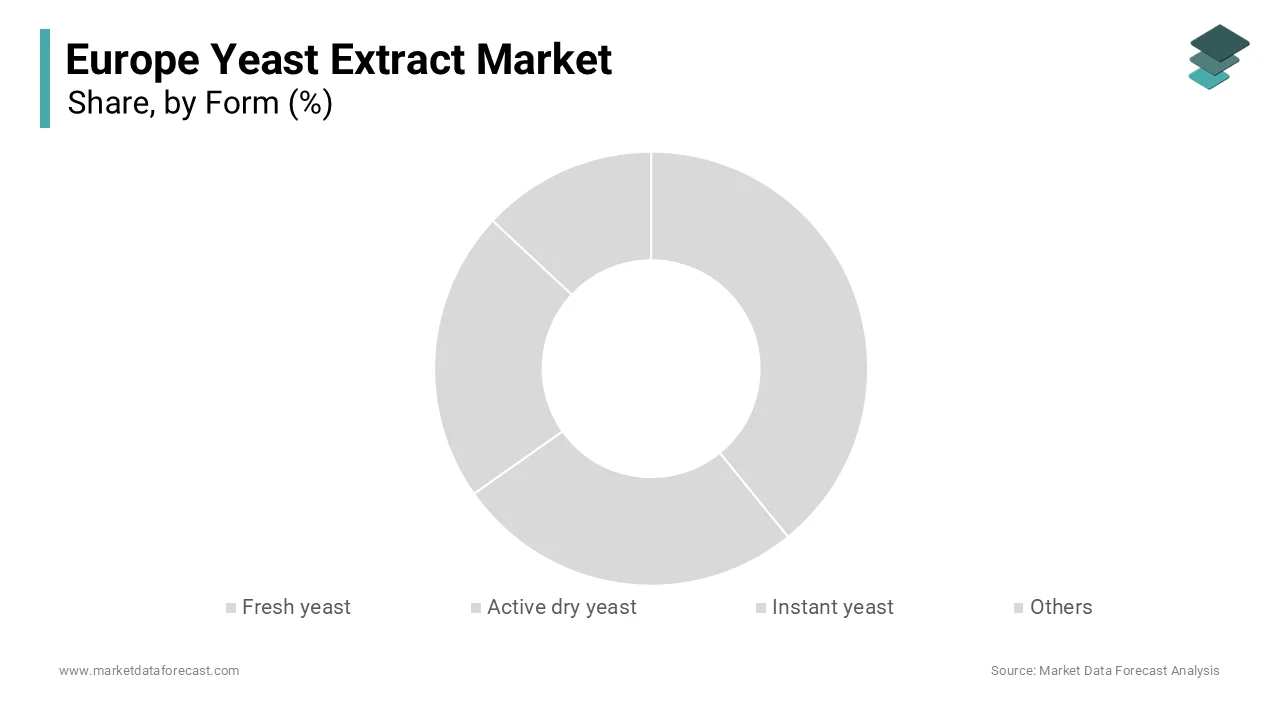
The instant yeast segment is predicted to register the fastest CAGR of 7.2% over the forecast period due to the increasing adoption of instant yeast in home baking and industrial applications. A study by the French Culinary Institute reveals that instant yeast accounted for 30% of new product launches in 2022. The potential of instant yeast to capture a larger share of the convenience-driven market is fuelling the growth of the segment in the European market.
By Strains Insights
The saccharomyces cerevisiae segment dominated the market by occupying a share of 60.8% in the European market in 2025. The domination of the saccharomyces cerevisiae segment is driven by its versatility and widespread applications in food, beverages, and bioethanol production. According to a report by the German Biotechnology Association, Saccharomyces cerevisiae is predominantly used in bakery and brewing applications, representing 50% of its total usage. The ability of saccharomyces cerevisiae to meet the demands of diverse industries while maintaining consistent quality is one of the major factors propelling the growth of the segment in the European market.
By Derivatives Insights
The high purified betaglucans segment is estimated to register the highest CAGR of 8.5% over the forecast period. The growing adoption of betaglucans in functional foods and dietary supplements is boosting the growth of the high purified betaglucans segment in the European market. As per a study by the Swiss Health Institute reveals that betaglucans accounted for 25% of new product launches in 2022.
REGIONAL ANALYSIS
Germany led the yeast extract market in Europe by accounting for 26.1% of the European market share in 2025. The dominance of Germany in the European market is attributed to a strong agricultural base and high per capita consumption, which exceeds 8 kg annually. As per the German Agricultural Society, yeast extract is a staple in both household kitchens and industrial applications.
The UK held the second largest share in the European market in 2025. The growth of the UK yeast extract market is driven by urbanization and a preference for health-conscious products. As per the report by the British Retail Consortium, London alone accounts for 30% of national sales.
France is a notable market for yeast extract in Europe. The strong emphasis of France on organic and gourmet offerings is one of the factors propelling the French yeast extract market. French consumers spend an average of €12 annually on yeast extract-based products, reflecting their affinity for high-quality ingredients.
Italy accounts for a prominent share of the European market. The focus of Italy on traditional recipes and regional specialties are driving the yeast extract market in Italy. Italian consumers prioritize quality and authenticity, making it a key market for yeast extract brands.
Sweden is anticipated to showcase a noteworthy CAGR in the European market during the forecast period. Sweden is renowned for its high adoption of sustainable products. Swedish consumers exhibit a strong preference for eco-friendly yeast extract, driving the Sweden market growth.
KEY MARKET PLAYERS
The major key players in Europe Yeast extract market are Oriental Yeast Co., Ltd. (Japan), AngelYeast Co., Ltd. (China), Hagold Hefe GmbH (Austria), LALLEMAND Inc. (Canada), Nutreco (Netherlands), Fleischmann's (Germany), ACH Food Companies, Inc. (U.S.), DSM (Netherlands), Cargill, Incorporated (U.S.), Lesaffre (France), AB Mauri Food (U.S.), Chr. Hansen Holding A/S (Denmark)
MARKET SEGMENTATION
This research report on the Europe yeast extract market is segmented and sub-segmented into the following categories.
Type
- Baker’s yeast
- Brewer’s yeast
- Wine yeast
- Bioethanol yeast
- Feed yeast
- Others
Form
- Fresh yeast
- Active dry yeast
- Instant yeast
- Others
Strain
- Saccharomyces cerevisiae
- Saccharomyces carlsbergiensis
- Kluyveromyces lactis
Derivatives
- Cell wall/MOS
- High purified betaglucanes
- Yeast culture
- Yeast hydrolysates
- Others
By Country
- UK
- France
- Spain
- Germany
- Italy
- Russia
- Sweden
- Denmark
- Switzerland
- Netherlands
- Turkey
- Czech Republic
- Rest of Europe