- Product Description Description
- Table of Contents TOC
- List of Table & Figure LOT
- Get Free Sample PDF Sample PDF
Market Size, 2025
$242.92 MnMarket Estimate, 2026
$256.62 MnMarket Forecast, 2034
$398.03 MnCAGR, 2026–2034
5.64%Executive Summary: European Home Appliances Market
- Market Scope: Comprehensive European home appliances market analysis covering appliance types, distribution channels, regional leadership frameworks, and consumer adoption metrics.
- Market Valuation: Valued at USD 242.92 million (2025), estimated at USD 256.02 million (2026), and projected to reach USD 398.03 million by 2034, registering a robust CAGR of 5.64% (2026–2034).
- Primary Growth Drivers: Demand for energy-efficient appliances, urbanization, rising disposable incomes, smart-home technologies, IoT-enabled products, AI-powered functionalities, and sustainability regulations. Key operational highlights include online sales accounting for ~25% of appliance volume (up from 15% in 2020) and >60% of EU consumers evaluating energy class, repairability, and recyclability prior to purchase.
Key Market Segment Metrics (2026–2034)
| Category | Leading Segment (2025 Position) | Fastest-Growing Segment |
|---|---|---|
| By Type | Major Appliances (dominated the European market with a 56.5% share in 2025) | Smart Home Appliances (projected to register the fastest CAGR of 8.88%) |
| By Distribution Channel | Supermarkets and Hypermarkets (accounted for the largest share in 2025) | Online / E-commerce Channels (forecast to expand at a CAGR of 7.12%) |
| By End Use / Consumer Sector | Residential Household Sector (retaining primary volume demand for essential kitchen and laundry units) | Smart Eco-Efficient Residential Housing Developments |
| By Region / Country | Germany (held the largest country-level market share in 2025, supported by manufacturing and smart tech) | Advanced Western and Northern European smart home-adopting markets |
Major Market Players & Market Structure
Market Structure: Highly competitive European home appliances landscape featuring major multinational electronics and appliance manufacturers competing intensely on energy efficiency, IoT connectivity, AI-enabled functionality, repairability, modular designs, and sustainable product development.
Key Companies: Whirlpool Corporation, Samsung Electronics Co. Ltd., Haier Inc., Bajaj Electricals Ltd., Koninklijke Philips N.V., IFB Appliances, KENT, Eureka Forbes Ltd., Panasonic Holdings Corporation, and Orient Electric.
European Home Appliances Market Size
The European home appliances market size was valued at USD 242.92 million in 2025 and is anticipated to reach a valuation of USD 256.02 million in 2026 and USD 398.03 million by 2034, growing at a CAGR of 5.64%, from 2026 to 2034.
Home appliances are a wide range of devices designed to facilitate everyday household tasks such as cooking, cleaning, and food preservation. This sector is broadly categorized into major appliances, including refrigerators, washing machines, and ovens, and small appliances like vacuum cleaners, coffee machines, and microwaves. The evolving consumer preferences, technological advancements, and increasing demand for energy-efficient and smart appliances are fuelling the demand for home appliances worldwide. Leading home appliance manufacturers in Europe focus on product innovation, sustainability, and digital integration to enhance convenience and efficiency. The adoption of smart technologies, such as IoT-enabled devices and AI-powered functionalities, is transforming consumer experiences and making home appliances more user-friendly and energy-efficient. Additionally, regulatory policies emphasizing energy conservation and sustainability have influenced product development and encouraged manufacturers to invest in eco-friendly solutions.
Urbanization, rising disposable incomes, and the growing trend of connected homes contribute to the steady expansion of the market in Europe. Consumers increasingly prefer appliances that offer remote operation, automation, and integration with digital assistants. The shift toward e-commerce has also played a crucial role in providing consumers with a seamless purchasing experience and access to a variety of brands and models.
MARKET DRIVERS
Rising Demand for Energy-Efficient Appliances
The growing emphasis on sustainability and cost savings is driving the demand for energy-efficient home appliances across Europe, which is one of the key factors propelling the European home appliances market growth. Consumers are increasingly opting for products that reduce electricity consumption and contribute to lower household energy bills and environmental conservation. Government policies such as the European Union’s Ecodesign Directive and Energy Labelling Regulation have set high efficiency standards to encourage manufacturers to develop energy-saving appliances. According to the European Commission, energy efficiency measures have helped households across EU member states cut down power consumption significantly. Refrigerators, washing machines, and dishwashers with advanced energy-saving technologies are gaining popularity, which further supports the regional market expansion. The shift toward eco-friendly appliances aligns with Europe’s broader climate goals and is accelerating adoption among environmentally conscious consumers.
Urbanization and Increasing Disposable Incomes
The ongoing urbanization trend and rising consumer purchasing power are also key drivers of the European home appliance market. As more people migrate to cities, the demand for modern and space-efficient home appliances continues to grow. Urban households seek appliances that enhance convenience, automation, and energy efficiency. For instance, urban populations across Europe are steadily increasing, and this is influencing consumer spending on home appliances. Higher disposable incomes also enable consumers to invest in premium products with advanced features, such as smart connectivity and automation. This trend is particularly evident in the expanding market for high-end kitchen appliances and laundry solutions, where consumers prioritize innovation, durability, and design.
MARKET RESTRAINTS
High Repair Costs and Limited Affordability
The high cost of repairing household appliances is one of the biggest challenges to the European home appliance market's growth. Consumers often find it more expensive to repair a product than to replace it, which is primarily due to expensive spare parts and labor charges. In the case of large appliances such as washing machines and refrigerators, repair costs can be significant, and this discourages consumers from opting for maintenance. This trend contributes to increased electronic waste and also counteracts the sustainability efforts and making affordability a growing concern. Many consumers demand policies that support repairability, such as extended warranties and affordable spare parts, but the financial burden of repairs continues to be a deterrent to long-term appliance usage.
Planned Obsolescence and Shorter Product Lifespan
The limited lifespan of household appliances is another significant restraint to the growth of the Europe home appliances market. Many home appliances are designed to function efficiently for a set period, after which performance declines or repairs become uneconomical. As a result, consumers are forced to replace products more frequently, which results in increased spending and higher electronic waste generation. Washing machines, vacuum cleaners, and kitchen appliances often have shorter lifespans than expected, which reduces consumer trust in product durability. The demand for long-lasting, repairable, and modular appliances is growing, but manufacturers continue to face pressure to balance innovation with product longevity, which is impacting market dynamics.
MARKET OPPORTUNITIES
Expansion of Smart Home Technologies
The increasing adoption of smart technologies is a major opportunity in the European home appliance market. Consumers are seeking advanced appliances with connectivity features that offer automation, remote control, and energy management capabilities. Smart home integration allows users to optimize energy consumption, enhancing efficiency and convenience. For instance, the European Commission actively supports digitalization and the Internet of Things (IoT) to drive innovation across industries. As digital infrastructure strengthens, the demand for smart refrigerators, washing machines, and kitchen appliances continues to rise. Considering these trends, the manufacturers investing in AI-driven features, voice control, and predictive maintenance solutions are well-positioned to capitalize on this growing market segment. The shift toward connected living is reshaping consumer expectations and is expected to create a lucrative space for technologically advanced home appliances.
Growth of Circular Economy and Sustainable Products
The push for sustainability and circular economy practices is also a key opportunity for home appliance manufacturers in Europe. Consumers are increasingly looking for durable, repairable, and energy-efficient appliances that align with environmental goals. For instance, the European Environment Agency encourages businesses to focus on extending product lifespans and enhancing recyclability to minimize waste. Manufacturers can leverage this trend by offering modular designs, repair services, and refurbishment programs that cater to eco-conscious buyers. Initiatives such as product-as-a-service models, where consumers rent appliances instead of purchasing them, are gaining traction. Emphasizing sustainability not only meets regulatory requirements but also strengthens brand reputation and long-term customer loyalty in an environmentally driven market landscape.
MARKET CHALLENGES
Declining Repair Sector and Increasing Product Replacement
The decline of the repair sector, as consumers increasingly replace appliances instead of repairing them, is a major challenge to the growth of the European home appliance market. High repair costs and limited availability of spare parts discourage repairability, which is leading to a shorter product lifecycle. This trend negatively impacts sustainability efforts, as more appliances are discarded rather than maintained. The diminishing repair industry also affects employment opportunities in the sector, reducing consumer access to affordable repair services. Encouraging policies that support cost-effective repairs and extended warranties could help address this issue. However, unless manufacturers and policymakers take steps to promote repair-friendly designs, the market will continue to struggle with excessive product turnover and electronic waste generation.
Environmental Challenges Due to Shorter Product Lifespan
The environmental impact of home appliances remains a major concern in Europe, as product lifespans continue to decrease that is further challenges the expansion of the Europe home appliances market. Many household appliances, including washing machines and refrigerators, do not last as long as consumers expect, which leads to higher waste levels. Shorter appliance lifespans contribute to increased raw material consumption, carbon emissions, and landfill waste. Consumers are becoming more conscious of sustainability and demanding durable and energy-efficient appliances. However, many products are still designed with limited repairability and resulting in frequent replacements. To overcome this challenge, manufacturers must invest in long-lasting, modular designs that align with circular economy principles. Stricter regulations on durability and repairability could also drive industry-wide change and thereby reduce the environmental footprint of home appliances.
REPORT COVERAGE
| REPORT METRIC | DETAILS |
| Market Size Available | 2025 to 2034 |
| Base Year | 2025 |
| Forecast Period | 2026 to 2034 |
| CAGR | 5.64% |
| Segments Covered | By Type, Distributional Channel, and Country |
| Various Analyses Covered | Regional and Country-Level Analysis, Segment-Level Analysis, DROC, PESTLE Analysis, Porter’s Five Forces Analysis, Competitive Landscape, Analyst Overview of Investment Opportunities |
| Regions Covered | Germany, the UK, France, Spain, Russia, Sweden, Denmark, Italy, Switzerland, the Netherlands, and the Rest of Europe. |
| Market Leaders Profiled | Whirlpool Corporation (U.S.), Samsung Electronics Co. Ltd. (South Korea), Haier Inc. (China), Bajaj Electricals Ltd (India), Koninklijke Philips N.V. (South Korea), IFB Appliances (India), KENT (India), Eureka Forbes Ltd. (India), Panasonic Holdings Corporation (Japan), Orient Electric (India) |
SEGMENTAL ANALYSIS
By Type Insights
The major appliances segment dominated the market in Europe in 2025 by holding 56.5% of the regional market share. This segment includes essential products such as refrigerators, washing machines, cooking appliances, and heating & cooling systems, which are crucial for everyday domestic use. The demand remains steady due to population growth, urbanization, and rising disposable incomes, and these factors are also expected to continue to drive the growth of the major appliances segment in the European market over the forecast period. Additionally, government initiatives promoting energy-efficient appliances, such as ENERGY STAR certification in the U.S., have further accelerated adoption. The necessity of major appliances for modern living is contributing significantly to the global economy and technological advancements in home automation; these factors are further likely to contribute to the segmental expansion in Europe over the forecast period.
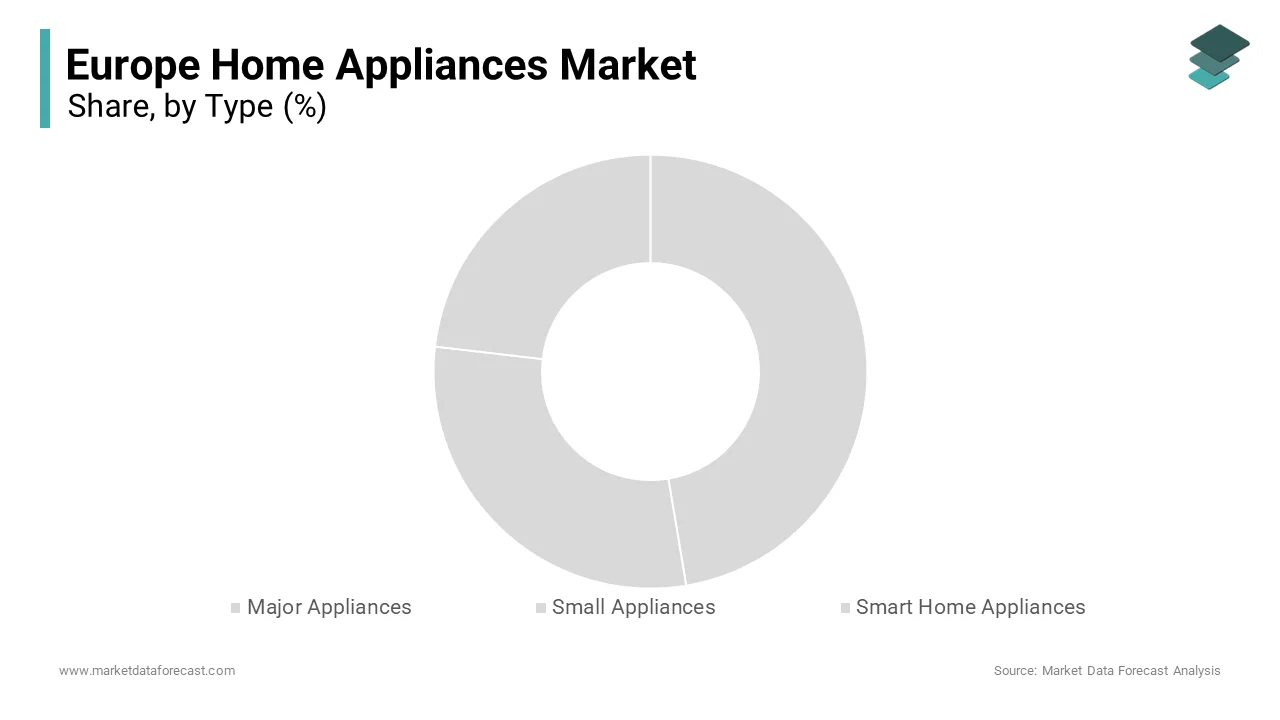
The smart home appliances segment is likely to register the fastest CAGR of 8.88% over the forecast period in the European market. Factors such as the increasing adoption of Internet of Things (IoT) technology that allows remote monitoring and automation via smartphone apps are majorly boosting the growth of the smart home appliances segment in the European market. Consumers prioritize energy efficiency, convenience, and security, which are contributing to the higher demand for smart refrigerators, washing machines, and automated kitchen appliances. Governments across Europe are encouraging smart energy solutions, which are fostering segmental growth. Additionally, the expansion of 5G networks enhances connectivity, thereby making smart home integration more seamless and attractive to modern consumers is adding a boost to the growth of the smart home appliances segment in the European market.
By Distribution Channel Insights
The supermarkets & hypermarkets segment accounted for the major share of the Europe home appliances market in 2025. The desire of consumers to physically assess products and receive immediate assistance has majorly to the dominance of this segment in the European market. The tactile experience and personalized service offered by brick-and-mortar stores play a crucial role in purchasing decisions. Additionally, immediate product availability and the opportunity to negotiate prices or obtain bundled deals enhance the appeal of offline shopping. These factors collectively contribute to the sustained prominence of the supermarket & hypermarkets segment in the European home appliances market.
The online/e-commerce segment is experiencing significant growth in the home appliances market and is estimated to witness a CAGR of 7.12% over the forecast period, owing to the increasing internet penetration, technological advancements, and evolving consumer shopping behaviors. Online platforms offer convenience, a wide range of products, competitive pricing, and the ability to compare options easily. Retailers are enhancing digital experiences with virtual product demonstrations, augmented reality visualization tools, and improved delivery services. The flexibility of online shopping, comprehensive product information,n and customer reviews have made e-commerce an increasingly popular choice for consumers purchasing home appliances. These factors are contributing significantly to the growth of the online segment in this market.
REGIONAL ANALYSIS
Germany Home Appliance Market Analysis
Germany dominated the European home appliance market with the largest share in 2025. The domination of Germany in the European market can be credited to its strong manufacturing sector and emphasis on energy-efficient and high-tech appliances. The presence of major brands such as Bosch and Miele enhances is Germany is further contributes to the domination of Germany in this regional market. Consumers prioritize durability, sustainability, and smart home integration are also driving continuous innovation in the German market.
France – Growing Demand for Premium Kitchen Appliances
France holds a significant position in the Europe home appliances market. The cultural emphasis of France on cooking and home aesthetics is primarily driving the growth of the home appliances market in France. The demand for multi-functional ovens, coffee machines, and connected appliances is rising, which is aligning with changing lifestyles and contributing to the increased demand for home appliances in France. Increased urbanization and disposable incomes further drive the French home appliances market growth.
United Kingdom – Leading in Sustainable Appliances
The UK is also a key player in the Europe home appliances market. The strong demand for eco-friendly and energy-efficient appliances is fuelling the market growth in the UK. Government policies are promoting low-energy consumption products and increasing awareness of carbon footprints influence consumer choices, which is a plus to the UK market growth. The growing online retail expansion in the UK also accelerates market growth.
KEY MARKET PLAYERS
A few of the market players in the european home appliance market include
- Whirlpool Corporation (U.S.)
- Samsung Electronics Co. Ltd. (South Korea)
- Haier Inc. (China)
- Bajaj Electricals Ltd (India)
- Koninklijke Philips N.V. (South Korea)
- IFB Appliances (India)
- KENT (India)
- Eureka Forbes Ltd. (India)
- Panasonic Holdings Corporation (Japan)
- Orient Electric (India)
MARKET SEGMENTATION
This research report on the European home appliances market is segmented and sub-segmented into the following categories.
By Type
- Major Appliances
- Refrigeration Equipment
- Cooking Appliances
- Washing & Drying Equipment
- Heating & Cooling Appliances
- Others
- Small Appliances
- Coffeemakers
- Food Processors
- Humidifiers
- Microwave Ovens
- Others
- Smart Home Appliances
By Distribution Channel
- Supermarkets & Hypermarkets
- Specialty Stores
- Online/E-commerce
- Others
By Country
- United Kingdom
- France
- Spain
- Germany
- Italy
- Russia
- Sweden
- Denmark
- Switzerland
- Netherlands
- Rest of Europe