- Product Description Description
- Table of Contents TOC
- List of Table & Figure LOT
- Get Free Sample PDF Sample PDF
Market Size, 2025
$47.11 BnMarket Estimate, 2026
$48.95 BnMarket Forecast, 2034
$66.47 BnCAGR, 2026–2034
3.9%Executive Summary: Global Event and Exhibition Market
- Market Scope: Comprehensive global event and exhibition market analysis covering exhibition types, revenue streams, regional leadership metrics, key industry participants, and emerging AI integration, immersive AR/VR, and ESG sustainability trends.
- Market Valuation: Valued at USD 47.11 billion (2025), estimated at USD 48.95 billion (2026), and projected to reach USD 66.47 billion by 2034, registering a steady CAGR of 3.9% (2026–2034).
- Primary Growth Drivers: Resurgence of in-person networking for high-value business transactions, integration of AI and data analytics for enhanced personalization and measurable ROI, and rising demand for flexible hybrid models.
Key Market Segment Metrics (2026–2034)
| Category | Leading Segment (2025 Position) | Fastest-Growing Segment |
|---|---|---|
| By Exhibition Type & Revenue | B2B segment (dominated in 2025 for commercial transactions); Exhibitor fees (captured 49.3% share in 2025) | Mixed/hybrid exhibition segment (expanding at a 13.4% CAGR); Sponsorship fees (growing at an 11.8% CAGR) |
| By Region | Europe (top performer in 2025, capturing 36.3% share via Germany), followed by North America (31.3% share) | Asia-Pacific region (rapid growth via government-backed infrastructure and corporate investment) |
Major Market Players & Market Structure
Market Structure: Highly competitive global trade fair and exhibition management landscape featuring major event organizers competing on AI-driven hybrid matchmaking platforms and carbon footprint calculators for sustainability.
Key Companies: Informa Markets, Fiera Milano SpA, Deutsche Messe, Messe Frankfurt GmbH, MCH Group AG, GL Events, Messe Munchen, Messe Düsseldorf, Koelnmesse, and Easyfairs.
Global Event and Exhibition Market Size
The size of the global event and exhibition market was worth USD 47.11 billion in 2025. The global market is expected to register a CAGR of 3.9% from 2026 to 2034 and be worth USD 66.47 billion by 2034 from USD 48.95 billion in 2026.
The Event and Exhibition is the planning, execution, and management of organized gatherings designed for networking, knowledge exchange, product showcasing, and brand engagement across industries such as technology, healthcare, education, and trade. These events range from large-scale international expos and trade fairs to niche conferences and hybrid forums, serving as nodes in global business ecosystems. According to the International Congress and Convention Association (ICCA), international association meetings alone generated over 1.3 million delegate days in 2023, with cities like Singapore, Barcelona, and Toronto emerging as leading hosts.
MARKET DRIVERS
Resurgence of In-Person Networking Fueling Business Growth
The resurgence of in-person networking as a strategic imperative for business development, in sectors reliant on relationship-based transactions, is driving the growth of the Event and Exhibition Market. According to a 2023 Global Business Travel Association survey, 83% of corporate decision-makers believe face-to-face interactions yield higher-quality leads than digital alternatives, with 67% indicating that post-pandemic deal closures are more frequently initiated at physical events. In the pharmaceutical industry, the American Society of Clinical Oncology reported that its 2023 annual meeting facilitated over 12,000 scheduled one-on-one meetings between researchers, clinicians, and biotech firms, accelerating collaboration on clinical trials. This revalidation of physical presence as a catalyst for trust and deal-making is reinvigorating demand for high-impact, industry-specific gatherings.
AI and Data Analytics Enhancing Event Personalization and ROI
The integration of artificial intelligence and data analytics into event management platforms, enabling hyper-personalization and measurable ROI for exhibitors, is another factor driving the growth of the Event and Exhibition Market. As per the Event Industry Council, 64% of event organizers now use AI-powered matchmaking tools to connect attendees with relevant sessions, exhibitors, and networking opportunities, increasing engagement efficiency by up to 40%. Salesforce’s 2023 Dreamforce conference utilized predictive algorithms to recommend personalized agendas for 170,000 participants, resulting in a 32% increase in session attendance compared to previous years. Moreover, exhibitors are leveraging real-time foot traffic analytics; at the 2023 Consumer Electronics Show in Las Vegas, infrared sensors and Wi-Fi tracking captured over 2.1 million visitor-interaction data points by allowing brands to quantify lead generation with unprecedented accuracy.
MARKET RESTRAINTS
Rising Costs of Hosting Large-Scale Physical Events
The escalating cost of hosting large-scale physical events, which includes venue rentals, labor, logistics, and compliance with sustainability mandates, is restricting the growth of the Event and Exhibition Market. According to the Professional Convention Management Association, the average cost of renting a major convention center space in cities like London, Dubai, or New York has risen by 38% since 2021, driven by inflation and increased demand. In addition, labor shortages in hospitality and event services have inflated staffing costs; the U.S. Bureau of Labor Statistics reports that wages for event coordinators and technical crews increased by 22% between 2022 and 2025.
Digital Fatigue and Competition from Virtual Alternatives
The persistent digital fatigue and competition from virtual alternatives, which continue to draw audience attention and reduce physical attendance is additionally to restrain the growth of the Event and Exhibition Market. According to the International Association of Exhibitions and Events, 41% of professionals now attend only hybrid or fully virtual events due to time constraints and travel costs, with 57% citing "content accessibility post-event" as a primary reason. While hybrid models offer flexibility, they dilute the exclusivity and immersive experience of in-person events, which is making it harder for organizers to justify premium pricing and maintain exhibitor engagement.
MARKET OPPORTUNITIES
Immersive Technologies Enhancing Engagement and Event Lifecycles
The adoption of immersive technologies such as augmented reality (AR), virtual reality (VR), and spatial computing to enhance attendee engagement and extend event lifecycles is lucratively to expand the growth of the Event and Exhibition Market in the coming years. As per PwC’s 2025 Global Events Outlook, 52% of major trade shows now incorporate AR elements by allowing visitors to visualize 3D product models or interact with digital twins of machinery on the exhibition floor. VR-enabled remote attendance is also gaining traction; NVIDIA’s GTC 2023 attracted 350,000 virtual participants through a metaverse-based platform, where users navigated digital exhibition halls using avatars. These technologies not only enrich the physical experience but also create lasting digital assets that can be repurposed for marketing and training, which is amplifying event value beyond the live dates.
Sustainability and ESG Integration Driving Event Differentiation
The strategic alignment of events with sustainability and ESG (Environmental, Social, and Governance) imperatives, transforming them into platforms for corporate responsibility and brand differentiation. According to the Global Reporting Initiative, 68% of Fortune 500 companies now include event-related carbon emissions in their annual sustainability disclosures, driving demand for low-impact formats. The COP28 Climate Expo in Dubai achieved carbon neutrality by sourcing 100% renewable energy, utilizing modular reusable stands, and offsetting 142,000 tons of CO₂ through verified reforestation projects, as reported by the UN Climate Change Secretariat. Similarly, the Green Events Index found that sustainable events in Europe saw a 29% higher exhibitor retention rate compared to conventional ones, indicating long-term brand loyalty. Cities like Copenhagen and Vancouver now prioritize hosting events that meet stringent green certification criteria by offering incentives for zero-waste operations.
MARKET CHALLENGES
Geopolitical Volatility and Travel Restrictions Disrupting Events
The geopolitical volatility and travel restrictions that disrupt international participation and scheduling are expected to hamper the growth of the Event and Exhibition Market in the coming years. According to the World Travel & Tourism Council, in 2023 alone, 18 major international events were postponed or relocated due to visa denials, regional conflicts, or sudden policy changes, including the cancellation of a major medical conference in Kazakhstan due to airspace closures. The Institute of International Education notes that scientists from sanctioned countries often face prolonged visa processing delays, preventing their participation in academic forums. These external shocks undermine long-term planning, reduce diversity of participation, and weaken the global inclusivity that defines high-value events.
Lack of Standardized Data Measurement Hindering ROI Assessment
The lack of standardized data measurement across events, which is making it difficult for organizers and sponsors to compare performance and justify investments, is likely to degrade the growth of the Event and Exhibition Market. According to the Event Marketing Institute, only 39% of event organizers use uniform KPIs for lead generation, brand recall, or attendee satisfaction, leading to inconsistent reporting. In a 2023 audit by the European Events Federation, 62% of post-event surveys lacked validated methodologies, relying on self-reported data with no third-party verification. This absence of benchmarking complicates ROI assessment; a study by Forrester found that 54% of exhibitors could not accurately quantify sales conversions from event leads due to poor CRM integration. The lack of interoperability between registration platforms, CRM systems, and analytics tools further fragments insights, hindering the sector’s ability to mature into a fully accountable, data-driven industry.
REPORT COVERAGE
| REPORT METRIC | DETAILS |
| Market Size Available | 2025 to 2034 |
| Base Year | 2025 |
| Forecast Period | 2026 to 2034 |
| CAGR | 3.9% |
| Segments Covered | By Type, Revenue Stream, and Region. |
|
Various Analyses Covered | Global, Regional, & Country Level Analysis; Segment-Level Analysis, DROC; PESTLE Analysis; Porter’s Five Forces Analysis; Competitive Landscape; Analyst Overview of Investment Opportunities |
| Regions Covered | North America, Europe, APAC, Latin America, Middle East & Africa |
|
Market Leaders Profiled | Informa markets, Fiera Milano SpA, Deutsche Messe, Messe Frankfurt GmbH, MCH Group AG, GL Events, Messe Munchen, Messe Düsseldorf, Koelnmesse, Easy fairs, and Others. |
SEGMENTAL ANALYSIS
By Type Insights
The B2B (business-to-business) exhibition segment dominated the global event and exhibition market share in 2025 by facilitating high-value commercial transactions, supply chain integration, and industry-specific innovation diffusion. B2B events serve as essential platforms for sectors such as industrial manufacturing, healthcare technology, and enterprise software, where complex products require in-person demonstration and negotiation. According to the International Congress and Convention Association, 74% of international association meetings are B2B-focused, generating over 1.1 million delegate days annually. These events are often sponsored by multinational corporations and supported by government trade agencies, reinforcing their economic significance and institutional backing.
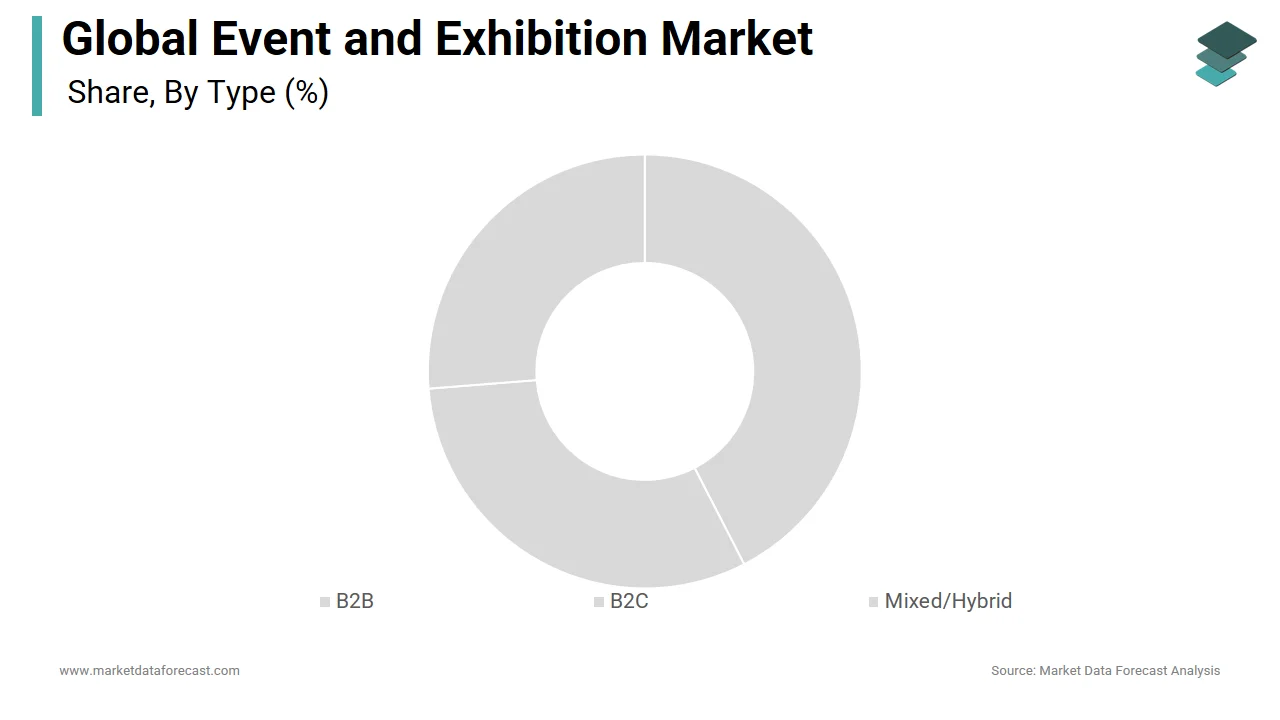
The mixed/hybrid exhibition segment is projected to expand at a CAGR of 13.4% in the coming years, with the demand for flexible participation models that combine physical attendance with digital access, maximizing reach and inclusivity. The shift gained momentum post-pandemic, with organizations recognizing the value of virtual components in extending event lifecycles. As per the Event Industry Council, hybrid events now attract 42% more total participants than purely in-person formats, with virtual attendees often engaging in on-demand content for up to six weeks post-event. Salesforce’s 2023 Dreamforce conference reported that 45% of its 170,000 total participants joined remotely, yet generated 30% of all qualified leads.
By Revenue Stream Insights
The exhibitor fees segment was the largest by capturing 49.3% of the share in 2025, with the high value companies place on physical brand visibility, product launches, and direct engagement with qualified buyers. Major trade fairs such as CES in Las Vegas and MEDICA in Düsseldorf generate the bulk of their income from booth rentals, with premium floor spaces commanding up to $250 per square foot. According to UFI, the average exhibitor spends between $50,000 and $200,000 per event, covering stand construction, staffing, and promotional materials.
The sponsorship fees segment is expected to grow at a CAGR of 11.8% in the coming years, with corporations seeking high-impact brand alignment with premium events in technology, healthcare, and sustainability. Unlike exhibitor fees, sponsorships offer exclusive branding rights, keynote speaking slots, and data access, providing deeper audience engagement. In 2023, title sponsorships at major events like Web Summit and Mobile World Congress exceeded $2 million per deal, as confirmed by event organizers. The Financial Times reports that tech giants such as Google, Microsoft, and Siemens now allocate up to 25% of their annual marketing budgets to strategic event sponsorships. Additionally, ESG-linked sponsorships are rising; at COP28’s Climate Expo, sustainability-focused brands paid a 30% premium for carbon-neutral partnership packages.
REGIONAL ANALYSIS
Europe Event and Exhibition Market Insights
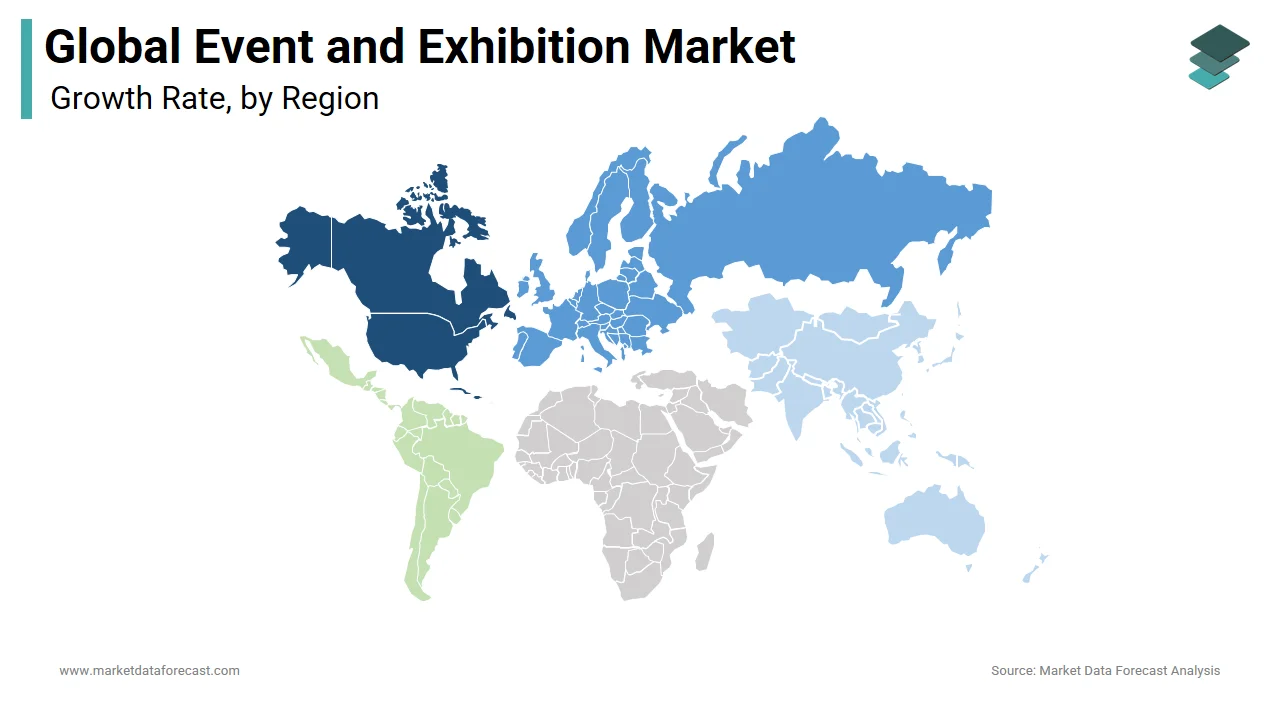
Europe was the top performer of the global event and exhibition market by capturing 36.3% of share in 2025. Germany dominated with cities like Frankfurt, Hannover, and Cologne hosting over 150 major B2B exhibitions annually, according to the Association of the German Trade Fair Industry (AUMA). The European Union supports this ecosystem through the Erasmus for Young Entrepreneurs program, which facilitates cross-border business matchmaking at trade shows. Additionally, Europe leads in sustainable event practices; Messe München operates on 100% renewable energy, and 82% of its exhibitions now comply with DIN ISO 20121 sustainability standards, as reported by the European Events Sustainability Network.
North America Event and Exhibition Market Insights
North America was positioned second by capturing 31.3% of the share in 2025. The United States hosts some of the world’s most influential gatherings, including CES, SXSW, and the National Retail Federation’s Big Show, drawing over 2.5 million business attendees annually, according to the U.S. Travel Association. Las Vegas and Orlando have emerged as premier convention destinations, with the Las Vegas Convention Center completing a $1 billion expansion in 2023 to accommodate growing demand. Canada complements this ecosystem with specialized forums like the Canadian Innovation Exchange (CIX), fostering startup investment. With robust digital infrastructure and corporate marketing budgets, North America remains a leader in hybrid event adoption and experiential design.
Asia-Pacific Event and Exhibition Market Insights
Asia-Pacific (APAC) Event and Exhibition Market growth is driven by the rapid urbanization, rising corporate investment, and government-backed exhibition infrastructure. China hosted over 10,000 trade events in 2023, with the China International Import Expo (CIIE) facilitating $38.6 billion in intended deals. India is emerging as a high-growth market, with the Ministry of Commerce confirming a 27% year-on-year increase in international exhibitions in 2023, driven by initiatives like the National Exhibition Policy.
Middle East and Africa Event and Exhibition Market Insights
Middle East and Africa (MEA) Event and Exhibition Market growth is ascribed to be driven by the increasing middle-class economies. The United Arab Emirates, particularly Dubai, has positioned itself as a global events gateway, hosting over 1,500 international exhibitions annually, including GITEX Global and Arab Health, which attracted 170,000 attendees in 2023, as reported by DWTC. The UAE government’s Vision 2030 includes a $2.7 billion investment in Expo City Dubai’s repurposing as a permanent business events district. Saudi Arabia is rapidly expanding its MICE infrastructure under Vision 2030, with the Jeddah Central Project set to include a 240,000-square-meter exhibition complex.
Latin America Event and Exhibition Market Insights
Latin America Event and Exhibition Market growth is likely to grow with the emphasis on regional integration and niche industry events. Brazil hosts the largest share of events in the region, including FISPAL Food Service and Feiplastic, drawing over 200,000 visitors annually, according to the Brazilian Association of Exhibitions and Events (ABEOC). São Paulo and Buenos Aires serve as key hubs for the pharmaceutical, agribusiness, and packaging sectors.
KEY MARKET PARTICIPANTS
Companies playing a major role in the global event and exhibition market include Informa Markets, Fiera Milano SpA, Deutsche Messe, Messe Frankfurt GmbH, MCH Group AG, GL Events, Messe Munchen, Messe Düsseldorf, Koelnmesse, and Easyfairs. Informa Markets and RX (formerly Reed Exhibitions) are currently the top vendors in the Global region.
TOP LEADING PLAYERS IN THE MARKET
Reed Exhibitions
Reed Exhibitions has established a commanding presence in the Asia-Pacific event landscape through its portfolio of industry-leading trade shows, including China International Import Expo (CIIE) partner events and India’s Big 5 Construct. The company has localized its strategy by collaborating with regional governments and industry associations to align exhibitions with national economic priorities such as infrastructure development and digital transformation. In 2023, Reed launched a hybrid event platform tailored for Southeast Asian SMEs by enabling Indonesian and Vietnamese manufacturers to showcase products to global buyers with integrated AI matchmaking.
Messe Frankfurt
Messe Frankfurt has deepened its engagement in Asia-Pacific by expanding its thematic events in textiles, lighting, and consumer goods, with flagship fairs such as Texworld in Vietnam and Ambiente India. The company operates a permanent representative office in Shanghai and partners with local organizers to ensure cultural and regulatory alignment. In 2022, Messe Frankfurt launched the “Smart Textiles Asia” summit in Bangkok, fostering collaboration between European technology providers and Southeast Asian manufacturers. It has also invested in sustainable event infrastructure, ensuring its Indian exhibitions comply with IGBC green standards. The company introduced a carbon footprint calculator for exhibitors at its Hong Kong trade shows, enhancing transparency and supporting corporate ESG reporting.
Informa Markets
Informa Markets has become a pivotal force in Asia-Pacific through its acquisition and expansion of sector-specific events in healthcare, food, and technology, including Food & Hotel Asia and CPHI India. The company leverages its global network to connect regional suppliers with international buyers, particularly in fast-growing markets like Indonesia and the Philippines. In 2023, Informa launched a digital twin platform for its Thailand Manufacturing Expo, allowing remote attendees to navigate virtual exhibition halls and initiate real-time chats with exhibitors. It also introduced an AI-powered lead generation system that analyzes attendee behavior to deliver qualified prospects to sponsors.
TOP STRATEGIES USED BY KEY MARKET PARTICIPANTS
Key players in the event and exhibition market are deploying hybrid event integration, industry vertical specialization, sustainability certification, digital matchmaking, and strategic regional partnerships to consolidate their global influence. Companies are investing in seamless physical-digital platforms to expand audience reach and extend engagement beyond live dates. Focus on niche sectors such as health tech, clean energy, and agri-business enhances relevance and attendee quality. Organizers are adopting ISO 20121 and other green standards to meet corporate ESG mandates and secure public-sector contracts. AI-driven networking tools improve lead generation and exhibitor ROI. Additionally, alliances with government economic zones and trade bodies ensure alignment with national development agendas in emerging markets where events serve as catalysts for foreign investment and export growth.
COMPETITION OVERVIEW
The competition in the event and exhibition market is intensifying as global organizers, regional players, and digital platforms vie for dominance in a post-pandemic, hybrid-first environment. While legacy players leverage scale and brand equity, challengers differentiate through technological agility and sector-specific focus. The battleground has shifted from attendance volume to engagement quality, data transparency, and sustainability compliance. Organizers are under pressure to deliver measurable ROI, prompting investment in AI analytics and lead-tracking systems. Geographic expansion into high-growth regions like Asia-Pacific and the Middle East is accelerating, often through joint ventures with local entities.
RECENT MARKET DEVELOPMENTS
- In June 2023, Reed Exhibitions launched a hybrid matchmaking platform for SMEs in Vietnam, integrating AI to connect local manufacturers with international buyers during its Saigonbuild event, enhancing cross-border trade opportunities.
- In September 2023, Messe Frankfurt introduced a carbon footprint calculator for exhibitors at its Hong Kong International Lighting Fair, enabling real-time emissions tracking and reinforcing its commitment to sustainable event management.
- In January 2024, Informa Markets deployed a digital twin experience at Food & Hotel Thailand, allowing remote participants to navigate virtual booths and engage in live product demonstrations via augmented reality.
- In March 2023, Reed Exhibitions partnered with India’s Ministry of Commerce to co-host the Global Buyers Summit, facilitating B2B meetings between Indian exporters and 1,200 international delegates in New Delhi.
- In October 2023, Messe Frankfurt inaugurated a permanent Smart Textiles Asia hub in Bangkok, supporting innovation in functional fabrics and strengthening its presence in Southeast Asia’s advanced manufacturing sector.
MARKET SEGMENTATION
This research report on the global event and exhibition market has been segmented and sub-segmented based on type, revenue stream and region.
By Type
- B2B
- B2C
- Mixed/Hybrid
By Revenue Stream
- Exhibitor Fee
- Sponsorship Fee
- Entrance Fee
- Services
By Region
- North America
- Asia Pacific
- Latin America
- Europe
- Middle East & Africa