- Product Description Description
- Table of Contents TOC
- List of Table & Figure LOT
- Get Free Sample PDF Sample PDF
Market Size, 2025
$3.15 BnMarket Estimate, 2026
$3.35 BnMarket Forecast, 2034
$5.41 BnCAGR, 2026–2034
6.2%Global Eye Exam Equipment Market Size, Growth, Trends & Forecast (2026–2034)
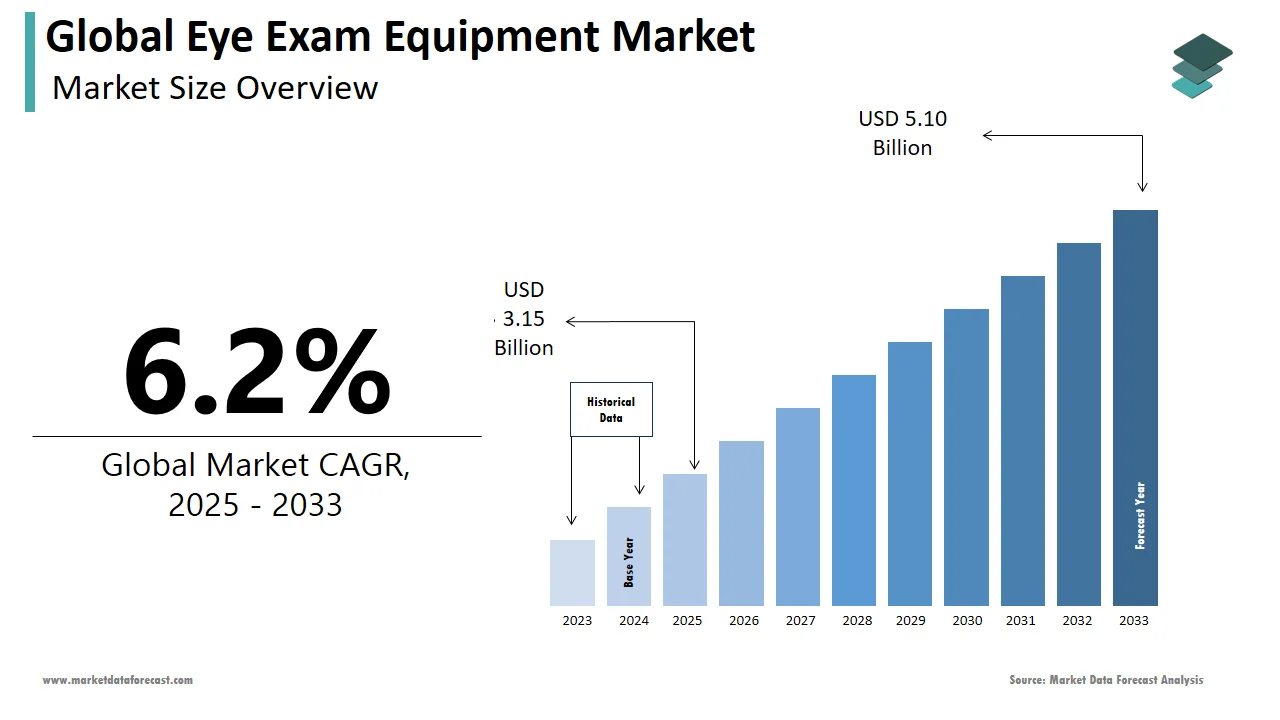
The size of the global eye exam equipment market was valued at USD 3.15 billion in 2025, is anticipated to reach USD 3.35 billion in 2026, and is projected to scale up to USD 5.41 billion by 2034, registering a compound annual growth rate (CAGR) of 6.2% during the forecast period from 2026 to 2034. Driven by the rapidly aging global population, rising prevalence of chronic eye conditions, and technological integrations like AI and automated diagnostics, the market is experiencing strong, sustained expansion.
Key Executive Metrics (At-a-Glance)
- 2025 Base Valuation: USD 3.15 Billion
- 2026 Current Valuation: USD 3.35 Billion
- 2034 Forecast Valuation: USD 5.41 Billion
- Compound Annual Growth Rate (CAGR): 6.2% (2026–2034)
- Dominant Type & End-User: Optical Coherence Tomography (OCT) Scanners / Clinics
- Fastest-Growing Region: Asia-Pacific (projected at a robust 7.0% CAGR)
- Dominant Region: North America (anchored by advanced healthcare infrastructure and high diagnostic adoption)
Core Market Drivers
- Aging Demographics: A growing geriatric population highly susceptible to degenerative eye disorders such as cataracts, glaucoma, and macular degeneration.
- Technological Innovation: Advancements in sophisticated diagnostic imaging and high-resolution automated systems improving early detection rates.
Primary Market Restraints & Challenges
- Skill Shortages: A scarcity of trained and specialized eye care professionals capable of operating complex, high-end diagnostic machinery.
- High Equipment Costs: Substantial capital investments required for advanced systems, limiting accessibility in low-income and developing economies.
Global Eye Exam Equipment Market Segmentation Breakdown
| Segment Category | Leading Sub-Segment (2025 Base) | Fastest-Growing Sub-Segment (2026–2034) |
|---|---|---|
| By Type | OCT Scanners (held the largest market share due to superior early-detection capabilities) | OCT Scanners & Autorefractors (expanding via enhanced clinical availability) |
| By End-User | Clinics (captured the largest share backed by diverse patient volumes and private practices) | Hospitals & Outpatient Surgical Centers (scaling up advanced tech infrastructure) |
| By Region | North America (dominated global market share owing to a sophisticated healthcare network) | Asia-Pacific (projected at 7.0% CAGR driven by public-private investments and rising awareness) |
Major Industry Players Profiled
Key market leaders shaping the competitive landscape include Carl Zeiss Meditec, Topcon Corporation, Haag-Streit Group, NIDEK Co. Ltd., Heidelberg Engineering, Canon Inc., Luneau Technology, Escalon Medical Corp., Novartis (Alcon), and Valent.
Global Eye Exam Equipment Market Size
The size of the global eye exam equipment market was worth USD 3.15 billion in 2025. The global market is anticipated to grow at a CAGR of 6.2% from 2026 to 2034 and be worth USD 5.41 billion by 2034 from USD 3.35 billion in 2026.
MARKET DRIVERS
The aged population is much more likely to get diagnosed with eye diseases such as cataracts, improper vision, and other related disorders.
Across the world, the aging population is significantly growing, and as explained before, this growth is expected to drive the global eye exam equipment market. Furthermore, factors such as the growing prevalence of retinal diseases and glaucoma, technological advancements in eye exam equipment, an increasing variety of eye care clinics, and growing access to modern & sophisticated ophthalmic diagnostic devices are primarily driving the global eye exam equipment market. As per the National Institute of Health, in 2017, nearly 2.7 million people in the United States aged 40 years and above had glaucoma. According to the statistics published by the World Health Organization (WHO), an estimated 2.2 billion population were suffered from vision impairment or blindness in 2019.
The growing usage of contact lenses and surgical ophthalmic devices during refractive error correction surgery is expected to add fuel to the global eye exam equipment market. According to the American Optometric Association (AOA), around 185 million people in North America in 2015 were affected by refractive errors like astigmatism, myopia, and presbyopia. Additionally, technological advancements and a rising number of government campaigns to increase the awareness of regulating visual disorders contribute to the hike in the growth rate of the market during the forecast period. Growing disposable incomes resulting in increased healthcare expenditure by individuals is further adding fuel to the global eye exam equipment market.
MARKET RESTRAINTS
The major restraint for this market is the lack of skilled and trained professionals who can diagnose the eyes' problems. The lack of skills to use advanced technology devices is also hindering the growth of the market. Eye tests and treatments are quite expensive, and countries with low per capita income cannot afford them. Making eye testing and treatment affordable is also a significant challenge for this market.
REPORT COVERAGE
| REPORT METRIC | DETAILS |
| Market Size Available | 2025 to 2034 |
| Base Year | 2025 |
| Forecast Period | 2026 to 2034 |
| Segments Covered | By Type, End-User, and Region. |
| Various Analyses Covered | Global, Regional, and Country-Level Analysis, Segment-Level Analysis, Drivers, Restraints, Opportunities, Challenges; PESTLE Analysis; Porter’s Five Forces Analysis, Competitive Landscape, Analyst Overview of Investment Opportunities |
| Regions Covered | North America, Europe, Asia Pacific, Latin America, Middle East & Africa |
| Market Leaders Profiled | Carl Zeiss, Haag-Streit, Topcon, NIDEK, Heidelberg Engineering, Escalon, Novartis, Valent, Canon, and Luneau Technology., and Others. |
SEGMENTAL ANALYSIS
By Type Insights
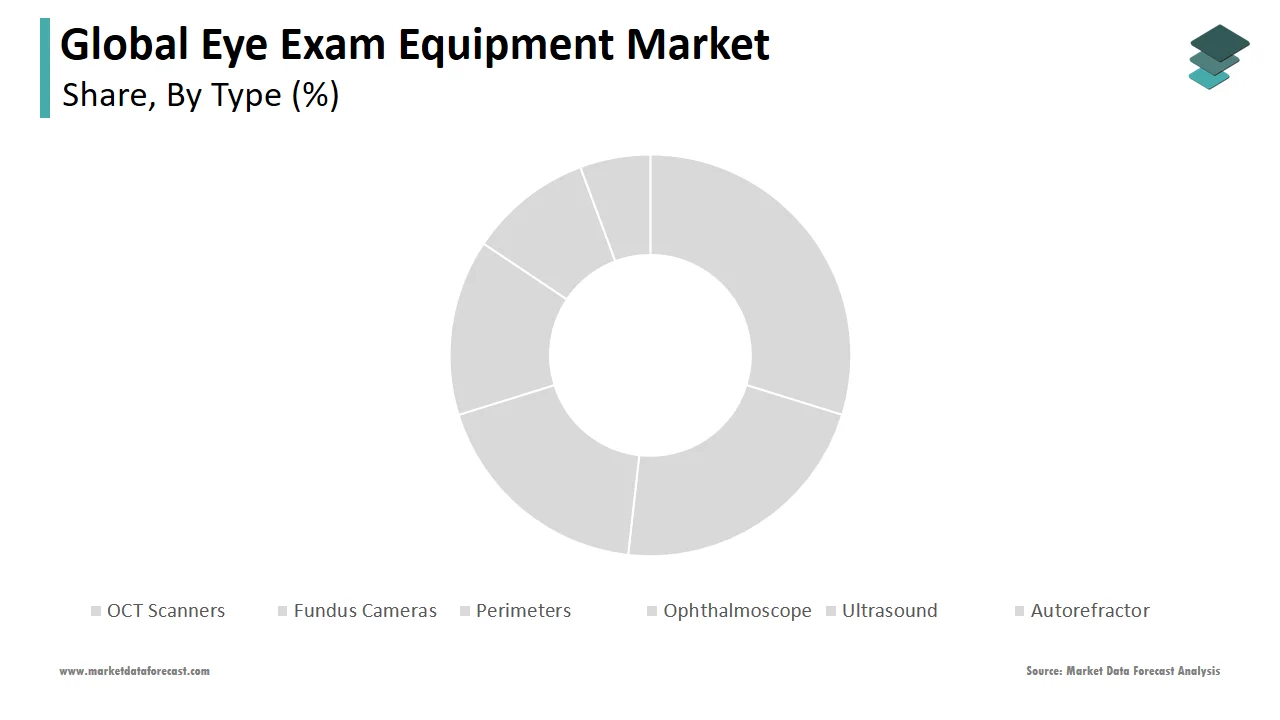
Based on type, the OCT had the largest market share in 2024 and is expected to grow faster during the forecast period. It is the technology for the future because it can enhance patient care. It can detect problems in the eye before any symptoms are present in the patient. The rising cases of eye problems have increased the market share of OCT scanning.The fundus camera is projected to grow at a reasonable rate as it is used to photograph the retina's back. Ophthalmoscope accounted for the third-largest market share and is expected to grow at a promising rate during the forecast period. An ophthalmoscope is a primary instrument used to test the health of an eye during an exam. It allows a health professional to see inside the fundus of the eye and other structures. Autorefractor is expected to grow at a decent CAGR during the forecast period because a quality healthcare facility is becoming available to more people.
By End User Insights
Based on the end-user, the clinic segment accounted for the most significant share of the eye exam equipment market in 2024. The massive share of the clinics' segment can be attributed to factors like the vast range of patient pools treated in clinics and the increasing range of corporate clinical practices established by ophthalmologists in developing countries.The hospital segment is following the clinics closely in accounting for the leading share of the market. Better technology facility is available in hospitals that attract more patients and thus drive market growth. The quality of medical personnel is also better in hospitals than in clinics. High treatment costs in the outpatient department can retard the development of the segment over the forecast period.
REGIONAL ANALYSIS
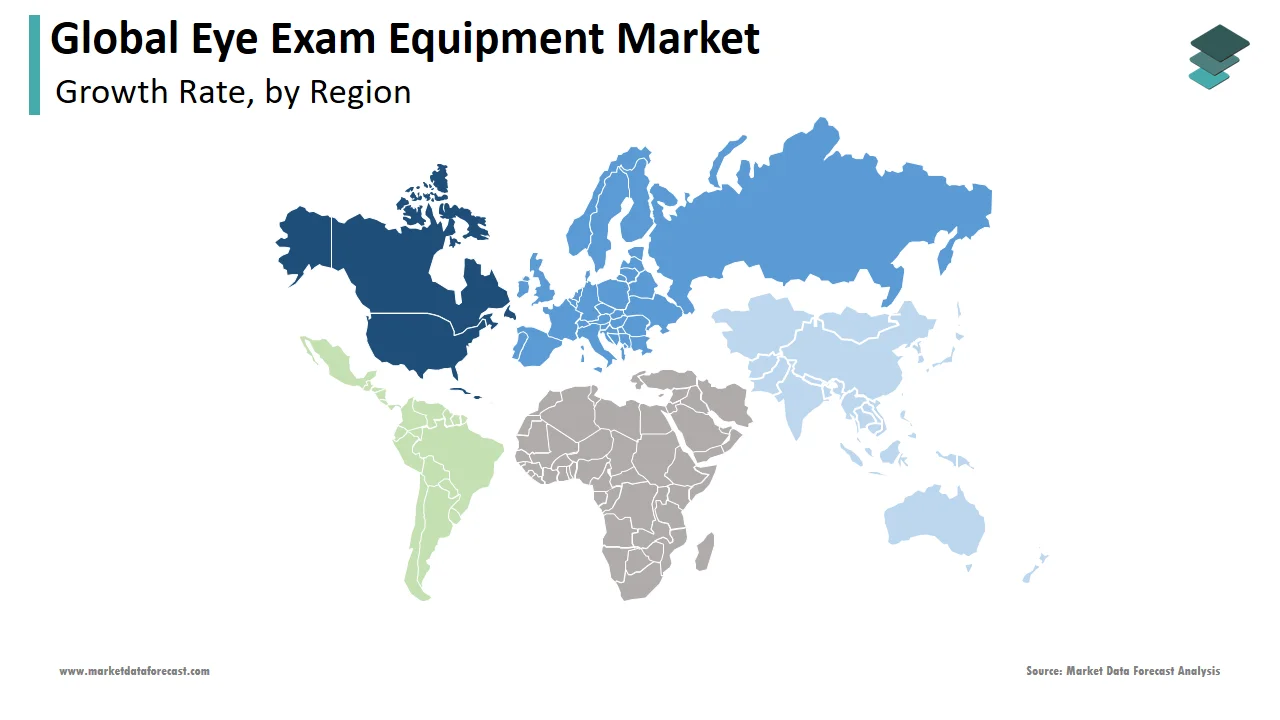
Geographically, North America accounted for the most significant share of the eye exam equipment market in 2024, followed by Europe and the Asia Pacific. The developed healthcare system, convenience and accessibility of technologically advanced eye exam equipment, and greater adoption of ophthalmology treatments and surgeries in this region are the foremost factors accountable for the large share of North America in the eye exam equipment market.
Europe had the second-largest market share in 2024. Greater adoption of ophthalmology practices and surgeries has driven the growth rate of the market. Rising government initiatives and support from the government in promoting quality healthcare are also reasons contributing to market growth.
The Asia Pacific market is expected to rise at a CAGR of 7.0% during the forecast period. The rise in investments from the public and private sectors is propelling the market demand in this region.
KEY MARKET PLAYERS
Some of the promising companies operating in the global eye exam equipment market profiled in this report are
- Carl Zeiss
- Haag-Streit
- Topcon
- NIDEK
- Heidelberg Engineering
- Escalon
- Novartis
- Valent
- Canon
- Luneau Technology
GLOBAL EYE EXAM EQUIPMENT MARKET NEWS
- On November 25, 2020, Topcon Healthcare launched a new refraction system called the "Chronos" in Europe. This Chronos is an automated binocular refraction system and features Sight Pilot guided refraction software.
- On June 16, 2018, Carl Zeiss revealed its next-generation VISULAS green photocoagulation laser treatment. Retinal photocoagulation lasers are used for treating different kinds of eye disorders.
- On January 08, 2021, the Haag-Streit UK-based Company launched the new version of iVue80 OCT. This new system is three times quicker than the original iVue model.
- On September 24, 2018, Heidelberg Engineering announced the anterior examination device. This device has got a CE-marking of anterion. The anterion unites corneal topography and tomography.
- On March 02, 2019, Birmingham Optical welcomed the Nidek GS-1 Gonioscope into its portfolio. The GS-1 is the first of its device offering 360 degrees of color imaging of gonioscopy.
MARKET SEGMENTATION
This research report on the global eye exam equipment market has been segmented and sub-segmented based on type, end-user, and region.
By Type
- OCT Scanners
- Fundus Cameras
- Perimeters
- Ophthalmoscope
- Ultrasound
- Autorefractor
- Slit Lamp
- Corneal Topography
- Lensmeter
- Chart Projectors
- Wavefront Analyzer
By End User
- Hospitals
- Clinics
By Region
- North America
- Europe
- Asia Pacific
- Latin America
- The Middle East and Africa