- Product Description Description
- Table of Contents TOC
- List of Table & Figure LOT
- Get Free Sample PDF Sample PDF
Market Size, 2025
$898.20 MnMarket Estimate, 2026
$951.91 MnMarket Forecast, 2034
$1,515 MnCAGR, 2026–2034
5.98%Global Fabry Disease Market Size
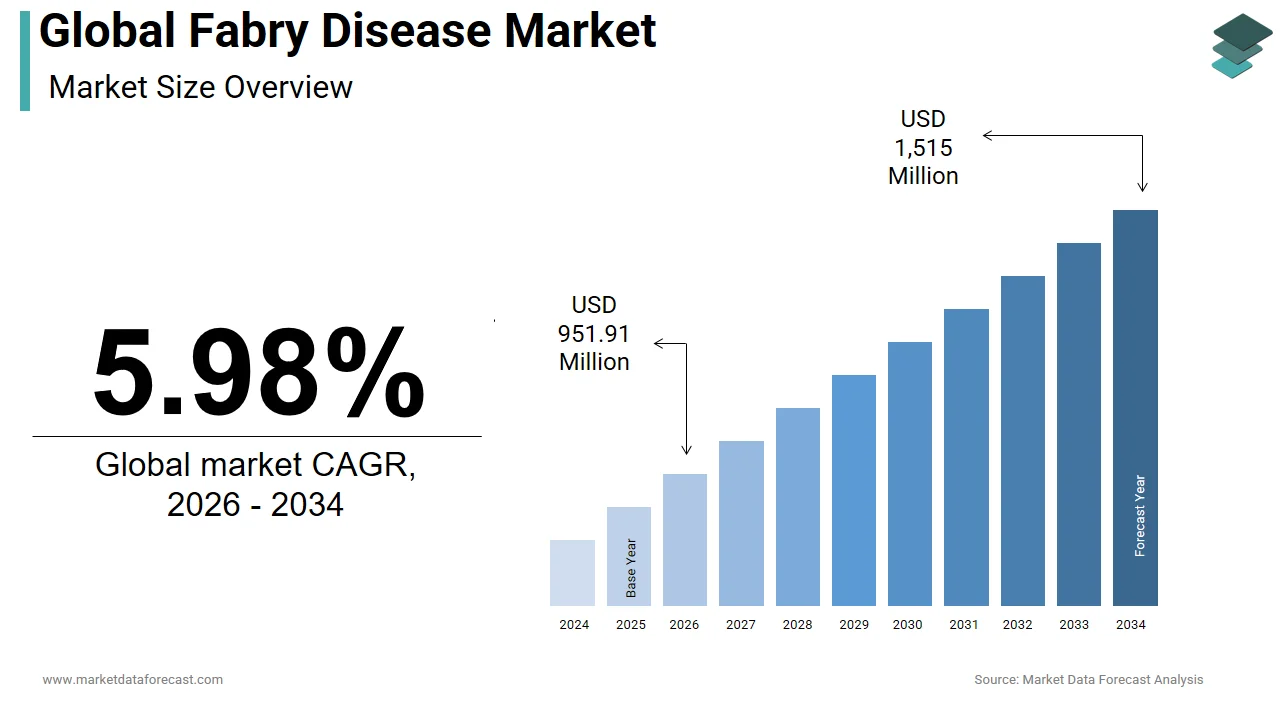
The global Fabry disease market was valued at USD 898.20 million in 2025, is estimated to reach USD 951.91 million in 2026, and is projected to reach USD 1,515 million by 2034, growing at a CAGR of 5.98% from 2026 to 2034.
Fabry disease is a rare genetic disorder caused by a lysosomal enzyme called -galactosidase that is inactive. A (-Gal A) causes glycosphingolipid (fat) metabolism to malfunction. A patient's alpha-galactosidase enzyme deficiency leads to gradual organ failure. The lysosomal enzyme is in charge of breaking down complex sugar-lipid polymers known as glycolipids and digesting specific substances. This enzyme deficiency can cause cell abnormalities and organ system failure, especially in small blood arteries, the heart, and the kidneys.
MARKET DRIVERS
Factors such as global healthcare infrastructure development and favorable reimbursement and financial support policies in developed nations are likely to drive the expansion of the global Fabry disease market.
The ongoing research operations and the implementation of advanced technology in these initiatives are boosting the market's growth significantly. In addition, several prominent regulatory authorities have recently approved innovative treatments for the condition. During the forecast period, the development and approval of such treatments are also predicted to accelerate market expansion. The emergence of pharmaceuticals used in the treatment of risk associated with Fabry illness and the rise in the strategic partnership and licensing arrangement between the firms are some of the essential reasons driving the Fabry disease drug market expansion, among others.
Patients with Fabry disease frequently experience strokes, excruciating pain, early heart condition, and impaired kidney function, leading to kidney failure and disabling gastrointestinal symptoms. Because there is no cure for Fabry disease, treatment focuses on managing problems associated with disease progression and providing symptomatic relief. Various people are frequently misdiagnosed due to mild symptoms. The global Fabry disease market is expected to rise at a significant rate in the following years due to these factors. Until the patent expires, the researcher or market leader has exclusive distribution rights to the medication. The key leaders will gain the most market share during the forecast period due to the strict supervision of new drugs, which is necessary due to the use of the therapy on a specific population affected by the disease and the limited number of approved drugs due to the associated risks of complications. Furthermore, increased R&D activities and the potential approval of promising pipeline products such as substrate reduction therapies and enzyme replacement therapies, and increased demand from emerging economies will create new opportunities for the Fabry disease drug market to grow during the forecast period.
MARKET RESTRAINTS
On the other hand, a lack of such diagnostic processes and educated specialists are likely to limit the worldwide Fabry disease market growth significantly. Furthermore, effective treatment is either unavailable or unaffordable. The lack of information about Fabry disease in several developing countries is among the primary factors acting as restraints. Therefore, it will continue to pose a challenge to the Fabry disease drug market during the forecast period. Furthermore, the market's growth in the coming years may be hampered by a lower susceptibility to drug approval following a significant investment.
REPORT COVERAGE
| REPORT METRIC | DETAILS |
| Market Size Available | 2025 to 2034 |
| Base Year | 2025 |
| Forecast Period | 2026 to 2034 |
| Segments Covered | By Treatment, End-User & Region |
| Various Analyses Covered | Global, Regional & Country Level Analysis, Segment-Level Analysis, Drivers, Restraints, Opportunities, Challenges, PESTLE Analysis, Porter’s Five Forces Analysis, Competitive Landscape, Analyst Overview of Investment Opportunities |
| Regions Covered | North America, Europe, Asia Pacific, Latin America, Middle East & Africa |
SEGMENTAL ANALYSIS
By Treatment Insights
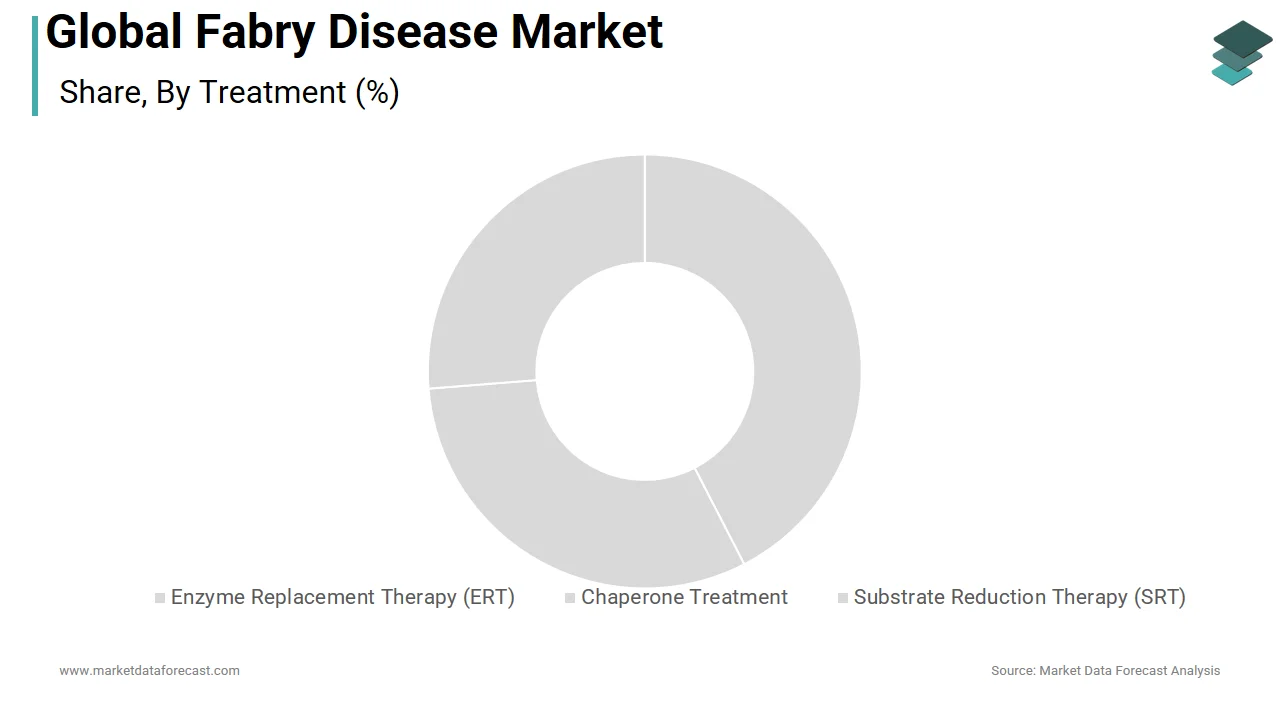
Based on the treatment, the enzyme replacement therapy segment is expected to develop significantly during the forecast period, as it is the only particular treatment for Fabry disease. Furthermore, the effects of this therapy on various organs have been investigated thoroughly, and it has been shown to improve patients' quality of life. In addition, the rising demand for timely diagnosis and increased awareness of Fabry disease in the healthcare community are expected to promote the expansion of the enzyme replacement therapy segment.
By End-User Insights
Based on the end-user, the clinic segment had the largest share in the global Fabry disease market in 2024. ICD-10-CM codes should also include complete healthcare data, which will aid in the establishment of advanced clinical pathways and disease regimens. However, there is currently no disease-modifying medicine on the market for Fabry disease, although there is much room for development in the near future.
REGIONAL ANALYSIS
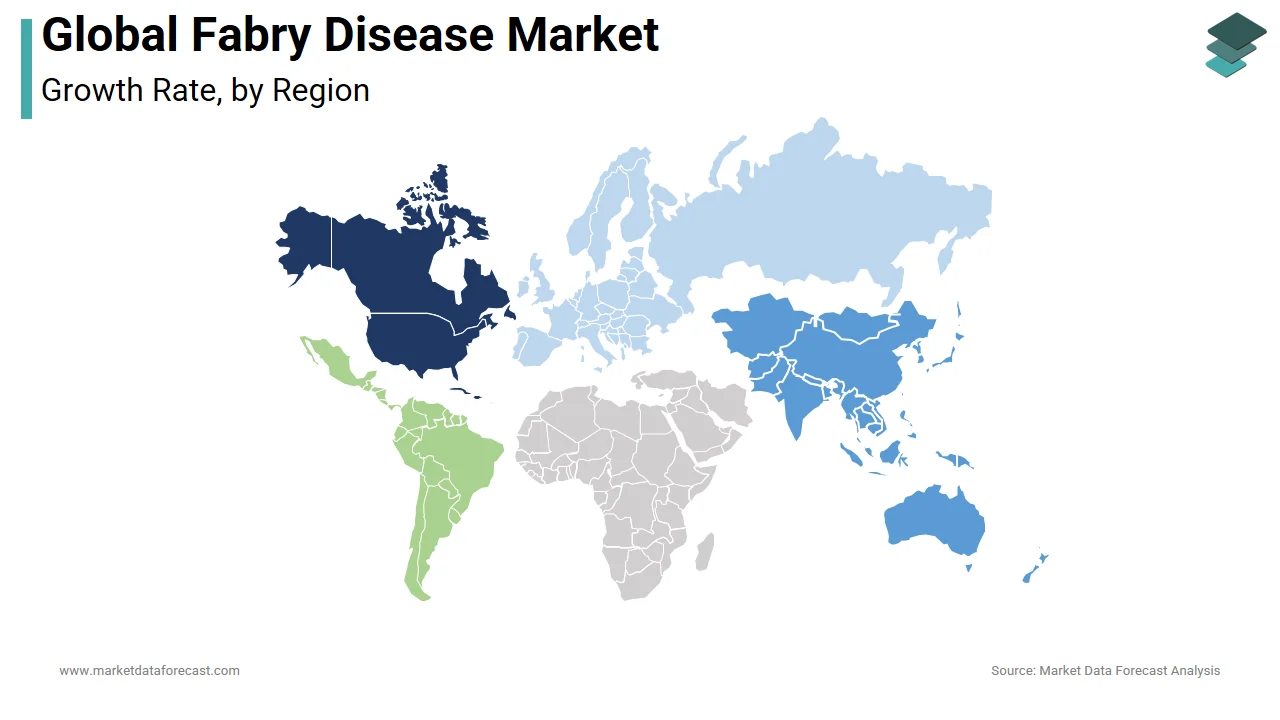
Geographically, the North American regional market dominated the Fabry disease market, accounting for the most significant proportion in 2024. The region's market development is aided by increased acceptance of novel therapies, favorable reimbursement policies, and enhanced healthcare services. In addition, as a result of health insurance programs covering health expenditure expenditures, drug companies boost their R&D efforts in uncommon diseases.
Europe is one of the most promising regions worldwide, and it is predicted to be the second-largest market for Fabry disease during the forecast period. The rising government financial support and endeavors for R&D operations to develop efficient treatment procedures are attributed to the market expansion in Europe.
Because of increased government initiatives to strengthen the healthcare sectors in emerging nations such as India and China, the Asia-Pacific region is expected to be the fastest-growing region of the worldwide Fabry disease market during the forecast period. Furthermore, increased consumer awareness of enzyme replacement treatment, rising healthcare expenditure on research & development, and the adoption of technologically advanced medical devices are likely to fuel market expansion in this area over the forecast period.
Due to a lack of awareness about the condition, a weak healthcare sector, low penetration of new technology, and a scarcity of trained labor in Africa, the Middle East and Africa are likely to hold the smallest share of the market. The slow growth of the market in Africa is expected to be driven by increased efforts by government and non-profit organizations to enhance the healthcare sector to provide basic medical amenities to consumers in the region.
KEY MARKET PLAYERS
Companies playing a notable role in the global Fabry disease market profiled in this report are
- ISU Abxis Co. Ltd.
- Greenovation Biotech GmbH
- Amicus Therapeutics Inc.
- AVROBIO Inc.
- Shire Plc
- Sanofi S.A.
- Moderna Therapeutics Inc.
- JCR Pharmaceuticals
- Protalix Biotherapeutics Inc.
- Idorsia Pharmaceuticals Ltd.
MARKET SEGMENTATION
This research report on the global fabry disease market has been segmented and sub-segmented based on the treatment, end-user, and region.
By Treatment
- Enzyme Replacement Therapy (ERT)
- Chaperone Treatment
- Substrate Reduction Therapy (SRT)
By End-User
- Hospitals
- Clinics
By Region
- North America
- Europe
- Asia-Pacific
- Latin America
- Middle East and Africa