- Product Description Description
- Table of Contents TOC
- List of Table & Figure LOT
- Get Free Sample PDF Sample PDF
Market Size, 2025
$2.67 BnMarket Estimate, 2026
$2.82 BnMarket Forecast, 2034
$4.36 BnCAGR, 2026–2034
5.6%Executive Summary: Global Feed Pelletizing Agents Market
- Market Scope: Global analysis of the feed pelletizing agents industry encompassing product types (natural vs. synthetic), animal types, functional roles (binders, lubricants), and regional performances.
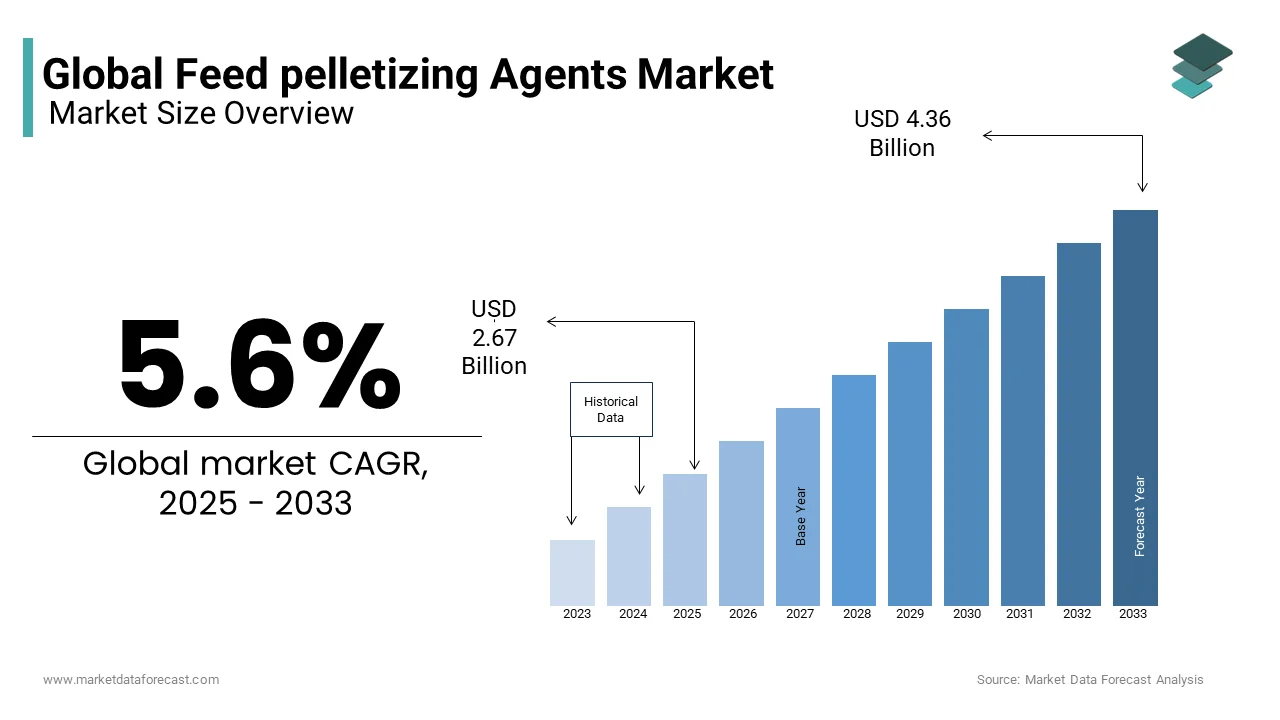
- Market Valuation: Valued at USD 2.67 billion in 2025, estimated at USD 2.82 billion in 2026, and projected to reach USD 4.36 billion by 2034, registering a steady CAGR of 5.6% during the forecast period (2026–2034).
- Primary Growth Drivers: Escalating global demand for animal protein, rising preference for pelleted feed due to enhanced digestibility, superior feed conversion efficiency, and strict regulatory shifts favoring naturally derived binding agents.
Key Market Segment Metrics (2026–2034)
| Category | Leading Segment (2025/2026 Position) | Fastest-Growing Segment |
|---|---|---|
| By Type / Source | Natural Agents (favored by farmers due to growing consumer demand for naturally derived and clean-label feed inputs) | Natural Binders (fastest-growing category driven by anti-synthetic regulations and organic farming expansion) |
| By Animal Type | Poultry & Ruminants (hold the largest volume share, driven by intensive meat and dairy production cycles) | Aquaculture (fastest-growing sector due to demand for water-stable floating feed pellets that prevent nutrient leaching) |
| By Region | North America (market leader historically anchored by widespread adoption of bentonite and high-tech feed mills) | Asia-Pacific (fastest-growing regional hub fueled by rising meat consumption, expanding commercial livestock, and rising production in China/India) |
Major Market Players & Market Structure
Market Structure: Highly competitive global ecosystem featuring major agrochemical, seed, and specialty ingredient manufacturers focusing on high-efficiency binders, structural pellet durability, and cost optimization.
Key Companies: BASF SE, Dow AgroSciences LLC, KWS SAAT SE, Monsanto Co., Land O’Lakes Inc., Sakata Seed Corp., Bejo Zaden BV, Takii Seeds, Agreliant Genetics LLC, Syngenta, Groupe Limagrain, E.I. du Pont de Nemours & Co., DLF Seeds, and Bayer Crop Science India Ltd.
Global Feed Pelletizing Agents Market Size
The global feed pelletizing agents market size was valued at USD 2.67 billion in 2025 and is anticipated to reach a valuation of USD 2.82 billion in 2026, and USD 4.36 billion by 2034, growing at a CAGR of 5.6%, from 2026 to 2034.
Feed pelleting can be defined as the conversion of finely ground mash feed into dense, free-flowing pellets or capsules, in a process that involves steam injection and mechanical pressure. There are several advantages to feeding broilers pelleted rather than mash feed. The key advantage is the improved bird performance, i.e., Improved feed intake, weight gain, and feed conversion.
MARKET DRIVERS AND RESTRAINTS
The feed Pelletizing market is mainly driven by the advantages of pelleted feed, such as higher feed intake and weight gain of animals. The market has further expanded with more evidence of enhanced performance of animals due to pelleted feed. The pelleted feed has proven to be easily digestible for many animals, as the process breaks many long-chain molecules. Ease of handling and transportation aids the market to grow further. Pelletizing agents are added to the feed during the processing stage. They bond the feed together in a required size and shape to form a pellet.
The population has been growing, and as the population grows, there are more mouths to feed, which is increasing the demand for protein, especially animal protein. To meet the market demands, farmers were pressured to increase animal production. Pelleted feed helped Theo achieve significant results. Currently, every type of feed, ranging from low to high quality, is available in the form of pellets. In most cases, it is also proven that the pelletizing costs are easily overcome by the pelleted feed's effecton animals, with great improvements in performance. High costs associated with processing and manufacturing the feed-to-pellet form are hindering the growth of the market. Moreover, unfavorable climatic conditions have also led to a rise in the cost of raw materials.
REPORT COVERAGE
| REPORT METRIC | DETAILS |
| Market Size Available | 2025 to 2034 |
| Base Year | 2025 |
| Forecast Period | 2026 to 2034 |
| CAGR | 5.6% |
| Segments Covered | By Type, Animal Type, and Region |
| Various Analyses Covered | Global, Regional & Country Level Analysis, Segment-Level Analysis, DROC, PESTLE Analysis, Porter’s Five Forces Analysis, Competitive Landscape, Analyst Overview of Investment Opportunities |
| Regions Covered | North America, Europe, APAC, Latin America, Middle East & Africa |
| Market Leaders Profiled | BASF SE, DOW Agrosciences LLC, KWS SAAT SE, Monsanto Co, Land O’ Lakes Inc, Sakata Seed Corp, Bejo Zaden BV, Takii Seeds, Agreliant Genetics LLC, Syngenta A, Groupe Limagrain, E.L. DuPont de Nemours & Co, DLF Seeds, Science, Bayer Crop Science India Ltd, Canterra Seeds Holdings Ltd, and Others. |
SEGMENTAL ANALYSIS
By Type Insights
Natural feed pelletizing agents are the dominating products in the market. They are favored by the farmers due to the growing demand for naturally derived products. Regulations against synthetic products have created an opportunity for natural products to spur the growth of the market.

By Animal Type Insights
Fish feed is mostly preferred in the pellet form as they floats in water for a long time, whichits easy for fish to digest and absorb. This makes the fish feed hold a considerable share in the market. Moreover, Pet and horse feeds are seen significantly in pelleted forms, as they have a long shelf life and are comparatively cheaper than wet food.
REGIONAL ANALYSIS
Based on geography, the market is segmented into North America, Asia Pacific, Europe, Latin America, the Middle East, and Africa. North America accounted for the largest share of the market. With the growing demand for organic or natural products and healthsafety consciousnesss in the USA and Canada, the demand for naturally derived agents is gaining popularity among pelletizing agents. Bentonite is a natural feed pelletizing agent that is produced mainly in the USA and Canada. The USA is the largest producer of Bentonite, with nearly one-third of the world’s production. Europe held the second-largest share of the market. The market is moving from developed to developing countries. As ingredients were cheaper in developing nations, and pelleted feed production was low. Compared to being a health-conscious nation, the demand for naturally derived products is gaining the attention of consumers. Asia Pacific is a hub for fast-growing nations in terms of economy and population. China and India are leading in meat production.
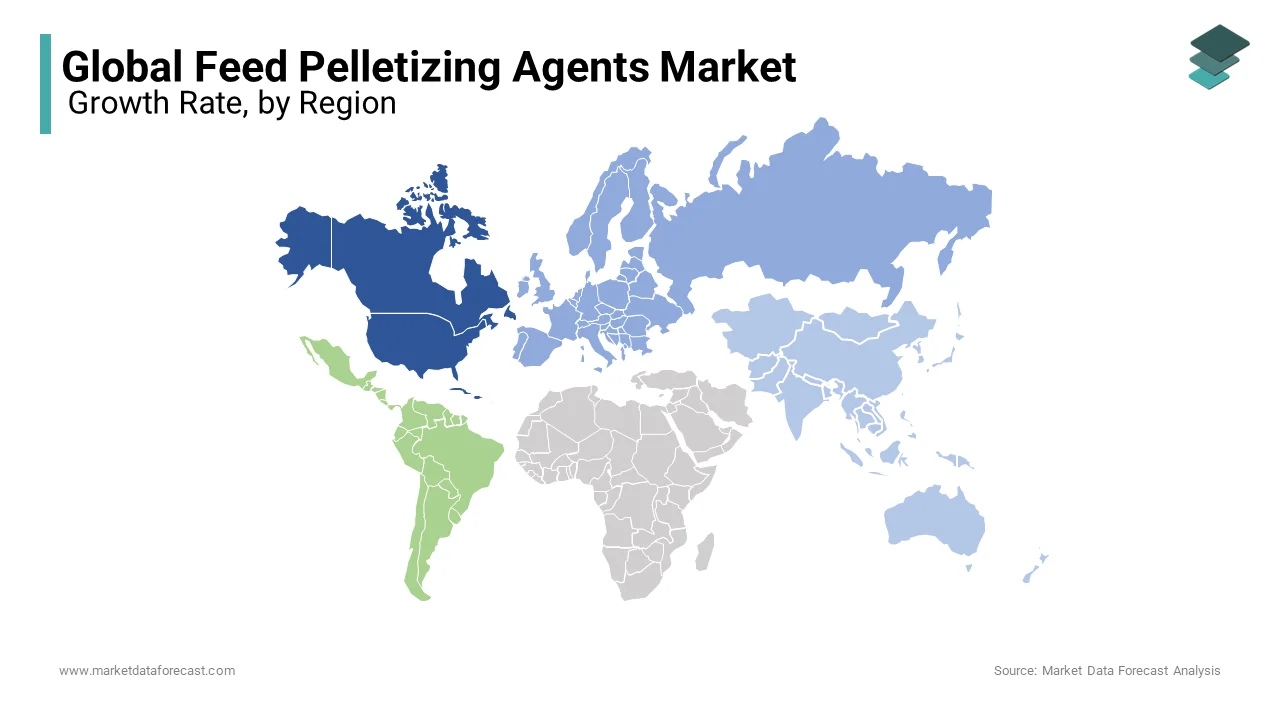
There is a scope for improvement, as the majority of the meat market is not organized. China is the leading manufacturer of pelletizing agents. This is due to the huge demand for feed pellets and the availability of cheaper sources growing population requires more, and livestock farmers are finding ways to increase production. India is also capitalizing on growth prospects through good investments and is expected to grow at a healthy rate. Australia has well-developed farming methods and is one of the leaders in livestock production. The presence of global firms and growing awareness about the efficiency of the product have further extended the growth of the market in this region. Political issues and the low cost of feed ingredients in many countries make the pelletizing process expensive in Africa. However, pelleting gives the farmer control over the feed formulation, thereby reducing the cost for the farmer. Demand for meat products is growing and presents a scope of growth for the feed pelletizing agent market. Awareness about pelletized feed is not widespread and is slowly increasing. Due to low feed ingredients cost, Africa presents an interesting case for the export market. Many African countries are turning into net exporters of feed.
KEY MARKET PLAYERS
Some of the market players dominate the global feed pelletizing market.
- BASF SE
- DOW Agrosciences LLC
- KWS SAAT SE
- Monsanto Co.
- Land O’ Lakes Inc.
- Sakata Seed Corp
- Bejo Zaden BV
- Takii Seeds
- Agreliant Genetics LLC
- Syngenta
- G Groupe LimagraiE.L.
- DuPont de Nemours & Co
- DLF Seeds
- Science
- Bayer Crop Science India Ltd
- Canterra Seeds Holdings Ltd
MARKET SEGMENTATION
This research report on the global feed pelletizing agents market has been segmented and sub-segmented based on Type, Animal Type, and Region.
By Type
- Natural
- Synthetic
By Animal Type
- Ruminant
- Poultry
- Swine
- Aquaculture
- Pet food
By Region
- North America
- Europe
- Asia Pacific
- Latin America
- Middle East and Africa
- Rest of the World