- Product Description Description
- Table of Contents TOC
- List of Table & Figure LOT
- Get Free Sample PDF Sample PDF
Market Size, 2025
$13.84 BnMarket Estimate, 2026
$15.26 BnMarket Forecast, 2034
$33.29 BnCAGR, 2026–2034
10.24%Executive Summary: Global Fiber Optic Cable Market
- Market Scope: Comprehensive global and regional analysis tracking cable types (armored, non-armored, ribbon), fiber modes, end-user industries, and geographical deployments across major world markets.
- Market Valuation: Valued at USD 13.84 billion in 2025, reaching USD 15.26 billion in 2026, and projected to expand to USD 33.29 billion by 2034, growing at a robust CAGR of 10.24% during the forecast period (2026–2034).
- Primary Growth Drivers: Escalating global demand for high-bandwidth applications (video streaming, cloud computing, enterprise data migration) and the widespread rollout of 5G wireless networks requiring dense fiber backhaul and fronthaul infrastructure. Key restraints include high initial deployment costs in last-mile and rural areas and a shortage of skilled fiber technicians.
Key Market Segment Metrics (2026–2034)
| Category | Leading Segment (2025 Position) | Fastest-Growing Segment |
|---|---|---|
| By Cable Type | Non-Armored Fiber Optic Cables (captured 45.1% of global share in 2025 due to widespread use in controlled environments and data centers) | Ribbon Fiber Optic Cable (predicted to witness the highest CAGR of 11.7% due to escalating need for high-fiber-count dense urban/5G networks) |
| By Fiber Mode | Single-Mode Fiber (SMF) (led the market in 2025 due to unmatched long-haul and high-bandwidth transmission capabilities) | Plastic Optical Fiber (POF) (anticipated to witness the fastest CAGR of 14.3% driven by automotive and industrial control system adoptions) |
| By End User | Telecommunication (captured 64.1% of global market share in 2025 propelled by structural shifts to FTTH, FTTx, and 5G backhaul) | Defense and Aerospace (estimated to register the fastest CAGR of 12.9% due to integration in avionics, secure communication, and radar) |
| By Region | Asia-Pacific (top performer accounting for 43.7% of global market share in 2025 driven by digital infrastructure and 5G investments) | North America (second-largest at 24.8% share) alongside steady growth in Europe, Middle East & Africa, and Latin America |
Major Market Players & Market Structure
Market Structure: Intense competitive landscape characterized by global market leaders with robust R&D and vertically integrated production, alongside agile regional players leveraging local market knowledge and cost advantages.
Key Companies: Corning Incorporated, Prysmian Group, Fujikura Ltd., Sumitomo Electric Industries Ltd., Sterlite Technologies Limited, Nexans S.A., LS Cable & System Ltd., Furukawa Electric Co. Ltd., Optical Cable Corporation, Yangtze Optical Fibre and Cable Joint Stock Limited Company (YOFC), Finolex Cables Ltd., OFS Fitel LLC, and Belden Inc.
Global Fiber Optic Cable Market Size
The global fiber optic cable market size was valued at USD 13.84 billion in 2025 and is anticipated to reach USD 15.26 billion in 2026 and USD 33.29 billion by 2034, growing at a CAGR of 10.24% during the forecast period from 2026 to 2034.
Fiber optic cable refers to the network infrastructure solution that transmits data as pulses of light through thin strands of glass or plastic fibers which enables high-speed, long-distance, and interference-free communication. Unlike traditional copper-based systems, fiber optics offer superior bandwidth, reduced signal loss, and enhanced security. This makes them indispensable in modern telecommunications, data centers, and smart city ecosystems. According to the study, the foundational role of fiber-based backbones in digital connectivity is underscored by the notable share of global internet traffic that now traverses them.
MARKET DRIVERS
The escalating global demand for high-bandwidth applications, particularly driven by video streaming, cloud computing, and enterprise data migration, is propelling the growth of fiber optic cable market. According to Cisco, global IP traffic was projected to reached 4.8 zettabytes per year in 2022 and is projected to surge in coming years which necessitates robust underlying infrastructure. This surge is largely attributed to a portion of of fixed internet traffic originating from video content, as per the research. Fiber optic cables, with their capacity to support multi-terabit transmission rates over long distances without degradation, are uniquely positioned to meet this demand. Besides, hyperscale data centers, which number significantly globally as per study, rely extensively on intra- and inter-data center fiber links to maintain low latency and high throughput. This further amplifies the deployment across cloud service providers.
The widespread rollout of 5G wireless networks is driving the growth of fiber optic cable market. This broad release inherently depends on dense fiber backhaul and fronthaul infrastructure. 5G base stations require significantly more fiber connectivity than their 4G predecessors due to higher frequency bands and smaller cell radii. As per study, the number of global 5G subscriptions would reach approximately 1.6 billion by the end of 2023. Each 5G macrocell typically requires kilometers of fiber deployment, according to the research. Moreover, as per a May 2026 report from the Wireless Infrastructure Association (WIA), there were approximately 197,850 outdoor small cells in the U.S. at the end of 2025. The architectural dependency positions fiber optics not as a complementary technology but as a foundational layer for 5G scalability. This directly fuels demand across urban and suburban telecommunications infrastructure.
MARKET RESTRAINTS
The high initial deployment cost, particularly in last-mile connectivity and rural areas is degrading the growth of the fiber optic cable market. Installation expenses, including trenching, permitting, and labour, can be significant for per mile in urban environments and even more in geographically challenging terrains, as per the study. These capital-intensive requirements deter rapid expansion, especially in regions with low population density where return on investment is prolonged. For instance, according to the World Bank, only a share of rural populations in developing economies have access to fixed broadband, largely due to prohibitive deployment costs. Apart from these, disruptions caused by civil works and community resistance often escalate budgetary and timeline risks, which constrains the equitable rollout of fiber despite technological readiness.
The shortage of skilled workforce capable of deploying and maintaining fiber optic networks is hindering the growth of fiber optic cable market. As per the research, the United States alone faces a deficit of trained fiber technicians needed to meet current deployment targets. This gap is mirrored globally. Like, the telecommunications industry in the EU is facing a critical labor shortage in specialized fields. Many EU countries are reporting a lack of skilled professionals for fiber-optic network installation and testing. Also, the European Telecommunications Network Operators’ Association shows significant workforce gaps in key areas of network technology across the EU. Training programs remain limited in scale and accessibility, with less share of telecom technicians in emerging markets receive formal fiber-specific certification. This human capital deficit delays project execution, increases error rates during installation, and elevates long-term maintenance costs. These factors ultimately impede the pace of fiber network expansion despite strong demand.
MARKET OPPORTUNITIES
The integration of fiber optic infrastructure within smart city initiatives, which demand real-time data transmission for traffic management, public safety, and energy systems, is setting new opportunities for the growth of fiber optic cable market. As per the research, many cities globally have launched comprehensive smart city programs. All of these programs rely on fiber as the backbone for IoT sensor networks and centralized command centers. For example, Barcelona’s city-wide fiber grid supports adaptive street lighting and waste management systems which reduces operational costs, as per the research. The convergence of urban digitization and fiber deployment positions telecom operators as strategic partners in municipal development by providing long-term public-private investment avenues.
The expansion of subsea fiber optic cable systems to support intercontinental data transfer and digital sovereignty is liekly to promote new opportunities for the fiber optic cable market. According to TeleGeography, the investment in new submarine cables between 2026 and 2027 will be over $13 billion. These cables carry significant share of international data traffic. Nations are increasingly prioritizing redundant and secure undersea links to reduce latency and avoid geopolitical bottlenecks. For instance, the Arctic Connect project, along with related initiatives like Polar Connect, aimed to establish a subsea fiber-optic cable via the Northern Sea Route or similar Arctic paths. This path represents a significantly shorter distance between Europe and Asia compared to the traditional routes through the Red Sea, Suez Canal, and Mediterranean Sea, and would result in lower latency for data transmission. Apart from these, countries like India and Indonesia are investing in domestic subsea loops to enhance internal connectivity across archipelagos. The trend emphasizess fiber’s role in commercial data exchange and in national digital resilience. This creates opportunities for specialized manufacturers and marine engineering firms.
MARKET CHALLENGES
The vulnerability of physical infrastructure to environmental and anthropogenic disruptions is challenging the growth of fiber optic cable market. As per the study, Excavation work is a leading cause of network outages in North America. Natural disasters exacerbate this risk. Like, the 2021 Pacific Northwest floods severed multiple fiber routes in British Columbia, disrupting services for over 72 hours, as per the Canada’s Internet Performance Test. Apart from these, rising temperatures and extreme weather events linked to climate change are increasing stress on cable sheaths and splice enclosures. The Intergovernmental Panel on Climate Change warns that infrastructure in coastal and flood-prone zones faces a higher degradation rate by 2030. These physical threats necessitate costly redundancy planning and hardened installations, which complicates scalability and reliability in vulnerable regions.
The growing concern over cybersecurity threats targeting fiber optic backbone networks is degrading the growth of fiber optic cable market. Sophisticated intrusion attempts are on the rise although fiber is inherently more secure than copper due to the difficulty of tapping without detection. As per the research, there were more reported incidents involving telecom infrastructure tampering in 2023 compared to the previous year. State-sponsored actors have been implicated in attempts to intercept data at key landing stations, such as the 2022 incident involving undersea cable monitoring in the Baltic Sea, as per the NATO’s Cooperative Cyber Defence Centre of Excellence. Moreover, the reliance on centralized network operation centers makes fiber systems susceptible to coordinated cyber-physical attacks. Hence, these threats demand advanced monitoring systems like distributed acoustic sensing (DAS), which only a share of global operators currently deploy, according to research. As a result, this shows a significant protection gap.
REPORT COVERAGE
| REPORT METRIC | DETAILS |
| Market Size Available | 2025 to 2034 |
| Base Year | 2025 |
| Forecast Period | 2026 to 2034 |
| CAGR | 10.24% |
| Segments Covered | By Cable Type, Fiber Mode, End User, and Region |
| Various Analyses Covered | Global, Regional, and Country Level Analysis; Segment-Level Analysis; DROC; PESTLE Analysis; Porter’s Five Forces Analysis; Competitive Landscape; Analyst Overview of Investment Opportunities |
| Regions Covered | North America, Europe, APAC, Latin America, Middle East & Africa |
| Market Leaders Profiled | Corning Incorporated, Prysmian Group, Fujikura Ltd., Sumitomo Electric Industries Ltd., Sterlite Technologies Limited, Nexans S.A., LS Cable & System Ltd., Furukawa Electric Co. Ltd., Optical Cable Corporation, Yangtze Optical Fibre and Cable Joint Stock Limited Company (YOFC), Finolex Cables Ltd., OFS Fitel LLC, Belden Inc. |
SEGMENTAL ANALYSIS
By Cable Type Insights
The non-armored fiber optic cables segment dominated the fiber optic cable market by capturing 45.1% of the global market share in 2025. The growth of non-armored fiber optic cables segment is primarily driven by their widespread use in controlled environments such as data centers, indoor networks, and metropolitan backbone systems where mechanical protection is less critical. The preference for non-armored cables is also propelled by their lightweight design and lower installation complexity, which reduces deployment time compared to armored variants, according to the study. Apart from these, the surge in hyperscale data center construction has amplified demand for flexible and high-density non-armored cables suitable for vertical and horizontal routing within server halls. This has led to an increase in production from cable manufacturers. Their cost-effectiveness, with installation expenses lower than armored alternatives, further strengthens their position in large-scale digital infrastructure projects.
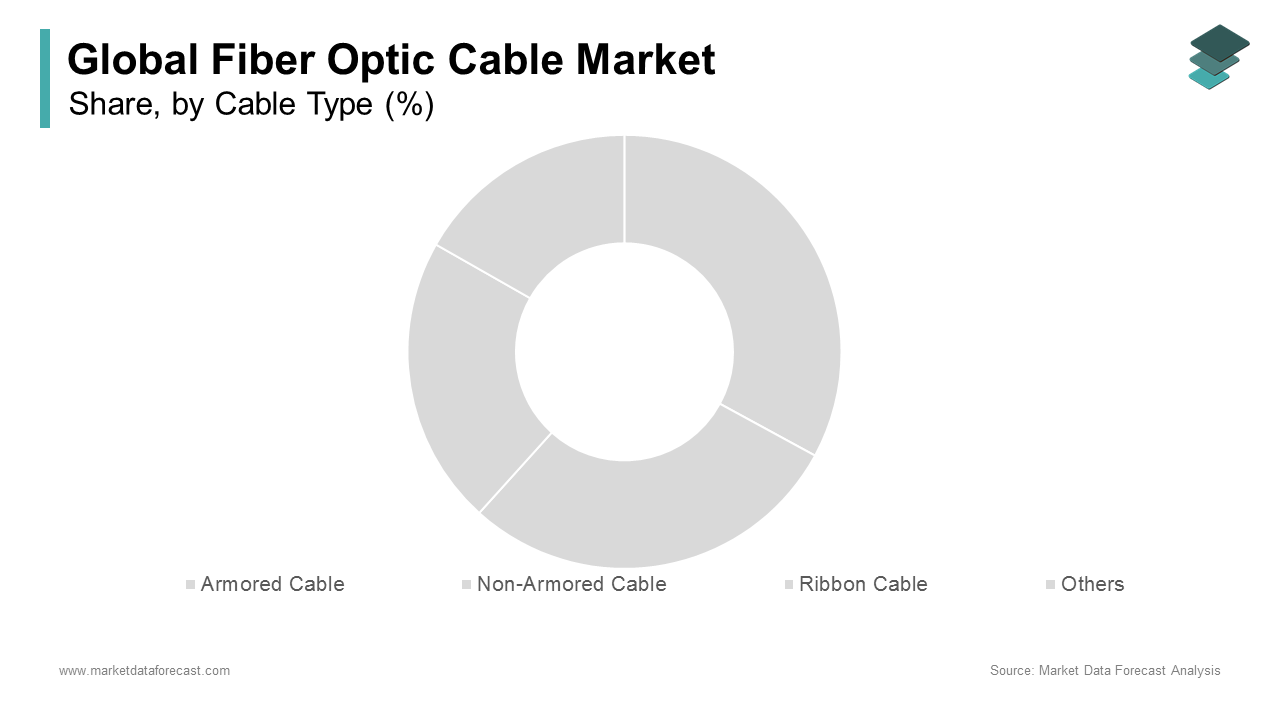
The ribbon fiber optic cable segment is predicted to witness the highest CAGR of 11.7% from 2026 to 2034 due to the escalating need for high-fiber-count deployments in dense urban networks and 5G transport layers. Ribbon cables capable of mass fusion splicing, which reduces splicing time compared to individual fiber handling, are more efficient, as per the study. This efficiency is critical in large-scale FTTH rollouts, such as India’s BharatNet project, which aims to connect a large number of villages with fiber. This requires rapid deployment methods. Furthermore, the adoption of space-optimized micro-duct cabling systems in cities like Seoul and Singapore has favored ribbon cables for their superior packing density, up to 3,456 fibers per duct.
By Fiber Mode Insights
The Single-mode fiber (SMF) segment led the fiber mode by capturing a substantial share of the global market in 2025. The growth of the single-mode fiber (SMF) segment is driven by its unmatched capability for long-haul and high-bandwidth transmission, which makes it the backbone of modern telecommunications and internet infrastructure. SMF supports transmission distances vast kilometers without signal regeneration, an important requirement for undersea cables and national backbone networks, as per the research. Moreover, SMF has become indispensable for cloud service providers and 5G transport networks as data rates are reaching 800 Gbps per channel in coherent systems. According to a study, over 90% of inter-data center links longer than 2 km utilize single-mode fiber due to its low attenuation and scalability. The deployment of dense wavelength division multiplexing (DWDM) systems, which can carry channels over a single fiber, further amplifies its utility in bandwidth-intensive applications.
The plastic optical fiber (POF) segment is anticipated to witness the fastest CAGR of 14.3% from 2026 to 2034. Its increasing adoption in automotive and industrial control systems, where ease of installation and mechanical robustness outweigh the need for ultra-long-distance transmission, is boosting the expansion of the plastic optical fiber (POF) segment in the global market. In modern vehicles, POF is used for infotainment and driver-assistance systems. It supports data rates up to 50 Mbps over short distances with minimal electromagnetic interference. According to the research, over 18 million vehicles equipped with POF-based MOST (Media Oriented Systems Transport) networks were produced. Apart from these, POF is gaining traction in smart home and building automation due to its flexibility and a low termination cost, which is cheaper than glass fiber termination, as per the study. Its immunity to electrical noise makes it ideal for harsh industrial environments, particularly in factory automation setups across Germany and Japan.
By End-User Industry Insights
The telecommunication segment led the fiber optic cable market by capturing a 64.1% of the global market share in 2025. The growth of the telecommunication segment is propelled by the sector’s structural shift toward fiber-based access networks, including FTTH, FTTx, and 5G backhaul. Telecom operators globally are replacing legacy copper infrastructure with fiber to support bandwidth-intensive services such as 4K/8K streaming, cloud gaming, and virtual reality. According to the study, fiber now accounts for a notable share of fixed broadband subscriptions worldwide, up from that in 2018. In China alone, substantial millions of FTTH connections were active in recent years, as per the research, driven by national digital infrastructure policies. Moreover, the rollout of 5G small cells, each requiring dedicated fiber connectivity, has intensified demand.
The defense and aerospace segment is estimated to register the fastest CAGR of 12.9% during the forecast period, owing to the integration of fiber optic systems in avionics, secure communication networks, and radar technologies, where high data throughput and electromagnetic immunity are paramount. Modern fighter jets, such as the F-35 Lightning II, utilize over 130 kilometers of fiber for onboard data buses, which reduces weight and latency compared to copper wiring, as detailed by Lockheed Martin. The U.S. Department of Defense has mandated fiber-based communication in all new military platforms due to its resistance to jamming and eavesdropping. Apart from these, satellite ground stations and UAV command systems increasingly rely on fiber for real-time data transmission. A study reports that fiber usage in defense platforms has increased. These factors combined with rising defense budgets in countries like India and South Korea are accelerating fiber adoption in essential applications.
REGIONAL ANALYSIS
Asia-Pacific Fiber Optic Cable Market Insights
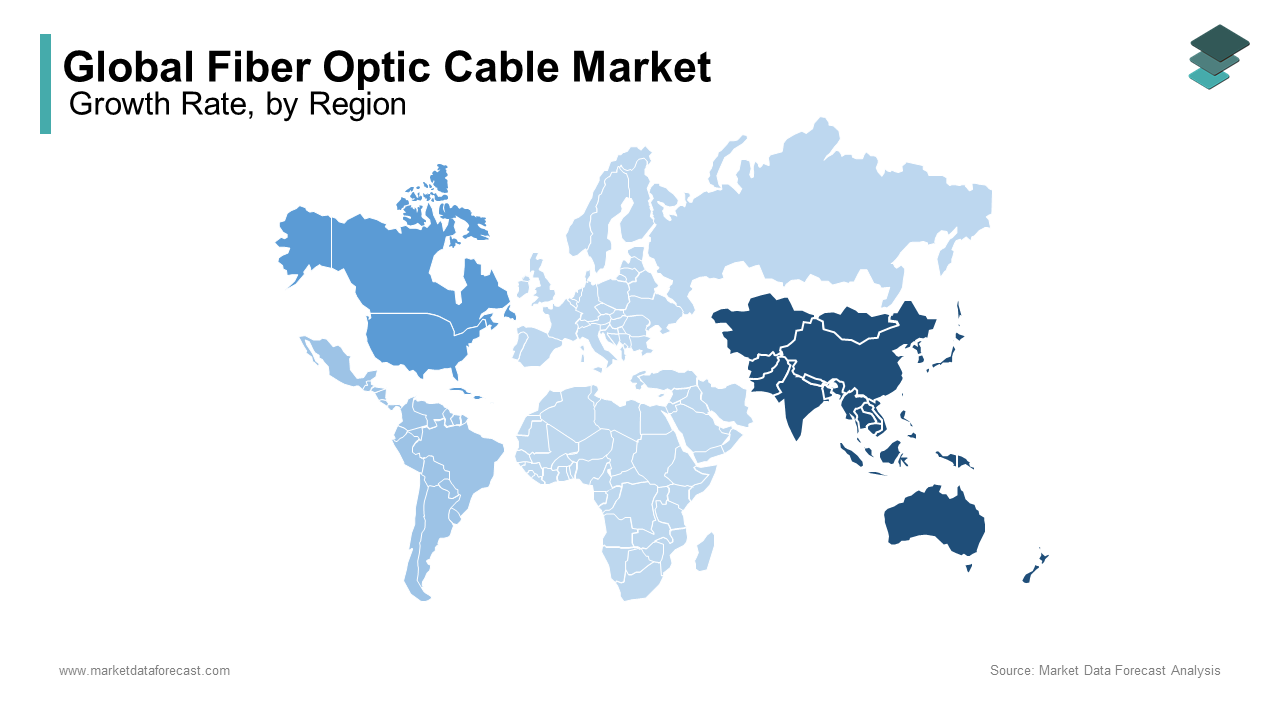
Asia-Pacific was the top performer in the fiber optic cable market in 2025 and accounted for 43.7% of the global market share in 2025. The domination of Asia Pacific in the global market is primarily driven by the proliferation of smart cities and data centers across Southeast Asia further amplifies demand. As the epicenter of digital infrastructure expansion, the region is witnessing unprecedented investment in broadband and 5G networks. China alone accounts for over half of global fiber production and consumption, with substantial number of FTTH subscribers as of 2023, according to study. India’s BharatNet project, aiming to connect significant gram panchayats with fiber, has deployed vast kilometers of cable, supported by government funding. Japan and South Korea continue to lead in ultra-high-speed networks, with average fixed broadband speeds exceeding 200 Mbps, as per the research. These factors position the region as the primary growth engine for the global fiber market.
North America Fiber Optic Cable Market Insights
North America is the second-largest in the fiber optic cable market and accounted for 24.8% of the global market share in 2025. The growth of North America in the global market is propelled by the region’s leadership in 5G deployment and cloud infrastructure, which supports robust fiber demand. According to the FCC's Internet Access Services: Status as of December 31, 2023 report, the U.S. had 28 million fiber connections by the end of 2023. The Program, part of the Infrastructure Investment and Jobs Act, allocates a significant amount to expand high-speed internet access by prioritizing fiber in unserved areas. Canada has similarly committed to connecting most of households to gigabit-capable networks by 2030, as per the research. There are several hyperscale data centers in operation. The region's heavy reliance on intra- and inter-facility fiber links ensures sustained demand for high-performance cabling solutions across both urban and rural landscapes.
Europe Fiber Optic Cable Market Insights
Europe grew steadily in the global fiber optic cable market. The region is undergoing a coordinated fiberization effort under the EU’s Digital Decade Policy Programme, which targets gigabit connectivity for all households by 2030. Germany and France lead in deployment, with millions of fiber connections respectively, according to study. The European Commission has mobilized notable amount in funding through the Connecting Europe Facility to support cross-border fiber corridors. The push for digital sovereignty and reduced reliance on non-EU infrastructure has further accelerated national fiber initiatives, particularly in Eastern Europe, where penetration remains low.
Middle East and Africa Fiber Optic Cable Market Insights
Middle East and Africa grew steadily in the global market. The growth of Middle East and Africa in the global market is driven by national broadband strategies and urban digitization. Saudi Arabia’s Vision 2030 includes a major investment in fiber infrastructure to achieve major gigabit network coverage by 2030, as per the research. The UAE has already achieved notable FTTH penetration, among the highest globally, according to the study. In Africa, countries like Kenya and South Africa are expanding fiber backbones through projects such as the National Optic Fibre Backbone Infrastructure (NOFBI), connecting over 200 government facilities. Submarine cable landings, including the 2Africa and PEACE cables, are enhancing international bandwidth by laying the foundation for long-term digital growth across the continent.
Latin America Fiber Optic Cable Market Insights
Latin America is likely to grow in the global fiber optic cable market. The region is witnessing accelerating fiber adoption, particularly in Brazil, Mexico, and Chile. Brazil’s program has facilitated the deployment of a substantial number of kilometers of fiber in underserved municipalities, which is supported by public-private partnerships. Chile, with one of the highest broadband speeds in Latin America at over 130 Mbps, as per research, is investing in fiber to support its growing tech sector. Apart from these, data center investments by firms like Amazon Web Services are driving demand for high-capacity interconnects by signaling a structural shift toward fiber-based digital infrastructure.
COMPETITIVE LANDSCAPE
KEY MARKET PLAYERS
Some of the companies that are playing a dominating role in the global fiber optic cable market include
- Corning Incorporated
- Prysmian Group
- Fujikura Ltd.
- Sumitomo Electric Industries Ltd.
- Sterlite Technologies Limited
- Nexans S.A.
- LS Cable & System Ltd.
- Furukawa Electric Co. Ltd.
- Optical Cable Corporation
- Yangtze Optical Fibre and Cable Joint Stock Limited Company (YOFC)
- Finolex Cables Ltd.
- OFS Fitel LLC
- Belden Inc
Top Strategies Used by the Key Market Participants
Key players in the fiber optic cable market are deploying multifaceted strategies to consolidate their positions. Vertical integration enables companies to control raw material supply, manufacturing, and deployment, which reduces costs and lead times. Strategic partnerships with telecom operators and governments facilitate large-scale infrastructure projects, particularly in emerging economies. Geographic expansion into underserved regions, such as rural Asia and island nations, allows firms to tap into government-funded broadband initiatives. Product differentiation through innovation, such as developing bend-insensitive, water-blocking, or anti-rodent cables, addresses region-specific challenges. Apart from these, investment in R&D centers and localized production hubs enhances responsiveness to regional demands. Capacity expansion and technology licensing also feature prominently, which ensures scalability and compliance with evolving network standards across diverse regulatory environments.
COMPETITION OVERVIEW
The fiber optic cable market exhibits intense competition shaped by technological differentiation, regional regulatory landscapes, and infrastructure development timelines. Global leaders maintain strong R&D and production capabilities. On the other hand, regional players leverage cost advantages and local market knowledge to contest dominance. Competition is increasingly defined by the ability to offer end-to-end solutions, including cables, splicing equipment, and network design support. Companies are investing heavily in environmentally resilient and installation-efficient products to meet the demands of diverse terrains across Asia, Africa, and Latin America. Strategic alliances with national broadband authorities and participation in public tenders have become critical competitive levers. Moreover, the race to support 5G, smart cities, and subsea connectivity has intensified innovation cycles, with firms differentiating through reliability, latency performance, and customization rather than price alone.
LEADING PLAYERS IN THE FIBER OPTIC CABLE MARKET
Corning Incorporated
Corning Incorporated has long been a pioneer in optical fiber and cable innovation, consistently advancing low-loss, high-capacity fiber solutions critical for next-generation networks. In the Asia Pacific region, Corning has deepened its footprint through strategic collaborations with national telecom operators such as NTT in Japan and Telstra in Australia, supporting 5G backhaul and FTTH deployments. These initiatives underscore Corning’s commitment to technological leadership and infrastructure enablement across diverse Asian markets.
YOFC (Yangtze Optical Fibre and Cable Joint Stock Limited Company)
YOFC, headquartered in Wuhan, China, is a dominant force in the Asia Pacific fiber optic landscape, which is renowned for its vertically integrated production and R&D capabilities. The company has played a central role in China’s nationwide fiberization drive, supplying cables for a portion of the country's recent FTTH expansions. YOFC has extended its influence to Southeast Asia by establishing joint ventures in Thailand and Vietnam to localize production and reduce import dependencies. Apart from these, YOFC launched anti-rodent armored cables suited for tropical environments, which demonstrates product innovation aligned with regional infrastructure challenges.
Fujikura Ltd.
Fujikura Ltd., a Japanese leader in optical fiber, cable, and splicing technologies, has significantly contributed to high-reliability network deployments across the Asia Pacific. The company’s advanced fusion splicers and low-drag microduct cables are widely used in Japan, South Korea, and India for minimizing installation time and signal loss. These efforts reflect Fujikura’s focus on engineering excellence and context-specific innovation to support resilient digital infrastructure.
MARKET SEGMENTATION
This research report on the global fiber optic cable market is segmented and sub-segmented into the following categories.
By Cable Type
- Armored Cable
- Non-Armored Cable
- Ribbon Cable
- Other
By Fiber Mode
- Single-Mode Fiber
- Multi-Mode Fiber
- Plastic Optical Fiber
By End User
- Telecommunication
- Power Utilities and Smart Grid
- Defense and Aerospace
- Industrial Automation and Control
By Region
- North America
- Europe
- Latin America
- Asia Pacific
- Middle East & Africa