- Product Description Description
- Table of Contents TOC
- List of Table & Figure LOT
- Get Free Sample PDF Sample PDF
Market Size, 2025
$6.95 BnMarket Estimate, 2026
$7.57 BnMarket Forecast, 2034
$15.01 BnCAGR, 2026–2034
8.93%Executive Summary: Global Fire Protection Materials Market
- Market Scope: Comprehensive global market analysis covering product types, application segments, regulatory frameworks, and regional leadership frameworks across the passive fire protection industry.
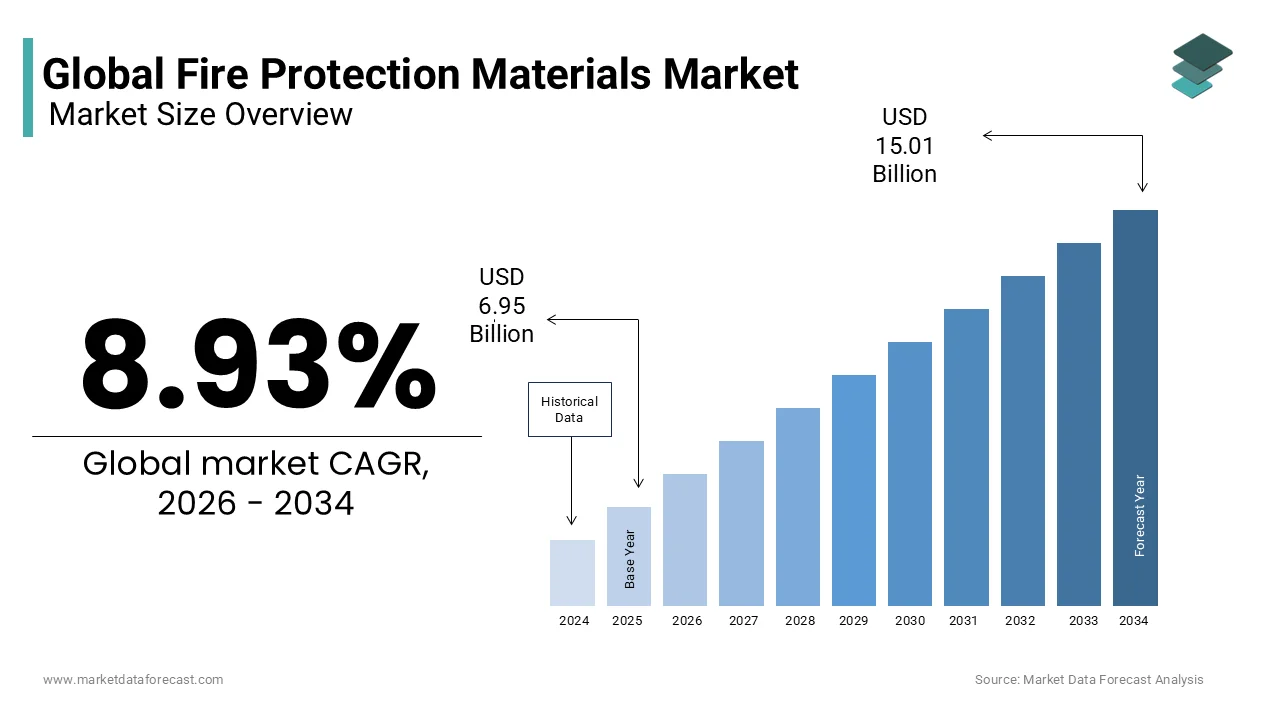
- Market Valuation: Valued at USD 6.95 billion (2025), estimated at USD 7.57 billion (2026), and projected to reach USD 15.01 billion by 2034, registering a CAGR of 8.93% (2026–2034).
- Primary Growth Drivers: Rising demand for passive fire protection systems, stringent building safety codes and standards in commercial and residential construction, and expanded implementation in the oil and gas sector to protect steel structures against explosive fire risks.
Key Market Segment Metrics (2026–2034)
| Category | Leading Segment (2025 Position) | Fastest-Growing Segment |
|---|---|---|
| By Type | Coatings & Sealants (Coatings recognized as market leaders due to construction flame-retardant needs) | Water-based intumescent paints and reactive insulating coatings |
| By Application | Commercial Construction (predicted to dominate throughout the forecast period) | Industrial & Oil and Gas Infrastructure |
| By Region | North America (leading global market with high infrastructure spending and strict safety codes) | Asia-Pacific (fastest expansion driven by India, China, and rapid industrialization) |
Major Market Players & Market Structure
Market Structure: Highly competitive global industry featuring major chemical and coatings manufacturers competing through advanced product innovations, eco-friendly fire retardants, and compliance with stringent environmental and building standards.
Key Companies: Sherwin Williams Company, Hempel A/S, 3M Company, Nippon Paint Co. Ltd, Akzo Nobel N.V., BASF Coating GmbH, Rolf Kuhn GmbH, PPG Industries Inc., Svt Holding GmbH, Hilti Group, Isolatek International, Termo Incorporated, Rectorseal, Morgan Advanced, and Contego International Inc.
Global Fire Protection Materials Market Size
The global fire protection materials market size was valued at USD 6.95 billion in 2025 and is expected to reach USD 15.01 billion by 2034 from USD 7.57 billion in 2026. The market is projected to grow at a CAGR of 8.93%.
The fire protection materials are specialized passive fire protection substances and structural formulations designed to contain, compartmentalize, and resist thermal degradation during emergency fire events. Deployment of these advanced materials across modern commercial complexes, industrial plants, and residential high rises is fundamentally governed by stringent municipal building codes and life safety mandates. According to the National Fire Protection Association, local fire departments in the United States responded to an estimated 470,500 structure fires in 2024, which collectively resulted in 15.3 billion dollars in direct property loss.
MARKET DRIVERS
Strict Modernization of Municipal Building Safety Codes and Structural Regulations
The continuous updates to global structural safety standards and fire safety codes directly compel real estate developers to integrate advanced passive fire protection materials, which is majorly bolstering the growth of the fire protection materials market. According to the National Fire Protection Association, an estimated 119,500 non-residential structure fires occurred in the United States in 2024, accounting for significant industrial disruption and structural degradation. Modern building authorities systematically enforce these material specifications during construction inspections to prevent catastrophic structural collapse and secure operational permits.
Rapid Global Urbanization and Multi Story High Rise Infrastructure Expansion
The accelerating construction of high-density residential towers and complex commercial high rises expands the total surface area requiring passive thermal insulation and firestopping materials. The ra[pid global urbanization and multi story high rise infrastructure expansion is additionally to escalate the growth of the fire protection materials market. According to the study, residential structure fires accounted for 351,000 incidents and 11.69 billion dollars in direct property damage in 2024, with multi-family apartment complexes exhibiting distinct vulnerability to smoke migration. Additionally, as per data compiled by the Insurance Information Institute, overall property losses from total reported fires exceeded 18.0 billion dollars across all insured sectors in 2022. This statistical reality directly accelerates market demand because modern high rise designs rely on compartmentalization strategies to prevent vertical flame propagation through utility shafts and curtain walls. Developers must continuously procure high expansion intumescent sealants, fire rated mineral wool, and specialized silicone firestops to isolate utility penetrations and satisfy structural safety mandates in urban centers.
MARKET RESTRAINTS
High Initial Installation Costs and Complex Volatile Raw Material Pricing
The significant financial capital required for specialized passive fire-retardant formulations among cost sensitive real estate developers is restraining the growth of the fire protection materials market. According to the United States Bureau of Labor Statistics, global price volatility in key chemical inputs, including epoxy resins, polyols, and specialized flame retardant additives, caused construction material input costs to fluctuate by more than 15% across recent fiscal cycles. Furthermore, as per surveys, high performance intumescent coating applications and certified firestop installations can increase total structural steel finishing costs by 8% to 12% per project. This dynamic directly restrains market expansion because general contractors facing tight margins frequently attempt to minimize passive fireproofing scope or opt for baseline compliance materials. The added expense of requiring certified technical labor to apply multi-layer intumescent coatings further delays project execution and dampens widespread adoption in price sensitive emerging economies.
Lack of Standardized Installation Inspections and Prevalence of Non Compliant Substitutes
The inconsistent enforcement of passive fireproofing inspection protocols, which is additionally hindering the growth of the fire protection materials market. According to the International Firestop Council, up to 25% of passive firestop penetrations inspected in commercial renovations display improper installation or non-listed material usage due to unqualified labor. The direct relationship with the market resides in the market dilution caused by cheap, non certified sealants and substandard insulation boards. When regulatory enforcement lacks rigorous, post installation destructive testing and certified third party verification, building owners often purchase low cost alternatives, stifling revenue growth for premium, highly tested fire protection formulations.
MARKET OPPORTUNITIES
Surging Construction of Mega Data Centers and High Tech Manufacturing Facilities
The rapid global expansion of artificial intelligence infrastructure and semiconductor fabrication plants creates massive demand for specialized, non-conductive fire protection materials that is likely to set up new opportunities for the growth of the fire protection materials market. According to the National Fire Protection Association, warehouse and high-tech storage structure fires averaged 1,544 incidents annually, with property damage per incident escalating sharply due to high value inventory and specialized processing machinery. Furthermore, as per statistical insights from the United States Fire Administration, electrical wire and cable insulation fires in industrial and processing facilities of total direct property damage in commercial structures. This scenario presents a major market opportunity because data center operators cannot utilize traditional water based suppression without destroying server arrays.
Strategic Shift Toward Eco Friendly and Low Halogen Passive Formulations
The growing environmental regulations and indoor air quality standards offer lucrative commercial avenues for manufacturers developing halogen free, low volatile organic compound fire protection materials. The strategic shift toward eco-friendly and low halogen passive formulations is According to the European Chemicals Agency, ongoing regulatory restrictions under the REACH framework aim to phase out brominated and chlorinated flame retardants due to their persistence and toxic off gassing during combustion. In addition, as per public health statistics published by the World Health Organization, smoke inhalation and toxic gas exposure account for over 70% of total fire related acute casualties in enclosed building blazes. This transition directly benefits the market by creating demand for bio based intumescent systems, hydrated mineral fillers, and water-based silicone firestops. Chemical manufacturers that successfully innovate high efficiency, halogen free thermal barriers stand to secure dominant long term procurement contracts with green building developers seeking LEED certification.
MARKET CHALLENGES
Technical Complexity in Retrofitting Aging Structural Infrastructure
The integrating modern passive fire protection materials into legacy architectural structures, which is a major challenge for the growth of the fire protection materials market. Furthermore, as per data, more than 50% of existing commercial building stock in developed nations was constructed over 40 years ago, featuring outdated structural layouts without standardized utility shafts. This structural reality creates a massive technical challenge for the market because applying intumescent coatings or installing certified firestop blocks in historic or legacy buildings requires invasive structural modifications, abatement of hazardous lead or asbestos coatings, and custom engineering judgments. The extreme cost and labor complexity associated with retrofitting aging concrete and structural steel deter building owners from upgrading passive thermal protection systems.
Severe Shortages of Certified Installers and Skilled Passive Fireproofing Technicians
The shortage of trained, certified labor capable of correctly applying complex passive fire retardant systems hampers project timelines and material performance that is also to degrade the growth of the fire protection materials market. Additionally, the improper mixing ratios, incorrect dry film thickness application of intumescent sprays, and incomplete sleeve sealing account for over 30% of field test failures during mandatory fire resistance inspections. Without a adequately trained workforce to apply complex intumescent formulations and install multi penetration firestops according to manufacturer specifications, the overall efficacy and market reputation of advanced passive fire protection materials remain compromised.
REPORT COVERAGE
| REPORT METRIC | DETAILS |
| Market Size Available | 2025 to 2034 |
| Base Year | 2025 |
| Forecast Period | 2026 to 2034 |
| CAGR | 8.93% |
| Segments Covered | By Type, Application, and Region |
| Various Analyses Covered | Global, Regional & Country Level Analysis, Segment-Level Analysis, DROC, PESTLE Analysis, Porter’s Five Forces Analysis, Competitive Landscape, Analyst Overview on Investment Opportunities |
| Regions Covered | North America, Europe, Asia Pacific, Latin America, and Middle East & Africa |
| Market Leaders Profiled | Sherwin Williams Company, Hempel A/S, 3M Company, Nippon Paint Co. Ltd, Akzo Nobel N.V., BASF Coating GmbH, Rolf Kuhn GmbH, PPG Industries Inc., Svt Holding GmbH, Hilti Group, Isolatek International, Termo Incorporated, Rectorseal, Morgan Advanced, and Contego International Inc. |
SEGMENTAL ANALYSIS
By Type Insights
The sealants & fillers segment held a dominant share of the global fire protection materials marketin 2025 with their indispensable role in maintaining the continuous structural integrity of fire rated assemblies, sealing expanding construction joints, and blocking smoke migration through wall penetrations. The regulatory requirement to prevent fire spread between building compartments drives the widespread adoption of firestop sealants and fillers. According to the National Fire Protection Association, non-residential structure fires caused 3.6 billion dollars in direct property loss in 2024 by prompting local code enforcement bodies to strictly audit wall and floor joint seals. Furthermore, properly sealed fire barriers reduce internal smoke migration rates during structural fire events.
The putty segment is likely to grow at a fastest CAGR of 9.4% during the forecast period with the extreme application versatility, non-curing properties, and high suitability for retrofitting electrical outlet boxes and complex cable penetrations. The continuous modernization of electrical wiring and telecommunications infrastructure across existing commercial structures accelerates demand for firestop putty pads and sticks. Furthermore, as per the National Electrical Code guidelines enforced by the National Fire Protection Association, all wall outlet boxes mounted back to back in fire rated partitions must be protected with certified intumescent putty pads. Electrical contractors rapidly adopt putty pads to achieve two hour wall ratings without requiring complex tools or lengthy drying times. The labor saving benefits and re-enterable nature of firestop putty drive its rapid adoption among MEP contractors. Additionally, as per building maintenance benchmarks from the Associated General Contractors of America, facilities utilizing reusable firestop putty experience a reduction in recurring routine maintenance expenses during cable installation cycles.
By Application Insights
The commercial construction segment was accounted in holding 34.2% of the global fire protection materials market share in 2025. The necessity to protect human lives and prevent catastrophic property loss in high occupancy commercial spaces underpins continuous procurement of passive fire barriers. Global investments in large scale commercial real estate, corporate campuses, and public infrastructure generate massive demand for structural fire protection. Additionally, as per data published by the U.S. Census Bureau, total commercial construction spending surpassed 120 billion dollars annually, with high rise office towers allocating up to 3% of total material budgets specifically to passive fireproofing coatings and penetration seals. The immense volume of structural steel and curtain wall assemblies in commercial builds requires continuous application of intumescent sprays and board systems.
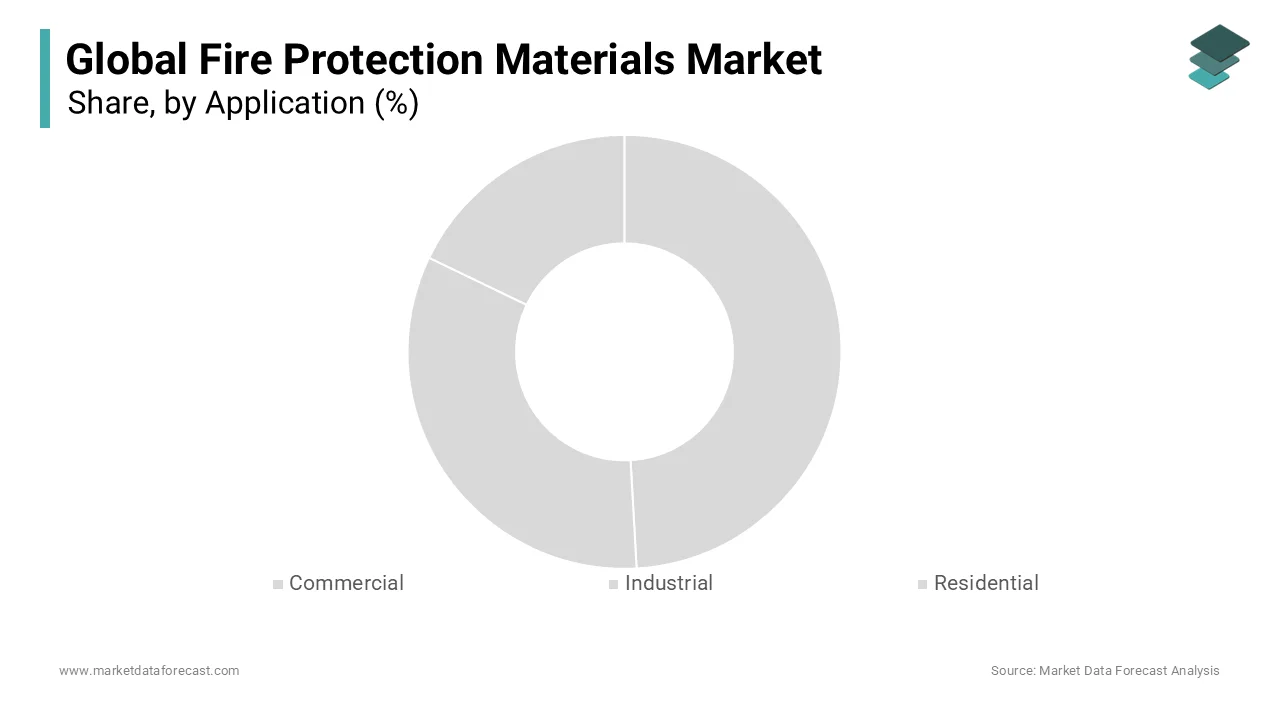
The residential construction segment is likely to grow at a fastest CAGR of 9.2% during the forecast period. The global surge in multi-family residential towers requires strict adherence to compartmentalization codes between adjoining apartment units. Furthermore, as per statistical updates from the National Fire Protection Association, residential structure fires accounted for 351,000 incidents and 11.69 billion dollars in property damage in 2024, prompting municipalities to update residential building codes. Municipal authorities increasingly mandate fire rated drywall boards, draftstopping putties, and firestop collars in residential partition walls to prevent lateral fire spread between living units. Heightened consumer focus on personal home safety drives aftermarket sales of residential fire protection kits and draftstopping materials. Additionally, as per consumer spending surveys from the Home Improvement Research Institute, residential retrofitting of fire rated insulation barriers and garage wall firestops grew.
REGIONAL ANALYSIS
North America Fire Protection Materials Market Analysis
North America was the largest contributor of the global fire protection materials market by accounting for 42.9% of share in 2025. This commanding position is supported by stringent building code enforcement by local authorities, extensive commercial real estate investments, and strict occupational safety regulations. Furthermore, local fire departments across the United States responded to 470,500 structure fires in 2024, which caused 15.3 billion dollars in property damage. The combination of mandatory international building code compliance and high corporate risk management spending ensures continuous procurement of intumescent coatings, firestop sealants, and fireproof boards across North American industrial and commercial construction sectors.
Europe Fire Protection Materials Market Analysis
Europe fire protection materials market was the ranked second by accounting for 28.5% of fire protection materials market share in 2025. Market performance across European member states is heavily shaped by strict European Union fire performance standards and rigorous sustainability guidelines. Furthermore, regulatory enforcement under the Construction Products Regulation mandates CE marking and Environmental Product Declarations for all passive fireproofing products sold across the European Economic Area. European developers actively prioritize eco-friendly, halogen free intumescent coatings and mineral wool insulation panels to satisfy both structural fire resistance requirements and stringent indoor air quality criteria.
Asia Pacific Fire Protection Materials Market Analysis
Asia Pacific fire protection materials market growth is likely to have significant growth opportunities throughout the forecast period with the massive urbanization, mega infrastructure investments, and expanding manufacturing sectors in China and India. According to the study, urban population ratios across Asia Pacific are projected to reach 55% by 2030, driving unprecedented demand for multi-story residential and commercial real estate. The rapid construction of industrial plants, commercial towers, and transit networks across Asia Pacific creates high volume purchasing streams for firestop mortars, sprays, and structural board systems.
Latin America Fire Protection Materials Market Analysis
Latin America fire protection materials market growth is driven by the fire protection materials market. Furthermore, recent updates to national fire protection standards mandate certified passive fire barriers in commercial buildings exceeding four stories. Latin American construction firms are progressively shifting from basic masonry barriers to advanced intumescent sprays, elastomeric sealants, and firestop devices to meet international safety benchmarks.
Middle East and Africa Fire Protection Materials Market Analysis
The Middle East and Africa fire protection materials market growth is likely to grow with the ambitious mega construction projects, luxury commercial high rises, and expanding oil and gas infrastructure. Additionally, as per the Saudi Arabian Civil Defense Authority, national building codes mandate rigorous UL listed passive fire protection materials for all commercial and high rise residential developments under Vision 2030. The extensive construction of giga projects and petrochemical refineries in the region drives substantial procurement of high performance intumescent coatings, heavy duty firestop mortars, and specialized cast-in devices.
COMPETITIVE LANDSCAPE
The fire protection materials market features dynamic competition driven by international industrial conglomerates, regional manufacturers, and specialized passive safety developers. Competition revolves around material performance, product certification standards, installation efficiency, and compliance with local fire safety codes. Established leaders leverage extensive global supply chains, massive manufacturing scale, and diverse product portfolios spanning intumescent coatings, firestop sealants, non-combustible insulation, and structural wraps. Mid-size enterprises focus on localized market demands by offering customized firestopping devices for specific architectural requirements. Strategic alliances between material manufacturers and digital design platform developers have intensified market competition, as firms aim to lock in specifications during early building design stages. Price volatility in raw chemical inputs and raw stone minerals forces companies to optimize operational efficiency and secure reliable supplier contracts.
KEY MARKET PLAYERS
Some of the key players in the global fire protection materials market are
- Sherwin Williams Company
- Hempel A/S
- 3M Company
- Nippon Paint Co. Ltd
- Akzo Nobel N.V
- BASF Coating GmbH
- Rolf Kuhn GmbH
- PPG Industries Inc.
- Svt Holding GmbH
- Hilti Group
- Isolatek International
- Termo Incorporated
- Rectorseal
- Morgan Advanced
- Contego International Inc
- Pilkington Group Ltd, etc
Top Players in the Market
- 3M delivers specialized thermal management solutions and fire barrier products designed to prevent heat transfer and flame spread. The company develops intumescent strip tapes, caulk sealants, and protective wrap blankets for commercial structures. 3M maintains strong industry partnerships to expand product integration across industrial applications. 3M expanded production lines for water-based fire barrier sealants and advanced testing capabilities. It continuously invests in sustainable materials with reduced volatile organic compound emissions. These strategies allow the company to maintain high performance safety standards, while expanding global client relationships.
- Hilti provides complete passive fire protection solutions, including cable transit systems, firestop collars, and prefabricated cast in devices. The enterprise creates modular fire barrier components that simplify job site installation for complex mechanical and electrical penetrations. Hilti enhances its market position through continuous digital integration, offering cloud-based documentation software alongside physical firestop products. Recent expansion activities include targeted regional partnerships and specialized technical training centers for construction professionals. The business focuses on integrated engineering services to secure long term agreements with global architectural firms.
- Rockwool manufactures stone wool insulation systems that offer natural non-combustible fire protection for buildings. The organization supplies structural curtain wall insulation, fire barrier slabs, and roof deck protection panels. Rockwool reinforces its market standing through substantial investments in regional manufacturing plants and advanced stone melt technologies. The firm recently launched enhanced fire resistance boards designed to meet updated international building safety codes.
Top strategies used by the key market participants
Key players in the Fire Protection Materials Market focus heavily on strategic acquisitions and geographic expansion to enter high growth regional construction sectors. Companies regularly acquire specialized regional manufacturers to gain regional distribution networks and proprietary product formulas. Another major strategy involves continuous investment in research and development to introduce intumescent coatings, high temperature sealants, and low emission insulation boards that satisfy changing building codes. Leading suppliers form technical partnerships with construction engineering firms to integrate firestop design directly into building information modeling software, ensuring seamless specification during planning phases. Furthermore, organizations focus on eco-friendly product lines with reduced volatile organic compound levels to capitalize on green building initiatives worldwide. Manufacturers also establish direct sales channels and technical training academies for field installers to guarantee proper system application, maintain product performance integrity, and retain long term commercial customer loyalty.
MARKET SEGMENTATION
This research report on the global fire protection materials market has been segmented and sub-segmented based on type, application, and region.
By Type
- Coatings
- Sealants and fillers
- Mortar
- Sheets/boards
- Spray
- Preformed device
- Putty
- Cast-in devices
By Application
- Commercial
- Industrial
- Residential
By Region
- North America
- Europe
- Asia Pacific
- Latin America
- Middle East & Africa