- Product Description Description
- Table of Contents TOC
- List of Table & Figure LOT
- Get Free Sample PDF Sample PDF
Market Size, 2025
$17.66 BnMarket Estimate, 2026
$18.59 BnMarket Forecast, 2034
$27.99 BnCAGR, 2026–2034
5.25%Global Fixed Satellite Services (FSS) Market Size
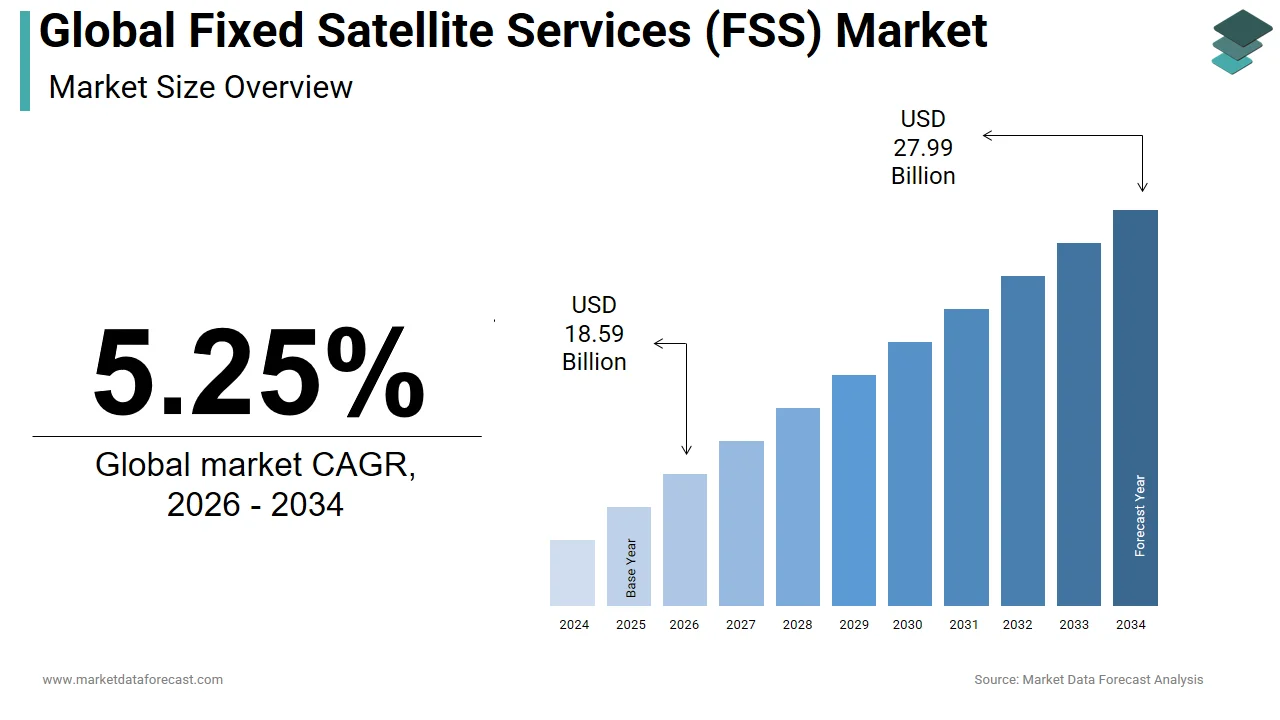
The size of the global fixed satellite services (FSS) market was worth USD 17.66 billion in 2025. The global market is anticipated to grow at a CAGR of 5.25% from 2026 to 2034, reaching USD 27.99 billion by 2034, up from USD 18.59 billion in 2026.
Fixed Satellite Services (FSS) refer to satellite communication services that facilitate the transmission of data, voice, and video signals between fixed ground-based locations. These services operate primarily in C-band, Ku-band, and Ka-band frequencies, enabling a wide range of applications including enterprise connectivity, broadcasting, government communications, and broadband access in remote areas. Unlike mobile satellite services, FSS is designed for stationary or semi-stationary use, making it ideal for long-term, high-capacity communication needs.
The global demand for FSS has seen steady growth due to increasing reliance on satellite infrastructure for backhaul connectivity, disaster recovery, and media distribution. As terrestrial networks struggle to meet the bandwidth demands of expanding digital ecosystems, FSS has emerged as a reliable alternative for ensuring uninterrupted communication across geographically diverse regions.
According to the Satellite Industry Association (SIA), satellite-based fixed services accounted for over 45% of total satellite industry revenues in 2023, underlining their strategic importance in both commercial and public sectors. Moreover, with rising investments in rural broadband initiatives and the expansion of hybrid network architectures integrating satellite and terrestrial systems, FSS continues to play a pivotal role in bridging the digital divide and supporting critical infrastructure globally.
MARKET DRIVERS
Rising Demand for Reliable Backhaul Connectivity in Remote Areas
One of the key drivers propelling the Fixed Satellite Services (FSS) Market is the growing need for dependable backhaul connectivity in remote and underserved regions. As enterprises and governments strive to extend digital infrastructure beyond urban centers, satellite-based solutions have become indispensable for connecting off-grid locations.
According to the International Telecommunication Union (ITU), nearly 3.6 billion people worldwide still lack regular internet access, with a significant portion residing in rural and island nations where terrestrial fiber deployment is economically unviable. In response, telecom operators and service providers are increasingly relying on FSS to support cellular backhaul, especially in countries like Indonesia, Papua New Guinea, and parts of Sub-Saharan Africa.
As digital transformation accelerates, the demand for robust, always-on backhaul via FSS continues to rise, reinforcing its position as a critical enabler of global connectivity.
Expansion of Broadcast and Media Distribution Networks
Another significant driver of the Fixed Satellite Services (FSS) Market is the continued expansion of broadcast and media distribution networks, particularly in emerging economies. Despite advancements in terrestrial and IP-based delivery, satellite remains the most efficient method for distributing television content to millions of viewers simultaneously.
According to the European Broadcasting Union (EBU), over 70% of TV channels in Europe and Asia rely on satellite for content delivery, highlighting its enduring relevance in the media ecosystem. Countries such as India, Brazil, and Nigeria have witnessed the rapid proliferation of Direct-to-Home (DTH) television services, which depend heavily on FSS for signal transmission. Besides, major sports events, news networks, and emergency broadcasts continue to leverage FSS for live transmissions, particularly in regions with limited fiber or microwave infrastructure. With the rise of Ultra High Definition (UHD) and 4K broadcasting, the demand for high-capacity satellite links is expected to grow further, solidifying FSS as a core component of modern media infrastructure.
MARKET RESTRAINTS
Spectrum Congestion and Regulatory Limitations
A primary restraint affecting the growth of the Fixed Satellite Services (FSS) Market is the increasing congestion of available spectrum and evolving regulatory restrictions governing satellite frequency allocations. The radio frequency spectrum used by FSS, particularly in the C-band and Ku-band ranges, is under pressure from terrestrial wireless services, including 5G deployments.
According to the Federal Communications Commission (FCC), interference risks between 5G base stations and C-band satellite receivers have led to regulatory changes that limit the use of certain frequency ranges in several countries. In 2023, the International Telecommunication Union (ITU) issued guidelines urging member states to re-evaluate spectrum sharing models to prevent signal degradation for satellite-based services.
Besides, many national regulators are imposing stricter licensing requirements and usage fees, complicating market entry for new players. As governments seek to balance the demands of terrestrial and satellite communications, the availability of clear and interference-free spectrum remains a persistent challenge for FSS operators seeking to scale their services.
High Capital Expenditure and Long Payback Periods
Another significant barrier in the Fixed Satellite Services (FSS) Market is the substantial capital investment required for satellite manufacturing, launch, and ground infrastructure development. This high upfront cost deters smaller companies from entering the market and limits the financial flexibility of even established players.
Furthermore, the payback period for satellite assets typically extends over 10–15 years, given the long deployment cycles and contractual structures of FSS service agreements. While the emergence of low Earth orbit (LEO) constellations offers an alternative, they come with their own complexities, including higher constellation management costs and increased regulatory scrutiny. As a result, despite strong demand for FSS, the economic viability of large-scale satellite projects remains a major constraint, influencing investment decisions and slowing down market expansion.
MARKET OPPORTUNITIES
Integration with Hybrid Communication Networks
A promising opportunity for the Fixed Satellite Services (FSS) Market lies in the integration of satellite connectivity into hybrid communication networks that combine terrestrial and space-based infrastructure. As businesses and governments seek resilient, high-capacity solutions for mission-critical operations, hybrid networks offer redundancy, scalability, and broader geographic reach. In the energy sector, oil and gas companies operating in offshore and remote exploration sites increasingly rely on FSS to maintain real-time data links for monitoring equipment and coordinating logistics. Similarly, in the aviation industry, airlines are leveraging satellite-based FSS for onboard Wi-Fi and flight tracking, complementing terrestrial air traffic management systems. Governments are also adopting hybrid architectures for defense and disaster response, ensuring continuous communication in crisis scenarios. With advancements in software-defined networking and edge computing, the ability of FSS to seamlessly integrate with terrestrial systems is opening new avenues for growth, positioning satellite as a vital component of next-generation communication ecosystems.
Growth of Satellite-Based Broadband Initiatives
An emerging opportunity in the Fixed Satellite Services (FSS) Market is the expansion of satellite-based broadband programs aimed at closing the global digital divide. With billions of people still lacking reliable internet access, governments and private entities are investing in satellite-driven broadband networks to deliver high-speed connectivity to rural and underserved populations.
In Nigeria, the National Space Research and Development Agency (NASRDA) initiated a satellite broadband program in 2023, aiming to connect over 10,000 schools and health facilities in remote areas using FSS-enabled terminals. Similarly, in Indonesia, Telkom deployed a dedicated satellite to provide broadband services to over 150,000 villages across the archipelago. Meanwhile, international organizations such as the World Bank have been funding satellite-based education and telemedicine projects in South Asia and Sub-Saharan Africa.
MARKET CHALLENGES
Competition from Terrestrial and Low Earth Orbit (LEO) Alternatives
One of the foremost challenges facing the Fixed Satellite Services (FSS) Market is the growing competition from terrestrial broadband networks and emerging Low Earth Orbit (LEO) satellite constellations. Traditional fiber optic and microwave networks offer lower latency and higher throughput, making them preferable for densely populated urban and suburban areas.
According to the OECD Broadband Statistics Report, terrestrial networks accounted for over 80% of fixed broadband subscriptions globally in 2023, leaving satellite services primarily for niche or hard-to-reach markets.
In addition, LEO-based satellite systems, such as those developed by SpaceX's Starlink and Amazon’s Project Kuiper, are gaining traction due to their promise of reduced latency and improved performance compared to traditional geostationary satellites. While LEO solutions are still in early adoption stages, their rapid evolution poses a strategic threat to FSS operators, compelling them to enhance service differentiation through reliability, security, and tailored enterprise offerings.
Technological Obsolescence and Long Satellite Lifecycles
Another pressing challenge for the Fixed Satellite Services (FSS) Market is the risk of technological obsolescence due to the long lifecycles of geostationary satellites. Once deployed, these satellites typically operate for 12–15 years, during which time terrestrial technologies may advance significantly, rendering satellite-based solutions less competitive.
According to a report by the Satellite Industry Association (SIA), nearly 40% of satellites launched before 2015 lacked high-throughput capabilities, limiting their ability to support modern data-intensive applications. Unlike terrestrial networks, which can be upgraded incrementally, satellite operators must invest in entirely new platforms to incorporate features such as higher bandwidth, dynamic beamforming, and onboard processing. This creates a dilemma for investors who must weigh the benefits of upgrading against the high costs of satellite replacement.
Moreover, as customer expectations shift toward seamless, high-speed connectivity, legacy FSS satellites struggle to meet demand without costly retrofits or complementary ground infrastructure. Consequently, maintaining technological relevance while managing capital expenditures remains a formidable challenge for FSS providers navigating the rapidly evolving digital landscape.
REPORT COVERAGE
| REPORT METRIC | DETAILS |
| Market Size Available | 2025 to 2034 |
| Base Year | 2025 |
| Forecast Period | 2026 to 2034 |
| CAGR | 5.25% |
| Segments Covered | By Service, Organization Size, End Use, and Region. |
|
Various Analyses Covered | Global, Regional & Country Level Analysis, Segment-Level Analysis, DROC, PESTLE Analysis, Porter’s Five Forces Analysis, Competitive Landscape, Analyst Overview on Investment Opportunities |
| Regions Covered | North America, Europe, APAC, Latin America, Middle East & Africa |
|
Market Leaders Profiled | Singapore Telecommunications Ltd (Singtel), Embratel Star One, Eutelsat Communications, Thaicom Public Company Ltd, Nigerian Communications Satellites Ltd, Telenor Satellite Broadcasting, Telesat Holdings, SKY Perfect JSAT Holdings, SES S.A, Arabsat, Hispasat, Intelsat S.A, etc and Others. |
SEGMENTAL ANALYSIS
By Service Insights
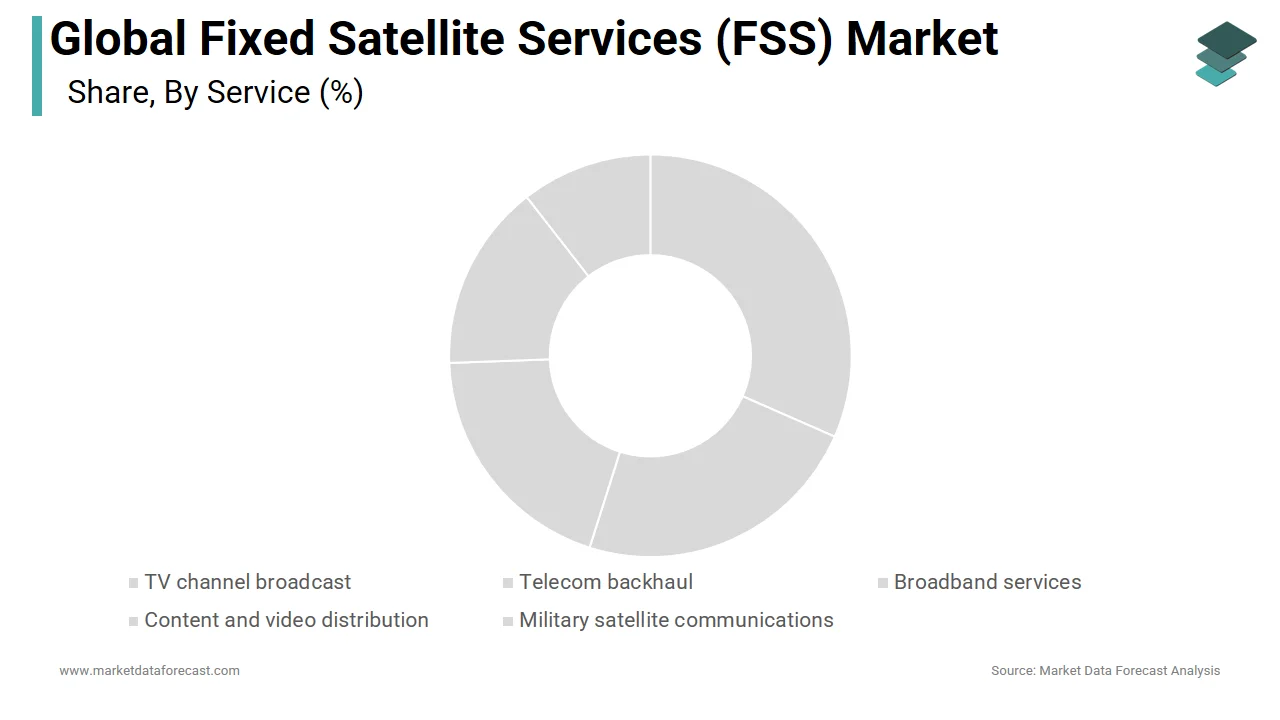
The TV Channel Broadcast remained the largest segment, accounting for 37.6% of global FSS revenue in 2024. This dominance is primarily attributed to the continued reliance on satellite for distributing television content across large geographic areas, particularly in regions where terrestrial infrastructure is limited or underdeveloped.
Also, major media conglomerates such as Sky UK, Tata Sky, and Star India depend heavily on FSS for delivering Direct-to-Home (DTH) services to millions of subscribers. The scalability and cost-effectiveness of satellite broadcasting, especially for live events and national networks, ensure that this segment maintains a strong foothold despite evolving digital distribution models.
The fastest-growing segment in the Fixed Satellite Services (FSS) Market is Broadband Services, projected to expand at a CAGR of 8.2% in thecoming years. This rapid progress is driven by increasing demand for high-speed internet access in remote and rural areas where terrestrial broadband infrastructure is either absent or unreliable.
Governments in countries like Nigeria, Brazil, and Indonesia have launched national satellite broadband programs aimed at bridging the digital divide, with many relying on FSS operators for backbone connectivity.
In addition, enterprises operating in offshore oil rigs, mining sites, and research stations are adopting satellite broadband to maintain real-time communication and operational efficiency.
Furthermore, educational institutions and healthcare providers in underserved regions are increasingly leveraging satellite-based broadband for e-learning and telemedicine applications. With growing investment in satellite-enabled education and health initiatives, this segment is poised for sustained expansion across both public and private sectors.
By Organization Size Insights
Large Enterprises spearheaded the segment, capturing an estimated 41.2% market share in 2024. These organizations require robust and scalable connectivity solutions for mission-critical operations, including enterprise networking, maritime communications, and remote asset monitoring.
Major oil and gas companies, such as Shell and BP, utilize FSS for offshore drilling site coordination, while defense agencies employ it for secure command and control systems.
Besides, large financial institutions and global logistics firms integrate FSS into their disaster recovery and backup communication strategies. The need for reliable, low-latency, and secure connectivity, especially in hybrid network environments, continues to drive adoption among large enterprises, reinforcing their dominant position in the FSS market landscape.
The booming segment in the Fixed Satellite Services (FSS) Market is Small Offices and Home Offices (SOHOs) , anticipated to grow at a CAGR of 7.9%. This development is fueled by the expanding remote work culture and the increasing need for reliable internet access in residential and small business settings.
According to a report by McKinsey & Company, the percentage of employees working remotely at least three days a week has increased by nearly 20% since 2020, necessitating stable connectivity beyond urban centers. In response, governments and telecom providers have been deploying satellite-based broadband solutions tailored for SOHO users in rural and semi-urban areas. For instance, in 2023, Viasat partnered with local ISPs in Latin America to offer affordable FSS-powered home internet packages targeting underserved communities. Similarly, in India and Southeast Asia, regulatory bodies have supported satellite-enabled broadband rollouts to support digital entrepreneurship and e-commerce growth in smaller towns. As more individuals and micro-businesses transition to remote operations, the demand for flexible, high-performance FSS connections in the SOHO segment is expected to surge significantly.
By End User Insights
Aerospace and Defense represented the biggest segment, holding 32.5% of total FSS usage in 2024. Governments and military organizations worldwide rely heavily on FSS for secure, long-range communication, surveillance, and intelligence-gathering missions.
Countries such as China, Russia, and India have also ramped up investments in military satellite programs to enhance national security and situational awareness.
Moreover, NATO and allied forces continue to leverage FSS for real-time coordination across global theaters. Beyond traditional defense roles, space agencies like NASA and ISRO utilize FSS for telemetry, tracking, and command (TT&C) functions in satellite launches and deep-space exploration missions. Given the critical nature of these operations and the reliability offered by fixed satellite links, the aerospace and defense sector remains the leading consumer of FSS technologies.
The rapidly expanding segment in the Fixed Satellite Services (FSS) Market is Education, projected to expand at a CAGR of 8.5% through 2033. This growth is primarily driven by the increasing deployment of satellite-based learning platforms in remote and under-resourced regions where conventional internet infrastructure is lacking.
In response, several governments, particularly in Africa and South Asia, have launched satellite-enabled e-learning initiatives to ensure continuity of education. Similarly, India’s National Council of Educational Research and Training (NCERT) expanded its DTH-based education program, reaching millions of students through FSS-supported broadcasts. Universities and vocational training institutions are also adopting satellite-delivered content to reach wider audiences without bandwidth limitations.
REGIONAL ANALYSIS
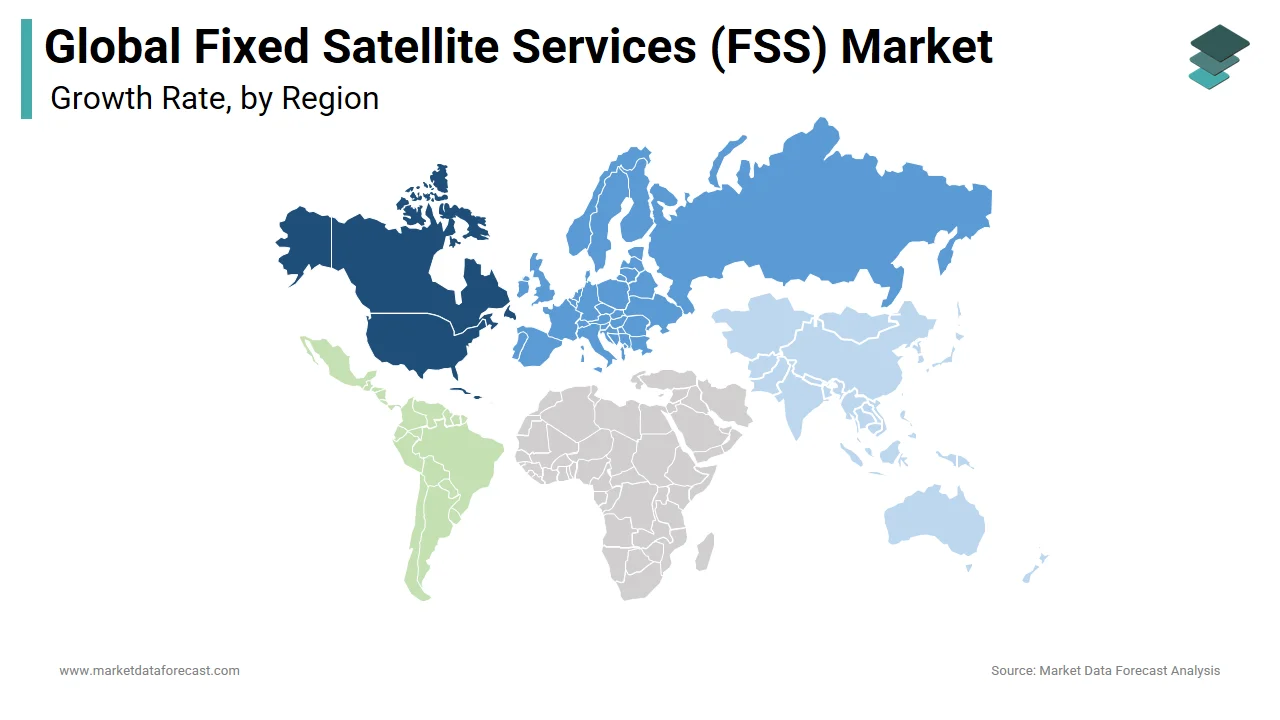
North America commanded the global Fixed Satellite Services (FSS) Market, accounting for 31.6% of total revenue in 2024. The region’s position is driven by strong government and commercial demand for satellite-based communication, particularly in defense, broadcasting, and enterprise networking.
The United States, being home to major FSS operators such as Intelsat, SES, and Hughes Network Systems, continues to dominate the market. Additionally, North America leads in the integration of satellite services with emerging technologies like 5G backhaul and IoT connectivity. Canada and Mexico also contribute significantly, with satellite playing a crucial role in connecting remote communities and supporting resource extraction industries. The presence of advanced ground infrastructure and ongoing investments in next-generation satellites further solidify North America’s position as the most mature and expansive FSS market globally.
Europe is making it the second-largest regional contributor. The region benefits from a well-established satellite ecosystem, with key players like Eutelsat, SES, and Hispasat headquartered in France, Luxembourg, and Spain respectively.
Apart from these, the European Union’s Digital Compass initiative aims to connect all households with gigabit networks by 2030, incorporating satellite as a complementary solution for rural and island regions. The UK, Germany, and Italy are actively investing in satellite-enabled broadband projects to bridge the digital gap. Moreover, defense spending across NATO member states has bolstered demand for secure satellite communication links. With regulatory frameworks encouraging innovation and spectrum availability, Europe remains a pivotal hub for FSS development, particularly in broadcasting, enterprise connectivity, and governmental applications.
Asia-Pacific is reflecting steady growth due to increasing investments in satellite infrastructure and digital transformation, as noted by NSR. The region’s diverse geography, including archipelagos and landlocked territories, makes satellite a vital component of national communication strategies. Countries like India, China, and Indonesia are leading adopters, utilizing FSS for broadcasting, rural broadband, and disaster management.
China has expanded its BeiDou and Hongyun satellite constellations to enhance FSS capabilities for commercial and military applications. Meanwhile, Japan and South Korea are integrating satellite services with 5G and IoT networks to support smart city and industrial automation projects. With rising demand for resilient connectivity and supportive government policies, the Asia-Pacific region is witnessing accelerated adoption of FSS across multiple sectors, positioning it as a key growth driver in the global market.
Latin America commands a notable share of the global Fixed Satellite Services (FSS) Market, driven by the necessity for satellite-based connectivity in vast, sparsely populated regions. Countries such as Brazil, Mexico, and Argentina rely heavily on FSS for broadcasting, mobile backhaul, and rural broadband initiatives. The Mexican government has launched national satellite broadband programs to connect rural schools and hospitals, leveraging FSS for seamless data delivery. Also, Colombia and Peru have integrated satellite services into emergency response and environmental monitoring systems. With increasing investments from international satellite operators and local telecom providers, Latin America continues to expand its FSS footprint, particularly in education, healthcare, and government sectors, offering substantial growth potential in the coming years.
The Middle East and Africa collectively account for descent share of the global Fixed Satellite Services (FSS) Market. Given the vast desert landscapes, political instability in certain regions, and underdeveloped terrestrial infrastructure, FSS plays a crucial role in providing communication services across the continent.
According to the International Telecommunication Union (ITU), nearly 60% of African mobile networks in rural areas depend on satellite backhaul, ensuring basic connectivity for millions. Countries such as Nigeria, Kenya, and Saudi Arabia have deployed FSS-based broadband initiatives to support digital inclusion and economic development. In the Middle East, defense and broadcasting remain key drivers, with state-owned broadcasters in the UAE and Qatar using FSS for pan-Arabic content distribution. Also, humanitarian organizations and NGOs frequently rely on satellite services for crisis communication and aid coordination in conflict-affected areas. With growing demand for digital transformation and expanding satellite broadband programs, the Middle East and Africa are steadily strengthening their presence in the global FSS ecosystem.
KEY MARKET PLAYERS
Key market participants of Fixed Satellite Services (FSS) market are Singapore Telecommunications Ltd (Singtel), Embratel Star One, Eutelsat Communications, Thaicom Public Company Ltd, Nigerian Communications Satellites Ltd, Telenor Satellite Broadcasting, Telesat Holdings, SKY Perfect JSAT Holdings, SES S.A, Arabsat, Hispasat, Intelsat S.A, etc.
TOP LEADING PLAYERS IN THE MARKET
One of the leading players in the Fixed Satellite Services (FSS) Market is SES S.A., a Luxembourg-based satellite operator with a global footprint. The company plays a pivotal role in delivering high-performance FSS solutions for broadcasting, enterprise connectivity, and government applications. SES has been instrumental in advancing hybrid satellite-terrestrial networks and offers a broad portfolio of services tailored to meet evolving customer demands across multiple industries.
Another key player is Intelsat, a veteran in the satellite communications industry. Known for its extensive geostationary satellite fleet, Intelsat provides critical FSS infrastructure for media distribution, telecom backhaul, and enterprise networks. The company continues to innovate by integrating next-generation technologies and expanding partnerships to enhance service delivery and ensure seamless global connectivity.
Eutelsat Communications, headquartered in France, is also a major contributor to the FSS market. Eutelsat serves broadcasters, internet service providers, and government agencies with reliable satellite capacity across multiple frequency bands. The company has been actively modernizing its fleet and investing in flexible payloads to better serve dynamic markets while maintaining a strong presence in both commercial and institutional sectors.
TOP STRATEGIES USED BY KEY PLAYERS IN THE MARKET
A core strategy employed by leading FSS operators is expanding service portfolios through strategic partnerships and collaborations. By aligning with terrestrial network providers, cloud service vendors, and regulatory bodies, companies are enhancing their reach and offering integrated communication solutions tailored to specific industry needs.
Another critical approach is investing in advanced satellite technologies and digital transformation initiatives. Companies are focusing on deploying high-throughput satellites, software-defined networking, and AI-driven analytics to improve efficiency, reduce latency, and offer scalable bandwidth solutions that meet growing demand.
Lastly, geographic diversification and market localization remain vital strategies. FSS providers are targeting emerging economies, launching region-specific satellite beams, and establishing local ground infrastructure to cater to unique regulatory and operational environments, thereby strengthening their global market presence.
COMPETITION OVERVIEW
The competition in the Fixed Satellite Services (FSS) Market is shaped by a combination of established satellite operators, emerging private space ventures, and evolving technological paradigms. Traditional players continue to dominate due to their vast satellite fleets, long-standing customer relationships, and well-developed ground infrastructures. However, increasing pressure from new entrants leveraging Low Earth Orbit (LEO) constellations is reshaping the competitive landscape. These newer systems promise lower latency and improved performance, challenging the dominance of geostationary satellites in certain applications. Additionally, the convergence of satellite and terrestrial networks is compelling FSS providers to rethink their business models and service offerings. Regulatory shifts around spectrum allocation and orbital congestion further influence strategic decision-making. As demand grows for hybrid communication ecosystems, companies are competing not only on price and performance but also on innovation, reliability, and adaptability to regional market conditions. This dynamic environment fosters continuous evolution, pushing firms to differentiate themselves through enhanced service quality, technological advancement, and customer-centric solutions.
RECENT MARKET DEVELOPMENTS
- In March 2024, SES announced a strategic collaboration with Microsoft Azure to integrate satellite connectivity into cloud-based enterprise networks. This initiative aims to deliver seamless hybrid communication solutions, particularly for remote operations in the energy and maritime sectors.
- In July 2023, Intelsat launched a new line of managed FSS services tailored for government and defense clients, focusing on secure, resilient communication links for mission-critical applications across international theaters.
- In November 2024, Eutelsat introduced a dedicated satellite beam over Southeast Asia, designed to support growing demand for broadcast and broadband services in the region, reinforcing its position in the Asia-Pacific FSS market.
- In February 2023, Hughes Network Systems partnered with Bharti Airtel to expand rural broadband coverage in India using FSS-enabled satellite gateways, marking a significant step toward bridging the digital divide in underserved areas.
- In October 2024, Telesat entered into a joint venture with a Canadian telecommunications provider to develop next-generation FSS solutions for enterprise customers, emphasizing scalability and integration with terrestrial 5G networks.
MARKET SEGMENTATION
This research report on the global fixed satellite services market has been segmented and sub-segmented based on the service, organization, end user, and region.
By Service
- TV channel broadcast
- telecom backhaul
- broadband services
- content and video distribution
- military satellite communications
By Organization Size
- small offices and home offices
- small and medium businesses
- large enterprises
By End User
- media and entertainment
- education
- government
- IT and communications
- retail
- oil & gas
- aerospace
- defense
By Region
- North America
- Europe
- Asia-Pacific
- Latin America
- The Middle East and Africa