- Product Description Description
- Table of Contents TOC
- List of Table & Figure LOT
- Get Free Sample PDF Sample PDF
Market Size, 2025
$139.5 BnMarket Estimate, 2026
$148.01 BnMarket Forecast, 2034
$237.69 BnCAGR, 2026–2034
6.10%Executive Summary: Flat Panel Display Market
- Market Scope: Comprehensive global flat panel display industry analysis covering OLED and LCD technology adoption, consumer electronics and automotive applications, regional leadership frameworks, strategic corporate developments, and competitive landscapes.
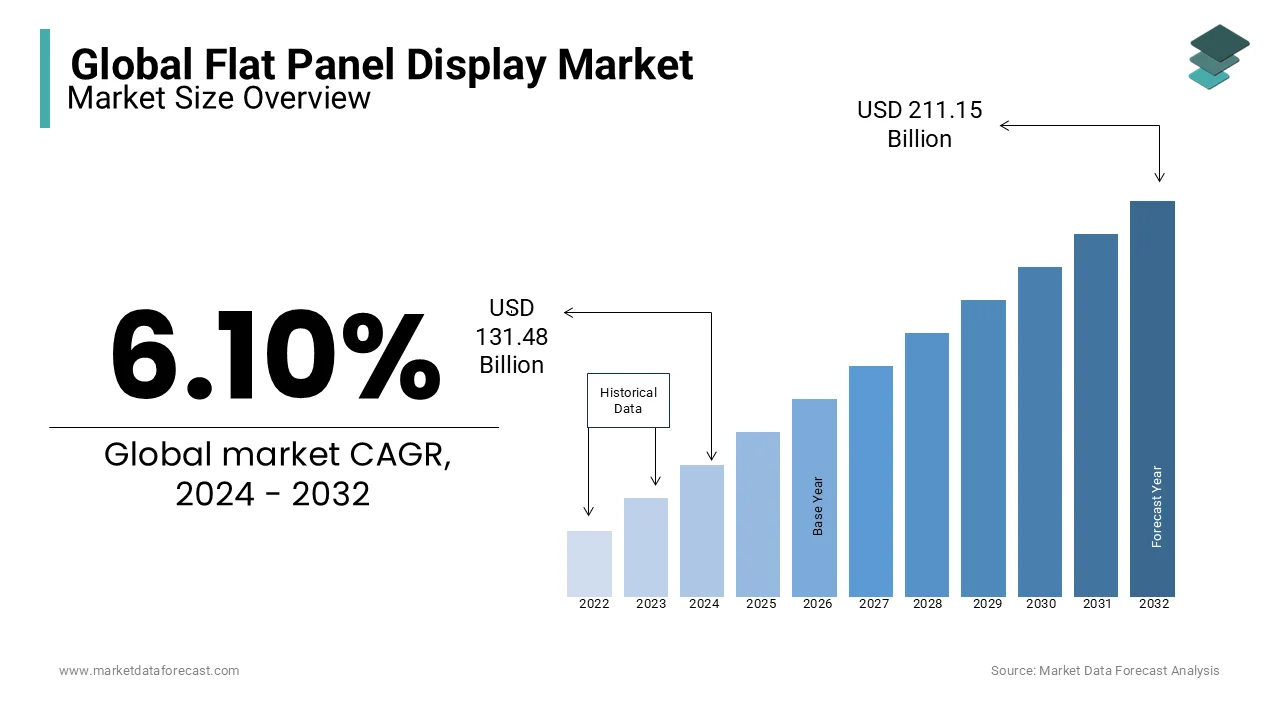
- Market Valuation: Valued at USD 139.50 billion (2025), estimated at USD 148.01 billion (2026), and projected to reach USD 237.69 billion by 2034, registering a steady CAGR of 6.10% (2026–2034).
- Primary Growth Drivers: Consumer electronics consumption, declining display prices, high-quality OLED and flexible display innovations (smartphones/automotive/digital signage), interactive touch-based equipment, 5G rollouts, and augmented reality applications. Restraints include high production costs and R&D commercialization barriers.
Key Market Segment Metrics (2026–2034)
| Category | Leading Segment / Region (Position) | Fastest-Growing Segment |
|---|---|---|
| By Technology & End-User | OLED technology (leads via superior resolution/viewing angles) & Consumer electronics segment | Flexible OLED and AMOLED bendable display solutions |
| By Application Category | Smartphones and tablets (largest application segment supported by premium OLED demand) | Vehicle displays (rapidly expanding application driven by automotive sector growth) & Digital signage |
| By Region | North America (dominates market owing to early technology adoption and corporate sales sector activity) | Asia-Pacific (high growth driven by China's manufacturing base, low costs, and next-gen display R&D) |
Major Market Players & Market Structure
Market Structure: Highly competitive global display manufacturing ecosystem focused on R&D investments in flexible OLED/AMOLED panels, production capacity expansions, and specialized industrial applications across entertainment and corporate verticals.
Key Companies: LG Display Co., Ltd., Sony Electronics Inc., NEC Display Solutions, Ltd., Samsung, Sharp Corporation, Japan Display Inc., Panasonic Corporation, AU Optronics Corp., E Ink Holdings Inc., Crystal Display Systems Ltd, Emerging Display Technologies, Innolux Corporation, Universal Display, Clover Display Limited, Densitron UK Ltd, and Chunghwa Picture Tubes, Ltd.
Global Flat Panel Display Market Size
The global flat panel display market was worth USD 139.50 billion in 2025. The global market is predicted to reach USD 148.01 billion in 2026 and USD 237.69 billion by 2034, growing at a CAGR of 6.10% from 2026 to 2034.
Flat panel display technology represents the dominant visual interface standard, characterized by thin, lightweight construction and superior image quality compared to traditional cathode ray tube systems. This sector encompasses various technologies, including liquid crystal displays, organic light-emitting diodes, and micro light-emitting diodes, which serve as critical components in consumer electronics, automotive interfaces, industrial control systems, and digital signage. The evolution of these displays has shifted from mere information presentation to immersive visual experiences driven by advancements in resolution, color accuracy, and refresh rates. According to the International Data Corporation, global shipments of display panels reached approximately 2.8 billion units in 2023, reflecting the pervasive integration of screens into daily life across multiple device categories. According to the Consumer Technology Association, over 95% of households in developed nations possess at least one flat panel television, indicating market saturation in primary living spaces but continued growth in secondary applications. The European Union has implemented stringent eco-design directives requiring displays to meet specific energy efficiency criteria, which are reshaping manufacturing processes and material selection. Modern flat panel displays increasingly incorporate touch sensitivity, flexible substrates, and high dynamic range capabilities to meet the demands of emerging applications, such as virtual reality headsets and foldable smartphones. This technological progression supports the broader digital transformation where visual interaction serves as the primary mode of human-machine communication, driving continuous innovation in panel architecture and production methodologies.
MARKET DRIVERS
Surge in Demand for Large Screen Televisions and Home Entertainment Systems Drives Market Expansion
The increasing consumer preference for larger screen sizes and higher resolution formats in home entertainment setups primarily drives the flat panel display market growth. According to Omdia, average television screen sizes have increased by approximately 1.5 inches annually over the past five years, with 65-inch and larger panels now accounting for over 25% of global TV shipments. According to Samsung Electronics, consumer surveys indicate that 70% of buyers prioritize screen size and 4K or 8K resolution when purchasing new televisions, driven by the availability of high-definition streaming content and next-generation gaming consoles. The proliferation of ultra-high-definition content on platforms such as Netflix and Amazon Prime Video necessitates displays capable of rendering detailed images with high dynamic range to enhance viewing immersion. Furthermore, the rise of home theater cultures during periods of restricted mobility has accelerated the replacement cycle for older, smaller displays. Manufacturers respond to this demand by optimizing production lines for larger glass substrates, which improves economies of scale and reduces per-unit costs for big screens. The integration of smart features and voice control into these large-format displays further enhances their appeal as central hubs for home automation. This sustained consumer appetite for premium visual experiences ensures steady volume growth for large-area flat panel manufacturers, particularly in the liquid crystal display and organic light-emitting diode segments.
Rapid Adoption of Electric Vehicles and Advanced Driver Assistance Systems Accelerates Automotive Display Integration
The automotive industry's transition toward electrification and autonomous driving technologies is creating substantial demand for sophisticated flat panel displays within vehicle interiors. According to S&P Global Mobility, the average number of displays per vehicle is projected to increase from 1.5 in 2020 to over 3.0 by 2030 as automakers integrate digital instrument clusters, infotainment systems, and rear-seat entertainment units. According to Tesla and other leading electric vehicle manufacturers, large central touchscreens have become defining features of modern car designs, replacing physical buttons with intuitive graphical interfaces for climate control, navigation, and media management. Advanced driver assistance systems rely on high-resolution displays to present real-time data from sensors, cameras, and radar, ensuring driver awareness and safety. The shift toward software-defined vehicles allows for over-the-air updates that can modify display layouts and functionalities, extending the lifecycle of the hardware. Organic light-emitting diode technology is increasingly favored in automotive applications due to its superior contrast ratio, flexibility, and ability to be integrated into curved surfaces, enhancing interior aesthetics. Regulatory mandates for improved safety information visibility also drive the adoption of high-brightness and wide-viewing-angle panels. This structural change in vehicle architecture positions the automotive sector as a high-growth vertical for flat panel display suppliers seeking diversification beyond consumer electronics.
MARKET RESTRAINTS
Volatility in Raw Material Prices and Supply Chain Disruptions Constrain Profitability
The flat panel display market faces significant financial pressure due to the fluctuating costs of critical raw materials, such as indium, gallium, zinc oxide, glass substrates, and polarizing films. According to the US Geological Survey, the price of indium, a key component in transparent conductive layers, has experienced volatility of up to 30% annually due to limited global reserves and concentrated production in specific regions. According to Display Supply Chain Consultants, disruptions in the supply of specialized chemicals and equipment from key suppliers in Japan and South Korea have led to production delays and increased inventory holding costs for manufacturers. The geopolitical tensions affecting trade routes further exacerbate these challenges, forcing companies to seek alternative sourcing strategies, which often come at a premium. Additionally, the energy-intensive nature of panel fabrication means that rising electricity and natural gas prices directly impact manufacturing margins. Manufacturers operate on thin profit margins, making them highly sensitive to input cost variations, which cannot always be passed on to price-sensitive consumers. The complexity of the supply chain involving multiple tiers of suppliers for glass, color filters, and backlight units creates vulnerabilities where a single bottleneck can halt entire production lines. These economic pressures compel manufacturers to continuously optimize processes and negotiate long-term contracts, but uncertainty remains a persistent restraint on market stability and expansion.
Stringent Environmental Regulations and E-Waste Management Requirements Increase Compliance Costs
Increasingly rigorous environmental regulations regarding the disposal of electronic waste and the use of hazardous substances impose significant operational and financial burdens on flat panel display manufacturers. According to the European Commission, the Waste Electrical and Electronic Equipment Directive mandates that producers finance the collection, recycling, and recovery of display devices, which adds substantial costs to the product lifecycle. According to the United Nations Environment Programme, global e-waste reached 53.6 million metric tons in 2023, with displays constituting a significant portion due to their short replacement cycles and complex material composition. Compliance with restrictions on hazardous substances, such as lead, mercury, and cadmium, requires manufacturers to invest in alternative materials and modified production processes, which can be technically challenging and expensive. The push for circular economy principles forces companies to design displays that are easier to disassemble and recycle, limiting design freedom and potentially increasing initial production costs. Furthermore, different regions have varying regulatory standards, requiring manufacturers to maintain multiple compliance frameworks for global markets. Failure to adhere to these regulations results in hefty fines and reputational damage. The need to implement sustainable manufacturing practices and develop take-back programs diverts resources from research and development, slowing down the pace. These regulatory hurdles act as a restraint, particularly for smaller players who lack the capital to manage complex compliance requirements effectively.
MARKET OPPORTUNITIES
Expansion of Commercial Digital Signage and Interactive Retail Experiences Creates New Revenue Streams
The growing utilization of flat panel displays in commercial environments for advertising, information dissemination and customer engagement is a lucrative opportunity for market growth. According to Grand View Research, the global digital signage market is expected to expand significantly, driven by the replacement of static print media with dynamic, high-resolution video walls and interactive kiosks. According to Nielsen studies, digital signage in retail environments can increase sales by up to 33% by capturing consumer attention with vibrant moving images and real-time promotional content. Shopping malls, airports, and hospitality venues are increasingly deploying large-format organic light-emitting diode and liquid crystal displays to create immersive brand experiences and provide wayfinding services. The integration of touch capabilities and sensor technologies allows these displays to interact with customers, offering personalized recommendations and seamless checkout options. Advances in transparency and flexibility enable innovative installations, such as window displays that show content while allowing visibility into stores. The shift toward smart cities also drives demand for outdoor-rated flat panel displays for public transportation updates and emergency alerts. These commercial applications offer higher-margin opportunities compared to saturated consumer markets and encourage manufacturers to develop specialized, durable, and high-brightness solutions tailored for continuous operation in diverse lighting conditions.
Integration of Artificial Intelligence and Smart Features Enhances Product Value and Differentiation
The incorporation of artificial intelligence and Internet of Things connectivity into flat panel displays offers a significant opportunity for the global flat panel display market. According to International Data Corporation, the number of connected display devices is growing rapidly as manufacturers embed processors and sensors that enable voice recognition, gesture control, and adaptive brightness adjustment. According to LG Electronics, smart displays can analyze viewing habits and ambient lighting conditions to automatically optimize picture settings and energy consumption, enhancing user convenience and satisfaction. In educational and corporate settings, AI-powered displays facilitate collaborative work through seamless wireless casting, annotation tools, and real-time language translation. The convergence of display technology with smart home ecosystems allows televisions and monitors to serve as central control panels for lighting, security, and appliances. This added functionality justifies premium pricing and extends the replacement cycle as consumers view displays as long-term investments in their digital lifestyle. Furthermore, AI algorithms can predict maintenance needs and diagnose issues remotely, reducing downtime for commercial users. By moving beyond simple visual output to intelligent interaction, flat panel manufacturers can differentiate their products in a crowded market and create new service-based revenue models through software updates and subscription features.
MARKET CHALLENGES
Intense Price Competition and Commoditization of Standard Display Technologies Erode Margins
The flat panel display market is characterized by fierce price competition, particularly in the mature liquid crystal display segment, where technological differentiation is minimal, and production capacity exceeds demand. According to TrendForce, oversupply in the global panel market has led to consecutive quarters of declining average selling prices for standard television and monitor panels, forcing manufacturers to operate at or below break-even points. According to BOE Technology Group, the commoditization of 1080p and 4K resolutions means that consumers often choose products based solely on price rather than brand or minor feature differences. This race to the bottom squeezes profit margins and limits the funds available for research and development of next-generation technologies. Smaller manufacturers struggle to compete with giants who benefit from massive economies of scale and vertical integration of supply chains. The constant pressure to reduce costs often leads to compromises in quality control and after-sales support, damaging brand reputation. Additionally, the rapid pace of technological obsolescence means that inventory can lose value quickly if not sold immediately. This hyper-competitive environment discourages new entrants and forces existing players to consolidate or exit certain market segments. The lack of pricing power makes the industry highly vulnerable to economic downturns and shifts in consumer spending behavior.
Technological Complexity and High Capital Expenditure for Next-Generation Production Facilities Pose Barriers
The development and mass production of advanced flat panel display technologies, such as micro light-emitting diodes and organic light-emitting diodes, require enormous capital investment and technical expertise, which act as a significant challenge for market participants. According to SEMI, the cost of building a new-generation fab for large-area organic light-emitting diode production can exceed 10 billion dollars due to the need for precision deposition equipment and cleanroom facilities. According to Apple Inc. supply chain reports, the yield rates for micro light-emitting diode displays remain low during initial production phases, leading to high waste and increased unit costs. The complexity of integrating millions of microscopic LEDs onto a substrate requires breakthroughs in transfer printing and bonding technologies that are still being refined. Furthermore, the rapid evolution of display standards means that equipment can become obsolete before it is fully amortized, posing financial risks. The shortage of skilled engineers and technicians capable of managing these sophisticated manufacturing processes further complicates expansion efforts. Companies must balance the need to innovate with the financial reality of high depreciation and operational costs. This barrier to entry protects incumbent leaders but also slows down the widespread adoption of superior technologies as manufacturers hesitate to commit to unproven production methods without guaranteed demand.
REPORT COVERAGE
| REPORT METRIC | DETAILS |
| Market Size Available | 2025 to 2034 |
| Base Year | 2025 |
| Forecast Period | 2026 to 2034 |
| Segments Covered | By Technology, End Users, Application, and Region. |
| Various Analyses Covered | Global, Regional, and Country-Level Analysis, Segment-Level Analysis, Drivers, Restraints, Opportunities, Challenges; PESTLE Analysis; Porter’s Five Forces Analysis, Competitive Landscape, Analyst Overview of Investment Opportunities |
| Regions Covered |
|
| Market Leaders Profiled | LG Display Co., Ltd., Sony Electronics Inc., NEC Display Solutions, Ltd., Samsung Display Co Ltd, Sharp Corporation, Japan Display Inc., Panasonic Corporation, AU Optronics Corp., E Ink Holdings Inc., Crystal Display Systems Ltd, Emerging Display Technologies, Innolux Corporation, BOE Technology Group Co Ltd, Universal Display, Clover Display Limited, Densitron UK Ltd, Chunghwa Picture Tubes, Ltd., and other players. |
SEGMENTAL ANALYSIS
By Technology Insights
The LCD segment held the major share of the global market in 2025 due to its mature manufacturing ecosystem, cost-effectiveness, and widespread adoption across a diverse range of applications, from televisions to industrial monitors. This technology remains the backbone of the global display industry despite the emergence of newer alternatives. The primary driver for LCD dominance is its significantly lower production cost compared to emerging technologies like Organic Light Emitting Diodes, which makes it the preferred choice for price-sensitive consumer segments and large-volume applications. According to Display Supply Chain Consultants, LCD panels account for over 70% of global display shipments by volume because established production lines allow manufacturers to achieve high yields and economies of scale. According to BOE Technology Group, the average selling price of LCD TVs has decreased by approximately 15% annually over the last decade, enabling mass market penetration in developing regions. The extensive supply chain for liquid crystal materials, glass substrates, and backlight units is well developed, reducing procurement risks and lead times. Manufacturers can produce large-format panels efficiently, making LCD the standard for commercial digital signage and public information displays where budget constraints are critical. Furthermore, the longevity and reliability of LCD technology in continuous-operation environments make it ideal for industrial and automotive applications where replacement costs are prohibitive. This economic advantage ensures that LCD remains the default technology for mainstream electronics, sustaining its market leadership through volume rather than premium features.
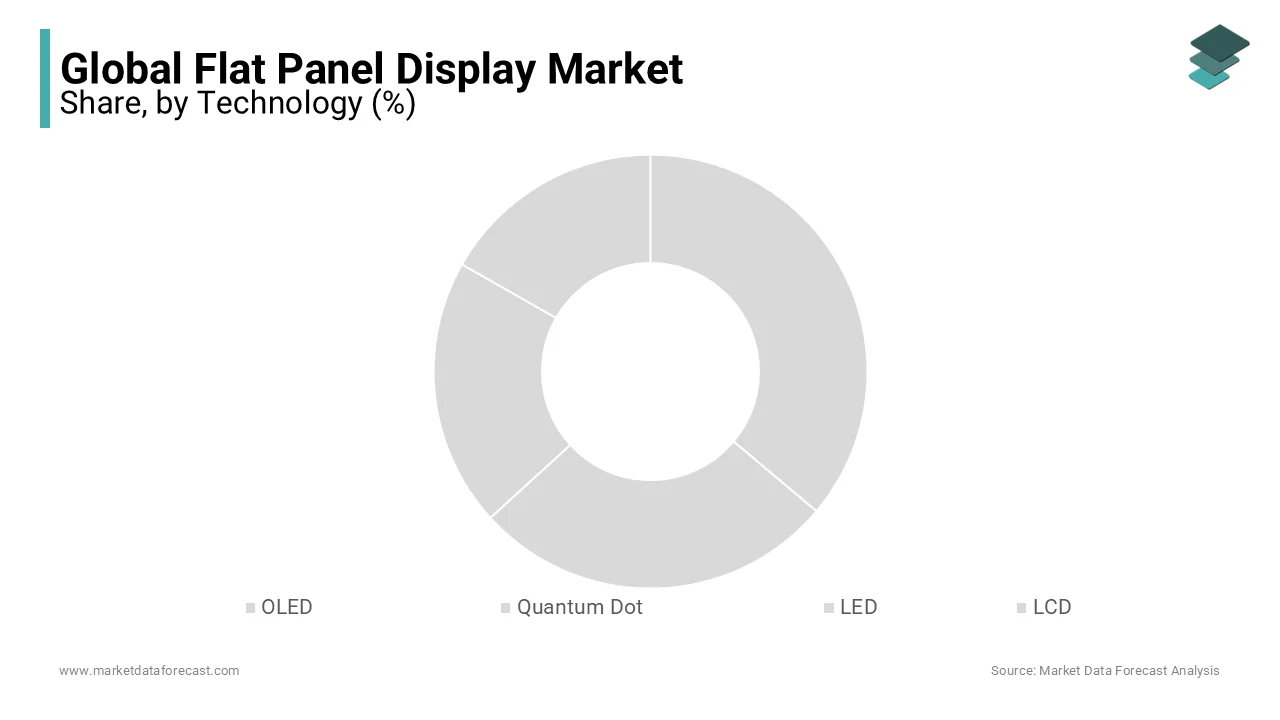
However, the OLED segment represents the fastest-growing technology in the flat panel display market and is predicted to grow at a promising CAGR of 14.5% over the forecast period in the global market owing to the superior image quality, flexibility, and increasing adoption in premium smartphones and televisions. OLED technology is experiencing rapid growth due to its ability to produce perfect blacks, infinite contrast ratios, and vibrant colors by emitting light directly from organic compounds without requiring a backlight. According to UBI Research, OLED panel shipments for smartphones exceeded 600 million units in 2023 as major manufacturers prioritize visual excellence in flagship devices. According to LG Display, the self-emissive nature of OLED allows for ultra-thin and flexible form factors, enabling the creation of foldable smartphones, curved televisions, and rollable displays that were previously impossible with rigid LCDs. This design freedom appeals to consumers seeking innovative and premium devices, driving higher average selling prices and profit margins for manufacturers. The fast response time of OLED pixels also makes them ideal for high-refresh-rate gaming monitors and virtual reality headsets where motion blur must be minimized. Furthermore, OLED panels consume less power when displaying dark content, which is beneficial for mobile devices using dark mode interfaces. These technical advantages create a strong value proposition that justifies the higher cost, encouraging widespread adoption in high-end consumer electronics and expanding the total addressable market for OLED technology.
By End User Insights
The consumer electronics segment led the market by capturing the highest share of the global market in 2025. The growth of the consumer electronics segment in the global market can be credited to the ubiquitous presence of smartphones, televisions, laptops, and tablets in daily life, driving massive volume demand. The dominance of the consumer electronics segment is further driven by the relentless demand for smartphones and televisions, which serve as the primary interfaces for communication, entertainment, and information access. According to International Data Corporation, global smartphone shipments reached 1.2 billion units in 2023, with each device requiring at least one high-quality flat panel display. According to Statista, the global television market continues to grow, with replacements driven by the adoption of 4K and 8K resolutions and larger screen sizes. Consumers upgrade their devices frequently to access new features, better cameras, and improved display technologies, creating a continuous replacement cycle. The integration of advanced display features, such as high dynamic range and high refresh rates, has become a key differentiator for manufacturers, stimulating consumer interest. Emerging markets contribute significantly to this volume as rising disposable incomes enable more households to purchase multiple devices. The sheer scale of the consumer base ensures that this segment remains the largest contributor to display panel revenues. Manufacturers prioritize innovation in this sector to capture market share, leading to rapid technological advancements that eventually trickle down to other segments. This constant churn and high volume sustain the leadership of consumer electronics in the flat panel display market.
However, the automotive segment is predicted to showcase a CAGR of 13.7% over the forecast period in the global market owing to the electrification of vehicles, integration of advanced driver assistance systems, and the transformation of car interiors into digital living spaces. The rapid transition to electric vehicles is reshaping automotive interiors, with large central touchscreens replacing traditional physical controls, driving significant demand for flat panel displays. According to S&P Global Mobility, the average number of displays per vehicle is expected to reach 3.5 by 2030, up from 1.5 in 2020 as automakers adopt digital cockpit architectures. According to Tesla and other EV pioneers, large vertical and horizontal screens serve as the primary interface for navigation, climate control, and entertainment, creating a minimalist interior aesthetic. Electric vehicles often feature unique dashboard layouts that accommodate larger displays due to the absence of traditional engine components. Consumers associate large, high-resolution screens with modernity and technological sophistication, influencing purchasing decisions. Automakers compete on the size and quality of these displays using Organic Light Emitting Diode and Mini LED technologies to enhance brand perception. The integration of multiple screens for drivers, passengers, and rear-seat occupants further increases the total display area per vehicle. This structural shift in vehicle design ensures that the automotive sector becomes a major growth engine for display manufacturers seeking to offset saturation in consumer electronics.
By Application Insights
The smartphone and tablet segment held the leading share of the global market in 2025. The growth of the smartphone and tablet segment in the global market is attributed to the massive global installed base of mobile devices and the frequent replacement cycles driven by technological advancements and consumer preferences. Smartphones and tablets are the most pervasive personal computing devices globally, ensuring a consistent and high-volume demand for flat panel displays. According to International Data Corporation, there are over 6 billion active smartphone users worldwide, each requiring a high-quality display for daily interaction. According to Apple Inc. and Samsung Electronics, flagship devices drive the adoption of premium display technologies, such as Organic Light Emitting Diodes, which then cascade to mid-range models. The tablet market remains strong in education and enterprise sectors where portable, large-screen devices are essential for productivity and learning. The portability and versatility of these devices make them indispensable for communication, work, and entertainment. Emerging markets continue to drive volume growth as first-time smartphone buyers enter the digital economy. The short lifecycle of mobile devices, typically two to three years, ensures a steady stream of replacement demand. Manufacturers continuously innovate with higher resolutions, better battery efficiency, and new form factors to stimulate upgrades. This relentless cycle of innovation and replacement sustains the smartphone and tablet segment as the largest application area for flat panel displays.
On the other hand, the vehicle display segment is anticipated to record a CAGR of 14.4% over the forecast period in the global market owing to the digitalization of car interiors, autonomous driving features, and the integration of infotainment systems. The transformation of car interiors into digital hubs with multiple screens for navigation, entertainment, and vehicle control is the primary driver for the rapid growth of vehicle displays. According to S&P Global Mobility, the total area of displays in premium vehicles has increased by 50% in the last five years as automakers replace physical buttons with touch interfaces. According to Mercedes-Benz and BMW, the latest models feature expansive curved displays that span the entire dashboard, providing a seamless visual experience for drivers and passengers. These large-format displays require high resolution and wide viewing angles to ensure usability for all occupants. The integration of streaming services, gaming, and video conferencing capabilities in cars increases the demand for high-quality audio-visual systems. Passengers expect the same level of connectivity and entertainment in vehicles as they have at home. This expectation drives automakers to invest in premium display technologies, such as Organic Light Emitting Diodes and Mini LEDs. The trend toward software-defined vehicles allows for regular updates that can enhance display functionalities, extending the relevance of the hardware. This shift toward digital interiors ensures that vehicle displays become a central component of the automotive value proposition.
REGIONAL ANALYSIS
Asia-Pacific Flat Panel Display Market Analysis
Asia-Pacific captured the largest share of the global market in 2025 due to the presence of major manufacturing hubs in China, South Korea, and Japan, and high domestic consumption. The region benefits from complete supply chain integration and government support for semiconductor and display industries. China leads the regional market with massive production capacity and growing domestic demand. According to the Ministry of Industry and Information Technology, China accounts for over 50% of global LCD production capacity, with companies like BOE and TCL CSOT expanding aggressively. According to the National Bureau of Statistics, Chinese consumer spending on electronics remains robust, supporting local display manufacturers. The government’s Made in China 2025 initiative prioritizes display technology self-sufficiency, driving investment in Organic Light Emitting Diode and Micro LED facilities. South Korea maintains leadership in premium technologies, with Samsung Display and LG Display dominating the Organic Light Emitting Diode market. According to the Korea Trade-Investment Promotion Agency, Korean firms focus on high-value-added products for global brands. Japan contributes through specialized materials and equipment suppliers essential for panel production. The region’s integrated ecosystem from raw materials to final assembly ensures cost competitiveness and rapid innovation.

Europe Flat Panel Display Market Analysis
Europe accounts for a substantial share of the global flat panel display market, characterized by strong demand in automotive and industrial sectors and stringent environmental regulations. The region lacks significant panel manufacturing but is a key market for high-end applications. Germany leads the European market with its powerful automotive industry driving demand for advanced vehicle displays. According to the German Association of the Automotive Industry, German carmakers are among the largest buyers of premium Organic Light Emitting Diode and Mini LED panels for digital cockpits. According to the European Commission, strict eco-design regulations push manufacturers to develop energy-efficient displays. The United Kingdom and France have strong aerospace and defense sectors requiring specialized ruggedized displays. Eastern European countries are emerging as assembly hubs for consumer electronics. The region’s focus on sustainability and quality drives demand for durable and efficient display solutions. Lack of local fabrication facilities means reliance on imports, but strong engineering expertise supports integration and customization.
Middle East and Africa Flat Panel Display Market Analysis
Middle East and Africa represents an emerging market with growing investments in infrastructure and digitalization, driving gradual adoption of flat panel displays. The region offers opportunities in digital signage and consumer electronics. United Arab Emirates leads the region with smart city projects requiring extensive digital signage and public information displays. According to the Dubai Statistics Center, the UAE invests heavily in tourism and retail infrastructure, driving demand for large-format screens. According to Saudi Vision 2030, the kingdom is developing entertainment and tourism sectors, increasing demand for consumer electronics. South Africa holds the largest market in sub-Saharan Africa, with a growing middle class purchasing smartphones and televisions. Limited local manufacturing means reliance on imports. Increasing internet penetration and urbanization support market growth. Government initiatives to improve education and healthcare also drive demand for interactive displays and medical monitors.
North America Flat Panel Display Market Analysis
North America represents a mature market characterized by high adoption of premium display technologies and strong demand in healthcare and defense sectors. The region focuses on innovation and high-value applications. United States leads the regional market with significant demand for large televisions and automotive displays. According to the Consumer Technology Association, US consumers prefer large-screen and high-resolution TVs, driving imports of premium panels. According to the Department of Defense, military applications require specialized rugged displays. Canada has a strong aerospace sector needing advanced cockpit displays. The region lacks panel manufacturing but hosts major design and software companies. Focus on innovation and early adoption of new technologies like Micro LED drives market dynamics. High disposable income supports premium product sales.
Latin America Flat Panel Display Market Analysis
Latin America represents a moderate growth market characterized by price sensitivity and growing access to consumer electronics. Economic volatility impacts purchasing power, but long-term trends are positive. Brazil leads the region with the largest consumer base and local assembly operations. According to the Brazilian Electrical and Electronics Industry Association, local policies encourage domestic production of televisions and monitors. According to the Mexican Association of the Automotive Industry, Mexico’s auto sector drives demand for vehicle displays. Argentina and Chile show steady growth in consumer electronics. Limited local manufacturing means reliance on imports. A growing middle class and urbanization support market expansion. Price sensitivity favors LCD technology over premium options.
COMPETITIVE LANDSCAPE
The flat panel display market exhibits intense competition characterized by a few dominant manufacturers who control the majority of global production capacity and technological innovation. Major competitors differentiate themselves through proprietary technologies, production efficiency, and strong relationships with key original equipment manufacturers. The landscape features continuous capital investment in new fabrication facilities to achieve economies of scale and maintain cost leadership. Price competition remains fierce, particularly in the mature Liquid Crystal Display segment where oversupply can lead to margin compression. New entrants face significant barriers due to high initial capital requirements and complex manufacturing processes. Strategic alliances between panel makers and material suppliers help secure critical resources and reduce dependency on external vendors. The shift toward Organic Light Emitting Diodes and Micro LEDs is reshaping competitive dynamics as companies race to establish dominance in these high-growth areas. Geographic concentration of manufacturing in Asia Pacific creates logistical advantages for regional players while global brands seek diversified supply chains. Intellectual property rights and patent portfolios play a crucial role in maintaining competitive advantage and preventing imitation.
KEY MARKET PLAYERS
The leading companies operating in the global flat panel display market include:
- LG Display Co., Ltd.
- Sony Electronics Inc.
- NEC Display Solutions, Ltd.
- Samsung Display Co. Ltd.
- Sharp Corporation
- Japan Display Inc.
- Panasonic Corporation
- AU Optronics Corp.
- E Ink Holdings Inc.
- Crystal Display Systems Ltd.
- Emerging Display Technologies
- Innolux Corporation
- BOE Technology Group Co. Ltd.
- Universal Display
- Clover Display Limited
- Densitron UK Ltd.
- Chunghwa Picture Tubes, Ltd.
TOP PLAYERS IN THE MARKET
- Samsung Display Co Ltd remains a global leader in the flat panel display market by pioneering advanced Organic Light Emitting Diode and Quantum Dot technologies for smartphones and televisions. The company actively strengthens its position by expanding production capacity for flexible and foldable OLED panels, which are increasingly demanded by premium device manufacturers. Samsung Display recently invested heavily in next-generation QD OLED technology that combines the self-emissive benefits of OLED with the color purity of quantum dots. The organization focuses on strategic partnerships with major smartphone brands to secure long term supply agreements for high-resolution displays. By continuously innovating in form factors such as rollable and transparent screens, Samsung Display maintains its technological edge. Their commitment to quality and performance ensures they remain the preferred supplier for flagship consumer electronics products worldwide.
- LG Display Co Ltd is a prominent manufacturer specializing in large-area Organic Light Emitting Diode panels for televisions and automotive applications, as well as Liquid Crystal Displays for monitors. The company enhances its market presence by leading the transition to OLED TV panels, which offer superior contrast and design flexibility for home entertainment systems. LG Display recently expanded its automotive display portfolio by developing integrated cockpit solutions that combine multiple screens into seamless curved surfaces. The organization focuses on sustainability by implementing eco-friendly manufacturing processes and reducing energy consumption in production facilities. By securing contracts with major global automakers, LG Display diversifies its revenue streams beyond consumer electronics. Their emphasis on innovation in large format displays and automotive interfaces allows them to capture high-value segments in the evolving display industry.
- BOE Technology Group Co Ltd has emerged as a dominant force in the flat panel display market, particularly in the Liquid Crystal Display segment for televisions, monitors, and laptops. The company strengthens its market position through massive investments in advanced production lines, including Generation 10.5 facilities that enable efficient manufacturing of large-size panels. BOE recently accelerated its development of Organic Light Emitting Diode technology for smartphones and tablets, challenging established players with competitive pricing and improving quality. The organization focuses on vertical integration by producing key materials and components in-house to reduce costs and ensure supply chain stability. By supplying displays to major global brands, BOE leverages economies of scale to maintain competitiveness. Their strategic expansion into emerging markets and diverse application areas such as healthcare and retail solidifies their role as a critical global supplier.
TOP STRATEGIES USED BY KEY MARKET PARTICIPANTS
Key players in the flat panel display market predominantly focus on transitioning from mature Liquid Crystal Display technologies to advanced Organic Light Emitting Diode and Micro LED solutions to capture higher margins and meet demand for premium visual experiences. Companies actively invest in research and development to improve yield rates and reduce production costs for next-generation panels. Strategic partnerships with consumer electronics and automotive manufacturers ensure stable demand and facilitate co-development of customized display solutions. Expansion of production capacity in regions with favorable government incentives helps optimize costs and mitigate supply chain risks. Emphasis on sustainability and energy efficiency aligns with global regulatory requirements and appeals to environmentally conscious consumers. Diversification into specialized applications such as medical imaging, virtual reality, and digital signage reduces dependence on volatile consumer electronics markets. Continuous innovation in form factors, including foldable, flexible, and transparent displays, creates new product categories and drives replacement cycles.
MARKET SEGMENTATION
This research report on the global flat panel display market is segmented and sub-segmented based on the technology, applications, end-users, and region.
By Technology
-
OLED
-
Quantum Dot
-
LED
-
LCD
By End Users
-
Consumer Electronic
-
Healthcare
-
Automotive
-
Retail
-
BFSI
-
Military & Defense
By Application
-
Smartphone & Tablet
-
Television & Digital Signage
-
PC & Laptop
-
Vehicle Display
-
Smart Wearable
By Region
-
North America
-
The United States
-
Canada
-
Rest of North America
-
-
Europe
-
The United Kingdom
-
Spain
-
Germany
-
Italy
-
France
-
Rest of Europe
-
-
Asia Pacific
-
India
-
Japan
-
China
-
Australia
-
Singapore
-
Malaysia
-
South Korea
-
New Zealand
-
Southeast Asia
-
-
Latin America
-
Brazil
-
Argentina
-
Mexico
-
Rest of LATAM
-
-
The Middle East and Africa
-
Saudi Arabia
-
UAE
-
Lebanon
-
Jordan
-
Cyprus
-