- Product Description Description
- Table of Contents TOC
- List of Table & Figure LOT
- Get Free Sample PDF Sample PDF
Market Size, 2025
$46.41 BnMarket Estimate, 2026
$57.78 BnMarket Forecast, 2034
$333.53 BnCAGR, 2026–2034
24.5%Global Fleet Management Market Size, Growth, Trends & Forecast (2026–2034)
The global fleet management market size was valued at USD 46.41 billion in 2025, is estimated to reach USD 57.78 billion in 2026, and is projected to reach USD 333.53 billion by 2034, registering a robust compound annual growth rate (CAGR) of 24.5% during the forecast period. Driven by the mass integration of real-time monitoring, cloud technology, IoT expansion, and strict government regulations, the market is undergoing a major digital evolution.
Key Executive Metrics (At-a-Glance)
- 2025 Base Valuation: USD 46.41 Billion
- 2026 Current Valuation: USD 57.78 Billion
- 2034 Forecast Valuation: USD 333.53 Billion
- Compound Annual Growth Rate (CAGR): 24.5% (2026–2034)
- Leading Geographic Regions: North America and Europe (major market contributors with high adoption maturity)
- Fastest-Growing Region: Asia-Pacific (propelled by major infrastructure and tech investments)
Core Market Drivers
- Real-Time Monitoring & Telematics: Rising integration of IoT and ICT components to track vehicle diagnostics, fuel efficiency, and continuous driver behavior.
- Regulatory Pressure & Safety: Stringent government mandates regarding vehicle emissions, maintenance protocols, and risk reduction (over 90% of global accidents stem from human factors).
Primary Market Restraints & Challenges
- Cybersecurity & Pricing Concerns: Fleet owners' apprehensions regarding data privacy vulnerabilities, system costs, and high initial setup expenses.
- Adoption Gaps in Small Fleets: Limited capital, budget constraints, and a lack of technical knowledge slowing down deployment among small-scale fleet owners.
Global Fleet Management Market Segmentation Breakdown
| Segment Category | Key Sub-Segments Covered | Strategic Focus / Outlook |
|---|---|---|
| By Solution | Operations Management, Vehicle Maintenance & Diagnostics, Performance Management, Fleet Analytics, Reporting | Operations management and analytics drive core asset tracking. |
| By Service | Professional Services, Managed Services | Crucial for customized telematics integration and upkeep. |
| By Deployment Type | Cloud-Based, On-Premise | Cloud deployment is expanding rapidly due to scalability and lower hardware costs. |
| By Region | North America, Europe, Asia-Pacific, Latin America, Middle East & Africa | North America & Europe lead; Asia-Pacific demonstrates high-speed growth. |
Major Industry Players Profiled
Key market participants shaping the global fleet management landscape include ARI Fleet Management (US), Azuga (US), Chevin Fleet Solutions (Australia), Ctrack (US), Geotab (Canada), GPS Insight (US), Masternaut (UK), MiX Telematics (South Africa), Nextraq (US), Teletrac Navman (US), Trimble (US), Verizon Connect (US), Wheels, Inc. (US), and Fleetroot (UAE).
Global Fleet Management Market Size
The size of the global fleet management market was worth USD 46.41 billion in 2025. The global market is expected to reach USD 333.53 billion by 2034, up from USD 57.78 billion in 2026, developing at a CAGR of 24.5% during the forecast period.
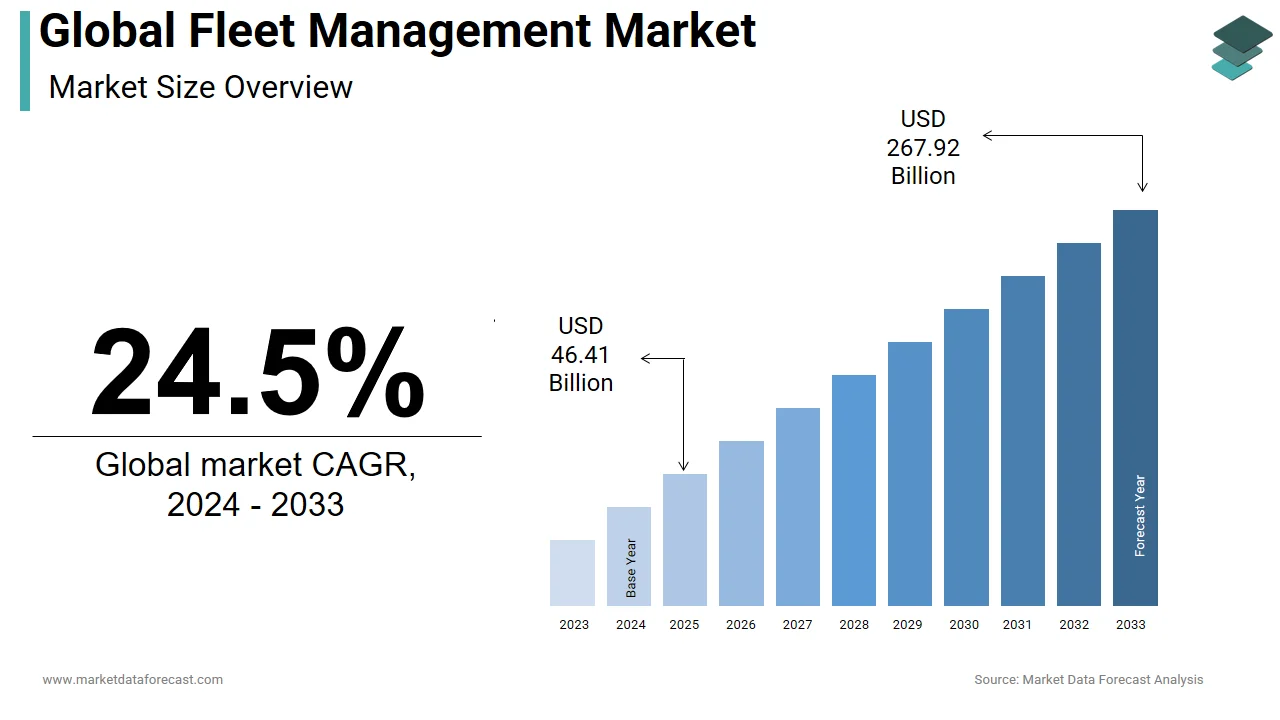
Fleet management is considered a process of managing the fleet of automobiles in an organization. The improper maintenance of a fleet of vehicles can lead to a negative effect on business operations. Fleet management usually contains vehicles like automobiles, trucks and corporate fleets, commercial and freight aircraft, buses, trams, and container ships. It also promotes activities like tracking automobiles and diagnostics and updates information about driver behavior. Vehicle monitoring and diagnostics further involve the management of risks, fuel supervision, telematics, and accident management. Fleet management has found extensive applications in end-users like oil and gas, mining, construction, chemicals, retail and logistics, public and private transport, utilities, waste management and services.
Fleet management enables companies to track and maintain their vehicles profitably, quickly, and affordably. It helps business organizations that rely heavily on transportation to reduce or completely eliminate the risks associated with the cost of personnel, operations, and others. The benefits of fleet management are reduced overall operating and fuel costs, improved safety, and optimized fleet operations, with real-time monitoring and surveillance of the fleet.
MARKET TRENDS
The driver management framework in fleet management solutions contains applications such as driver registration, insurance risk management, and analysis. The main purpose of driver management systems is to study driver behavior and make necessary changes to driving styles, which will reduce fuel consumption and improve vehicle maintenance.
These systems promote better driving behavior and continually send comments indicating the driving style with alerts. Organizations adopt this solution because it saves fuel, reduces maintenance costs, and gives them confidence in vehicle and customer management.
According to a recent safety report by Volvo Trucks, more than 90% of worldwide mishaps were caused by human factors. The investigation indicates that more than 13% of the accidents killed heavy vehicle occupants. These statistics pave the way for tremendous growth opportunities in the global fleet management market.
MARKET DRIVERS
The progressions in the global fleet management market are driven by the increase in the incorporation of real-time fleet monitoring systems in automobiles, the increase in the use of cloud technology for smart fleet management solutions, and improved supervision in vehicle and fuel management.
Large and medium-scale fleet owners are implementing these fleet management solutions broadly to streamline operations. The adoption rate among small fleet owners has been slow due to factors such as lack of knowledge, limited scale of operations, smaller budgets, less compliance standards, high demands on increased capital, and operating costs.
Furthermore, the advent and integration of IoT and Information, Communication, and Technology (ICT) in automotive, logistics and transportation sectors are driving the market growth. In addition, continuous driver behavior monitoring, automotive tracking, real-time visibility, driver management, and so on have resulted in significant market growth. Increased government regulations are a significant factor driving the growth of the global fleet management market. Other factors promoting this industry growth involve lower hardware and software expenses and the introduction of autonomous fleets.
MARKET RESTRAINTS
Growth in the vehicle replacement market and increased international trade drive this market growth. However, fleet owners' concerns about pricing and cybersecurity are hampering industry growth. Awareness of increased driver and vehicle safety and better business decisions for fleet owners is expected to provide lucrative opportunities for fleet management companies in the near future.
REPORT COVERAGE
| REPORT METRIC | DETAILS |
| Market Size Available | 2025 to 2034 |
| Base Year | 2025 |
| Forecast Period | 2026 to 2034 |
| CAGR | 24.05% |
| Segments Covered | By Solution, Service, Deployment Type, Transport Mode, and Region |
|
Various Analyses Covered | Global, Regional & Country Level Analysis, Segment-Level Analysis, DROC, PESTLE Analysis, Porter’s Five Forces Analysis, Competitive Landscape, Analyst Overview on Investment Opportunities |
| Regions Covered | North America, Europe, APAC, Latin America, Middle East & Africa |
|
Market Leaders Profiled | ARI Fleet Management (United States), Azuga (United States), Chevin Fleet Solutions (Australia), Ctrack (United States), Donlen Corporation (United States), Geotab (Canada), GPS Insight (United States), Masternaut (United Kingdom), MiX Telematics (South Africa), Nextraq (United States), Teletrac Navman (United States), Trimble (United States), Verizon Connect (United States), Wheels, Inc (United States) and Fleetroot (United Arab Emirates) and others. |
REGIONAL ANALYSIS
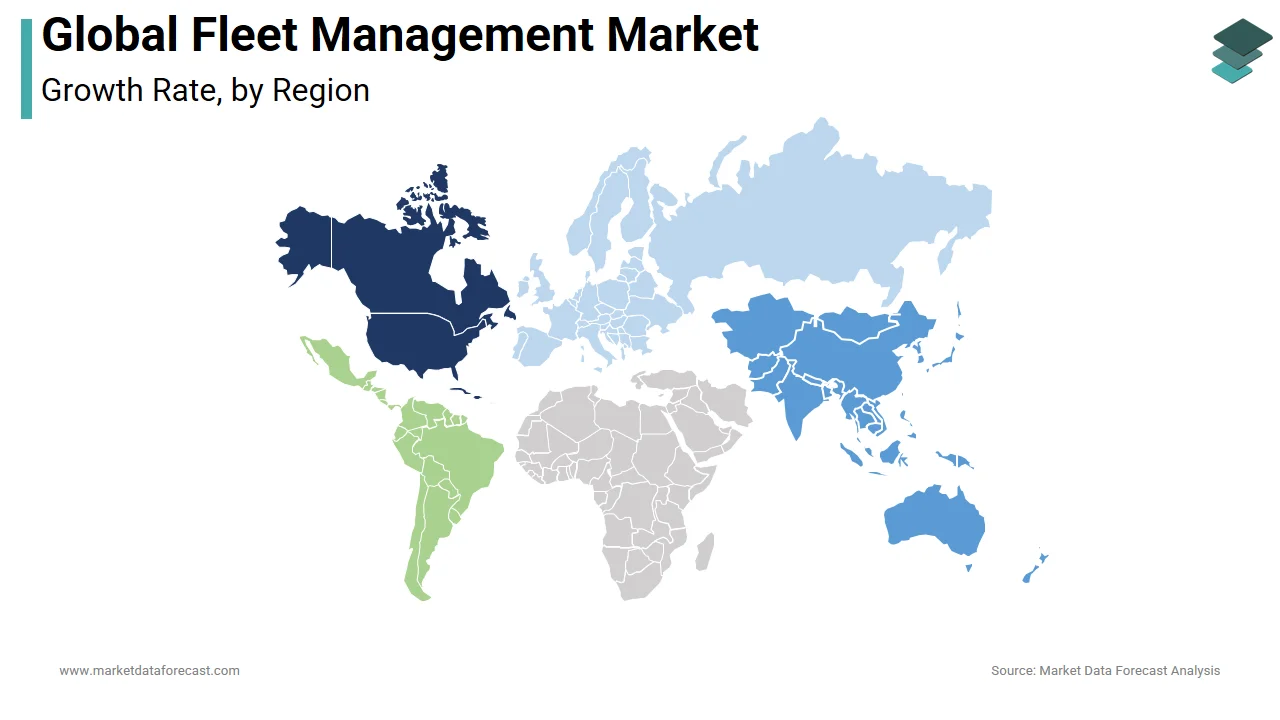
By region, the global fleet management market is studied in areas like North America, Europe, Asia-Pacific, and LAMEA. The smart fleet management market is calculated based on various traction technologies that are employed in automobiles around the world. North America and Europe are the leading contributors to the global market that are expanding at a notable rate. The Asia Pacific region is considered to register a notable share in the international marketplace due to the increasing investments by market giants in this area.
KEY MARKET PLAYERS
ARI Fleet Management (United States), Azuga (United States), Chevin Fleet Solutions (Australia), Ctrack (United States), Donlen Corporation (United States), Geotab (Canada), GPS Insight (United States), Masternaut (United Kingdom), MiX Telematics (South Africa), Nextraq (United States), Teletrac Navman (United States), Trimble (United States), Verizon Connect (United States), Wheels, Inc (United States) and Fleetroot (United Arab Emirates) and other market players
RECENT MARKET HAPPENINGS
-
Fleetonomy focuses on providing a cloud-based fleet management service for automakers, car rental companies, and carpoolers.
-
Chevin has launched a SaaS package designed to take on the core responsibilities of fleet management, maintenance, and compliance. Some of the other main players in this industry are AT&T Inc. and Cisco Systems.
-
Cisco Jasper launched a platform for automated mobility management, Control Center for Mobile Enterprise. This platform automates the management of enterprise mobile services and devices.
MARKET SEGMENTATION
This research report on the global fleet management market has been segmented and sub-segmented based on the solution, service, deployment type, and region.
By Solution
- Operations Management
- Vehicle Maintenance and Diagnostics
- Performance Management
- Fleet Analytics
- Reporting
By Service
- Professional
- Managed
By Deployment Type
- Cloud
- On-Premise
By Region
- North America
- Europe
- Asia-Pacific
- Latin America
- The Middle East and Africa