- Product Description Description
- Table of Contents TOC
- List of Table & Figure LOT
- Get Free Sample PDF Sample PDF
Market Size, 2025
$23.19 BnMarket Estimate, 2026
$25.49 BnMarket Forecast, 2034
$54.24 BnCAGR, 2026–2034
9.9%Global Forage Seed Market Size
The global forage seed market size was valued at USD 23.19 billion in 2025 and is anticipated to reach a valuation of USD 25.49 billion in 2026 and USD 54.24 billion by 2034, growing at a CAGR of 9.9% during the forecast from 2026 to 2034.
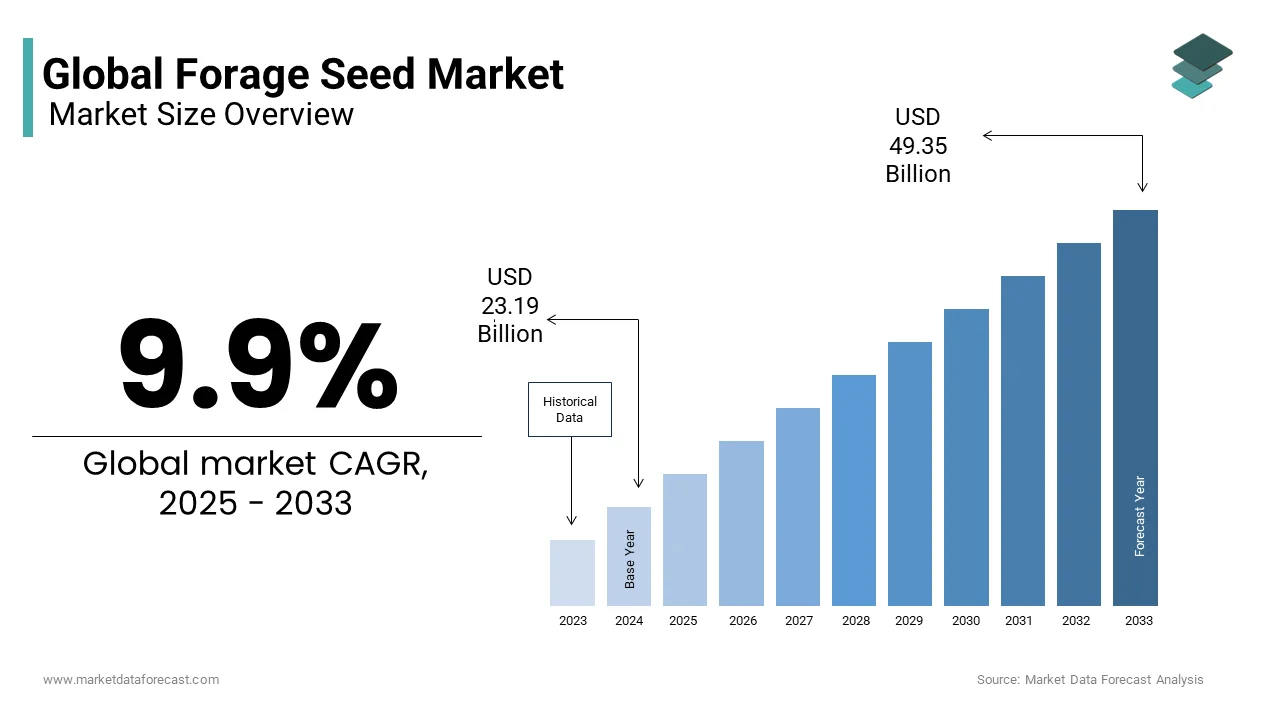
The rise in demand for animal feed and livestock production is driving the market growth for forage seeds worldwide. Feed quality and quantity, overgrazing, border conflicts, drought, and lack of seed and planting materials remain major challenges for forage seed production in developing countries such as South Africa, Ethiopia, and Brazil.
REPORT COVERAGE
| REPORT METRIC | DETAILS |
| Market Size Available | 2025 to 2034 |
| Base Year | 2025 |
| Forecast Period | 2026 to 2034 |
| CAGR | 9.9% |
| Segments Covered | By Type, Livestock, Species, Organic, Form, and Region. |
| Various Analyses Covered | Global, Regional & Country Level Analysis, Segment-Level Analysis, DROC, PESTLE Analysis, Porter’s Five Forces Analysis, Competitive Landscape, Analyst Overview on Investment Opportunities |
| Regions Covered | North America, Europe, APAC, Latin America, Middle East & Africa |
| Market Leaders Profiled | E.I. du Pont de Nemours and Company (U.S.), Dow AgroSciences LLC (U.S.), Land O’ Lakes (U.S.), Monsanto (U.S.), Advanta Seed Ltd. (India), and Others. |
SEGMENTAL ANALYSIS
By Type Insights
The alfalfa segment accounted for the largest market in the forage seeds market in 2015. Alfalfa contains about 15% to 22% crude protein and a high volume of 10 different vitamins. It is primarily used for feeding cattle, goats, horses, sheep, and dairy cows.
By Livestock Insights
The cattle segment accounted for the highest consumption of the forage seeds in 2015. The quality of milk and meat products depends on the quality of feed used for cattle. Forages are added to cattle feed by livestock producers to make sure that production is efficient. They aid in raising the milk quantity and enhance the immune system of cattle and feed efficiency.
By Species Insights
The grasses category is estimated to grow at a higher growth rate in the market in the forecast period. Forage grasses include natural grasses for pasture, grazing, and hay crops. Grasses aid in maintaining the balance of chemical compounds in the feed of ruminants.
REGIONAL ANALYSIS
The Asia-Pacific region is estimated to be the fastest-growing market for forage seeds in the aforementioned forecast period. The Asia-Pacific market witnesses the maximum consumption of forage seeds owing to the growing demand for animal feed, the reduction of grazing land, and the rise in demand for dairy products.
KEY MARKET PLAYERS
Key players in the market include
- E. I du Pont de Nemours and Company (U.S.)
- Dow AgroSciences LLC (U.S.)
- Land O’ Lakes (U.S.),
- Monsanto (U.S.)
- Advanta Seed Ltd. (India).
MARKET SEGMENTATION
This research report on the global forage seed market is segmented and sub-segmented into the following categories.
By Type
- Alfalfa
- Clover
- Ryegrass
- Chicory
By Livestock
- Poultry
- Cattle
- Swine
By Species
- Legumes and Grasses
By Organic
- Organic
- Inorganic
By Form
- dry
- green
By Region
- North America
- Europe
- Asia Pacific
- Latin America
- Middle East and Africa