- Product Description Description
- Table of Contents TOC
- List of Table & Figure LOT
- Get Free Sample PDF Sample PDF
Market Size, 2025
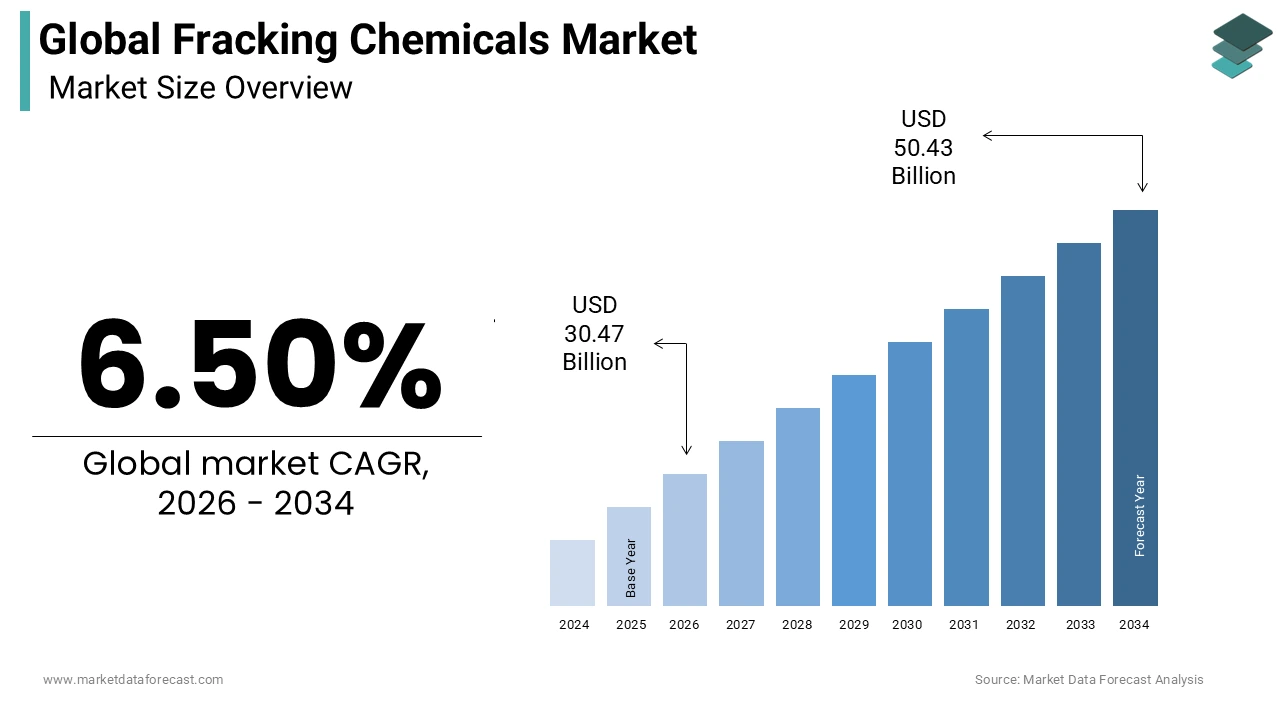
$28.61 BnMarket Estimate, 2026
$30.47 BnMarket Forecast, 2034
$50.43 BnCAGR, 2026–2034
6.50%Global Fracking Chemicals Market Size
The global fracking chemicals market size was calculated to be USD 28.61 billion in 2025 and is anticipated to be worth USD 50.43 billion by 2034, growing from USD 30.47 billion in 2026 at a CAGR of 6.50% during the forecast period.
Fracking chemicals comprise a specialized array of chemical formulations essential for hydraulic fracturing operations in the oil and gas industry. These chemicals serve critical functions, such as reducing friction, increasing fluid viscosity, preventing corrosion, and inhibiting bacterial growth within wellbores. The primary components include gelling agents, crosslinkers, breakers, surfactants, and biocides, which are mixed with water and proppants to create the fracturing fluid. This process enables the extraction of hydrocarbons from tight shale formations that are otherwise inaccessible through conventional drilling methods. In North America, particularly the United States, the market is deeply integrated with the shale revolution, which has transformed the global energy landscape. According to the United States Energy Information Administration, tight oil, commonly referred to as unconventional crude oil, accounted for approximately 64% of total United States crude oil production in 2023, demonstrating the reliance on hydraulic fracturing technologies. As per the International Energy Agency, the United States remains the world's largest oil producer, largely due to advancements in fracking techniques. The complexity of shale geology requires precise chemical engineering to optimize recovery rates while minimizing environmental impact. According to the Environmental Protection Agency, the volume of water used in hydraulic fracturing has increased significantly, necessitating efficient chemical solutions to manage fluid dynamics. The industry faces intense scrutiny regarding water usage and chemical transparency, driving innovation in green chemistry and water recycling technologies. This dynamic environment defines the current state of the fracking chemicals sector, where technological efficacy must balance with regulatory compliance and sustainability goals.
MARKET DRIVERS
Rising Global Demand for Energy Security and Domestic Production
The urgent need for energy security and the strategic shift towards domestic hydrocarbon production is primarily driving the expansion of the fracking chemicals market. Geopolitical tensions and supply chain disruptions have prompted nations to reduce reliance on imported energy sources, favoring local shale resources. According to the United States Energy Information Administration, domestic crude oil production in the United States reached record highs in 2023, exceeding 12.9 million barrels per day. This surge in output is directly linked to increased hydraulic fracturing activities, which require substantial volumes of specialized chemicals. As per the International Energy Agency, energy independence has become a top priority for many developed economies, leading to renewed investment in shale plays. In Europe, although fracking is limited, the global demand for liquefied natural gas has incentivized producers in North America to maximize output. According to the Department of Energy, natural gas prices remain competitive due to abundant shale supplies, supporting continued drilling operations. Operators are optimizing well performance using advanced chemical formulations to enhance recovery factors from existing wells. The economic viability of shale projects depends heavily on the efficiency of fracking fluids, which reduce operational costs and improve yield. Consequently, the drive for self-sufficiency in energy supplies ensures sustained demand for high performance fracking chemicals. This strategic imperative outweighs short term price fluctuations, ensuring long term market stability.
Technological Advancements in Enhanced Oil Recovery Techniques
Continuous technological innovations in enhanced oil recovery and hydraulic fracturing techniques significantly drive the adoption of advanced fracking chemicals, which is another significant market driver. Modern shale reservoirs present complex challenges, requiring customized chemical solutions to maintain well integrity and maximize hydrocarbon flow. According to the Society of Petroleum Engineers, the use of nanotechnology and smart fluids has improved proppant transport and fracture conductivity by up to 20% in recent years. These advancements rely on sophisticated chemical additives, such as nano-silica and viscoelastic surfactants, that perform under extreme pressure and temperature conditions. According to the American Petroleum Institute, horizontal drilling lengths have increased substantially, requiring fluids with superior lubricity and stability. Chemical manufacturers are developing bio based and synthetic polymers that offer better rheological control and environmental compatibility. According to the Department of Energy, research into next generation fracking fluids that minimize formation damage and enhance cleanup efficiency is well supported. Operators are increasingly adopting real time monitoring systems that adjust chemical compositions dynamically during operations. This precision approach reduces waste and improves overall well productivity. The integration of artificial intelligence in fluid design allows for predictive modeling of chemical behavior in diverse geological settings. These technological strides enable the exploitation of previously uneconomical reserves, driving demand for specialized chemical formulations. The pursuit of higher recovery rates through innovation ensures that the fracking chemicals market remains vibrant and evolving.
MARKET RESTRAINTS
Stringent Environmental Regulations and Water Usage Constraints
Strict environmental regulations governing water usage, waste disposal, and chemical disclosure act as significant restraints on the fracking chemicals market. Hydraulic fracturing requires millions of gallons of water per well, raising concerns about resource depletion and contamination. According to the Environmental Protection Agency, guidelines mandate rigorous reporting of chemical ingredients and stricter management of wastewater streams. Several states in the United States have imposed limits on freshwater withdrawal for fracking operations, forcing operators to seek alternative sources. The European Union has implemented bans or moratoriums on hydraulic fracturing in countries like France and Germany due to environmental risks. According to the World Resources Institute, water stress in key shale basins, such as the Permian Basin, is intensifying regulatory scrutiny. Compliance with these regulations increases operational costs and extends project timelines. Companies must invest in expensive water treatment and recycling technologies to meet legal requirements. The Toxic Substances Control Act requires detailed safety assessments for new chemical formulations, adding to development burdens. Public opposition to fracking further influences policy makers to enact tougher restrictions. The lack of standardized federal regulations creates uncertainty for chemical suppliers operating across different jurisdictions. These regulatory hurdles limit the expansion of fracking activities and constrain the demand for traditional chemical additives. The industry must adapt to a highly regulated environment, which slows down market growth.
Volatility in Oil and Gas Prices Impacting Exploration Budgets
The inherent volatility in global oil and gas prices poses a major restraint on the fracking chemicals market by influencing exploration and production budgets. When crude oil prices decline, shale operators often reduce capital expenditure on new drilling projects to maintain financial stability. According to the United States Energy Information Administration, fluctuations in West Texas Intermediate prices directly correlate with the number of active drilling rigs in the United States. A drop in prices below the breakeven point for many shale plays leads to deferred completions and reduced chemical consumption. According to the International Monetary Fund, energy market instability affects investment decisions in the upstream sector significantly. High interest rates and inflation further exacerbate cost pressures, making operators cautious about spending. The Federal Reserve's monetary policies impact the cost of capital for energy companies, limiting their ability to fund extensive fracking operations. During periods of low prices, operators focus on optimizing existing wells rather than drilling new ones, which reduces the volume of chemicals required. The unpredictability of market conditions makes long term planning difficult for chemical suppliers. Contract cancellations and order delays become common during downturns, affecting revenue streams. This economic sensitivity creates a cyclical demand pattern that hinders consistent market growth. Suppliers must navigate these fluctuations by offering cost effective solutions and flexible pricing models.
MARKET OPPORTUNITES
Development of Green and Bio Based Chemical Formulations
The growing emphasis on sustainability and environmental responsibility is a significant opportunity for the fracking chemicals market growth. Operators are increasingly seeking eco-friendly alternatives to traditional synthetic additives to reduce their environmental footprint and comply with regulations. According to reports from the oil and gas chemicals sector, the deployment of bio based surfactants and sustainable polymers is projected to see expanding integration, growing by around 8% annually through 2030. These green chemicals are derived from renewable resources, such as plant oils and agricultural by products, offering biodegradability and lower toxicity. According to the Department of Energy, funding is provided for research initiatives aimed at creating sustainable fracturing fluids that minimize ecological impact. Companies are innovating with enzyme based breakers and organic corrosion inhibitors that perform effectively while being environmentally safe. The Global Green Chemistry Initiative promotes the adoption of safer chemical processes in industrial applications. Shale operators are willing to pay a premium for green solutions that enhance their corporate social responsibility profiles. Regulatory incentives for using non-hazardous substances further drive this trend. The transition to green chemistry opens new markets for specialized chemical manufacturers who can provide certified sustainable products. Collaborations between chemical firms and environmental agencies facilitate the validation and approval of new bio based formulations. This shift towards sustainability not only addresses regulatory concerns, but also appeals to investors and stakeholders prioritizing environmental governance.
Expansion of Water Recycling and Reuse Technologies
The increasing adoption of water recycling and reuse technologies offers a lucrative opportunity for the fracking chemicals market by addressing water scarcity and disposal challenges. Recycling produced water reduces the need for freshwater acquisition and minimizes wastewater disposal costs. According to the United States Geological Survey, approximately 30% of water used in hydraulic fracturing in some basins is now recycled. This trend drives demand for specialized chemicals that can treat and condition reused water for subsequent fracking operations. Recycled water often contains high levels of salts and contaminants, requiring robust scale inhibitors and biocides to prevent equipment damage. According to the Environmental Protection Agency, water conservation practices in energy production are encouraged through regulatory frameworks. Chemical manufacturers are developing advanced formulation packages tailored for high total dissolved solids environments. According to the Interstate Oil and Gas Compact Commission, water recycling infrastructure investments are rising in major shale plays. Operators benefit from reduced logistics costs and improved community relations by minimizing water trucking. The integration of mobile treatment units allows for on site water processing, enhancing efficiency. This circular approach to water management creates a steady demand for treatment chemicals, regardless of drilling activity levels. Companies that provide comprehensive water management solutions, including chemicals and technical support, gain a competitive edge. The shift towards sustainable water practices ensures long term growth opportunities in this niche segment.
MARKET CHALLENGES
Complex Supply Chain Logistics and Raw Material Availability
The intricate supply chain logistics and fluctuating availability of raw materials present significant challenges for the fracking chemicals market. Many specialized chemicals rely on petrochemical feedstocks, whose prices and availability are subject to global market dynamics. According to the United States Chemical Safety Board, disruptions in the supply of key precursors, such as ethylene oxide, can halt production of essential fracking additives. The pandemic and geopolitical conflicts have exposed vulnerabilities in global supply chains, causing delays and price spikes. According to the Department of Commerce, transportation bottlenecks affect the timely delivery of bulk chemicals to remote drilling sites. Shale plays are often located in areas with limited infrastructure, requiring complex logistics for chemical transport. According to the American Trucking Associations, driver shortages and fuel costs impact the efficiency of chemical distribution. Manufacturers must maintain large inventories to mitigate supply risks, tying up capital and increasing storage costs. Quality control becomes challenging when sourcing raw materials from multiple suppliers to ensure consistency. The lack of standardized packaging and handling protocols for hazardous chemicals adds to logistical complexities. Regulatory requirements for transporting dangerous goods further complicate logistics. These supply chain issues can lead to operational delays for drilling companies, affecting their productivity. Managing these logistical challenges requires robust planning and diversified sourcing strategies, which are difficult to implement consistently.
Public Opposition and Social License to Operate Issues
Persistent public opposition and the struggle to maintain a social license to operate pose considerable challenges for the fracking chemicals market. Community concerns regarding groundwater contamination, air quality, and seismic activity associated with hydraulic fracturing create resistance to new projects. According to the Pew Research Center, public opinion remains highly divided on hydraulic fracturing, with a significant portion of the population remaining skeptical about the safety of fracking practices. Protests and legal challenges delay permitting processes and increase operational costs for energy companies. According to the Environmental Defense Fund, transparency in chemical disclosure is a key demand from communities living near shale plays. Failure to address these concerns can lead to stricter local ordinances and bans on fracking activities. The industry faces reputational risks that affect investor confidence and access to capital. Chemical suppliers must engage in extensive community outreach and education efforts to build trust. The lack of uniform communication strategies across companies leads to inconsistent messaging. Social media amplifies negative perceptions, making crisis management difficult. The industry must demonstrate tangible improvements in safety and environmental stewardship to regain public trust. This social challenge requires ongoing dialogue and collaboration with stakeholders, which is resource intensive. Without a strong social license, the market faces potential restrictions and operational hurdles that impede growth.
REPORT COVERAGE
| REPORT METRIC | DETAILS |
| Market Size Available | 2025 to 2033 |
| Base Year | 2025 |
| Forecast Period | 2026 to 2033 |
| CAGR | 6.5% |
| Segments Covered | By Function Type, Fluid Type, Well Type, and Region. |
|
Various Analyses Covered | Global, Regional & Country Level Analysis, Segment-Level Analysis, DROC, PESTLE Analysis, Porter’s Five Forces Analysis, Competitive Landscape, Analyst Overview of Investment Opportunities |
| Regions Covered | North America, Europe, APAC, Latin America, Middle East & Africa |
|
Market Leaders Profiled | Halliburton (U.S.), Schlumberger (U.S.), Baker Hughes (U.S.), DuPont (U.S.), AkzoNobel (Netherlands), BASF (Germany), Ashland (U.S.), and Others. |
SEGMENTAL ANALYSIS
By Function Type Insights
The friction reducers segment held the largest share of the global market in 2025. The dominance of friction reducers segment in the global market is driven by their critical role in enabling high volume hydraulic fracturing operations by reducing the pressure required to pump fluids into wellbores. These chemicals are essential for slickwater fracturing, which is the most common technique used in shale gas and tight oil extraction. According to the United States Energy Information Administration, over 90% of new oil and gas wells in the United States utilize hydraulic fracturing techniques that rely heavily on friction reducers to achieve efficient proppant placement. The ability of friction reducers to lower the coefficient of friction allows operators to pump at higher rates and pressures without exceeding equipment limits. According to the Society of Petroleum Engineers, the use of advanced polyacrylamide based friction reducers can reduce pumping pressure by up to 70% significantly lowering energy consumption and operational costs. According to the American Petroleum Institute, horizontal drilling lengths have increased substantially, requiring fluids with superior lubricity and stability. According to the American Petroleum Institute, friction reducers account for the largest volume of chemicals used per well due to the massive quantities of water injected during stimulation. Their cost effectiveness and ease of handling further cement their dominance. Operators prioritize these chemicals to maximize the number of stages completed per day, enhancing overall productivity. The continuous innovation in high temperature and high salinity tolerant friction reducers ensures their sustained leadership in the market.
On the other hand, the biocides segment is emerging as the fastest growing segment in the fracking chemicals market and is expected to register a CAGR of 7.5% during the forecast period owing to the increasing use of recycled and produced water in fracking operations, which contains high levels of bacteria that can cause corrosion and souring. According to the Environmental Protection Agency, the reuse of produced water has increased by 25% in major shale basins, such as the Permian Basin, necessitating effective bacterial control. Biocides prevent the growth of sulfate reducing bacteria, which produce hydrogen sulfide, a toxic and corrosive gas that poses safety risks and damages infrastructure. According to the International Association of Oil and Gas Producers, bacterial contamination can lead to significant equipment failure and production losses if not managed properly. The shift towards green and non-oxidative biocides is also driving growth as operators seek environmentally friendly solutions that comply with stricter regulations. According to the Department of Energy, support is directed toward research into bio based biocides that are less toxic and more biodegradable. The rising awareness of microbial induced corrosion and its impact on well integrity prompts operators to invest in high performance biocide treatments. Furthermore, the complexity of water chemistry in recycled streams requires specialized biocide formulations that can withstand high salt concentrations. These factors collectively accelerate the adoption of biocides in the fracking chemicals sector.
By Fluid Type Insights
The water-based fluids segment dominated the market by capturing the major share of the global market in 2025 due to their cost effectiveness, availability, and environmental advantages compared to oil based alternatives. Slickwater and gel based water systems are the standard for most shale gas and tight oil operations globally. According to the United States Geological Survey, approximately 95% of hydraulic fracturing jobs in the United States use water based fluids because they are easier to handle and dispose of than oil based systems. The abundance of water resources in key shale plays, although increasingly stressed, makes this fluid type economically viable. According to the Environmental Protection Agency, water based fluids have a lower risk of causing formation damage in many shale formations compared to oil based muds. The simplicity of mixing water with proppants and chemical additives allows for rapid execution of fracturing stages. According to the American Petroleum Institute, the logistics of transporting water are less complex and costly than handling hydrocarbon based fluids. Regulatory frameworks often favor water based systems due to lower flammability risks and easier compliance with disposal regulations. The development of advanced water soluble polymers and surfactants has enhanced the performance of water based fluids, making them suitable for a wider range of geological conditions. The industry’s focus on reducing carbon footprint also supports the use of water based systems, which generally have lower embedded emissions. This widespread acceptance and operational efficiency ensure the continued dominance of water based fluids.
However, the foam-based fluids segment is estimated to showcase a CAGR of 8.4% during the forecast period in the global market owing to their unique ability to address water scarcity and formation damage issues. Foam fracturing uses significantly less water than conventional methods, making it an attractive option in arid regions where water availability is limited. According to the Department of Energy, foam based fluids can reduce water usage by up to 50% while maintaining effective proppant transport capabilities. This technology is particularly beneficial in areas facing strict water withdrawal regulations or community opposition to large scale water use. According to the Society of Petroleum Engineers, foam fluids exhibit superior lift capacity, allowing for better cleanup of fracturing fluids after treatment, which enhances gas production. The reduced hydrostatic pressure of foam minimizes formation damage in sensitive reservoirs, leading to higher initial production rates. According to the International Energy Agency, water stress is becoming a critical constraint for shale development in regions like the Middle East and parts of the United States. Foam technology offers a sustainable solution by utilizing nitrogen or carbon dioxide instead of large water volumes. The growing interest in carbon capture and utilization also supports the use of CO2 based foams. These environmental and operational benefits drive the rapid adoption of foam based fracturing fluids.
By Well Type Insights
The horizontal wells segment led the market by accounting for the largest share of the global market in 2025 because they provide significantly greater exposure to the reservoir rock compared to vertical wells, maximizing hydrocarbon recovery. The majority of modern shale developments utilize long lateral horizontal wells that require extensive hydraulic fracturing to unlock trapped resources. According to the United States Energy Information Administration, over 95% of new oil and gas wells drilled in the United States are horizontal, reflecting the industry’s shift away from vertical drilling. Horizontal wells allow operators to access thin shale layers over large areas, making them economically superior for unconventional resources. According to the American Petroleum Institute, horizontal wells can produce up to 10 times more oil and gas than vertical wells in shale formations. This high productivity justifies the substantial volume of chemicals required for multi stage fracturing operations. Each stage of a horizontal well requires millions of gallons of fracturing fluid and thousands of pounds of proppant, driving immense demand for chemicals. The technical complexity of horizontal drilling necessitates specialized friction reducers and gelling agents to ensure successful proppant placement across long distances. The economic viability of shale projects depends on the efficiency of horizontal completions. The continuous improvement in drilling technologies has extended lateral lengths, further increasing chemical consumption per well. This structural shift in drilling practices cements the dominance of horizontal wells in the fracking chemicals market.
On the other side, the vertical wells segment is experiencing a niche but steady growth in specific applications and is predicted to showcase a CAGR of 5.5% during the forecast period owing to the infill drilling and secondary recovery efforts. While horizontal wells dominate new developments, vertical wells remain crucial for accessing deeper formations and conducting workovers in mature fields. According to the Society of Petroleum Engineers, vertical wells are increasingly used for injection purposes, such as wastewater disposal and enhanced oil recovery, which require chemical treatments to maintain well integrity. According to the Department of Energy, vertical wells are essential for monitoring reservoir pressure and fluid movement, providing data that optimizes horizontal well placement. In regions with complex geology or regulatory restrictions on horizontal drilling, vertical wells offer a viable alternative. According to the American Association of Petroleum Geologists, vertical wells are cost effective for shallow targets and conventional reservoirs where horizontal drilling is not economically justified. The use of vertical wells for carbon sequestration projects is also emerging as a growth driver, requiring specialized chemicals for injection optimization. The rehabilitation of old vertical wells to extend their productive life involves chemical stimulation treatments. Although smaller in volume compared to horizontal operations, the strategic importance of vertical wells in reservoir management and environmental compliance drives their targeted growth.
REGIONAL ANALYSIS
North America Fracking Chemicals Market Analysis
North America held the dominant position in the global market in 2025 and is anticipated to experience robust infrastructural optimization and highly consistent output rates across core shale plays over the next few years. The United States is the largest contributor due to its extensive shale plays in the Permian, Appalachia, and Eagle Ford basins. According to the United States Energy Information Administration, the United States accounted for approximately 80% of global hydraulic fracturing activity in 2023, driving immense demand for specialized chemicals. The region benefits from advanced technological capabilities and a robust supply chain for chemical manufacturing. Canada also contributes with its oil sands and shale gas operations in British Columbia and Alberta. The North American market is driven by the need for cost effective and high performance chemicals to maintain profitability in competitive energy markets. According to the Environmental Protection Agency, regulations on water usage and chemical disclosure influence product formulation and adoption. The presence of major service companies and chemical suppliers fosters innovation and competition. The region’s focus on energy independence and export capabilities sustains high levels of drilling activity. The integration of digital technologies for real time monitoring enhances chemical efficiency. North America remains the benchmark for fracking chemical consumption and technological advancement globally.
Europe Fracking Chemicals Market Analysis
Europe is projected to see highly specialized and tightly regulated deployment of niche oilfield chemical technologies over the next few years, maintaining a limited but specialized position in the fracking chemicals market influenced by stringent environmental regulations and public opposition to hydraulic fracturing. Most European countries, including France and Germany, have imposed bans or moratoriums on fracking due to environmental concerns. According to the European Commission, only a few countries, such as Poland and the United Kingdom, have explored shale gas potential but with limited commercial success. The region’s focus is shifting towards renewable energy and energy efficiency, reducing the scope for fracking expansion. However, Europe remains a significant market for specialized chemicals used in conventional oil and gas operations and geothermal energy projects. According to the European Environment Agency, strict controls on chemical substances under the REACH regulation affect product availability. The region’s expertise in green chemistry drives the development of eco-friendly additives for global export. The geopolitical shift towards energy security has sparked debates on domestic gas production, but regulatory hurdles remain high. The market is characterized by high value niche applications rather than volume driven shale operations. Research institutions in Europe lead in developing sustainable fracturing technologies. The regulatory landscape ensures that any future fracking activities will adhere to the highest environmental standards.
Asia Pacific Fracking Chemicals Market Analysis
The Asia Pacific region is expected to showcase rapid regulatory evolution and substantial project commercialization over the next few years, being poised for growth in the Fracking Chemicals Market driven by increasing energy demand and the exploration of unconventional resources in China and Australia. China holds the world’s largest technically recoverable shale gas reserves and is actively developing its Sichuan Basin. According to the China National Petroleum Corporation, shale gas production in China has grown significantly, reaching over 20 billion cubic meters annually. The Chinese government’s energy security strategy prioritizes domestic gas production to reduce reliance on imports. Australia is also expanding its coal seam gas operations, which utilize similar chemical technologies. According to the Asian Development Bank, energy consumption in Asia Pacific is expected to grow by 3% annually, driving investment in upstream activities. The region faces challenges related to water scarcity and complex geology, requiring customized chemical solutions. Local manufacturers are partnering with international firms to transfer technology and build capacity. Regulatory frameworks are evolving to balance energy needs with environmental protection. The presence of major national oil companies facilitates large scale projects. The region’s growing industrial base supports the development of a local supply chain for fracking chemicals. Asia Pacific represents a high potential market for future expansion.
Latin America Fracking Chemicals Market Analysis
Latin America is anticipated to experience rapid infrastructure buildout and a steady influx of international exploration investments over the next few years, representing an emerging market for Fracking Chemicals with growth driven by Argentina’s Vaca Muerta shale formation which is one of the largest outside North America. Argentina is actively attracting foreign investment to develop its shale resources to boost energy exports. According to the Argentine Ministry of Energy, shale oil and gas production in Vaca Muerta has increased by 30% annually in recent years. The region benefits from favorable geological conditions and government incentives for energy development. Brazil and Mexico are also exploring unconventional resources, but face regulatory and infrastructure challenges. According to the Inter-American Development Bank, initiatives to improve energy infrastructure and regulatory frameworks in the region are actively supported. The availability of water and logistical constraints pose challenges for large scale fracking operations. Local chemical suppliers are expanding capabilities to meet growing demand. The region’s focus on energy independence and economic growth drives investment in upstream activities. Political stability and regulatory clarity are critical for sustained growth. Latin America offers significant opportunities for chemical suppliers who can navigate local complexities. The development of Vaca Muerta serves as a catalyst for regional market expansion.
Middle East and Africa Fracking Chemicals Market Analysis
The Middle East and Africa region is expected to undergo targeted upstream diversification and an expanded deployment of waterless stimulation techniques over the next few years, showing emerging potential in the Fracking Chemicals Market driven by the need to maximize recovery from mature fields and develop unconventional resources in Saudi Arabia and Algeria. Saudi Arabia is investing heavily in its unconventional gas reserves to support domestic energy needs and petrochemical industries. According to Saudi Aramco, the kingdom aims to increase unconventional gas production to 60% of its total gas mix by 2030. The region faces extreme water scarcity, making water efficient fracking technologies essential. The use of foam and gas based fracturing fluids is gaining traction.
COMPETITION OVERVIEW
The competition in the Fracking Chemicals Market is characterized by intense rivalry among integrated oilfield service giants and specialized chemical manufacturers striving for dominance through innovation and sustainability. Major players leverage their extensive distribution networks and technical expertise to offer comprehensive solutions that integrate chemicals with completion services. The market sees significant competition in developing green chemistry alternatives that comply with stringent environmental regulations and address public concerns. Price sensitivity remains a factor particularly in mature basins where operators seek cost effective solutions to maintain profitability. Companies differentiate themselves through proprietary formulations that enhance well performance and reduce water usage. Strategic collaborations with local suppliers facilitate market entry and expansion in emerging regions. Intellectual property protection for novel chemical compounds is crucial for maintaining technological leadership. The shift towards digitalization enables competitors to offer data driven insights that optimize chemical application and improve operational efficiency. Regulatory compliance and safety standards act as barriers to entry for smaller firms lacking resources. The continuous push for sustainability and efficiency drives ongoing innovation and dynamic competitive interactions in this specialized sector.
KEY MARKET PLAYERS
A few major players in the global fracking chemicals market include
- Halliburton
- Schlumberger
- Baker Hughes
- DuPont
- AkzoNobel
- BASF
- Ashland
Top Strategies Used by Key Market Participants
Key players in the Fracking Chemicals Market primarily focus on developing sustainable and eco friendly chemical formulations to address environmental concerns and regulatory pressures. Companies invest heavily in research and development to create bio based additives that reduce toxicity and improve biodegradability. Strategic partnerships with oil and gas operators enable customized solutions that enhance well productivity and operational efficiency. Expanding manufacturing capacities in key shale basins ensures reliable supply chains and reduces logistical costs. Digital integration allows for real time monitoring and optimization of chemical usage improving performance and reducing waste. Acquisitions of specialized technology firms broaden product portfolios and enhance technical capabilities. Emphasizing transparency in chemical disclosure builds trust with regulators and communities. These strategies collectively drive growth and establish competitive advantages in the evolving fracking chemicals landscape.
Leading Players in the Global Fracking Chemicals Market
- Halliburton Company is a global leader in oilfield services with a dominant presence in the fracking chemicals sector through its comprehensive product portfolio. The company provides advanced friction reducers biocides and gelling agents tailored for complex shale formations. Halliburton recently launched new environmentally friendly chemical formulations that reduce water usage and enhance fluid recovery rates. This innovation aligns with stricter environmental regulations and operator sustainability goals. The company leverages its digital platforms to optimize chemical dosing in real time improving operational efficiency. Halliburton also expands its manufacturing capacity in key shale basins to ensure reliable supply chains. Their integrated approach combining chemicals with completion services strengthens customer relationships. By focusing on high performance and sustainable solutions Halliburton maintains its position as a critical partner for energy producers seeking to maximize well productivity while minimizing environmental impact.
- Schlumberger Limited is a premier technology provider in the energy industry offering specialized fracking chemicals that enhance reservoir stimulation effectiveness. The company develops proprietary surfactants and crosslinkers designed to withstand extreme downhole conditions. Schlumberger recently introduced a suite of green chemistry products that minimize ecological footprints and comply with global regulatory standards. These advancements address growing concerns regarding water contamination and chemical transparency. The company integrates its chemical solutions with advanced diagnostic tools to provide data driven insights for well optimization. Schlumberger also collaborates with operators to customize chemical packages for specific geological challenges. Their focus on digitalization and sustainability drives innovation in fluid systems. By delivering reliable and eco conscious solutions Schlumberger supports the industry’s transition towards more responsible extraction practices. This strategic emphasis on technology and environmental stewardship reinforces its leadership in the global fracking chemicals market.
- BASF SE is a leading chemical manufacturer that plays a vital role in the fracking chemicals market through its extensive range of performance additives. The company produces high quality friction reducers scale inhibitors and corrosion protectants used in hydraulic fracturing operations. BASF recently expanded its production facilities in North America to meet the increasing demand for specialized shale chemicals. This expansion ensures consistent supply and reduces logistics costs for regional customers. The company invests heavily in research and development to create bio based and biodegradable chemical alternatives. BASF also partners with service companies to develop integrated fluid systems that improve well performance. Their commitment to sustainability and innovation addresses regulatory pressures and operator needs. By offering diverse and environmentally responsible solutions BASF strengthens its position as a key supplier in the global fracking chemicals industry. The company’s global reach and technical expertise enable it to serve diverse markets effectively.
MARKET SEGMENTATION
This research report on the global fracking chemicals market has been segmented and sub-segmented based on function type, fluid type, well type and region.
By Function Type
- Biocides
- Corrosion Inhibitors
- Friction Reducers
- Gelling Agents
- Scale Dissolvers
- Cross-Linkers
- Others
By Fluid Type
- Water-based
- Oil-based
- Foam-based
- Others
By Well Type
- Vertical
- Horizontal or Directional
By Region
- North America
- Europe
- Asia-pacific
- Middle-east and Africa
- Latin America