- Product Description Description
- Table of Contents TOC
- List of Table & Figure LOT
- Get Free Sample PDF Sample PDF
Market Size, 2025
$16.44 BnMarket Estimate, 2026
$20.17 BnMarket Forecast, 2034
$103.63 BnCAGR, 2026–2034
22.7%Executive Summary: Global Function-as-a-Service (FaaS) Market Analysis & Growth Forecast (2026-2034)
- Market Scope: Comprehensive industry evaluation encompassing user types (developer-centric and operator-centric FaaS), applications, service types, deployment models (public, private, and hybrid cloud), organization sizes (SMEs and large enterprises), industry verticals, and regional landscapes across North America, Europe, Asia-Pacific, Latin America, and Middle East & Africa.
- Market Valuation: Valued at USD 16.44 billion in 2025, estimated at USD 20.17 billion in 2026, and projected to reach USD 103.63 billion by 2034, registering a compound annual growth rate (CAGR) of 22.7% from 2026 to 2034.
- Primary Growth Drivers: Shift from traditional DevOps to serverless computing models, microservice-based application deployment, enhanced IT agility, and the elimination of server provisioning and idle-time costs.
Key Global FaaS Market Segment Metrics (2026-2034)
| Category | Leading Segment (Position) | Fastest-Growing / High-Impact Segment |
|---|---|---|
| By Deployment Model | Public Cloud (holds the primary revenue share due to extensive pre-existing cloud infrastructure and native serverless platform support) | Hybrid & Private Cloud (experiencing rising enterprise implementation for enhanced data governance and security compliance) |
| By User Type | Developer-Centric FaaS (dominates the market by allowing developers to write and execute code smoothly without managing backend infrastructure) | Operator-Centric FaaS (growing rapidly as IT administrators seek multi-cloud visibility, compliance tracking, and operational control) |
| By Region | North America (leads the global market space owing to the early and dense concentration of major cloud hyper-scalers and tech leaders) | Asia-Pacific (APAC) (projected to expand at the highest CAGR driven by surging digital transformation and enterprise efficiency demands) |
Major Global FaaS Market Players & Industry Structure
Market Structure: Highly diversified ecosystem featuring established cloud infrastructure giants and agile tech firms implementing aggressive product development, strategic partnerships, and cross-platform integrations.
Key Companies: Amazon Web Services (AWS), Microsoft, Google Inc., IBM Corporation, Oracle, Alibaba, Cloudflare, Capgemini, NTT DATA, and Rackspace.
Global Function as a Service Market Size
The global function-as-a-service (FaaS) market was worth USD 16.44 billion in 2025. The global market is anticipated to grow at a CAGR of 22.7% from 2026 to 2034 and be worth USD 103.63 billion by 2034, up from USD 20.17 billion in 2026.
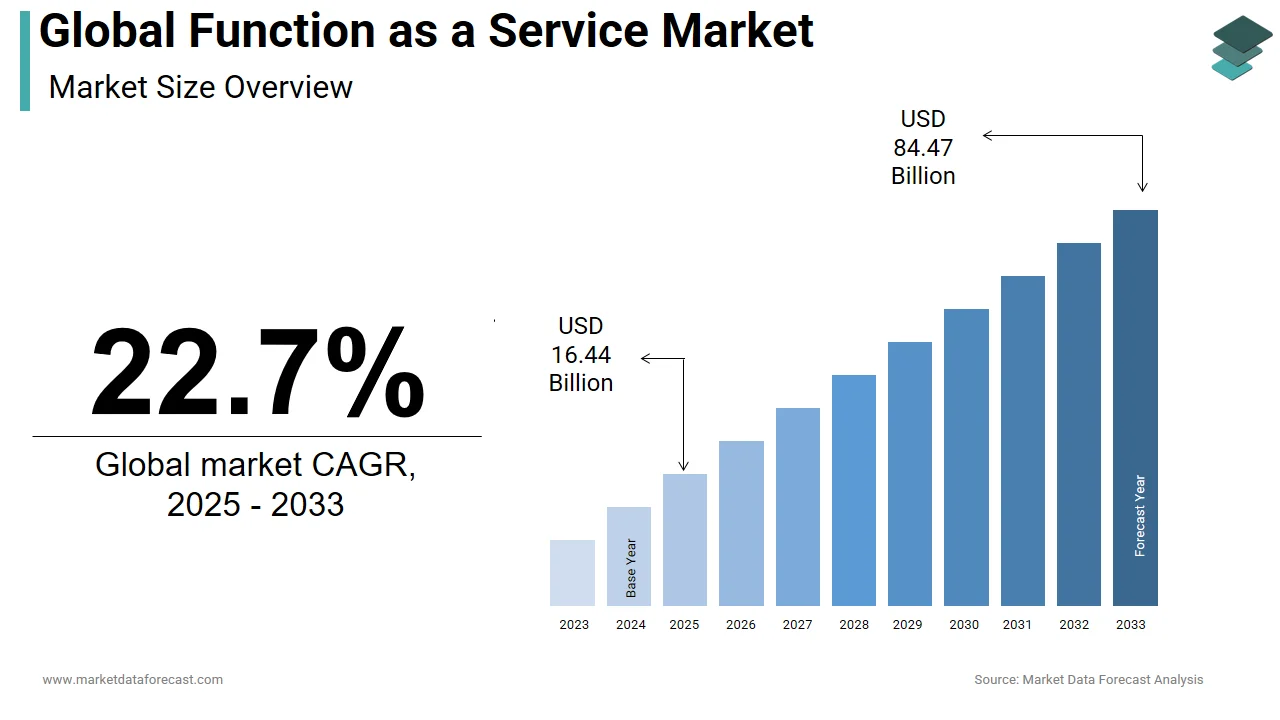
FaaS, also known as serverless computing, has created a revolution in the field of cloud computing. Serverless architectures help in supporting distributed workloads. It has played a pivotal role in increasing IT agility by releasing developers from the taxing job of managing and provisioning servers. Furthermore, FaaS cancels the need to administer servers and pay for them when not in use hence, making it easier to leverage and scale complex automation areas. The critical feature of FaaS is that it is an event-driven computing service that executes functions and codes only when required.
The global FaaS market is expected to grow at a knockout CAGR of 22.7% as organizations are tending to shift from DevOps (development & operations) to serverless computations. The market is further driven by the optimization of microservices and multiple platform management. Companies around the globe are implementing FaaS as a means to run, manage, and deploy applications. FaaS can also be employed to optimize different applications, such as research, academic, mobile, and web. Even though there are issues pertaining to portability to the cloud, the availability of robust pre-existing cloud infrastructure and easy management are forecasted to make up for the market disincentive.
MARKET DRIVERS
-
Simple Installation And Manageable
-
Matured Hosted Services
-
Switch To Serverless Computing From DevOps
-
Microservice-Based Deployment
MARKET RESTRAINTS
-
Easy transferability of applications
-
Issues with third-party services
-
Architectural & operational complexity
-
Security and compliance concerns due to loss of control over infrastructure
REPORT COVERAGE
| REPORT METRIC | DETAILS |
| Market Size Available | 2025 to 2034 |
| Base Year | 2025 |
| Forecast Period | 2026 to 2034 |
| CAGR | 22.7% |
| Segments Covered | By User Type, Application, Service Type, Deployment Model, Organization Size, Industry Vertical, and Region. |
|
Various Analyses Covered | Global, Regional & Country Level Analysis, Segment-Level Analysis, DROC, PESTLE Analysis, Porter’s Five Forces Analysis, Competitive Landscape, Analyst Overview on Investment Opportunities |
| Regions Covered | North America, Europe, APAC, Latin America, Middle East & Africa |
|
Market Leaders Profiled | IBM Corporation, Microsoft, Google Inc., Amazon Web Services, Oracle, Capgemini, NTT DATA, Cloudflare, Rackspace, Alibaba, Stackpath, Rogue Wave Software, TIBCO Software Inc., Fiorana Software, Affiliates, and others. |
REGIONAL ANALYSIS
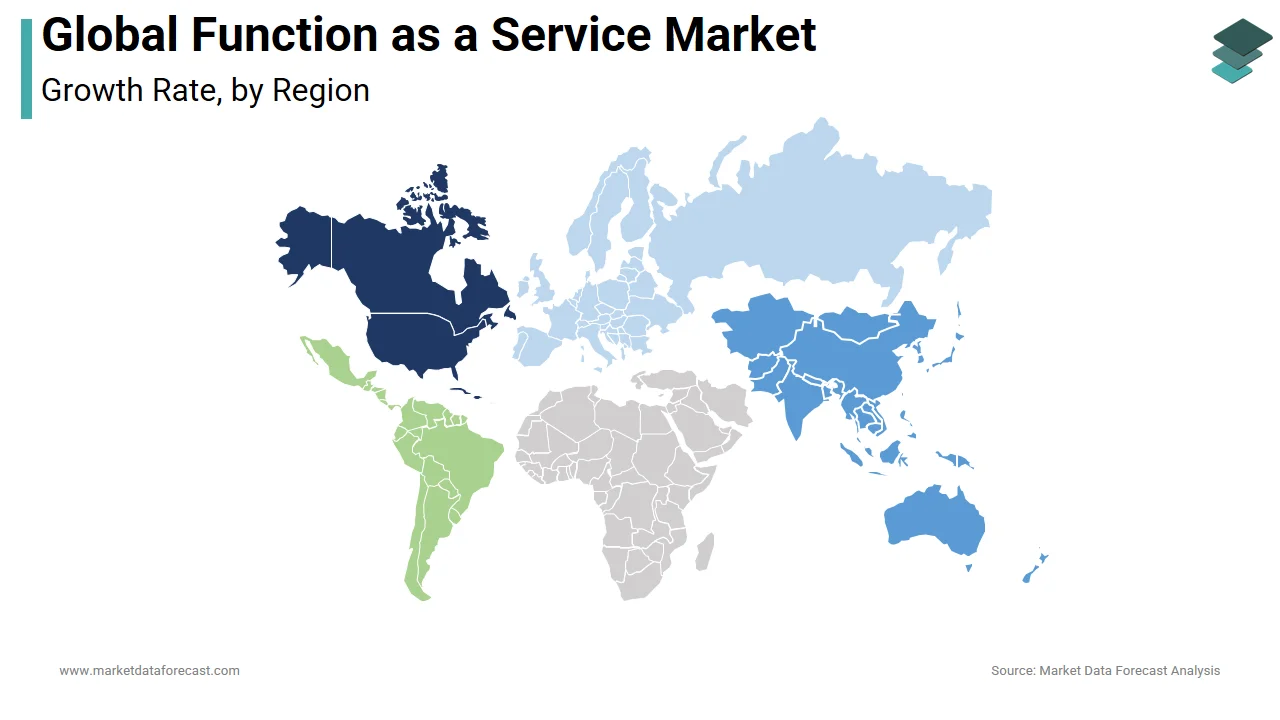
Asia-Pacific is expected to grow at the highest CAGR over the forecast period as the leading players in this area are focusing more on enhancing operational efficiency and meeting customer demands. This is generating an immense growth potential for the APAC FaaS market. The North American FaaS market is projected to develop in a remarkable due to the presence of leading market players in the vicinity.
KEY PLAYERS IN THE MARKET
IBM Corporation, Microsoft, Google Inc., Amazon Web Services, Oracle, Capgemini, NTT DATA, Cloudflare, Rackspace, Alibaba, Stackpath, Rogue Wave Software, TIBCO Software Inc., Fiorana Software and Affiliates are some of the major players in the global function as a service market. The global FaaS market is highly diversified with the presence of several established and start-up companies. Development strategies like product launches, new agreements, joint ventures, partnerships, acquisitions and others are mainly implemented by enterprises across the globe. The rising trend of customer-centric approach and adoption of novel technologies are likely to improve the performance of companies in this market in the coming days.
RECENT HAPPENINGS IN THE MARKET
-
In April 2020, Amazon Web Services launched Fargate 1.4, which is a new version of its serverless container platform that supports shared Elastic File System storage and limits the usage of the Docker engine.
-
In March 2020, HPE developed and launched a powerful Virtual Desktop Infrastructure (VDI) product with reliable financing terms and pre-configured solutions for working from remote locations.
-
In March 2020, Alibaba introduced a new series of anti-coronavirus solutions that are available over cloud.
-
In March 2020, Google introduced a Rapid Response Virtual Agent program that can deploy Contact Center AI agents for managing online conversations or over the phone to aid during the COVID-19 pandemic.
MARKET SEGMENTATION
This research report on the global function as a service market has been segmented and sub-segmented based on user type, application, service type, deployment model, organization size, vertical and region.
By User Type
- Developer-centric FaaS
- Operator-centric FaaS
By Application
-
Web-based and Mobile Applications
-
Research and Academic Application
-
Others
-
Stream Processing
-
Media Processing
-
By Service Type
- Automation and Integration Service
- Microservice Monitoring and Management Service
- API Management Service
- Support & Maintenance
- Training & Consulting
- Metering and Billing
By Deployment Model
- Public Cloud
- Private Cloud
- Hybrid Cloud
By Organization Size
- Small and Medium Enterprise (SME)
- Large enterprise
By Industry Vertical
- BFSI (Banking, Financial Services and Insurance)
- Telecommunication and ITES
- Consumer goods and retail
- Healthcare and life sciences
- Government and Public sector
- Manufacturing
- Media and entertainment
- Others
By Region
- North America
- Europe
- Latin America
- Asia Pacific
- Middle East & Africa