- Product Description Description
- Table of Contents TOC
- List of Table & Figure LOT
- Get Free Sample PDF Sample PDF
Market Size, 2025
$238 BnMarket Estimate, 2026
$253 BnMarket Forecast, 2034
$414 BnCAGR, 2026–2034
6.32%Global Gas Processing Market Size
The global gas processing market size was valued at USD 238.75 billion in 2025 and is expected to reach USD 414.46 billion by 2034 from USD 253.84 billion in 2026. The market is projected to grow at a CAGR of 6.32%.
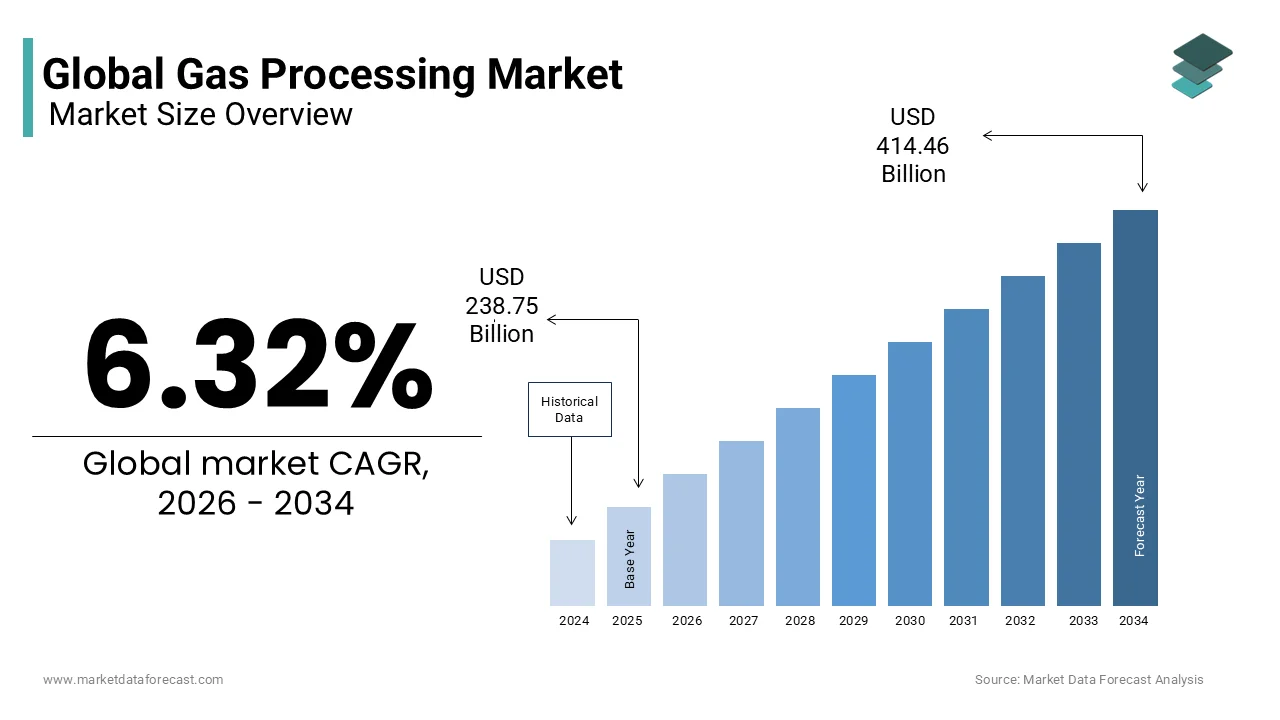
Increased demand for natural gas is driving the industry. The abundance, versatility, and clean-up characteristics of natural gas drive its requirement. As a result of the enhanced use of natural gas in transport, the demand for natural gas has risen. In addition, natural gas supply for power generation is another variable increasing the development of the industry in emerging nations. This increased demand for natural gas will contribute to the development during the forecast period of the world gas handling industry.
Some factors which are driving the global gas processing market are fast expansion in natural gas production, rising initiatives for the adoption of NGL, and increasing call for natural gas. Pressure-assisted stripping (PAS) technology further fuels the efficiency of gas purification procedures by lowering the requirement for heat generation by more than 25%. In the same manner, dynamic compressor model technology assists in reducing operational costs by improving the understanding of the instabilities and operational failures of compressors during the acid-cleaning operation. These innovations in gas processing technology are seen as critical gas processing market trends that will have a positive effect on the expansion of the market.
The production of natural gas is escalating owing to the escalated investments in upstream oil and gas and E&P activities to improve the production of natural gas. According to the IEA, global upstream oil and gas investments rose by 6% in 2019 over that in 20178. The adoption of natural gas is growing as they produce lower greenhouse gas emissions as compared to other fossil fuels throughout combustion. The US and China are the most significant contributors to global natural gas production due to the escalated shale oil and gas drilling activities in the US, and CBM and shale gas drilling activities in China. Therefore, the rising natural gas production due to higher investments and upstream oil and gas activities is driving the call for gas processing that in turn, driving the expansion of the market.
The abundance, versatility, and lower carbon dioxide emissions of natural gas have fuelled its popularity in end users. The call for natural gas is exceptionally high in the APAC region, where the employment of natural gas has escalated notably in fertilizer plants, power generation units, transportation, petrochemicals, and residential and commercial segments. As natural gas is a clean and environment-friendly fuel, it is highly employed as a fuel in the transportation and power generation segment, mainly in growing countries like China and India. The rising call for natural gas will create a requirement for gas processing for separating impurities like hydrogen sulfide, carbon dioxide, nitrogen, and water vapor from unrefined natural gas.
The increasing call for natural gas will be a significant factor boosting the expansion of the gas processing market at a CAGR of over 4% throughout the forecast period. This rising call for natural gas and innovations in gas processing technology are some of the factors estimated to drive market expansion in the future. The market report offers a complete analysis of the market by product (dry gas and NGL) and geography (APAC, Europe, MEA, North America, and Latin America). The global gas processing market is showcasing the advancement of many innovative technologies that will improve the technical and economic feasibility of gas processing operations. By reducing energy consumption, these technologies will assist gas processing firms to make major cost savings. For example, immobilized amine technology assists in decreasing the energy and size of the gas processing reactor in the absence of an aqueous solvent by improving gas processing. It also reduces energy consumption during water evaporation.
Strict environmental rules relating to hydraulic fracturing issued by governments and agencies to safeguard public interests are estimated to hinder the global gas processing market expansion in future.
REPORT COVERAGE
| REPORT METRIC | DETAILS |
| Market Size Available | 2025 to 2034 |
| Base Year | 2025 |
| Forecast Period | 2026 to 2034 |
| CAGR | 6.32% |
| Segments Covered | By Product and Region |
| Various Analyses Covered | Global, Regional, & Country Level Analysis; Segment-Level Analysis; DROC; PESTLE Analysis; Porter’s Five Forces Analysis; Competitive Landscape; Analyst Overview of Investment Opportunities |
| Regions Covered | Asia Pacific, Europe, North America, South America, Middle East & Africa |
| Market Leaders Profiled | Gazprom, Exxon Mobil, China National Petroleum Corporation (CNPC), Royal Dutch Shell, BP, Chevron, TotalEnergies, Statoil (now Equinor), ConocoPhillips, and Eni |
REGIONAL ANALYSIS
The North America gas processing market accounted for the largest share in the global business in 2019. Even though the market's expansion in North America will be slower than the development of the market in MEA, the region will account for the most significant gas processing market share throughout the forecast period. The US is a substantial market for gas processing in the area. The rising oil and gas E&P activities will boost the call for gas processing in North America. The discovery of many oil and gas reserves in North America has fueled oil and gas E&P activities and consequently escalated oil and gas production. The increasing call for natural gas is one of the critical reasons for the expansion of the gas processing market. Escalated investments in upstream oil and gas E&P activities have resulted in a significant increase in the production of natural gas. Furthermore, the adoption of natural gas is rising highly as it produces lower greenhouse gas emissions as compared to other fossil fuels. The US and China are the biggest contributors to global natural gas production due to the rise in shale oil and gas drilling activities in the US and shale gas drilling activities in China.
KEY MARKET PLAYERS
-
Gazprom (Russia)
-
Exxon Mobil (US)
-
China National Petroleum (China)
-
Royal Dutch Shell (U.K)
-
BP (U.K.)
-
Chevron (US)
-
Total (France)
-
Statoil (Itlay)
-
ConocoPhillips (U.S)
-
Eni (U.S.)
Market Segmentation
This research report on the global gas processing market is segmented and sub-segmented into the following categories.
By Product
- Dry Gas
- NGL
By Region
- North America
- Europe
- Asia Pacific
- Latin America
- Middle east and Africa