- Product Description Description
- Table of Contents TOC
- List of Table & Figure LOT
- Get Free Sample PDF Sample PDF
Market Size, 2025
$137 MnMarket Estimate, 2026
$140 MnMarket Forecast, 2034
$162 MnCAGR, 2026–2034
1.82%Global Gasoline Market Size, Growth, Trends & Forecast (2025–2034)
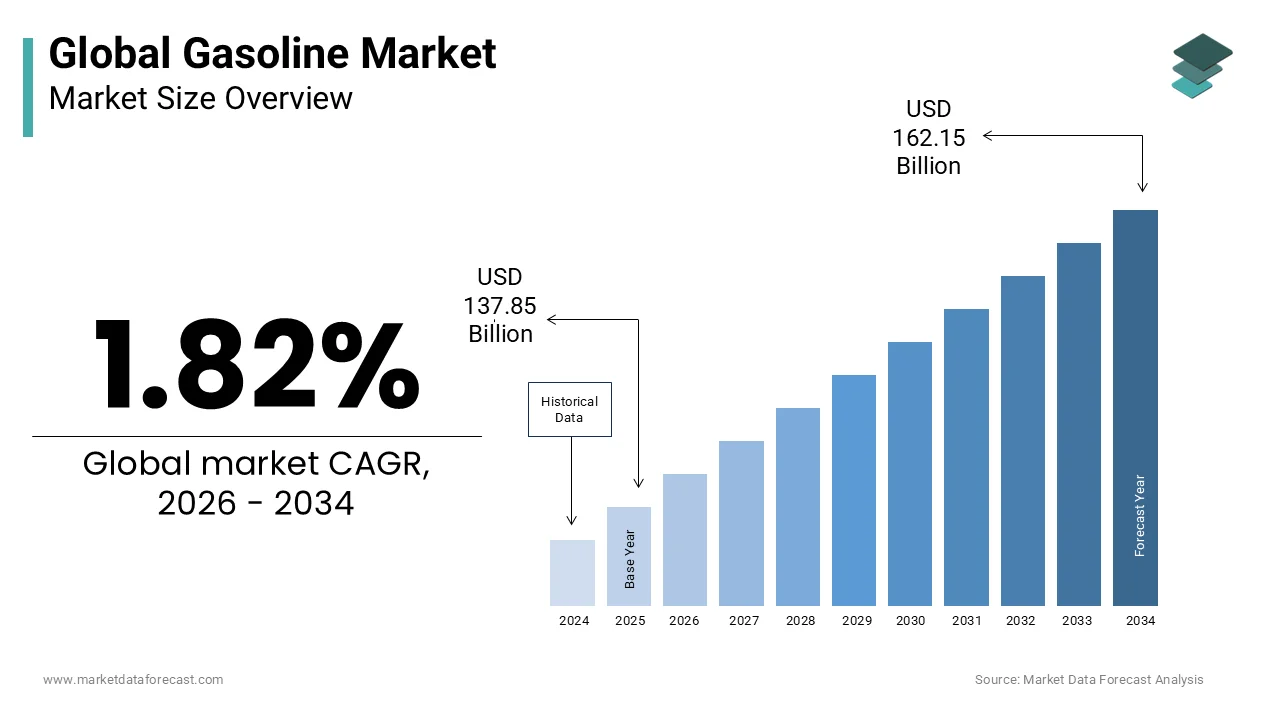
The global gasoline market size was valued at USD 137.85 billion in 2025, is estimated at USD 140.36 billion in 2026, and is projected to reach USD 162.15 billion by 2034, registering a compound annual growth rate (CAGR) of 1.82% during the forecast period from 2026 to 2034. Driven by growing middle-class disposable incomes, expanding automobile ownership in emerging economies, and persistent transportation fuel demands, the market continues to expand steadily.
Key Executive Metrics (At-a-Glance)
- 2025 Base Valuation: USD 137.85 Billion
- 2026 Current Valuation: USD 140.36 Billion
- 2034 Forecast Valuation: USD 162.15 Billion
- Compound Annual Growth Rate (CAGR): 1.82% (2026–2034)
- Leading End-User Sector: Transportation (largest consumer segment)
- Leading Regional Market: North America (largest regional market in 2025)
- Fastest-Growing Region: Asia-Pacific (propelled by vehicle fleet expansion in India and China)
Core Market Drivers
- Rising Disposable Incomes: Growing middle-class populations in emerging Asia-Pacific economies stimulating automobile demand.
- Expanding Vehicle Fleet: Continuous growth in the volume of gasoline-powered passenger cars, motorcycles, and light trucks globally.
- Rising Upstream Oil Production: Increased crude oil output and refining activity, particularly across North America (Canada and the United States).
Primary Market Restraints & Challenges
- Clean Energy Alternatives: Government initiatives promoting renewable fuels, electric vehicles, and alternative energy sources (LPG, CNG, diesel).
- Economic & External Pressures: Slow economic growth in Europe and fluctuations in external demand impacting consumption patterns.
Global Gasoline Market Segmentation Breakdown
| Segment Category | Leading Sub-Segment | Fastest Growing Segment |
|---|---|---|
| By End-User | Transportation (dominates market share via automotive and internal combustion engine applications) | Transportation (driven by emerging market vehicle demand) |
| By Region | North America (largest market share) | Asia-Pacific (fastest-growing consumer base led by India and China) |
Major Industry Players Profiled
Key corporations shaping the global gasoline market include Abu Dhabi National Oil Company, China Petrochemical Corporation (Sinopec), Petroliam Nasional Berhad (PETRONAS), Eni S.p.A., ENOC Company, and Nigerian National Petroleum Corporation (NNPC).
 Download Free Sample Report
Global Gasoline Market Size
The global gasoline market size was valued at USD 137.85 billion in 2025 and is expected to reach USD 162.15 billion by 2034 from USD 140.36 billion in 2026. The market is projected to grow at a CAGR of 1.82%.
Gasoline is a mixture of hydrocarbons derived from crude oil and is primarily used to fuel internal combustion engines in motorcycles, cars, and small trucks. Gasoline is a by-product obtained from the refining of crude oil. It is an important fuel for automotive transportation, and its use in internal combustion engines (ICE) is only competed with by diesel fuel, which is predominant in commercial vehicles. Gasoline is also used as an aviation fuel for propeller planes. Recreational vehicles and some ships also use gasoline.
The transport sector accounts for around 20% of global energy consumption and is the largest consumer of oil in the world. Transportation fuels are energy sources that power various modes of transportation, typically to power internal combustion engines. Mainly around the world, gasoline is used as fuel for vehicles such as cars, motorcycles, trucks, boats, etc. It is one of the main consumer products in the world. The growth of the market is driven by the growth in the number of gasoline vehicles in the world. In addition, regions such as Europe, the Middle East, Africa, and Asia-Pacific have shown decent growth in gasoline consumption due to increased industrialization and increased numbers. Vehicles. Therefore, the demand for gasoline as a fuel is expected to proliferate in the transportation segment globally during the forecast period. These systems use artificial neural networks, which results from a rigorous simulation of the distillation process. i-Heat ™ is the latest software tool from Process Integration Limited used for performance analysis and identifies areas where power and capacity improvements can be made.
MARKET DRIVERS
The gasoline market is expected to experience substantial growth during the forecast period. The rapid growth in disposable income of the middle class, especially in emerging Asia-Pacific economies, is expected to stimulate demand for automobiles which, in turn, will drive demand for moto gasoline over the forecast period. The increase in population, in particular, the increase in the number of cars, and the easy availability of gasoline are some of the main factors that make gasoline a fuel market. The number of gasoline-powered vehicles has increased significantly in India and China, which is one of the major factors in the demand for gasoline in the Asia-Pacific market. North America and Europe also showed substantial growth due to increased industrialization and an increase in the number of vehicles. The increasing population, especially in the Asia Pacific, the increasing number of cars, and the easy availability of gasoline are some of the major factors driving the gasoline trading market. These positive factors are likely to drive gasoline demand for years to come. In the coming years, oil prices are expected to increase as the global economy increases the demand for fuel around the world. The rapid growth in disposable income of the middle class, especially in emerging Asia-Pacific economies, is expected to stimulate demand for automobiles which, in turn, will drive demand for motor gasoline over the forecast period.
MARKET RESTRAINTS
Using alternative sources of clean energy to reduce carbon emissions is likely to slow the growth of the market. The factors holding back the growth of the gasoline market are the slowdown in external demand and the weakness of the stock markets. Slow economic growth in Europe has had a negative impact on gasoline demand. The increasing use of alternatives such as LPG, diesel, and CNG as fuels, coupled with increasing government initiatives to promote the use of renewable fuels, is expected to limit the global market demand for motor gasoline during the forecast period.
MARKET OPPORTUNITIES
The emerging use of portable gasoline-powered generators in event and home applications is expected to create vast opportunities for the gasoline fuel market in the near future.
MARKET CHALLENGES
Lack of industrialization is one of the major factors challenging the growth of the market.
REPORT COVERAGE
| REPORT METRIC | DETAILS |
| Market Size Available | 2025 to 2034 |
| Base Year | 2025 |
| Forecast Period | 2026 to 2034 |
| CAGR | 1.82% |
| Segments Covered | By End-User and Region. |
|
Various Analyses Covered | Global, Regional and Country Level Analysis, Segment-Level Analysis, DROC, PESTLE Analysis, Porter’s Five Forces Analysis, Competitive Landscape, Analyst Overview of Investment Opportunities |
| Regions Covered | North America, Europe, Asia Pacific, Latin America, Middle East & Africa. |
| Market Leaders Profiled | Abu Dhabi National Oil Company, China Petrochemical Corporation, Petroliam Nasional Berhad, Eni S.p.A., ENOC Company, NNPC, and Others. |
SEGMENTAL ANALYSIS
Global Gasoline Market By End-User
The transportation segment is anticipated to dominate the gasoline-fuel market during the forecast period. The transportation industry in the United States is undergoing continuous changes in terms of the technological upgrading of light vehicles. Vehicles manufactured today have improved bodies and engines. In addition, strict government regulations encourage the use of higher-quality gasoline, leading to more efficiency gains. This, in turn, leads to a decrease in the amount of gasoline consumed per mile. A combination of these two factors has resulted in a steady decline in gasoline consumption over the years, which is expected to continue throughout the forecast period.
REGIONAL ANALYSIS
North America was the largest region in the global motor gasoline market in 2025. Growth in the region is driven by increasing car sales in the regions, particularly the United States, followed by It is predicted that Asia-Pacific will be the second-largest and fastest-growing region in the global automotive gasoline market. China, Japan, and India are expected to boost demand for automotive gasoline in the region during the forecast period. The increase in construction activity and the significant growth in nonresidential construction spending reflect the notable increase in demand for gasoline generators in this region.
The United States is the main national gasoline market due to the high number of automobile owners and lower efficiency standards. The United States is the main domestic market for gasoline due to the high number of car owners and lower efficiency standards than developing countries and European consumers. With its various components and additives, gasoline is more volatile than kerosene, jet fuel (naphtha), diesel, or fuel oil in developing countries and European consumers. With its various components and additives, gasoline is more volatile than kerosene, jet fuel (naphtha), diesel, or fuel oil.
U.S. oil production was 576.7 million tonnes in 2023, and Canadian oil production was 264.9 million tonnes in the same year. Another factor that has contributed to the growth of this region in the gasoline market is the increase in oil production, particularly in Canada and the United States. Gasoline includes aviation gasoline and motor gasoline. In 2020, according to the Energy Information Administration (EIA), gasoline accounted for about 62% of the transportation energy source share in the United States.
KEY MARKET PLAYERS
Abu Dhabi National Oil Company, China Petrochemical Corporation, Petroliam Nasional Berhad, Eni S.p.A., ENOC Company, NNPC are some of the notable companies in the global Gasoline market.
RECENT HAPPENINGS IN THE MARKET
- In December 2020, Indian Oil Corp launched India's first 100-octane gasoline. Octane ratings are measures of fuel stability. It is a measure of a fuel's ability to avoid shock. Knocking occurs when fuel ignites prematurely in the engine cylinder, degrading performance and can damage the engine. The higher the octane number, the more impact-resistant the gasoline mixture will be.
MARKET SEGMENTATION
This research report on the global gasoline market has been segmented and sub-segmented based on end-user, and region.
By End-User
- Transportation
- Power Generation
- Others
By Region
- North America
- Europe
- Asia Pacific
- Latin America
- Middle East & Africa