- Product Description Description
- Table of Contents TOC
- List of Table & Figure LOT
- Get Free Sample PDF Sample PDF
Market Size, 2025
$2.58 BnMarket Estimate, 2026
$3.53 BnMarket Forecast, 2034
$43.18 BnCAGR, 2026–2034
36.76%Executive Summary: Generative AI In Healthcare Market
- Market Scope: Comprehensive global generative AI in healthcare market analysis covering component categories, functional applications, robotic surgical integration, regional leadership frameworks, and clinical outcome metrics.
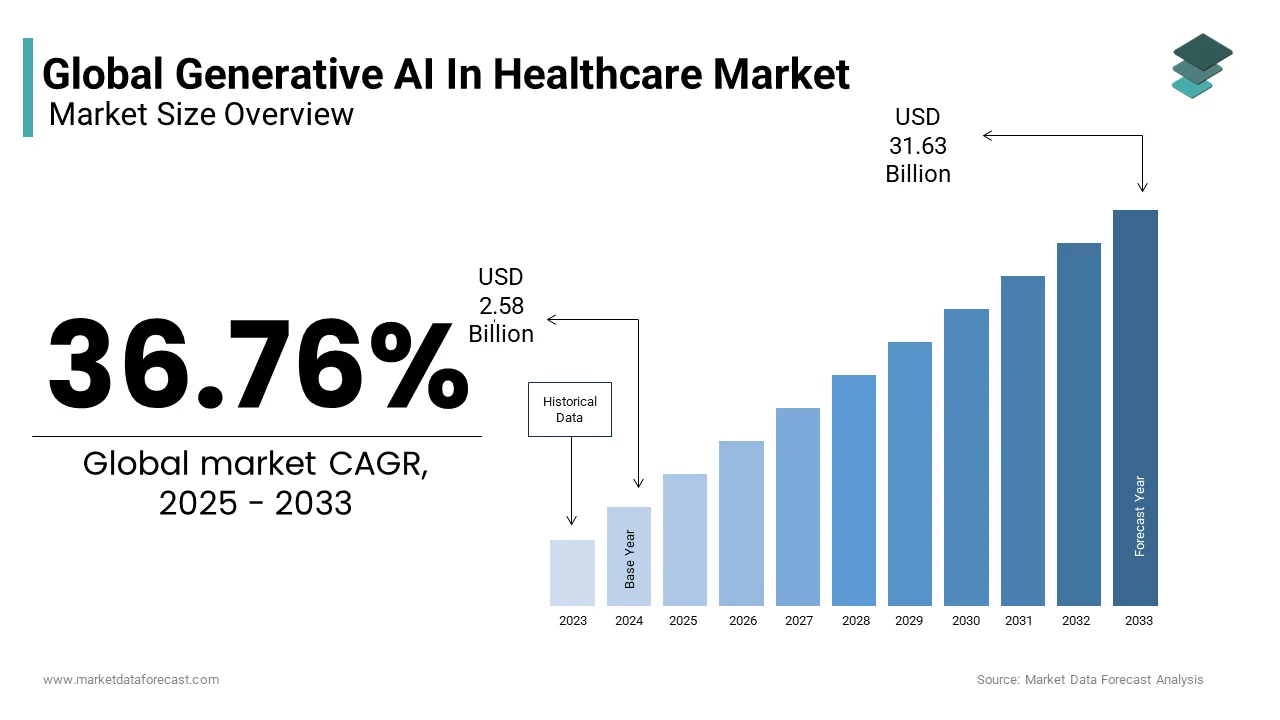
- Market Valuation: Valued at USD 2.58 billion (2025), estimated at USD 3.53 billion (2026), and projected to reach USD 43.18 billion by 2034, registering a rapid CAGR of 36.76% (2026–2034).
- Primary Growth Drivers: Workflow automation, clinical documentation, diagnostic augmentation, medical imaging, drug discovery, and rapid knowledge synthesis. Key clinical and operational highlights include AI-enabled radiology software improving cancer screening diagnostic accuracy by 20%, 85% of health IT deployments requiring vendor-led training/maintenance, remote patient-engagement tools reducing chronic-care hospital readmissions by 18%, and robot-assisted AI surgeries lowering complication rates by 25% compared to traditional laparoscopic approaches.
Key Market Segment Metrics (2026–2034)
| Category | Leading Segment (2025 Position) | Fastest-Growing Segment |
|---|---|---|
| By Component | Generative AI Software Solutions (dominated component segment in 2025 across imaging and diagnostics) | Implementation, Maintenance, & Managed Healthcare AI Services (projected at a 38.1% CAGR) |
| By Healthcare Function | Virtual Nursing Assistants & Remote Patient-Engagement Tools | Robot-Assisted AI Surgery & Automated Drug Discovery Platforms (projected at a 16.5% CAGR) |
| By Clinical Application | Radiology Imaging, Diagnostics, & Clinical Documentation Workflow Automation | Generative Drug Discovery & Real-Time Synthetic Patient Data Modeling |
| By Region / Country | North America (dominated with a 42.3% market share in 2025), followed by Europe (21.2%) | Asia-Pacific (projected to record a fast-paced regional CAGR of 37.6%) |
Major Market Players & Market Structure
Market Structure: Highly competitive global artificial intelligence and healthcare technology landscape featuring major tech titans and specialized biotech/AI innovators competing intensely on clinical AI integration, medical imaging analysis, decision support systems, drug discovery infrastructure, cloud computing frameworks, strict data security/regulatory compliance, and strategic healthcare enterprise partnerships.
Key Companies: Google LLC, IBM Watson, Johnson & Johnson, Microsoft Corporation, Google DeepMind, Neuralink Corporation, NioyaTech, OpenAI, Oracle, Saxon, Syntegra, and Tencent Holdings.
Global Generative AI In Healthcare Market Size
The global generative AI in healthcare market size was valued at USD 2.58 billion in 2025 and is anticipated to reach a valuation of USD 3.53 billion in 2026 and USD 43.18 billion by 2034, growing at a CAGR of 36.76% from 2026 to 2034.
Generative AI in healthcare refers to machine-learning systems, which are primarily large language models and multimodal generators that synthesize clinical summaries, draft patient-facing education, interpret images, and assist research workflows by producing new, contextually relevant outputs from learned patterns. Its immediate value lies in automating documentation, accelerating hypothesis generation, and augmenting diagnostic triage in resource-constrained settings.
MARKET DRIVERS
Workflow automation and clinician productivity
Generative AI’s most tangible pull is its ability to automate repetitive cognitive work, such as clinical notes, discharge summaries, prior-authorization text, and patient education, which is a major factor propelling the growth of generative AI in the healthcare market. The productivity dividend reduces clinician administrative load, enabling more patient-facing time or faster throughput in system workflows. That operational relief is a strong demand factor for health systems looking to preserve capacity without adding staff, which is making documentation and coding automation a primary, near-term commercial use case for generative models.
Diagnostic augmentation and rapid knowledge synthesis
Generative models excel at synthesizing vast literatures and producing candidate differentials or structured summaries that clinicians can vet, and are additionally leveraging the growth of generative AI in the healthcare market. Multiple evaluations show modern LLMs reaching competency on many medical question sets and exams, which supports their use as decision-support and education aids. Tools that can summarize trials, propose clinical pathways, or flag rare diagnoses materially shorten the cognitive work of clinicians and researchers.
MARKET RESTRAINTS
Hallucinations and clinical safety risk
The propensity to “hallucinate” generates plausible but incorrect statements or citations, which creates patient-safety risk when left unchecked, and is hampering the growth of generative AI in the healthcare market. Recent peer-reviewed frameworks quantify nontrivial hallucination and omission rates in clinical documentation experiments, and emphasize that even small error rates can cause downstream harm in diagnosis or treatment plans unless robust guardrails are applied. Addressing hallucinations requires layered validation, retrieval-augmented architectures, and human-in-the-loop workflows.
Trust, perceived effectiveness, and variable institutional success.s
Adoption is also constrained by clinician trust and mixed institutional outcomes, which are also hindering the growth of generative AI in thehealthcaree market. Surveys and implementation studies show that while many organizations experiment with AI, relatively few report high-degree success in clinical diagnosis or full operational integration; only a minority of institutions report consistent positive outcomes from AI diagnostics. Skepticism about reliability, medico-legal exposure, and peer perception of clinicians who use generative AI creates cultural headwinds. These perceptional and evidentiary barriers increase the amount of demonstration evidence, explainability tooling, and clinical trials vendors must produce before health systems will scale deployments.
MARKET OPPORTUNITIES
Low-cost screening and expanded access in low-resource settings.s
Generative AI combined with edge imaging and offline models opens an opportunity to expand screening and triage where specialists are scarce, which will eventually enhance the growth of generative AI in the healthcare market. Field validations (for example, AI-enabled smartphone screening workflows in ophthalmology) show high sensitivity and specificity for certain conditions when combined with appropriate imaging devices, suggesting practical pathways to scale early detection programs.
Accelerating clinical research and trial operations
Generative AI can speed clinical research by automating protocol drafts, eligibility matching, synthetic control arms, and rapid literature synthesis by reducing months of manual effort in protocol development and feasibility. These capabilities lower administrative friction for investigators, shorten time-to-first-patient, and enable adaptive trial designs that respond quickly to emergent signals. In drug development and translational research, generative models that reliably summarize evidence and propose hypothesis-driven experiments can shorten R&D cycles and democratize analytic capabilities across smaller research centers.
MARKET CHALLENGES
Data privacy, provenan,ce, and regulatory compliance
Generative systems require vast, often sensitive, training data; ensuring HIPAA-equivalent protections, provenance tracking, and auditability is likely to degrade the growth of generative AI in the healthcare market. Health systems must be able to demonstrate what data were used, how models were validated, and how PHI is protected during inference. Regulatory frameworks are evolving but vary by jurisdiction, obliging vendors to invest in differential privacy, secure enclaves, and extensive documentation. The combined engineering and legal burden slows supplier onboarding and increases the total cost of ownership for generative AI solutions in regulated clinical environments.
Integration with clinical workflows and measurement of real-world impact
The tougher problem is embedding generative AI seamlessly into electronic health records, order flows, and multidisciplinary team workflows so that outputs are timely, actionable, and measurable. Many pilot projects fail to translate into sustained gains because the outputs aren’t aligned with clinician needs, generate extra validation work, or create alert fatigue. Demonstrating measurable clinical value, reduced time-to-diagnosis, fewer adverse events, or improved outcomes requires rigorous prospective evaluation, robust interoperability engineering, and change-management investments.
REPORT COVERAGE
| REPORT METRIC | DETAILS |
| Market Size Available | 2025 to 2034 |
| Base Year | 2025 |
| Forecast Period | 2026 to 2034 |
| CAGR | 36.76% |
| Segments Covered | By Component, Function, End-User, Application, And Region. |
| Various Analyses Covered | Global, Regional & Country Level Analysis, Segment-Level Analysis, DROC, PESTLE Analysis, Porter’s Five Forces Analysis, Competitive Landscape, Analyst Overview on Investment Opportunities |
| Regions Covered | North America, Europe, APAC, Latin America, Middle East & Africa |
| Market Leaders Profiled | Google LLC, IBM Watson, Johnson & Johnson, Microsoft Corporation, Neuralink Corporation, NioyaTech, OpenAI, Oracle, Saxon, Syntegra, Tencent Holdings Ltd |
SEGMENT ANALYSIS
By Component Insights
The software segments accounted for a dominant share of the generative AI in healthcare market in 2025, with the integration of AI models in imaging, diagnostics, and drug discovery platforms. According to the World Health Organization in 2025, approximately 50% of diagnostic errors globally could be reduced through advanced AI-assisted interpretation, with the growing reliance on software solutions. Another key factor is the rapid adoption of AI-driven imaging platforms, with the U.S. National Institutes of Health stating that AI-enabled radiology software improved diagnostic accuracy by 20% in cancer screening programs.
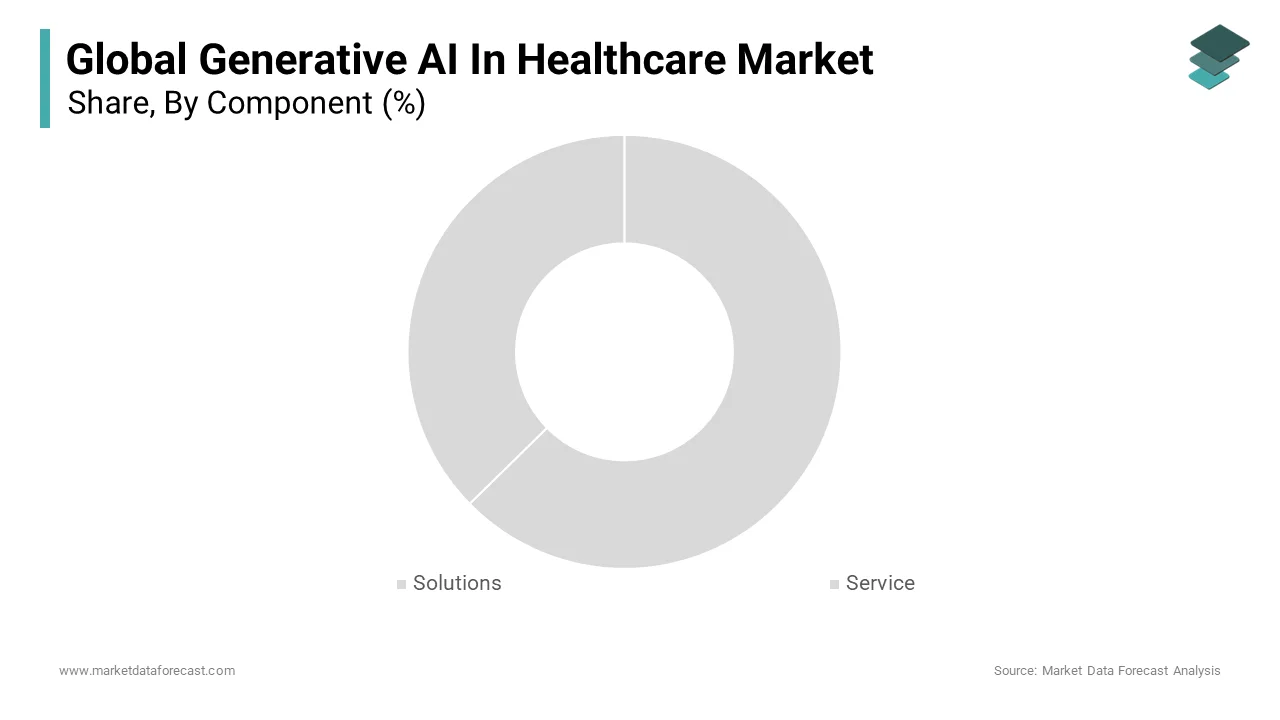
The services segment is projected to grow at a CAGR of 38.1% from 2025 to 2033, with rising demand for consulting, model training, and implementation services required to integrate generative AI tools into healthcare workflows. Furthermore, the U.S. Department of Health and Human Services noted that 85% of health IT deployments require vendor-led training and maintenance, emphasizing why service providers are seeing heightened growth as healthcare systems pursue large-scale AI rollouts.
By Function Insights
The virtual nursing assistants segment held a dominant share of the generative AI in healthcare market in 2025. Additionally, the U.S. Centers for Medicare & Medicaid Services confirmed that remote patient engagement tools reduced hospital readmission rates by 18% in chronic care management programs.
The robot-assisted AI surgery segment is likely to grow with an anticipated CAGR of 16.5% during the forecast period, with the rising precision requirements in minimally invasive surgeries and demand for reduced recovery times. As per the American College of Surgeons in 2025, robotic surgeries lowered complication rates by 25% compared to traditional laparoscopic approaches.
REGIONAL ANALYSIS
North America Market Analysis
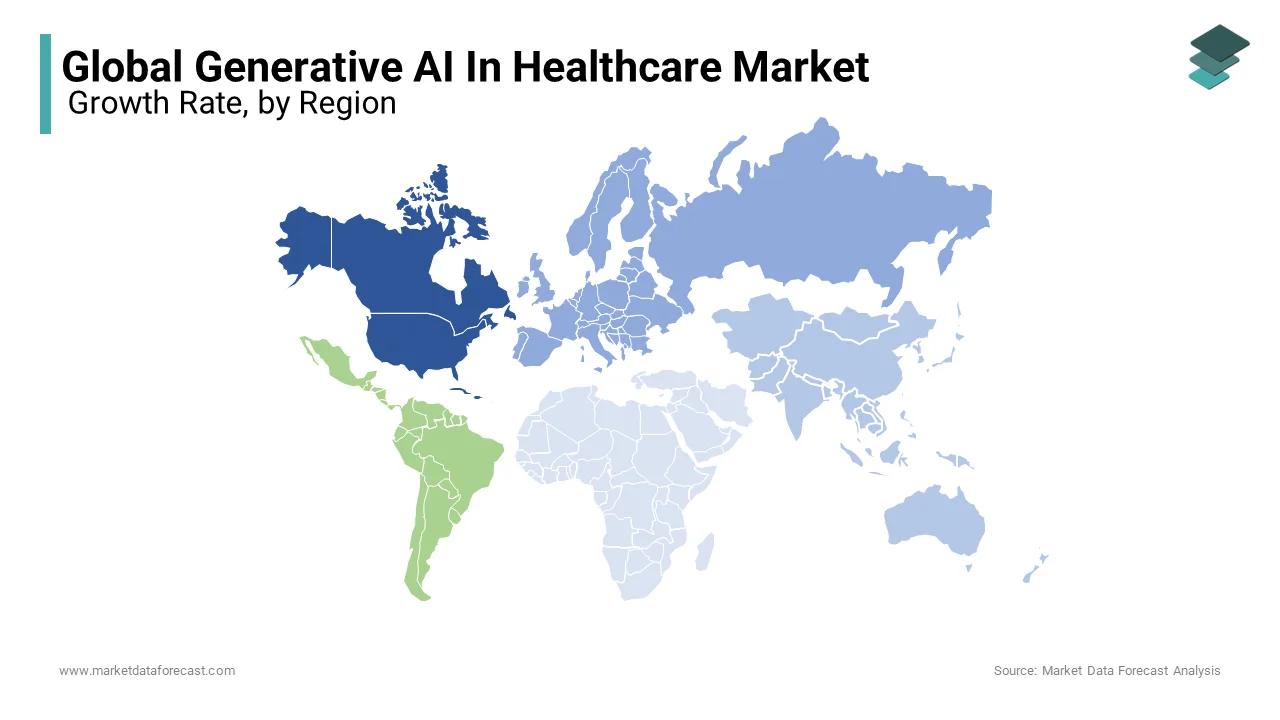
North America dominated the generative AI in healthcare market by holding 42.3% the share in 2025, with the advanced digital infrastructure, high healthcare spending, and strong AI adoption in diagnostics and drug discovery. The U.S. Food and Drug Administration reported in 2025 that more than 500 AI-based medical devices had received clearance, the majority in imaging and decision-support tools.
Europe Market Analysis
Europe's generative AI in healthcare market was positioned second by capturing 21.2% of the market share in 2025, with strong adoption of AI in personalized medicine and chronic care management. The European Commission confirmed in 2025 that EU healthcare systems spend approximately EUR 150 billion annually on chronic disease management, prompting demand for AI-driven efficiency. Countries such as Germany and the UK are accelerating AI integration in clinical workflows through government-backed digital health strategies, making Europe a key regional contributor.
Asia Pacific Market Analysis
Asia Pacific generative AI in healthcare market growth is expected to grow with an estimated CAGR of 37.6% during the forecast period. This surge is driven by rapidly aging populations, rising chronic disease burden, and strong government investments in AI infrastructure. China, Japan, and India are leading investments in AI-assisted imaging and remote monitoring, which is making the region pivotal for future market expansion.
Latin America Market Analysis
Latin America's generative AI in healthcare market growth is anticipated to have significant growth opportunities, with rapid expansion due to telehealth penetration and the rising need for affordable healthcare solutions. The Pan American Health Organization reported in 2025 that Brazil and Mexico are piloting AI-powered triage systems to reduce emergency care delays.
Middle East & Africa Market Analysis
The Middle East & Africa generative AI in healthcare market growth is enhancing with the national digital health programs, particularly in Saudi Arabia and the UAE, where governments are actively funding AI adoption in hospitals. As per the World Health Organization in 2025, more than 50% of hospitals in the Gulf region are investing in AI-powered diagnostic tools. While Africa lags in adoption due to limited infrastructure, pilot AI programs in South Africa and Kenya are expected to contribute to gradual market uptake.
COMPETITIVE LANDSCAPE
The Generative AI in Healthcare Market is witnessing intensifying competition as global technology leaders and regional innovators seek to establish dominance in the Asia Pacific’s rapidly expanding digital health sector. Major players like Microsoft, IBM, and Google DeepMind are competing with regional startups and healthcare technology firms that offer localized AI solutions. The competitive landscape is characterized by collaborations with hospitals, pharmaceutical companies, and government health bodies to deploy scalable AI applications. Regulatory compliance, data security, and integration with existing health infrastructure are becoming key differentiators. Furthermore, continuous R&D investments and the launch of generative AI-powered imaging, clinical decision support, and drug discovery platforms are accelerating competition.
KEY MARKET PLAYERS
A few of the market players in the global generative AI healthcare market include
- Google LLC
- IBM Watson
- Johnson & Johnson
- Microsoft Corporation
- Google DeepMind
- Neuralink Corporation
- NioyaTech
- OpenAI
- Oracle
- Saxon
- Syntegra
- Tencent Holdings Ltd
Top Players In The Market
- Microsoft has become a pivotal contributor to the Generative AI in Healthcare Market in the Asia Pacific, particularly through its Azure OpenAI Service and collaborations with regional healthcare providers. The company has partnered with hospitals in India and Singapore to deploy generative AI models for medical imaging and clinical decision support. These initiatives underline Microsoft’s focus on integrating generative AI with electronic health records and cloud-based systems to enhance efficiency, reduce diagnostic errors, and improve patient outcomes across the Asia Pacific.
- IBM continues to advance the Generative AI in Healthcare Market in the Asia Pacific through its Watson Health initiatives and emerging generative AI frameworks. The company has invested in AI-driven drug discovery and oncology research collaborations with Japanese and Australian institutes. Its emphasis on building secure, transparent, and ethical AI systems aligns with the regulatory frameworks of Asia Pacific countries, positioning IBM as a trusted technology partner in hospitals, research centers, and pharmaceutical companies across the region.
- Google DeepMind plays a central role in shaping the Generative AI in Healthcare Market across the Asia Pacific by leveraging its cutting-edge AI models in diagnostics and predictive analytics. The company has expanded collaborations with healthcare providers in China, Japan, and Australia to apply AI in radiology, genomics, and chronic disease management. Its strength lies in translating research into applied healthcare solutions, allowing DeepMind to push the boundaries of medical imaging and personalized medicine in the Asia Pacific.
Top Strategies Used by Key Market Participants
The leading players in the Generative AI in Healthcare Market are employing strategies centered on partnerships, regional collaborations, and AI integration within clinical ecosystems. Companies such as Microsoft, IBM, and Google DeepMind are focusing on long-term collaborations with hospitals and governments to ensure localized adoption of generative AI models. Investment in research and development remains another core strategy, with significant emphasis on tailoring AI tools for imaging, diagnostics, and predictive analytics specific to Asia Pacific health challenges. Additionally, firms are building AI-powered cloud infrastructures to enhance data security and compliance with local health regulations.
MARKET SEGMENTATION
This research report on the global generative AI in healthcare market is segmented and sub-segmented into the following categories.
By Component
- Solutions
- Service
By Function
- Virtual Nursing Assistants
- Robot-Assisted AI Surgery
- Administrative Process Optimization
- Medical Imaging Analysis
By End-use
- Clinical Research
- Medical Centers
- Diagnostic Centers
- Others
By Application
- Clinical
- System
By Region
- North America
- Europe
- Asia-Pacific
- Latin America
- Middle East and Africa