Global Geosynthetics Market Size, Share, Trends & Growth Forecast Report, Segmented By Product and By Region (North America, Europe, Asia-Pacific, Latin America, Middle East And Africa), Industry Analysis From (2026 to 2034)
Market Size, 2025
$36.25 BnMarket Estimate, 2026
$38.67 BnMarket Forecast, 2034
$64.82 BnCAGR, 2026–2034
6.67%Executive Summary: Geosynthetics Market
- Market Scope: Comprehensive global geosynthetics market analysis covering product categories, application sectors, regional leadership frameworks, and civil engineering infrastructure metrics.
- Market Valuation: Valued at USD 36.25 billion (2025), estimated at USD 38.67 billion (2026), and projected to reach USD 64.82 billion by 2034, registering a steady CAGR of 6.67% (2026–2034).
- Primary Growth Drivers: Infrastructure modernization, strict environmental regulations, and waste containment needs. Key engineering and infrastructure highlights include India incorporating geotextiles across over 35,000 km of highway construction (reducing maintenance costs by up to 30%), geosynthetic-reinforced embankments delivering up to 50% higher load-bearing capacity than conventional fills, and over 85% of U.S. landfills utilizing composite liners (consuming >200 million square meters of geosynthetics annually).
Key Market Segment Metrics (2026–2034)
| Category | Leading Segment (2025 Position) | Fastest-Growing Segment |
|---|---|---|
| By Product Category | Geotextiles (dominated product segment with 38.2% market share in 2025) | Geocells (projected to register a robust CAGR of 10.7%) |
| By Application Sector | Water Management (led applications with a 32.1% share in 2025) | Mining Infrastructure & Containment Systems (projected to expand at a 9.8% CAGR) |
| By Material & Function | Polymeric Geomembranes, Grids, & Stabilization Fabrics | Recyclable Polymer Geosynthetics & Smart Sensor-Embedded Materials |
| By Region / Country | Asia-Pacific (dominated globally with a 37.3% share in 2025, led by China), followed by North America (24.3%) | Asia-Pacific Infrastructure & Highway Modernization Hubs (India and China) |
Major Market Players & Market Structure
Market Structure: Highly competitive global civil engineering and geosynthetic manufacturing landscape featuring major international material producers competing intensely on product durability, recyclable polymers, smart geosynthetics, engineering design expertise, strict regulatory compliance, and localized technical support.
Key Companies: Koninklijke Ten Cate, GSE Environmental, TENAX, Fibertex Nonwovens, Tensar International, HUESKER, Strata Systems, AGRU America, Global Synthetics, Garware Technical Fibres, and SKAPS Industries.
Global Geosynthetics Market Size
The global geosynthetics market size was valued at USD 36.25 billion in 2025 and is anticipated to reach USD 38.67 billion in 2025 and USD 64.82 billion by 2034, growing at a CAGR of 6.67%, from 2026 to 2034.
The Geosynthetics are a range of synthetic polymeric materials engineered for integration into civil, geotechnical, and environmental engineering systems to enhance performance, stability, and longevity of infrastructure. Additionally, the European Environment Agency indicates that more than 11 million tonnes of hazardous waste are landfilled annually across the EU, intensifying the demand for impermeable containment systems.
MARKET DRIVERS
Accelerated Infrastructure Modernization Driving Geosynthetic Demand
The global push toward resilient and cost-efficient infrastructure is a primary factor driving the growth of the geosynthetics market. In India, the National Highways Authority has incorporated geotextiles in over 35,000 kilometers of highway construction to mitigate soil subsidence in weak subgrades, reducing maintenance costs by up to 30%, according to the Indian Ministry of Road Transport and Highways. The U.S. Army Corps of Engineers has also validated that geosynthetic-reinforced embankments on soft soils exhibit up to 50% higher load-bearing capacity than conventional fills.
Rising Environmental Regulation and Waste Containment Needs
Stringent environmental legislation concerning waste containment and water resource protection is significantly amplifying the geosynthetics market growth. As per the World Bank, global municipal solid waste generation is projected to reach 3.4 billion tonnes annually by 2050, with over 2 billion tonnes expected to be disposed of in landfills. The European Union’s Landfill Directive requires 100% of new landfills to incorporate high-density polyethylene (HDPE) geomembranes, driving adoption across member states. Furthermore, China’s Ministry of Ecology and Environment reported that over 7,000 closed or inactive landfills require retrofitting with impermeable liners, creating a substantial retrofit market.
MARKET RESTRAINTS
High Initial Material and Installation Costs Limiting Adoption in Developing Economies
The upfront investment required for geosynthetic materials and specialized installation in low-income regions is degrading the growth of the Geosynthetics market. According to the International Labour Organization, skilled labor for geosynthetic installation is scarce in over 60% of African countries, leading to increased project costs and delays. Additionally, high-quality HDPE geomembranes can cost between $3 and $6 per square meter, a prohibitive expense for municipal landfill projects in nations where per capita infrastructure spending remains below $50 annually, as noted by the World Bank. These financial and technical constraints hinder widespread adoption in public-sector projects with tight budgets and limited access to engineering support.
Environmental and Long-Term Durability Concerns Amid Climate Variability
Although engineered for longevity, geosynthetics face growing scrutiny regarding their performance under extreme climatic conditions and long-term degradation. As per the Intergovernmental Panel on Climate Change, the frequency of heavy precipitation events has increased by 30% in temperate zones since 1980, subjecting geosynthetic-reinforced slopes and barriers to unprecedented hydrostatic stress. A study by the UK’s Centre for Ecology & Hydrology found that prolonged UV exposure and thermal cycling reduce the tensile strength of polypropylene geotextiles by up to 15% over a decade, raising concerns about design life assumptions. Moreover, microplastic leaching from degrading geosynthetics has emerged as a concern; the Helmholtz Centre for Environmental Research detected polymer fragments in soil samples near aging landfill sites, prompting regulatory reviews in Germany and the Netherlands.
MARKET OPPORTUNITIES
Expansion of Renewable Energy Infrastructure Creating Niche Applications
The global energy transition is unlocking novel applications for geosynthetics in renewable energy projects, positively impacting the growth of the Geosynthetics market. As per the International Renewable Energy Agency, solar photovoltaic installations are expected to exceed 8,500 GW by 2050, requiring stable, erosion-resistant ground covers for solar farms on marginal lands. Geotextiles are increasingly used to stabilize soil beneath solar panel arrays in arid regions such as the Middle East, where sand movement can damage infrastructure. In Spain, over 40% of new solar parks utilize geocells to prevent surface degradation, according to Spain’s National Energy and Climate Plan.
Advancements in Smart Geosynthetics and Digital Integration
The integration of sensor technology and digital monitoring into geosynthetic systems is additionally enhancing the new growth opportunities for the Geosynthetics market. Smart geotextiles embedded with fiber-optic sensors or strain gauges enable real-time monitoring of soil movement, moisture levels, and structural integrity. According to the UK’s Transport Research Laboratory, pilot projects on smart motorways have demonstrated a 40% improvement in early fault detection using sensor-integrated geogrids. Additionally, the European Commission’s Horizon 2020 program has funded multiple initiatives to develop IoT-enabled geosynthetics for smart cities.
MARKET CHALLENGES
Supply Chain Vulnerability to Petrochemical Feedstock Fluctuations
Geosynthetics are predominantly derived from petroleum-based polymers such as polyethylene and polypropylene, rendering the sector highly susceptible to feedstock price volatility. As per the International Energy Agency, global polyethylene prices surged by 22% in 2022 due to supply disruptions and energy market instability, directly impacting production costs for geosynthetic manufacturers. In Turkey, a key regional producer, local geotextile manufacturers reported a 30% increase in raw material expenses, forcing project delays in public infrastructure, according to the Turkish Chamber of Civil Engineers.
Standardization and Regulatory Fragmentation Across Geographies
A lack of harmonized global standards for geosynthetic performance, testing, and certification impedes cross-border project implementation and technology transfer, which will quietly degrade the growth of the geosynthetic market. As per ASTM International, over 80 distinct test methods exist for geotextile evaluation, with significant variation in acceptance criteria between North America, Europe, and Asia. In India, for instance, only 35% of state-level public works departments adhere to national Bureau of Indian Standards (BIS) guidelines for geosynthetic use, leading to inconsistent quality and performance, according to the National Institute of Construction Management and Research. Similarly, the absence of unified certification for smart geosynthetics hampers innovation adoption. The European Committee for Standardization (CEN) and ASTM are currently working toward alignment, but progress remains slow.
REPORT COVERAGE
| REPORT METRIC | DETAILS |
| Market Size Available | 2025 to 2034 |
| Base Year | 2025 |
| Forecast Period | 2026 to 2034 |
| CAGR | 6.67% |
| Segments Covered | By Product and Region. |
| Various Analyses Covered | Global, Regional, and Country Level Analysis; Segment-Level Analysis, DROC; PESTLE Analysis; Porter’s Five Forces Analysis; Competitive Landscape; Analyst Overview of Investment Opportunities |
| Regions Covered | North America, Europe, APAC, Latin America, Middle East & Africa |
| Market Leaders Profiled | Koninklijke Ten Cate B.V., GSE Environmental, TENAX SPA, Fibertex Nonwovens A/S, Tensar International Corporation, HUESKER, Strata Systems, Inc., AGRU AMERICA, INC., Global Synthetics, Terram Geosynthetics Pvt. Ltd. (TGPL), CTM Geosynthetics, Garware Technical Fibres Ltd., Tuflex India, Texel, Fibromat (M) Sdn Bhd., Techno Fabrics Geosynthetics Pvt. Ltd., SKAPS Industries, Pietrucha Group, Steklonit, Maharshee Geomembrane (India) Pvt. Ltd. |
SEGMENTAL ANALYSIS
By Product Insights
The geotextiles segment accounted in holding 38.2% of the geosynthetics market share in 2025. Geotextiles are extensively deployed in road and railway construction due to their ability to stabilize weak subgrades and extend pavement life. According to the U.S. Federal Highway Administration, over 70% of U.S. pavements constructed on soft soils now incorporate geotextiles, reducing base layer thickness by up to 30% and cutting material costs significantly. In coastal Louisiana, where land loss exceeds 75 square kilometers annually, the Coastal Protection and Restoration Authority has installed geotextile tubes in over 120 restoration projects, containing more than 100 million cubic meters of dredged sediment.
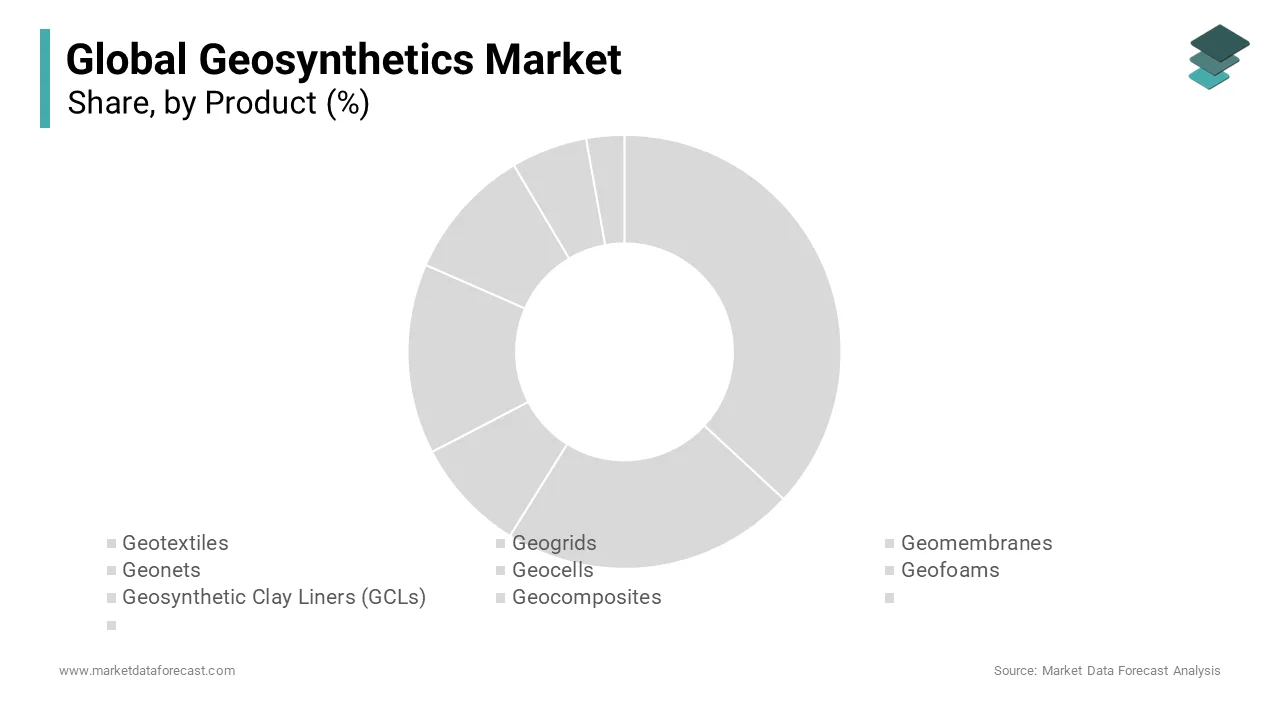
The geocells segment is projected to register a CAGR of 10.7% from 2025 to 2033. Geocells are three-dimensional cellular confinement systems, which are increasingly adopted in areas with weak or erodible soils, such as deserts, floodplains, and permafrost zones. The U.S. Army Engineer Research and Development Center found that geocell-reinforced unpaved roads exhibit up to 3.5 times higher load-bearing capacity than unreinforced sections, enabling rapid deployment of military and emergency access routes. Urban greening initiatives are accelerating geocell adoption for vegetated retaining walls and terraced landscaping. In South Korea, the Seoul Metropolitan Government has mandated cellular confinement systems in all new hillside stabilization projects since 2021, resulting in a 45% improvement in slope stability, according to the Korea Institute of Civil Engineering and Building Technology.
By Application Insights
The water management application segment accounted in holding 32.1% of the geosynthetics market share in 2025. In Pakistan, where canal seepage losses exceed 40%, the Indus River System Authority has retrofitted over 1,200 kilometers of irrigation channels with HDPE geomembranes and geotextiles, reducing water loss by up to 60%, according to their 2023 Water Conservation Strategy. Urban flooding is affecting over 100 million people annually, as estimated by the United Nations Office for Disaster Risk Reduction. In response, cities are integrating geonets and geocomposites into permeable pavements and detention basins. The Tokyo Metropolitan Government has installed geosynthetic drainage layers beneath 35% of its urban roads, enhancing infiltration rates by 50%, according to the Tokyo Sewerage Bureau.
The mining application segment is projected to expand at a CAGR of 9.8% throughout the forecast period. The Global Industry Standard on Tailings Management, endorsed by the United Nations Environment Programme, mandates the use of geosynthetic clay liners (GCLs) and geomembranes in all new TSFs. Gold and copper mining increasingly rely on heap leaching, a process requiring impermeable pads lined with HDPE geomembranes to prevent cyanide and acid leakage. The U.S. Geological Survey estimates that over 75% of primary gold production in Latin America now uses lined leach pads, with an average pad size exceeding 200 hectares. In Nevada, the largest gold-producing state in the U.S., the Bureau of Mining and Geology confirms that geosynthetic-lined pads have reduced groundwater contamination incidents by 80% since 2015.
REGIONAL ANALYSIS
Asia Pacific Market Analysis
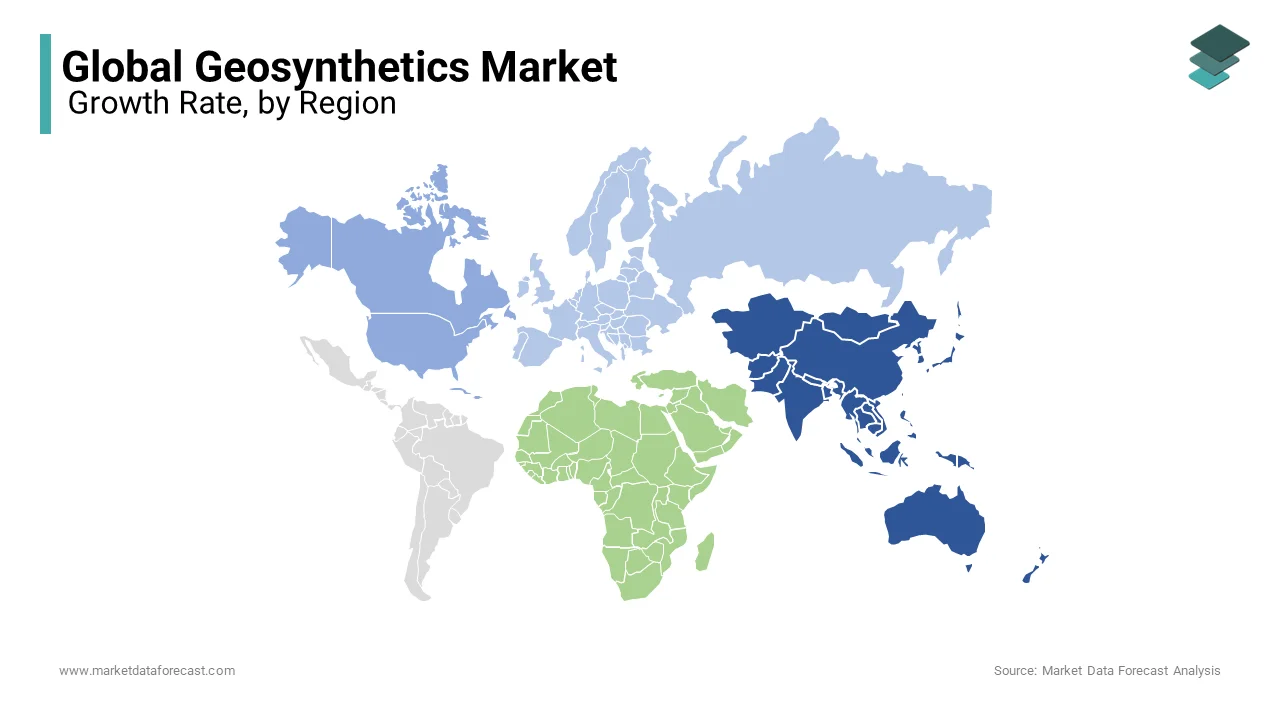
Asia Pacific was the top performer in the global geosynthetics market with a 37.3% share in 2025.
China was the largest contributor to the geosynthetics market. According to the Ministry of Housing and Urban-Rural Development, China constructs over 2,500 kilometers of new highways annually, many on soft coastal soils requiring geotextile reinforcement. Rapid industrialization and climate resilience planning are cementing the region’s dominance.
North America Market Analysis
North America was positioned second by capturing 24.3% the geosynthetics market share in 2025.
The United States dominated the market with the Environmental Protection Agency mandating double-lined landfill systems in all new municipal waste facilities, which is also driving demand for geomembranes and GCLs. According to the Solid Waste Association of North America, over 85% of U.S. landfills now use composite liners, consuming more than 200 million square meters of geosynthetics annually.
Europe's geosynthetics market growth is likely to be driven by a strong emphasis on sustainability and environmental protection. Germany's geosynthetics market growth is likely to grow with its stringent water protection laws. The Federal Environment Agency states that 98% of new landfills in Germany use HDPE geomembranes, among the highest compliance rates globally.
Middle East and Africa Market Analysis
The Middle East & Africa geosynthetics market is expected to have significant growth opportunities during the forecast period.
Saudi Arabia is spearheading demand through its Vision 2030 megaprojects, including NEOM and the Red Sea Development, where over 500 kilometers of desert roads are being built on geocell-reinforced foundations to combat sand encroachment, as detailed in the Royal Commission’s technical briefings. In South Africa, where mine rehabilitation is mandatory, the Council for Geoscience reports that geosynthetic clay liners are used in 70% of decommissioned tailings dams to prevent acid mine drainage.
COMPETITIVE LANDSCAPE
Competition in the geosynthetics market is intensifying as global demand for resilient and sustainable infrastructure rises. The landscape features a mix of multinational corporations with advanced material science capabilities and regional manufacturers offering cost-competitive solutions. Differentiation is increasingly driven by technical expertise, product durability, and compliance with stringent environmental regulations rather than price alone. Companies are investing in localized support networks, including engineering advisory services and installation training, to strengthen client relationships. Innovation in smart geosynthetics and recyclable polymers is creating new competitive frontiers. While Western firms lead in high-performance and specialty products, Asian manufacturers are rapidly closing the gap through partnerships and technology adoption.
KEY MARKET PLAYERS
A few of the market players in the global geosynthetics market include
- Koninklijke Ten Cate bv
- GSE Environmental
- TENAX SPA
- Fibertex Nonwovens A/S
- Tensar International Corporation
- HUESKER
- Strata Systems, Inc.
- AGRU AMERICA, INC
- Global Synthetics
- Terram Geosynthetics Pvt. Ltd. (TGPL)
- CTM Geosynthetics
- Garware Technical Fibres Ltd.
- Tuflex India
- Texel
- Fibromat (M) Sdn Bhd.
- Techno Fabrics Geosynthetics Pvt. Ltd.
- SKAPS Industries
- Pietrucha Group
- Steklonit
- Maharshee Geomembrane (India) Pvt. Ltd.
Top Players In The Market
- TenCate (now part of Koninklijke Ten Cate NV, operating under Toray Industries post-acquisition) has long been a technological pioneer in advanced geosynthetics, particularly in high-performance geotextiles and geocomposites. In the Asia Pacific region, the company has established a strong engineering support network in India, Japan, and Australia, collaborating with public infrastructure agencies on railway stabilization and coastal protection projects.
- GSE Holding is a global leader in geomembrane technology, with extensive influence in waste containment and mining applications across the sSIAPacific. The company has deepened its regional footprint through technical collaborations with environmental agencies in Thailand and Indonesia, supporting landfill compliance with international liner standards. The company also expanded its technical service team in Singapore to provide on-site welding and QA/QC support for lining projects.
- NAUE GmbH & Co. KG is renowned for its innovation in geosynthetic clay liners and high-strength geogrids, with growing influence in the Asia Pacific’s infrastructure and mining sectors. The German company has established technical alliances with engineering firms in South Korea and Vietnam, supporting major highway and tunneling projects requiring advanced soil reinforcement. The company also opened a regional training center in Bangkok to certify local contractors in proper geosynthetic installation by addressing a skills gap.
Top Strategies Used By Key Market Participants
Key players in the geosynthetics market are prioritizing technological innovation, strategic regional expansion, and vertical integration to consolidate their positions. Companies are investing heavily in R&D to develop high-durability, recyclable, and smart-enabled geosynthetics that meet evolving regulatory and environmental standards. Strategic partnerships with engineering firms and government agencies are enabling deeper penetration into large-scale infrastructure projects. Mergers and acquisitions are being leveraged to expand product portfolios and geographic reach, particularly in emerging markets.
MARKET SEGMENTATION
This research report on the global geosynthetics market is segmented and sub-segmented into the following categories.
By Product Type
- Geotextiles
- By Material
- Synthetic
- Polypropylene
- Polyester
- Polyethylene
- Natural
- Jute
- Coir
- Synthetic
- By Product
- Woven
- Nonwoven
- Knitted
- By Application
- Road Construction
- Erosion Control
- Pavement Repair
- Drainage
- Railroad
- Agriculture
- Others
- By Material
2. Geogrids
-
- By Material
- HDPE
- Polypropylene
- Polyester
- By Product
- Uniaxial
- Biaxial
- Multiaxial
- By Application
- Road Construction
- Railroad
- Soil Reinforcement
- Others
- By Material
3. Geomembranes
-
- By Material
- HDPE
- LDPE
- Ethylene Propylene Diene Monomer (EPDM)
- PVC
- Others
- By Technology
- Calendering
- Extrusion
- Others
- By Application
- Water Management
- Waste Management
- Tunnels & Civil Construction
- Mining
- Others
- By Material
4. Geonets
-
- By Material
- Polyethylene
- HDPE
- MDPE
- By Application
- Road Construction
- Drainage
- Railroad
- Others
- By Material
5. Geocells
-
- By Material
- Polypropylene
- HDPE
- Others
- By Application
- Load Support
- Water Retention
- Channel & Slope Protection
- Others
- By Material
6. Geofoams
-
- By Product
- Expanded Polystyrene (EPS)
- Extruded Polystyrene (XPS)
- By Application
- Road & Highway Construction
- Building & Infrastructure
- Airport Runways & Taxiways
- Others
- By Product
7. Geosynthetic Clay Liners (GCLs)
-
- By Application
- Containment & Wastewater Treatment
- Landfill
- Roadways & Civil Construction
- Others
- By Application
8. Geocomposites
-
- By Application
- Water & Wastewater Management
- Road & Highway
- Landfill & Mining
- Soil Reinforcement
- Others
- By Application
By Region
- North America
- Europe
- Asia Pacific
- Latin America
- Middle East and Africa
Frequently Asked Questions
What is driving demand in the global geosynthetics market?
Rapid infrastructure development—especially in roads, railways, and landfills—coupled with growing emphasis on soil stabilization and erosion control in emerging economies is fueling market growth. Sustainability mandates and cost-efficiency compared to traditional materials further boost adoption.
Which geosynthetic type is most widely used?
Geotextiles dominate the market due to their versatility in filtration, drainage, and separation applications across civil engineering, agriculture, and environmental projects—particularly in road construction and coastal protection.
How are environmental regulations influencing the market?
Stricter waste management and water conservation laws are increasing demand for geosynthetics in landfill liners, containment systems, and erosion control—while also pushing manufacturers toward recyclable and bio-based materials.
What are the key challenges facing the industry?
Fluctuating raw material prices (like polypropylene and polyester), lack of standardized installation practices, and limited awareness in developing regions can hinder consistent performance and market penetration.
Who are the major global players in this sector?
Leading companies include Solmax, TenCate (now part of Toray), NAUE GmbH, Agru America, and HUESKER—firms recognized for technical innovation, global project experience, and strong compliance with international geotechnical standards.
How is infrastructure investment in emerging economies impacting geosynthetics demand?
Massive public and private investments in transportation, water management, and urban development across Asia-Pacific, Latin America, and Africa are significantly increasing geosynthetics usage for cost-effective, durable engineering solutions.
Are geosynthetics being used in climate resilience projects?
Yes—geosynthetics play a critical role in coastal protection, flood control, and slope stabilization, making them essential in climate adaptation strategies for vulnerable regions facing extreme weather and sea-level rise.
What role does product innovation play in market growth?
Manufacturers are developing high-strength, UV-resistant, and biodegradable variants—such as geocomposites and smart geosynthetics with embedded sensors—to meet evolving engineering demands and sustainability goals.
How does the circular economy affect geosynthetics?
While most geosynthetics are long-life products, the industry is advancing recycling techniques and exploring reusable or bio-based polymers to align with circular economy principles and reduce landfill dependency.
Is the geosynthetics market fragmented or consolidated?
The market is moderately fragmented, with a mix of global leaders and regional specialists—though consolidation is increasing as larger players acquire niche firms to expand product portfolios and geographic reach
Access the study in MULTIPLE FORMATS
Purchase options starting from
$ 2500
Didn’t find what you’re looking for?
TALK TO OUR ANALYST TEAM
Need something within your budget?
NO WORRIES! WE GOT YOU COVERED!
Call us on: +1 888 702 9696 (U.S Toll Free)
Write to us: sales@marketdataforecast.com