- Product Description Description
- Table of Contents TOC
- List of Table & Figure LOT
- Get Free Sample PDF Sample PDF
Market Size, 2025
$8.07 BnMarket Estimate, 2026
$8.38 BnMarket Forecast, 2034
$11.39 BnCAGR, 2026–2034
3.9%Executive Summary: Global Integrated Bridge Systems Market
- Market Scope: Comprehensive global evaluation of the integrated bridge systems (IBS) market, covering hardware and software components, platforms, vessel size segments, and regional adoption across North America, Europe, Asia Pacific, Latin America, and Middle East & Africa.
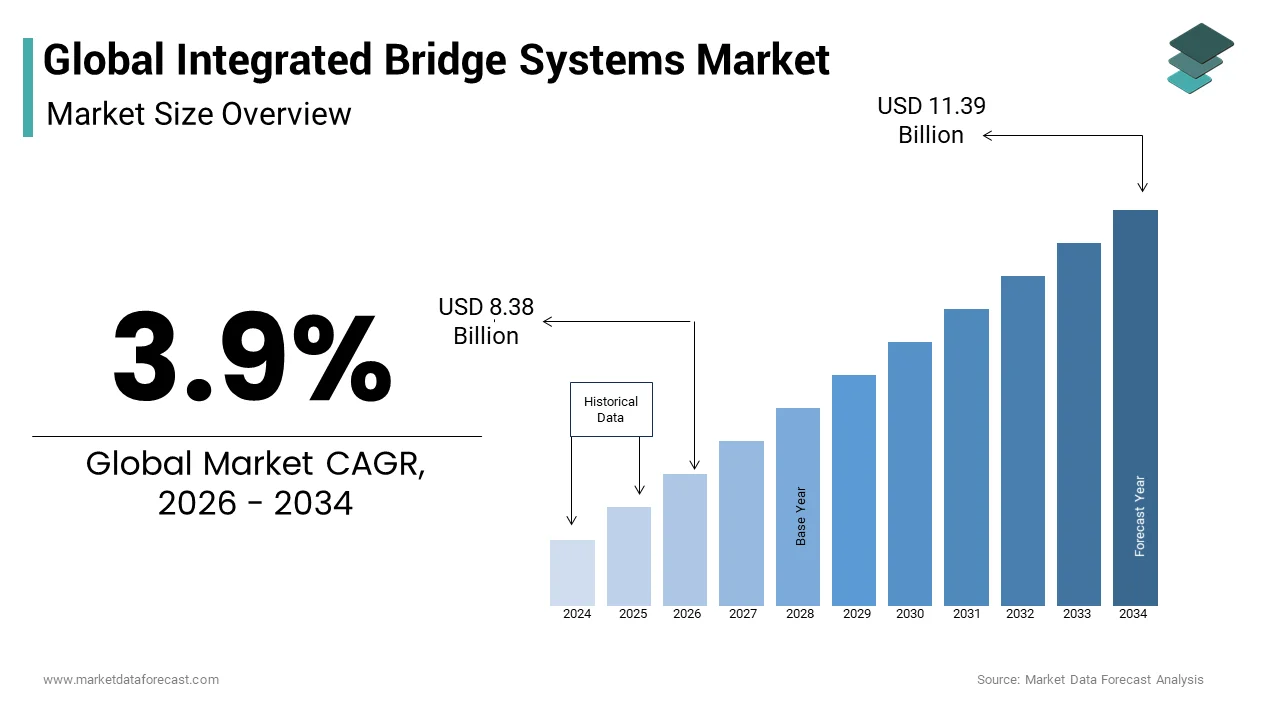
- Market Valuation: Valued at USD 8.07 billion in 2025, reaching USD 8.38 billion in 2026, and projected to expand to USD 11.39 billion by 2034, growing at a compound annual growth rate (CAGR) of 3.9% from 2026 to 2034.
- Primary Growth Drivers: Growth in maritime import/export activities, increasing maritime tourism and digitization, compliance with stringent maritime safety regulations, and rising port city developments in emerging countries.
Key Market Segment Metrics (2026–2034)
| Category | Leading Segment (2025 Position) | Fastest-Growing Segment |
|---|---|---|
| By Component | Hardware segment (holding the largest market share in terms of revenue and physical display architecture) | Software segment (expanding with the highest CAGR driven by rising demand for advanced analysis, monitoring applications, and user interface integration) |
| By Platform | Commercial Vessels segment (dominating the outlook period due to rising marine passenger transport and pleasure craft demand) | Naval Warships segment (advancing with specialized defense integration requirements) |
| By Vessel Size | Medium and Large vessels (commanding high-capacity commercial shipping deployment) | Small vessels and recreational craft adopting compact modular IBS configurations |
| By Region / Country | North America (traditionally receptive to technology adoption) and Asia-Pacific (leading due to booming shipbuilding industries in China, South Korea, and Japan) | Asia-Pacific (capturing immense container port volume and maritime infrastructure modernization) |
Major Market Players & Market Structure
Market Structure: Highly consolidated marine technology market dominated by established international maritime electronics and defense contractors providing modular, scalable, and open-architecture navigation solutions.
Key Companies: Kongsberg (Norway), Wärtsilä (Finland), Northrop Grumman Corporation (USA), Raytheon Company (USA), Furuno Electric Co. Ltd. (Japan), and Japan Radio Co. Ltd. (Japan).
Global Integrated Bridge Systems Market Size
The global integrated bridge systems market size was valued at USD 8.07 billion in 2025 and is anticipated to reach USD 8.38 billion in 2026 and to reach USD 11.39 billion by 2034, growing at a CAGR of 3.9% during the forecast period from 2026 to 2034.
An Integrated Bridge System (IBS) is a series of tightly grouped and connected displays and modules that provide centralized access to navigation, propulsion, surveillance, and control information. IBS aims to improve the safe and efficient vessel management by the skilled operator. It combines connected systems to allow a centralized monitoring of various navigation tools. IBS will enable operators to control sensor information for several operations, such as pass execution, machine control, communication, and safety. Integrating bridge systems helps operators intelligently plan routes, track control systems, and perform automatic route maintenance. An integrated gangway system improves operational efficiency for all navigation requirements. The IBS system extensively uses features such as flexibility, modularity, scalability, open architecture, and standard interfaces.
MARKET DRIVERS
Several shipping companies worldwide are implementing integrated bridge systems to improve safety and facilitate maritime operations. Integrated bridge systems are expected to gain popularity soon due to the significant growth in importing and exporting goods and services via the sea route.
In addition, increasing digitization leads to a marked increase in maritime tourism, further fueling the demand for optimized navigation systems. This, in turn, stimulates the growth of integrated bridge systems. In addition, a key factor estimated to drive the development of the integrated bridge systems market during the forecast period includes increased compliance with maritime safety regulations.
Nonetheless, the dramatically growing number of port cities in developing countries is estimated to provide significant growth opportunities for the Integrated Bridge Systems market during the outlook period.
MARKET RESTRAINTS
However, the lack of technical skills regarding IBS implementation is foreseen to limit the growth of the global market for integrated bridge systems in the coming years. Furthermore, digitization in the maritime sector makes ships vulnerable to cyber threats, which is expected to restrict the market for integrated bridge systems.
REPORT COVERAGE
| REPORT METRIC | DETAILS |
| Market Size Available | 2025 to 2034 |
| Base Year | 2025 |
| Forecast Period | 2026 to 2034 |
| CAGR | 3.9% |
| Segments Covered | Based on Component, Platform, Vessel Size, and Region |
| Various Analyses Covered | Global, Regional & Country Level Analysis, Segment-Level Analysis, DROC, PESTLE Analysis, Porter’s Five Forces Analysis, Competitive Landscape, Analyst Overview on Investment Opportunities |
| Regions Covered | North America, Europe, APAC, Latin America, Middle East & Africa |
| Market Leaders Profiled | Kongsberg (Norway), Wärtsilä (Finland), Northrop Grumman Corporation (USA), Raytheon Company (USA), Furuno Electric Co. Ltd. (Japan), and Japan Radio Co. Ltd. (Japan). |
SEGMENTAL ANALYSIS
By Component Insights
Of these, the hardware segment held a substantial share in the review period, while the software segment is touted to expand with the highest growth rate in the future.
An Integrated Bridge System (IBS) combines hardware and software that uses interconnected controls and displays to provide the mariner with a complete set of navigation data. The software segment is expected to experience a higher CAGR than the hardware segment during the forecast period. Software plays a vital role in this market, and its demand for analysis and monitoring applications is increasing. The individual components of the bridge system are integrated using software applications, which provide an interface to display information. However, it is estimated that the hardware segment held the largest market share.
By Platform Insights
The commercial segment is likely to dominate the market during the outlook period. An increase in the number of passengers using marine transportation and a surge in demand for pleasure craft will drive the growth of the commercial segment of the integrated bridge systems market globally.
REGIONAL ANALYSIS
North America is expected to dominate the market for integrated bridge systems, as the region is very receptive to adopting the latest technologies.
Asia-Pacific is anticipated to lead the integrated bridge systems market during the envisioned period. The shipbuilding industry in Asia-Pacific is booming, and significant regional players, such as South Korea, China, and Japan, are advancing technology skills to capture a more substantial market share. According to the World Shipping Council, Asia has the ten most active container ports. According to UNCTAD, in 2019, 64% of the world's container ports' total volume came from Asia, supporting the demand in the IBS market.
KEY MARKET PLAYERS
Some of the major players in the global integrated bridge systems market are
- Kongsberg (Norway)
- Wärtsilä (Finland)
- Northrop Grumman Corporation (USA)
- Raytheon Company (USA)
- Furuno Electric Co. Ltd. (Japan)
- Japan Radio Co. Ltd. (Japan).
MARKET SEGMENTATION
This research report on the global integrated bridge systems market has been segmented and sub-segmented based on the component, platform, vessel size, and region.
By Component
- Hardware
- Software
By Platform
- Commercial Vessels
- Naval Warships
By Vessel Size
- Small
- Medium
- Large
By Region
- North America
- Europe
- APAC
- Latin America
- Middle East and Africa