- Product Description Description
- Table of Contents TOC
- List of Table & Figure LOT
- Get Free Sample PDF Sample PDF
Market Size, 2025
$9.75 BnMarket Estimate, 2026
$10.41 BnMarket Forecast, 2034
$17.63 BnCAGR, 2026–2034
6.8%Executive Summary: Global MRO Software Market
- Market Scope: Comprehensive global evaluation of the Maintenance, Repair, and Overhaul (MRO) software sector, covering functions, technical solutions, pricing models, end-user categories, and regional deployments across North America, Europe, Asia-Pacific, Latin America, and Middle East & Africa.
- Market Valuation: Valued at USD 9.75 billion in 2025, reaching USD 10.41 billion in 2026, and projected to expand to USD 17.63 billion by 2034, growing at a compound annual growth rate (CAGR) of 6.8% from 2026 to 2034.
- Primary Growth Drivers: Rising demand to reduce response times, replacement of legacy systems with advanced SaaS digital solutions, fleet growth among commercial and military airlines, and increasing adoption of prescriptive/predictive analytics powered by AI and IoT.
Key Market Segment Metrics (2026–2034)
| Category | Leading Segment (2025 Position) | Fastest-Growing Segment |
|---|---|---|
| By Function | Maintenance Management segment (capturing the largest market share through basic maintenance, engine management, fleet management, and line maintenance modules) | Maintenance Management and Operations Management segments |
| By Solution | Software segment (dominating overall spending as digital platforms replace legacy management information tools) | Software segment (growing at a high CAGR driven by aviation digital upgrades) |
| By Pricing Model | Ownership model (historically capturing substantial baseline deployment revenues) | Subscription model (expanding at a high CAGR due to lower initial capital outlays, flexibility, and periodic renewal value metrics) |
| By End User | Operators and OEMs (managing massive commercial fleets) | MROs segment (registering the highest CAGR due to rising industry demands for digital operational efficiency) |
| By Region | North America (holding the largest share driven by massive commercial aircraft fleets and advanced analytics adoption in the US) | Asia-Pacific (surging rapidly with expanding fleet sizes and major maintenance hubs in China and Singapore) |
Major Market Players & Market Structure
Market Structure: Highly competitive global landscape featuring enterprise software leaders, aerospace specialists, and specialized aviation IT firms focusing on cloud integrations, predictive analytics, and flexible SaaS subscription models.
Key Companies: SAP SE (Germany), International Business Machines Corporation (US), HCL Technologies Limited (India), Ramco Systems Limited (India), IFS AB (Sweden), Oracle Corporation (US), Boeing (US), Infor (US), Trax (US), Swiss Aviation Software (Switzerland), IBS Software (India), and Lufthansa Technik AG (Germany).
Global MRO Software Market Size
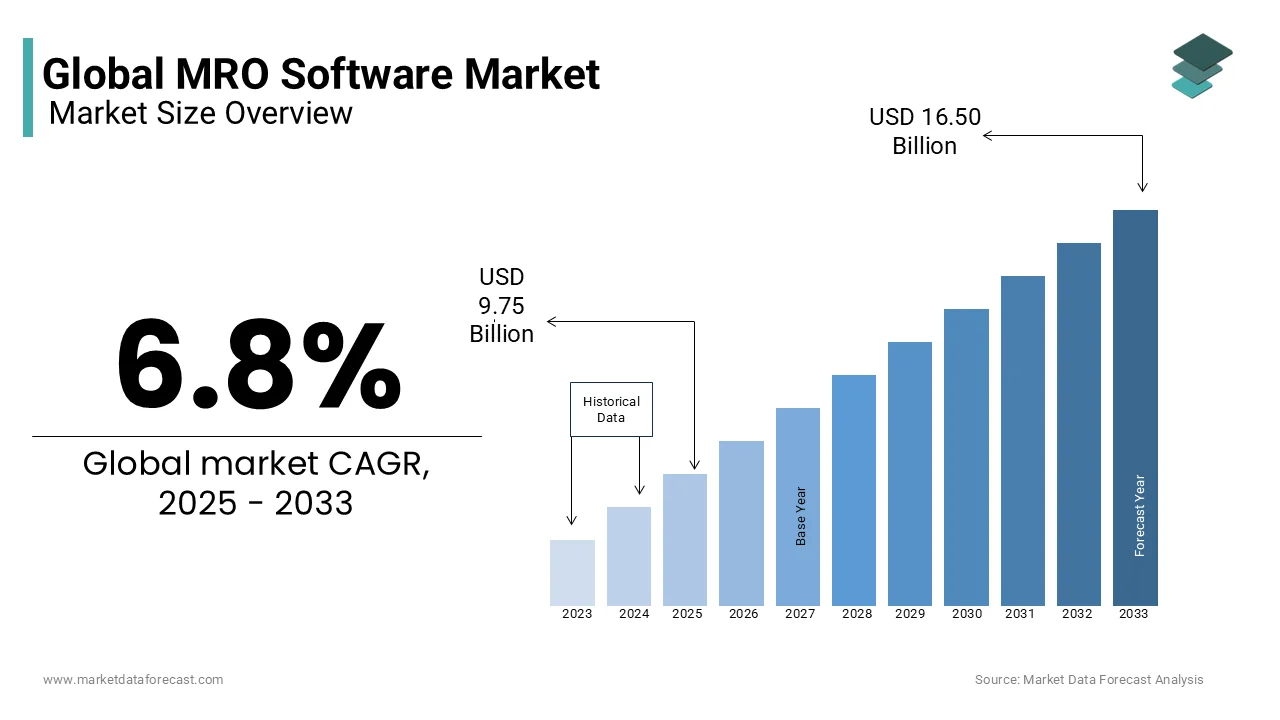
The global MRO software market size was valued at USD 9.75 billion in 2025 and is anticipated to reach USD 10.41 billion in 2026 to reach USD 17.63 billion by 2034, growing at a CAGR of 6.8% from 2026 to 2034.
MARKET DRIVERS
Rising Demand to Reduce Response Times and Increasing Adoption of Software as a Service
The MRO market uses aeronautical MRO software primarily to improve the functional efficiency of various activities, such as servicing, maintenance, upgrade, and modernization of various aircraft engines, spare parts, components, and systems. The industry is further classified according to the size of the employees, considering the adoption of the decided aeronautical MRO software. The replacement of legacy MRO software systems with advanced digital software solutions and IT infrastructure modernization programs is expected to boost the target market. The subscriber model is widely adopted by users of MRO software due to its advantages, such as low cost and flexibility of use. The initial cost of subscription-based software is usually lower than the proprietary model. Additionally, subscriptions are generally renewed monthly or annually, where the software provider is encouraged to demonstrate the continued value of the software in building a relationship with customers. Therefore, the subscription model should be one of the main drivers of MRO software. The global aviation industry is experiencing significant growth in the number of aircraft in the current market scenario. Commercial airlines and military forces buy aircraft in bulk, where substantial market space has been created for MRO activities. The increase in MRO business in recent times has been a big boost in the global MRO software market, which has allowed end-users to troubleshoot easily.
Furthermore, the request for aircraft maintenance based on prescriptive and predictive analytics is increasing exponentially among end-users, catalyzing the growth of the global MRO software market. The adoption of software as a service between airlines, aircraft original equipment manufacturers, and MRO companies has facilitated the escalation of the MRO software market over the years. Artificial Intelligence (AI), the Internet of Things, and Big Data will drive the market demand for aviation MRO software in the coming years.
MARKET RESTRAINTS
Limited budgets restrict MRO software acceptance and can hamper the global MRO software market. Another factor limiting the growth of the MRO software market is the lack of common data standards.
REPORT COVERAGE
| REPORT METRIC | DETAILS |
| Market Size Available | 2025 to 2034 |
| Base Year | 2025 |
| Forecast Period | 2026 to 2034 |
| CAGR | 6.8% |
| Segments Covered | By Function, Solution, Pricing Model, End User, and Region |
| Various Analyses Covered | Global, Regional & Country Level Analysis, Segment-Level Analysis, DROC, PESTLE Analysis, Porter’s Five Forces Analysis, Competitive Landscape, Analyst Overview on Investment Opportunities |
| Regions Covered | North America, Europe, APAC, Latin America, Middle East & Africa |
| Market Leaders Profiled | HCL Technologies Limited (India), SAP SE (Germany), International Business Machines Corporation (US), Ramco Systems Limited (India), IFS AB (Sweden), Oracle Corporation (US), Boeing (US), Infor (US), Trax (US), Swiss Aviation Software (Switzerland), IBS Software (India), Rusada (Switzerland), Communications Software Limited (UK), Flatirons Solutions, Inc. (US), Aviation Intertec Services (Canada), BytzSoft Technologies Pvt. Ltd. (India), Tracware Limited (UK), FLY Online Tools (US), Aerosoft Systems Inc. (US), Lufthansa Technik AG (Germany), GE Aviation (US), and Sopra Steria (France). |
SEGMENTAL ANALYSIS
By Function Insights
The maintenance management segment is expected to have the largest market share during the outlook period. In addition, it is segmented into basic maintenance, engine maintenance, fleet management, and line maintenance. Demand from operators and MROs for efficient management of heavy maintenance controls is likely to increase demand for the basic maintenance MRO software module in the coming years.

By Solution Insights
The software section is supposed to grow at a high CAGR during the outlook period. The growing need to upgrade legacy Management Information systems to digital MRO software in aviation is driving the market growth.
By Pricing Model Insights
The subscription model segment is estimated to grow at a high CAGR as it is extensively used by MRO software users due to its low-cost advantages and flexibility of use. Additionally, subscriptions are typically renewed on a monthly or annual basis, which encourages the software vendor to demonstrate the ongoing value of the software and build relationships with customers.
By End User Insights
The MRO segment is foreseen to register the highest CAGR because of the rising call for digitization in the aviation sector. The industry uses an aeronautical MRO software tool to improve functional efficiencies in various aeronautical MRO activities, such as service, maintenance, upgrade, and modernization of various aircraft engines, spare parts, and system components.
REGIONAL ANALYSIS
The North American region is expected to have the largest share during the outlook period due to a large fleet of aircraft in the United States and the growing need for analytics to improve service industries are some of the factors that drive the progress of the market. Furthermore, an increase in government funding for research and development activities is also driving the market growth. The increasing progress and development of sophisticated drone software in China are driving substantial market growth. The growth of the aircraft fleet and the presence of major aircraft maintenance and repair facilities in countries such as China and Singapore that adopt MRO software are driving the market growth.

KEY MARKET PLAYERS
The key market players in the global MRO Software market are
- HCL Technologies Limited (India)
- SAP SE (Germany)
- International Business Machines Corporation (US)
- Ramco Systems Limited (India)
- IFS AB (Sweden)
- Oracle Corporation (US)
- Boeing (US)
- Infor (US)
- Trax (US)
- Swiss Aviation Software (Switzerland)
- IBS Software (India)
- Rusada (Switzerland)
- Communications Software Limited (UK)
- Flatirons Solutions, Inc. (US)
- Aviation Intertec Services (Canada)
- BytzSoft Technologies Pvt. Ltd. (India)
- Tracware Limited (UK)
- FLY Online Tools (US)
- Aerosoft Systems Inc. (US)
- Lufthansa Technik AG (Germany)
- GE Aviation (US)
- Sopra Steria (France).
SAP is a German International company that manufactures business software to manage business operations and customer relationships. The company is recognized for its ERP software. In terms of revenue, SAP is the largest software publisher in Europe and the third largest in the world.
RECENT MARKET NEWS
-
In June 2020, IBS Software signed an agreement to collaborate with cargo with proven integration, providing seamless access to airline cargo and an emerging user base.
-
In June 2020, GE Aviation launched a Health Application identification card for the aviation industry. The solution focuses on three important areas: employee screening, passenger screening, and object screening.
MARKET SEGMENTATION
This research report on the global MRO software market has been segmented and sub-segmented based on the function, solution, pricing model, end user, and region.
By Function
- Maintenance management
- Operations management
- Commercial management
- Electronic management of flight bags and flight logbooks
By Solution
- Software
- Services
By Pricing Model
- Subscription model
- Ownership model
By End User
- Operators
- OEMS
- MROS
- Lessors
By Region
- North America
- Europe
- Asia-Pacific
- Latin America
- Middle East and Africa