- Product Description Description
- Table of Contents TOC
- List of Table & Figure LOT
- Get Free Sample PDF Sample PDF
Market Size, 2025
$0.84 BnMarket Estimate, 2026
$0.91 BnMarket Forecast, 2034
$1.68 BnCAGR, 2026–2034
7.94%Executive Summary: Global Harbor Management Software Market
- Market Scope: Comprehensive global analysis of the harbor management software sector, covering end-user tiers, cloud and on-premises deployments, and core port operations or logistics applications.
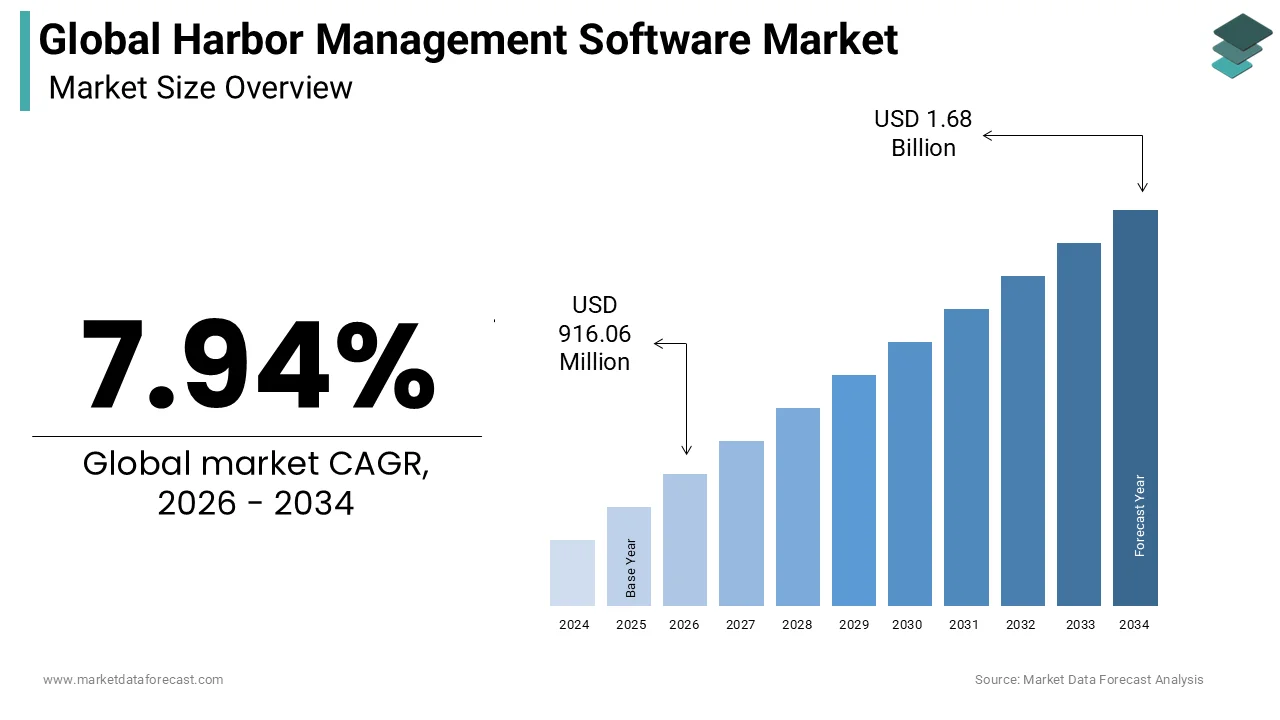
- Market Valuation: Valued at USD 848.68 million in 2025, reached USD 916.06 million in 2026, and is projected to scale up to USD 1.68 billion by 2034, registering a compound annual growth rate (CAGR) of 7.94% across the forecast period.
- Primary Growth Drivers: Surge in global container traffic, stringent environmental compliance regulations, and the ongoing structural shift toward smart port ecosystems and digitized marine logistics worldwide.
Key Market Segment Metrics
| Category | Leading Segment (Base Position) | Fastest-Growing / High-Growth Segment |
|---|---|---|
| By End User & Deployment | Large Enterprises (dominant market share driven by high-volume throughput and extensive infrastructure) & On-Premises (leading deployment prioritized for data sovereignty, low-latency, and security control) | Small and Medium-Sized Enterprises (fastest-growing category registering 13.3% CAGR via cloud SaaS models) & Cloud (fastest-growing deployment expanding at 14.4% CAGR due to scalability and lower cost of ownership) |
| By Application | Port Operations Management (dominant share ensuring essential berth scheduling, crane allocation, and yard management) | Logistics & Supply Chain Coordination (fastest-growing at 16.1% CAGR for end-to-end visibility) |
| By Region | North America (leading regional market with advanced infrastructure and federal cybersecurity enforcement) | Asia-Pacific (fastest-growing regional hub powered by extensive port capacity and smart city/port initiatives) |
Major Market Players & Industry Landscape
Market Structure: Highly competitive global tech-driven landscape featuring major software and engineering enterprises navigating high implementation costs, legacy complexities, and critical cybersecurity vulnerabilities.
Key Companies: Oracle Corporation, IBM Corporation, SAP SE, Hexagon AB, Kaleris, Tideworks Technology, Navis, Awake.AI, NXT Port, PortXchange, ABB Ltd., Siemens AG, Wärtsilä, TBA Group, and INFORM GmbH.
 Download Free Sample Report
Global Harbor Management Software Market Size
The Global Harbor Management Software market size was calculated at USD 848.68 million in 2025 and is anticipated to reach USD 1.68 billion by 2034, from USD 916.06 million in 2026, growing at a CAGR of 7.94% during the forecast period.
Harbor management software represents a comprehensive digital ecosystem designed to optimize the operational efficiency, security, and logistical coordination of port authorities and terminal operators. These platforms integrate diverse functions, including vessel traffic services, berth allocation, cargo handling, gate automation, and environmental monitoring into a unified interface. The technology leverages real-time data from Internet of Things sensors, automated identification systems, and global positioning satellites to facilitate seamless communication between stakeholders such as shipping lines, customs agencies, and logistics providers. According to the United Nations Conference on Trade and Development, maritime transport handles over 80% of global merchandise trade by volume, underscoring the critical need for efficient port operations to sustain international supply chains. As per the International Maritime Organization, the implementation of digital solutions is essential for meeting carbon intensity indicators that require ports to reduce emissions through optimized vessel turnaround times. Modern harbor management systems enable predictive analytics that anticipate congestion and automate resource allocation, significantly reducing dwell times for containers and vessels. The integration of blockchain technology enhances transparency in documentation processes, minimizing fraud and administrative delays. Regulatory frameworks such as the European Union’s Single Window Environment for Customs mandate the digitization of reporting procedures, driving adoption among major port hubs. These software solutions transform traditional ports into smart hubs capable of handling increasing cargo volumes while maintaining high safety standards and environmental compliance. The shift toward autonomous vessels and automated cranes further necessitates robust software infrastructure to manage complex interactions within the port environment.
MARKET DRIVERS
Surge in Global Container Traffic Necessitates Operational Efficiency
The exponential growth in global maritime trade volumes places immense pressure on port infrastructure, which is compelling authorities to adopt advanced harbor management software to prevent bottlenecks and maintain competitive service levels, and is a key market driver. According to the World Bank, global container port throughput remains high, reflecting a steady increase in demand that outpaces physical infrastructure expansion capabilities. Ports face chronic congestion issues when manual processes fail to keep pace with the rapid influx of vessels and cargo, leading to costly delays for shipping lines and supply chain disruptions. Harbor management software addresses this challenge by optimizing berth scheduling and yard planning through algorithmic precision, ensuring that limited dock space is utilized maximally. As per the Port of Rotterdam, the implementation of integrated digital systems and machine learning models has successfully reduced waiting times by 20%. Automated gate systems powered by these platforms reduce truck waiting times, enhancing landside connectivity and reducing local traffic congestion. Shipping alliances demand faster turnaround to maintain schedule reliability, pressuring ports to eliminate inefficiencies through digital transformation. The cost of demurrage and detention charges incurred due to port delays amounts to billions of dollars annually, providing a strong financial incentive for operators to invest in software solutions that streamline operations. As vessel sizes continue to increase with ultra-large container ships requiring precise coordination, the complexity of port operations escalates beyond human management capacity, making sophisticated software indispensable for maintaining operational continuity and meeting service level agreements.
Stringent Environmental Regulations Drive Digital Compliance Solutions
International and regional regulatory bodies are enforcing stricter environmental standards on port operations, which are driving the adoption of harbor management software that enables accurate monitoring and reporting of emissions and energy consumption, and further contributing to the harbor management software market expansion. As per the International Maritime Organization, the Carbon Intensity Indicator mechanism requires ships to track and reduce their carbon footprint, necessitating detailed data collection that manual systems cannot provide efficiently. Harbor management platforms integrate with environmental sensors to monitor air quality, water pollution, and noise levels in real time, allowing authorities to take immediate corrective actions when thresholds are exceeded. The European Green Deal mandates that major ports achieve climate neutrality by 2050, prompting significant investments in digital tools that optimize energy usage and support the transition to shore power facilities. Software solutions enable the calculation of precise emission inventories for vessels at berth, facilitating compliance with local sulfur oxide and nitrogen oxide limits. As per industry benchmarks, predictive analytics in port operations can lead to a 20% reduction in greenhouse gas emissions by optimizing vessel berthing sequences and minimizing idle times. Additionally, digital platforms streamline the reporting process for regulatory submissions, reducing administrative burdens and minimizing the risk of non-compliance penalties. Governments are increasingly linking port funding and concessions to environmental performance metrics, making digital compliance capabilities a prerequisite for operational licenses. This regulatory landscape transforms environmental management from a voluntary initiative into a core operational requirement, fuelling demand for specialized software modules that ensure transparency and accountability in sustainability efforts.
MARKET RESTRAINTS
High Implementation Costs and Legacy System Integration Complexities
The substantial financial investment required for deploying harbor management software is primarily impeding the harbor management software market growth, particularly for smaller ports and developing nations with limited budgetary resources. Implementing a comprehensive digital platform involves not only licensing fees but also extensive costs related to hardware upgrades, network infrastructure development, and specialized personnel training. According to industry analysis, the initial deployment cost for a mid-sized port can exceed 5 million dollars, with ongoing maintenance and update expenses adding to the total cost of ownership. Many ports operate on legacy systems that were developed decades ago and lack the interoperability required for modern digital integration. Migrating data from these outdated architectures to newcloud-basedd or hybrid environments is a complex and risky process that often leads to operational disruptions during the transition phase. The customization needed to align software functionalities with unique port workflows further inflates development costs and extends implementation timelines. Small and medium-sized ports struggle to justify such expenditures when facing thin profit margins and volatile cargo volumes. Furthermore, the shortage of skilled IT professionals with expertise in maritime logistics creates a talent gap that hinders effective system management and optimization. These financial and technical barriers prevent widespread adoption, leaving many ports reliant on inefficient manual processes that compromise their competitiveness in the global supply chain. The reluctance to invest in unproven technologies amidst economic uncertainty further slows market penetration, particularly in regions where government support for digital infrastructure is lacking.
Cybersecurity Vulnerabilities Threaten Critical Port Operations
The increasing digitization of port operations exposes harbor management systems to sophisticated cyber threats that can disrupt critical infrastructure and compromise sensitive data, which is another significant restraint to the global market growth. Ports are considered critical national infrastructure, making them attractive targets for state-sponsored actors, criminal organizations, and hacktivists seeking to cause economic damage or extract ransom payments. As per the American Society of Civil Engineers, cyber-attacks on transportation infrastructure saw a significant increase in recent years, highlighting the growing vulnerability of interconnected digital systems. Harbor management software relies on continuous data exchange with external stakeholders, including shipping lines, customs agencies, and logistics providers, creating multiple entry points for potential breaches. A successful ransomware attack can halt terminal operations, freeze cargo movements, and lead to significant financial losses and reputational damage. The 2017 NotPetya attack on Maersk demonstrated how a single cyber incident could disrupt global shipping networks for weeks, costing hundreds of millions of dollars. Ensuring robust cybersecurity requires continuous investment in encryption, firewalls, intrusion detection systems, and employee training, which adds to the operational burden for port authorities. Many legacy systems lack built-in security features, making them susceptible to exploitation even when newer software layers are added. The complexity of securing Internet of Things devices connected to the network further exacerbates the risk profile. Regulatory requirements for data protection, such as the General Data Protection Regulation, impose strict liability for data breaches, increasing the legal and financial stakes for port operators. This persistent threat landscape forces organizations to prioritize security over functionality, potentially slowing the adoption of innovative features that may introduce new vulnerabilities.
MARKET OPPORTUNITIES
Integration with Blockchain for Enhanced Supply Chain Transparency
The adoption of blockchain technology within harbor management software presents a significant opportunity for the harbor management software market. Traditional paper-based documentation for cargo handling is prone to errors, fraud, and delays, costing the shipping industry an estimated 15 billion dollars annually, according to the World Economic Forum. Blockchain-enabled harbor management platforms create immutable digital records of transactions, bills of lading, and customs declarations that are accessible to all authorized parties in real time. This decentralized ledger system eliminates the need for intermediaries and reduces the time required for verification and approval processes. Various industry initiatives have demonstrated the potential for blockchain to streamline data sharing among multiple stakeholders, paving the way for new industry-led solutions. Smart contracts embedded within the software can automate payments and release of cargo once predefined conditions are met, accelerating cash flow and reducing administrative overhead. Ports that implement blockchain solutions can offer value-added services to shipping lines and freight forwarders, differentiating themselves in a competitive market. The ability to trace the origin and journey of goods enhances compliance with sanitary and phytosanitary regulations, which is increasingly important for agricultural and pharmaceutical shipments. As global trade demands greater visibility and trust, harbor management software that integrates blockchain capabilities will become essential for facilitating seamless cross-border transactions and reducing friction in international logistics networks.
Expansion into Smart Port Ecosystems through Internet of Things Connectivity
The evolution of ports into smart ecosystems driven by the Internet of Things offers substantial opportunities for harbor management software providers to expand their functional scope and value proposition. Smart ports utilize a dense network of sensors, cameras, and connected devices to collect granular data on every aspect of port operations, from container positions to crane performance. Harbor management software serves as the central brain that processes this vast amount of data to enable predictive maintenance, automated resource allocation, and real-time decision making. As per case studies, ports have reported a 10% increase in operational efficiency after deploying an Internet of Things-based platform that monitors equipment health and predicts failures before they occur. This proactive approach reduces downtime and maintenance costs while extending the lifespan of critical assets. Software providers can offer modular solutions that allow ports to start with basic connectivity and gradually add advanced analytics and artificial intelligence capabilities as their digital maturity grows. The integration of autonomous guided vehicles and automated stacking cranes requires sophisticated software coordination to ensure safe and efficient interaction with human-operated equipment. As 5G networks become widely available in port areas, the latency and bandwidth limitations that previously hindered real-time data processing are being removed, enabling more complex applications. This technological convergence allows harbor management software to evolve from a transactional tool into a strategic asset that drives continuous improvement and innovation in port operations, opening new revenue streams through data monetization and premium analytical services.
MARKET CHALLENGES
Interoperability Issues among Heterogeneous Stakeholder Systems
A major challenge facing the harbor management software market is the lack of standardization and interoperability among the diverse systems used by various stakeholders in the port ecosystem. Ports interact with shipping lines, terminal operators, freight forwarders, customs authorities, and rail providers, each of whom may use different software platforms with proprietary data formats and communication protocols. This fragmentation creates data silos that hinder seamless information exchange and require manual intervention to reconcile discrepancies. The International Port Community Systems Association highlights that inconsistent data standards result in significant inefficiencies and increased administrative costs for all parties involved. Developing middleware solutions to bridge these gaps is technically complex and expensive, often leading to fragile integrations that break down when systems are updated. The absence of a universal data standard for maritime logistics means that harbor management software vendors must constantly adapt their products to connect with a wide array of external systems, diverting resources from innovation. Stakeholders are often reluctant to change their existing systems due to high switching costs and operational risks, perpetuating the interoperability problem. This lack of cohesion prevents the realization of fully automated end-to-end supply chain visibility, limiting the overall effectiveness of harbor management solutions. Efforts to establish global standards, such as the Digital Container Shipping Association guidelines, are progressing slowly, leaving the industry in a transitional state where manual workarounds remain necessary despite significant digital investments.
Resistance to Cultural Change and Workforce Adaptation
The successful implementation of harbor management software is frequently hindered by resistance to cultural change and the difficulty of adapting the workforce to new digital workflows, which is also challenging the global market expansion. Port operations have traditionally relied on experienced personnel who manage tasks through established manual processes and informal communication channels. Introducing automated systems and data-driven decision-making tools requires a significant shift in mindset and behavior that many employees find challenging. According to industry research, 70% of digital transformation initiatives fail to achieve their goals due to employee resistance and lack of engagement. Older workers may struggle to acquire the necessary digital skills, leading to productivity dips during the transition period. Training programs are often insufficient or poorly timed, resulting in frustration and reduced morale among staff who feel threatened by automation. Unionized labor forces in many ports may oppose digitalization efforts due to fears of job displacement, leading to industrial action that disrupts implementation schedules. Management must invest heavily in change management strategies to address these concerns and foster a culture of innovation and continuous learning. However, many port authorities lack the expertise or resources to execute effective change management programs, leading to underutilization of the software capabilities. This human factor remains a critical barrier that technology alone cannot overcome, requiring a holistic approach that balances technical deployment with organizational development and workforce empowerment to ensure long-term success.
REPORT COVERAGE
| REPORT METRIC | DETAILS |
| Market Size Available | 2025 to 2034 |
| Base Year | 2025 |
| Forecast Period | 2026 to 2034 |
| CAGR | 7.94% |
| Segments Covered | By End User, Deployment, Application, and Region |
| Various Analyses Covered | Global, Regional & Country Level Analysis; Segment-Level Analysis; DROC, PESTLE Analysis; Porter’s Five Forces Analysis; Competitive Landscape; Analyst Overview of Investment Opportunities |
| Regions Covered | North America, Europe, Asia Pacific, the Middle East and Africa, And Latin America |
| Market Leaders Profiled | Oracle Corporation, IBM Corporation, SAP SE, Hexagon AB, Kaleris, Tideworks Technology, Navis, Awake.AI, NXT Port, PortXchange, ABB Ltd., Siemens AG, Wärtsilä, TBA Group, INFORM GmbH |
SEGMENTAL ANALYSIS
By End User Insights
The large enterprises segment dominated the market by capturing the highest share of the global market in 2025. The dominance of the large enterprises segment in the global market can be credited to the sheer scale of their operations, substantial capital budgets, and the critical need for integrated digital solutions to manage complex global supply chains. Major port authorities and terminal operators handle millions of containers annually, requiring robust software infrastructure to maintain efficiency and compliance. Large port authorities and terminal operators manage vast infrastructures that include multiple berths, extensive yard areas, and intricate intermodal connections, necessitating comprehensive harbor management software to coordinate these elements effectively. According to the United Nations Conference on Trade and Development, the top 100 container ports globally handle a massive concentration of traffic that demands high-performance computing and advanced analytics. These large entities operate 24 hours a day with thousands of simultaneous transactions involving vessels, trucks, trains, and customs agencies, creating data volumes that manual systems cannot process. The cost of operational inefficiencies for a large port can exceed 100 million dollars annually due to demurrage charges and lost throughput, providing a strong financial imperative for investing in premium software solutions. Large enterprises also face stricter regulatory scrutiny regarding environmental emissions and security protocols, requiring specialized modules for real-time monitoring and reporting that are only available in enterprise-grade platforms. The ability to integrate with existing enterprise resource planning and customer relationship management systems is crucial for maintaining data consistency across the organization. Furthermore, large ports serve as hubs for global shipping alliances that demand standardized digital interfaces for booking and tracking, forcing operators to adopt sophisticated software that meets international industry standards. This complexity ensures that large enterprises remain the primary consumers of advanced harbor management technologies.
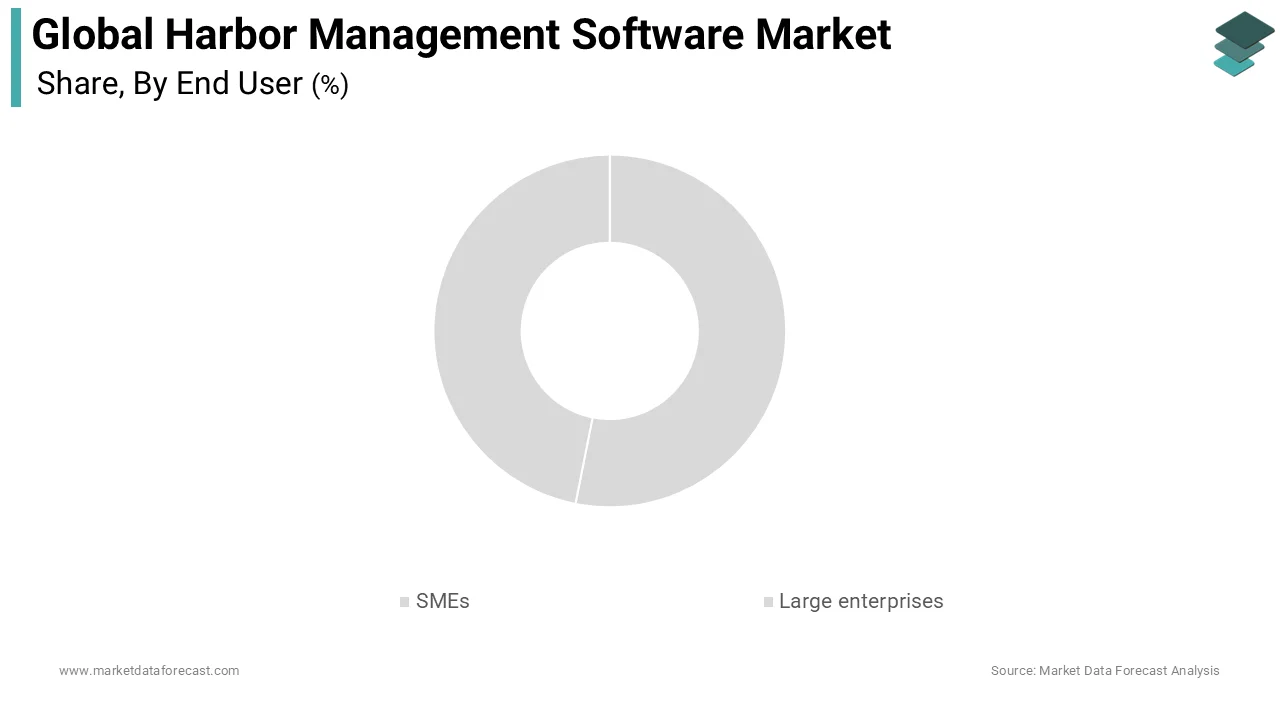
On the other side, the small and medium-sized enterprises segment is the fastest-growing segment and is predicted to register a CAGR of 13.3% during the forecast period, owing to the availability of cloud-based software as a service models that lower entry barriers and the increasing pressure to digitize regional trade hubs. The emergence of cloud-based harbor management software has democratized access to advanced digital tools, allowing small and medium-sized ports to adopt sophisticated systems without the heavy upfront capital expenditure associated with on-premises installations. Software as a service models enable ports to pay subscription fees based on usage, transforming large capital expenses into manageable operational costs. According to industry data, the adoption of cloud services in the logistics sector continues to grow annually, driven by the flexibility and scalability they offer to smaller organizations. Small ports often lack the IT infrastructure and technical expertise to manage complex server environments, making cloud solutions an attractive alternative that includes maintenance, updates, and security patches provided by the vendor. This shift allows smaller operators to compete more effectively with larger hubs by improving their turnaround times and service reliability. The modular nature of cloud platforms enables SMEs to start with basic functionalities such as berth scheduling and gradually add modules for billing or gate automation as their needs evolve. This scalability reduces the risk of implementation failure and ensures that the software grows with the business. As internet connectivity improves in remote coastal regions, the viability of cloud-based solutions increases, opening up new markets for software providers who previously focused exclusively on large terminals.
By Deployment Insights
The on-premises segment led the market in 2025 by holding the leading share of the global market because many port authorities prioritize data sovereignty, security control, and low-latency performance for critical operational systems that cannot tolerate internet connectivity issues. Port authorities often classify operational data as critical national infrastructure information, necessitating strict control over where and how this data is stored and processed. On-premises deployment allows ports to keep all sensitive data within their physical boundaries, complying with stringent national security regulations and data protection laws that restrict cross-border data flows. As per international guidelines, increasing maritime cyber risk prompts many governments to mandate local storage of vessel traffic and cargo data to prevent foreign surveillance or interference. Large ports prefer on-premises servers because they can implement customized security protocols, air gapped networks, and physical access controls that are difficult to replicate in shared cloud environments. The fear of data breaches exposing proprietary operational details or national security vulnerabilities makes local hosting the preferred choice for state-owned port authorities. Additionally, on-premises systems provide complete ownership of the hardware and software lifecycle, allowing ports to dictate upgrade schedules and maintenance windows without relying on third-party vendor availability. This level of control is essential for integrating with legacy industrial control systems that may not be compatible with cloud architectures. The ability to audit and verify security measures internally provides peace of mind for regulators and stakeholders, reinforcing the dominance of on-premises deployment in the market despite the rising popularity of cloud alternatives.
However, the cloud segment is growing exponentially and is estimated to register a CAGR of 14.4% during the forecast period, owing to the rising need for scalability, remote accessibility, and reduced IT maintenance burdens for port operators. Cloud deployment offers unparalleled scalability, allowing port operators to adjust computing resources dynamically based on fluctuating cargo volumes and seasonal demands without investing in additional physical hardware. This flexibility is particularly valuable for ports experiencing rapid growth or variable traffic patterns, as it prevents over-provisioning and underutilization of IT assets. According to industry analysts, organizations that migrate to cloud infrastructure reduce their total cost of ownership by up to 30% over five years due to savings on hardware maintenance, energy consumption, and physical space. Cloud-based harbor management software enables automatic updates and feature enhancements delivered by the vendor, ensuring that ports always have access to the latest technologies without disruptive upgrade projects. The subscription-based pricing model transforms capital expenditures into predictable operational expenses, improving cash flow management for port authorities. Additionally, cloud platforms facilitate easier integration with external stakeholders such as shipping lines and customs agencies through standardized APIs, enhancing supply chain visibility. The ability to access the system from any location supports remote monitoring and management, which became increasingly important during recent global disruptions. As confidence in cloud security grows and connectivity improves, more ports are shifting non-critical and eventually critical applications to the cloud, driving rapid growth in this segment.
By Application Insights
The port operations management segment held the major share of the global market in 2025. Port operations management software is the backbone of terminal activities, handling the complex logic required to allocate berths, schedule cranes, and manage container storage efficiently. Without these core functions, a port cannot operate effectively, making this application a mandatory investment for any commercial terminal. According to industry research, efficient berth utilization can increase terminal throughput by up to 20%, directly impacting revenue and competitiveness. The software optimizes the sequence of vessel arrivals and departures to minimize idle time and maximize crane productivity, which is critical given the high cost of port equipment. Yard management modules ensure that containers are stacked logically to minimize reshuffling and retrieval times, reducing fuel consumption and wear on machinery. The integration of these functions into a single platform provides operators with a holistic view of terminal status, enabling quick decision-making during disruptions. Since every port, regardless of size or specialization, requires these fundamental operational capabilities, the demand for port operations management software is universal and consistent. The continuous need to improve turnaround times and reduce operational costs ensures that this segment remains the largest and most stable part of the harbor management software market.
On the other hand, the logistics and supply chain coordination segment is the fastest-growing segment and is expected to exhibit a CAGR of 16.1% during the forecast period, owing to the growing demand for end-to-end visibility and seamless integration with broader supply chain networks. Shippers and consignees increasingly demand real-time visibility into the status and location of their cargo throughout the entire supply chain, extending beyond the port gates to inland destinations. Harbor management software is evolving to include modules that track cargo movement across multiple modes of transport, providing a single source of truth for all stakeholders. According to industry reports, visibility is a top priority for supply chain leaders, with 90% of companies investing in technologies that enhance tracking capabilities. By integrating with railway and trucking systems, port software can provide accurate estimated times of arrival and departure, reducing uncertainty and inventory holding costs for customers. This transparency builds trust and strengthens relationships between ports and their clients, becoming a key differentiator in a competitive market. The ability to proactively notify stakeholders of delays or exceptions allows for quicker mitigation actions, minimizing supply chain disruptions. As global supply chains become more complex and fragmented, the value of coordinated logistics information increases, driving rapid adoption of these advanced software features.
REGIONAL ANALYSIS
North America Harbor Management Software Market Analysis
North America captured the highest share of the global market in 2025 and is expected to see steady growth as ports prioritize the modernization of aging infrastructure and the implementation of robust cybersecurity frameworks over the next few years. The United States represents the largest national market, with ports like Los Angeles, Long Beach, and New York/New Jersey investing heavily in digital solutions to address congestion and improve efficiency. The Federal Maritime Commission’s focus on supply chain bottlenecks has accelerated funding for technology upgrades, while the Cybersecurity and Infrastructure Security Agency mandates robust digital defenses for critical port assets. Canada is also advancing its port digitalization through the Vancouver Fraser Port Authority’s smart port initiatives, leveraging software to optimize rail and truck connectivity. The region benefits from a strong presence of leading software vendors and a mature IT ecosystem that supports complex implementations. High labor costs drive the adoption of automation and software-driven efficiency gains. The emphasis on environmental sustainability, particularly in California, requires software that can monitor and report emissions accurately. These factors combine to make North America a leader in the adoption of sophisticated harbor management solutions.
Europe Harbor Management Software Market Analysis
Europe is likely to maintain its dominant position by accelerating digital twin adoption and environmental compliance as part of its Green Deal initiatives over the next few years. The European Union’s Green Deal and Digital Transport Logistics Forum drive the adoption of software that enhances energy efficiency and data sharing. Ports in Rotterdam, Hamburg, and Antwerp are pioneers in implementing digital twin technologies and blockchain for supply chain transparency. The Single Window Environment for Customs regulation mandates standardized digital reporting, forcing ports across the continent to upgrade their management systems. The region’s focus on interoperability and standardization through the European Port Community System Association facilitates smoother cross-border trade. High awareness of cybersecurity risks leads to significant investment in secure software architectures. The presence of major global shipping lines headquartered in Europe further drives demand for integrated digital platforms. These regulatory and technological drivers ensure Europe remains at the forefront of harbor management software innovation and adoption.
Asia-Pacific Harbor Management Software Market Analysis
Asia-Pacific is expected to witness the highest rate of infrastructure expansion and smart port integration, solidifying its role as the global growth engine over the next few years. Factors such as the massive expansion in port capacity, rising trade volumes, and government initiatives to build smart ports in China, India, and Southeast Asia are propelling the market growth in the Asia-Pacific. China dominates the region with the world’s busiest ports, such as Shanghai and Shenzhen, investing billions in automated terminals and advanced management software to maintain its competitive edge. The Chinese government’s Belt and Road Initiative encourages digital connectivity among participating ports, driving software adoption. India is modernizing its major ports under the Sagarmala project, incorporating digital systems to improve efficiency and reduce dwell times. Southeast Asian countries like Singapore and Vietnam are adopting smart port technologies to handle increasing transshipment traffic. The region’s rapid economic growth and expanding middle class drive consumer goods imports, increasing pressure on port infrastructure. Government support for digital infrastructure and a growing local software development industry contribute to market expansion. These dynamic factors position the Asia Pacific as the primary engine of global growth for harbor management software.
COMPETITION OVERVIEW
The harbor management software market features intense competition among established technology giants and specialized niche providers vying for dominance in digital port solutions. Major players differentiate themselves through comprehensive integrated platforms that combine terminal operating systems with community connectivity and advanced analytics capabilities. Specialized firms compete by offering highly customized solutions tailored to specific port types such as container, bulk, or cruise terminals. Innovation cycles are rapid as companies integrate emerging technologies like artificial intelligence, Internet of Things, and blockchain to enhance operational efficiency and transparency. Strategic alliances with hardware manufacturers and telecommunications providers create holistic smart port ecosystems that lock in customers through interoperability. Price competition is moderate in the high-end segment, where performance and reliability outweigh cost considerations, but it intensifies in the small and medium-sized port sector. Regulatory compliance capabilities serve as a key differentiator, particularly in regions with strict environmental and security mandates. Customer retention relies heavily on continuous support and software updates that adapt to evolving trade patterns and technological standards. The market remains fragmented due to diverse regional requirements and legacy system constraints, preventing total consolidation.
KEY MARKET PLAYERS
A few major players in the global harbor management software market include
- Oracle Corporation
- IBM Corporation
- SAP SE
- Hexagon AB
- Kaleris
- Tideworks Technology
- Navis
- Awake.AI
- NXT Port
- PortXchange
- ABB Ltd
- Siemens AG
- Wärtsilä
- TBA Group
- INFORM GmbH
Top Strategies Used by Key Market Participants
Key players in the harbor management software market prioritize the development of cloud native architectures to enhance scalability and reduce implementation costs for port authorities. Strategic partnerships with technology providers enable integration of artificial intelligence and blockchain for improved operational efficiency and transparency. Companies focus on modular software designs that allow ports to adopt specific functionalities gradually without disrupting existing workflows. Investment in cybersecurity measures is critical to protect sensitive maritime data and ensure compliance with international regulations. Expanding into emerging markets through local collaborations helps vendors navigate regulatory complexities and cultural barriers. Continuous innovation in user interface design improves adoption rates among the port workforce with varying digital literacy levels. These strategies collectively drive market growth by addressing the diverse operational needs and technological requirements of global port ecosystems effectively.
Leading Players in the Global Market
- Oracle Corporation provides comprehensive harbor management solutions through its specialized port and terminal operating systems that integrate seamlessly with broader enterprise resource planning platforms. The company leverages its robust cloud infrastructure to offer scalable software as a service models for global port authorities seeking digital transformation. Recent actions include enhancing artificial intelligence capabilities within its logistics modules to predict vessel arrival times and optimize berth allocation dynamically. Oracle collaborates with major shipping alliances to ensure data interoperability and streamline supply chain visibility. Their focus on cybersecurity and data sovereignty addresses critical concerns for state-owned port operators. By integrating blockchain technology for documentation transparency, Oracle strengthens its position as a leader in secure and efficient maritime digital ecosystems worldwide.
- IBM Corporation contributes significantly to the harbor management software market by offering advanced artificial intelligence and Internet of Things platforms designed for smart port operations. The company utilizes its Watson AI engine to analyze vast amounts of operational data for predictive maintenance and congestion mitigation. Recent initiatives involve partnering with leading port authorities to deploy digital twin technologies that simulate and optimize terminal workflows in real time. IBM focuses on hybrid cloud solutions that allow ports to maintain data control while accessing scalable computing resources. Their expertise in cybersecurity protects critical maritime infrastructure from evolving digital threats. By providing modular and interoperable software components, IBM enables ports to modernize legacy systems incrementally. This strategic approach enhances operational resilience and efficiency, solidifying IBM’s role as a key enabler of next-generation smart port infrastructure globally.
- Kale Logistics Solutions specializes in community system platforms that connect multiple stakeholders within the port ecosystem, including terminals, customs, and freight forwarders. The company offers cloud-based software that facilitates seamless data exchange and process automation across the supply chain. Recent actions include expanding its global footprint through strategic partnerships with port communities in Asia and Europe to standardize digital protocols. Kale focuses on reducing dwell times and administrative burdens through automated gate systems and electronic documentation handling. Their platform supports regulatory compliance with international trade standards and single window environments. By prioritizing user experience and rapid deployment capabilities, Kale attracts small and medium-sized ports seeking affordable digitalization options. This customer-centric approach and strong regional presence strengthen their competitive position in the rapidly evolving harbor management software landscape.
MARKET SEGMENTATION
This research report on the Global Harbor Management Software market has been segmented and sub-segmented based on end user, deployment, application, and region.
By End User
- SMEs
- Large enterprises
By Deployment
- On-premises
- Cloud
By Application
- Port operations management
- Traffic and navigation control
- Logistics and supply chain coordination
- Security and surveillance management
By Region
- North America
- Europe
- Asia Pacific
- Middle East and Africa
- Latin America